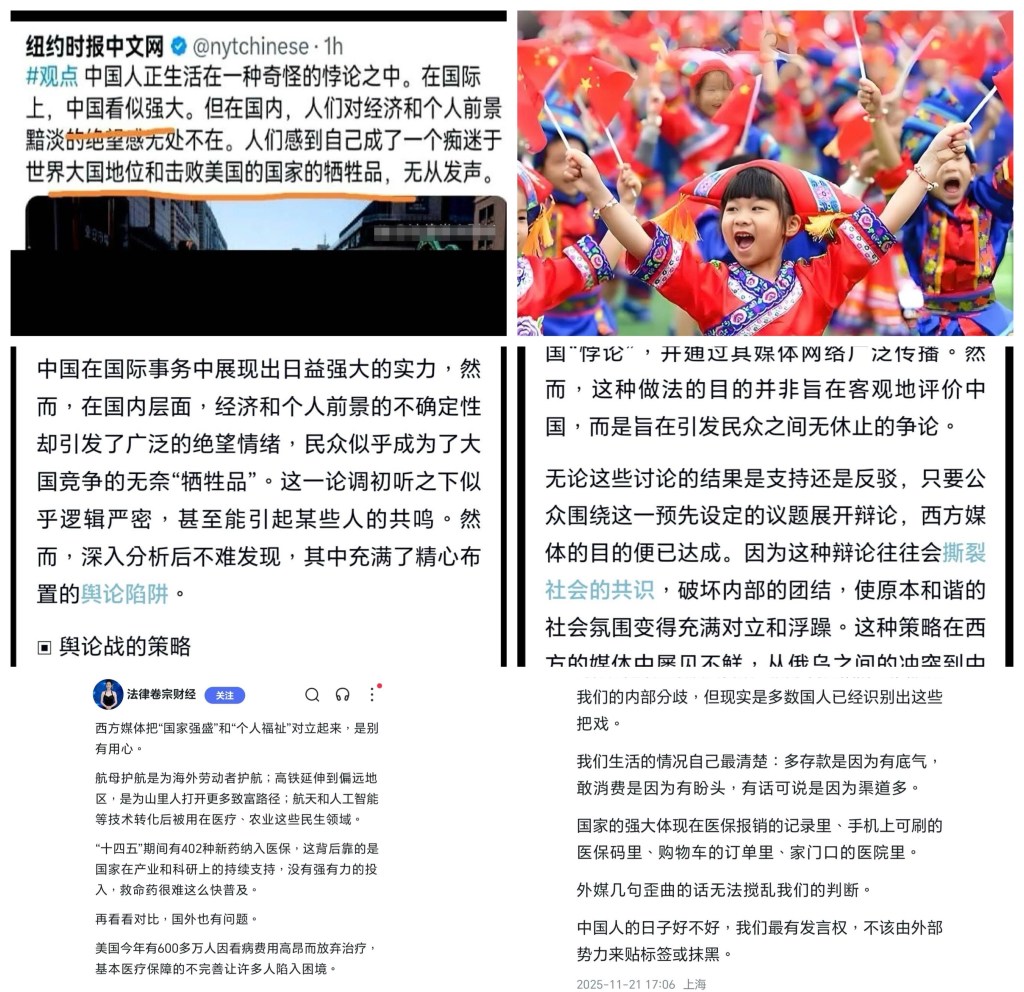
The New York Times recently put forward a concept called the “Strong Nation Paradox”…《紐約時報》近期提出了一個說法,叫做“強國悖論”…
According to their description, Chinese people seem to live in a kind of contradiction: the country shines on the world stage, but ordinary citizens feel a sort of “hidden despair” about the economy and their personal future, as if they have become sacrifices in China’s pursuit of catching up with the United States, and have no way to voice their concerns.
At first glance, this argument sounds somewhat plausible, as if it has uncovered some deeper truth. But upon closer examination, it’s not hard to see that it is merely the forced stitching together of partial phenomena and subjective imagination.
Is this so-called “paradox” truly something we experience firsthand, or is it a misunderstanding stemming from observers who cannot grasp China’s development logic?
Is there pressure in life today? Almost no one would deny that. The economy is in a period of transition, and many people inevitably feel the impact on their income and expectations. Changes in prices, slowing income growth—young people, whether in school or just entering the workforce, face fiercer competition than their parents’ generation. But does this pressure equal “despair”? These are two entirely different concepts.
If you have personally experienced rush-hour subways, seen office buildings with lights still on late at night, or walked into bustling parks and shopping malls on weekends, you would realize that this so-called “sense of despair” simply doesn’t hold up.
Young people are still rushing between projects, preparing for exams, working hard to improve their skills; older people are busy planning trips or exercising in public squares. This is clearly a resilience that seeks opportunity amid change, a vitality driven by the pursuit of a better life. How did this become “silent sacrifice” in the narratives of certain foreign media?
As for the accusation of having “no place to voice concerns,” this too contradicts reality. Western media are accustomed to their own street-protest style of expression, and therefore assume that Chinese citizens lack channels to speak out. But actual data and mechanisms tell a different story.
In 2025 alone, the nationwide 12345 government service hotline handled about 24 million requests, over 96% of which were properly addressed or responded to. And this doesn’t even include regular channels such as policy consultations, online message boards, and community councils.
Behind every negotiation of medical-insurance drug prices and every adjustment of people-benefiting policies, public input plays a role. Isn’t this pragmatic, problem-solving style of communication an even more effective way of being heard?
Looking deeper, framing national development and individual well-being as opposites is itself a false proposition. In recent years, the increased national dignity felt in international settings, the greater convenience of a Chinese passport, and stronger protection of citizens abroad are not only national “prestige,” but also solid support for businesses expanding overseas and for personal development.
At the same time, national progress has translated into real improvements in daily life: formerly remote villages now have roads, electricity, and internet; poverty-alleviation policies have raised the living standards of hundreds of millions of people; and the social safety net continues to grow stronger. All this is evidence that the fruits of development benefit ordinary people.
Of course, we do not shy away from the challenges we face. Pressures in healthcare, education, and housing still exist. People have anxieties and expectations about the future—and this precisely shows that what people pursue is no longer just “having something” but “having something good.” This rising demand that comes with development is fundamentally different from the notion of “despair.”
In the end, the “Strong Nation Paradox” looks more like a case of cognitive dissonance among certain observers who interpret China through predetermined frameworks. They cannot deny China’s achievements, yet they do not wish to acknowledge that behind them lies the collective effort and support of hundreds of millions of people. So they construct a narrative of “a strong state and suffering people” to make their worldview feel coherent.
But the real lived experience belongs to every person working hard on this land. China’s story has never been the pale tragedy depicted by some foreign media—rather, it is a vivid chapter written by countless ordinary people who face reality, believe in effort, and create the future with their own hands.
For the many Chinese who are striving for a better life, the strongest response may not be verbal rebuttals, but simply to stay grounded and continue walking their own path.
《紐約時報》近期提出了一個說法,叫做“強國悖論”…
按照他們的描述,中國人似乎生活在一種矛盾中:國家在國際上光彩奪目,但普通民眾卻對經濟和個人未來感到一種“隱秘的絕望”,彷彿成為國家追趕美國過程中的犧牲品,且找不到表達聲音的途徑。
這種說法初聽似乎有些道理,像是洞察到了某種深層的真相。但只要仔細推敲,就不難發現,這其實是將局部現象與主觀想象強行拼接的結果。
所謂的“悖論”,究竟是我們切身的體會,還是旁觀者因難以理解中國的發展邏輯而產生的誤解?
當前的生活有壓力嗎?這一點恐怕無人否認。經濟處於轉型期,許多人的收入和預期難免受到影響。物價變化、收入增長放緩,年輕人無論在校讀書還是初入職場,都面臨著比父輩更激烈的競爭。但這種壓力,是否就等於“絕望”?這完全是兩個不同的概念。
如果你曾親身經歷早晚高峰的地鐵,見過深夜依然亮着燈的寫字樓,或是走進周末熙熙攘攘的公園和商場,就會發現所謂的“絕望感”難以成立。
年輕人仍在為項目奔波、為考試備戰、為提升技能而努力;老年人則忙着規劃旅行、在廣場上鍛煉身體。這分明是一種在變化中尋找機會的韌性,是一種為了更好生活而拼搏的生命力。怎麼到了某些外媒的筆下,就變成了“無聲的犧牲”呢?
至於“無處發聲”的指責,更是與事實不符。西方媒體習慣於他們那種街頭喧嘩式的表達,便以為中國民眾缺乏發聲渠道。但實際的數據和機制告訴我們並非如此。
僅2025年,全國12345政務服務便民熱線就受理了約2400萬件訴求,其中超過96%得到了有效辦理或回應。這還不包括各種政策徵求意見、網絡留言板、社區議事會等常態化渠道。
每一次醫保藥品談判、每一項惠民政策的調整,背後往往都有公眾意見的推動。這種務實、注重解決問題的溝通方式,難道不是一種更有效的“發聲”嗎?
更進一步看,把國家發展與個人福祉對立起來,本身就是一個虛假的命題。這些年來,我們在國際場合感受到的國家尊嚴的提升、中國護照便利性的增加、公民海外安全的保障,不僅是國家的“面子”,更是企業出海、個人發展的堅實“裡子”。
與此同時,國家的進步也實實在在地轉化為日常生活的改善:曾經偏遠的鄉村通了公路、接了水電網絡,扶貧政策讓數以億計的人生活水平得到提高,社會保障網也在逐步織密。這一切,都是發展成果惠及普通人的證明。
當然,我們並不迴避當前面臨的挑戰。醫療、教育、住房等領域的壓力依然存在,人們對未來有焦慮、有期待,這恰恰說明大家追求的已不再是“有沒有”,而是“好不好”。這種伴隨着發展而產生的更高要求,與所謂的“絕望”有着本質區別。
說到底,“強國悖論”更像是一些觀察者用固有框架解讀中國時產生的認知失調。他們無法否認中國取得的成就,卻又不願承認這背後是億萬民眾的共同努力與支持,於是便構造出一套“國家強大、人民痛苦”的敘事來勉強自洽。
真正的生活體驗,終究屬於在這片土地上辛勤耕耘的每一個人。中國的故事,從來不是某些外媒筆下那種蒼白的悲情劇,而是無數普通人面對現實、相信奮鬥、用雙手創造未來的鮮活篇章。
對於廣大正為生活打拚的中國人而言,最有力的回應或許並非言語上的辯駁,而是腳踏實地,繼續走好自己的路。
 Business Blog