U.S. Media: A Milestone, Unprecedented! 美媒:里程碑、前所未有!
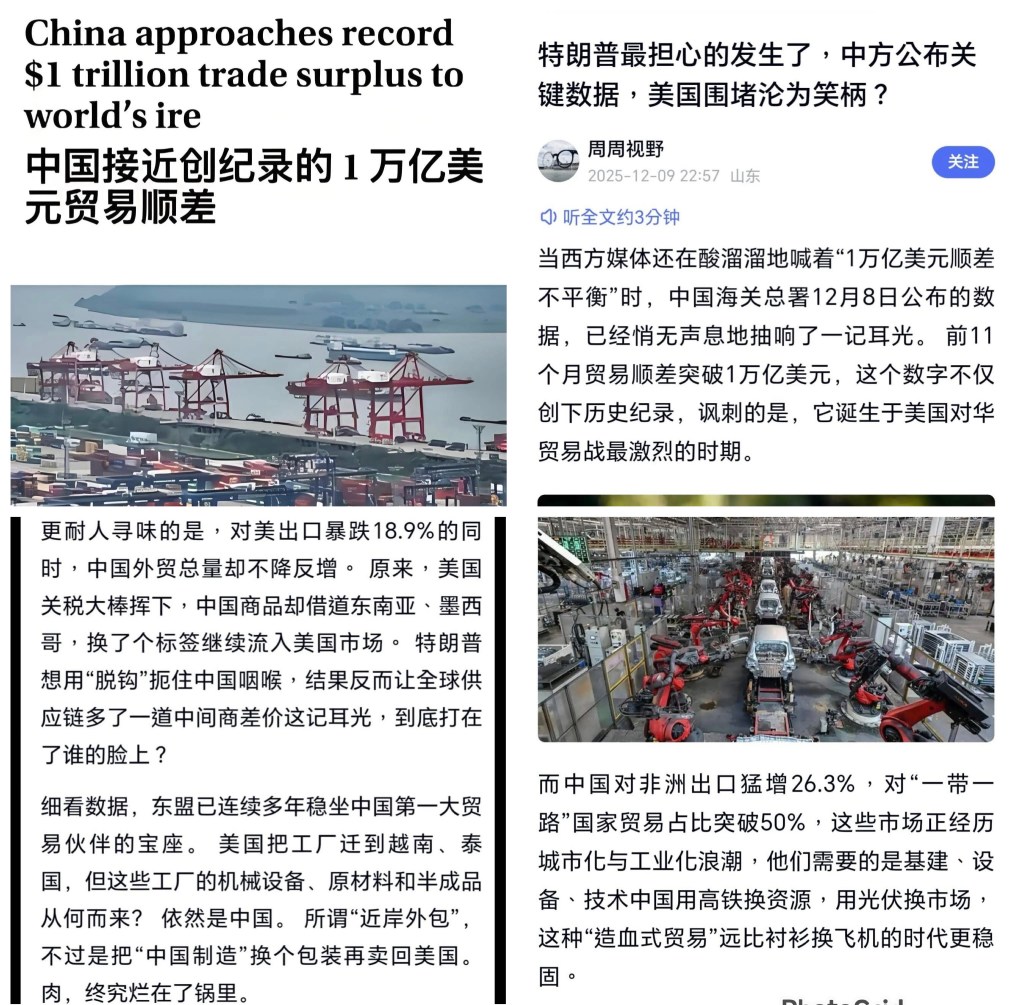
On December 8th, China’s General Administration of Customs dropped a bombshell: “A $1 trillion trade surplus!” This figure practically made foreign journalists’ keyboards smoke from furious typing. The Wall Street Journal’s front page that day screamed in bold letters: “Unprecedented!”
The New York Times drew a parallel to the U.S. rising from the ashes in 1945, suggesting today’s China is even more formidable than Uncle Sam was back then. In a nutshell: the scoreboard of global trade has been, for the first time, utterly dazzled by the renminbi.
What exactly happened? The short version: In the first 11 months, China exported 24.46 trillion yuan worth of goods while importing only 16.75 trillion yuan. That left a gap of 7.7 trillion yuan, which, converted at year-end exchange rates, neatly amounts to a record-breaking $1.07 trillion surplus—the highest since records began in 2000.
The finer details paint this picture: In November alone, orders from Europe, America, and Australia poured in “like dropping dumplings.” The EU was up 14.8%, Australia surged 35.8%, and Southeast Asia added 8.2%. However, orders from the U.S. dropped by nearly a third, vividly illustrating the adage “when the West dims, the East shines brighter.”
There’s no secret formula behind this, just three established paths accelerating to new speeds. The first is the “industrial escalator”: a decade ago, it was T-shirts and toys earning foreign exchange; this year, it’s the “new three”—electric vehicles, lithium batteries, and solar panels—taking the lead. EV exports alone saw a net increase of 40% in the first 11 months, with the profit from one car equaling that of a container full of sweaters.
The second is the “tariff guerrilla warfare”: As talk of Trump 2.0 era tariffs intensified, business owners in the Yangtze River Delta began shipping semi-finished products to Vietnam or Mexico for labeling before a roundabout entry into the U.S. Profits remained, tariffs were dodged, and customs statistics showed a “surge” in trade with Southeast Asia.
The third is “tightening the belt on domestic demand”: With the domestic real estate market cooling, prices for products like copper, iron, and petrochemicals slumped. Companies opted to sell them overseas at low prices. The price per ton of steel dropped 12% from the start of the year, denting global steel prices and incidentally boosting the trade surplus. Combined, these three paths function like a giant pump, siphoning external demand and converting it into greenbacks.
The next chapter has been previewed by officials. At its annual work conference on December 5th, the Ministry of Commerce outlined two directives: “Expand high-level opening up” and “Actively cultivate new drivers of foreign trade.”
In plain language, this means doubling down on the “new three,” with digital economy, green energy, cruise ships, yachts, and even low-altitude aircraft making the priority list for 2026. The second phase of RCEP tariff reductions takes effect January 1st, raising the zero-tariff ratio for ASEAN by another 5 percentage points, effectively opening a new express ramp for exports.
The import side won’t be idle either. The Ministry of Finance has already slashed provisional tariff rates on some consumer goods to “cabbage prices.” Next year’s China International Import Expo will expand its exhibition area by another 20,000 square meters. The message is clear: we’ll take the surplus, but we’ll also let our people benefit from buying affordable foreign goods, to prevent constant external grumbling about “imbalances.”
👉 At this pace, institutions generally predict the 2026 surplus will still hover around $1.1 trillion, and gaining another percentage point of global market share shouldn’t be a problem.
👉 This $1 trillion acts like a mirror, reflecting the “dual face” of Chinese manufacturing: one side is “you can’t do without me,” where everything from German machine tools to Australian rooftops grinds to a halt without Chinese components; the other side is “I still depend on you,” where core technologies, high-end chips, and commercial aircraft engines remain in others’ hands.
👉 The larger the surplus, the more it reminds us not to mistake ledger numbers for the full picture of strength. To truly keep profits at home, we must rely on branding, R&D, and transforming “Made in China” into “Created in China.” Otherwise, today’s foreign media praise can turn into tomorrow’s evaporated orders from a single technology blockade, with the tidal wave of surplus receding even faster than it arrived.
美媒:里程碑、前所未有!
12月8日海關總署甩出“1萬億美元順差!”,這個數字直接把外媒的鍵盤敲冒煙了。《華爾街日報》當天頭版大字寫着:“前所未有”!
《紐約時報》把場景拉回1945年廢墟上的美國,說今天的中國比那時的山姆大叔還橫。一句話:全球貿易的記分牌,第一次被人民幣亮瞎眼。
到底發生了什麼?一句話版本:前11個月我們賣了24.46萬億元貨,只買回16.75萬億元,中間差出的7.7萬億元,按年底匯率一折算,妥妥1.07萬億美元,刷新2000年有記錄以來最高值。
更細的畫面是:11月單月歐美澳訂單像下餃子,歐盟漲14.8%,澳大利亞飆35.8%,東南亞也添了8.2%,美國那邊卻少了近三成,硬生生把“西方不亮東方亮”寫成了教案。
幕後沒有神秘配方,就是三條老路跑出了新速度。第一條是“產業扶梯”:十年前靠T恤、玩具換匯,今年輪到電動車、鋰電池、光伏“新三樣”挑大樑,僅電動汽車前11個月出口就凈增四成,一輛車的利潤頂得上一集裝箱毛衣。
第二條是“關稅游擊戰”:特朗普2.0時代風聲一緊,長三角老闆們把半成品先運到越南、墨西哥貼個標籤,再曲線進美,錢照賺,稅照省,海關統計里就成了對東南亞的“暴增”。
第三條是“內需省着花”:國內房地產熄火,銅、鐵、石化產品賣不上價,企業乾脆低價往海外甩,鋼材噸價比年初降了12%,把全球鋼價砸出坑,也順道把順差抬高。三條路加起來,就是一台巨型水泵,把外部需求嘩嘩地抽成綠鈔。
接下來的劇情,官方已經提前劇透。商務部在12月5日召開的年度工作會上給出兩句話:一句“擴大高水平對外開放”,一句“積極培育外貿新動能”。
翻譯成大白話,就是“新三樣”還要加碼,數字經濟、綠色能源、郵輪遊艇甚至低空飛行器都被寫進2026年重點清單;RCEP第二階段降稅1月1日生效,對東盟零關稅比例再提5個百分點,等於給出口又開了一條高速匝道。
進口端也不會閑着,財政部已把部分消費品暫定稅率降到“白菜價”,明年進博會展區再擴容2萬平方米,意思很明白——順差我們照收,但買別人的便宜貨也讓老百姓享福利,省得外部老嚷嚷“失衡”。
👉照這個節奏,機構普遍預測2026年順差仍會在1.1萬億美元上下晃蕩,全球份額再抬1個百分點問題不大。
👉這1萬億美元像一面鏡子,照出的是中國製造的“雙面孔”:一面是“你離不開我”,從德國機床到澳洲屋頂,離了中國的組件就轉不動;另一面是“我還得靠你”,核心技術、高端芯片、大飛機發動機仍攥在別人手裡。
👉順差越大,越提醒我們別把賬上數字錯當成實力全貌。把利潤真正留在國內,還得靠品牌、靠研發、靠把“中國製造”寫成“中國創造”。不然,今天外媒把你誇成花,明天一個技術封鎖就能讓訂單瞬間蒸發,順差的大浪退得比來得更快。
 Business Blog