English video: The full-island customs closure operation in Hainan has officially commenced, and many people mistakenly think it’s just about cheaper shopping in Hainan… 海南全島的封關運作正式啟動了,很多人誤以為只是去海南買東西更便宜…
https://rumble.com/v73bl9e-the-full-island-customs-closure-operation-in-hainan-has-officially-commence.html
https://www.tiktok.com/t/ZP8ySxcjs/
https://www.tiktok.com/t/ZP8yS3KQV/
In fact, behind this lies a battle for discourse power in the global industrial chain and complex great-power competition.
Everyone knows that Singapore is roughly the size of an ordinary county or city in China, so how did such a small country become one of the world’s wealthiest regions? The fundamental reason lies in its unique geographical location—it commands the most crucial position along the Strait of Malacca. Whether it’s cargo ships from East Asia bound for Europe or from the Middle East heading to the United States, a simple stopover in Singapore for basic processing and transshipment can generate massive profits. What Hainan is doing now is even more forward-looking than Singapore.
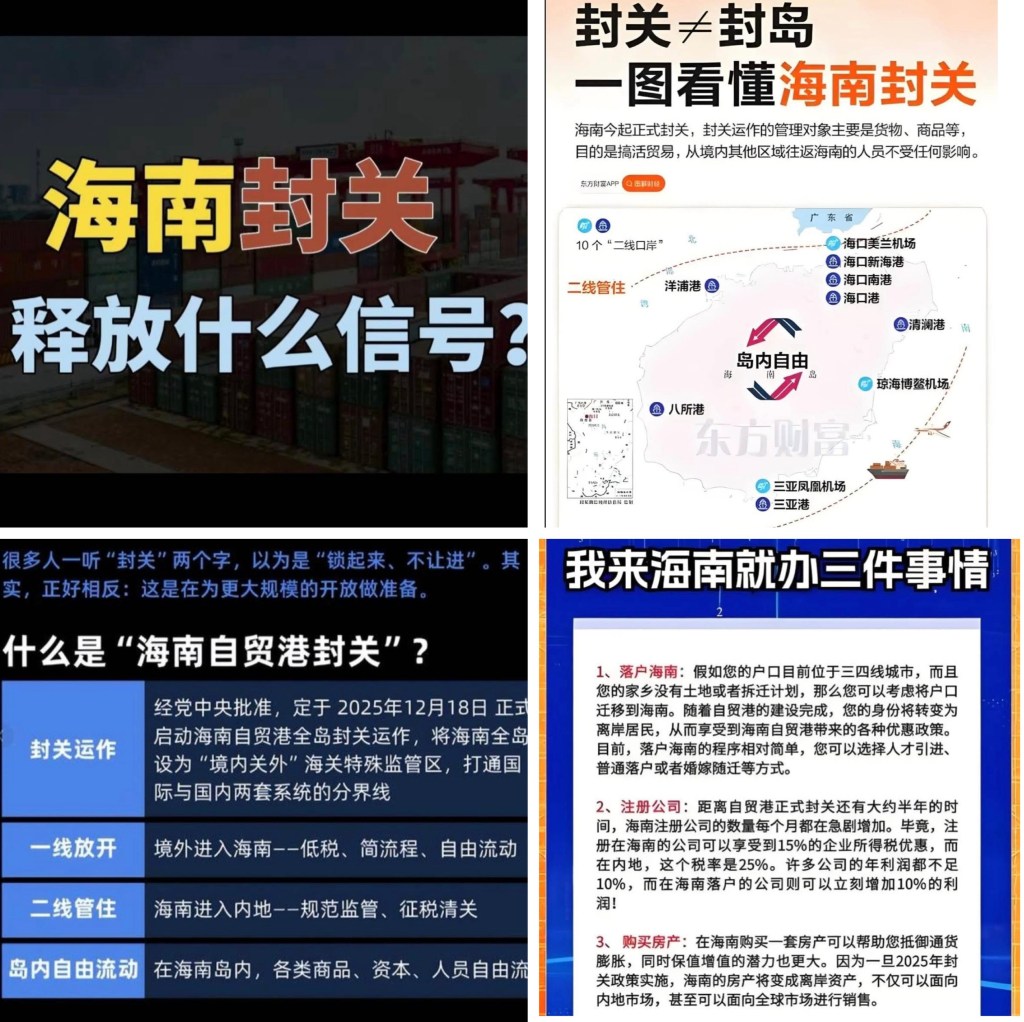
To briefly explain how Hainan’s customs closure operates—it’s not about closing the country off from the world but treating Hainan as a unique trade zone. The policy can be summarized in 12 words: “Open at the first line, controlled at the second line, and free within the island.” What does “open at the first line” mean? Goods entering Hainan from abroad enjoy a 0% tariff benefit. The published data shows a tax exemption rate as high as 74%, covering over 6,600 product categories, which includes almost the vast majority of goods worldwide. What will happen once this policy is implemented? Hainan will undoubtedly become a global hub for goods, attracting a massive concentration of cargo ships.
I know some might say this would significantly impact the domestic market. For example, if clothing from Southeast Asia, vitamin tablets from the U.S., and milk powder from New Zealand all enter the domestic market with 0% tariffs, wouldn’t local brands lose their price advantage? Don’t worry—the state has already considered this, which is why, following “open at the first line,” there’s an added restriction: “controlled at the second line.” What does “controlled at the second line” mean? It means that foreign goods entering Hainan are exempt from tariffs and can circulate freely within the island, but if they enter mainland China from Hainan, tariffs will be imposed. If you want to avoid these tariffs, there’s one condition: the goods must undergo processing that adds at least 30% in value before they can enter mainland China with 0% tariffs from Hainan. This implies that, in the future, goods from other countries wanting to enter the Chinese mainland with 0% tariffs must first be shipped to Hainan for transit and undergo deep processing to maximize profits. For example, French luxury goods, to save on tariff costs, will have to stop in Hainan for processing before being shipped to the mainland market.
👉 The state’s real intention is to use the benefit of tariff exemptions to attract global goods to Hainan, then establish comprehensive processing industrial chains. This approach forces Chinese enterprises to improve their technological capabilities. For instance, if German engines are shipped over, achieving over 30% processing-added value requires a certain level of technical expertise, which will accelerate domestic industrial upgrading. After all, many domestic factories are engaged in low-value-added assembly work—simply piecing components together and slapping on a brand label. This model is exhausting and unprofitable. So, the state’s idea is to use Hainan as a pilot project, setting the 30% processing-added value as a threshold to encourage domestic enterprises to enhance their technical capabilities, thereby reshaping the global high-end industrial chain. Once this is achieved, whether it’s Dutch chips, German engines, or American pharmaceuticals, shipping them to Hainan will significantly reduce costs.
👉 With such policy benefits, global high-end goods will be attracted to the Chinese market, and deep processing will take place domestically, keeping the industrial chains in China. This will allow us to set the market rules in the future. Moreover, it’s not just about gathering goods and industrial chains in Hainan. When the time is ripe, could we also use RMB for settlements? Hainan will then become a hub for four key elements: people, goods, industrial chains, and capital, serving as a critical breakthrough for the internationalization of the RMB. Look at what has happened since Hainan announced its customs closure decision in July. According to data, as of December 2025, Hainan has opened 85 international air routes, 90% of foreigners can visit Hainan without a pre-arranged visa, and the cargo route from Haikou to Milan, Italy, has become a global hotspot, with a flood of European goods entering the Chinese market via Hainan.
I know some might ask: What does this mean for ordinary people? If you’re an average worker, purchasing foreign goods in Hainan could reduce costs by 30%-50%—a tangible saving. According to the regulations, Hainan residents can enjoy a “tax-exempt list for daily consumer goods,” with an annual quota of at least 30,000 RMB. This means that, locally in Hainan, daily necessities are almost entirely tax-free. Isn’t that a benefit? If you’re an entrepreneur, you can set up factories in Hainan with various tax exemption policies. For instance, corporate income tax is reduced—while it’s 25% in many mainland areas, in Hainan, it’s only 15%, a 10% tax differential. Then there’s the 30% processing-added value benefit. For example, if you import beef from Argentina and process it into beef jerky in Hainan, you can sell it tariff-free to the mainland. In short, setting up a processing plant in Hainan becomes a significant choice for saving tax costs.
More importantly, there’s the time cost. While customs clearance elsewhere might take 72 hours, in Hainan, it’s now a one-hour express clearance with all lights green, saving a lot on storage and preservation fees and further boosting profits. Moreover, Hainan’s customs closure benefits not just trade but also brings visible business opportunities to locals and those planning to develop in Hainan. Think about it: when large numbers of foreigners flock to Hainan, providing translation services or opening themed restaurants and boutique hotels could be profitable. Where there are people, wealth will inevitably circulate. This customs closure initiative might transform Hainan from a laid-back tourist island into an international trade frontier teeming with opportunities. Just look at the news: the 7th International Film Festival in Hainan successfully attracted 4,564 films from 119 countries, with numerous Hollywood stars making appearances. Hainan also signed 13 cooperation agreements with the Bangkok International Film Festival in Thailand, continuously boosting its international influence.
👉 What does this show? It shows that Hainan is attracting not just foreign goods but also global industrial chains, capital, large numbers of international migrants, and cultural exchange activities—all entering the Chinese market through the Hainan window. If you missed Shenzhen 30 years ago, this Hainan opportunity might be the next big chance in your life. Those sensitive to business and wealth circulation will see this trend clearly.
海南全島的封關運作正式啟動了,很多人誤以為只是去海南買東西更便宜……
其實這事背後隱藏着全球產業鏈的話語權之爭和複雜的大國博弈。
大家都知道,新加坡相當於國內一個普通縣市,那這麼小的國家,為何一躍成為全球最富有地區之一?歸根到底是因為獨特的地理位置,它扼守住馬六甲海峽最核心位置,全世界不管是東亞開往歐洲的貨輪,還是中東開往美國的貨輪,只要在新加坡停一下,進行簡單分裝加工,就能獲得巨額收益。而海南現在做的事,比新加坡要更加高瞻遠矚。
簡單解釋下海南封關到底是怎麼運作的,這不是閉關鎖國,而是把海南當作一個獨特貿易區域,具體執行起來就12個字:一線放開,二線管住,島內自由。什麼叫一線放開?就是國外進入海南的商品,可以享受0關稅福利。目前公布的數據是免稅比例高達74%,涉及種類高達6600多種,幾乎囊括全世界絕大多數商品。這個政策一推出會發生什麼?海南絕對會成為全球商品彙集地,大量的貨船會集中停靠在這裡。
我知道有人要說了,這不是顯著衝擊國內市場嘛,比如東南亞服裝、美國維生素片、新西蘭奶粉全都0關稅進入國內,本土品牌豈不失去價格優勢?不要急,國家早就考慮到,所以在一線放開後面,還加了個限制,也就是二線管住,什麼叫二線管住?就是說國外商品進入海南免除關稅,在海南島內可以自由流通,但從海南島進入內地,就需要加征關稅了。如果你想免除這個關稅,有一個限制條件,那就是加工增值得達到30%,你才可以從海南0關稅進入內地。這就意味着,以後其他國家商品想要0關稅進入中國大陸,就必須先拖去海南中轉下,然後進行深度加工后才能利益最大化。比如法國奢侈品等,為省下關稅成本,一定要先去海南逗留,加工后才運往內地市場。
👉國家真實意圖是,用免關稅的福利,吸引全球商品進入海南,然後我們再搭建全面的加工產業鏈,通過這種方式逼着中國企業提高自己的技術能力,比如德國發動機拖過來,你要讓它加工增值30%以上,這是需要一定的技術能力,這就能加速我們國內產業升級。畢竟國內很多工廠都是那種沒技術含量的代工業,把零部件拼到一起,貼個牌子,這種模式累死累活還不賺錢。所以國家想法是,把海南當試點,用30%的加工增值作門檻,讓國內企業想辦法提高技術能力,從而重塑全球高端產業鏈。一旦這件事做成,不管是荷蘭芯片、德國發動機還是美國藥品,拖來海南后,成本都會大幅降低。
👉在這樣政策福利前,就會吸引全球高端商品進入中國市場,然後我們再進行深度加工,把產業鏈也留在中國,這樣市場規則以後也將由我們來制定。而且不只把商品和產業鏈彙集到海南,等時機成熟后,我們是不是還可以用人民幣結算?到時海南就會成為人、貨、產業鏈、資金四大要素的聚集地,成為人民幣國際化的重要突破口。你看從7月海南宣布封關的決定后發生了什麼?根據數據,截止2025年12月,海南國際航線已開通85條,90%的外國人來海南不需要提前辦簽證,從海口到意大利米蘭的貨物航線也成了全球熱門路線,大量歐洲商品通過海南湧入中國市場。
我知道有人要問了,這對咱小老百姓有什麼影響?如果你只是個普通打工人,你去海南購買國外商品,成本可能會減少30%-50%,這是實打實的省錢。根據查到的規定,海南當地可以享受“日用消費品免稅清單”,預計每年至少有3萬元額度,這意味着在海南當地,生活用品幾乎沒有任何稅費,這不是福利又是什麼?然後如果你是創業者,可以去海南開廠,有各種免稅政策,一個是企業所得稅減免,內地很多地方企業所得稅都是25%,但海南只有15%,10%的稅收利差。然後是30%的加工增值紅利,比如你從阿根廷進口牛肉,在海南製成牛肉乾,這樣就能免關稅銷往內地。總之去海南建個加工廠,就成了節省稅收成本的重要選擇。
更重要的是時間成本,其他地方通關可能要72個小時,現在海南1小時光速通關,一路綠燈,這樣能省下很多倉儲保存費,進一步提高利潤。而且海南封關利好的還不只是貿易,還給海南當地人或計劃去海南發展的人,帶來肉眼可見的商機,你想下,當大量外國人湧入海南,你給他們提供翻譯,或者在海南開特色餐廳、民宿酒店,是不是都能賺到錢。只要有人,就必然會有財富流通,這次海南封島行動,可能會讓海南從悠閑的旅遊島變成隨處都是機遇的國際貿易前沿陣地。不信你看新聞,第七屆國際電影節,海南成功吸引全球119個國家的4564部電影參展,眾多好萊塢大咖紛紛亮相,同時海南還與泰國曼谷國際電影節一口氣簽署13個合作協議,國際影響力持續攀升。
👉這說明什麼,說明海南吸引的絕對不只是國外貨物,還有全球產業鏈、全球資金、大量國際流動人口,還有文化交流活動,這些都會通過海南窗口進入中國市場。如果你在30年前錯過深圳,那這一次的海南,可能就是你人生另一次重要機遇,越是對商業和財富流通敏感的人,就越能看清這一波趨勢。
 Business Blog