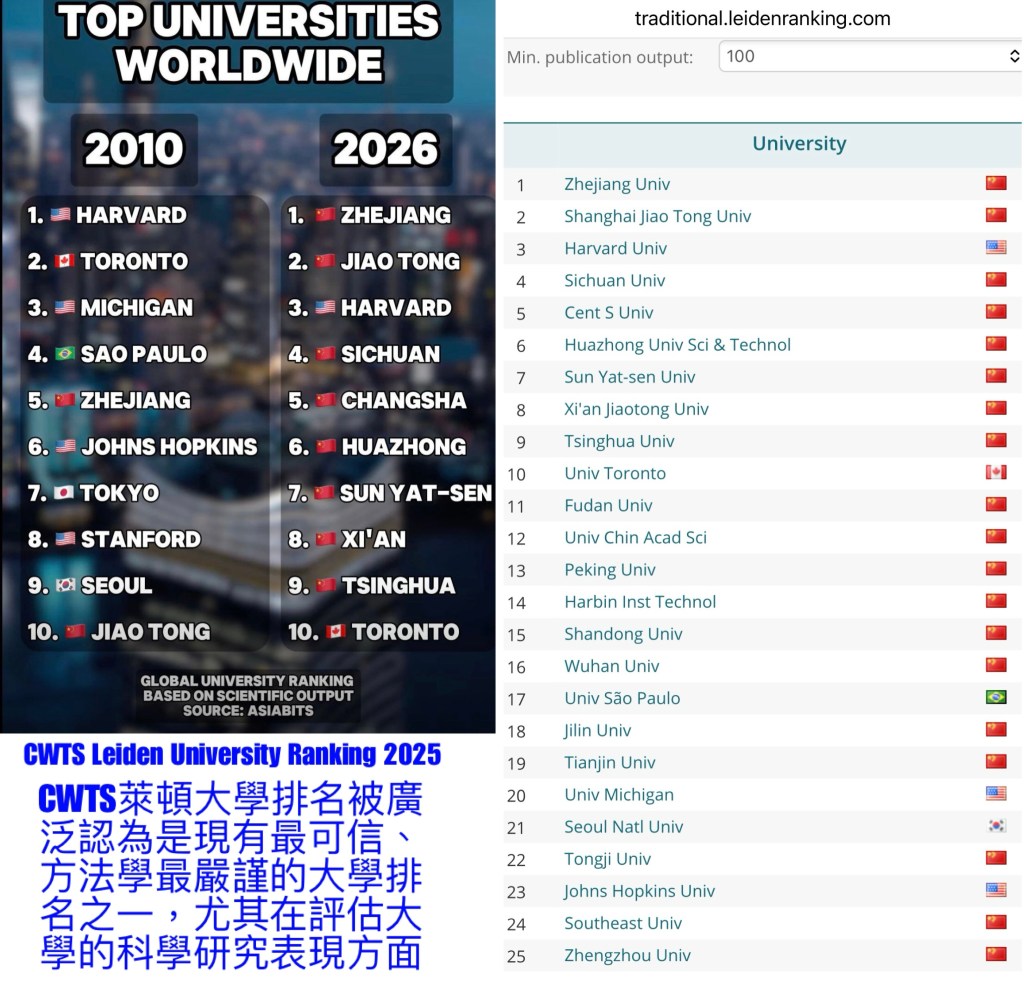
Video: Chinese universities are steadily rising in world rankings, with eight of the top ten being from China. 中国大学在世界排名中不断上升,前十竟有八所来自中国
https://youtu.be/GgjI-hj94q0?si=gzlDhDygdVbRnFxb 👈
How credible is CWTS Leiden University Ranking. The CWTS Leiden Ranking is widely regarded as one of the most credible and methodologically rigorous university rankings available, particularly for assessing university scientific research performance. CWTS萊頓大學排名的可信度如何? CWTS萊頓大學排名被廣泛認為是現有最可信、方法學最嚴謹的大學排名之一,尤其在評估大學的科學研究表現方面。
Here’s a breakdown of its credibility, strengths, and limitations:
High Credibility & Key Strengths
- Focus on Pure Research Output: It exclusively measures universities’ scientific publications and citation impact. It does not include subjective surveys, teaching quality, or reputational data. This makes it transparent and objective.
- Transparent and Sophisticated Methodology: Developed by the Centre for Science and Technology Studies (CWTS) at Leiden University, a leading research institute in bibliometrics. Their methodology is openly published and highly respected.
- Crucial Normalization for Field Differences: This is its biggest strength. It accounts for huge variations in publishing and citation practices across different scientific fields (e.g., comparing a molecular biology paper to a mathematics paper). This allows for fairer comparisons between institutions strong in different disciplines.
- Avoids “Publication Bias”: It counts all eligible publications equally, regardless of the journal’s prestige (like Nature vs. a specialized journal). This reduces the advantage of universities that target high-impact journals indiscriminately.
- Multiple Meaningful Indicators: Instead of one composite score, it provides a suite of indicators, allowing users to choose what matters to them:
· Impact Indicators: e.g., Proportion of publications in the top 10% most cited (PPtop10%).
· Collaboration Indicators: e.g., Proportion of publications with industry or international co-authors.
· Open Access Indicators: Tracks open access publishing. - Focus on “Proportion” rather than volume: Most indicators are presented as percentages (e.g., % of top-cited papers), which favors excellence over sheer size. A smaller, excellent university can outperform a massive, mediocre one.
Important Limitations and Caveats
- Narrow Scope: It only measures research performance through publications. It ignores teaching quality, student experience, employability, societal impact beyond citations, arts and humanities output (non-indexed publications), and reputation. It is not a “best overall university” ranking.
- Bibliometric Limitations Inherent: Like all bibliometric tools, it is based on the Web of Science database, which has its own coverage biases (strong in STEM, weaker in Social Sciences, limited in Arts & Humanities, non-English language bias).
- Time Lag: It uses a multi-year citation window. The latest ranking reflects publications from 4-5 years ago, so it doesn’t capture very recent developments.
- Can Be Misinterpreted: If used as a general “university ranking” without understanding its narrow focus, it gives a distorted picture. A university with mediocre teaching but strong STEM research could rank very highly.
Comparison to Other Major Rankings
· vs. ARWU (Shanghai Ranking): Similar objective, publication-focused approach. Leiden is often seen as more sophisticated in its field normalization and offers more nuanced indicators.
· vs. THE & QS: These are composite “world university” rankings. They include teaching, reputation, and research. Leiden is considered far more credible for pure research assessment because it excludes the often-criticized subjective survey components of THE/QS.
· vs. U-Multirank: Both offer multidimensional profiles. Leiden is deeper and more precise on bibliometrics; U-Multirank is broader across missions.
Who Uses It and For What?
· Researchers and Research Managers: To identify strong research groups in specific fields, benchmark institutional performance, and analyze collaboration patterns.
· University Leadership: For strategic research planning and benchmarking against peers.
· Governments & Funding Agencies: To inform science policy and evaluate research output.
· Informed Students (especially PhDs and postdocs): To identify universities with high-impact research in their specific field of study.
Verdict on Credibility
For assessing the volume, impact, and collaboration patterns of scientific research at universities, the CWTS Leiden Ranking is arguably the most credible ranking available. Its transparency, sophisticated methodology, and focus on field-normalized citation impact make it the gold standard for bibliometric comparison.
However, its credibility is strictly confined to this purpose. It is not credible as a measure of overall university quality, undergraduate education, or broader societal impact. The key is to use it for what it is designed for: a precise, analytical tool for research performance.
In short: If you want to know which universities produce the most influential scientific research, Leiden is exceptionally credible. If you want to know where to get the best undergraduate education or overall experience, look elsewhere or use it as just one narrow data point.
以下是其可信度、優勢與局限性的詳細解析:
高可信度與關鍵優勢
- 專注於純研究產出:它僅衡量大學的科學出版物和引用影響力。不包含主觀調查、教學品質或聲譽數據。這使其透明且客觀。
- 透明且精細的方法學:由萊頓大學科學技術研究中心(CWTS)制定,該中心是文獻計量學領域的頂尖研究機構。其方法學公開出版並備受推崇。
- 對領域差異的關鍵標準化處理:這是其最大優勢。它考慮了不同科學領域在出版和引用實踐上的巨大差異(例如,比較分子生物學論文與數學論文)。這使得在不同學科強項的機構之間能進行更公平的比較。
- 避免「出版偏見」:它平等計算所有符合資格的出版物,不論期刊的聲望高低(例如《自然》期刊相對於專業期刊)。這減少了那些不加區分地追求高影響力期刊的大學的優勢。
- 多個有意義的指標:它不是提供一個綜合分數,而是提供一系列指標,讓使用者選擇他們看重的方面:
· 影響力指標:例如,位列被引用次數前10%的出版物比例(PPtop10%)。
· 合作指標:例如,與產業界或國際合著者共同發表的出版物比例。
· 開放取用指標:追蹤開放取用出版情況。 - 注重「比例」而非總量:大多數指標以百分比形式呈現(例如,高被引論文百分比),這有利於追求卓越而非單純追求規模。一個規模較小但優秀的大學可以勝過一個龐大但平庸的大學。
重要的局限性與注意事項
- 範圍狹窄:它僅透過出版物衡量研究表現。忽略教學品質、學生體驗、就業能力、超越引用的社會影響力、藝術與人文學科產出(未被索引的出版物)以及聲譽。它並非一個「最佳整體大學」排名。
- 固有的文獻計量學局限:與所有文獻計量工具一樣,它基於Web of Science資料庫,該資料庫本身存在收錄偏見(強於STEM領域,弱於社會科學,對藝術與人文學科收錄有限,存在非英語語言偏見)。
- 時間延遲:它使用多年的引用窗口。最新排名反映的是4-5年前的出版物,因此無法捕捉最新的發展。
- 可能被誤解:如果不理解其狹窄的側重點,而將其用作通用的「大學排名」,則會給出扭曲的圖景。一所教學平庸但STEM研究強勁的大學可能排名非常高。
與其他主要排名之比較
· 對比 ARWU(上海軟科排名):目標相似,均以出版物為核心。萊頓排名在領域標準化處理方面通常被視為更精細,並提供更細緻的指標。
· 對比 THE(泰晤士高等教育)與 QS 排名:這些是綜合性的「世界大學」排名。它們包含教學、聲譽和研究。對於純研究評估,萊頓排名被認為可信度更高,因為它排除了THE/QS中常受批評的主觀調查成分。
· 對比 U-Multirank(多維度全球大學排名):兩者都提供多維度概況。萊頓排名在文獻計量學方面更深入、更精確;U-Multirank則在更廣泛的大學使命層面進行比較。
使用族群與用途
· 研究人員與研究管理人員:用於識別特定領域的強勢研究團隊、對機構表現進行基準測試,以及分析合作模式。
· 大學領導層:用於制定戰略研究規劃和與同儕進行基準比較。
· 政府與資助機構:用於為科學政策提供資訊和評估研究成果。
· 有資訊意識的學生(尤其是博士生和博士後研究員):用於識別在其特定研究領域具有高影響力研究的大學。
關於可信度的結論
對於評估大學科學研究的產量、影響力和合作模式而言,CWTS萊頓大學排名可以說是現有最可信的排名。 其透明度、精細的方法學以及對領域標準化引用影響力的關注,使其成為文獻計量比較的黃金標準。
然而,其可信度嚴格局限於此目的。 它不可信作為衡量整體大學品質、本科教育或更廣泛社會影響力的指標。關鍵在於按其設計用途使用它:一個用於研究表現的精確分析工具。
簡而言之:如果您想知道哪些大學產生了最具影響力的科學研究,萊頓排名異常可信。如果您想知道哪裡能獲得最佳的本科教育或整體體驗,請參考其他排名,或僅將其作為一個狹窄的數據點來使用。
 Business Blog