Canadian Prime Minister Carney: The Rules-Based International Order Has Completely Ended…加拿大總理卡尼:基於規則的國際秩序已徹底終結…
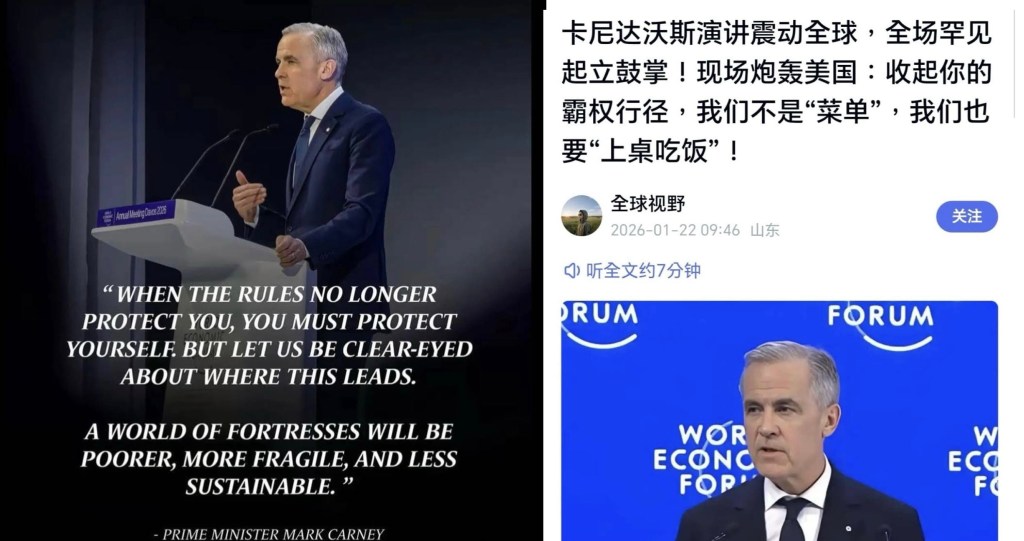
On January 20, Canadian Prime Minister Carney’s speech at the Davos Forum in Switzerland could be described as earth-shattering, and might even be seen as a manifesto declaring the complete end of the “rules-based international order.”
It is clear that his remarks in Beijing were not made on a whim but were based on a long-standing assessment of the international landscape. So, what noteworthy soundbites did Carney deliver in this speech?
Carney set a pessimistic tone from the very beginning. He told the elites at Davos that his talk would be about “the fracture of the world order, the end of a beautiful story, and the beginning of a harsh reality.” These words were like a bucket of cold water poured over those who still cling to illusions of the past.
He pointed out bluntly that the so-called “rules-based international order” has largely been a façade. The most powerful nations have always been able to exempt themselves from obligations when necessary, and the application of international law has often followed a double standard depending on the target. This statement tore away the fig leaf that had long covered these realities.
Carney took aim at “major powers” for “weaponizing” economic integration. Tariffs have become leverage, financial infrastructure a tool of coercion, and supply chains exploitable vulnerabilities. Although he did not name the United States, everyone present knew exactly who he was referring to.
Faced with this situation, Carney issued a series of warnings. He said, “Nostalgia is not a strategy,” emphasizing that past assumptions of comfort no longer hold. He cautioned, “If we are not at the table, we will be on the menu.” This phrase quickly went viral, capturing the survival anxiety of middle powers.
His conclusion was that the long-standing U.S.-led international order has come to an end. A hegemonic power cannot indefinitely profit from leveraging its relationships. Canada must be “principled and pragmatic,” refocus on domestic development, and diversify its trade relationships.
Carney called on middle powers like Canada to unite. He argued that they must collectively carve out an influential “third way,” establishing a new order that incorporates their own values. This is seen as a collective response to the coercion of superpowers.
Ironically, just hours before Carney’s speech, U.S. President Trump posted an image on social media showing Canada, Greenland, and other areas covered by the American flag. This served as the most vivid footnote to Carney’s warnings, making his speech sound less like a prediction and more like a timely indictment.
The speech resonated within Canada. Some commentators noted that Carney essentially declared that the American Empire is over, and “we’re done acting as a vassal state.” Such blunt expression would have been unimaginable in the past.
1月20日,加拿大總理卡尼在瑞士達沃斯論壇上的演講,可謂是振聾發聵,甚至可以說是一篇宣告「基於規則的國際秩序」徹底終結的檄文。
可以看出他在北京說的那些話,並不是一時興起,而是長期以來對於國際格局的判斷。那麼卡尼在這場演講中,又有哪些值得關注的金句呢?
卡尼的開場白定下了悲觀的調性。他告訴達沃斯的精英們,今天要談的是「世界秩序的斷裂、美好故事的終結,以及殘酷現實的開端」。這句話像一盆冷水,澆在了那些還對舊日時光抱持幻想的人頭上。
他毫不客氣地指出,那個所謂「基於規則的國際秩序」在很大程度上是虛假的。最強大的國家總能在需要時豁免自己的義務,國際法的應用也因對像不同而有雙重標準。這句話撕下了長久以來的遮羞布。
卡尼將矛頭指向「大國」將經濟整合「武器化」的行為。關稅成了槓桿,金融基礎建設成了脅迫工具,供應鏈成了可利用的弱點。他雖未點名美國,但所指何人,在場者都心知肚明。
面對這種局面,卡尼拋出了一串警句。他說「懷舊不是一種戰略」,過去的安逸想法已不再成立。他警告:「如果我們不在談判桌上,就會出現在菜單上。 」這句話迅速流傳,道盡了中等國家的生存焦慮
他的結論是,長期由美國主導的國際秩序已經終結。霸權國家不可能永遠靠變現關係獲利。加拿大必須“有原則且務實”,轉向國內建設,並使貿易關係多元化。
卡尼呼籲像加拿大這樣的中等強國團結起來。 他認為大家必須聯合開闢一條有影響力的“第三條道路”,建立融入自身價值觀的新秩序。這被視為對超級大國脅迫的集體回應。
諷刺的是,就在卡尼演講前數小時,美國總統川普在社群媒體上發布了一張圖片,其中加拿大、格陵蘭等地被美國國旗覆蓋。這恰好為卡尼的警告提供了最生動的註腳,讓他的演講聽起來不像預測,更像及時的控訴。
演講在加拿大國內引發了共鳴。有評論稱,Carney essentially declared that the American Empire is over, and weʻre done acting as a vassal state (基本上宣告了美利堅帝國的終結,我們不再扮演附庸國的角色)。這種直白的表達,在過去是不可想像的。
 Business Blog