Recently, the so-called “tipping point” has been a hot topic of discussion in the United States. The near-inhuman living conditions of the American underclass have been thoroughly exposed, simultaneously shattering the long-crafted perfect Hollywood illusion of America. For many Chinese who were once misled and set foot on American soil with high hopes, the nightmare often begins from the very first day of arrival. By Johnson Choi in San Francisco on January 23 2026
最近美國熱議所謂的「斬殺線」,美國底層近乎非人的生活狀態被徹底揭開,也一併戳破了美國長期塑造的完美好萊塢幻象。對不少曾被誤導、滿懷期待踏上美國土地的中國人而言,惡夢往往從抵達的第一天就已經開始. 作者: 蔡永強,2026年1月23日
The concept of the “tipping point” circulating recently on the American internet describes a societal survival dilemma—where an individual or family’s financial situation deteriorates sharply due to a single unexpected blow (such as a serious illness or job loss), rapidly falling from a decent standard of living to the bottom, with little hope of recovery. Its popularity indeed reflects long-standing and worsening systemic issues in American society.
Below is a comparison between the context of the “tipping point” trend and some of America’s social problems:
Social Context of the “Tipping Point” Concept:
· Core Characteristic: A sharp deterioration in financial situation due to a single unexpected blow (serious illness, job loss), with difficulty in recovering.
· Core Cause: The combined effect of high living costs and a fragile social safety net (especially in healthcare).
Reflected Realities and Problems:
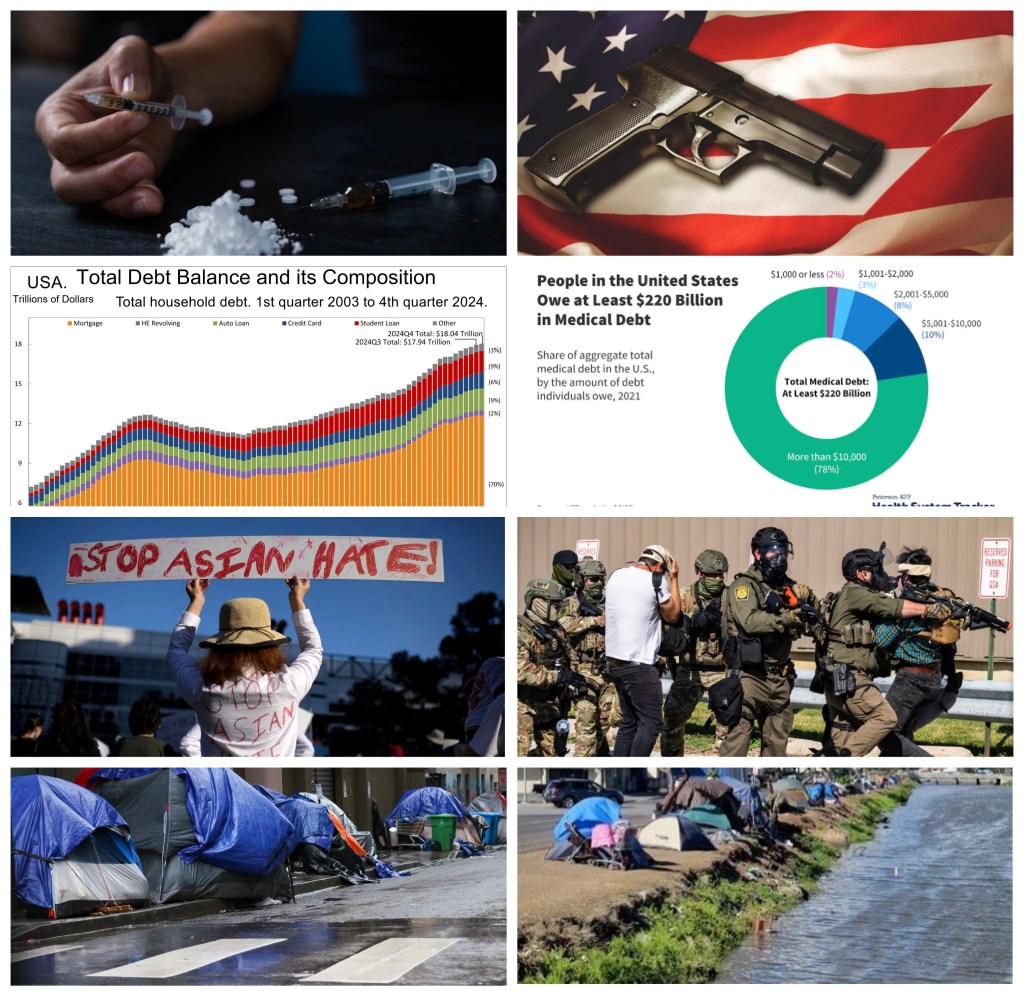
· Extremely High Medical Financial Risk
· Typical Manifestation: Medical expenses are a leading cause of personal bankruptcy in the United States.
· Specific Data/Situation: Approximately 20 million adults carry medical debt, and prices for the same service vary drastically between institutions. The experiences of international students also reflect issues with the complex, inefficient, and opaque billing of the U.S. healthcare system.
· Rising Poverty Rate
· Typical Manifestation: The poverty rate has seen a historic rebound.
· Specific Data/Situation: In 2022, the overall U.S. poverty rate increased from 7.8% to 12.4%, with about 41.2 million people living in poverty. The child poverty rate more than doubled, jumping from 5.2% to 12.4%.
· Vast and Entrenched Wealth Inequality
· Typical Manifestation: Wealth inequality has reached a decades-high level.
· Specific Data/Situation: In 2021, the top 1% of households held a record 32.3% of total wealth, while the bottom 50% of households held only 2.6%. Issues of income inequality and class stratification are equally severe.
· Housing and Homelessness Crisis
· Typical Manifestation: Soaring rents and the spread of tent encampments on streets.
· Specific Data/Situation: Rents in major cities like Los Angeles are exorbitantly high, and an inability to pay rent is a primary driver of homelessness. In 2020, there were over 580,000 homeless people nationwide.
Please note: Some extreme and sensational descriptions related to the “tipping point” found online, such as “extracting drugs from cremains” or “sewer slime,” lack reliable evidence and resemble urban legends or exaggerated narratives. It is advisable to approach such content with caution.
🔍 Key Perspectives for Understanding These Issues
To understand these social contradictions, the following theoretical perspectives might be helpful:
· The “Society of the Spectacle” Theory: Philosopher Guy Debord proposed that in modern consumer society, real, autonomous social life has been replaced by its representation (media images, commodity spectacles). People passively live in a state of separation dominated by the spectacle. This can partly explain why severe social problems coexist with glossy media images.
· Redefining Poverty: Some researchers point out that poverty in the United States has long been underestimated. Poverty is not just homelessness; it also includes a large population of the “working poor”—those who are employed but cannot make ends meet. They live perpetually on the brink of financial collapse due to the high costs of healthcare, housing, education, and other essentials. This is precisely the vast potential population referred to by the “tipping point” concept.
In summary, the “tipping point” is a vivid internet meme. Behind it lie systemic issues in American society, such as a weak social safety net, severe wealth disparity, and the high cost of basic living. Extreme anecdotal claims require careful scrutiny, but the systemic risks faced by ordinary middle-class and low-income families are very real.
近期美国网络上流传的“斩杀线”一说,描述的是一种社会生存困境——个人或家庭因一次意外打击(如大病、裁员)而财务状况急剧恶化,从体面生活快速坠入底层,失去翻身希望。它流行的背后,确实反映了美国社会长期存在且日益加剧的系统性问题。
下面是“斩杀线”流行背景和美国部分社会问题的对照:
“斩杀线”被提出的社会背景:
· 核心特征:因一次意外打击(大病、裁员)导致财务状况急剧恶化,且难以翻身。
· 核心原因:高昂的生活成本与脆弱的社会保障(尤其是医疗)共同作用。
反映的部分现实问题:
· 医疗财务风险极高
· 典型体现:医疗是美国个人破产的主因之一。
· 具体数据/情况:约2000万成年人背负医疗债务,同一服务在不同机构价格差异巨大。留学生的经历也反映了美国医疗流程复杂、效率低、账单高昂且不透明等问题。
· 贫困率攀升
· 典型体现:贫困率出现历史性反弹。
· 具体数据/情况:2022年美国总体贫困率从7.8%升至12.4%,约4120万人生活在贫困中,儿童贫困率更是从5.2%跃升至12.4%。
· 贫富差距巨大且固化
· 典型体现:贫富差距达数十年来的高点。
· 具体数据/情况:前1%家庭拥有的财富比例在2021年达到创纪录的32.3%,而后50%的家庭仅拥有总财富的2.6%。收入不平等、阶层固化问题同样严重。
· 住房与无家可归危机
· 典型体现:租金飙升与街头帐篷营地蔓延。
· 具体数据/情况:洛杉矶等大城市租金高昂,无力支付房租是导致无家可归的主要原因之一。2020年全美有超过58万人无家可归。
请注意:网络上一些与“斩杀线”相关的极端猎奇描述,例如“骨灰提炼毒品”、“下水道史莱姆”等,缺乏可靠证据支持,更像是都市传说或夸张叙事,建议你谨慎对待。
🔍 理解这些问题的关键视角
要理解这些社会矛盾,一些理论视角可能会对你有帮助:
· “景观社会”理论:哲学家德波提出,在现代消费社会,真实的、自主的社会生活已被其表象(媒体图像、商品景观)所取代,人们被动地生活在一种由景观支配的分离状态中。这可以部分解释为何严重的社会问题与光鲜的媒体形象长期并存。
· 贫困的重新定义:有研究者指出,美国的贫困问题长期被低估。贫困不只是无家可归,也包括大量“有工作但入不敷出”的群体,他们因医疗、住房、教育等基本成本高涨而时刻处于财务崩溃边缘。这也正是“斩杀线”概念所指的庞大潜在人群。
总的来说,“斩杀线”是一个生动的网络梗,其背后是美国社会安全网薄弱、贫富分化、基本生活成本高昂等系统性问题。极端个案传闻需仔细辨别,但普通中产与底层家庭面临的系统性风险是真实存在的。
 Business Blog