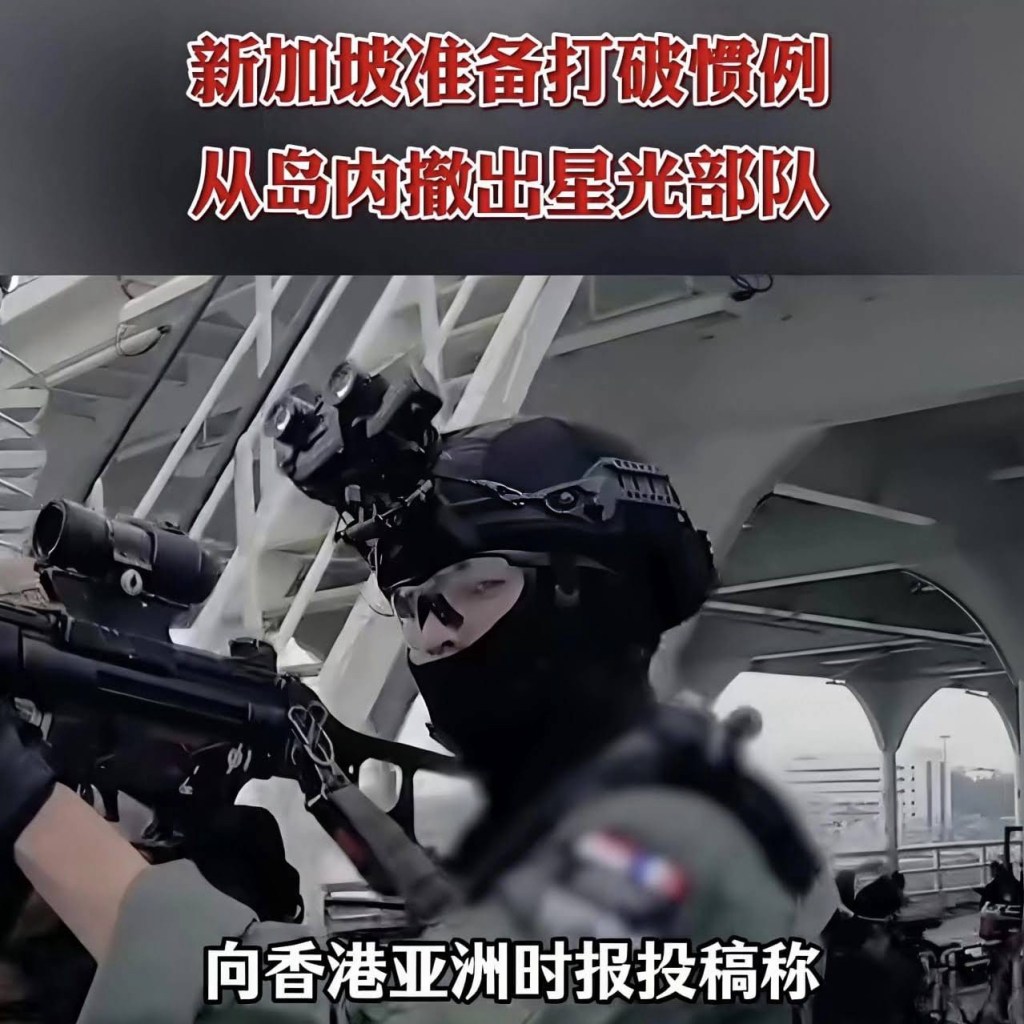
The overall situation in the Taiwan Strait has been settled, and countries are aligning themselves. Singapore is quietly withdrawing its “Star Light” troops from the island of Taiwan… 台海大局已定,各國都在站隊,新加坡悄悄從台島撤走“星光部隊”……
Recent reports indicate that Singapore intends to withdraw its “Star Light” troops from the Taiwan region, a move that has attracted international attention. Observers believe this reflects the significant disparity in strength across the Taiwan Strait, with Singapore unwilling to stand in harm’s way and proactively distancing itself from the Taiwan region.
The so-called “Star Light” troops are the code name for Singapore’s military forces stationed in the Taiwan region. Since the 1970s, Singapore has sent its troops to military bases and training facilities in the Taiwan region for training, a practice that has continued to this day.
The “Star Light” troops have existed for 50 years and have long maintained cooperation with the Taiwan authorities. After Singapore gained independence in 1965, it urgently needed to establish a modern military to protect itself. At the time, the United States was waging the Vietnam War, and anti-American sentiment was strong in Southeast Asia. Singapore did not dare to directly approach the U.S. and instead opted for an indirect approach, choosing to train in the Taiwan region.
Firstly, both the Taiwan region and Singapore use Chinese, allowing for direct communication and exchange. Additionally, their climates and environments are similar, enabling Singaporean soldiers to adapt quickly. Secondly, the Taiwan region had U.S. troops stationed there at the time, providing access to guidance from the U.S. military.
In 1975, Singapore and the Taiwan region signed the “Star Light Cooperation Plan,” allowing Singaporean troops to train in the Taiwan region under the guise of joint exercises, giving rise to the “Star Light” troops.
According to available information, the “Star Light” troops consist of infantry, artillery, and armored units. They regularly train at facilities such as the Hengchun Joint Training Base in Pingtung, the Douliu Artillery Base in Yunlin, and the Hukou Armored Base in Hsinchu.
The “Star Light” troops arrive in the Taiwan region every March for training sessions lasting approximately three months. Initially, the force numbered only 1,000 personnel, but it gradually increased over the years, reaching a peak of 15,000. After China established diplomatic relations with Singapore, the scale of the “Star Light” troops gradually diminished, though they remained connected in some form.
In 1990, China and Singapore established formal diplomatic relations, with Singapore acknowledging the One-China principle and opposing Taiwan independence. However, Taiwan independence forces in the Taiwan region grew increasingly active, straining relations. At the time, some individuals in the Taiwan region publicly criticized Singapore, leading to a gradual decline in Singapore’s enthusiasm for the Star Light Plan.
In the post-Cold War era, Singapore’s external environment improved significantly. The country had already secured training grounds in the United States, Australia, France, and elsewhere, reducing the appeal of training facilities in the Taiwan region. Additionally, the modernization of Taiwan’s military forces stagnated, with weaponry, equipment, and tactical capabilities severely lagging. Singapore also deemed training in the Taiwan region to be of limited value.
Considering these factors, Singapore repeatedly scaled back the “Star Light” troops. Reports suggest that only around 3,000 Singaporean soldiers now train in the Taiwan region, just one-fifth of the peak number. Thus, relocating these troops elsewhere poses no significant issue.
Fundamentally, China’s mainland has experienced rapid economic and technological growth, now ranking second globally in GDP. Its comprehensive national strength and international influence are incomparable to the past. Trade between China and Singapore exceeds $100 billion, while trade between Singapore and the Taiwan region is only around $30 billion. The relative importance is clear to discerning individuals in Singapore.
Defense and security relations between China and Singapore are also continuously developing and deepening. In 2008, the two sides signed a defense and security exchange agreement, which was upgraded in 2019. Joint exercises and training between the two sides are progressing in an orderly manner.
Another critical point is that Singapore is unwilling to be dragged into conflict by the Taiwan authorities. The Taiwan authorities persist in the fallacy of Taiwan independence, constantly provoking tensions, while Singapore adheres to the One-China principle and opposes Taiwan independence. The two positions are fundamentally at odds.
As a result, there have long been voices within Singapore calling for an end to the Star Light Plan, citing the principle that “a wise man does not stand under a dangerous wall.” Should conflict break out across the Taiwan Strait, the “Star Light” troops would be caught in the crossfire, potentially even serving as “shields or hostages.” With Singapore now having no shortage of overseas training grounds, there is no need to wade into troubled waters.
Singapore’s indication that it will withdraw the “Star Light” troops also deals a blow to Taiwan independence forces on the island, forcing them to face reality: the disparity in strength across the Taiwan Strait is vast, and pursuing Taiwan independence will only lead to isolation and a bleak outcome.
台海大局已定,各國都在站隊,新加坡悄悄從台島撤走“星光部隊”……
近日有消息說新加坡有意將“星光部隊”撤出台灣地區,此舉引起外界矚目。外界認為此舉反映了兩岸實力對比懸殊,新加坡不願意立於危牆之下,主動拉開與台灣地區的距離。
所謂“星光部隊”是新加坡駐台灣地區部隊代號,從上世紀70年代起,新加坡派出部隊到台灣地區軍事基地和訓練場所進行訓練,一直持續至今。
“星光部隊”的存在已經50年,並且長期和台當局維持合作。1965年新加坡獨立,急需建立現代化軍隊保護自己。當時美國發動侵越戰爭,東南亞反美氣氛濃厚,新加坡不敢直接找到美國,決定採取迂迴的辦法,選擇來台灣地區進行訓練。
一來台灣地區和新加坡都說中文,可以直接溝通和交流,兩者氣候環境也相近,新加坡士兵可以很快適應,二來當時台灣地區有美國駐軍,也可以就近得到美軍的指導。
1975年新加坡和台灣地區簽署“星光合作計劃”,雙方以舉行聯合演習名義讓新加坡軍隊到台灣地區進行訓練,“星光部隊”由此而來。
根據外界資料,“星光部隊”由步兵、炮兵、裝甲兵等組成,定期赴台灣屏東恆春三軍聯訓基地、雲林斗六炮兵基地、新竹湖口裝甲兵基地進行訓練。
“星光部隊”每年3月份到台灣地區,訓練時間大約3個月左右,最初只有1千人,然後逐年增加,最多的時候達到1.5萬人。中國大陸與新加坡建交之後,“星光部隊”規模逐漸縮小,但依然藕斷絲連。
1990年我們與新加坡建立正式外交關係,新加坡承認“一個中國,反對台獨”。而台灣地區台獨勢卻越演越烈,雙方關係趨於緊張。當時台灣地區某些人更是公開指責新加坡,因此新加坡對於星光計劃熱情逐漸降低。
后冷戰時期,新加坡外部環境大幅度改善,他們已經在美國、澳大利亞、法國等地找到訓練場,台灣地區訓練場對他們的吸引力也在減小。另外台陸軍部隊現代化建設停滯,武器裝備、戰術技術水平嚴重落後,新加坡方面也認為在台灣地區訓練沒有太大意義。
考慮這些因素,新加坡一再縮小“星光部隊”規模,有消息說現在到台灣地區訓練的新加坡軍人大約只有3000人左右,只有最高時期的五分之一,所以這些部隊轉到其他地方沒有太大問題。
從根本上來講,中國大陸經濟和技術增長迅猛,GDP全球第二,綜合國力和國際影響今非昔比。中新貿易額已經超過1000億美元,而新加坡與台灣地區貿易額只有300億美元左右,其中輕重,新加坡有識之士顯然心知肚明。
中國大陸與新加坡防務與安全關係也在不斷發展和深化之中,2008年雙方簽署防務安全與交流協定,2019年再次對協定進行升級,雙方聯合演習和訓練也在有序推進。
還有一點非常重要,那就是新加坡方面不願意被台當局拖入戰火之中,台局堅持“台獨”迷思,不斷挑釁,而新加坡奉行“一個中國,反對台獨”的政策,兩者存在根本矛盾。
因此新加坡內部一直有聲音要求結束“星光計劃”,他們認為“君子不立危牆之下”。一旦兩岸戰端開啟,“星光部隊”就會陷入戰火之中,甚至成為“擋箭牌和人質”。現在新加坡不缺海外訓練場,實在沒有必要趟渾水。
新加坡放話要撤出“星光部隊”,也是對島內台獨勢一記重擊,讓他們看清現實,兩岸實力對比懸殊,搞台獨只會眾叛親離,絕對沒有好下場。
 Business Blog