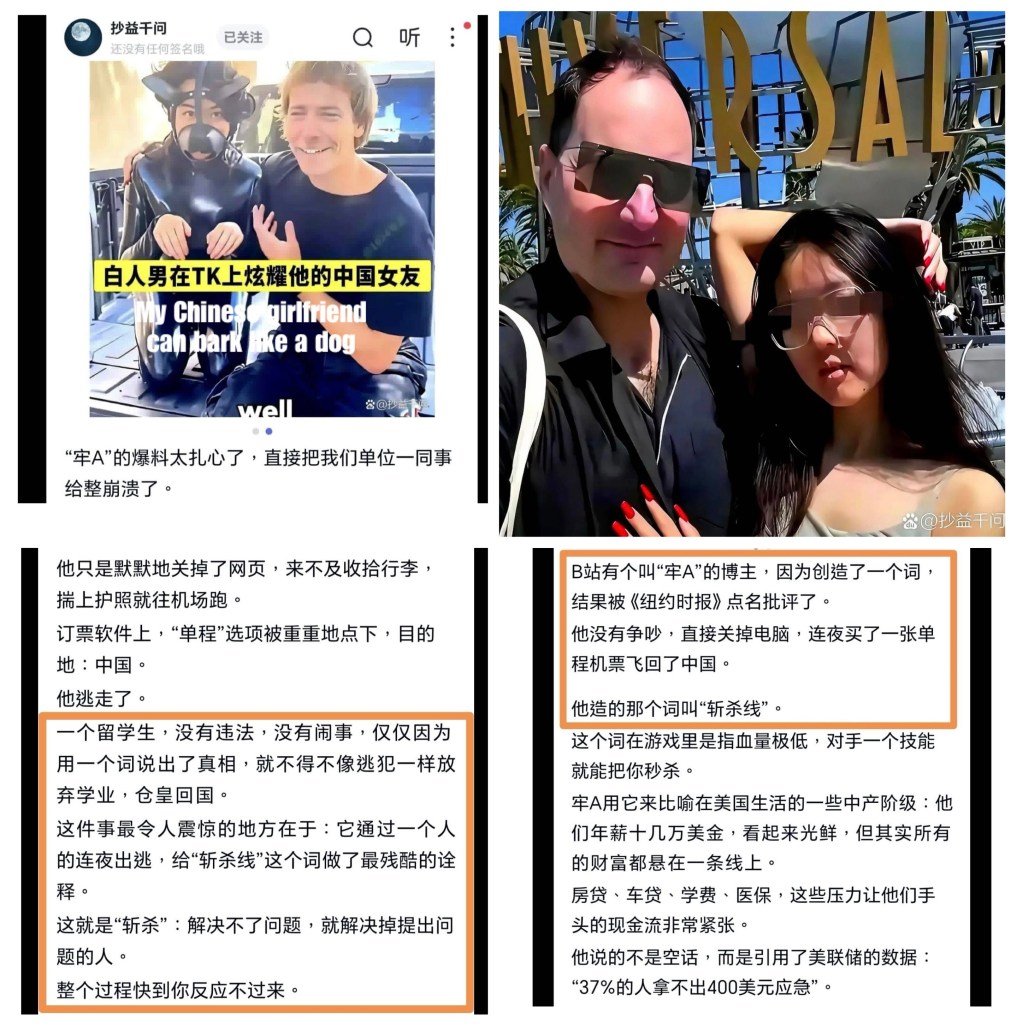
The emergence of “Prisoner A” is truly infuriating; he single-handedly disrupted the dating scene…「牢A」的出現真是太讓人氣憤了,他一個人就把相親市場攪亂了…有些白人男子炫耀他們的中國女朋友,還說她們可以像狗一樣吠叫。這是一種羞辱😡
In the past, having a study abroad background was a sparkling advantage, but now it has actually become a disadvantage!
Initially, we looked up to those who studied abroad, especially those sent on government scholarships—they were definitely top students, one in a million. Later, studying abroad became a trend, and graduates from Ivy League schools were considered the elite among elites, something to be admired.
But as some “diploma mills” were exposed, people started to take a more cautious view of students from ordinary universities, though they still held a high regard for Ivy League graduates.
However, the “Prisoner A” incident revealed the truth: the admissions criteria of American Ivy League schools are completely different from China’s score-focused system. The fairness of China’s college entrance exam lies in its disregard for background or family circumstances—if your scores are high enough, you get in.
But the U.S. is different. Scores are just one factor; admissions also consider the amount of donations, race, and even whether the applicant has a “disability.” What’s even more absurd is that all these complex conditions can be outweighed by a single letter of recommendation from an American power elite.
Many people gain admission by “auditing” courses in elite families for half a year and then securing a recommendation letter. With such questionable admissions thresholds, shouldn’t they at least focus on studying diligently after entering?
Look at Harvard’s data: In 2014, about 3% of undergraduates received academic accommodations (not referring to physical disabilities, but conditions such as dyslexia, mental health issues, etc., requiring formal diagnosis). By 2024, this figure had skyrocketed to 21%.
It’s worth noting that the institution responsible for these diagnoses has close ties to Harvard. With these “accommodations,” students can apply for extended time, open-book exams, and various other loopholes, which they exploit skillfully.
This may be the root cause of the talent shortage in the United States. Those local students who rely on recommendation letters or exploit “loopholes” to gain admission to prestigious universities are not fundamentally there for academic pursuits—they simply want a diploma.
These individuals take up spots that should belong to genuinely capable students. Even if some students from less privileged backgrounds manage to get into Harvard, they are often burdened with crushing student loans after graduation.
In fact, the current talent crisis in the United States is its biggest problem.
過去,留學生背景是個亮閃閃的加分項,現在竟然成了減分項!
起初,我們對留學生是仰視的,尤其是公派出去的,那絕對是萬裡挑一的尖子生。後來留學成了風潮,像是常春藤名校的畢業生,那是菁英中的菁英,讓人羨慕。
但隨著一些「野雞大學」被曝光,大家對普通學校的留學生開始持保留態度,可對常春藤的濾鏡還很厚。
然而,「牢A」事件揭開了真相:美國常春藤的錄取和中國看重分數的體系完全不同。中國高考的公平性在於它不看背景和家境,分數夠了就上。
但美國不一樣,分數只是其中一項,錄取還看捐款多少、膚色、甚至有沒有「殘疾」等。更滑稽的是,這些複雜的條件,都抵不過一份來自美國權貴的推薦信。
很多人是透過去權貴家庭「借讀」半年,然後拿到推薦信才進來的。入學門檻這麼有貓膩,總該好好學習了吧?
看看哈佛的數據:2014年,獲得學習便利(不是指身體殘疾,而是閱讀障礙、心理疾病等需要鑑定的情況)的本科生約佔3%,到了2024年竟飆升到21%。
別忘了,這個鑑定機構和哈佛關係匪淺。有了這個“便利”,學生就可以申請延長時間、開卷考試,各種“鑽空子”玩得很溜。
這或許就是美國本土出不了人才的根源。 那些靠推薦信、靠「卡Bug」進名校的本土學生, 本質上就不是來搞學術的,他們就是想要一張文憑。
這些人佔據了本該屬於真正有實力的學生的名額。 就算有些家境不好但有實力的學生擠進了哈佛,出來後還要被沉重的學生貸款壓垮。
其實,美國現在的人才危機,才是它最大的問題。
 Business Blog