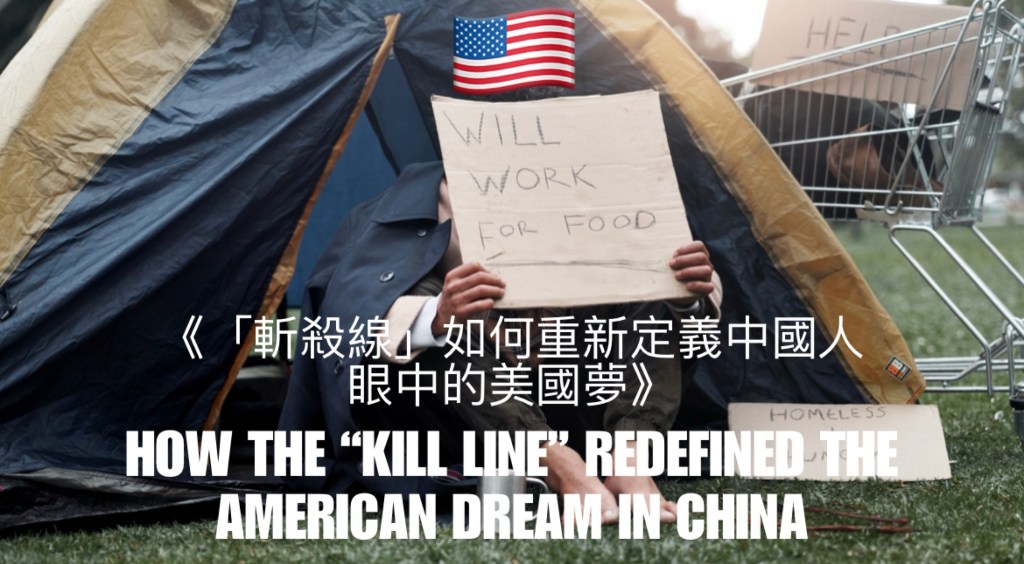
HOW THE “KILL LINE” REDEFINED THE AMERICAN DREAM IN CHINA. By Jianlu Bi | January 22, 2026 《「斬殺線」如何重新定義中國人眼中的美國夢》作者:畢健鷺 | 2026年1月22日
The growing holes in America’s safety net reveal the insecurity at the core of the world’s richest nation.
Recently, a wave of digital shockwaves rippled across Chinese social media platforms like Bilibili and Xiaohongshu. It wasn’t triggered by a geopolitical skirmish or a trade dispute, but by a viral video from a Seattle-based vlogger. The video depicted a former software engineer, once a “gold-collar” professional, living in a tent after a medical emergency led to job loss and eviction. For millions of Chinese netizens, this was the moment the “US Kill Line” entered the national lexicon.
The term, borrowed from competitive gaming, refers to a health threshold where a character is vulnerable to an instant, unblockable finishing move. In the context of American life, Chinese observers use it to describe a terrifyingly low “margin for error.” This is the point where a single stroke of bad luck—a $3,000 ambulance ride or a sudden layoff—triggers a terminal collapse into homelessness.
The shock stems from a fundamental realization. In the world’s wealthiest nation, the floor is not made of wood or stone, but of thin glass.
The Arithmetic of Anxiety
The primary reason for this disillusionment is the brutal mathematical gap between the “official” American story and the lived reality. For decades, the U.S. federal poverty line—set at $32,150 for a family of four in 2025—was viewed from afar as a benchmark of success. However, as information barriers have dissolved, Chinese netizens have discovered that this figure is a relic of 1960s economics.
Current financial analyses suggest that once you account for modern housing, childcare, and the inescapable costs of private healthcare, the actual survival threshold in major US cities is closer to $136,500 for a family of four. For a Chinese public that prizes “stability” and high savings as the ultimate shields against fate, the realization that nearly 40 percent of American adults cannot cover a $400 emergency is not just a statistic—it is a horror story.
It reveals that even the American “middle class” is walking a tightrope just inches above the kill line.
The Cruelty of the “Welfare Cliff”
Perhaps most incomprehensible to the Chinese observer is the “welfare cliff.” In China, social safety nets are generally perceived as a staircase: as you earn more, you contribute more, but basic protections remain. In contrast, the American system often functions like a trapdoor.
Under policies like the One Big Beautiful Bill Act of 2025, which tightened SNAP (food stamp) eligibility and work requirements, many families find themselves in a systemic trap. A family earning $30,000 might qualify for Medicaid and food assistance. However, if they work hard and increase their income to $70,000, they often lose these subsidies.
Suddenly, they are thrust into a “no-man’s land”—too “rich” for government help, but too poor to afford the exorbitant private insurance deductibles and market-rate rents. To Chinese eyes, this is a “physical slashing” of the working class, where the reward for social mobility is increased vulnerability.
The Great Information Leveling
This shift in perception is driven by radical transparency. For the first time, the “American Dream” is being filtered through the lens of real people rather than Hollywood studios. Through international students and overseas Chinese on TikTok and Weibo, the “unfiltered” America has been revealed.
Instead of the manicured suburbs of Desperate Housewives, Chinese netizens see the sprawling tent cities of the West Coast. They witness the “Great Reckoning” on Xiaohongshu, where American users share medical bills that look like mortgage statements.
In contrast, Chinese citizens enjoy a system where a General Practitioner (GP) visit costs less than a cup of coffee and major medical expenses are largely covered by a basic national insurance scheme. This “no-middleman” information flow has humanized the suffering of ordinary Americans, turning what was once a “shining city on a hill” into a cautionary tale of social Darwinism.
A New National Confidence
Finally, the decline of the U.S. image coincides with a surge in Chinese national confidence. Having built a comprehensive social safety net that covers over 95 percent of its population, China has moved past the era of blind imitation. When ordinary Chinese look at the United States today, they no longer see a mentor; they see a society that prioritizes “market efficiency” over “social reproduction.”
A 2025 global survey conducted by American business intelligence company Morning Consult reflected this shift: For the first time, China’s global favorability among its own citizens surpassed that of the United States by a significant margin. This isn’t necessarily rooted in anti-Americanism, but in a profound disillusionment with unmet expectations. For a society that values collective well-being and risk aversion, the American emphasis on individualism at the expense of a safety net is seen as a fatal weakness.
The “Kill Line” phenomenon marks the end of an era of romanticism. The American Dream was built on the promise of upward mobility, but to the modern Chinese observer, that mobility looks like a treadmill where the floor is perpetually falling away. Until the United States addresses the systemic fragility that keeps its citizens in a state of permanent anxiety, its image in China will remain tarnished by the harsh reality of the “Kill Line”—the point where the dream of a superpower meets the nightmare of a single unpaid bill.
《「斬殺線」如何重新定義中國人眼中的美國夢》作者:畢健鷺 | 2026年1月22日
美國社會安全網日漸擴大的破洞,揭示了這個全球最富裕國家核心的不安全感。
近期,一波數字衝擊波在B站、小紅書等中國社交平台擴散開來。引發這股浪潮的並非地緣政治摩擦或貿易爭端,而是一位西雅圖視頻博主走紅的短片。影片記錄了一位前軟件工程師——曾經的「金領」專業人士——因醫療緊急狀況導致失業和驅逐後,只能棲身帳篷的境遇。對數百萬中國網民而言,這一刻標誌著「美國斬殺線」正式進入國民詞彙庫。
這個源自競技遊戲的術語,原指角色生命值低至會被無法格擋的終結技一擊致命的臨界點。在美國社會語境中,中國觀察者用它來描述一種令人膽寒的「容錯空間」——當一次厄運降臨(例如3000美元的救護車費用或突然失業),便會觸發無家可歸的終局性崩塌。這種震撼源於一個根本性認知:在世界首富之國,社會底層並非由木石鋪就,而是脆弱的玻璃。
焦慮的數學公式
這種幻滅感主要源於「官方」美國敘事與現實生活間的殘酷數字鴻溝。幾十年來,美國聯邦貧困線(2025年四口之家標準為32,150美元)在遠觀者眼中曾是成功的基準。然而隨著信息壁壘瓦解,中國網民發現這個數字實為1960年代經濟學的遺物。
當前財務分析顯示,若計入現代住房、育兒成本及無法迴避的私人醫保支出,美國主要城市四口之家的實際生存門檻已接近136,500美元。對於崇尚「穩定」、視高儲蓄為抵禦命運終極盾牌的中國民眾而言,近四成美國成年人無力承擔400美元緊急開支的事實不僅是統計數據,更是一部恐怖片。這揭示出即便美國「中產階級」也行走在距斬殺線僅咫尺之遙的鋼索上。
「福利懸崖」的殘酷性
最令中國觀察者費解的或許是「福利懸崖」。在中國,社會安全網通常被視為階梯:收入越高貢獻越多,但基本保障始終存在。相比之下,美國體系往往運作得像一道活板門。
根據《2025年美好大法案》等政策——該法案收緊了營養補充援助計劃(食品券)資格與工作要求——許多家庭陷入系統性困境。年收入3萬美元的家庭可能符合醫療補助和食品援助資格,但若通過努力將收入提升至7萬美元,則往往會失去這些補助。
他們突然被拋入「無人區」:對政府援助而言過於「富裕」,卻又無力承擔高昂的私人保險自付額與市場價租金。在中國視角下,這無異於對工人階級的「物理斬殺」——社會流動性的獎賞竟是更大的脆弱性。
信息平權革命
這種認知轉變由徹底的信息透明驅動。首次,「美國夢」正通過真實民眾而非好萊塢片場的鏡頭被審視。透過TikTok和微博上的留學生與海外華人,「未經濾鏡」的美國已然顯現。
中國網民看到的並非《絕望主婦》中修剪整齊的郊區,而是西海岸蔓延的帳篷城。他們在小紅書見證「大清算」——美國用戶分享著如抵押貸款賬單般的醫療費用單。
相比之下,中國民眾享有掛號費低於一杯咖啡的基層醫療體系,重大醫療支出主要由全民醫保覆蓋。這種「去中介化」的信息流動使普通美國人的苦難具象化,將昔日「山巔閃耀之城」變為社會達爾文主義的警示寓言。
新型國家自信
最終,美國形象的衰落與中國國民自信的高漲同時發生。中國已建成覆蓋超95%人口的全面社會安全網,告別了盲目模仿的時代。當今普通中國民眾審視美國時,眼中所見的不再是導師,而是一個將「市場效率」置於「社會再生產」之上的社會。
美國商業情報公司晨間諮詢2025年的全球調查反映了這種轉變:中國在本國公民中的全球好感度首次顯著超越美國。這未必根源於反美情緒,而是對未達預期的深刻幻滅。對於重視集體福祉與風險規避的社會而言,美國以犧牲安全網為代價的個人主義至上,已被視為致命缺陷。
「斬殺線」現象標誌著浪漫主義時代的終結。美國夢曾建立在階層躍升的承諾之上,但在現代中國觀察者眼中,這種流動性猶如腳下地板不斷坍塌的跑步機。除非美國正視使其公民深陷永久焦慮的系統性脆弱,否則其在中國的形象將持續被「斬殺線」的嚴酷現實所玷污——那是一個超級大國之夢與一張未付賬單的噩夢交匯的临界點。
 Business Blog