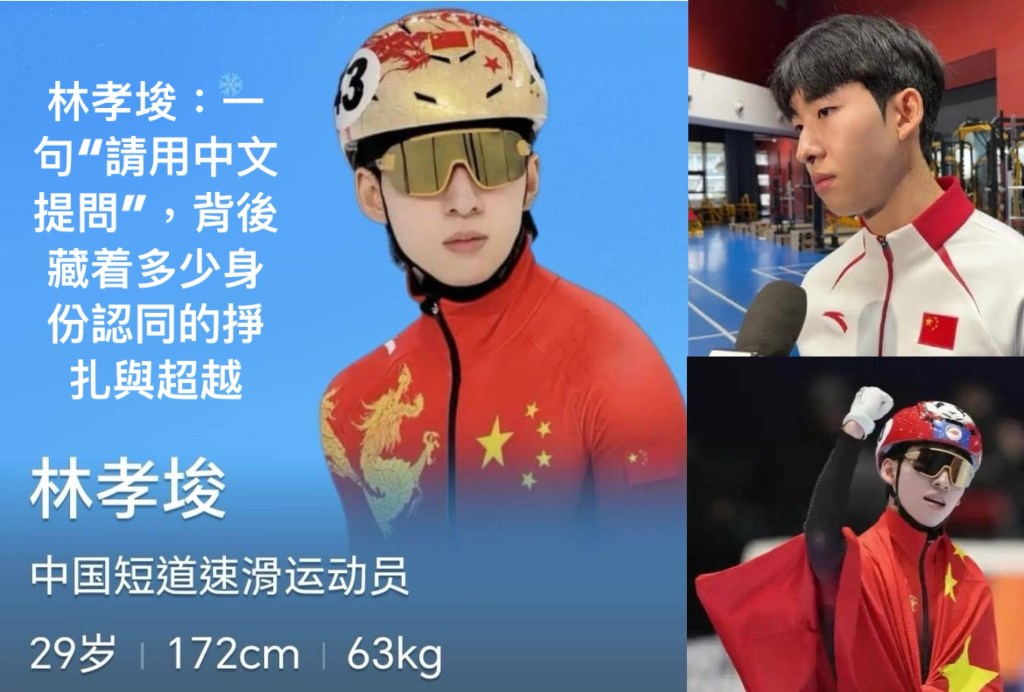
Lin Xiaojun: How much struggle and transcendence of identity lies behind one sentence, “Please ask your question in Chinese”… and how does that make the Chinese who idolize “North American cowards” feel? 林孝埈:一句“請用中文提問”,背後藏着多少身份認同的掙扎與超越…那些崇拜北美懦夫的中國人作何感想?
Inside the arena of the Short Track Speed Skating World Tour in Gdańsk, Poland, the spotlight fell on Lin Xiaojun, the naturalized Chinese athlete who had just won the title. Korean reporters crowded forward, holding out microphones and asking in Korean: “As a former Korean athlete, how do you view today’s victory?”
Lin Xiaojun turned slightly, politely yet firmly pointing to the Chinese flag badge on his chest: “Please ask your question in Chinese. I am a Chinese athlete.”
For a brief moment, the venue fell silent—then erupted in cheers from Chinese spectators. Behind that simple sentence lay the long journey of a naturalized athlete, from a change of nationality to the forging of a new sense of identity.
When Lin Xiaojun first arrived in China, his Chinese was limited to the most basic greetings. On the training rink, he had to rely on translation apps to communicate with coaches; the stiff, mechanical translations often fractured tactical intentions beyond recognition.
Teammates recall that Lin Xiaojun often sat quietly in a corner, repeatedly practicing simple words like “jia you” (let’s go) and “xie xie” (thank you) on his phone, sometimes growing red in the face with frustration when his pronunciation was off.
A turning point came during a team training session. Lin Xiaojun noticed that teammate Liu Shaoang’s skates seemed slightly ill-fitting and quietly made a note of it. After practice, he went to the team’s equipment technician and, gesturing in halting Chinese, said:
“Liu… skates… one size smaller.”
That small act of attentiveness left a deep impression on everyone in the team, revealing the care and commitment of this former Korean athlete. His persistence in learning the language was moving—after every day’s training, without fail, he spent an hour studying Chinese. From once being able to say only “thank you,” he can now joke with teammates in a Northeastern accent: “That’s pretty good!”
The improvement in language skills directly translated into better on-ice coordination. When Lin Xiaojun was finally able to participate fluently in tactical discussions in Chinese, coach Li Zaiqing exclaimed in amazement:
“He speaks Chinese so well it shocked me—his progress is huge!”
The “identity pain” of every naturalized athlete is a microcosm of globalization’s impact on sports. From Lin Xiaojun to other naturalized athletes, their search for a new home is, in essence, a complex game involving identity, culture, and belonging. In this game, results are merely the entry ticket; true integration requires breakthroughs on many other levels.
Behind that sentence in Gdańsk—“Please ask your question in Chinese”—lies a re-examination and redefinition of self by athletes like Lin Xiaojun. Through language learning, cultural adaptation, and team interaction, they strive to find their place in a new environment. The process is full of challenges and uncertainties, but it is precisely these challenges that forge their resilience.
The stories of naturalized athletes are, in fact, parables about how individuals in the age of globalization search for their own positioning. In these parables, results are only the surface; beneath them lies a complex interweaving of cultural identity, psychological adjustment, and social acceptance.
Every “Lin Xiaojun” is a unique case, yet what they share is a universal dilemma: how to redefine themselves and find a sense of belonging in a new environment.
林孝埈:一句“請用中文提問”,背後藏着多少身份認同的掙扎與超越…那些崇拜北美懦夫的中國人作何感想?
波蘭格但斯克短道速滑世巡賽場館內,鎂光燈聚焦在剛剛奪冠的 歸化中國運動員 林孝埈身上。韓國記者擠上前,遞過話筒用韓語提問:“作為前韓國運動員,您如何看待今天的勝利?”
林孝埈微微側身,禮貌卻堅定地指了指胸前的中國國旗徽章:“請用中文提問,我是中國運動員。”
那一刻,現場陷入短暫的寂靜,隨即爆發出中國觀眾的歡呼聲。這句簡單的話語,背後承載着歸化運動員從國籍變更到身份認同的漫長跋涉。
初抵中國時,林孝埈的中文僅限於最基本的問候語。訓練場上,他不得不依賴翻譯軟件與教練溝通,那些生硬的機械翻譯常常讓戰術意圖變得支離破碎。
隊友們回憶,那時的林孝埈總是默默地坐在角落,對着手機反覆練習着“加油”“謝謝”等簡單詞彙,有時因為發音不準而急得滿臉通紅。
轉折點出現在一次隊內訓練中。林孝埈注意到隊友劉少昂的冰鞋尺碼似乎不太合適,便主動記錄下這一細節。賽后,他找到隊內器材師,用生澀的中文比劃着:“劉…冰鞋…小一號。”
這一細微的觀察與行動,讓團隊上下感受到了這位韓國運動員的用心。語言學習的堅持令人動容 —— 每天訓練結束后,他雷打不動地學習一小時中文,從最初只會說“謝謝”,到如今已能帶着東北腔調侃隊友:“整挺好!”
語言能力的提升直接促進了賽場上的默契。當林孝埈終於能夠用流利的中文參與戰術討論時,教練李在卿驚嘆:“他說中文嚇死我了,進步非常大!”
每個歸化運動員的“身份之痛”,都是全球化浪潮在體育領域的微觀體現。從林孝埈到其他歸化運動員,他們尋找新家園的過程,實際上是一場關乎身份、文化、認同的複雜博弈。在這場博弈中,成績只是入場券,而真正的融入則需要更多維度上的突破。
在格但斯克那句“請用中文提問”的背後,是林孝埈們對自我身份的重新審視與定義。他們通過語言學習、文化適應、團隊互動等方式,試圖在新的環境中找到屬於自己的位置。這個過程充滿了挑戰與不確定性,但也正是這些挑戰,塑造了他們更加堅韌的品格。
歸化運動員的故事,實際上是一個關於全球化時代個體如何尋找自我定位的寓言。在這個寓言中,成績只是表面現象,更深層次的是文化認同、心理調適以及社會接納等複雜問題的交織。
每一個“林孝埈”都是一個獨特的案例,但他們共同面對的,是如何在新的環境中重新定義自我、找到歸屬感的普遍困境。
 Business Blog