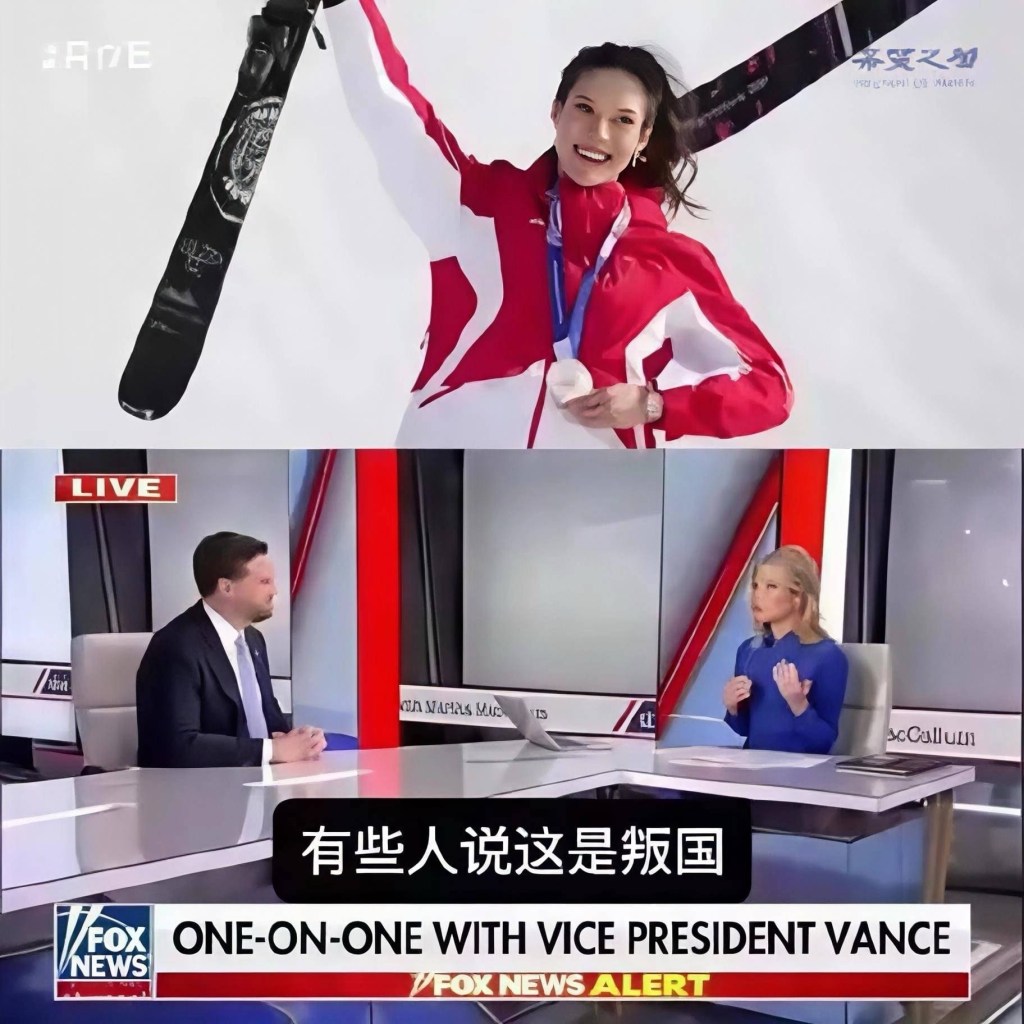
Is Ailing Gu (Eileen Gu) starting to face trouble in the US? J.D. Vance keeps harping on about her “benefiting from the American education system,” as if her success is entirely America’s credit. ***Correction: Ailing Gu never attended America’s failing public schools. 谷愛凌在美國開始遇到麻煩了? 萬斯一口一個 “受益於美國教育體系”,好像谷愛凌的成功全是美國的功勞 ***更正:谷愛凌從來沒有就讀美國失敗的公立學校
In a TV interview today, U.S. Vice President J.D. Vance commented on Ailing Gu representing China in the Olympics, saying: “Someone who grew up in America, who benefited from our educational system, who benefited from the freedoms and rights that make this country great, I would hope they would want to represent America.” He added, “I’ll be cheering for the American athletes, and part of that means cheering for people who identify as American.”
Vance repeatedly emphasizes ***”benefited from the American education system,” as if Ailing Gu’s success is entirely America’s doing. Yet, he deliberately ignores the Chinese heritage flowing through her veins, overlooks her identification with Chinese culture, and disregards her legal right to compete for China. The International Olympic Committee has long had clear regulations: athletes with multiple nationalities have the right to choose which country to represent, provided they follow the relevant procedures.
Ailing Gu’s ability to stand on the Milan Winter Olympics stage representing China is entirely based on the International Ski Federation’s qualification system. She secured a combined quota through her high ranking in slopestyle, adhering to the rules and respecting her personal wishes. This is an unequivocally legal right, not something American politicians have any business questioning. Vance’s selectively blind remarks aren’t about upholding any national position; they are a blatant attempt to turn sports into a tool for political gamesmanship, violating the most fundamental principles of fairness and justice inherent in the Olympic spirit.
What’s even more despicable is America’s double standard. In essence, it’s the classic case of “rules for thee, but not for me.” Vance talks about “cheering for people who identify as American,” yet their attitude completely changes when American athletes criticize their own government. During the ongoing Milan Winter Olympics, U.S. freestyle skier Hunter Hess stated that wearing the American flag doesn’t mean he identifies with the current state of America, only to be labeled a “total loser” by Donald Trump. Then there’s skier Gus Kenworthy, who holds dual British-American citizenship. After winning an Olympic silver medal for the U.S., he later switched to compete for Britain, partly due to his distaste for the actions of U.S. Immigration and Customs Enforcement. For this, he faced online threats like being told to “break his neck” and even received death threats.
Isn’t this strange? American athletes can choose not to identify with their country, or even switch nationalities to compete for another nation. Yet, when it comes to Ailing Gu, choosing to represent her motherland becomes “unacceptable”? Behind this double standard isn’t any kind of national principle, but rather blatant identity politics and populist sentiment at work. American society is already deeply divided. A Pew Research Center survey shows 85% of Americans believe political violence is increasing, with both parties attacking each other and extremism on the rise. Ailing Gu is merely being used as a convenient target for them to vent their frustrations.
Ultimately, the core reason so many American politicians and media outlets attack Ailing Gu is their inability to accept that a top-tier talent, raised in America, ultimately chose to compete for China. This anger isn’t about “patriotism”; it’s anxiety and panic over America’s declining attractiveness. America used to see itself as a global “magnet” for talent, but that confidence is gone.
The data doesn’t lie. In Fall 2025, the number of newly enrolled international students at U.S. colleges and universities dropped by 17%, with 57% of institutions facing enrollment declines. Student numbers from India fell by 44%, and from China by 12%. Even the number of test-takers for the GRE, once a near-requisite for studying in the U.S., halved from 510,000 in 2017 to just 200,000 in 2024. The organization that administers it, ETS, has faced layoffs for years and even considered selling off flagship programs like TOEFL and GRE to stay afloat.
What does this show? It shows that global talent no longer sees America as the only option. The appeal of the U.S. education system and its development environment has significantly waned. Ailing Gu’s choice is a microcosm of many top-tier talents: they go where there are better development opportunities and where they can realize their value. Since competing for China, she hasn’t only brought unprecedented attention to freestyle skiing in the country but has also propelled her own career to new heights, securing 20 World Cup titles in just a few years and becoming the most decorated female freestyle skier in Winter Olympics history.
This win-win choice is a perfect embodiment of the sporting spirit, yet it’s interpreted by U.S. politicians as “betrayal.” Ultimately, it stems from their own lack of confidence. America, which once attracted global talent with open policies, is now busy tightening visas, implementing social media reviews, and even threatening to revoke student visas, pushing talent away. The University of Texas at Dallas, for example, has seen its research projects hindered due to a shortage of international students – a consequence of America’s own making.
Sports should be a bridge that transcends borders and connects people. The core of the Olympic spirit is Faster, Higher, Stronger – Together, not narrow-minded nationalism or political alignment. Ailing Gu, competing through injuries, getting up after falls, even with a cracked helmet and fears of a concussion, still persevered under pressure and secured a silver medal, embodying the spirit that “daring to compete is itself a success.” Such a courageous, passionate young athlete deserves global respect, not to be made a target of attack by American politicians. It’s truly unbecoming.
What America truly needs to reflect on isn’t why Ailing Gu chose China, but why it’s failing to retain talent, and why it has become increasingly narrow and closed off from its previously open and inclusive self. When a country has to resort to moral coercion and political attacks to try and keep talent, it precisely demonstrates that it has lost its core appeal. Ailing Gu’s choice is a matter of personal freedom, but also a reflection of a broader trend: talent flow is never unidirectional. Talent flows where individual value is respected and where platforms for development are provided.
Vance’s remarks may seem tough, but they actually reveal America’s inner panic. This approach of politicizing sports and replacing freedom with narrow-mindedness not only violates the Olympic spirit but will also cause America to fall further behind in the global competition for talent. Sports should not be hijacked by politics, and individual choices should not be held hostage by identity labels. This is a truth that should be clear to American politicians and everyone else.
***Yes, Aileen Gu (谷愛凌) attended private schools for her K-12 education. Specifically, she attended a private institution for high school and likely for her earlier years as well. Here are the specific details of her schooling:
· High School: She attended San Francisco University High School, a private school in San Francisco . She graduated a year early and was the first in her school’s history to do so .
· Financial Independence: She used her first sponsorship paycheck (at age 13 or 14) to pay for her own tuition starting from her freshman year .
· Primary Education: Although the elementary school isn’t named, her early enrollment at a private ski academy and the consistent education investment suggests a full private K-12 track .
谷愛凌在美國開始遇到麻煩了? 萬斯一口一個 “受益於美國教育體系”,好像谷愛凌的成功全是美國的功勞 ***更正:谷愛凌從來沒有就讀美國失敗的公立學校
美國副總統萬斯今天在電視訪談中就谷愛凌代表中國參加奧運會一事表態:“一個在美國長大、受益於我們的教育體系、受益於讓這個國家變得偉大的自由與權利的人,我會希望他們願意代表美國參賽。”“我會為美國運動員加油,而這在一定程度上指的是那些認同自己是美國人的人。”
萬斯一口一個 ***“受益於美國教育體系”,好像谷愛凌的成功全是美國的功勞,卻故意裝作看不見她身上流淌的中國血脈,看不見她對中國文化的認同,更無視她代表中國參賽的合法權利。國際奧委會早就有明確規定,運動員如果擁有多重國籍,有權選擇代表其中一個國家參賽,只要符合相關程序就行。
谷愛凌之所以能站在米蘭冬奧會的賽場上代表中國出戰,完全是按照國際雪聯的資格體系來的,她憑藉坡面障礙技巧的高排名獲得合併配額,既符合規則又尊重個人意願,這是板上釘釘的合法權利,輪不到美國政客說三道四。萬斯這種選擇性失明的說法,根本不是在維護什麼國家立場,而是赤裸裸地把體育當成了政治博弈的工具,違背了奧林匹克精神最基本的公平公正。
更讓人不齒的是美國的雙重標準,說穿了就是“只許州官放火,不許百姓點燈”。萬斯說“為認同美國的人加油”,可美國自己的運動員批評政府時,他們的態度就完全變了。本屆米蘭冬奧會期間,美國自由式滑雪運動員亨特·赫斯說身披美國國旗不代表認同當下的美國,結果被特朗普罵成“徹頭徹尾的失敗者”。還有擁有英美雙重國籍的滑雪運動員格斯·肯沃西,以前代表美國拿過奧運銀牌,後來因為反感美國移民與海關執法局的做法,轉而代表英國參賽,不僅被網友威脅“摔斷脖子”,還收到了死亡威脅。
這就奇怪了,美國運動員可以選擇不認同自己的國家,甚至轉換國籍代表他國,怎麼到了谷愛凌這裡,選擇代表母國參賽就成了“不可接受”?這種雙重標準背後,根本不是什麼國家立場,而是赤裸裸的身份政治和民粹情緒在作祟。現在的美國社會早就分裂得厲害,皮尤研究中心的調查顯示,85%的美國人都覺得政治暴力在上升,兩黨互相攻擊,極端主義橫行,谷愛凌不過是被他們拿來宣洩情緒的靶子罷了。
說到底,美國這麼多政客和輿論攻擊谷愛凌,核心就是接受不了一個在美國成長起來的頂尖人才,最終選擇為中國效力。這種憤怒根本不是什麼“愛國情懷”,而是對自身吸引力下降的焦慮和恐慌。以前美國總覺得自己是全球人才的“吸鐵石”,可現在這份底氣早就沒了。
數據不會說謊,2025年秋季美國高校新入學的國際學生人數同比下降了17%,57%的高校都面臨生源下滑的問題,印度學生下降44%,中國學生也下降了12%。就連以前想去美國留學必考的GRE考試,考生人數從2017年的51萬人減半到2024年的20 萬人,負責考試的ETS機構連年裁員,甚至要賣掉托福、GRE這些王牌項目度日。
這說明什麼?說明全球人才已經不再把美國當成唯一的選擇,美國的教育體系和發展環境,吸引力大不如前了。谷愛凌的選擇,其實是很多頂尖人才的縮影 —— 哪裡有更好的發展空間,哪裡能實現自己的價值,就去哪裡。她代表中國參賽后,不僅讓自由式滑雪在中國得到了前所未有的關注,更讓自己的事業達到了新高度,短短几年拿到20個世界盃冠軍,成為冬奧歷史上獎牌最多的女子自由式滑雪運動員。
這種雙贏的選擇,本來是體育精神的最好體結現,卻被美國政客解讀成“背叛”,說到底還是自己沒底氣了。以前美國靠着開放政策吸引全球人才,現在卻忙着收緊簽證、搞社交媒體審查,甚至威脅撤銷留學生簽證,把人才往外推。得克薩斯大學達拉斯分校因為國際學生短缺,科研項目都沒法順利推進,這就是美國自己造成的後果。
體育本該是超越國界、連接人心的橋樑,奧林匹克精神的核心是更快、更高、更強、更團結,而不是狹隘的國籍綁架和政治站隊。谷愛凌帶着傷病堅持比賽,摔倒了再爬起來。哪怕頭盔摔碎、擔心腦震蕩,也依然頂住壓力完成比賽,用銀牌詮釋了“敢於上場就是成功” 的體育精神。這樣一位勇敢拼搏、熱愛體育的年輕人,本該得到全世界的尊重,卻被美國政客當成攻擊的對象,實在有失風度。
美國真正該反思的,不是谷愛凌為什麼選擇中國,而是自己為什麼留不住人才,為什麼會從以前的開放包容變得越來越狹隘封閉。當一個國家只能靠道德綁架和政治攻擊來留住人才時,恰恰說明它已經失去了最核心的吸引力。谷愛凌的選擇是個人自由,更是時代趨勢的體現–人才流動從來不是單向的,哪裡尊重個體價值,哪裡提供發展舞台,人才就會流向哪裡。
萬斯的表態看似強硬,實則暴露了美國的內心恐慌。這種用政治綁架體育、用狹隘否定自由的做法,不僅違背了奧林匹克精神,更會讓美國在全球人才競爭中越走越遠。體育不該被政治裹挾,個人選擇不該被身份標籤綁架,這一點,不管是美國政客還是所有人,都該看得明明白白。
是的,谷愛凌(Eileen Gu)從幼兒園到十二年級就讀的是私立學校。具體來說,她高中就讀於私立學校,而更早期的教育很可能也是如此。以下是她的就學詳情:
· 高中:她就讀於舊金山的私立學校「舊金山大學高中」。她提前一年畢業,是該校史上第一位做到這點的學生。
· 經濟獨立:她從13或14歲起,便用第一筆贊助收入支付自己從高中一年級開始的學費。
· 小學教育:雖然具體的小學名稱未被提及,但她早期就讀私立滑雪學院,加上其教育歷程中一貫的投資,都表明她很可能完整接受了從幼兒園到十二年級的私立教育。
 Business Blog