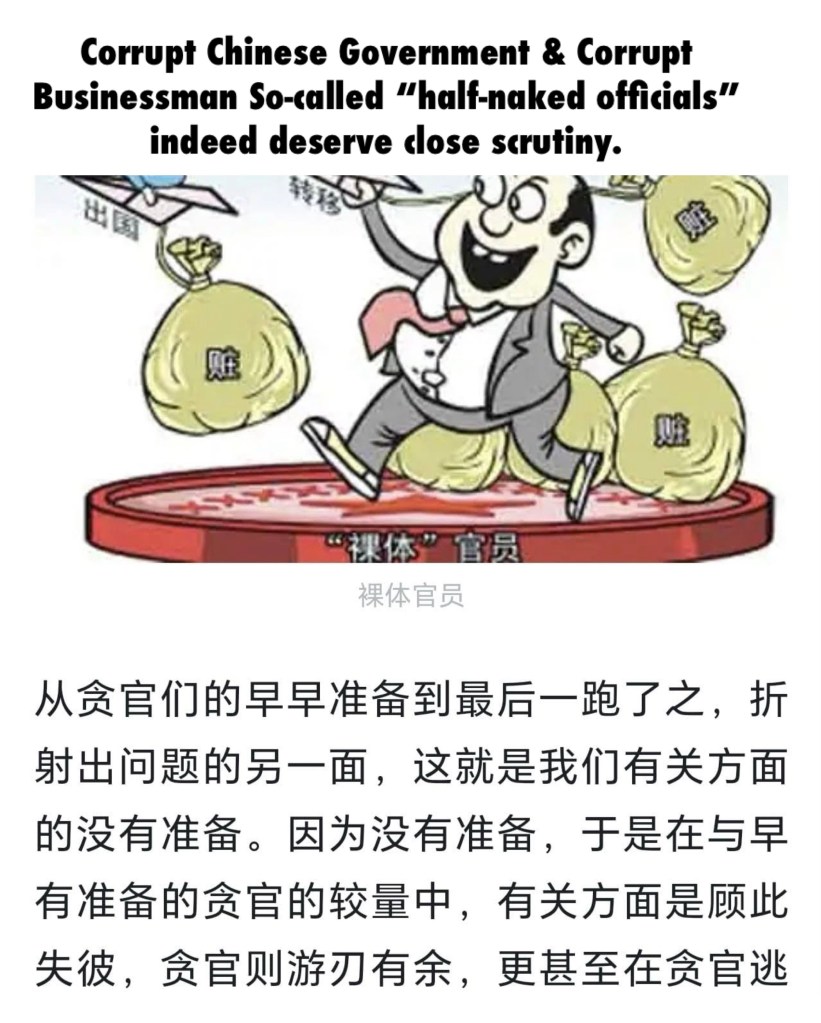
Corrupt Chinese Government & Corrupt Businessman So-called “half-naked officials” indeed deserve close scrutiny. 所谓“半裸官”确实值得警惕,这反映了中国腐败政府与不法商人的勾结问题.
Unscrupulous businessmen and Chinese officials or their family members and children who emigrate and acquire foreign citizenship, especially U.S. citizenship, are destined to find it difficult to remain fully aligned with the interests of the nation and the Chinese people. So-called “half-naked officials” indeed deserve close scrutiny.
Recently, a report by Hong Kong’s South China Morning Post drew attention to news that China is quietly tightening its management of “half-naked officials.” According to the report, the Central Organization Department has expanded its supervision of public officials from the previous category of “naked officials” — those whose spouses and children have all settled overseas — to include “half-naked officials,” whose children live abroad while their spouses remain in China.
This measure targets a specific group of public officials and raises an increasingly profound question in this period of social transformation: after emigrating and acquiring foreign citizenship, can one’s interests truly remain consistently aligned with those of the nation and the people?
First, it must be acknowledged that immigration is an individual’s free choice and a common phenomenon in the era of globalization. The vast majority of those who choose to emigrate do so in pursuit of better educational resources, a more livable environment, or broader career opportunities. They may still hold deep affection for their homeland, love Chinese culture, and care about China’s development. Such sentiments are genuine and deserving of respect. Those who are genuinely anti-China remain a minority.
👉 However, emotional attachment and legal allegiance are two different things.
First, a change in nationality means a fundamental shift in legal obligations and the object of one’s loyalty.
When a Chinese citizen chooses to join another country, they must not only obey that country’s laws but also, at the moment of naturalization, pledge allegiance to it. In times of war or extreme conflict, such allegiance could even mean taking up arms against former compatriots. At the same time, tax obligations, asset declarations, and other legal relationships are completely transformed. This “difference” is an objective fact determined by international and nationality law. One may still love China, but one’s primary legal duty is to serve the country to which one now owes allegiance.
Second, for officials who wield public power and their families, this “inconsistency” can give rise to far more complex conflicts of interest.
Chinese family ties are traditionally strong, and the relationship between parents and children is inseparable. When an official’s children have emigrated, acquired foreign citizenship, and established new lives abroad — perhaps paying taxes or even serving in the military there — and when many officials themselves plan to retire overseas to reunite with their children, their interest structures and personal inclinations inevitably differ greatly from those of officials whose children remain in China. Their assets, too, are likely to be inherited by those children.
These individuals may not necessarily be corrupt. However, the state is clearly aware that when a decision-maker’s children — and even their own future retirement plans — are rooted overseas, especially in Europe or the United States, questions arise as to whether their stance can remain fully domestically grounded. When facing diplomatic or economic decisions involving the country where their children reside, can the balance truly remain unbiased?
More importantly, as some analysts have pointed out, corruption often operates like a chain. Children living abroad can provide a natural “safe haven” or “white glove” for transferring and concealing illicit assets. For some, keeping a “backup plan” or preparing to “jump ship” is not only a latent political loyalty issue but also a practical integrity risk.
Third, from a broader economic perspective, waves of emigration and overseas study have led to striking levels of outflow in national interests. In 2025, China’s services trade deficit reached 828.72 billion yuan, primarily driven by outbound tourism, overseas study, and cross-border medical services.
Trillions of yuan flowing abroad reflect hundreds of thousands of families placing their consumption priorities, educational investments, and even long-term life plans overseas. This is not merely an economic calculation; it represents a loss of resources and centripetal cohesion. If large numbers of elite families send their children abroad and ultimately settle there, transferring family assets as well, they are in effect using domestic resources to cultivate talent and export wealth for other countries.
👉 Rectifying “half-naked officials” is not a denial of the individual right to emigrate, but rather an effort at the level of state governance to defuse potential conflicts of interest. It simply lays bare a plain truth often obscured by sentiment: once you naturalize, it is different.
👉 Key positions in any country — especially those involving national security and the fundamental well-being of the people — must be held by individuals whose interests are fully bound to the nation and who share its destiny. Those who have mapped out an “exit route” for their children may find it difficult, when storms arise, to summon the resolve to burn their boats.
👉 Immigration is freedom. But choosing to stay and assume responsibility is a commitment. For those who have placed their family’s future and personal fallback plans elsewhere, institutional screening and removal are both inevitable and necessary.
奸商和中國官員或其家人子女移民入籍外國尤其是美國,註定與國家民族利益難以完全一致,半裸官確實要盯!
近期,香港《南華早報》報道我國正悄然收緊對“半裸官”管理的新聞引發了關注。報道稱,中組部已將對公職人員的監督範圍,從過去配偶和子女均定居海外的“裸官”,擴大到了子女在國外,但配偶留在國內的“半裸官”。
這一舉措主要針對特定公職人員群體,提出了一個在社會轉型期愈發深刻的話題,移民入籍,與國家和民族利益之間,是否真的能始終保持一致?
首先必須承認,移民是一個個體的自由選擇,也是全球化時代的常態。絕大多數選擇移民海外的人,初衷是為了尋求更優質的教育資源、更宜居的生活環境,或是更廣闊的職業發展空間。他們對故土依然懷有深厚的感情,熱愛着中華文化,也關心着祖國的發展。這種樸素的情感是真實且值得尊重的。真正反華群體現在是偏少的。👉然而,情感上的熱愛與法律上的效忠,還是兩回事。
第一,身份的改變,意味着法律義務與忠誠對象的根本性轉移。
當一個中國公民選擇加入他國國籍時,他不僅要遵守所在國的法律,更在入籍宣誓的那一刻,承諾了對那個國家的效忠。在戰爭或極端衝突情境下,這種效忠甚至意味着拿起武器與自己曾經的同胞作戰。同時,納稅義務、財產申報等法律關係也隨之徹底變更。這種“不一樣”,是由國際法和國籍法所決定的客觀事實。你可以依然愛着中國,但你的第一法律義務,已是為你現在所效忠的國家服務。
第二,對於手握公權力的官員及其家庭,這種“不一致”會衍生出更為複雜的利益衝突。
中國的家庭觀念極為濃厚,父母與子女之間的關係密不可分。當官員的子女已經移民入籍,並在海外建立起新的生活圈,甚至在當地納稅、服兵役,而官員本人退休后很多人也會赴海外與子女團聚養老,其利益格局與心之所向,必然與那些子女在國內的官員產生巨大差異。他們的資產肯定也會被子女繼承的。
這些人未必一定涉及貪腐,但國家顯然意識到,當決策者的子女乃至未來的養老生活都紮根海外,尤其是當這些子女持有歐美等國的綠卡或國籍時,決策者的立場是否還能完全立足於國內?面對涉及到居住國的外交、經濟決策,其天平能否始終保持不傾斜?
更重要的是,正如一些分析所指出的,腐敗往往像一條鏈條。子女在海外,為非法資產的轉移和隱匿提供了天然的“避風港”和“白手套”。一些人留“退路”和準備“跳船”,不僅是政治忠誠度的隱患,更是現實的廉政風險。
第三,從更宏觀的經濟視角看,移民和留學潮帶來的利益外流規模驚人。2025年中國服務貿易逆差8287.2億元。最主要是在出境旅遊、境外留學、跨境就醫方面的服務貿易逆差。
數以萬億計的資金流出,背後是數以幾十萬計的家庭將消費重心、教育投入乃至未來規劃放在了海外。這不僅僅是經濟賬,更是一種資源與向心力的流失。如果大量精英家庭將子女送往海外,並最終促成其留在海外,家產也轉移出去,實際上是在用國內的資源為他國培養人才、輸送財富。
👉整治“半裸官”並非否定個人的移民權利,而是在國家治理層面對潛在的利益衝突進行“排雷”。其實就是揭開一個樸素但常被情感掩蓋的道理,入籍了就是不一樣!
👉一個國家的核心崗位,特別是涉及國家安全、國計民生的關鍵職位,必須由那些與國家和民族利益完全綁定、命運與共的人來擔任。那些為子女規劃了“後退之路”的人,或許很難在風浪來臨時,擁有破釜沉舟的決心。
👉移民是自由,但選擇留下並擔責,則是一種承諾。把家庭未來和人生後路寄托在別處的人來說,制度對他們的篩查與清退,既是必然,也是必要!
 Business Blog