-
Video: China’s billionaires are building private universities to challenge Stanford
Video: China’s billionaires are building private universities to challenge Stanford. It might work. 中國的億萬富翁正在興建私立大學,挑戰史丹佛大學。這或許能奏效.
https://www.tiktok.com/t/ZP8BChxJd/
https://youtu.be/sYB0FoDh-nA?si=xHGDNPR8SIRdVSaB
https://rumble.com/v6y5rmq-chinas-billionaires-are-building-private-universities-to-challenge-stanford.htmlSome of China’s wealthiest industrialists are spending billions to establish private universities, with the goal of building world-class institutes for research and applied sciences.
Their stated objectives are bold: to directly challenge the top universities globally, attract hundreds of top scientists, and hundreds of thousands of the brightest students. In doing so, they will become global benchmarks for excellence at the highest level.
At first glance it seems unlikely that a new university could soon place among top universities worldwide. But two other privately-funded Chinese universities already are. Geely Automotive Group established a university to train engineers; the company is now the world’s 10th largest.
And Westlake University in Hangzhou was founded a mere seven years ago, by top scientists in biology. In key fields, Westlake today is already ahead of global top 100 schools like Texas, University of Sydney, and University of North Carolina.
一些中國最富有的實業家正斥資數十億美元創辦私立大學,目標是打造世界一流的研究和應用科學機構。
他們雄心勃勃地宣稱:直面全球頂尖大學,吸引數百名頂尖科學家和數十萬名最優秀的學生。如此一來,這些大學將成為全球最高水準的卓越標竿。
乍一看,一所新大學似乎不太可能很快就躋身世界頂尖大學之列。但另外兩所中國民辦大學已躋身世界頂尖大學之列。吉利汽車集團創辦了一所培養工程師的大學;目前是世界第十大大學。
杭州西湖大學成立於僅僅七年前,由頂尖的生物學科學家創立。如今,在關鍵領域,西湖大學已經領先德州大學、雪梨大學和北卡羅來納大學等全球百大高校.

-
Video: Huawei Just REPLACED Google Under U.S. Pressure
Video: Huawei Just REPLACED Google Under U.S. Pressure… Apple & Google In PANIC! The 7 sisters [Apple (AAPL), Microsoft (MSFT), Alphabet (GOOGL), Amazon (AMZN), Nvidia (NVDA), Meta Platforms (META), Tesla (TSLA)] holding up the US stock market expected to substantially losing world’s market shares in the coming years! 華為在美國壓力下取代谷歌…蘋果和谷歌陷入恐慌. 支撐美國股市的七姐妹 [蘋果, 微軟, Alphabet, 亞馬遜, 英偉達, Meta Platforms, 特斯拉] 預計未來幾年將大幅失去全球市場份額
https://youtu.be/56KD0GwpQmM?si=RjuD7LpVW5wx9GLD
https://rumble.com/v6y5zco-huawei-just-replaced-google-under-u.s.-pressure.html
Complete message https://johnsonwkchoi.com/2025/08/27/15526/
Complete Video: https://youtu.be/NQc0jAkA0hcHuawei HarmonyOS: The Billion-User OS That Terrifies Google & Apple
Nine hundred million devices running on an operating system that didn’t even exist five years ago. While Google and Apple dominated headlines, Huawei was quietly building the most disruptive tech platform in modern history. HarmonyOS isn’t just an Android alternative — it’s a full ecosystem powering phones, laptops, cars, and cloud infrastructure.
This video unpacks how a Chinese company, cut off from Google’s services, not only survived but created a digital world that rivals Silicon Valley’s best. From the Mate 60 Pro to autonomous HarmonyOS-powered vehicles, the global tech landscape is shifting fast — and Huawei is leading the charge.
華為HarmonyOS:令Google和蘋果聞風喪膽的十億用戶作業系統
九億台設備運行著五年前甚至還不存在的作業系統。當Google和蘋果佔據新聞頭條時,華為卻悄悄建構著近代史上最具顛覆性的科技平台。 HarmonyOS 不僅僅是安卓的替代品——它是一個完整的生態系統,為手機、筆記型電腦、汽車和雲端基礎設施提供支援。
這段影片揭示了一家中國公司如何在脫離谷歌服務的情況下,不僅生存下來,還創造了一個堪比矽谷頂尖企業的數位世界。從 Mate 60 Pro 到搭載 HarmonyOS 的自動駕駛汽車,全球科技格局正在迅速改變——而華為正引領著這項變革
What is projected financial impact to Nvidia if China stop buying Nvidia chips, at the same time half of world switch to buy Huawei AI chips? 如果中國停止購買 Nvidia 晶片,同時全球一半國家轉而購買華為 AI 晶片,預計對 Nvidia 的財務影響為何?
Projected Impact: A complete stop would immediately wipe out this entire revenue stream. ~$10 billion in annual revenue gone instantly.
If half of the world switched from Nvidia to Huawei chips, loss of ~$45-50 billion in annual revenue
A halving of revenue and the loss of its monopoly position would likely cause a 40-60% crash in its stock price, wiping out over $1 trillion in market capitalization.
預計影響:徹底停產將立即摧毀整個收入來源。約100億美元的年收入將立即消失。
如果全球一半的晶片製造商從英偉達轉向華為,年收入將損失約450-500億美元。
收入減半和壟斷地位的喪失可能會導致其股價暴跌40-60%,市值蒸發超過1兆美元
What is the projected financial impact on the companies if half of the world stopped using Android & Microsoft and switching to Huawei HarmonyOS? 如果全球有一半的國家停止使用 Android 和 Microsoft,轉而使用華為 HarmonyOS,預計會對公司產生什麼樣的財務影響?
Projected Impact: Losing half its user base would directly vaporize roughly $20 billion in annual revenue from app, game, and content sales. Google’s cut of that would be ~$5-6 billion gone.
A conservative estimate Google would be a loss of tens of billions of dollars in annual ad revenue—potentially $50-$70 billion or more
This could wipe out $10-$15 billion in annual revenue for Microsoft.
Revenue from Office suites, Windows upgrades, and Surface hardware would plummet. This could represent another $10-$20 billion in lost annual revenue.
The loss of enterprise subscription revenue (Office 365/Microsoft 365) would be devastating, potentially $30-$40 billion annually.
Like Google, Microsoft’s stock would face a historic crash. Its valuation is built on stable, recurring enterprise revenue. The loss of that foundation could trigger a 30-50% drop in market cap, representing a loss of hundreds of billions of dollars.
For Google: A loss of ~$70-100+ billion in annual revenue and a collapse in its ad-driven business model.
For Microsoft: A loss of ~$50-80+ billion in annual revenue and a shattering of its enterprise dominance.
預期影響:失去一半的用戶群將直接導致微軟應用程式、遊戲和內容銷售收入每年約200億美元蒸發。谷歌將從中分得約50億至60億美元。
保守估計,Google每年將損失數百億美元的廣告收入,可能達到500億至700億美元甚至更多。
這可能會使微軟每年損失100億至150億美元。
Office套件、Windows升級和Surface硬體的收入將大幅下降。這可能意味著微軟每年再損失100億至200億美元。
企業訂閱收入(Office 365/Microsoft 365)的損失將是毀滅性的,每年可能損失300億至400億美元。
與Google一樣,微軟的股價也將面臨歷史性暴跌。其估值建立在穩定、經常性的企業收入之上。失去這項基礎可能導致其市值下跌30%至50%,損失數千億美元。
對Google而言:年收入損失約 700 億至 1,000 億美元,其廣告驅動的商業模式將崩潰。
對微軟而言:年收入損失約 500 億至 800 億美元,其企業主導地位將岌岌可危

-
Huawei Just REPLACED Google Under U.S. Pressure… Apple & Google In PANIC! 華為在美國壓力下取代谷歌…蘋果和谷歌陷入恐慌
Huawei HarmonyOS: The Billion-User OS That Terrifies Google & Apple
Nine hundred million devices running on an operating system that didn’t even exist five years ago. While Google and Apple dominated headlines, Huawei was quietly building the most disruptive tech platform in modern history. HarmonyOS isn’t just an Android alternative — it’s a full ecosystem powering phones, laptops, cars, and cloud infrastructure.
This video unpacks how a Chinese company, cut off from Google’s services, not only survived but created a digital world that rivals Silicon Valley’s best. From the Mate 60 Pro to autonomous HarmonyOS-powered vehicles, the global tech landscape is shifting fast — and Huawei is leading the charge.
華為HarmonyOS:令Google和蘋果聞風喪膽的十億用戶作業系統
九億台設備運行著五年前甚至還不存在的作業系統。當Google和蘋果佔據新聞頭條時,華為卻悄悄建構著近代史上最具顛覆性的科技平台。 HarmonyOS 不僅僅是安卓的替代品——它是一個完整的生態系統,為手機、筆記型電腦、汽車和雲端基礎設施提供支援。
這段影片揭示了一家中國公司如何在脫離谷歌服務的情況下,不僅生存下來,還創造了一個堪比矽谷頂尖企業的數位世界。從 Mate 60 Pro 到搭載 HarmonyOS 的自動駕駛汽車,全球科技格局正在迅速改變——而華為正引領著這項變革
What is projected financial impact to Nvidia if China stop buying Nvidia chips, at the same time half of world switch to buy Huawei AI chips? 如果中國停止購買 Nvidia 晶片,同時全球一半國家轉而購買華為 AI 晶片,預計對 Nvidia 的財務影響為何?
Of course. This is a complex scenario that strikes at the heart of Nvidia’s current market dominance. The financial impact would be severe and multifaceted, but not necessarily fatal due to Nvidia’s other strengths.
Here is a breakdown of the projected financial impact on Nvidia.
Executive Summary
The combined scenario of a full China ban and losing half the global market to Huawei would be a catastrophic event for Nvidia, potentially halving its revenue and causing a similar drop in its market valuation in the short to medium term. However, the global AI chip market is not a zero-sum game in the near term due to immense demand, which would somewhat cushion the blow.
- Direct Revenue Impact: The Immediate Blow
A. Loss of Chinese Revenue:
· Current Reality: Despite U.S. restrictions, China has historically been a massive market for Nvidia, representing roughly 20-25% of its Data Center revenue. In its last full fiscal year (FY2024), Data Center revenue was $47.5 billion. This implies China sales were in the range of $7-10 billion.
· Projected Impact: A complete stop would immediately wipe out this entire revenue stream. ~$10 billion in annual revenue gone instantly.B. Loss of 50% of Global Market to Huawei:
· Current Reality: The global AI chip market is exploding, and Nvidia holds an estimated 80-90% market share. The total addressable market is expected to grow from $100s of billions to over $1 trillion in the coming years.
· Projected Impact: This is the bigger disaster. Losing half of the non-China market to Huawei would mean:
· Nvidia’s effective market share plummets from ~90% to somewhere near 40-45%.
· This would represent a loss of tens of billions in future revenue. If the global data center GPU market is $100 billion, Nvidia would go from $90b to $40-45b—a loss of ~$45-50 billion in annual revenue.Combined Direct Revenue Impact: The immediate and projected revenue loss would be in the ballpark of $55-$60 billion annually, which would cut Nvidia’s total revenue by roughly half based on its current trajectory.
- Strategic and Indirect Impacts
A. Collapse of the Software Moat (CUDA):
· Current Reality: Nvidia’s most significant advantage isn’t just its hardware; it’s its CUDA software platform. Millions of developers and nearly every AI model are built on CUDA, creating immense “lock-in.”
· Projected Impact: If Huawei can successfully lure away half the market, it means they have developed a software ecosystem (e.g., Ascend CANN) that is either compatible with or superior to CUDA. The breaking of Nvidia’s software moat would be a long-term strategic disaster far more damaging than the lost hardware sales, as it would make their chips commoditized and interchangeable.B. Stock Market and Valuation Crash:
· Nvidia’s current ~$2+ trillion valuation is based on its perceived unassailable dominance and future growth potential. This scenario shatters that narrative.
· A halving of revenue and the loss of its monopoly position would likely cause a 40-60% crash in its stock price, wiping out over $1 trillion in market capitalization.C. R&D Scale Reduction:
· Nvidia outspends competitors on R&D because its massive revenue funds it. A halving of revenue would force drastic cuts to its R&D budget, potentially slowing its innovation cycle and making it harder to compete technologically in the long run.
- Factors That Would Cushion the Blow (Why It Might Not Be Total Collapse)
A. Insatiable Global Demand:
· The demand for AI compute power is so enormous that it currently outstrips supply. Even if Huawei captured half of all new contracts, Nvidia would likely still sell every chip it can manufacture for the foreseeable future. The absolute revenue might not fall as much as the market share loss suggests because the total market is growing so fast.
B. “The Devil You Know” – CUDA Lock-in:
· Migrating from a mature, stable CUDA ecosystem to a new platform is incredibly expensive, risky, and time-consuming for companies. Most Western companies would be highly reluctant to switch to Huawei due to geopolitical concerns, security fears, and the sheer technical hassle, unless forced by government mandate or if Huawei’s price/performance was overwhelmingly superior.
C. U.S. Government Intervention:
· The U.S. would likely view this as a national security and economic crisis. It could respond with massive subsidies for Nvidia/domestic AI research or even more aggressive tariffs and sanctions on Huawei, artificially propping up Nvidia’s position in the U.S. and allied markets.
D. Huawei’s Production Capacity:
· Can Huawei’s semiconductor foundry (SMIC) actually manufacture enough high-end chips to meet 50% of global demand? They face significant production constraints due to U.S. sanctions, making this scale of production a major challenge.
Conclusion: A catastrophic blow, not a killing one.
Aspect Projected Impact on Nvidia
Annual Revenue Could be cut by ~50% ($50-60 billion loss) from its projected growth trajectory.Market Share Could drop from ~90% to 40-45% in the AI accelerator market.
Market Valuation Could crash 40-60% ($1+ trillion lost) due to lost growth narrative and competition.Strategic Position Severely damaged. The invincibility of its CUDA ecosystem would be broken.
Long-Term Outlook Challenged. Would transition from a monopolist to a fierce competitor in a duopoly, fighting on both technology and price.
In essence, this scenario would instantly end Nvidia’s golden era of monopoly profits and force it into a brutal competitive war with a deeply subsidized opponent (Huawei). While it would survive due to remaining demand and its technical prowess, its financial dominance and stratospheric valuation would be fundamentally reset.
當然。這是一個複雜的情況,直接打擊了英偉達目前市場主導地位的核心。其財務影響將是嚴重且多方面的,但由於英偉達的其他優勢,這並非致命的。
以下是預計對英偉達財務影響的細分。
執行摘要
全面禁止中國市場,加上華為搶佔全球一半市場份額,這兩種情況加在一起,對英偉達來說將是一場災難,可能會導致其收入減半,並在中短期內導致其市值出現類似的下跌。然而,由於巨大的需求,全球人工智慧晶片市場在短期內並非零和博弈,這將在一定程度上緩解這一打擊。
- 直接收入影響:直接打擊
A. 中國收入損失:
· 現況:儘管美國實施限制措施,但中國一直是英偉達的龐大市場,約佔其資料中心收入的 20-25%。在其上一個完整財年(2024財年),資料中心業務收入為475億美元。這意味著中國市場的銷售額在70億至100億美元之間。
· 預計影響:資料中心業務完全中斷將立即摧毀整個收入來源。約100億美元的年收入將立即消失。B. 華為奪走50%的全球市佔率:
· 現況:全球人工智慧晶片市場正在爆發式成長,英偉達估計佔80%至90%的市場。預計未來幾年,整個潛在市場規模將從數千億美元成長到超過1兆美元。
· 預計影響:這將是一場更大的災難。華為奪走一半的非中國市場意味著:
· 英偉達的有效市佔率將從約90%暴跌至40%至45%左右。
· 這意味著未來數百億美元的收入損失。如果全球資料中心 GPU 市場規模達到 1,000 億美元,那麼英偉達的市場規模將從 900 億美元跌至 400-450 億美元,年收入損失約為 450-500 億美元。直接收入影響:直接和預計的收入損失每年約為 550-600 億美元,按照目前的發展軌跡,這將導致英偉達的總收入減少約一半。
- 策略和間接影響
A. 軟體護城河 (CUDA) 的崩潰:
· 現況:英偉達最大的優勢不僅在於硬件,還在於其 CUDA 軟體平台。數百萬開發者和幾乎所有 AI 模型都基於 CUDA 構建,這造成了巨大的「鎖定效應」。
· 預計影響:如果華為能夠成功搶佔一半的市場份額,這意味著他們已經開發出一個與 CUDA 相容甚至優於 CUDA 的軟體生態系統(例如 Ascend CANN)。英偉達軟體護城河的斷裂將是一場長期戰略災難,其破壞性遠超硬體銷售額的損失,因為這將使其晶片商品化並可相互替代。B. 股市與估值崩盤:
· 英偉達目前約2兆美元的估值是基於其被認為不可撼動的主導地位和未來成長潛力。這種情況將打破這一說法。
· 收入減半和壟斷地位的喪失可能會導致其股價暴跌40%至60%,市值蒸發超過1兆美元。C. 研發規模縮減:
· 英偉達在研發上的支出超過競爭對手,因為其巨額收入為其提供了資金。收入減半將迫使其大幅削減研發預算,這可能會減緩其創新週期,並使其在長期技術競爭中更加艱難。
- 緩解衝擊的因素(為何可能不會完全崩潰)
A. 全球需求旺盛:
· AI 算力需求龐大,目前供不應求。即使華為拿下所有新合約的一半,英偉達在可預見的未來仍可能售出其所能生產的所有晶片。由於整體市場成長迅速,絕對收入可能不會像市場份額損失所暗示的那樣大幅下降。
B. 「你所了解的魔鬼」-CUDA 鎖定:
· 對於企業來說,從成熟且穩定的 CUDA 生態系統遷移到新平台極為昂貴、風險高且耗時。大多數西方公司出於地緣政治、安全疑慮以及純粹的技術難題等原因,都不願轉向華為,除非政府強制要求,或者華為的性價比絕對優勢明顯。
C. 美國政府乾預:
· 美國可能會將此視為國家安全和經濟危機。它可能會採取大規模補貼英偉達/國內人工智慧研究,甚至對華為徵收更嚴厲的關稅和製裁,人為地支撐英偉達在美國及其盟友市場的地位。
D. 華為的產能:
· 華為的半導體代工廠(中芯國際)真的能夠生產足夠的高階晶片來滿足全球50%的需求嗎?由於美國的製裁,他們面臨嚴重的生產限制,這使得這種規模的生產成為一個重大挑戰。
結論:這是災難性的打擊,而不是致命的打擊。
方面:預計對英偉達的影響
年收入可能減少約50%(損失50-600億美元)What is the projected financial impact on the companies if half of the world stopped using Android & Microsoft and switching to Huawei HarmonyOS? 如果全球有一半的國家停止使用 Android 和 Microsoft,轉而使用華為 HarmonyOS,預計會對公司產生什麼樣的財務影響?
Of course. This is a fascinating “what if” scenario that touches on technology, economics, and global markets. The financial impact would be catastrophic for Google and Microsoft, but it would also create massive ripple effects across the entire global economy.
Here’s a breakdown of the projected financial impact, starting with the direct hits to the companies and expanding to the wider world.
Executive Summary: The Scale of the Shock
This isn’t just a product recall; it’s a systemic failure of two foundational platforms of the modern digital world. The immediate financial impact would be measured in hundreds of billions of dollars in lost revenue and market capitalization for Google and Microsoft alone. The long-term collateral damage to the global economy would be measured in trillions.
- Direct Impact on Google (Android)
Android’s business model isn’t about selling licenses; it’s about ecosystem control and data.
A. Lost Google Play Revenue:
· Current Reality: The Google Play Store generated over $40 billion in consumer spending in 2023. Google takes a 15-30% commission on every sale.
· Projected Impact: Losing half its user base would directly vaporize roughly $20 billion in annual revenue from app, game, and content sales. Google’s cut of that would be ~$5-6 billion gone.B. Lost Advertising Revenue (The Biggest Blow):
· Current Reality: Google’s core business is ads. Android is the largest gateway to Google services (Search, Gmail, Maps, YouTube) on the planet. This drives immense ad revenue. Google’s total annual ad revenue is ~$200 billion.
· Projected Impact: This is the real catastrophe. Losing half of Android users would severely diminish the scale of Google’s advertising network. A conservative estimate would be a loss of tens of billions of dollars in annual ad revenue—potentially $50-$70 billion or more. The exact number depends on the geographic distribution of the lost users (with North American and European users being the most valuable).C. Loss of Market Data and Ecosystem Control:
· The value of Android is the unparalleled data it provides on user behavior. This data trains AI, improves ad targeting, and informs new product development. Losing half of this data firehose would cripple Google’s strategic advantage.
D. Stock Market Valuation:
· Investors value companies based on future growth potential. Such a catastrophic event would signal the end of Google’s dominance. Its stock would likely crash by 40-60%, wiping out hundreds of billions of dollars in market capitalization almost overnight.
- Direct Impact on Microsoft
Microsoft’s model is more diversified, blending direct sales (licenses, hardware, cloud) with subscription services.
A. Lost Windows OEM Licensing Revenue:
· Current Reality: Microsoft sells licenses to PC manufacturers (Dell, HP, Lenovo, etc.) to pre-install Windows. This is a multi-billion dollar business.
· Projected Impact: If half the world stopped using Windows, PC sales would crater. OEMs would stop buying licenses. This could wipe out $10-$15 billion in annual revenue.B. Lost Direct Software and Surface Sales:
· Revenue from Office suites, Windows upgrades, and Surface hardware would plummet. This could represent another $10-$20 billion in lost annual revenue.
C. Collapse of the Enterprise Ecosystem (The Biggest Blow):
· Current Reality: Microsoft’s true strength is its deep entrenchment in the corporate world. Enterprises run on Windows, Office 365, Azure Active Directory, and Microsoft Teams.
· Projected Impact: If half the companies suddenly couldn’t use these products, it would cause absolute chaos. The loss of enterprise subscription revenue (Office 365/Microsoft 365) would be devastating, potentially $30-$40 billion annually. Furthermore, it would break the integration loop that drives companies to use Azure (Microsoft’s cloud), harming that growth engine.D. Stock Market Valuation:
· Like Google, Microsoft’s stock would face a historic crash. Its valuation is built on stable, recurring enterprise revenue. The loss of that foundation could trigger a 30-50% drop in market cap, representing a loss of hundreds of billions of dollars.
- Combined & Indirect Impact on the Tech Industry
The disaster would not be contained to just these two companies.
· Device Manufacturers Collapse: Companies like Samsung, Xiaomi, Dell, HP, and Lenovo would face an existential crisis. Demand for their phones and PCs would disappear overnight. Many would face bankruptcy.
· App Developer Apocalypse: Millions of developers and companies whose livelihoods depend on the Google Play Store and the Windows software ecosystem would see their market cut in half. Many would go out of business.
· Semiconductor Industry Crash: Companies like Intel, AMD, Qualcomm, and TSMC would see demand for their chips evaporate, leading to a global semiconductor depression.
· Telecom Carrier Revenue Drop: Mobile carriers would see data usageplummet, harming their revenue streams.- Macroeconomic Impact on the Global Economy
This is where the scenario becomes a global recession trigger.
· Mass Unemployment: The direct layoffs at Google, Microsoft, and all the affected device makers would number in the hundreds of thousands. The indirect layoffs across the app economy, support industries, and retail would number in the millions globally.
· Productivity Plunge: Businesses and individuals would be forced to learn new, unfamiliar systems (presumably macOS/Linux and iOS). This transition would take years and cause a massive, global drop in productivity, costing trillions in lost economic output.
· Supply Chain Destruction: The hardware manufacturing supply chain, from factories in Asia to retail stores worldwide, would be severely disrupted.
· Investor Crisis and Market Volatility: The stock market would experience extreme volatility. The tech sector, a major driver of market growth for decades, would lead a catastrophic crash, destroying retirement funds and institutional wealth.Conclusion: A World of “And” not “Or”
The key takeaway is that Android and Microsoft are not just products; they are platforms and ecosystems. Their value is derived from the network of users, developers, and businesses that depend on them.
The financial impact of half the world abandoning them would be:
- For Google: A loss of ~$70-100+ billion in annual revenue and a collapse in its ad-driven business model.
- For Microsoft: A loss of ~$50-80+ billion in annual revenue and a shattering of its enterprise dominance.
- For the World: A triggered global recession, mass unemployment in the tech sector, and a catastrophic breakdown in business productivity and digital infrastructure.
This scenario is less like a competitor winning and more like a coordinated attack on the foundation of the digital age. The financial costs would be almost incalculably high.
當然。這是一個引人入勝的「假設」情景,涉及技術、經濟和全球市場。其財務影響對Google和微軟來說將是災難性的,但它也會對整個全球經濟產生巨大的連鎖反應。
以下是預計的財務影響的細分,首先是對這些公司的直接衝擊,然後擴展到更廣闊的世界。
執行摘要:衝擊的規模
這不僅是一次產品召回;這是現代數位世界兩大基礎平台的系統性故障。光是谷歌和微軟的直接財務影響就將達到數千億美元的收入和市值損失。全球經濟的長期附帶損害將達到數兆美元。
- 對Google(Android)的直接影響
Android 的商業模式並非銷售授權;而是生態系統控制和資料。
A. Google Play 收入損失:
· 現況:2023 年,Google Play Store 的消費者支出超過 400 億美元。谷歌從每筆銷售中抽取 15-30% 的佣金。
· 預計影響:失去一半的用戶群將直接導致其應用程式、遊戲和內容銷售年收入約 200 億美元蒸發。谷歌將從中抽取約 50-60 億美元的分成。B. 廣告收入損失(最大的打擊):
· 現況:Google的核心業務是廣告。 Android 是全球最大的Google服務(搜尋、Gmail、地圖、YouTube)入口。這帶來了龐大的廣告收入。谷歌每年的廣告總收入約為 2000 億美元。
· 預計影響:這才是真正的災難。失去一半的 Android 用戶將嚴重削弱Google的廣告網路規模。保守估計,Google每年的廣告收入將損失數百億美元——可能達到 500-700 億美元甚至更多。具體數字取決於流失用戶的地理分佈(北美和歐洲用戶的價值最高)。C. 失去市場數據與生態系控制權:
· Android 的價值在於它提供的無與倫比的用戶行為數據。這些數據可以訓練人工智慧、改善廣告定位,並為新產品開發提供資訊。失去一半的數據將削弱谷歌的戰略優勢。
D. 股票市場估值:
· 投資者根據未來的成長潛力來評估公司。這樣的災難性事件將標誌著谷歌主導地位的終結。其股價可能會暴跌 40% 至 60%,幾乎在一夜之間蒸發數千億美元的市值。
- 對微軟的直接影響
微軟的模式更加多元化,將直銷(授權、硬體、雲端)與訂閱服務結合。
A. 失去 Windows OEM 授權收入:
· 現況:微軟向 PC 製造商(戴爾、惠普、聯想等)出售預先安裝 Windows 的授權授權。這是一項價值數十億美元的業務。
· 預期影響:如果全球一半的公司停止使用 Windows,PC 銷售將大幅下滑。 OEM 廠商將停止購買授權許可。這可能導致微軟年收入損失 100 億至 150 億美元。B. 失去直接軟體和 Surface 銷售:
· Office 套件、Windows 升級和 Surface 硬體的收入將大幅下降。這可能導致微軟年收入再損失 100 億至 200 億美元。
C. 企業生態系崩潰(最大的打擊):
· 現況:微軟的真正優勢在於其在企業界的深厚根基。企業運行 Windows、Office 365、Azure Active Directory 和 Microsoft Teams。
· 預計影響:如果有一半的公司突然無法使用這些產品,將造成徹底的混亂。企業訂閱收入(Office 365/Microsoft 365)的損失將是毀滅性的,每年可能高達300億至400億美元。此外,這將打破推動企業使用Azure(微軟雲端)的整合循環,從而損害這一成長引擎。
D. 股票市場估值:
· 與Google一樣,微軟的股價將面臨歷史性暴跌。其估值建立在穩定、經常性的企業收入之上。失去這項基礎可能導致市值下跌30%至50%,損失數千億美元。
- 對科技業的綜合及間接影響
這場災難不會僅限於這兩家公司。
· 設備製造商倒閉:三星、小米、戴爾、惠普和聯想等公司將面臨生存危機。對它們的手機和PC的需求將在一夜之間消失。許多公司將面臨破產。
· 應用程式開發者末日:數百萬依賴 Google Play 商店和 Windows 軟體生態系統生存的開發者和公司將面臨市場份額減半的境地。許多公司將面臨倒閉。· 半導體產業崩潰:英特爾、AMD、高通和台積電等公司將面臨晶片需求蒸發,導致全球半導體產業衰退。
· 電信業者收入下降:行動業者的數據使用量將大幅下降,損害其

https://youtu.be/NQc0jAkA0hc?si=43JAI8FMNIZIleLf -
Video: Israel’s Blood Diamonds Funded Its Military. China Made the Whole System Obsolete
Video: Israel’s Blood Diamonds Funded Its Military. China Made the Whole System Obsolete 以色列的血鑽資助其軍事。中國讓整個系統變得過時
The Diamond Deception: How China’s Cheap Sparkle is Dulling Israel’s War Chest
Who needs sanctions when you have capitalism, Chinese style? 💎💥 In this snarky, data-driven exposé, we reveal how China’s booming synthetic diamond industry is inadvertently (or perhaps, conveniently) undermining a significant financial pillar of Israel’s economy. Turns out, the best way to hit where it hurts isn’t with a boycott, but with a bargain!
For years, Israel’s diamond industry has been a glittering jewel in its economic crown, even contributing a staggering $1 billion annually to its Defence Ministry. But with wholesale diamond prices plummeting by 40% in just two years and lab-grown alternatives costing up to 90% less, the natural diamond market is getting rocked. And guess who’s leading the charge? China, the new undisputed king of lab-grown diamonds, churning out half the world’s supply!
Join us as we dive deep into the fascinating, and somewhat dark, twist in the tale of global economics and geopolitics. Discover how changing consumer preferences (especially among millennials and Gen Z who prefer ethical, affordable sparkle) and China’s relentless efficiency are creating an unintended sanction on Israel’s diamond industry. It’s a stark reminder that in our interconnected world, a shift in consumer taste can have profound geopolitical consequences.
Chapters:
00:00 – Introduction: The Glittering Problem
00:27 – THE DIAMOND-DEFENSE PIPELINE
02:24 – CHINA’S SYNTHETIC DIAMOND BOOM
03:50 – WHY CONSUMERS DON’T CARE ABOUT “REAL” ANYMORE
05:10 – ISRAEL’S FINANCIAL CRACKUP
07:09 – THE UNINTENDED GEOPOLITICAL CONSEQUENCESources:
[1] Hughes, A. (2025, July 26). The natural diamond industry is getting rocked. You can thank the lab-grown variety for that. CBC News. https://www.cbc.ca/news/business/lab-…
[2] SCMP. (2024, December 22). Diamonds are plunging in value around the world. Is China to blame? South China Morning Post. https://www.scmp.com/economy/china-ec…
[3] professional hog groomer. (2024, September 23). Western left: “China needs to sanction Israel!” China: launches synthetic-diamond industry that crashes price of diamonds worldwide and renders largest sector of Israeli economy obsolete Western left: “no! not like that! 😡🤬” [Tweet]. X. https://x.com/bidetmarxman/status/194…
[4] Sixth Tone. (2024, August 23). Behind the Numbers: China’s Diamond Industry. https://www.sixthtone.com/news/1015760
[5] Wikipedia. (n.d.). Diamond industry in Israel. Retrieved July 29, 2025, from https://en.wikipedia.org/wiki/Diamond…
[6] TRT Global. (2024, September 17). Israel uses conflict diamonds to finance Gaza genocide. https://trt.global/world/article/1820…
[7] Golan, E. (2025, May 5). Israel’s Diamond Financing Sinks to $0.5 Bln. Edahn Golan Diamond Research & Data. https://www.edahngolan.com/israels-di…
-
Video: Japan’s “national inferiority” has never changed! “Over-emphasis on history”? Japan’s absurd logic and despairing truth
Video: Japan’s “national inferiority” has never changed! “Over-emphasis on history”? Japan’s absurd logic and despairing truth 日本的「民族劣根性」從未改變! 「過度強調歷史」?日本的荒唐邏輯與絕望真相.
https://www.tiktok.com/t/ZP8BQQ1vc/
https://youtu.be/4ua_lg0kp_I?si=30DZRIQ66qoQDBeP
https://rumble.com/v6y5c0s-japans-national-inferiority-has-never-changed-over-emphasis-on-history-japa.html
-
Video: Taiwan’s China Television News: Macron announces participation in the 93rd military parade in Beijing!
Video: Taiwan’s China Television News: Macron announces participation in the 93rd military parade in Beijing! France becomes the first Western nation to switch sides! Breaking away from the US and turning to Sino-French cooperation, this new signal signals a far-reaching strategy. 台灣中天新聞: 馬克宏宣布參加93閱兵! 法國成西方第一個倒戈國家! 擺脫美國轉往中法合作 新信號背後有深遠佈局
https://www.tiktok.com/t/ZP8BQuRdm/
https://youtu.be/jPgVcySWXpY?si=Ezv9i-V3m4dlnS2t
https://rumble.com/v6y55kc-macron-announces-participation-in-the-93rd-military-parade-in-beijing.html
-
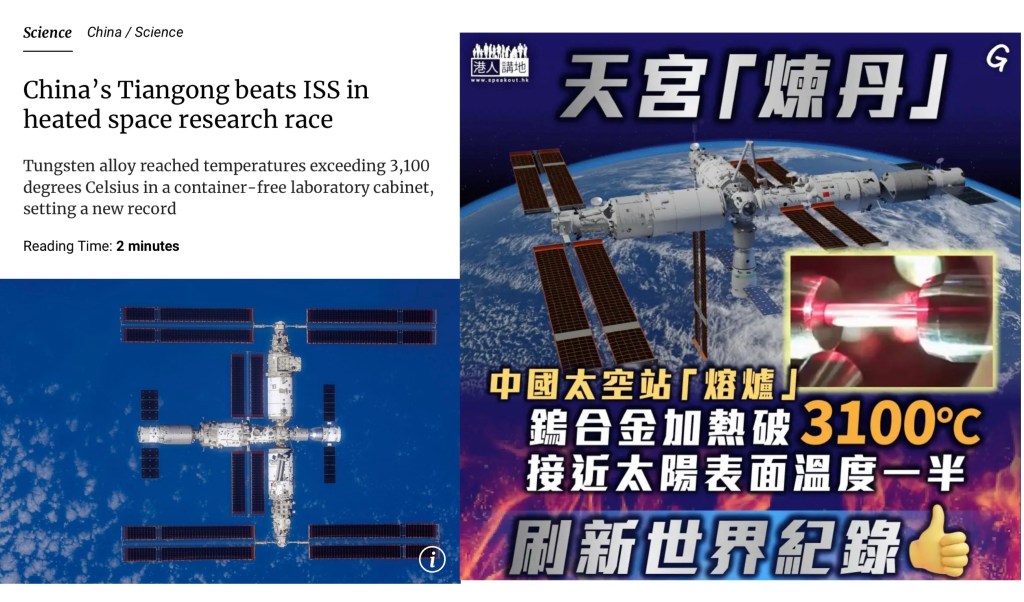
SCMP: China wins again! China’s Tiangong beats ISS in heated space research race
SCMP: China wins again! China’s Tiangong beats ISS in heated space research race. China’s Tiangong space station has set a new record in space-based materials research after a tungsten alloy was heated to temperatures exceeding 3,100 degrees Celsius (5,612 degrees Fahrenheit). 《南華早報》:中國再次獲勝!中國天宮二號在激烈的太空研究競賽中擊敗國際太空站。中國天宮二號太空站將鎢合金加熱到超過3100攝氏度(5612華氏度)的溫度,創造了太空材料研究的新紀錄.
https://www.scmp.com/news/china/science/article/3323171/chinas-tiangong-beats-iss-heated-space-research-race?天宮「煉丹」 中國呢個太空「煉丹爐」已達到國際領先水平!
中國太空站天和核心艙內有一個被稱為「煉丹爐」的無容器材料實驗櫃,近期在航天員協助下已成功突破攝氏3100度,刷新國際上太空材料科學實驗最高加熱溫度的紀錄。「煉丹爐」在軌運行4年來,一直忙著「煉丹」,不過其所煉的並非長生不老的丹藥,而是能扛住火箭發動機烈燄的鎢合金、鈮合金等,以及一些新型材料。
材料科學主要研究物質結構、屬性和加工過程之間的關係。由於在地面,這些關係會受重力的強烈影響,很難對材料微觀現象獲得深入認識,故中國太空站的建成,其太空微重力和超高真空等環境可以為材料科學研究提供特殊的實驗環境。
多位中國科學家在日前中國材料大會的學術研討中表示,無容器材料科學實驗櫃作為中國首個、國際上第二台在軌運行的同類實驗設施,具有更高的技術指標和實驗支持能力,達到了國際領先水平。
-
AI bubble could be here anytime as 95% of AI companies losing money
AI bubble could be here anytime as 95% of AI companies losing money expect to mirror the bursting of the dot-com bubble, the Nasdaq Composite index dropped by approximately 76% to 78% from its peak in 2000. 人工智慧泡沫隨時可能到來,95%的人工智慧公司虧損,預計將出現網路泡沫破裂的情況,可能像那斯達克指數較2000年的峰值下跌了約76%至78%
Dot-com bubble timeline
Peak (March 10, 2000): The Nasdaq Composite reached its highest point at 5,048.62.
Trough (October 2002): The index hit its lowest point, dropping to a range of 1,114 to 1,139.
Total decline: This represents a decline of over 76% from its peak.
The US stock market is currently supported by the **7 high tech & AI companies. If you are not following Warren Buffett’s ***Berkshire Hathaway footsteps who sold a lot of stocks with 350 billions of cash on hand waiting for major correction to shop for bargains, the major correction could send you to the poor house.
**[Apple (AAPL), Microsoft (MSFT), Alphabet (GOOGL), Amazon (AMZN), Nvidia (NVDA), Meta Platforms (META), Tesla (TSLA)]
***Berkshire Hathaway has amassed the largest cash hoard of any public company, with its total reaching around $350 billion by the end of Q2 2025

-
Video: Taiwanese General Shuài huà mín couldn’t stand it: “Never forget our national humiliation.”
Video: Japan urged other countries not to participate in the Sept 3rd China’s military parade in Beijing. Choosing to forget history from WWII! The Japanese are sinixter villains, their polite smiles & mannerisms concealing a hidden knife. Taiwanese General Shuài huà mín couldn’t stand it: “Never forget our national humiliation.” 日本籲各國別參加九三閱兵, 二戰選擇忘記歷史?! 日本人是陰險小人,他們的笑臉禮貌都是笑𥚃藏刀, 台灣帥化民將軍不忍了: “勿忘國恥”
https://www.tiktok.com/t/ZP8Bx1qsq/
https://youtu.be/FNHfWr1gtYE?si=0B2BA7H6br0Teimx
https://rumble.com/v6y49y2-taiwanese-general-shui-hu-mn-couldnt-stand-it-never-forget-our-national-hum.html
-
Video: Yao Qizhi, China’s first Nobel Prize winner in computer science, a patriotic Chinese scientist resolutely gave up his US citizenship at the age of 68 and returned to China
Video: Yao Qizhi, China’s first Nobel Prize winner in computer science, a patriotic Chinese scientist resolutely gave up his US citizenship at the age of 68 and returned to China to conduct research, leading China to a global lead in quantum communication Technology 中国首位诺贝尔计算机奖得主姚期智, 一位愛國的頂尖科學家在68岁坚决放弃美国国籍回国科研, 带领中国量子通信技术领跑全球
https://www.tiktok.com/t/ZP8B9vCY8/
https://youtu.be/YeNnKdkpJro?si=BolJ1HhUJ7vd9ihf
https://rumble.com/v6y471a-yao-qizhichinas-1st-nobel-prize-winner-computer-science-gave-up-his-us-citi.html
Complete video: https://youtu.be/au-OVx8ZoHs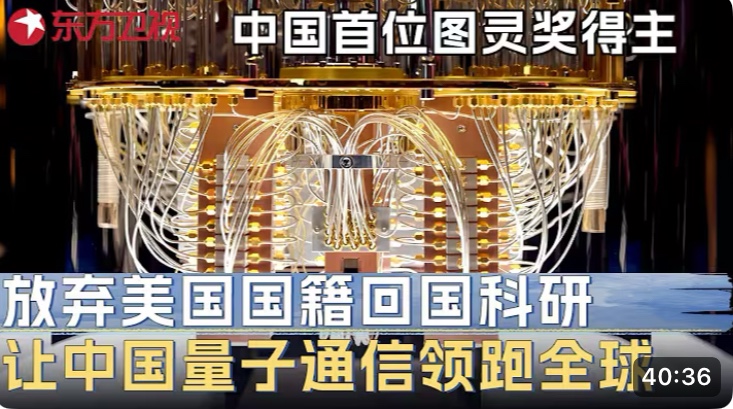
-
Subscribe
Subscribed
Have a WordPress.com account? Log in now.

