-
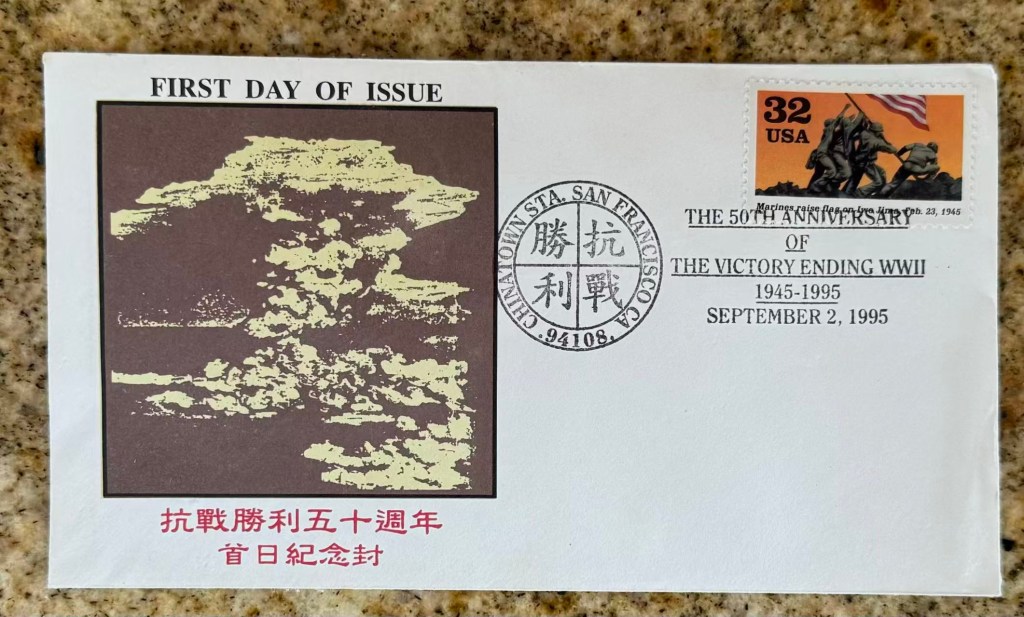
Today I found a commemorative envelope bearing a postmark designed by Herbert Lam in SF for the United States Postal Service (USPS)
Today I found a commemorative envelope bearing a postmark designed by Herbert Lam in SF for the United States Postal Service (USPS). It bears the Chinese characters “Victory of the Anti-Japanese War” and the date “September 2, 1995.” Thirty years have passed in the blink of an eye. The Guangzhou Overseas Chinese Museum is currently celebrating the 80th anniversary of the victory of the Anti-Japanese War, and Lin Kaibin has decided to donate it to the museum for its permanent collection. 今天發現一個紀念封,上面蓋有林凱斌為美國郵政(USPS)設計的郵戳,帶有中文字「抗戰勝利」,1995 年9 月2 日等字,𨍭眼便是30 年了。「廣州華僑博物館」正舉辦抗戰勝利80周年活動,林凱斌決定把它捐贈博物館永久收藏.
-
Video: Some Chinese immigrants to the US become more patriotic, some become anti-China, and some become traitors
Video: Some Chinese immigrants to the US become more patriotic, some become anti-China, and some become traitors. However, the thinking of the rich is completely different. In the US, many wealthy and powerful people are above the law, but not in China. 中國人移民美国,有人更爱国,有人成恨国党,有人成賣國賊,而有钱人的思维却完全不一样, 在美國不少富豪和有權有錢的人可以凌駕於法律之上, 但在中國不能.
https://www.tiktok.com/t/ZP8BB36FN/
https://youtu.be/Z_spe6kof-E?si=mFYsu43y4NRvtNnh
https://rumble.com/v6xw284-some-chinese-immigrants-to-the-us-become-more-patrioticsome-become-anti-chi.html
-
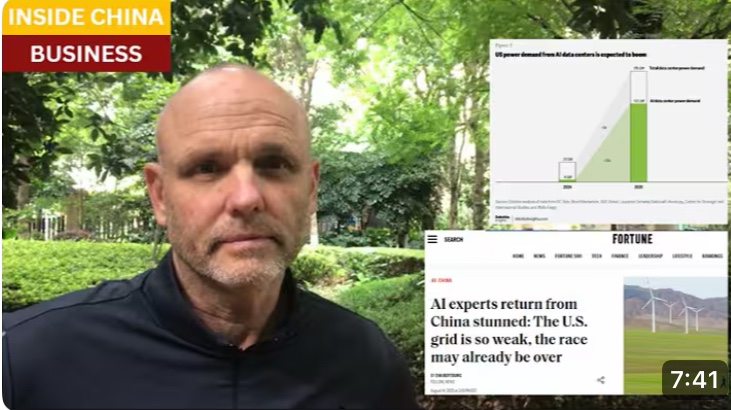
Video: China’s “overcapacity” was always deliberate: US experts stunned by Chinese AI, declare race is over for US, US already lost the AI battle to China.
Video: China’s “overcapacity” was always deliberate: US experts stunned by Chinese AI, declare race is over for US, US already lost the AI battle to China. 中國的「產能過剩」一直是故意的:美國專家對中國人工智慧感到震驚,宣稱美國的競賽已經結束,已經在人工智慧之戰中輸給了中國.
https://www.tiktok.com/t/ZP8BBxe9H/
https://youtu.be/NgojWbJDiY4?si=HC2nYMnVYEpOxdN7
https://rumble.com/v6xvees-us-experts-stunned-by-chinese-ai-declare-race-over-for-us-us-already-lost-t.htmlTop AI experts from Silicon Valley were stunned upon seeing China’s enormous head start across all segments of applied artificial intelligence.
Of particular concern was China’s access to cheap electricity, which is simply not available in the United States, and very likely never coming.
The experts conclude that the AI race is likely already over.
In China, the power demand increases each year by the equivalent of an entire Germany’s worth of electricity consumption. But China’s energy supplies are growing much faster, and add two Germany’s worth of power annually.
This abundance, which is typical of “overcapacity” of so many other critical building blocks of industry, is the result of a deliberate strategy, executed over decades: Chinese planners develop infrastructure far in advance of when it will be needed.
矽谷頂尖的人工智慧專家看到中國在人工智慧應用領域的各個領域都遙遙領先,不禁大吃一驚。
尤其令人擔憂的是中國能否獲得廉價電力,而美國根本無法取得,而且很可能永遠無法取得。
專家們得出結論,人工智慧競賽可能已經結束。
在中國,每年的電力需求成長量相當於一個德國的用電量。但中國的能源供應成長速度更快,每年新增電力相當於兩個德國的用電量。
這種充足的能源供應,是許多其他關鍵工業基礎「產能過剩」的典型特徵,是數十年來精心策劃的策略的結果:中國規劃者在基礎設施建設方面遠遠領先於實際需求.
-
China’s DeepSeek & Kimi K2 ruined OpenAI Sam Altman’s get rich quick schemes
China’s DeepSeek & Kimi K2 ruined OpenAI Sam Altman’s get rich quick schemes. China AI now beating him at his game, as a loser he is asking US government to fight his losing battle. What a coward! 中國的DeepSeek和Kimi K2破壞了OpenAI Sam Altman的發財大計,中國人工智慧現在正在這場遊戲中擊敗他,而他作為一個失敗者,正在要求美國政府為他打一場必敗的仗. 真是個懦夫!

-
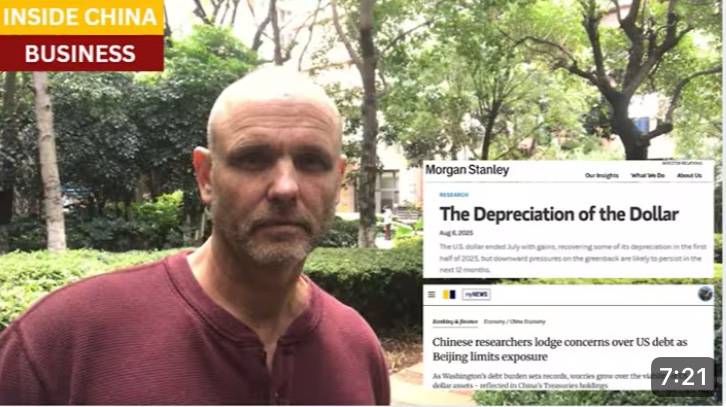
Video: Morgan Stanley, Goldman Sacks, Bank of China sees the US Dollar will keep falling
Video: Morgan Stanley, Goldman Sacks, Bank of China sees the US Dollar will keep falling. They recommend more gold buying, selling US Treasuries and more hedging 摩根士丹利、高盛和中國銀行預計美元將繼續下跌。他們建議增加黃金購買量,拋售美國國債,並加強避險.
https://www.tiktok.com/t/ZP8BhSkd5/
https://youtu.be/wMbngx95fEc?si=9dIgRh7uoJ-hQMQc
https://rumble.com/v6xumda-morgan-stanley-goldman-sacks-bank-of-china-sees-the-us-dollar-will-keep-fal.htmlThe US Dollar is seeing its steepest decline in fifty years, and investment banks forecast continued weakness.
The fiscal position in the United States is deteriorating, with record deficits. Trade policies have also eroded global confidence.
Most foreign holdings of US Treasuries are unhedged against further rises in interest rates, and investors are being repaid in cheaper dollars. Hedging activity will likely surge to protect against further losses to bondholders.
China’s central bank is being urged to further reduce its Treasury holdings, already at their lowest level in fifteen years. Increased gold buys and BRI investments to lock down key supply chains are also recommended.
美元正經歷五十年來最大跌幅,投資銀行預測美元將持續走弱。
美國財政狀況不斷惡化,赤字創歷史新高。貿易政策也削弱了全球信心。
大多數外國持有的美國國債並未對沖利率進一步上升的風險,投資者獲得的回報是以更便宜的美元計價的。對沖活動可能會激增,以防止債券持有人進一步蒙受損失。
中國央行正被敦促進一步減持其美國國債,目前其持有量已處於十五年來的最低水準。此外,央行也建議增加黃金購買量和「一帶一路」投資,以保障關鍵供應鏈的安全.
-
Video with English subtitles: What is the significance of China’s Sept 3rd military parade?
Video with English subtitles: What is the significance of China’s Sept 3rd military parade? Weak nation has no diplomacy! Chinese won’t forget the humiliation by the Western Empire! 中國9月3日閱兵意義何在? 弱國無外交! 14億中國人永遠不會忘記以美國為首的西方帝國給中國人的屈辱! 無忘國恥.
https://www.tiktok.com/t/ZP8BhhNQc/
https://youtu.be/JkYQiup9zzE?si=UofbM6NZaOQwnDzG
https://rumble.com/v6xunf8-what-is-the-significance-of-chinas-sept-3rd-military-parade.html
-
The right to rule: How China’s Mandate of Heaven redefined legitimacy
The right to rule: How China’s Mandate of Heaven redefined legitimacy 統治權:中國天命如何重新定義合法性 by Frans Vandenbosch 方腾波 20.08.2025
Qing Dynasty (Taoist) painting of the Chinese pantheon, Hunan Museum
For millennia, rulers have sought divine justification for their power but none framed it as conditionally as China’s Mandate of Heaven. Unlike Europe’s rigid divine right of kings, this ancient doctrine tied authority to moral governance, allowing rebellion when rulers failed. From peasant uprisings to Manchu conquests, the mandate shaped empires through cosmic accountability. Yet its legacy endures, echoing in modern debates about leadership and legitimacy.What can this philosophy teach us about power’s fleeting nature and the price of losing heaven’s favour?
The mandate of heaven: moral legitimacy and cultural power in imperial China
The mandate of heaven (天命, tiānmìng) stands as one of history’s most enduring political doctrines, blending divine authority with tangible moral accountability [1]. Originating in the Zhou dynasty’s overthrow of the Shang (circa 1046 BCE), it established a revolutionary principle: rulers governed not by immutable right, but through heaven’s conditional approval, contingent on virtuous governance [2]. Unlike Europe’s rigid divine right of kings, this framework allowed for dynastic upheaval when rulers failed their subjects, a philosophy that shaped China’s governance for two millennia [1].
At its core, the mandate fused cosmic legitimacy with Confucian ethics. Emperors, as “sons of heaven”, were expected to embody dé (德, virtue) and rén (仁, benevolence), ensuring social harmony through just rule [1]. Larry C Johnson emphasises how this created a paradox: while the emperor held absolute power theoretically, his authority could dissolve if floods, famines, or rebellions signalled heaven’s displeasure [1]. The Han dynasty’s collapse amid peasant revolts and the Ming’s demise after ecological crises demonstrated this accountability in brutal practice [2].
Greg Pasciuto enriches this analysis with cultural nuance, noting how the mandate transcended ethnic boundaries [2]. Non Han dynasties like the Mongol Yuan and Manchu Qing strategically adopted the doctrine to legitimise their rule [2]. The Qing conquest in 1644 exemplified this: they framed their takeover not as foreign invasion, but as restoring heaven’s order after Ming misrule [2]. Such cases reveal the mandate’s flexibility: it was less about bloodline than perceived moral competence, allowing even a peasant born emperor like the Ming’s Hongwu to ascend the throne [2].
The mandate’s interplay with religion further illustrates its cultural adaptability [2]. While Confucianism dominated state ideology, Pasciuto highlights how Daoist rituals and Buddhist concepts of karma subtly reinforced the idea of cosmic judgement [2]. Even Jesuit missionaries in the 16th century, like Matteo Ricci, engaged with the mandate, with Chinese converts such as Li Zhizao reconciling tiān with Christian monotheism [2]. These interactions underscore how the doctrine served as a bridge between political authority and spiritual belief [2].
In contemporary terms, the mandate’s legacy endures in China’s emphasis on performance legitimacy, where rulers justify authority through stability and prosperity [1]. Johnson’s political philosophical lens reveals its relevance to modern governance debates: like the Zhou emperors, today’s leaders face implicit expectations to balance power with moral responsibility [1]. Yet Pasciuto’s human stories of rebellions sparked by famine, or Manchu rulers performing Confucian rites, remind us that abstract ideals were lived through visceral crises and cultural negotiation [2].
The mandate of heaven thus remains a compelling model of conditional sovereignty, where authority hinges on ethical stewardship rather than force alone [1,2]. Its blend of moral philosophy and pragmatic adaptability offers timeless insights into the relationship between power and legitimacy.
Losing the mandate:
Five emperors in Chinese history, traditionally regarded as having lost the Mandate of Heaven due to misrule. Their failures became moral lessons in Confucian historiography, illustrating that governance must align with virtue to retain divine favour.
King Jie of Xia, last ruler of the Xia dynasty (c. 1728–1675 BC), was overthrown for his cruelty and neglect. His oppressive reign provoked rebellion, while floods and droughts were interpreted as signs of heavenly disapproval. He was defeated by Tang of Shang, founder of the next dynasty.
King Zhou of Shang (c. 1075–1046 BC) was notorious for his tyranny, including torture of dissenters, and obsession with his consort Daji. His misrule led to revolt, with astronomical anomalies seen as portents of divine condemnation. The Zhou dynasty replaced him after victory at Muye.
Emperor Qin Er Shi (r. 210–207 BC) presided over the Qin collapse, weakened by corruption and peasant revolts. His reliance on the eunuch Zhao Gao and failure to address unrest hastened the dynasty’s fall, viewed as withdrawal of celestial sanction.
Emperor Yang of Sui (r. AD 604–618) exhausted the state with costly projects and wars, triggering famine and rebellion. His assassination by ministers was deemed heavenly retribution for his excesses.
Emperor Chongzhen of Ming (r. 1627–1644) faced natural disasters, economic crisis, and rebellion. Despite his personal diligence, the Ming fell to peasant revolt and Manchu invasion, his suicide symbolising lost legitimacy.
Common themes in these downfalls include tyranny or incompetence causing suffering, natural disasters as divine displeasure, rebellions proving lost legitimacy, and dynastic collapse following the ruler’s overthrow. These cases reinforced the Confucian ideal that just governance was essential to maintaining Heaven’s approval.
Garden of Pleasure, Tang Yifen, 1848, handscroll, in the British Museum
Political Legitimacy: a comparison between Blijde Inkomst, Divine Right, and the Mandate of HeavenThe concepts of political legitimacy in medieval and early modern societies often revolved around the relationship between rulers and their subjects, framed through either theological or contractual principles. Three prominent systems: the Flemish blijde inkomst, the Western divine right of kings, and the Chinese mandate of heaven, each developed distinct approaches to justifying authority while addressing the question of resistance against unjust rule. Though emerging from different cultural contexts, these doctrines reveal fascinating parallels and contrasts in how they balanced power, obligation, and the right to rebellion.
The Blijde inkomst, meaning “joyous entry,” was a ceremonial and legal tradition practised primarily in the medieval Low Countries, particularly in regions such as Flanders and Brabant. When a new duke, count, or later a Habsburg ruler assumed power, they would formally enter major cities and swear oaths to uphold local privileges, laws, and freedoms. In return, the cities and estates would pledge their loyalty. This mutual agreement was not merely symbolic but carried constitutional weight. The most famous example, the 1356 Blijde Inkomst of Brabant, explicitly stated that if the ruler violated these terms, the subjects had the right to withdraw obedience [3]. This principle was invoked during the Dutch Revolt against Philip II of Spain, demonstrating its practical significance in justifying resistance.
The Divine right of kings, which dominated Western European political thought from the medieval period through the early modern era, asserted that monarchs derived their authority directly from God. Unlike the contractual nature of the blijde inkomst, divine right theory held that kings were accountable only to divine judgment, not to earthly institutions or their subjects. This absolutist vision was epitomized by Louis XIV of France, whose famous declaration “L’État, c’est moi” (“I am the state”) encapsulated the idea that royal power was indivisible and beyond earthly challenge [4]. Prominent exponents such as James I of England similarly argued that resistance to a monarch was tantamount to rebellion against God himself, citing biblical passages such as Romans 13 to reinforce the idea that even tyrannical rulers were divinely ordained. This doctrine rejected any notion that parliaments, nobles, or citizens could lawfully depose a king, though in practice, European monarchs still negotiated with powerful estates. Divine right ideology thus provided a theological shield against challenges to authority, elevating the king above human judgment.
The Mandate of heaven in China, an ancient political philosophy dating back to the Zhou dynasty (1046–256 BCE), presented a different model of legitimacy. According to this principle, heaven granted the right to rule to a dynasty only as long as its rulers governed justly and effectively. Signs of misrule – such as natural disasters, rebellions, or corruption – indicated that heaven had withdrawn its mandate, justifying the overthrow of the dynasty. Unlike the divine right of kings, the mandate of heaven did not protect rulers from rebellion but instead legitimised it under certain conditions. However, unlike the blijde inkomst, which was based on explicit legal agreements, the mandate was more abstract, relying on moral and cosmic interpretations rather than written charters [5].
When comparing these systems, several key differences emerge. The blijde inkomst was fundamentally contractual, rooted in specific legal documents that outlined reciprocal obligations between ruler and ruled. Its strength lay in its enforceability; if a ruler broke his oath, resistance was not only permitted but legally justified. The divine right of kings, by contrast, denied any such contractual basis for authority, instead grounding power in an unmediated relationship between God and the monarch. This made rebellion not just illegal but sinful, a stark departure from the conditional loyalty seen in Flanders and Brabant. The mandate of heaven occupied a middle ground: while it acknowledged that rulers could lose legitimacy, it lacked the precise legal mechanisms of the blijde inkomst, instead relying on broader philosophical and moral reasoning.
Another crucial distinction lies in their approaches to dynastic continuity. Divine right theory emphasised hereditary succession, viewing the royal bloodline as intrinsically chosen by God. The mandate of heaven, however, was indifferent to lineage. A new dynasty could claim the mandate regardless of ancestry, provided it ruled effectively. The blijde inkomst, meanwhile, was less concerned with the ruler’s origins than with their adherence to sworn agreements, meaning that even an inherited title could be voided by violating local privileges.
Despite these differences, all three doctrines sought to answer the same fundamental question: under what circumstances could authority be legitimately resisted? The blijde inkomst provided a clear legal framework, the divine right of kings forbade resistance entirely, and the mandate of heaven allowed for it based on moral and practical outcomes. Each system reflected the political culture from which it emerged: the contractual traditions of European urban communes, the absolutist tendencies of early modern monarchies, and the philosophical pragmatism of Chinese statecraft.
Ultimately, the decline of these doctrines mirrored broader historical shifts. The divine right of kings was fatally undermined by the Enlightenment and revolutions, while the blijde inkomst evolved into modern constitutionalism. The mandate of heaven, though no longer invoked in contemporary China, left a lasting legacy in the cyclical view of political legitimacy. Together, they illustrate the diverse ways societies have sought to reconcile power, justice, and the right to resist oppression.
Serving the People
Now imagine Ursula von der Leyen or Mark Rutte riding in a festive, solemn procession through the historic “Blijde Inkomstraat” (Joyous Entry Street) towards the centre of Leuven. Will they be applauded or booed?
Then imagine Xi Jinping riding in an open Hongqi Guoli along Cháng’ān Jiē to Tiananmen Square. Who then holds the Mandate of Heaven?The Mandate of Heaven was more than a political tool; it was a moral compass for empires that recognised governmental accountability. Its lessons resonate today: legitimacy hinges not on force alone, but on serving those governed. Where Divine Right claimed sacred appointment and Blijde Inkomst established formal contracts, the Mandate demanded continuous virtuous performance. As dynasties rose and fell by heaven’s judgement, so too do modern leaders face scrutiny, not from celestial signs, but from the people. In a world still grappling with authority and justice, China’s ancient mandate reminds us that true power is always on borrowed time.
Endnotes
[1] Johnson, L C, “The frontier man”, 2024 https://www.versesvisions.com/p/the-mandate-of-heaven
[2] Pasciuto, G, “What was the mandate of heaven in imperial China”, The Collector, 2024 https://www.thecollector.com/mandate-of-heaven-imperial-china/
[3] Blockmans, Wim. Emperor Charles V, 1500–1558. Translated by Isola van den Hoven-Vardon, Oxford University Press, 2002. This work provides a detailed analysis of the blijde inkomst tradition within the broader context of Habsburg rule in the Low Countries, including its role in the Dutch Revolt.
[4] Sommerville, Johann P. Politics and Ideology in England, 1603–1640. Longman, 1986. A seminal study on the divine right of kings, particularly focusing on James I’s political theology and its impact on Stuart England.
[5] Pines, Yuri. The Everlasting Empire: The Political Culture of Ancient China and Its Imperial Legacy. Princeton University Press, 2012. This book offers a comprehensive examination of the mandate of heaven, tracing its development from the Zhou dynasty through imperial China.

-
SCMP: US racist attitudes towards Chinese Americans, no future for Chinese scientists in America
SCMP: US racist attitudes towards Chinese Americans, no future for Chinese scientists in America. Mathematician Zhang Yitang, who joined Sun Yat-sen University in Guangzhou from California in June, has called the wave of Chinese researchers exiting the US a “positive trend”. 《南華早報》:美國對華裔美國人的種族主義態度,華裔科學家在美國沒有未來。今年六月從加州加入廣州中山大學的數學家張益唐稱,中國研究人員離開美國的浪潮是一個「正面趨勢」.
https://www.scmp.com/news/china/science/article/3322381/mathematician-zhang-yitang-says-he-left-us-china-due-political-climate?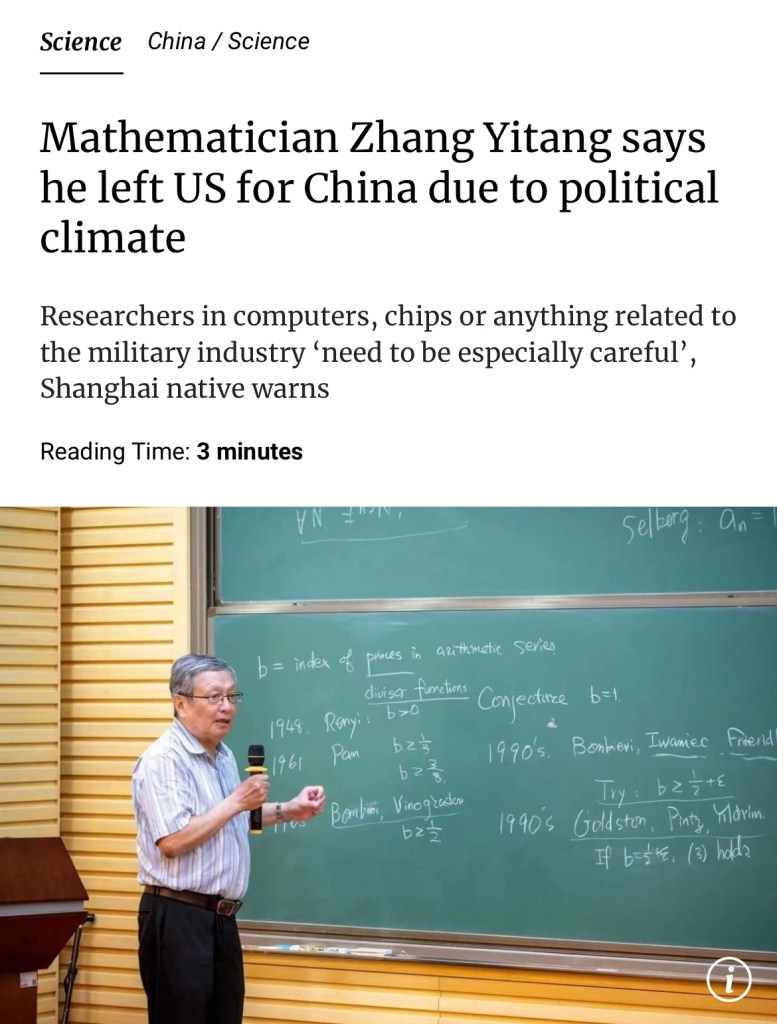
-
SCMP: Chinese President Xi Jinping arrives in Tibet for landmark anniversary on Thursday
SCMP: Chinese President Xi Jinping arrives in Tibet for landmark anniversary on Thursday to mark the 60th anniversary of the autonomous region, making him the first Chinese president to attend the once-a-decade activities. 南華早報:中國國家主席習近平週四抵達西藏,參加西藏自治區成立 60 週年慶典,成為第一位出席這一十年一度慶典活動的中國國家主席.
https://www.scmp.com/news/china/politics/article/3322542/chinese-president-xi-jinping-arrives-tibet-landmark-anniversary?
-
Video: China Just ORDERED Chinese Companies to STOP Buying US Chips
Video: China Just ORDERED Chinese Companies to STOP Buying US Chips. 中國剛剛命令中國公司停止購買美國晶片.
https://youtu.be/ImjVJwDdxi0?si=a7dvpb3eP8FzQorD
https://rumble.com/v6xtp5u-china-just-ordered-chinese-companies-to-stop-buying-us-chips.htmlChina has delivered a shock to Washington by ordering all Chinese companies to stop buying U.S.-made chips. Overnight, American semiconductor sales to China’s vast tech industry have been cut off, triggering panic among U.S. officials, including Treasury Secretary Scott Bessent.
Donald Trump believed he had set a profitable trap. He loosened restrictions so Nvidia could sell its downgraded H20 AI chips to China, while imposing a 15% tax on every sale. The idea was that China would gain hardware, U.S. firms would profit, and the Treasury would collect billions. Instead, Beijing rejected the deal outright, cancelling orders not only from Nvidia but also from AMD, and banning U.S. chips from government-backed projects. The move symbolized a decisive break from dependence on American processors.
This rupture follows years of U.S. restrictions meant to keep China from accessing advanced semiconductors. Washington limited exports of chips, design software, and lithography tools. Yet Beijing responded by pouring tens of billions into its domestic semiconductor sector, building industrial parks, funding universities, and subsidizing chip firms. Gaps once projected to take a decade to close were narrowed in just four to five years. Trump’s trade war only accelerated this effort, transforming self-sufficiency into a national mission.
China’s progress is evident. Domestic high-performance AI systems like DeepSeek now rival U.S. platforms, proving Beijing no longer needs weakened, compliance-bound chips like Nvidia’s H20. For China, paying higher prices for downgraded products—while letting Washington skim revenue—was unacceptable. The rejection was a public declaration of independence.
The stakes for U.S. companies are immense. In 2022, about 25% of Nvidia’s data center revenue came from China, a market worth an estimated $15 billion in lost sales. Qualcomm relies on China for 64% of its revenue, supplying processors for brands like Xiaomi and Oppo. Apple earned 19% of its global revenue from Greater China in 2023, while Tesla’s Gigafactory in Shanghai produces hundreds of thousands of vehicles annually. Losing this market undercuts revenue, R&D, and global competitiveness.
The wider impact is systemic. U.S. manufacturers already face rising costs, delays, and broken supply chains, while allies grow wary of Washington’s tariff threats. Many are quietly building alternative trade and financial networks that bypass U.S. control.
The question now is stark: has Washington’s strategy to contain China backfired, leaving America weaker in global tech and trade leadership?
中國下令所有中國公司停止購買美國製造的晶片,令華盛頓大吃一驚。一夕之間,美國對中國龐大科技產業的半導體銷售被切斷,引發了包括財政部長史考特·貝森特在內的美國官員的恐慌。
唐納德·川普認為他設下了一個有利可圖的陷阱。他放鬆了限制,以便英偉達可以將其降級的H20 AI晶片出售給中國,同時對每筆銷售徵收15%的關稅。他的想法是,中國將獲得硬件,美國公司將獲利,財政部將獲得數十億美元的收入。然而,北京斷然拒絕了這筆交易,不僅取消了英偉達的訂單,還取消了AMD的訂單,並禁止美國晶片參與政府支持的項目。此舉象徵著美國徹底擺脫了對美國處理器的依賴。
此前,美國多年來一直限制中國取得先進的半導體,華盛頓限制了晶片、設計軟體和光刻工具的出口。然而,北京方面卻以數百億美元投入國內半導體產業,興建工業園區,資助大學,並補貼晶片公司。原本預計需要十年才能彌補的差距,在短短四、五年內就縮小了。川普的貿易戰更是加速了這一進程,將自給自足變成了一項國家使命。
中國的進步顯而易見。像DeepSeek這樣的國產高性能人工智慧系統如今已能與美國平台相媲美,這證明北京不再需要像英偉達H20這樣性能弱化、受合規約束的晶片。對中國來說,為低端產品支付更高的價格,同時讓華盛頓從中榨取收入,是不可接受的。拒絕中國,無異於公開宣示獨立。
這對美國公司來說意義重大。 2022年,英偉達資料中心約25%的收入來自中國,而這個市場估計損失了150億美元的銷售額。高通64%的營收來自中國,為小米和Oppo等品牌供應處理器。 2023年,蘋果公司19%的全球收入來自大中華區,而特斯拉位於上海的超級工廠每年生產數十萬輛汽車。失去這個市場會削弱其收入、研發能力和全球競爭力。
更廣泛的影響是系統性的。美國製造商已經面臨成本上升、延誤和供應鏈中斷的問題,而盟友對華盛頓的關稅威脅也越來越警覺。許多國家正在悄悄建立繞過美國控制的替代貿易和金融網絡。
現在的問題很嚴峻:華盛頓遏制中國的戰略是否適得其反,導緻美國在全球科技和貿易領域的領導地位進一步削弱?

-
Subscribe
Subscribed
Have a WordPress.com account? Log in now.

