-
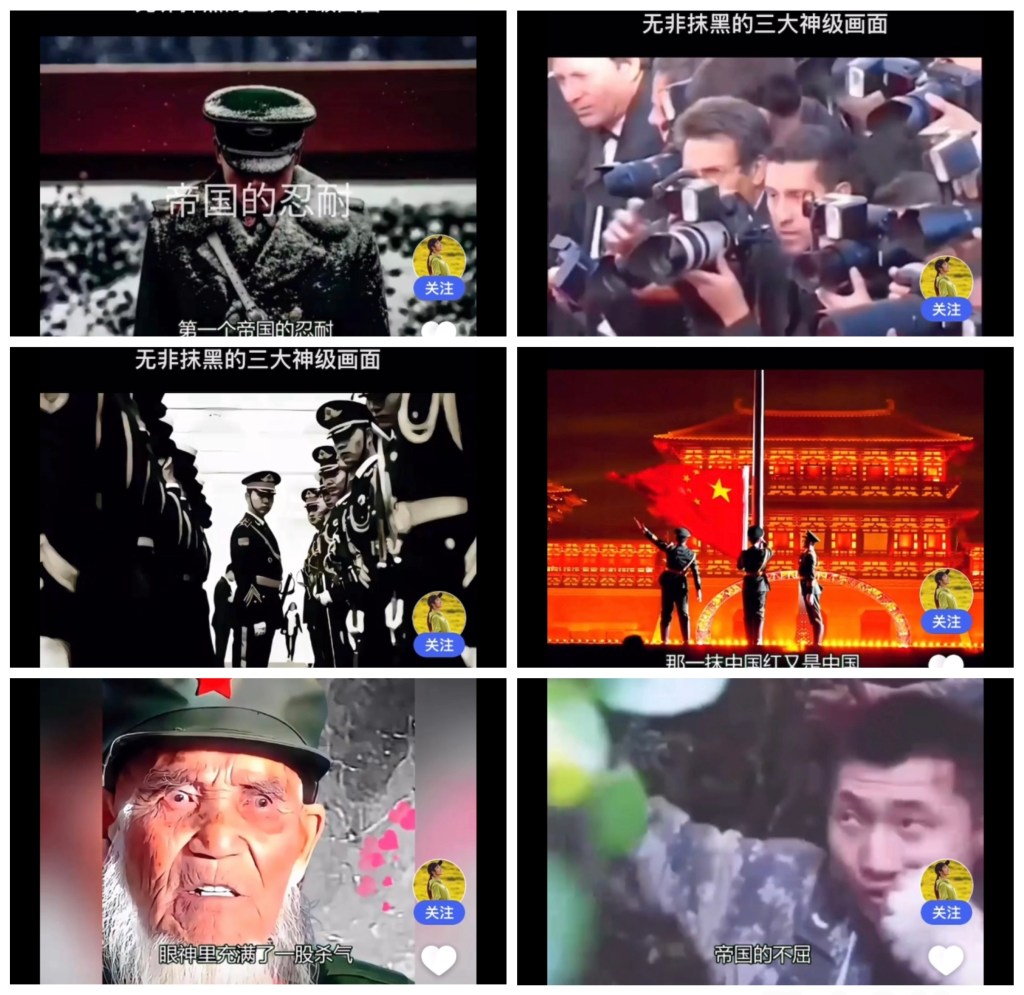
Video: The technique used by Agence France-Presse (AFP) to demonize China
Video: The technique used by Agence France-Presse (AFP) to demonize China 总部位于巴黎法新社国际新闻妖魔化中國的慣用手法
https://www.tiktok.com/t/ZP8hhbX4c/
https://youtu.be/67K11WvrtJU?si=MWkmZotb3ORoZQ8hhttps://rumble.com/v6vwxbo-the-technique-used-by-agence-france-presse-afp-to-demonize-china.html
-
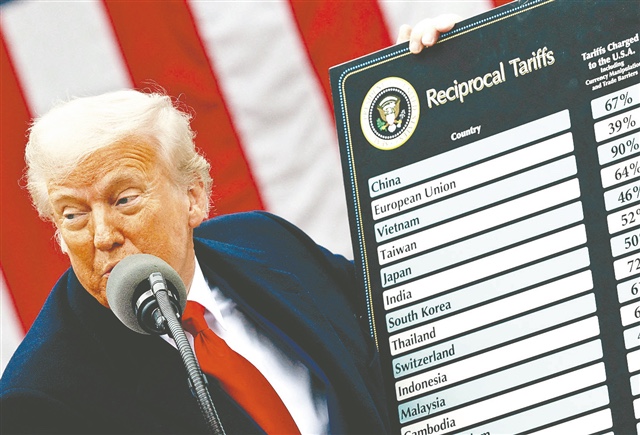
The White House sent new extortion letters to 14 countries
The White House sent new extortion letters to 14 countries, once again a no-cost business of buying and selling short by the American. The maximum amount of ransoms is increased to 40%, which is more powerful than the zero-dollar purchase in California. Trump is also very generous to extend the grace period of the extortion deadline to 8/1. The reputation of king of thieves is no nonsense. The first wave of 14 countries to pay ransoms including Japan, South Korea, Thailand and Myanmar, etc. 美國加州世界日報重點新聞:白宮寄14國新敲詐勒索函, 再次買空賣空的無本生意. 要加碼到最高40%,好過去搶,比加州的零元購更利害,還超大方地把協議寬限期延至8/1. 正牌爛仔贼亞爸. 首波共14國,包含日本、南韓、泰國與緬甸等.
-
Video: White House Reporter ask Trump if he will deport himself as children of immigrants with 34 criminal records
Video: White House Reporter ask Trump if he will deport himself as children of immigrants with 34 criminal records 白宮記者問川普,他是否會將自己驅逐出境因爲作為有34項犯罪記錄的移民子女後代是否應該一視同仁呢?
https://youtube.com/shorts/WRt8z3E28ug?si=fdNlXEIkaZaLgwqR
https://www.tiktok.com/t/ZP8hrBTED/
https://rumble.com/v6vvzq4-white-house-reporter-ask-trump-if-he-will-deport-himself-as-children-of-imm.html
-
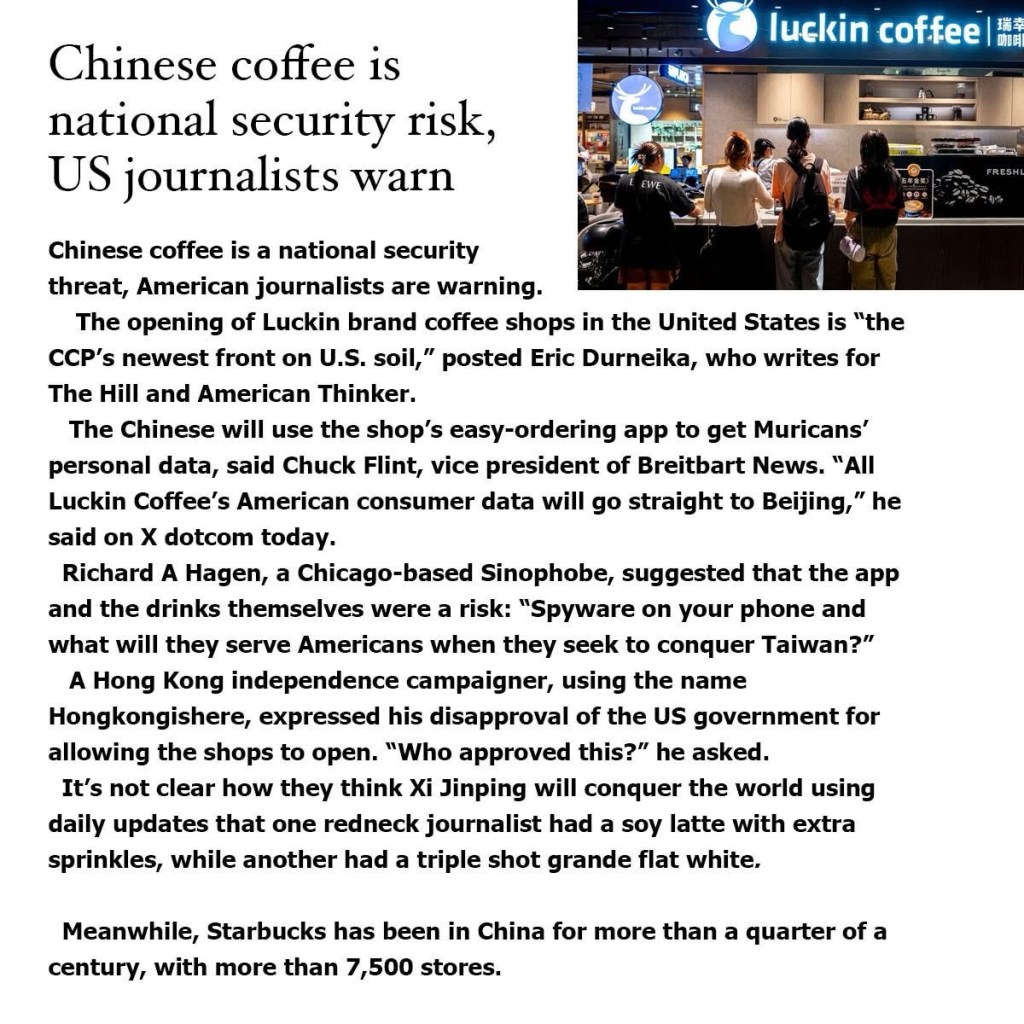
Americans fantastic fantasy and racism
Americans fantastic fantasy and racism, why didn’t this racist American Journalist get rid of his make in China iPhone, TV, Coffee Machine, underwear, refrigerator and automobile parts inside his Detroit made car? Those Chinese dying to send their kids to schools here and worst to migrate to US, you got to love this country! 美國人天馬行空的幻想和種族主義,為什麼這個種族主義的美國記者不把他的中國產iPhone、電視、咖啡機、內衣、冰箱和汽車零件扔進他的底特律產的車裡呢? 那些渴望送孩子來這裡上學甚至移民到美國的中國人,你們一定會愛上這個國家吧?
-
More Chinese students choosing Singapore and HK as US declines
SCMP: Status, culture, cost, Asian hates, gun violence, racism, drugs, homeless street people and dangerous to leave home after dark: more Chinese students choosing Singapore and HK as US declines 香港南華早報: 地位、文化、成本、亞裔仇恨、槍支暴力、種族主義、毒品、無家可歸的街頭流浪者以及天黑後離開家的危險:隨著美國留學人數的減少,越來越多的中國學生選擇新加坡和香港.
Miya Zheng once aimed to earn a master’s degree when she first arrived in the United States for her undergraduate studies. But now, three years later, the Chinese national has shifted her sights halfway across the world – to Singapore. 她初到美國讀本科時,目標是攻讀碩士學位。但三年後的今天,這位中國姑娘卻把目光投向了地球的另一邊 – 新加坡.
https://www.scmp.com/news/china/diplomacy/article/3317302/us-drops-among-chinese-study-preferences-singapore-beckons-status-and-culture?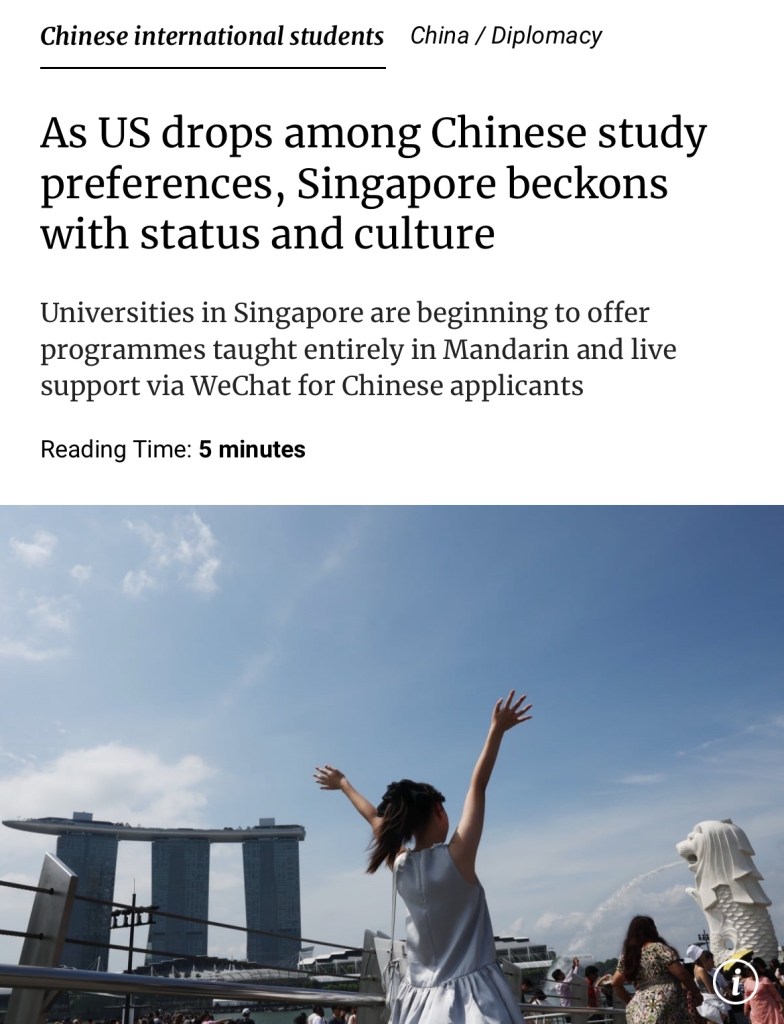
-
China engineers envisions to produce aircraft like mobile phones
Chief designer of China’s J-15 carrier-borne fighter jet envisions to produce aircraft incorporate unmanned systems, artificial intelligence (AI), as well as other advanced technologies like mobile phones in future. 中國殲-15艦載戰鬥機總設計師設想未來生產出融合無人系統、人工智慧以及手機等其他先進技術的飛機.

-
Many HK top scorers students are planning to stay in HK
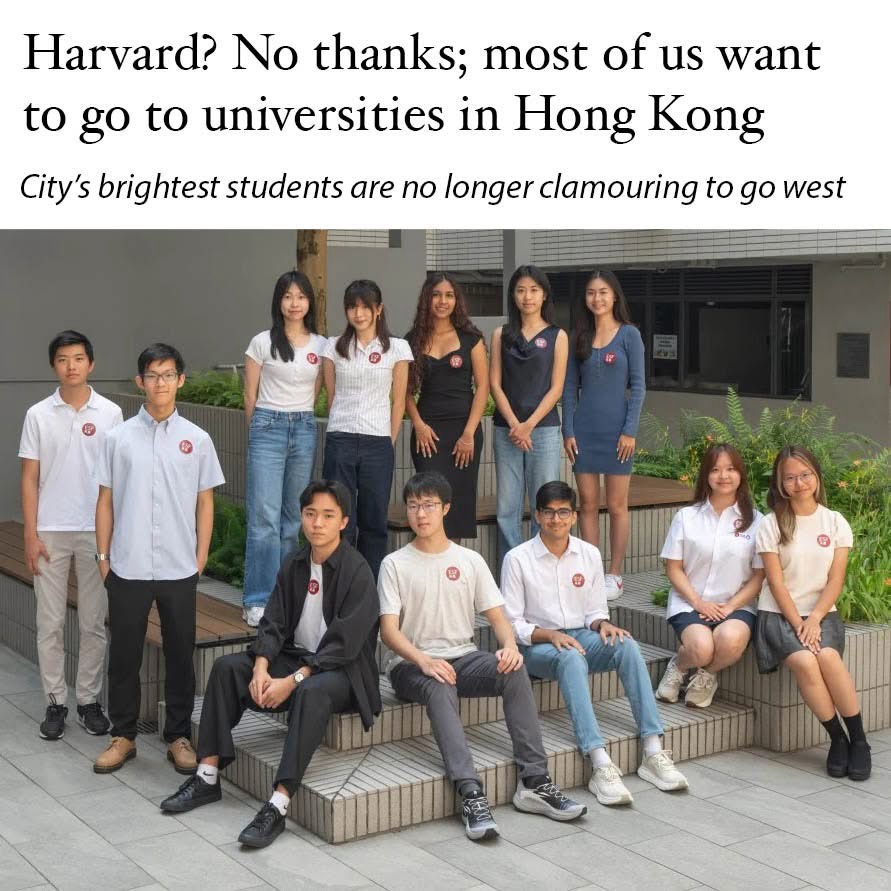
A RESULTS UPDATE last night lifted Hong Kong’s “perfect score” students in the International Baccalaureate results to 37 and many top scorers are planning to stay in HK, cementing the city’s reputation for having a disproportionate number of the world’s best schools. By Nury Vittachi, July 7 2025
Out of the 15 ESF students who got maximum possible points, 10 will stay in Hong Kong to study medicine, the South China Morning Post reported today.
This makes sense—considering that the QS global university rankings last month showed that Hong Kong had more universities in the world’s top 100 than any other city—and confirming that Chinese universities in general were on the rise.
Global interest in applying to US universities was more than 50% lower from April this year than the same period 12 months ago, according to data shared by Keystone Education Group last month.
RELATIVELY RELAXED
While East Asia has a reputation for pressurizing students, Hong Kong schools are relatively relaxed, with ESF schools in particular known for their creative arts.In contrast, schools in South Korea have some of the world’s highest suicide rates, with Japan not far behind.
The picture, from ESF in Hong Kong, shows (seated, from left) Zhu Baihan, Joshua Lee Wing-fung, Kush Zingade, Chloe Wong Sum-yin and Kristie Lo Ji-kiu; (standing, from left) David Yuan, Isaac Hung Man-hei, Kelly Chak Hoi-lam, Sharon Sim Ai-xim, Yashasvini Agarwal, Ava Wong Wing-heng and Charmaine Lie Suet-lam.
-
China is Not Our Enemy
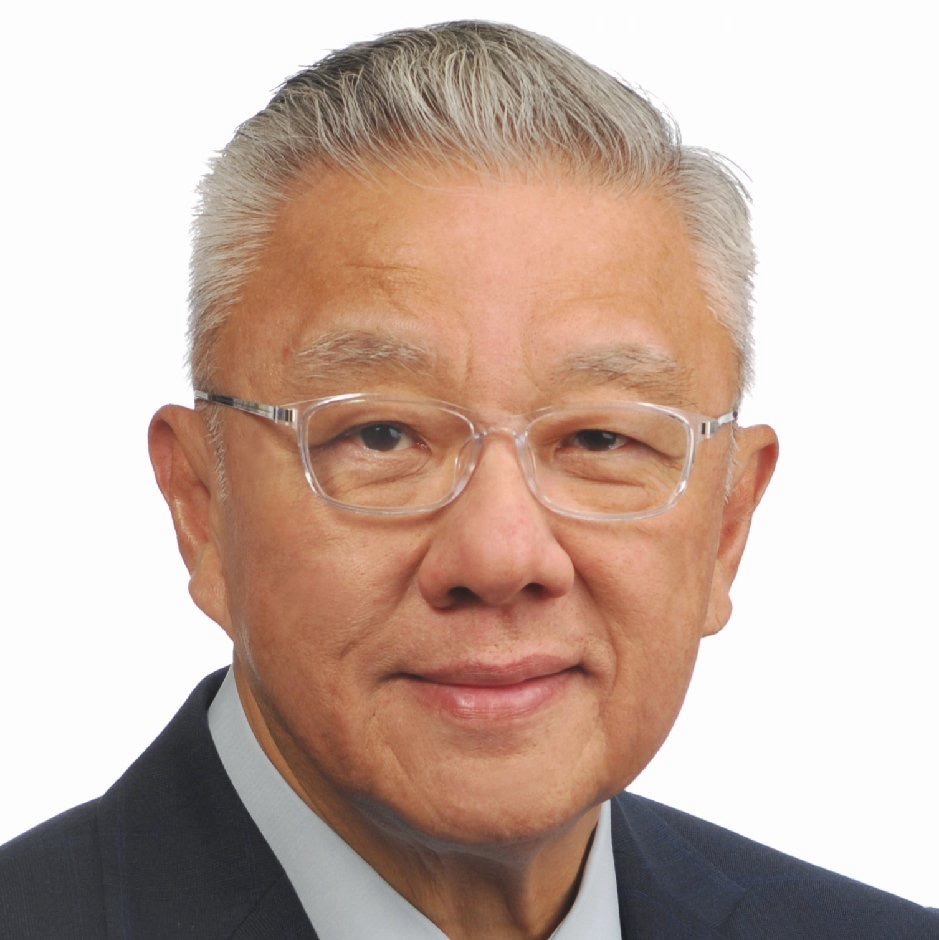
China is Not Our Enemy 中國不是我們的敵人 By Fred S. Teng 滕紹駿 July 2025
In recent years, a troubling narrative has gained momentum in the United States: that China is America’s foremost adversary, a threat to our way of life, and a rival to be contained. This view—once a fringe perspective—has now become a bipartisan rallying cry. Tariffs, sanctions, technological restrictions, and political hostility are increasingly justified not on strategic grounds, but on the assumption that confrontation with China is inevitable.
But is it? Does China truly seek to undermine the United States, dominate the world, or overturn the global order? The facts suggest otherwise. China is not our enemy. It is a rising nation pursuing its own development, security, and prosperity—just as any country would. The choice to turn this into a zero-sum contest lies not in Beijing, but in Washington.
A Vision of Rejuvenation, Not Domination
At the heart of China’s national trajectory is the goal of national rejuvenation—a long-standing aspiration to restore dignity, prosperity, and global respect after a century of foreign humiliation, civil war, and poverty. This goal is not built on ideology or expansionism, but on a desire to provide a better life for the Chinese people.Over the past four decades, China has lifted hundreds of millions out of poverty, modernized its infrastructure, and emerged as a global center of manufacturing, innovation, and trade. Its achievements are not about challenging the United States—they are about ensuring national stability and fulfilling the basic aspirations of its people.
China’s development model is not perfect, nor is it universally applicable. But it is not being exported or imposed on others. Beijing does not seek to remake the world in its image; it seeks recognition as a legitimate and respected voice in global affairs.
Respect for Sovereignty and Regional Solutions
Much of the current U.S. anxiety about China centers on the issues of Taiwan and the South China Sea. But these are regional matters, best addressed by the parties directly involved.Taiwan is a Chinese internal affair—a complex, historic issue rooted in the legacy of civil war. It is up to people on both sides of the Taiwan Strait to find a peaceful resolution and pursue their own path toward eventual reunification. Outside interference only complicates this delicate process and raises the risk of misunderstanding.
Similarly, disputes in the South China Sea should not be viewed through the lens of great power competition. China has already successfully resolved land border disputes with 12 of its 14 neighbors. It is fully capable of working out maritime differences with ASEAN countries through dialogue, negotiation, and regional diplomacy. These are not global flashpoints, but regional challenges that require patience—not provocation.
A Multipolar World, not a Confrontation
China does not seek to replace the United States as a global hegemon. Instead, it advocates for a multipolar world, a more balanced international order where power and responsibility are shared, and where countries large and small have a voice.This includes strengthening institutions like the United Nations, the G20, the BRICS group, and the Belt and Road Initiative. It also means reforming outdated systems to better reflect today’s global realities, especially the aspirations of the Global South.
China’s emphasis on sovereignty, mutual respect, and non-interference is not a rejection of global cooperation. It is a call for partnership based on equality, not hierarchy.
No Dialogue Without Mutual Respect
A growing obstacle to U.S.-China relations is not ideological difference or economic friction—but rhetoric. When the United States labels China as an adversary, competitor, or threat, it closes the door to genuine engagement. China has made clear—repeatedly and consistently—that it cannot engage in meaningful strategic dialogue or deep cooperation with a country that fundamentally questions its legitimacy or seeks to contain its rise.Diplomacy cannot function in an atmosphere of hostility. The principle of mutual respect is not a diplomatic formality—it is the foundation for any productive relationship. No country, including China, will cooperate with a partner that speaks of containment while asking for collaboration.
If the United States truly wants dialogue, it must first change the tone—recognizing China as a sovereign nation with its own path and interests, not an adversary to be managed or a rival to be defeated.
The Danger of a Manufactured Rivalry
Framing China as America’s enemy may serve short-term political agendas, but it is generating long-term harm. It distorts policy, erodes trust, and fuels hostility across society. The rise in so-called “anti-Asian hate” is, in reality, anti-China and anti-Chinese hate. U.S. politicians—who fan the flames of anti-China sentiment—often hide behind the vague term “Asian” to avoid accountability for the discrimination they enable.This isn’t just political rhetoric—it has real and devastating consequences: assaults on Chinese Americans, suspicion toward students and scholars, and targeted scrutiny of Chinese businesses. Worse still, baseless investigations have been launched against Chinese American government employees, research scientists, and university professors—resulting in cruelty and lasting harm to individuals and their families. Careers have been destroyed, communities have been shaken, and a chilling climate of fear has taken root.
This fear does not stop at the Chinese American community—it infects our universities, our laboratories, our public discourse, and our democratic values. It damages the United States itself, undercutting our claim to fairness, pluralism, and openness—the very ideals we say we defend.
Meanwhile, academic exchange programs are being dismantled, visas are being denied, and scientific partnerships are being broken—all in the name of national security. Economic decoupling is disrupting global supply chains and hurting workers and consumers on both sides. We are drifting toward confrontation not by necessity, but by political design.
More importantly, this artificial rivalry blinds us to shared global challenges. Climate change, public health, food security, and responsible technological governance require cooperation—not confrontation. If the U.S. and China cannot work together on these existential issues, the world will be the one that suffers.
A Call for Clarity—and for Courage
The United States faces a choice: to continue down the path of rivalry, distrust, and escalation—or to step back and reimagine its relationship with China based on realism, mutual respect, and shared responsibility.We don’t need to agree on everything. But we do need to understand China as it is. China is not a threat just because it is different. It is a sovereign nation with its own history, priorities, and global role to play.
If America insists on treating China as an enemy, it will eventually create the enemy it fears. But if we choose a path of respect, diplomacy, and coexistence, we may still shape a future of peace, prosperity, and shared progress.
Fred Teng is President of America China Public Affairs Institute, and the Chairman of Partnership for Peace and Prosperity.
-
Solving the Needham paradox
Solving the Needham paradox. How Confucian culture first delayed and then accelerated China’s innovation. 解决李约瑟悖论. 儒家文化如何先延缓然后又加速了中国的创新 By Frans Vandenbosch 方腾波 04.07.2025
English https://yellowlion.org/solving-the-needham-paradox/
Chinese https://yellowlion.org/zh/needham-paradox-cn/Smashing the European myth
For centuries, Western narratives have portrayed science and technology as exclusively Western achievements, overlooking China’s profound contributions. Joseph Needham’s Science and Civilisation in China shattered this myth, revealing how China pioneered key innovations long before the West. From mathematics and physics to dining culture and governance, China’s historical advancements challenge Eurocentric views of progress. This article explores these overlooked achievements, contrasting them with persistent Western biases and examining China’s modern scientific resurgence. By revisiting Needham’s work and contemporary developments, we uncover a civilization that never faded; it simply followed a different path.
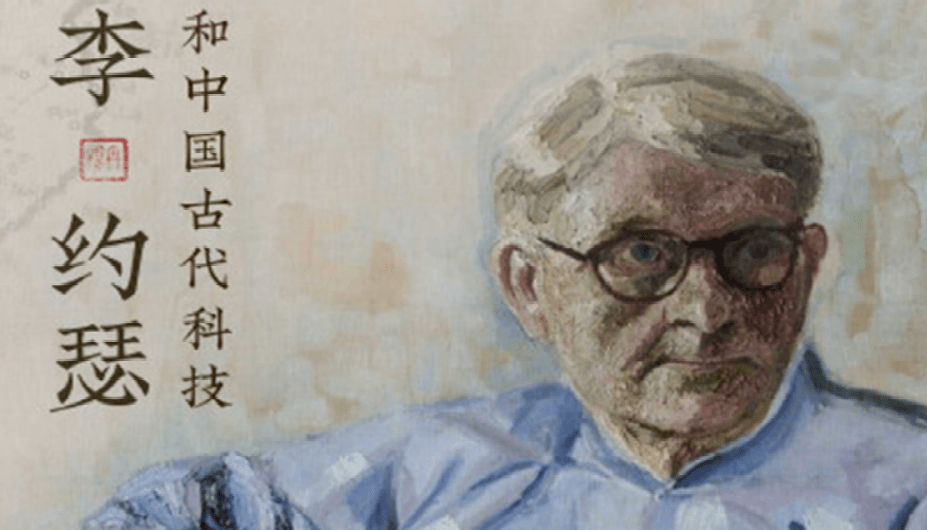
Joseph Needham’s Science and Civilisation in China stands as one of the most monumental scholarly achievements of the 20th century, spanning 36 volumes that meticulously document China’s profound and often overlooked contributions to science and technology. When first published, it shocked the Western academic world by revealing that many so-called “Western” innovations (such as paper, printing, gunpowder, and the compass) were in fact developed centuries earlier in China. Needham’s work fundamentally challenged Eurocentric narratives of progress, proving that China was a global leader in science for much of its history. Despite the overwhelming evidence he presented, some sceptics and ideologues still refuse to accept the depth and significance of China’s early scientific achievements. To this day, Needham’s findings remain controversial among those who cling to outdated notions of Western superiority. His magnum opus remains not only a towering intellectual achievement but also a powerful corrective to historical amnesia.
China’s embarrassment of riches is an English idiom, applied by Joseph Needham to describe China’s overwhelming number of early scientific and technological achievements. The expression reflects Needham’s awe and the central puzzle of the “Needham Question”: why such a rich technological tradition did not lead to an early scientific revolution in China.
This historical whitewashing wasn’t accidental. It served a colonial narrative. But the deeper mystery isn’t what China invented, but why this didn’t lead to a Western-style scientific revolution in China.
The Confucian brake
The Needham Question explores why China, the home to ground-breaking inventions like paper and the compass, did not develop modern science before Europe, despite its early technological dominance. One key factor may lie in Confucian values, which emphasized harmony, humility, and respect for tradition, discouraging the bold questioning of nature that fuelled Europe’s Scientific Revolution. Unlike Europe’s competitive, individualistic thinkers, China’s scholars often focused on moral and administrative wisdom rather than disruptive scientific theories, aligning with a society that prized stability over radical innovation. Additionally, the imperial examination system reinforced classical Confucian texts over experimental science, steering intellectual energy toward state service rather than pure discovery. Yet, this doesn’t mean China “fell behind”. Its advancements were simply guided by a different philosophy, one that valued practical knowledge and societal order in ways Europe did not.
Boasting, American exceptionalism, virtue signalling: In traditional Chinese culture attitudes involving boastfulness are generally regarded with disapproval for they tend to undermine the virtue of humility (谦逊 qiānxùn) which plays a vital role in fostering harmonious interpersonal relations. Such conduct is perceived as contrary to the cultural emphasis on modesty and the preference for collective achievement over overt displays of personal success. Additionally, the notion of American exceptionalism which asserts inherent superiority is at odds with the Confucian ideal of self-reflection and the value placed on collective progress rather than national glorification. The practice of virtue signalling whereby individuals openly exhibit moral attitudes primarily to gain social approval is often viewed as inauthentic or hypocritical since it conflicts with the Confucian principles of sincerity (诚 chéng) and inner moral integrity. Collectively these behaviours are seen as disruptive to the social equilibrium and ethical standards upheld by traditional Chinese values.
Yet this ‘delay’ wasn’t stagnation – it was the cultivation of a different kind of innovation engine, one now overpowering Western models.
Proof of pre-eminence
The decimal system has ancient origins in China, with evidence from the Shang Dynasty (1600–1046 BCE) showing early use of decimal counting through oracle bone inscriptions. By the Zhou Dynasty, the Chinese developed counting rods, a sophisticated tool that used a place-value system based on powers of 10 to perform arithmetic. Traditional Chinese numerals also reflect a decimal structure, using distinct characters for numbers and combining them to represent larger values. The influential mathematical text The Nine Chapters on the Mathematical Art (circa 1st century CE) applied decimal arithmetic to solve complex problems in areas like geometry and fractions. Although not positional like the much later Hindu-Arabic system, China’s decimal methods were highly advanced and practical. These early contributions highlight China’s significant role in the development and use of the decimal system in ancient mathematics.
The origins of eating utensils, such as the fork, knife, and spoon, can be traced back to ancient China, where similar tools were used as early as the Shang Dynasty (circa 1600–1046 BCE). Archaeological evidence shows that the Chinese used bronze knives for cutting and spoons, often made from jade or bronze, for scooping food and liquids. Fork-like implements also existed in early China, though they were mainly used for cooking or serving rather than eating. However, chopsticks, which became the most iconic Chinese eating utensil, began to emerge as a common tool during the Shang Dynasty, but they became widely adopted as the primary eating utensil during the Han Dynasty (206 BCE–220 CE). This shift was likely influenced by changes in cooking methods, such as the increased use of boiling and stir-frying, which produced smaller, softer pieces of food that were easier to pick up with chopsticks. Over time, chopsticks spread across East Asia, while knives and forks remained more common in the West. This development highlights China’s early and lasting influence on global dining practices and utensil use.
Newtons laws: In ancient China scholars developed intuitive understandings of motion and force long before Isaac Newton formalised his laws of motion in the seventeenth century. During the Han Dynasty (206 BCE–220 CE) the scholar Zhang Heng (78–139 CE) studied mechanics and described principles related to inertia and equilibrium in his work on balances and seismology. In the Tang Dynasty (618–907 CE) the military treatise Wujing Zongyao (武经总要) included early descriptions of projectile motion and the effects of resistance on moving objects. During the Song Dynasty (960–1279 CE) engineers such as Su Song (1020–1101) applied principles akin to Newton’s third law in designing advanced mechanical devices including water clocks and astronomical instruments. Although these early Chinese insights were not formulated as universal laws, they demonstrate a sophisticated empirical understanding of physical principles comparable to those later defined by Newton.
Many everyday products and cultural icons we associate with other countries actually trace their origins back to Chinese innovations that were later adapted, renamed, and popularized abroad. The vibrant koi fish (鲤鱼 lǐyú), for instance, began as common Chinese carp before Japanese breeders transformed them into the celebrated Nishikigoi. Similarly, the ginkgo tree (银杏 yínxìng), a living fossil preserved in Chinese temple gardens for millennia, entered global consciousness under its Japanese-derived name when Western botanists encountered it through 18th century Dutch traders.
Floral history reveals similar rebranding: delicate tulips (郁金香 yùjīnxiāng) first grew wild in China’s Tian Shan mountains before becoming synonymous with Dutch horticulture, while fragrant Arabian jasmine (茉莉花 mòlìhuā)—native to subtropical China—gained its Middle Eastern moniker through Silk Road trade. The Persian lilac (波斯丁香 bōsī dīngxiāng) followed an analogous path from Himalayan foothills to European gardens under a misleading geographic label.
Culinary transformations abound. What we know as Italian pasta evolved from Chinese wheat noodles (面 miàn) documented as early as the Han Dynasty, just as Turkish delight (软糖 ruǎntáng) descended from Chinese starch-based confections. Even the tea in your English breakfast blend (红茶 hóngchá) owes its existence to Chinese Keemun varieties, later standardized by British trading companies. Dairy products show parallel stories: techniques for Swiss cheese (乳酪 rǔlào) and Greek yogurt (酸奶 suānnǎi) both have roots in Central Asian and Chinese fermentation methods.
Industrial materials weren’t exempt from this rebranding. The nickel alloy German silver (白铜 báitóng) was first produced in Yunnan centuries before European industrialization, while India ink (墨 mò), the essential calligraphy medium of Chinese scholars, acquired its misnomer through colonial trade networks. Even nature itself was relabelled: the so-called Brazil nuts (巴西坚果 bāxī jiānguǒ) actually grew in Xishuangbanna’s rainforests before Portuguese merchants transplanted them to South America.
These linguistic and commercial transformations reflect complex historical currents—from the Silk Road’s cultural diffusion to colonial commodity chains. In each case, Chinese innovations became globally famous under foreign branding, their origins obscured by time and trade. Yet their Chinese names and heritage persist in the historical record, waiting to be rediscovered beneath layers of global rebranding. From garden design (园林 yuánlín reborn as Japanese Zen gardens) to perfumery (香薰 xiāngxūn refined into French luxury), this pattern reveals how cultural attribution often follows power and marketing as much as actual origins.
These weren’t isolated accidents, but manifestations of a sustained scientific tradition Western historians systematically erased
The modern reckoning
China’s five-year planning system has proven remarkably effective in identifying and nurturing strategic industries, demonstrating the unique advantages of its long-term, state-driven approach. Unlike private venture capital, which demands quick returns, China’s system tolerates short-term losses to achieve breakthroughs in critical sectors like semiconductors, automation, and new materials. This patient, large-scale investment strategy (akin to a well-funded VC fund with an extended time horizon) has allowed China to dominate emerging technologies where other nations hesitated or failed. While not every bet succeeds, the system’s ability to absorb failures and amplify successes ensures that its industrial policy remains globally competitive. As Arthur Kroeber highlights, China’s willingness to sustain long-term bets, coupled with strategic flexibility, makes its five-year planning model a uniquely powerful engine for economic and technological advancement.
China’s focused investment in STEM ensure a bright scientific future—one that contrasts sharply with the West’s “crisis of futurelessness” (China’s Bright Future, yellowlion.org). As I’ve argued, China has found a “second answer” to civilizational cycles of rise and fall (The Historical Cycle of Civilizations, yellowlion.org), blending institutional adaptability with long-term planning. This resurgence echoes Joseph Needham’s revelation in Science and Civilisation in China: that China once led the world in science, only to see its momentum disrupted, not by failure, but by external forces. Today, China’s scientific rise may fulfil Needham’s vision of a civilization reclaiming its former glory through renewed commitment to knowledge and innovation. Far from fading, China’s civilization appears poised for a new era of leadership.
Godfree Roberts’ weekly newsletters are an indispensable resource for anyone seeking to understand China’s breath-taking scientific and technological advancements. As the author of Why China Leads the World, Roberts brings deep insight and a sharp analytical eye to every issue, highlighting breakthroughs, from satellite refuelling and AI chip design to revolutionary cancer therapies—that often surpass Western achievements. His coverage not only mirrors the spirit of Joseph Needham’s Science and Civilisation in China but brings it thrillingly into the 21st century. Roberts’ ability to distil complex innovations into accessible, engaging insights makes his work a modern-day chronicle of China’s scientific renaissance. For readers tracing the legacy of Needham’s work, his newsletters offer living proof of China’s enduring leadership in innovation. They are, quite simply, the best window into China’s scientific future.
This isn’t ‘progress’ – it’s the reawakening of civilizational patterns Needham first identified
The cycle completed
The title of my own book Statecraft and Society in China is a tribute to the late Cambridge scholar Joseph Needham (1900–1995), whose monumental Science and Civilisation in China revolutionized the West’s understanding of Chinese innovation. Similar to Needham’s work, my book Statecraft and Society in China challenges the prevailing narratives, offering a bold reassessment of China’s political and social dynamics. It dismantles Western media stereotypes, revealing how grassroots democracy, participatory governance, and philanthropy with Chinese characteristics shape modern China. While Needham documented China’s scientific legacy, this book uncovers its living political system, where ordinary citizens influence policy and local committees build social harmony. Though some may find its perspective provocative, the goal remains constructive: to replace misinformation with a clearer, more balanced vision of China’s governance and society.
China’s scientific legacy, meticulously documented by Needham, proves that its historical innovations were not anomalies but the result of a sophisticated, enduring system. From decimal mathematics to early physics, China’s contributions were foundational yet long ignored. Today, its five-year planning model and STEM investments suggest a future where it once again leads global innovation. Meanwhile, Western exceptionalism and cultural biases continue to obscure this reality, even as evidence mounts. By embracing Needham’s vision (and modern voices like Godfree Roberts) we can finally acknowledge China’s rightful place in the history of science.
Thank you for reading! We’d love to hear your thoughts. Please share your comments here below and join the conversation with our community!
打破欧洲神话
几个世纪以来,西方的叙事将科学技术描绘成西方独有的成就,忽视了中国的深远贡献。李约瑟的《中国科学技术史》打破了这一神话,揭示了中国如何早在西方之前就率先开创了关键的创新。从数学和物理到饮食文化和治理,中国的历史进步挑战了以欧洲为中心的进步观。本文探讨了这些被忽视的成就,将其与西方根深蒂固的偏见进行对比,并考察了中国现代科学的复兴。通过重温李约瑟的著作和当代发展,我们发现了一个从未衰落的文明;它只是走上了一条不同的道路。
李约瑟的《中国科学技术史》是20世纪最伟大的学术成就之一,其36卷著作细致地记录了中国在科学技术方面做出的深远而常常被忽视的贡献。该书首次出版时,就震惊了西方学术界,因为它揭示了许多所谓的“西方”创新(例如造纸、印刷术、火药和指南针)实际上是在中国几百年前发展起来的。李约瑟的著作从根本上挑战了以欧洲为中心的进步叙事,证明了中国在其历史上的大部分时间里都处于全球科学领先地位。尽管他提供了压倒性的证据,但一些怀疑论者和理论家仍然拒绝接受中国早期科学成就的深度和意义。时至今日,李约瑟的发现在那些固守西方优越性过时观念的人们中仍然备受争议。他的这部巨著不仅是一项卓越的学术成就,也是对历史遗忘症的有力纠正。
China’s embarrassment of riches(中国的尴尬财富)是一句英语习语,由李约瑟(Joseph Needham)用来形容中国早期科技成就的惊人数量。这句话体现了李约瑟的敬畏之心,也揭示了“李约瑟之问”的核心谜题:如此丰厚的技术传统为何未能在中国引发早期科学革命。
这种历史粉饰并非偶然。它服务于一种殖民叙事。但更深层的谜团并非中国发明了什么,而是为什么这没有引发一场西方式的科学革命。
儒家的刹车
《李约瑟之谜》the Needham Question探讨了为何中国——造纸术和指南针等突破性发明的发源地——未能在欧洲之前发展现代科学,尽管其早期在技术上占据主导地位。一个关键因素或许在于儒家价值观,这种价值观强调和谐、谦逊和尊重传统,阻碍了推动欧洲科学革命的大胆质疑自然。与欧洲那些竞争性强、个人主义的思想家不同,中国学者往往注重道德和行政智慧,而非颠覆性的科学理论,这与当时重视稳定而非激进创新的社会理念相契合。此外,科举制度强调儒家经典而非实验科学,将知识分子的精力引导至国家服务而非纯粹的探索发现。然而,这并不意味着中国“落后”了。中国的发展只是受到一种不同的哲学理念的引导,这种哲学理念重视实践知识和社会秩序,而欧洲则不然。
自吹自擂、美国例外论、炫耀美德:在中国传统文化中,自吹自擂通常不被认可,因为它们往往会损害谦逊的美德,而谦逊在促进和谐的人际关系中起着至关重要的作用。这种行为被认为违背了中国文化对谦逊的重视,以及重视集体成就而非公开炫耀个人成功的理念。此外,主张先天优越性的美国例外论与儒家的自我反省理念以及重视集体进步而非国家荣耀的价值观相悖。个人为了获得社会认可而公开展现道德态度的炫耀行为,通常被视为不真诚或虚伪,因为它与儒家的诚恳原则和内在道德操守相冲突。总的来说,这些行为被视为破坏了中国传统价值观所维护的社会平衡和道德标准。
然而,这种“延迟”并不是停滞——而是培育一种不同的创新引擎,一种如今已压倒西方模式的创新引擎。
卓越证明
十进制在中国有着古老的起源,商朝(公元前 1600-1046 年)的甲骨文就表明人们很早就开始使用十进制计数。到了周朝,中国人发明了数杖,这是一种使用基于 10 的幂的位值系统进行算术运算的复杂工具。中国传统数字也体现了十进制结构,用不同的字符表示数字,并将它们组合起来表示更大的值。具有影响力的数学著作《九章算术》(约公元 1 世纪)应用十进制算术来解决几何和分数等领域的复杂问题。虽然中国的十进制方法不像后来的印度-阿拉伯系统那样采用位置计算,但它们非常先进且实用。这些早期贡献凸显了中国在古代数学十进制系统的发展和使用中所发挥的重要作用。
叉子、刀子和勺子等餐具的起源可以追溯到古代中国,早在商朝(约公元前1600-1046年)人们就已使用类似的工具。考古证据表明,中国人使用青铜刀切割,使用通常由玉或青铜制成的勺子舀取食物和液体。早期中国也存在叉子类器具,但它们主要用于烹饪或盛菜,而非进食。然而,筷子作为中国最具标志性的餐具,在商朝开始成为一种常用工具,但在汉朝(公元前206-公元220年)才被广泛采用,成为主要的用餐器具。这种转变很可能受到烹饪方法变化的影响,例如水煮和翻炒的增多,这使得食物更小、更软,更容易用筷子夹取。随着时间的推移,筷子传遍了东亚,而刀叉在西方则更为普遍。这一发展凸显了中国对全球餐饮习俗和餐具使用的早期和持久影响。
牛顿定律:早在艾萨克·牛顿于17世纪正式提出运动定律之前,中国古代学者就对运动和力形成了直观的理解。汉代(公元前206年-公元220年),学者张衡(公元78-139年)研究力学,并在其关于天平和地震学的著作中描述了与惯性和平衡相关的原理。唐代(公元618-907年)的军事著作《武经总要》包含了对抛射运动以及阻力对运动物体影响的早期描述。宋代(公元960-1279年),苏颂(1020-1101年)等工程师将类似于牛顿第三定律的原理应用于设计先进的机械装置,包括水钟和天文仪器。虽然这些早期的中国见解并未被表述为普遍定律,但它们展现了对物理原理的复杂经验理解,堪比后来牛顿定义的物理原理。
许多我们与其他国家联系在一起的日常用品和文化符号,实际上都起源于中国的创新,这些创新后来被改编、重新命名并推广到国外。例如,色彩鲜艳的锦鲤(鲤鱼)最初是普通的中国鲤鱼,后来被日本养殖者改造成著名的锦鲤。同样,银杏(银杏)是中国寺庙园林中保存了数千年的活化石,当西方植物学家通过18世纪的荷兰商人接触到它时,它以其源自日语的名称进入了全球视野。
花卉历史也展现出类似的品牌重塑:娇嫩的郁金香最初在中国天山山脉野生生长,后来成为荷兰园艺的代名词;而原产于中国亚热带的芳香茉莉花则通过丝绸之路贸易获得了中东的称号。波斯丁香也沿着类似的路径,以误导性的地理标签从喜马拉雅山麓传入欧洲花园。
烹饪的演变比比皆是。我们所知的意大利面食源于早在汉代就有记载的中国小麦面条(面miàn),正如土耳其软糖(ruǎntáng)源于中国的淀粉类甜点一样。就连英式早餐混合茶(红茶)也源于中国杞岭红茶,后来由英国贸易公司标准化。乳制品也展现出类似的发展历程:瑞士奶酪(乳酪)和希腊酸奶(酸奶suānnǎi)的制作工艺都源于中亚和中国的发酵方法。
工业材料也未能幸免于这种标签的重塑。镍合金白铜(白铜 báitóng)最早产于云南,早于欧洲工业化几个世纪;而中国文人墨客的必备书法工具——墨 mò,则通过殖民贸易网络获得了这一错误名称。甚至连自然界本身也被重新命名:所谓的巴西坚果(巴西坚果 bāxī jiānguǒ)实际上生长在西双版纳的雨林中,后来被葡萄牙商人移植到南美洲。
这些语言和商业的变迁反映了复杂的历史潮流——从丝绸之路的文化传播到殖民商品链。在每一个案例中,中国的创新都在外国品牌的映衬下享誉全球,其起源却被时间和贸易所掩盖。然而,它们的中国名称和文化遗产却依然留存在历史记录中,等待着在层层全球品牌重塑之下被重新发现。从园林设计(园林一词重生为日本禅宗花园)到香水(香薰一词精炼为法式奢华),这种模式揭示了文化归属往往不仅取决于实际起源,也取决于权力和营销。
这些并非孤立的事件,而是西方历史学家系统性地抹去的持续科学传统的表现
现代清算
事实证明,中国的五年规划体系在识别和培育战略性产业方面卓有成效,彰显了其长期且国家主导型模式的独特优势。与追求快速回报的私人风险投资不同,中国的五年规划体系能够容忍短期亏损,以在半导体、自动化和新材料等关键领域取得突破。这种耐心且规模庞大的投资策略(类似于资金雄厚且投资期限较长的风险投资基金)使中国能够在其他国家犹豫或失败的新兴技术领域占据主导地位。虽然并非每一次押注都能成功,但该体系吸收失败并放大成功的能力确保了其产业政策在全球保持竞争力。正如葛艺豪所强调的,中国坚持长期押注的意愿,加上战略灵活性,使其五年规划模式成为推动经济和技术进步的独特而强大的引擎。
中国对STEM领域的重点投资确保了其光明的科学未来——这与西方“没有未来的危机”(《中国的光明未来》,yellowlion.org)形成鲜明对比。正如我所论证的,中国找到了应对文明兴衰周期的“第二种答案”(《文明的历史循环》,yellowlion.org),将制度适应性与长远规划相结合。这种复兴呼应了李约瑟在《中国科学技术史》一书中的启示:中国曾经引领世界科学,但其势头的瓦解并非源于失败,而是源于外部力量。如今,中国的科学崛起或许正应验李约瑟的愿景:一个文明将通过重新致力于知识和创新,重现昔日辉煌。中国文明非但没有衰落,反而似乎已准备好迎接一个新的领导时代。
Godfree Roberts 的每周新闻简报对于任何想要了解中国令人叹为观止的科技进步的人来说都是不可或缺的资源。作为《中国为何引领世界》一书的作者,Roberts 对每个议题都展现了深刻的见解和敏锐的分析眼光,重点报道从卫星加油、人工智能芯片设计到革命性的癌症疗法等诸多突破性进展——这些进展往往超越了西方的成就。他的报道不仅体现了李约瑟《中国科学技术史》的精神,更将其精彩地带入了 21 世纪。Roberts 能够将复杂的创新提炼成通俗易懂、引人入胜的见解,这使得他的作品成为一部当代中国科学复兴的编年史。对于追寻李约瑟著作遗产的读者来说,他的新闻简报为中国在创新领域持续领先的地位提供了鲜活的证明。毋庸置疑,它们是了解中国科学未来的最佳窗口。
这不是“进步”——而是李约瑟首次发现的文明模式的重新觉醒
循环完成
我的书名《中国治国之道与社会》Statecraft and Society in China是对已故剑桥大学学者李约瑟(1900-1995)的致敬,他的巨著《中国科学技术史》彻底改变了西方对中国创新的理解。与李约瑟的著作类似,我的著作《中国治国之道与社会》挑战了主流叙事,对中国的政治和社会动态进行了大胆的重新评估。它打破了西方媒体的刻板印象,揭示了具有中国特色的基层民主、参与式治理和慈善事业如何塑造了现代中国。李约瑟记录了中国的科学遗产,而本书则揭示了其鲜活的政治体系,普通公民影响政策,地方委员会构建社会和谐。尽管有些人可能认为本书的观点具有挑衅性,但其目标仍然是建设性的:用更清晰、更平衡的中国治理和社会愿景取代错误信息。
李约瑟一丝不苟地记录了中国的科学遗产,这证明其历史上的创新并非偶然,而是一个复杂而持久的体系的产物。从十进制数学到早期物理学,中国的贡献是奠基性的,但却长期被忽视。如今,中国的五年规划模式和STEM(科学、技术、工程和数学)投资预示着未来中国将再次引领全球创新。与此同时,即使证据越来越多,西方例外论和文化偏见仍在掩盖这一现实。通过拥抱李约瑟的远见(以及像戈德弗里·罗伯Godfree Roberts茨这样的现代声音),我们最终能够承认中国在科学史上的应有地位。
-
To my fellow UH TIM Alumni Raymond
To my fellow UH TIM Alumni Raymond: well said, homes are never those in US or Canada, those are foster homes. Home is where your hearts belongs. No home is better than your home where your roots belongs, where your father, grandfather and great grandfather born and raised, a country with 5,000 history called China.
“Bows and flows of angel hair And ice cream castles in the air And feather canyons everywhere. I’ve looked at clouds that way..
I’ve looked at life from both sides now
From win and lose and still somehow
It’s life’s illusions I recall
I really don’t know life, at all” ~ Joni MitchellFrom one scaled down luxury to another, from Cathay Pacific to Accor Hotels, from one great city to the next.. From Canada “foster home” back to China real home soil. Both Sides Now.

-
Subscribe
Subscribed
Have a WordPress.com account? Log in now.

