-
Harvard Business Review: If you haven’t been to China in the past six months, you haven’t been to today’s China
Harvard Business Review: West must learn from China’s innovation. China is achieving a new level of global competitiveness, thanks to its hyper-adaptive population. 哈佛商業評論:西方必須向中國創新學習 得益於其超強適應性的人口,中國的全球競爭力正在達到新的水平
https://hbr.org/2021/05/chinas-new-innovation-advantage
Remove the obligatory orientalism by Zak Dychtwald
Stay informed at China speed. As the saying goes, “If you haven’t been to China in the past six months, you haven’t been to today’s China.” Stay informed constantly and consciously. 隨時了解中國速度。 俗話說:“如果你過去六個月沒有去過中國,你就沒有去過今天的中國。” 不斷、有意識地了解情況。
“Chinese are not really innovative, they just have more people” and this article sends a humbling message:
- We were blind to China’s innovative talents
- China is out-innovating the West: they are eating our lunch
- The West must learn from China.
Long considered a global copycat, China is now home to many of the fastest start-ups to reach a $1 billion valuation globally. Whatever has propelled Chinese companies to the top, the metrics we use to evaluate innovation have missed it. The author argues that China today has a resource that no other country has: hundreds of millions of people who have lived through unprecedented amounts of change—and who, consequently, can adopt and adapt to innovations at a speed and scale unmatched anywhere else on earth. Those hyper-adaptive and hyper-adoptive consumers are what make China so globally competitive today. But competition with the Chinese should not be considered a zero-sum game. Foreign companies would do well to seek to learn from China’s newly powerful example.
The future of the Chinese economy lies in innovation, and everyone in China knows it. But that hasn’t always been true. Innovation didn’t drive the manufacturing miracle that has unfolded in China over the past half century, during which some 700 million people have been raised—or lifted themselves—out of desperate poverty. Instead the driver has in large part been what might be called brute-force imitation. Relying on a seemingly limitless supply of cheap labor, provided by the hundreds of millions of ambitious workers born during the postwar baby boom, China devoted itself prodigiously to the production of other countries’ innovations. The effort enabled a country that missed the Industrial Revolution to absorb the world’s most modern manufacturing advances in just a decade or two. Fittingly, China earned a reputation as a global copycat.
But can China innovate? Can it compete at a global level with developed nations that have built their economies on innovation for decades? Many observers are doubtful. In recent years, they note, the West has steadily produced an abundance of innovations and innovators, while China has produced relatively few. In March 2014 this magazine published “Why China Can’t Innovate,” by Regina M. Abrami, William C. Kirby, and F. Warren McFarlan, an article that captured the conventional wisdom. The authors’ arguments were sound and well supported at the time. But just two years later eight of the 10 companies that had reached a $1 billion valuation in the shortest time ever were Chinese—and six of those eight were founded the year that article was published.
Those are startling numbers for a country that in 2020 ranked only 14th on the Global Innovation Index. Something clearly propelled those Chinese companies to the top, but the metrics we use to evaluate innovation have missed it. We tend to focus on people and companies that generate big new ideas—charismatic heroes with dash, daring, and dynamic thinking. By that measure the U.S. innovation ecosystem stands apart. But in the past five years, as an “innovation cold war” has taken shape between world powers, China has achieved a kind of parity with the United States—and the driving force behind its success may not be its innovators at all.
The story of mobile payment is especially instructive, because the technology that enables it emerged in the United States and China at almost exactly the same time. Thus their comparative innovativeness or timing—who copied whom?—becomes almost a nonfactor. In 2014 Apple Pay was launched in the U.S., followed a year later by Samsung Pay and Android Pay, and Alipay and WeChat Pay were launched in China.
In timing and tech the innovations were all but equal, but their adoption rates have differed dramatically. In early 2019 Apple announced with much fanfare that 383 million phones around the world had activated Apple Pay—but at that point only 24% of U.S. iPhone owners had ever actually used the technology. And not until that year did Apple Pay surpass the Starbucks mobile app—used only in Starbucks stores—as the most-used mobile-payment app in the United States.
Things have unfolded very differently in China, where WeChat Pay has won 84% market penetration among smartphone users. (The app is available to users of Tencent’s super-app WeChat, which has 1.2 billion monthly active users.) That kind of penetration explains why in 2018 WeChat Pay did 1.2 billion transactions a day, whereas Apple Pay did one billion a month. And it’s why in 2019 the total gross expenditure in China via mobile app (347 trillion yuan, or roughly $54 trillion) was 551 times greater than the total expenditure in the United States ($98 billion)
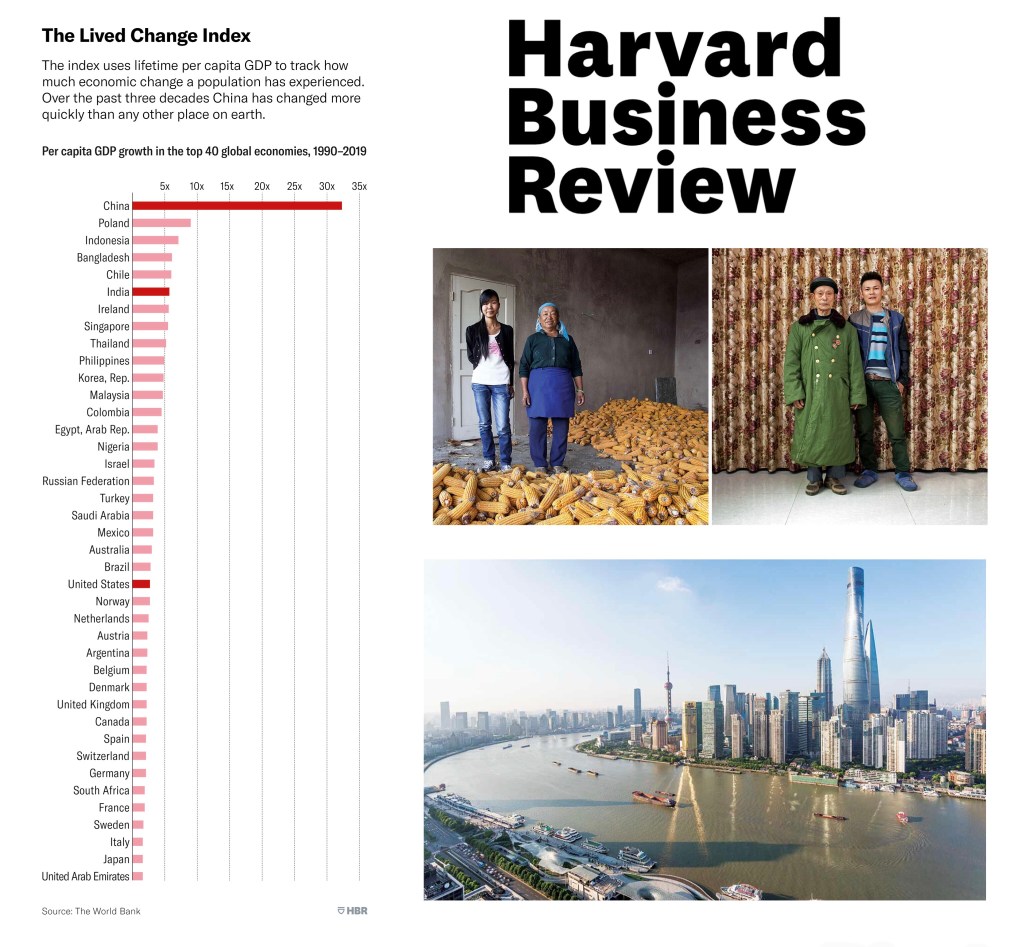
American Millennials have lived through dramatic, life-altering changes since 1990, the year I was born. First came the internet. Then cell phones. Then smartphones, social media, dating apps, mobile banking, electric cars, big data, CRISPR, and so much more. Since 1990 Americans have seen U.S. per capita GDP grow by roughly 2.7 times, which sounds impressive until you realize that somebody born in China in 1990 has seen per capita GDP grow by 32 times—a whole order of magnitude greater. In 1990 China’s GDP represented less than 2% of the global total. By 2019 its share had jumped to nearly 19%.
Consider some of the specifics. In just three years, from 2011 to 2013, China poured more concrete than the United States had poured in the entire 20th century. In 1990 China’s rural population had one refrigerator per 100 households; today that number is 96 per 100. (Food preservation is a common benchmark for development.) In 1990 China had only 5.5 million cars on the road; today it has 270 million, of which 3.4 million are electric, representing 47% of the global electric fleet. In 1990 three-quarters of the country’s population was rural; today nearly two-thirds is urban, an increase of more than half a billion people
What explains it? You can find the answer on the Lived Change Index. During the past three decades per capita GDP in India has grown in a roughly linear fashion, from just over $350 to more than $2,000—whereas in China it has grown almost exponentially, from just under $350 to more than $10,000. That disparity helps explain why many Chinese will scan a QR code but many Indians will not. The point here is not that any one culture is better at innovation but, rather, that certain developmental ecosystems create naturally different attitudes toward change, adoption, and newness. More than any other population in the world, the Chinese in recent years have had to adapt to radical change—and they have learned that innovative technologies can be key to their survival
To compete with China, imitation must be a weapon in the arsenal of global companies—one they’re willing to use.
Some of the smartest non-Chinese companies already understand this and are looking to Chinese rivals for ideas. That’s what Facebook did in 2019 when it added an integrated payment option to its chat function, five years after WeChat had introduced a similar option on a mass scale, in a pioneering example of how to productively fuse the worlds of social and commercial technology. It’s what Amazon did when it modeled its Prime Day (a wildly successful annual event during which Prime members receive all sorts of sale offers and discounts) on Alibaba’s Singles Day. Instagram got the idea for its Reels feature from TikTok. The list goes on and on.Companies looking to China for ideas should consider these courses of action:
Lead from your China team. We’ve all been told to localize for China. Take that a step further and, at least in part, lead from China. Few companies empower their China teams to help create global strategy. That’s a missed opportunity. What is second nature to your China team may be revelatory to your other teams. What you learn about local strategy in China may well help transform your global strategy.
Expose your best. Send your best and brightest to China. Expose them to new ideas there. Expand their sense of what’s possible. I have spoken with delegations representing a range of companies, from German auto manufacturers to U.S. retailers, who told me that part of their mission in visiting China was to learn from the digital ecosystem there and take those lessons back home.
Stay informed at China speed. As the saying goes, “If you haven’t been to China in the past six months, you haven’t been to today’s China.” Stay informed constantly and consciously. Quarterly updates from trendspotters and on-the-ground resources are a good start. For global executives, video updates illustrating trends and experiences can be a close second to travel
-
Taiwan US-China Expert Joanna Lei Video: China delivers knockout punches to US
Taiwan US-China Expert Joanna Lei Video: China delivers knockout punches to US Military, Science and Tech, infrastructure, EV & green energy 台灣國際財經尊家雷倩: 中国六大国银降低存款利率,雷倩:中国经济虽面临风险但仍有韧性。从工业到航天,中国科技正在全球领域加速崛起,美国还能做什么?
https://rumble.com/v2yskx4-china-delivers-knockout-punches-to-us.html
https://www.tiktok.com/t/ZT8d2VSVF/
-
Video: There are 313 US military bases around China
Video-US Democratic presidential candidate Williamson: US should wake up! There are 313 US military bases around China & 750 in the world. Who is the greater threat to global security?
https://rumble.com/v2yrtoc-us-should-wake-up-there-are-313-us-military-bases-around-china.html
https://www.tiktok.com/t/ZT8dY7QdG/
-
Video: why Chinese want to be used by US & Japan to kill each others?
Taiwan retired general video: Chinese got slaughtered by the Japanese during WWII because of inferior equipment, why Chinese want to be used by US & Japan to kill each others? 台灣退役將軍視頻:二戰時中國人因裝備劣質被日本屠殺,中國人為何要被美日利用互相殘殺
https://www.youtube.com/live/yP3oURfm0bs 👈
-
Gallium and germanium ban by China are not technically rare earth metals
Gallium and germanium ban by China are not technically rare earth metals 中國禁止的鎵和鍺從技術上講並不屬於稀土金屬
https://www.rareelementresources.com/rare-earth-elements
https://pubchem.ncbi.nlm.nih.gov/periodic-table/Gallium* arsenide and the gallium semiconductors are used for outer space electronics (such as used in satellites and some missiles). This is because Gallium semiconductors are much more resistant to radiation.
US battle doctrine is based on the full deployment of space assets in a networked panopticon of surveillance, detection, and control, and that in turn is based on having the electronics to make that possible.
The military that commands Airspace commands Land and Sea. But the military that commands Space commands Air. That has just been made more difficult for the US.
Gallium and Germanium are not technically rare earth metals. REM’s are usually metals that are so rare you rarely hear them named unless you are in the industry or commerce.

-
Western Media only focus on China unemployment on one age group to demonize Chinese and China
China’s surveyed urban unemployment rate stood at 5.2% in May 2023, unchanged from April’s 16-month low. The unemployment rate of the population aged 25-59 decreased to 4.1% in May from 4.2% in the previous month, 👉while the rate for those aged 16-24 climbed to a record high of 20.8% from 20.4%
👉 Western Media only show one age group sectors to spread fears and fake news to demonize Chinese and China. 16-24 age groups are in High Schools and Universities not actively seeking jobs 16-24歲人群的這一比例從20.4%攀升至20.8%的歷史新高 👉 西方媒體只展示16-24歲的群體,散佈恐懼和假新聞,妖魔化華人和中國。 16-24歲年齡段在高中和大學,不積極尋找工作Meanwhile, the jobless rate in 31 large cities and towns was unchanged at 5.5% in May. The average weekly working hours of employees in enterprises across the country inched down to 48.6 hours in May from 48.8 hours a month earlier. For 2023, the government has targeted a jobless rate of around 5.5%, with the creation of about 12 million new urban jobs. China has set a GDP growth target of around 5% for 2023. source: National Bureau of Statistics of China
https://tradingeconomics.com/china/unemployment-rate
-
Video: HK police issued a global arrest warrant for 8 treasonous criminals
Video: HK police issued a global arrest warrant for 8 treasonous criminals which is very clever by cutting off their $ train, they also sentenced them to life imprisonment. 屈穎妍在線: 他們的無期徒刑 香港警方今次對8個叛國罪犯發全球通緝令非常高招,除了斷絕他們的後援米路,還給他們判了無期徒刑,從此活不安樂
https://rumble.com/v2ypqb2-hk-police-issued-a-global-arrest-warrant-for-8-treasonous-criminals.html
https://www.tiktok.com/t/ZT8dN6Y74/ 👈無論裝得如何從容不逼、如何處之泰然,大家應該會感受到他們的惶恐。
說的,就是被香港警隊國安處通緝的8個亂港叛國罪犯:羅冠聰、郭榮鏗、許智峯、任建峰、袁弓夷、蒙兆達、劉祖廸、郭鳳儀,每人100萬懸賞通緝。
口說不害怕,騙得自己騙不了人,我相信這世上沒有人會在懸紅通緝告示上看到自己的照片及名字後可以一笑置之,可以安樂生活。
躲藏在澳洲墨爾本的律師任建峰故作鎮定接受訪問:「我不覺得自己是一個什麼罪犯,只是一些影得唔靚的身分證相片而已。」
至於頭號通緝犯羅冠聰則表示,自己在英國應該「相對安全」,但由於有懸賞存在,他在透露自己行蹤時要更加小心,「比如,在我到某些國家轉機的時候,他們有可能將我引渡」。
羅冠聰的恐懼是應該的,因為特首李家超說過,會終身追究他們的法律責任:「無論他們逃到天涯海角,我們都會終身追捕這些罪犯。」
羅冠聰和另一通緝犯劉祖廸才29歲,名單內還有26歲的郭鳳儀,想像一下,廿幾歲就成為全球通緝犯,成世流流長,以後的人生該怎樣過?
這世上,有兩種囚牢,一種是有形的,把你囚禁在監獄,身體沒自由,但腦袋可以很自由。不愁三餐,不怕睡不安寧,不再怕被追捕,除了牢房沒冷氣、廁所沒有門,生活倒是安樂的,你看那個肥了兩個碼的岑子杰就知道。
另一種囚牢,卻是無形的。你可以在特定範圍內自由來往,身體自由,但心靈卻滿佈圍牆。吃飯怕被下毒,睡覺怕被破門,交朋友怕被出賣,識女仔怕墮美人計,搭飛機怕中途急降,有人舉機怕被偷拍,出街走路怕被跟蹤……
監獄的囚禁是有限期的,心靈的囚牢卻是無期徒刑,廿來歲的通緝犯,算你有80歲命,還有50年不安樂的日子要過。
當然,今天英國外交大臣和澳洲外交部長都誓神劈願站在通緝犯那邊,但政治是多變的,難保有一天,澳洲或英國易了主、轉了路線,覺得還是跟中國做朋友好,於是,這些通緝犯必定成為棄卒、甚至賀禮。
還記得那個因揭秘美軍在戰爭中濫殺平民的「駭客羅賓漢」、維基解密創辦人阿桑奇嗎?他被美國及西方國家出紅色追捕令全球通緝,於是喬裝成快遞員,躲進厄瓜多爾駐英國大使館尋求政治庇護,在領事館一藏就是7年,每天擔驚受怕,由年青煥發變成滄桑老頭。
當時的厄瓜多爾總統科雷亞明明承諾為阿桑奇提供無限期保護,可惜新總統莫雷諾一上台,就第一時間撤銷政治庇護,並協助英國警方入領事館拘捕阿桑奇。這就是政治,政治是沒有永遠的朋友。
香港警方今次對8個叛國罪犯發全球通緝令非常高招,除了斷絕他們的後援米路,還給他們判了無期徒刑,從此活不安樂。
正如保安局長鄧炳強所言:「香港執法部門會窮一生精力將你們拘捕,今天你們尚有少少利用價值,可能外國會給你一些保護傘,他朝當你沒有利用價值時,你就會變成棄卒。」
我們等著瞧,這一天應該不會太遙遠

-
Old stamp issued by the US shows Xinjiang and Taiwan part of China
Old stamp issued by the US shows Xinjiang and Taiwan part of China. This post is dedicated to those who died in WWII, especially the July 7th fighters and Richmond workers whose support and patriotism helped win the war. 美國發行的舊郵票顯示新疆和台灣是中國的一部分. 這篇文章獻給那些在二戰中犧牲的人,尤其是7月7日的抗日戰士和列治文工人,他們的支持和愛國主義幫助贏得戰爭.
列治文軍工複合體2023-07-07 (晚生姓高 聖羅倫佐)
1937年7月7日晚,日本駐軍在盧溝橋附近軍事演習。10時40分,結束演習的日軍稱演習地點傳來槍聲,並有一士兵志村菊次郎「失蹤」,要求進入宛平城搜查,遭守城的第二十九軍(前身之一為西北軍)拒絕。翌日清晨5時許,日軍砲轟宛平城,第二十九軍奮起抵抗。隨後發生平津作戰。第二十九軍戰敗,撤退保定,平津地區為日本佔領,侵華戰爭全面爆發。中國動員奮起抗日,這製造的藉口無端入侵!
1941年12月7日,日本偷襲珍珠港,美國傷亡慘重,羅斯福總統宣布國恥日,對日本帝國宣戰。次年四月,杜立德率領航空隊,從大黃蜂號航空母艦的甲板上飛出,空襲東京,轟炸震驚了日本,非常害怕暴露在空襲之下。
1942年7月7日是中國抗日侵略五年,為慶祝和鼓勵中美同盟國的戰鬥精神,美國郵政局發行藍色橫版五美分藍色郵票。 林肯左邊:民有民治民享,孫文右邊:民族民權民生, 中國包括西藏和台灣,地圖背景,疊加在地圖上的是帶漢字的國民黨標誌,抗戰建國。今年是紀念中美並肩作戰,為自由和擺脫奴役的光榮八十一周年。提醒美政客重視這段寶貴歷史,台灣是不可分割領土!
許多年輕人參軍,進攻日本。加州是後勤支援的重要州,灣區的列治文是個軍工綜合體重鎮,1942年招募了十萬名女性來支持,鉚釘工蘿西,最有名是由米勒(J. Howard Miller)1943年設計的海報,標題是:我們能做到!
主要來自南部各州的數十萬人湧入列治文,大增只有兩萬五千人的小鎮。許多白人家庭主婦,加入工廠招聘。許多華婦加入這個主流社區。
由於這區非常靠近,最近晚生去探訪,回顧這段二戰重要歷史。
鉚釘工蘿西國家歷史公園位於舊金山附近的列治文。公園保留並詮釋二戰期間後方的遺址,包括凱撒造船廠、勝利號 SS Red Oak Victory、坦克工廠、住宅開發區,和其他為支持,加入二戰而建造的設施。特別是溫習尊重婦女和非裔在戰爭工業中的作用。在展覽中,有一面中緬印戰區盟友的旗幟。晚生珍藏兩張二戰海報:一張是賀年全套軍裝飛天將,背插兩面三角旗,腳踩地上被打敗的日軍;另一張是長桌兩邊的中美士兵,背負38大步槍,牆上掛著中美國旗孫文肖像。
福特汽車裝配廠是西岸最大,為全國僅有的三個坦克庫之一,大約組裝五萬輛吉普車,並加工約九萬輛其他軍用車輛。二戰期間,福特在該工廠僱傭數千名工人,其中許多是首次工作的女性。
為了充分發揮戰時生產潛力,聯邦軍事當局和私營企業,開始以美國歷史上,前所未有的規模密切合作,為冷戰期所謂的「軍工複合體」奠定基礎。
四個凱撒造船廠,建造了747艘船,這是世上無法比擬的壯舉。自由號和勝利號都在這裡建造。這些船以四分一成本完工。SS Robert E. Peary在不到五天內組裝完成,但到1944年,用標準方法組裝一艘自由號飛船,僅用兩周多的驚人時間。
SS Red Oak Victory (紅橡樹勝利號)是一艘保存為博物館的船。它是二戰期間建造的414艘勝利艦之一(在造船廠建造),但也是少數從商船隊轉移到美海軍船隻之一。1945年該船運送貨物和彈藥。
在太平洋執行危險任務期間,提供補給許多噸彈藥,沒有傷亡。許多女工講述焊接船隻工作,多麼細心重要,意識到戰士生命,取決船運貨物。
大量工人湧入居住,帶來了巨大壓力,嚴重缺乏住房,工人被迫尋找。整晚睡在電影院裡,共用日夜更輪流床睡,或外面露營。
艾奇遜村住房項目是地方與聯邦合作,為國防工人提供急需的住房。簡陋的木建築,清楚地反映這時期,公費建設的限制(時間、金錢和材料)。
由於種族歧視,少數族裔在獲住房,表現很差。經常住在棚屋裡、把原材料運到城市的板條箱裡、拖車裡或汽車裡。他們和其他收入較低的工人很幸運,後來能夠搬到為二戰工人,造似軍營的宿舍,戰後未被摧毀。
在1944年6月盟軍反攻歐洲前,死於後方事故的工人,比死於戰場的美軍還要多。造船廠的創始人Henry J. Kaiser (亨利·凱撒)認識到,只有健康的勞動力,才能滿足期限和施工需求。
他將一個革命性想法制度化,即為工人提供預付費醫療服務,並很快擴展到工人之外。對於許多工人,這是他們第一次看醫生,是首個集體醫療、預付費用,團體計劃。凱撒今仍是最大的非營利性HMO。
Ruth Powers兒童中心是二戰期間建立,為在船廠工作婦女提供托兒服務。建築仍存。Maritime Child Development Center是學區運營,結合漸進式教育計劃,並配備營養師、精神病學家和認證教師。每天可容納180名兒童。在鼎盛時,有24,500名女性受僱於Kaiser,市內的兒童保育計劃維持了每天1,400名兒童的總出勤率。
軍工複合體是天時、地利、人和的結合:列治文氣候宜人,適合工作養家,屋崙灣是深水良港;全國總動員團結,保家衛國,打敗法西斯敵人。開啟女權和民權運動,讓白人在車間,接受女性和非裔,是引以為豪時刻,愛國合作,為戰後更好的和平生活。
無論白人有色人種,富人窮人,民主黨共和黨,沒有分化。現政客是誰在製造分裂?遊客中心放映紀錄片,講述日裔美國人為國家安全,被關進集中營。歷史會不會在同問題上,在華裔身上重演?

-
Marco Polo Bridge Incident video
Marco Polo Bridge Incident video: How Japanese on 7/7/1937 use “false flag” claims missing soldier to launch attack against China, exactly same tactics used by US today 盧溝橋事件視頻:1937 年 7 月 7 日日本如何使用“偽旗行動” 聲稱失踪士兵向中國發動攻擊,與今天用”謊言治國”的美國今天使用的戰術完全相同.
https://rumble.com/v2yo4ts-marco-polo-bridge-incident-video.html
https://www.tiktok.com/t/ZT8d8Esgq/
-
AIT Chairwoman: US is the only outside force allowed to interfere with Taiwan Province election
AIT Chairwoman: US is the only outside force allowed to interfere with Taiwan Province election supporting anti-China political candidate 美國註台恊會主席:美國是唯一可以干預台灣省選舉、支持反華政治候選人的外部勢力

-
Subscribe
Subscribed
Have a WordPress.com account? Log in now.

