US is getting so desperate to bypass the Federal Reserve. This will make 2008 subprime mortgages leading to the world financial crisis a child play. The end is near. To protect yourself look for gold & RMB based & backed investments, avoid US$ based & backed investments. 美國正如此不顧一切地想要繞過美國聯準會。這將使2008年次貸危機引發的全球金融危機如同兒戲。美國末日將至。為了保護自己,請專注以黃金和人民幣為基礎和支持的投資,避免美元為基礎和支持的投資.
THE U.S. DOESN’T UNDERSTAND ITS COMPETITORS 美國不了解其競爭對手 By M.B.
I am always amazed how little western governments are aware of their own (lack of) capabilities as well as of the nature and capabilities of their ‘enemies’.
They tend to not know the basic economic and sociological facts about their opponents. They operate on whatever nonsense they have come to believe about their ‘enemies’. They overestimate their own position, miscalculate and are astonished when, as a result, the factual situation turns against them.
We may recount, as Tucker Carlson does, that the U.S. was “assured by some of the dumbest people on the planet, who currently serve in the United States Senate, that Russia was merely ‘a gas station with nuclear weapons’.”
Sanctions were imposed on Russia but failed to trouble it. They hurt those who imposed them the most.
U.S. ATTACK ON BRAZIL The Trump administration recently put a 50% tariff on all goods from Brazil (even though it has a trade surplus with that country).
This was to punish its government and judiciary for pursuing charges against the former president Jair Bolsonaro for plotting a coup after he had lost the elections.
Brazil is a nationalistic, well developed country which is allergic to interference by foreign powers. Anyone knowing that fact could have anticipated this reaction:
[Washington Post quote begins]
“For [President] Lula, whose left-wing allies face a tough 2026 election, the moment is a windfall. Polls show revived support for his administration in the face of Bolsonaro-provoked American bullying. The tariffs also harm the interests of business elites who are often the biggest boosters of Lula’s conservative opposition.
“What was meant as a show of strength by MAGA and its Brazilian franchise has turned into a political gift for Lula, who now gets to credibly present himself as a symbol of national resistance while leaving his opponents scrambling to choose between loyalty to Bolsonaro and the economic interests of their own base,” observed Brazil historian Andre Pagliarini.
[Washington Post quote ends]
OUTPLAYED BY CHINA The U.S. trade war against China is another point where the lack of knowledge about the opponent led to the loss of the battle:
[New York Times quote begins] When Mr. Trump raised tariffs on Chinese exports in April, some top Trump officials thought Beijing would quickly fold, given its recent economic weakness.
Instead, Beijing called Mr. Trump’s bluff by restricting rare earths needed by American makers of cars, military equipment, medical devices and electronics.
As the flow of those materials stopped, Mr. Trump and other officials began receiving calls from chief executives saying their factories would soon shut down. Ford, Suzuki and other companies shuttered factories because of the lack of supply.
Mr. Trump and his top advisers were surprised by the threat that Beijing’s countermove posed, people familiar with the matter say.
That brought the United States back to the negotiating table this spring to strike a fragile trade truce, which Trump officials are now wary of upsetting. That agreement dropped tariffs from a minimum 145 percent to 30 percent, with the Chinese agreeing to allow rare earths to flow as freely as before.
[New York Times quote ends]
Trump and his advisor likely did not even know what rare earths were. They did not know that China has a monopoly of making them into magnets. They did not know that these magnets were needed to create U.S. high-tech products.
CHINA PLAYS U.S. GAME Moreover, China used the U.S. pretext of ‘national security’ to make its move stick:
[NYT quote begins]
Mr. Trump was the first to harness the power of U.S. export controls, by targeting Chinese tech giant Huawei and putting global restrictions on American technology in his first term.
But the Biden administration expanded those rules. Concerned that China’s growing A.I. capacity would advance its military, Biden officials cracked down on exports of Nvidia chips, seeing them as the most effective choke point over Chinese A.I. capabilities.
Since then, when Chinese officials raised their objections to U.S. technology controls in meetings, U.S. officials had responded by insisting that the measures were national security matters and not up for debate.
But in the meeting in Geneva in May, China finally had a powerful counterargument. Beijing insisted that its minerals and magnets, some of which go to fighter jets, drones and weaponry, were a “dual-use” technology that could be used for the military as well as civilian industries, just like A.I. and chips. It demanded reciprocity: If the United States wanted a steady flow of rare earths, Washington should also be ready to lessen its technology controls.
[NYT quote ends]
China has regained access to Nvidia chips and Trump is seeking a meeting with China’s president Xi. Evidently, China has won this battle.
I am sure there are some specialists on China down in the bowels of the Commerce Department or State, who did know how China could hit back. They probably had gamed-out and predicted how China would hit back.
But U.S. politicians, be they Obama, Biden or Trump, are too full of themselves to doubt their own level of knowledge about their opponents. They do not know their ‘enemies’. The battles they plan out and launch do inevitably end in disasters.
WINNERS AND LOSERS As I have observed the U.S. losing one foreign policy battle after the other over the last 25 years I was waiting for the moment where sanity would set in. Where realistic assumptions would be made before launching this or that new adventure. I am no longer expecting that to happen.
Some say the U.S. is in a strong position and, despite creating chaos by losing such battles, does win from it.
But in reality only some are profiting from fighting and losing these battles while the country as a whole is getting diminished by it.
21 July, 2025, USA.
[MB is a popular independent American journalist who runs a news discussion board at MoonofAlabama .org]
NYT: US House Speaker Mike Johnson shutting down House early said he would send lawmakers home early for their summer recess in order to Block Epstein Vote demands by Democratic on calling for the release of files from the investigation into Jeffrey Epstein. 紐約時報:美國眾議院議長麥克·約翰遜提前關閉眾議院,表示他將讓議員提前回家休會,以阻止民主黨人投票要求公佈對傑弗裡·愛潑斯坦的調查文件, 川普在名單上!
American logistic expert reports from China video: Chinese families are keeping their college kids home. Washington is shutting off everyone else. 中國家庭讓孩子待在家裡, 不要到美國大學. 華盛頓則關閉了所有其他國家的邊境不讓孩子來美國讀書.
Mainstream public opinion in China has shifted dramatically, and more now firmly believe that it is a waste of time and money to send Chinese students abroad for university study. 中國主流輿論已發生巨大轉變,越來越多的人堅信送中國學生出國讀大學是浪費時間和金錢.
While Chinese families are increasingly choosing domestic schools, Washington is closing off applicants from over a dozen other countries.
Officials claim that this is a push to suppress anti-Semitism on American campuses. But it is also slamming students from countries like Dubai, Turkiye, and even India, where consultants warn of a 70% student decline.
US universities face a severe crisis, and many will not survive.
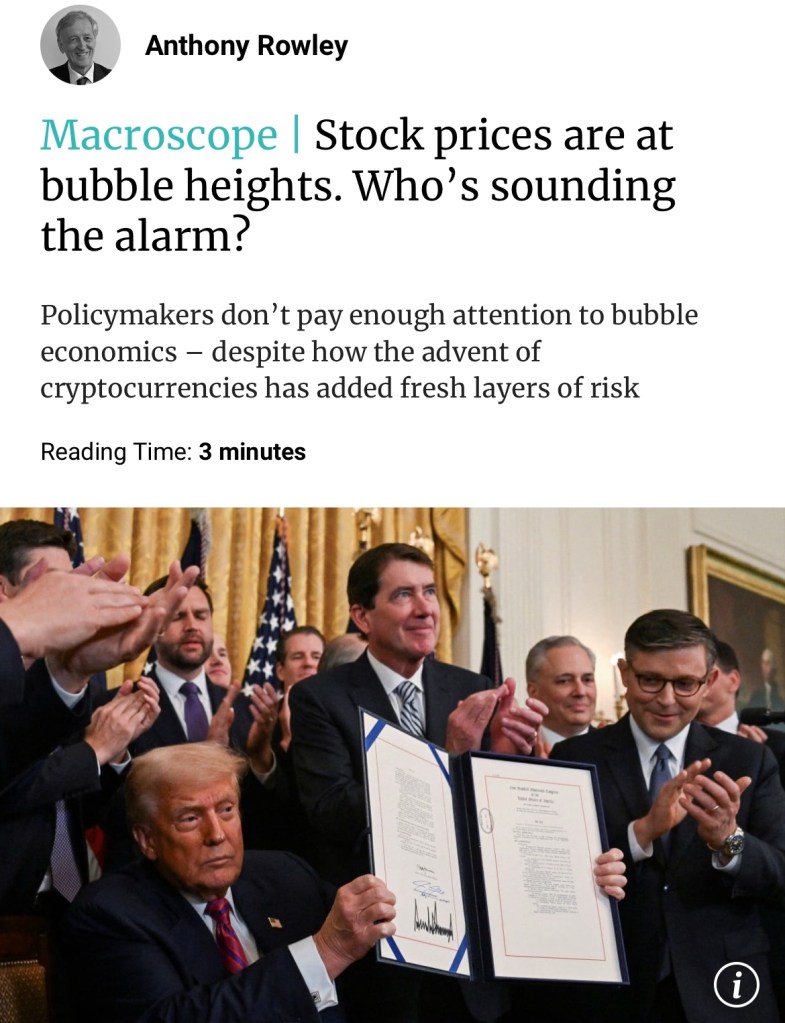
A top Wall Street economist is sounding the alarm on sky-high valuations in AI stocks — and drawing comparisons to the tech bubble of the late 1990s. 一位華爾街頂級經濟學家對人工智慧股票的過高估值發出了警告,並將其與 20 世紀 90 年代末的科技泡沫進行了比較.
“Yes, AI will do incredible things for all of us,” Torsten Sløk, chief economist at Apollo Global Management, said on Yahoo Finance’s Opening Bid. “But does that mean I should be buying tech companies at any valuation?”
According to Sløk, the answer is increasingly no. In a research note to clients this week, he pointed to internal data showing the price-to-earnings ratios (P/E) of the 10 largest companies in the S&P 500 (^GSPC) — many of them AI stock picks like Meta (META) and Nvidia (NVDA) — have eclipsed P/E levels seen at the height of the dot-com bubble in 1999.
That signals a dangerous concentration of investor exposure in just a handful of tech giants, Sløk argued.
“Almost 40% of the S&P 500 is made up by the 10 largest companies,” he said. “So if I take $100 as an investor and buy the S&P 500, I think I have exposure to 500 different stocks, but I’m really just betting on the Nvidia and the AI story continuing.”
China is literally diving into the future—by submerging entire data centers underwater. Off the coast of Hainan and Shanghai, massive cylindrical data pods are being dropped beneath the sea, where cool ocean temperatures naturally regulate heat, cutting energy usage by over 30%. Powered by clean energy like offshore wind, these aquatic supercomputers are designed to support AI models while slashing environmental and operational costs.
This bold move isn’t just about cooling—it’s about outpacing global tech giants. With the world facing a data explosion and rising temperatures, China may have just found the perfect intersection of AI, energy efficiency, and climate strategy. The question is: will others dive in or be left on the shore?