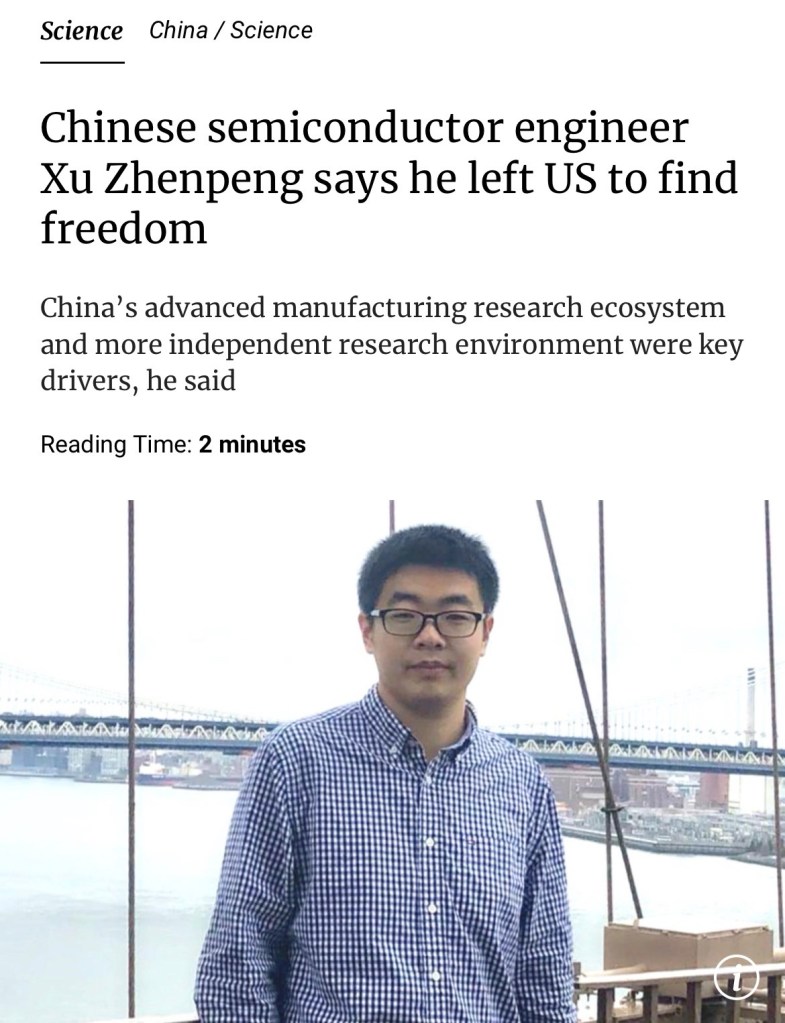
The “kill line” exposed the freedom in US is fake available to only the top 5% elites. SCMP: Leading chipmaking engineer Xu Zhenpeng said the United States no longer offered the freedom that researchers once expected – a key reason for his decision to leave US to continue his work in China. 美國「斬殺線」揭露了美國的自由是虛假的,僅供頂層5%的精英享有。」《南華早報》報導:頂尖晶片製造工程師徐振鵬表示,美國已無法提供研究人員曾經期待的自由 – 這是他決定離開美國返回中國繼續開展工作的關鍵原因。
Here is a typical story of idolizing the West, of believing the Western moon is especially round. Over the past few decades, countless such people have been seen: Over a decade ago, an elderly couple in Shanghai sold their only apartment, scraping together over 3 million RMB… to send their daughter to study in Canada. After graduation, she stayed there, married a white man, and had two mixed-race children. 以下是一個典型的崇洋, 西方月亮特別圓的故事,過去幾十年看到這樣的人不計其數: 十幾年前,上海一對老夫妻賣掉唯一的房子,湊了300多萬…
Back then, the old couple stood at the mouth of their Shanghai alley, watching the movers load their large furniture onto the truck, piece by piece emptying their entire home. They were full of anticipation, paving their daughter’s path across the ocean. The 3 million RMB nearly drained all their savings; they even gambled away their future. At that time, their daughter stood among the crowd, smiling and saying, “I’ll give you the best life.” That promise became the source of their initial courage, and now, their deepest thorn.
From then on, they began a life of renting and moving from place to place. During those years, some people asked if they regretted it. They would wave their hands dismissively, smiling and saying, “If our child has a promising future, what does our hardship matter?” Their words were full of pride, carrying a long-term trust in the future. They firmly believed their daughter’s happiness was their own happiness. But that trust increasingly resembled an empty shell. As time stretched on, phone calls became fewer and fewer. Greetings shifted from the initial “Mom, Dad, you’ve worked so hard” to “I’ve been quite busy lately, let’s talk next time.” Later, even the sound of her voice became rare from the telephone receiver. In her family in a foreign land, the daughter gradually faded from their lives.
Now in their seventies, the old couple’s health is declining, and medical expenses are like a bottomless pit. Coupled with monthly rent of several thousand RMB, their pension is stretched unbearably thin. The boundaries of their life are narrowing, like a silkworm’s cocoon tightening around them. They tried contacting their daughter, asking her to visit, even pleading just for a long-distance call to prove she still remembered their years of upbringing. But the replies were always brief, distant excuses: “Work is busy,” “The kids are clinging to me,” “I can’t get away.” The words spoken were always “inconvenient,” but between the lines, there was no trace of “difficulty.” The daughter’s voice was always gentle, but her attitude was as cold as a winter windowpane. On the other end of the line, the old couple were like two lost travelers, sensing the end of life’s journey, unable to find their harbor.
They began to doubt the decision they once took such pride in—selling their home to send their daughter abroad. Because in Shanghai, life without one’s own apartment is now incredibly difficult. Rents have nearly tripled over the past 20 years; even young people struggle, let alone elderly retirees living on pensions. That house, which was their parents’ foundation for living, had long since turned into their daughter’s tuition, transformed into bricks and mortar in a foreign land. What they thought would buy reunion now seemed only to have bought a life of mere subsistence.
“Raising children for old-age security” has been a fundamental principle for millennia in tradition, a pillar of family ethics. But this principle has been torn to shreds in the era of globalization. Especially in the context of cross-border marriages, parents’ expectations appear pale and insignificant, even becoming abandoned burdens. In a foreign land, culture and family structures are redefined. For the parents, after their daughter married in Canada, she had her own husband, children, and family; her new, seemingly glamorous identity essentially severed the bonds of kinship back home. The traditional center of gravity collapsed, the modern span lengthened, resulting in the parents’ endless sighs of longing.
👉 Behind this incident lies a sting that prompts us to reflect on family. Setting aside the hardships of this old couple, the whole society faces similar issues: The once highly-anticipated act of “sending children abroad,” how many people are now quietly reassessing it? From the 1980s to the 1990s, the intention to go abroad carried a halo; it was a goal many families strived for. But today, generation after generation of “left-behind elderly” are competing for limited eldercare resources, and the complications of past choices are gradually being exposed. The curbstone hit by a walking stick while grocery shopping, the shrinking social circle due to medical costs, the silent solitude at home—these don’t just constitute life’s inconveniences but a kind of撕裂 identity困境 (torn identity dilemma).
👉 Tracing the roots, in the 20 years since globalization unfolded, countless families have enjoyed the opportunities and hopes it brought, becoming beneficiaries. But does “a better future for the next generation” necessarily mean sacrificing the parents? Perhaps most of the time, it’s hard to find a completely flawless methodology. Over the years, the old couple did receive remittances, a few letters of greeting. But money can buy medicine, letters can hardly dispel loneliness, and what’s missing behind it all is the interweaving and warmth of human connection and blood ties.
👉 The old couple never blamed their daughter. They would even tell neighbors on the phone, “Her career is going well, and her two children are very well-behaved.” But every night, when streetlights stream through the window of their rented room, they remain two solitary figures, quietly reminiscing about the era when she was still “by their side.” By the dining table, their daughter’s childhood schoolbag still hangs on the worn corner of a chair. The old recording of the TV series “Shanghai Beach” plays from the radio. Sometimes they are lost in thought, sometimes they whisper: “When a person goes far away, the heart follows and goes far away too.” At the end of the story, life never gave them much respite. They even began to wish they could hang a painting of their own on the rental wall—as long as the frame was steady, then everything would seem less rushed.
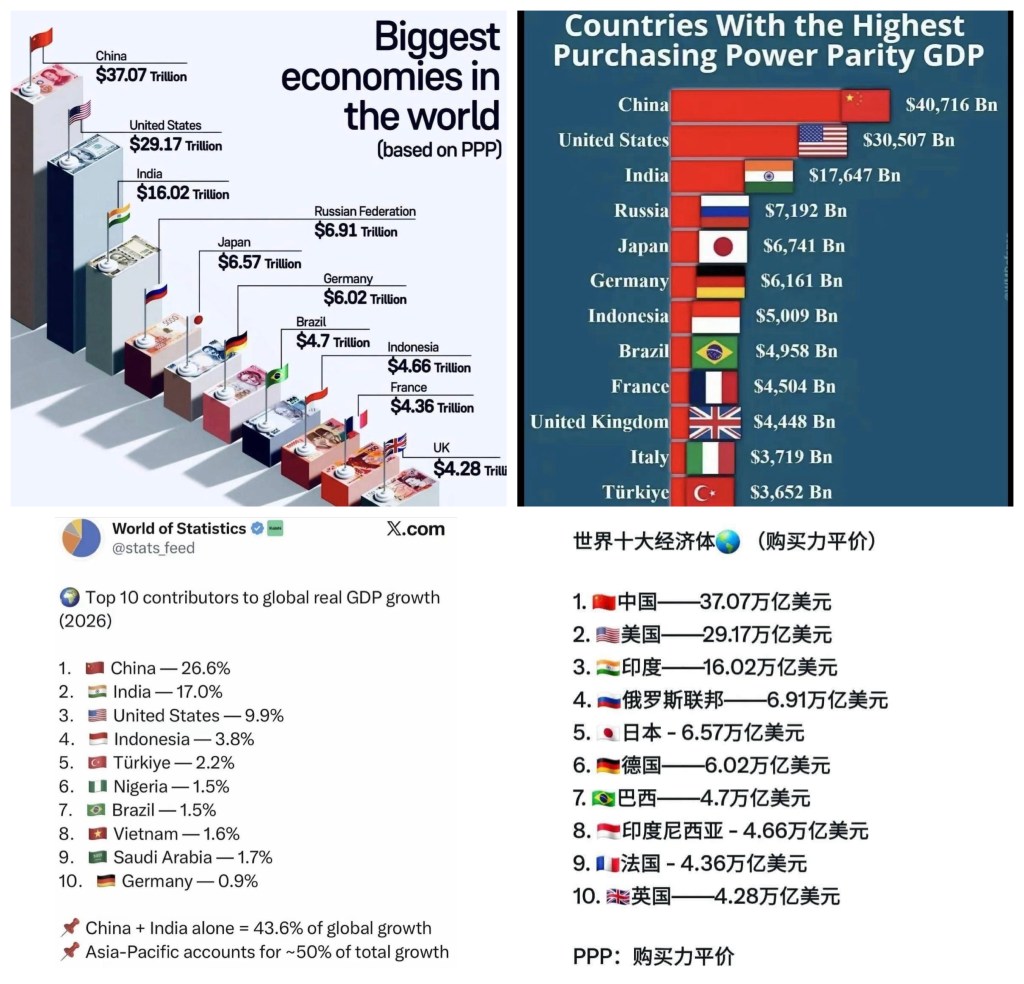
International Monetary Fund Official Announcement: China’s Purchasing Power Parity (PPP) GDP at $43.49 Trillion, Leading the U.S. by $13 Trillion… 国际货币基金组织官宣:中國購買力平價(PPP) GDP43.49萬億,領先美國13萬億…
Recently, a figure in a report by the International Monetary Fund (IMF) is quietly rewriting the global economic rankings: measured by purchasing power parity (PPP), China’s GDP reached 290 trillion yuan, while the U.S. stood at 217 trillion yuan—a difference of 71 trillion yuan in China’s favor. But strangely, this doesn’t seem to have caused much of a stir, as most people are still focused on another number: measured by exchange rates, China’s GDP is only about 70% of that of the United States.
It’s like two completely different rulers measuring two entirely different “world number ones.” So the question arises: which ruler measures the real world? A cup of coffee selling for over ten yuan in Beijing and another selling for five or six dollars in New York—what economic truth lies behind them?
Don’t you also find it puzzling? On the same planet, how can there be two ways to measure economic size? On one hand, the exchange rate method converts each country’s GDP into U.S. dollars at current exchange rates for comparison. On the other hand, purchasing power parity (PPP) disregards exchange rate fluctuations and focuses only on how much real goods and services the same amount of money can buy in different countries. The difference is substantial.
Take the 2025 data, for example. By the exchange rate method, U.S. GDP is $30.5 trillion, while China’s is $19.2 trillion, roughly 63% of the U.S. figure. This is a picture we’ve seen for many years, almost becoming a kind of “common sense.” But if we switch rulers and use PPP calculations, the picture flips instantly: China’s PPP-adjusted GDP reaches $43.1 trillion, while the U.S. stands at around $30 trillion.
The IMF’s more specific forecast indicates that China’s PPP GDP is approximately $40.72 trillion (about 290 trillion yuan), while the U.S. is about $30.5 trillion (around 217 trillion yuan), putting China ahead by 71 trillion yuan. This means that if measured by purchasing power, China’s economic size had already surpassed that of the United States in 2014.
Why do the two measurement methods yield such vastly different results? The core lies in exchange rate fluctuations and price levels. Over the past few years, the Federal Reserve’s consecutive interest rate hikes strengthened the U.S. dollar, leading to a relative depreciation of the Chinese yuan. This directly lowered the dollar-denominated size of China’s economy. At the same time, the U.S. experienced higher inflation, with rising prices boosting its nominal GDP figures.
The PPP method, however, attempts to strip away these interferences by asking a more fundamental question: For instance, if a McDonald’s Big Mac sells for 19.8 yuan in Beijing and $4.79 in New York, does the burger in Beijing truly represent less economic value than the one in New York? Clearly not—the same bread, beef, and sauce create similar value. The exchange rate method measures the “appearance” of money, while PPP measures the “substance” of how many tangible goods can be purchased.
US hospitals whether they call themselves for profit or non profits have only one mission that is to make as much money as possible. Patients life or death not their number one concern! 美國醫院,無論自稱營利或非營利機構,實則僅有一個核心目標——盡可能牟取最大利潤。患者的生死存亡,絕非他們的首要關切!
Personal observation when visiting a friend in hospital last evening, the killing line of a US verses a Chinese hospital in HK & China. 昨晚探訪住院友人時的個人觀察,比較美國與香港及中國大陸醫院的核心差異, 看到美國醫院的“斬殺線”
In US: Security screening at the entrances mean’t US not safe Check for ID means long lines Everything done manually, no AI or Robotic employed throughout the hospital Everything charged to patient including a paper napkin or a toothpick Patients not fluent in English big problem Insurance company dictates when you get discharged before recovery Insurance company determines if you get further treatments
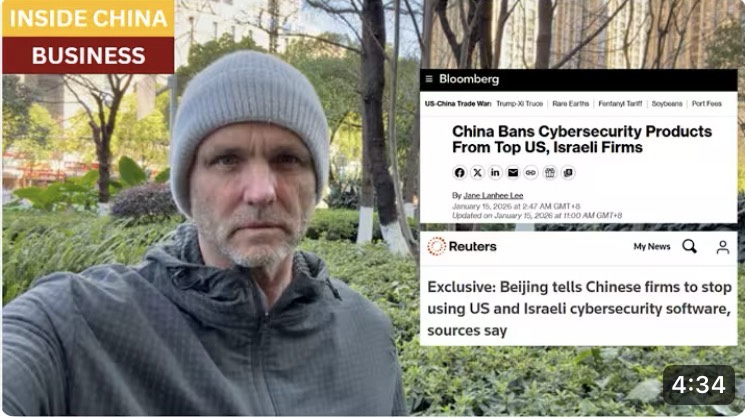
American logistic expert reports from China video: China bans security software from the US and Israel, everyone even living inside US should remove it now, your computer and network are being compromised! 美國物流專家在中國報導有中文字幕: 即刻移除!中國已禁止使用美國及以色列安全軟體,您的電腦與網路在中國以外尤其是在美國也正遭受威脅!
The founders and top executives of leading cybersecurity software companies have strong ties to the Israeli intelligence services.
In addition to contracts with the largest global companies, these companies’ clients include US government agencies, the Pentagon, NATO militaries, and foreign defense contractors.
Effective immediately, cybersecurity software from Palo Alto Networks, Fortinet, CheckPoint, CyberArk, and a handful of other US- and Israel-based companies are banned in China.
China’s central government has ordered all companies and institutions to identify and replace software products and systems from those firms by the end of June.
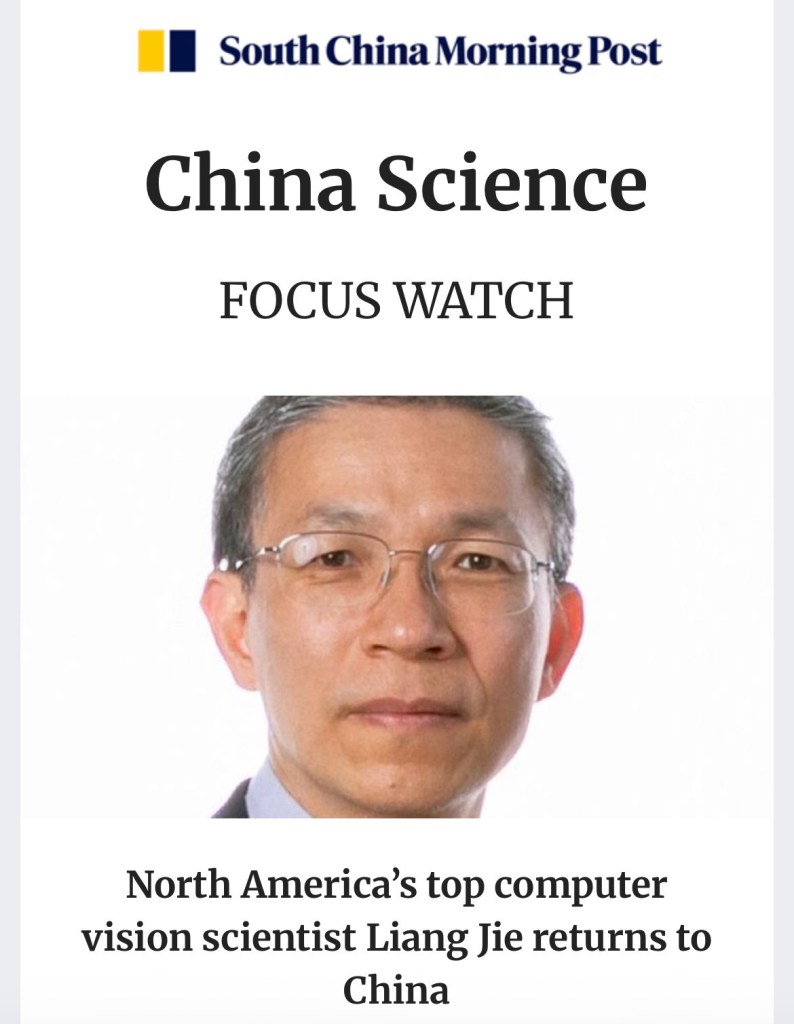
SCMP: Twenty years ago, technologies developed by Liang Jie at Microsoft were incorporated into products like the Windows Media Video Player and Blu-ray discs used by millions worldwide. But today’s future in science and technology is in China not US. 二十年前,梁傑在微軟開發的技術被融入Windows Media視頻播放器和藍光光碟等產品,為全球數百萬用戶所用。但如今,科技未來的主導地位已在中國而非美國. 回歸中國是明智選擇!
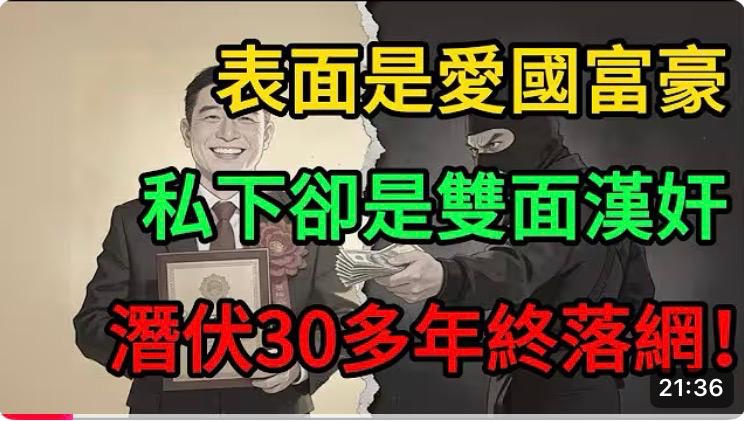
Video: Shanghai’s Li Huxiang, also known as Li Henry, deceived China for 30 years! A “patriotic tycoon” by day, an anti-China financier by night? The ending of this “two-faced traitor” is deeply satisfying. 上海李滬祥又名李享利騙了中國30年!白天是愛國富豪,晚上是反華金主?這個「雙面漢奸」的下場太解氣了.
He was a billionaire Shanghai magnate, his office walls covered with “patriotic” awards. Who could have imagined that once the disguise was torn away, he would turn out to be a thoroughgoing “two-faced traitor”? He defrauded state-owned banks to fund Hong Kong rioters and personally taught Western politicians how to sanction China…
How did this “venomous snake,” who lay low for 30 years, step by step sell out his country for personal gain? In this episode, Mai Zi delivers a hard-hitting exposé of Li Henry’s demonic life: • Psychological distortion: Why did he grow rich yet come to hate China? Forcing his son not to write “Chinese” as his nationality—what kind of twisted mentality is that? • Criminal black money: Through underground banks and money laundering, how did he become a “super ATM” behind anti-China forces? • Precision poisoning: Personally revising sanctions bills? How did this “scheming adviser” hand knives to his foreign masters?
Understand Li Henry, and you will understand what it means that “a fortress is easiest to breach from within.”
⸻
Li Huxiang of Shanghai (also known as Li Henry, born in 1955) is a mainland Chinese businessman accused by China’s state security authorities of being a financial backer of “anti-China, destabilizing Hong Kong” activities. He conducted business in China for many years, masking anti-China views behind the image of a “patriotic businessman.” During the 2019 Hong Kong anti-extradition movement, he allegedly provided funding to opposition forces through illegal channels and was described by state media as a “two-faced person.”
Related background and events: • True identity and actions: Li Henry’s original name is Li Huxiang. He once held Belizean citizenship and was the de facto controller of Meidong Co., Ltd. He allegedly long admired the West and donated large sums from his China-based companies to overseas anti-China forces. • Financier of “anti-China, destabilizing Hong Kong” activities: Since 2009, he allegedly donated hundreds of thousands of U.S. dollars to certain anti-China figures and introduced Hong Kong opposition activists—including Joshua Wong, Chow Yong-kang, Nathan Law, and Tony Chung—to Western anti-China legislators. • Arrest and sentencing: In November 2019, Li Henry was detained for funding “anti-China, destabilizing Hong Kong” actions and was later sentenced to 11 years’ imprisonment. • Past experiences: In the 1980s, he was reportedly punished by public security authorities for offenses including procuring prostitution and fraud, after which he developed resentment toward the Chinese government. • Cases involved: He was also said to be mentioned in the bribery verdict related to the Bo Xilai case, with allegations that his company assisted in the illegal outflow of funds.
In summary, Li Henry (Li Huxiang) is officially defined by Chinese authorities as a long-term, domestically operating “two-faced” financier who engaged in activities endangering national security.
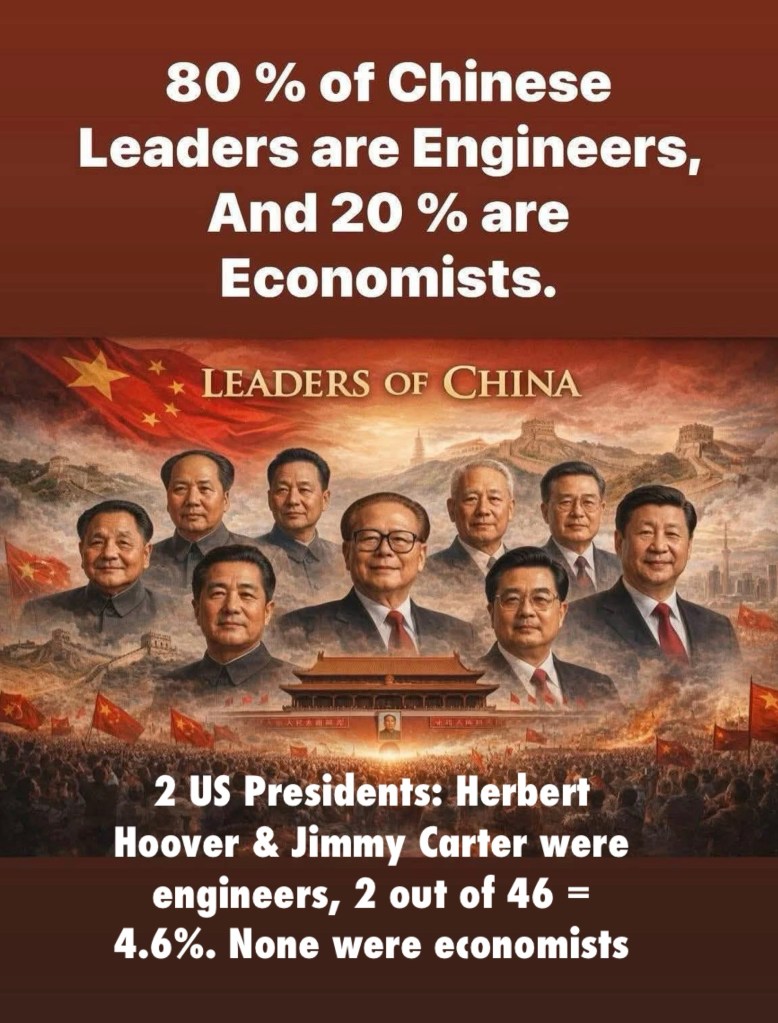
80% of Chinese Leaders are Engineers, 20% are Economists. US leaders: Herbert Hoover & Jimmy Carter were engineers, 2 out of 46 = 4.6%. None were economists! 中國領導人中80%是工程師,20%是經濟學家。美國領導人:赫伯特·胡佛與吉米·卡特是工程師,46人中有2位,佔4.6%。沒有經濟學家! https://www.tiktok.com/t/ZP8uQkvtf/ 🇨🇳
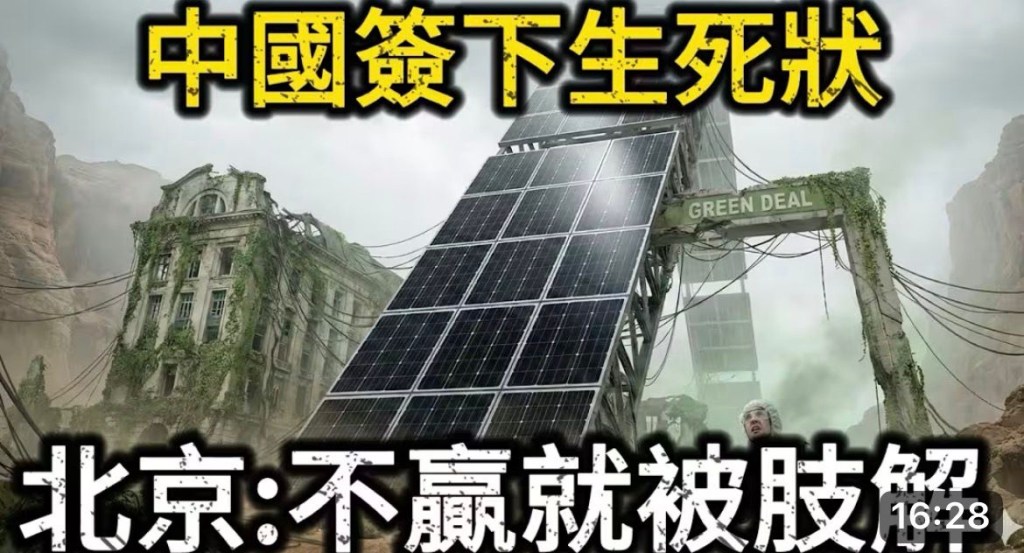
Video with English subtitles: What’s So Ruthless About the 15th Five-Year Plan? China Has Issued a Do-or-Die Order! 影片有英文字幕:十五五规划狠在哪,中国下死命令了!欧美想搞“绿色殖民”,结果被中国反向卡住了咽喉, 美國不死心,未來五年是美國弄死中國的最後機會,否則未來一百年將是中國人的天下。这是一场没有退路的突围。输了,可能面临苏联式的肢解;赢了,就是重回世界之巔。
The West Tried “Green Colonialism”—Only to Be Choked by China Instead. The U.S. Isn’t Giving Up: The Next Five Years Are the Last Chance to Crush China—Fail, and the Next Hundred Years Will Belong to the Chinese People.
This Is a Breakout With No Road Back: Lose, and Face Soviet-Style Disintegration; Win, and Return to the Summit of the World.
Recently, many people’s social media feeds have been flooded with news about mainland China’s “15th Five-Year Plan.” A lot of people see it as just another dull official document—skim it and move on. But if I told you that reading this several-thousand-word document line by line late at night would give you a chilling sense of urgency down your spine, would you still think it was bland and ordinary?
In today’s video, we’re going to completely tear off the bureaucratic mask of this document and help you understand the strongest signal China’s top leadership is sending to every ordinary person. This is not a normal economic plan—it is a wartime-style mobilization order in an era of peace. The authorities have rarely used words like “stormy seas and towering waves,” signaling that they are making the worst, most extreme assumptions about the future international situation.
We will take a deep dive into why Europe and the U.S. will not give China a second chance. In this decisive showdown—one that stakes five thousand years of national destiny—how did China turn the tables, transforming the West’s carefully designed trap of “green colonialism” into a boomerang that clamps back around their own throats? When Western solar and new-energy industries can no longer function without Chinese production capacity, how do so-called “carbon tax” barriers instantly lose their power?
More importantly, we’ll talk about a major shift that directly affects your wallet and mine. The country is moving from “investing in things” to “investing in people,” from frenzied infrastructure expansion to improving people’s livelihoods. Does this mean the definitive end of the real-estate era? In this age of massive reshuffling, how can ordinary people wake up from old speculative dreams and find new cracks for survival?


 Business Blog