More Smart Chinese scientists with high IQ & EQ are returning to China. SCMP: Shang Rui, a chemistry professor at the University of Tokyo, will return to China later this year to join Westlake University, where he will establish a new lab focused on sustainable catalysis and functional molecules. 智商高、情商高的中國科學家正在回國。 《南華早報》:東京大學化學教授尚銳將於今年稍後回國,加入西湖大學,在那裡建立一個專注於永續催化和功能分子的新實驗室. https://johnsonwkchoi.com/2025/04/24/more-smart-chinese-scientists-with-high-iq-eq-are-returning-to-china/
More Smart Chinese scientists with high IQ & EQ are returning to China. SCMP: Shang Rui, a chemistry professor at the University of Tokyo, will return to China later this year to join Westlake University, where he will establish a new lab focused on sustainable catalysis and functional molecules. 智商高、情商高的中國科學家正在回國。 《南華早報》:東京大學化學教授尚銳將於今年稍後回國,加入西湖大學,在那裡建立一個專注於永續催化和功能分子的新實驗室.
Trump says Zelenskyy is prolonging the war in Ukraine is absolutely correct. The longer the war the richer Zelensky gets as he takes a % of all the aides to Ukraine. 川普說澤連斯基在拖延烏克蘭戰爭,這完全正確。戰爭拖得越久,澤倫斯基就越有錢,因為他能從所有烏克蘭援助金中分一杯羹.
Video: The US$ plummeted, so the yen and the euro appreciated, but the RMB did not appreciate could be opportunity for smart investors. 美元大跌, 所以日元歐元等變相大升值, 祇有人民幣沒有升值. 這可能是聰明投資者的機會.
I have many friends and customers who exchanged most of their US dollars for RMB. Just like they sold all the Nvidia and Tesla stocks at the end of last year (I can almost tell you that Nvidia and Tesla are finished) and switched to buy Chinese stocks such as BYD. BYD has risen by 80% in just six months. The shareholders of Nvidia and Tesla are bleeding in the sand! 21 Chinese companies may delist from the US’s NYSE this year and be listed on the HK’s HKSE. Those are all large/powerful Chinese companies. If it is true, you should buy stocks on the Hong Kong Stock Exchange. Now the whole world is not optimistic about the US tariff war. US will definitely lose, and it will lose miserably. The United States is actually very stupid. In this tariff war, many countries that are not friendly to China, such as the European Union, Canada, Australia, Japan, etc., now want to do more business with China and want to have a relationship 💝Except Taiwan😅 我有不小朋友客人把大部分美元換人民幣. 就像他們把 Nvidia 和 Tesla 的股票去年底全賣了(我差不多肯定的告訴你Nvidia 和 Tesla已經玩完) 轉買 BYD 等中國股,BYD 在六個多月,升了八成,Nvidia 和 Tesla 的持股人血染沙塲! 有二十一家中國企業可能今年在美國股票市場 NYSE 退市,改到香港HKSE 掛牌,那些都是中國的實力股,如果是眞的話,要買港交所股票,現在全世界都不看好美國關稅戰,美國一定輸,而且會輸得好慘。美國其實很笨,這塲關稅戰,不少對中國不友好的國家好像歐盟,加拿大,澳洲,日本等,現在都想和中國做更多生意,想談戀愛💝除了台灣😅
While there is absolutely no future for Chinese tech and scientists in America. Jobs opportunities in science and technology are waiting to be filled in China: Postdoc job vacancies in China outnumber PhD graduates by 5 to 1, as similar US roles are slashed due to anti-Chinese sentiment in “delete Chinese” US government tech funding and ongoing hiring freezes. Most Chinese scientists with high IQ and EQ left, those lack EQ are staying subject to endless racist attack and discrimination in America 當中國科技和科學家在美國絕對沒有未來。中國科技領域的就業機會正在等待填補:中國博士後職位空缺數量是博士畢業生的5倍,而美國類似的職位由於中國的反華情緒而被削減,美國政府刪除了科技資金並持續凍結招聘. 智商高、情商高的美國華人科學家大多離開了,情商低的只能在美國遭受無止盡的種族攻擊和歧視!
Behind Trump’s wishful thinking on ‘reindustrialization’: Why China can do it, U.S. can’t 川普「再工業化」如意算盤背後:為什麼中國能做到,美國做不到 By Sara Flounders posted on April 21, 2025
In the 1950s, when Japan and much of Europe was in ruins, the U.S. accounted for 50% of the world’s global production. By the 1960s, this was 35%, declining to 25% by the 1980s. By 2025, the U.S. share of global production had fallen to 12% as production grew elsewhere. (itif.org, Feb. 18)
The capitalist class in the U.S. has grown frantic about this reversal. Its focus is on China, and it blames China for its spectacular level of modern industrial development. In advanced technology manufacturing the future is clear: China holds 45% of the global share to 11% for the U.S.
Higher levels of production need a high-tech infrastructure to move what is produced to global markets. China dominates the global commercial shipbuilding market, producing over 50% of the world’s new ship orders, while the U.S. share has dwindled to less than 1%. China’s shipbuilding industry is backed by a vast industrial base with government support, allowing it to compete on a larger scale than the U.S.
China’s high-speed railroads connect 500 cities and reach through Central Asia into Europe. Meanwhile in the U.S., freight and passenger railroads are in decline.
Can this precipitous decline of U.S. capitalist hegemony be stopped? Can it be reversed? President Donald Trump would have us believe so, but evidence points to a negative answer. The corporate media presents the competition between the U.S. and China as a contention between two nation states, falsely accusing the Chinese government of not playing fair. In reality, China’s advantage arises from the sharp difference in two wholly different forms of organizing society.
Fears of global financial collapse haunt capitalists
The head of the world’s largest hedge fund, billionaire investor Ray Dalio of Bridgewater Associates, recently warned of a global financial system collapse. Trump’s aggressive and erratic tariff policies and ballooning debt could trigger a breakdown of the global financial system. “I’m worried about something worse than a recession if this isn’t handled well,” Dalio said on Meet the Press on April 13.
Dalio said the world is at a critical juncture, marked by profound changes in the political, economic and geopolitical order — factors which have historically led to severe crises. The only way, according to Dalio, to get through this crisis for the whole system is to lower the deficit from 7% to 3%. Dalio did not mention lowering the military budget or taxing the billionaires. Thus, he is justifying an all-out attack on the working class.
False promises of reindustrialization
Several past U.S. presidents have promised, as Trump has promised, to reindustrialize the U.S. economy and bring millions of productive manufacturing jobs back to the U.S. Trump promised this eight years ago during his first term and former President Joe Biden promised a vast program to “Build Back Better” and reindustrialize the U.S. economy and modernize infrastructure.
Both Trump and Biden promised job growth. Neither effort moved past the proclamation stage.
The national urgency to reindustrialize and modernize U.S. industry was a source of anxiety and debate in ruling circles long before the balance of trade with China was a factor.
Reindustrialization was a huge promise of the Jimmy Carter and Ronald Reagan administrations in the 1970s and 1980s. At that time, reindustrialization was a precursor to the so-called “high tech revolution.” It was the first stage of a massive capitalist restructuring that killed untold numbers of good-paying jobs by replacing human beings with robots and automation.
Real wages, adjusted for inflation, have barely budged for most workers and have fallen for the lowest–paid workers since the assault in the 1970s. The pitch in the 1980s — that the increased need for a highly skilled technological workforce would balance out the drop in manufacturing jobs — never materialized. Thanks to technology, the astronomical rise in worker productivity has led to enormous profits but no increase in real wages.
Trump’s magical thinking
On April 2, Trump’s announced tariffs on 150 countries, proclaimed as “Liberation Day,” would purportedly reorder the international economic system and force manufacturing to return to the U.S. This is wishful or magical thinking. It ignores the most basic law of capitalist investment.
As Karl Marx explained 175 years ago in his classic work, “The Communist Manifesto,” the bourgeoisie, i.e. the capitalist class, chases all over the globe for the highest rate of profit, the quickest returns, the cheapest labor. The owning class has no sentimental loyalty to any country, only to securing markets and profits. The productive forces are constantly being revolutionized, modernized and made more ruthlessly efficient.
The tumbling stock market forced Donald Trump to quickly “pause” global tariffs for 90 days, because they so severely impacted U.S. billionaires operating in a global market.
Trump then further raised tariffs on goods imported from China, as China in response imposed higher tariffs on U.S. imports. U.S. tariffs on Chinese imports ballooned to 145% on some products, up to 245% on others.
Again, certain U.S. billionaires forced Trump to reverse course. Apple and Nvidia scored major victories with Trump’s decision to exempt many popular consumer electronics imported from China. These include iPhones, iPads, Macs, Apple Watches and AirTags, other smartphones, computers and consumer electronics.
In another reversal, Washington had originally placed fees as high as $1.5 million per port call on all Chinese-built ships. But that order was quietly dropped after a stormy public hearing in which U.S. officials faced a chorus of objections from shipping executives.
The latest executive order — titled Restoring America’s Maritime Dominance — puts forth a grand program but with no amount of grand money to carry it out, except for funding aircraft carriers and destroyers. The order contains no plans for ports or freight carriers.
Military budget – a drain on the economy
As they have done for decades, at each step to boost their bottom line, U.S. capitalists chose the easiest, most immediately profitable path. Investment money gravitates relentlessly to the highest guaranteed profits, and that is usually the military budget with its huge, guaranteed, multibillion-dollar annual subsidy.
In a further effort to halt a free fall in the stock markets, Trump announced the largest military budget in history. “Nobody’s seen anything like it,” he bragged, describing a Pentagon budget that would exceed $1 trillion. This means that the U.S. strategy is still to impose its military domination at the expense of funds for industrial development and infrastructure.
This quick fix won’t solve the problem of building new industries with new jobs, but it throws a bone to the giant military industries.
Federal funding has been pumped into the military for over two generations, to where it now dominates the U.S. economy. This funding provides a huge subsidy and a guaranteed source of profits to the military-industrial complex. But what was a quick fix has become a drag on the economy.
In the same way a drug can initially provide a stimulant and boost energy, with time military spending becomes an addiction that hollows out the rest of society. It adds nothing of real value to the economy and weakens the civilian infrastructure by draining it of resources needed for vital social programs, including those that educate its workforce.
Partly due to 75 years of endless military expenditures, the U.S. economy is in an irretrievable downward spiral. More threats, more sanctions and more tariffs will lead to further deterioration of a declining U.S. economy.
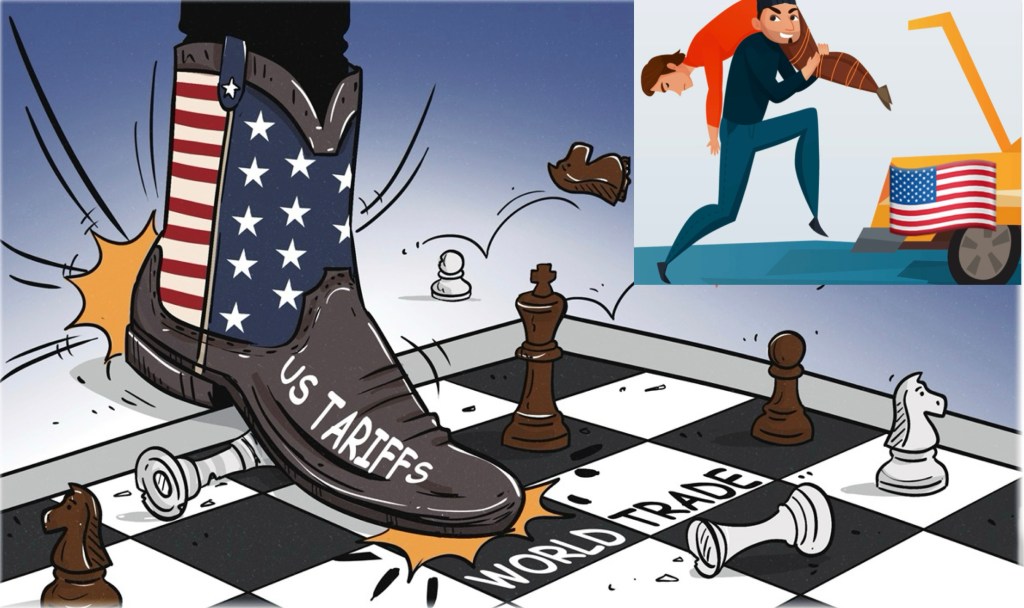
Tariffs are a tax
U.S. tariffs are not paid by the businesses that export to the U.S. Tariffs are paid to the U.S. government by the U.S. corporations that ordered the goods. Most often the cost is passed on to the consumer. It’s true that, with the mega-billions in profits the wealthy have reaped from stolen workers’ labor, the wealthy could afford to eat at least a portion of the cost of tariffs. But they won’t! So tariffs are paid by working people in the U.S. in the form of higher prices.
Despite Trump’s hype, tariffs will not reindustrialize the U.S. economy in a way that brings back any significant number of manufacturing jobs. They won’t reverse the U.S. economy’s increasingly slow growth, long-term decline and the loss of U.S. competitiveness in global markets. Creating a wall of protection to stop the flow of imported goods into the U.S. won’t build new factories here.
In a similar way, U.S. sanctions are a failed form of economic warfare against more than 40 developing and formerly colonized countries comprising one-third of the world’s population. Economic strangulation, the policy of intentionally blocking all trade, credits and loans, creating artificial famines, shortages, hyperinflation, even depriving essential medicines, has had disastrous results.
The tax on millions of imported products will backfire on a deteriorating U.S. economy and harm working people. It is already fueling inflation, eroding international relations, creating a trade war and destabilizing the global economy.
The system is to blame
By moving production overseas for the past four decades, U.S. corporations ruthlessly deindustrialized the U.S. economy under the rallying cry of “free trade.” Their goal was to maximize profits by paying lower wages to overseas workers. Millions of U.S. workers lost jobs, homes, futures and pensions as a result, while overseas workers were superexploited. The average wage of a Mexican autoworker is around $5 an hour; in India it’s about half that amount, compared to a top rate of over $30 an hour for a unionized autoworker in the U.S.
What was called reindustrialization was really deindustrialization. Deindustrialization meant the loss of heavy industry: auto, steel, ship building, railroads and ports. It meant closing factories that produced basic appliances, from washing machines to air conditioners. Every imaginable industry from canneries and food processing to the garment industry moved their highest tech production lines to low-wage countries.
In the 1960s, some 95% of garments worn in the U.S were made domestically. This garment industry has all but disappeared. This loss was part of a broader erosion of the U.S. manufacturing base in which more than 70,000 factories were permanently closed.
Blaming workers in other countries for a process initiated by U.S. capitalists means deliberately opening a totally unwarranted and racist attack.
The U.S. stands as a dominant force in global outsourcing. Approximately 300,000 jobs are outsourced annually. The economic implications are substantial, as the U.S. market alone generates $62 billion of the $92.5 billion in globally outsourced products and services. (Forbes, Oct. 15, 2024)
Many U.S. tariffs target countries that have been U.S. allies. Destabilizing the economies of other countries is a shortsighted and desperate act. But it will still not strengthen the U.S. economy.
Why can’t U.S. capitalists save their own economy?
The U.S., as a capitalist country, really can’t and won’t reindustrialize, because that is a fabulously expensive process involving many years of investment of the capitalists’ own money.
In U.S. corporate law and policy, “shareholder primacy” ordains that it’s a corporate board’s exclusive fiduciary duty to maximize shareholder value — that is, to boost the price of stock and the goodies distributed to shareholders. Implicitly, this means that corporations do not have binding obligations to pursue the good of their workers or the public as a whole.
Corporate CEOs know they will only survive by maximizing profits and guaranteeing hefty returns every quarter. Any attempt to reindustrialize requires a rethinking of, and massive investments in, infrastructure and education needed for such an economy. This takes decades of investments.
Why can China plan while the U.S. can’t?
In sharp contrast to the narrow U.S. view, China plays a worldwide role through international initiatives. This includes a key role in BRICS+, an intergovernmental trade organization with 11 member countries and nine partners; the Shanghai Cooperation Organization, with 10 members; and especially China’s Belt and Road Initiative with 140 members.
These trade and development organizations foster greater economic and geopolitical integration, a sharing of technology and coordination for emerging economies.
China has a socially planned economy where the greatest sources of wealth in society are owned by the whole nation. Banking, communication, freight, raw materials, electric power, railroads, ports, etc., are State Owned Enterprises (SOEs).
There are big capitalists in China, but the largest share of the Chinese economy is state-run.
The Chinese Communist Party, with 90 million members, controls this development process. It is rooted in a revolutionary overturn of the corrupt, old feudal society and ending imperialist occupation in 1949. Its economic policies and reorganization of society have ended dire poverty for 800 million people and transformed the poorest country on the planet into today’s modern marvel.
A significant portion of China’s free higher education starts with an emphasis on STEM education — science, technology, engineering and math. Each year the country produces some 3.5 million STEM graduates. This is approximately 10 times as many as those from U.S. educational institutions. In the U.S., 54% of adults read at below sixth grade levels. (Reddit, October 2023)
High levels of skill and advanced education are essential for intervention in today’s world.
Capitalism: an impediment to social progress
Ruthlessly lowering wages, cutting social benefits, infrastructure investments and education is the short-sighted billionaire strategy.
The private ownership of the means of production, the expropriation of all socially produced wealth by a handful of billionaires can mean fabulous wealth for a few, in the short term. However, it is an actual impediment to the ability to modernize industry in today’s global supply chains. U.S. imperialism is incapable of modernizing into today’s global economy, because it is totally chained to an outmoded form of production — capitalism.
U.S. imperialism can threaten to destroy its opponents to impose its demands. This is a powerful threat. But the capitalists will discover that military might not backed up by industrial capacity becomes a paper tiger, growling without substance.
The interests of workers and oppressed people in the U.S. are bound up with the development of the people of the whole world. Only through increased cooperation and solidarity will our class here develop the ability to solve the enormous global problems.
The ability to rationally plan and invest socially created wealth into rapidly improving technology and infrastructure is decisive. This requires socialism.
SCMP: video-Chinese researchers have successfully detonated a hydrogen-based explosive device in a controlled field test, triggering devastating chemical chain reactions without using any nuclear materials, according to a study published last month. 香港南華早報: 視頻: 根據上個月發表的一項研究,中國研究人員在一次受控現場試驗中成功引爆了一枚氫基爆炸裝置,在不使用任何核材料的情況下引發了毀滅性的化學鍊式反應.
Johnson Choi, Yen Chun and others were the Delegates from Honolulu Hawaii to attend the Hainan-Honolulu City Sister Agreement signed in Hainan in 1985. The first international hotel in Sanya Hainan was Sheraton opened in 1995. Today Hainan is known as China’s Hawai’i also a free trade zone in China. Currently the hostilities by US towards China, Hainan has become the alternatives replacing Hawai’i. 1985年, 蔡永強,陳燕等人作為夏威夷檀香山市的代表,出席了海南省與檀香山市締結友好城市協議的簽署儀式。第一家在海南三亞開設國際飯店是1995年開幕的喜來登飯店. 如今,海南被稱為中國的夏威夷,也是中國的自由貿易區。目前美國對華採取敵對行動,海南已成為夏威夷的替代選擇.