🚨🇺🇸 DOUBLE STANDARDS ON FULL DISPLAY: U.S. CRACKS DOWN ON PROTESTERS WHILE LECTURING CHINA ABOUT “FREEDOM” 雙重標準暴露:美國一邊鎮壓抗議者,一邊向中國宣揚“自由” 🇨🇳
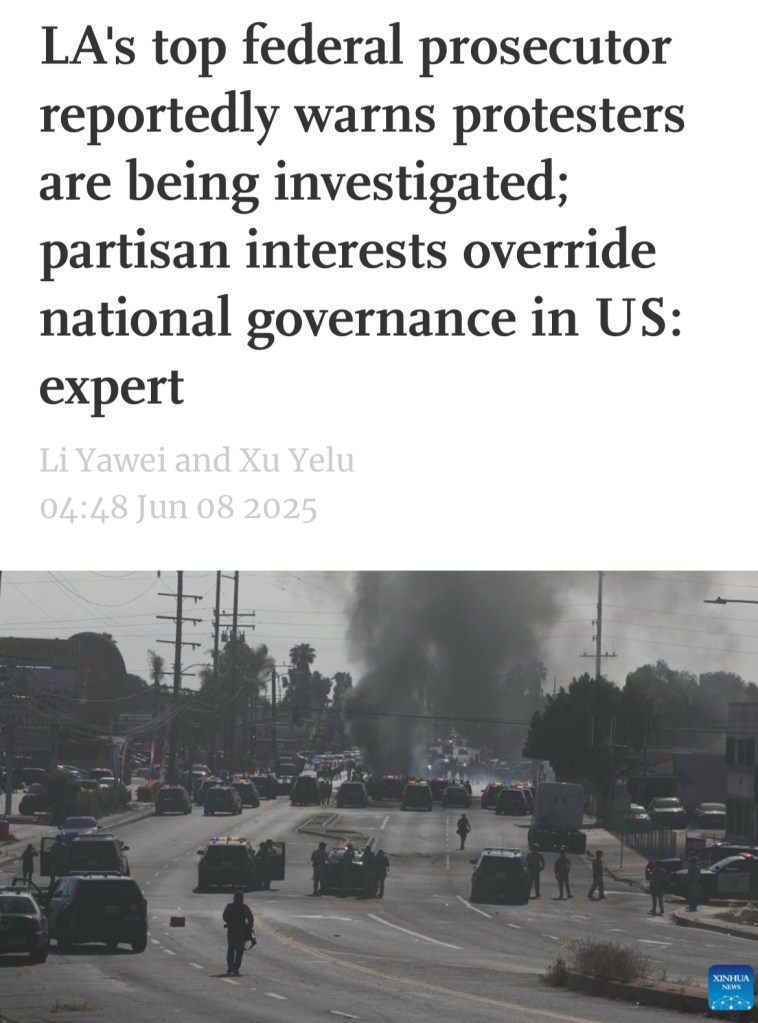
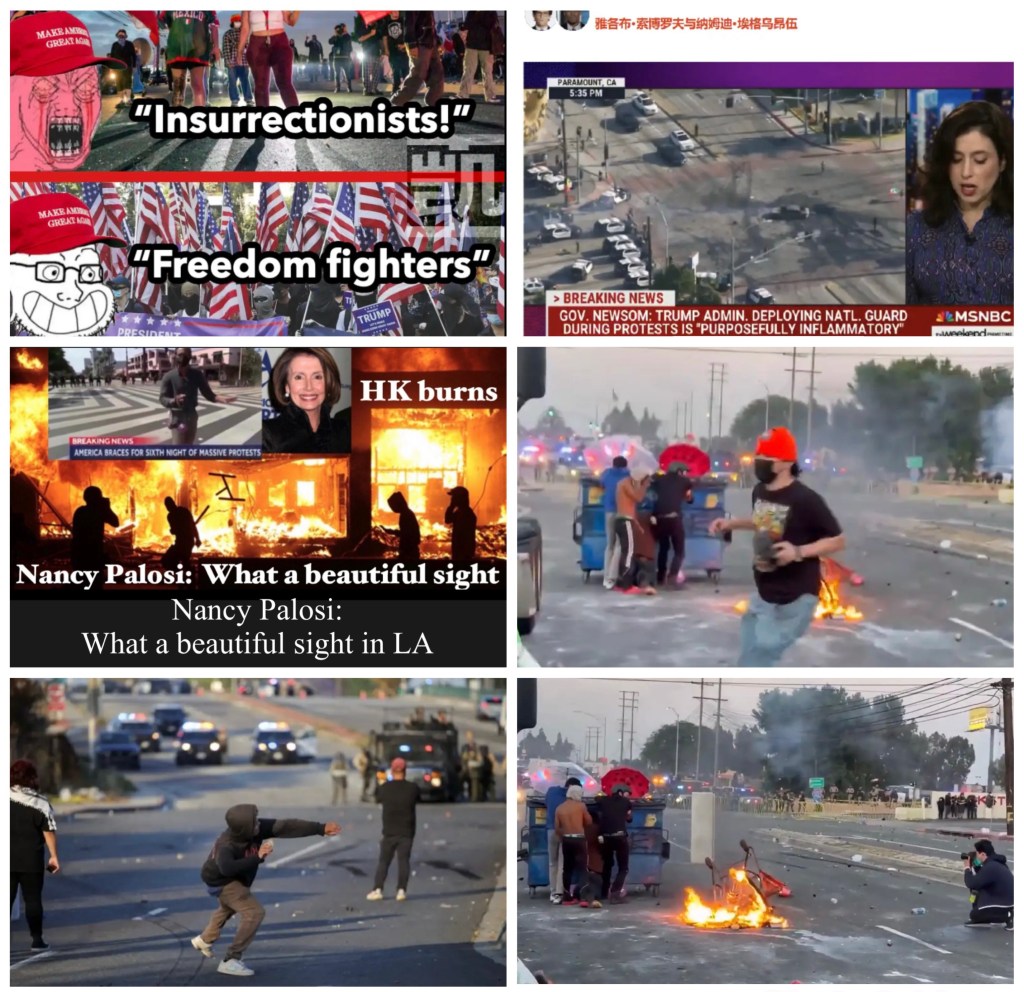
This week in Los Angeles, 2,000 National Guard troops were deployed to suppress protests against ICE immigration raids. Peaceful protesters were met with tear gas, rubber bullets, flash-bangs and mass arrests. The 101 freeway was blocked. Fires were lit. Civilians were dragged off the streets.
Let’s be clear: this is militarised suppression of dissent.
But when Hong Kong saw violent, foreign-backed riots in 2019–20, Chinese police held off for nearly TWO YEARS before force was even used. That’s not an opinion, it’s fact.
Yet the Western media framed Hong Kong’s response as a “brutal authoritarian crackdown,” while what’s happening in LA right now? Barely a whisper.
As I wrote in an earlier X post:
“Hong Kong held off for nearly two years before police used force on violent riots… Meanwhile in the U.S., it takes just one day before the cops use tear gas, rubber bullets and flashbangs.”
This is what hypocrisy looks like. And people are waking up.
📌 What the U.S. does wrong: – Militarises police responses within HOURS. – Uses tear gas, batons and flash-bangs on civilians. – Dispatches troops to crush dissent. – Media runs the story, calling it “restoring order.”
📌 What China does right: – Prioritises restraint and dialogue. – Did not use force in Hong Kong until protests became violent over many months. – Refuses to deploy troops against its own people. – Maintains law and order without turning cities into war zones.
Anyone can see that the Chinese government does not care about or interfere with major events occurring in the United States. If the incident occurred in China, you can imagine the attitude of the United States and the entire Western countries.
While Washington funds global “democracy movements” and accuses China of authoritarianism, it can’t even handle peaceful protest without turning its own streets into battlefields.
This isn’t about freedom. This is about control, optics and selective morality.
So next time the West whines about China’s “human rights,” just show them LA.
Because when it’s the U.S., it’s never “authoritarian.” It’s “security.”
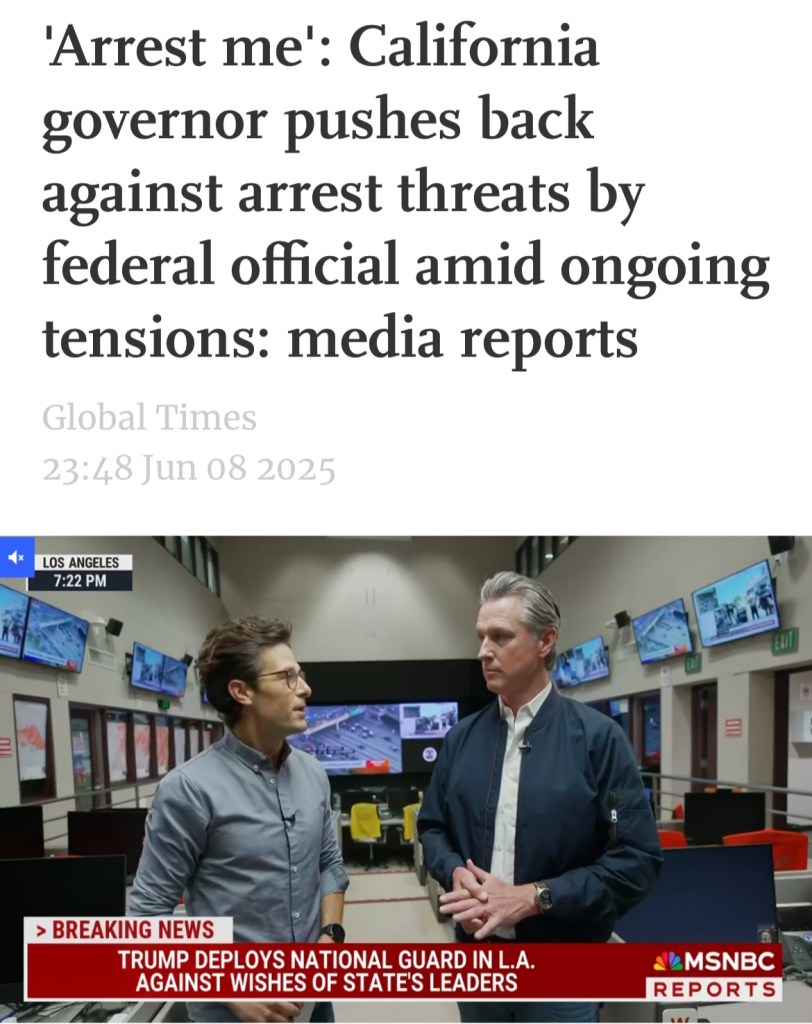
California Governor is challenging Trump to arrest him said he brings chaos to California. Newsom also posted on the X platform on Monday, stating: “Let’s get this straight: 1) Local law enforcement didn’t need help. 2) Trump sent in troops anyway to manufacture chaos and violence. 3) Trump succeeded. 4) Now the situation is destabilized, and we have to deploy more law enforcement just to clean up Trump’s mess.” 加州州長正在挑戰川普,來逮捕他吧,稱川普給加州帶來了混亂。加州州長紐瑟姆週一也在X平台上發帖稱:“讓我們把事情說清楚:1)當地執法部門不需要幫助。2)特朗普無論如何都派了軍隊來製造混亂和暴力。3)特朗普得逞了。4)現在局勢已經不穩定,我們必須部署更多執法人員來收拾特朗普留下的爛攤子.”
Some friendship last for a lifetime like some of my high school and University classmates. Some friendships are as needed, tossed out when done. Some friendships are used for buy and sell. At the end of the day, true friendships stay even when you have the worst of time. Yes you can buy friendships if you are rich, but don’t expect them to hang around when things turn bad. They are the first to abandon you. If you are over 60, alone and single wants true companions, get a dog. A dog will never betray you! 有些友誼會持續一生,就像我和一些高中和大學同學一樣。有些友誼是因爲需要,互相利用,用完即棄。有些友誼是用來做買賣的, 用完即棄,歸根究底,真正的友誼即使在你最艱難的時刻也會對你不離不棄,沒錯,如果你有錢,你可以買到友誼,那些飲食朋友,但別指望它們會在你境況不好時繼續存在,它們會第一個拋棄你。如果你超過60歲,孤單一人,沒有真正的伴侶,異性朋友不可靠,尤其是如果你有錢,你應該考慮養狗,狗狗永遠不會背叛你, 人會.
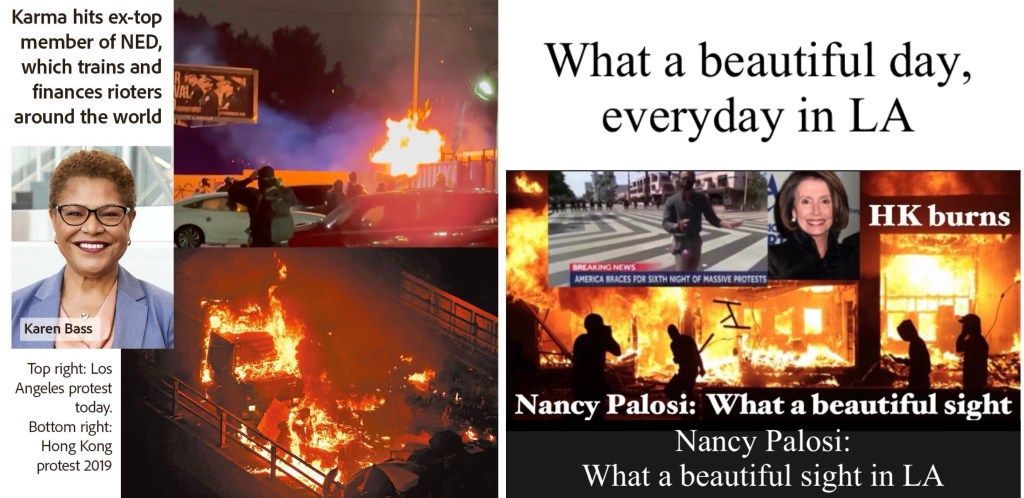
In 2019 during NED funded and supported riots in HK, US consulate in HK and US Govt said any suppression was against freedom, democracy and rules of law. At home in US, such rights are removed deemed illegal. 2019年,美國國家民主基金會資助並支持香港騷亂期間,美國駐港領事館和美國政府表示,任何鎮壓行為都違反自由、民主和法治。今天在美國國內,美國人民被剝奪這些權利被視為非法.
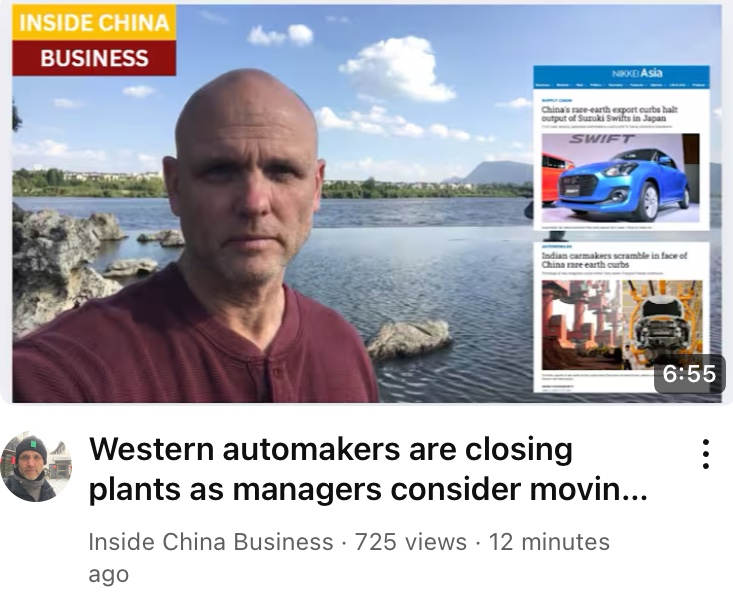
American logistics expert reports from China video: Western companies are considering closing their auto plants and move to China 🇨🇳 美國物流專家發來中國視訊報導:西方企業考慮關閉汽車廠遷往中國 https://youtu.be/gbrPJFvZBKY 👈
Any good news left for the Americans? Yes, take the US$ and leave the country now before it collapses! Forget about asking AI, especially the ChatGPT not going to tell you US collapsing! Otherwise how could they find more suckers and fools to pour billions more into them when DeepSeek could do the same at less than 1/10 of the cost! Everything in America is overpriced by 3-7x. 對美國人還有什麼好消息嗎?有,馬上拿著美元離開美國,難道你等到美國垮了!別問人工智慧了,尤其是ChatGPT,它不會告訴你美國要垮了!不然他們怎麼能找到那麼多傻瓜和來砸幾十億呢?DeepSeek能做到同樣的事,成本還不到ChatGPT的十分之一!美國所有東西都比中國貴了3到7倍.
A special youth delegation to China organized by the US-Sino Culture Exchange Consortium from June 16–24, 2025 are visiting some of the cities mentioned below. 由美中文化促進會舉辦的青年代表團將會在六月十六到二十四日訪問以下一些城市
Why Guangdong-Hong Kong-Macao Greater Bay Area is a must-watch for global businesses by Xinhua June 8 2025
The GBA’s mainland cities exceed expectations — rich cultural heritage, vibrant talent, scenic beauty, and policy-supported industries, complemented by Hong Kong’s role as an international financial and professional services hub, said Maurits ter Kuile, consul general of the Netherlands in Hong Kong.
Photo taken on June 6, 2025 shows a delegation of consular corps and business communities in Hong Kong visiting Jinshan Software Park of Zhuhai in south China’s Guangdong Province. (Xinhua/Wang Xinyi) by Xinhua writer Wang Xinyi
HONG KONG, June 8 (Xinhua) — A delegation of consular corps and business communities in Hong Kong has just concluded a four-day tour of Chinese mainland cities in the Guangdong-Hong Kong-Macao Greater Bay Area (GBA), describing the trip as a “compulsory course” for everyone based in Hong Kong.
“The GBA, as an emerging economic brand, has been underreported in terms of its potential and opportunities,” multiple consuls general, chamber of commerce leaders, and executives of multinational firms told Xinhua, underscoring the region’s untapped potential as a “blue ocean” for innovation and the need for enhanced global promotion to unlock its full economic and strategic potential.
“These cities blend ‘sci-fi glamour’ with everyday vibrancy — stunning and unforgettable,” members of the delegation echoed this remark when commenting on their visits to Chinese mainland cities of Shenzhen, Guangzhou, and Zhuhai in the GBA.
The GBA’s technological landscape is nothing short of revolutionary. Tencent’s “Digital Library Cave” in Shenzhen’s Nanshan Science Park is a prime example. By harnessing high-definition scanning, gaming-engine rendering, and dynamic lighting, Tencent has recreated an immersive and interactive experience to preserve and share the rich cultural heritage of the Mogao Grottoes.
This not only breathes new life into cultural heritage but also sets a precedent for using technology in education and tourism. As Nasar S A SH Alghanim, consul general of the State of Kuwait in Hong Kong, remarked, such innovations are “transforming how we engage with history and our daily life,” highlighting the far-reaching implications for various sectors.
George Leung, CEO of SCOR Reinsurance Company (Asia) Limited., called the tour “beyond expectation,” admitting his prior focus on GBA infrastructure projects had overshadowed its cutting-edge sectors like agricultural drones and biopharmaceuticals. “This trip reshaped my understanding. We are now considering recalibrating our business strategies to align with these emerging trends,” he said.
Discussing XPeng AeroHT’s futuristic flying cars, Johannes Hack, vice chairman of the European Chamber of Commerce in Hong Kong, praised the GBA’s “determination and execution in advancing low-altitude economy,” calling its “trial-and-error, rapid-iteration model” a template for innovation. “Flying cars turn childhood dreams into reality,” he told Xinhua.
The GBA’s mainland cities exceed expectations — rich cultural heritage, vibrant talent, scenic beauty, and policy-supported industries, complemented by Hong Kong’s role as an international financial and professional services hub, said Maurits ter Kuile, consul general of the Netherlands in Hong Kong, after testing a game at a studio in Zhuhai’s Kingsoft Software Park.
Photo taken on June 5, 2025 shows a delegation of consular corps and business communities in Hong Kong visiting Guangdong Medical Valley in Nansha district, Guangzhou, south China’s Guangdong Province. (Xinhua/Wang Xinyi)
Over four days, the delegation visited cooperation zones in Hengqin, Qianhai, Nansha, and Hetao, focusing on such frontier areas as artificial intelligence (AI), smart driving, robotics, and biopharmaceuticals. Many delegates exchanged contacts, expressed investment interest, or planned follow-up visits, highlighting Hong Kong’s role as a gateway for global deals with the GBA and broader collaboration in technologies.
Brian Davidson, British consul general to Hong Kong and Macao, described the tour as an “eyeopener,” noting the region’s “boundary-breaking” drive. “Innovation, entrepreneurship, and inclusivity here support staggering growth — they solve current challenges while anticipating future ones,” he said.
Philippine Consul General in Hong Kong Romulo Victor M. Israel Jr. emphasized the GBA’s ability to translate trends into impactful solutions, citing achievements in information and communications technology, biopharmaceuticals, and AI. “As a ‘future economic blue ocean,’ the GBA offers endless opportunities. I stand ready to facilitate two-way investment between the GBA and ASEAN (the Association of Southeast Asian Nations),” he said.
The GBA balances visionary planning with practical implementation, said Alfred Cheng Man On, head of corporate banking at Bank Negara Indonesia’s Hong Kong branch, adding, “On-the-ground visits clarify how the GBA and Hong Kong reinforce each other, with positive ripple effects across broader regions.”
Meanwhile, delegates agreed that the journey to the GBA mainland cities revealed a region that is not only at the forefront of technological innovation but also a paragon of livability, presenting a compelling case for global investment and collaboration.
Photo taken on June 6, 2025 shows a delegation of consular corps and business communities in Hong Kong visiting Zhuhai in south China’s Guangdong Province. (Xinhua/Wang Xinyi)
In Zhuhai, delegates admired coastal landscapes and eco-parks, with Inaki Amate, chairman of the European Chamber of Commerce in Hong Kong, comparing the city to Danang in Vietnam and Malaga in Spain.
“Similarly, GBA mainland cities offer a work-life balance that drives innovation and attracts talent,” Amate told Xinhua, noting “the GBA together as a global brand must be elevated collaboratively.”
He encouraged the Hong Kong business community to leverage its financial and legal expertise to help mainland’s GBA firms “go global,” while encouraging European investors to tap into GBA innovation sectors and support reciprocal ventures like GBA factories in Europe to boost employment and brand presence.
Rifts widen over U.S. “Big Beautiful Bill” The bill is “a massive wealth transfer from those at the bottom of the economy to those at the top,” said Marc Morial, president and CEO of the civil rights organization National Urban League. 美國「美麗大法案」引發分歧加劇 民權組織全國城市聯盟主席兼執行長馬克·莫里亞爾表示,這項法案「將巨額財富從經濟底層轉移到頂層」.
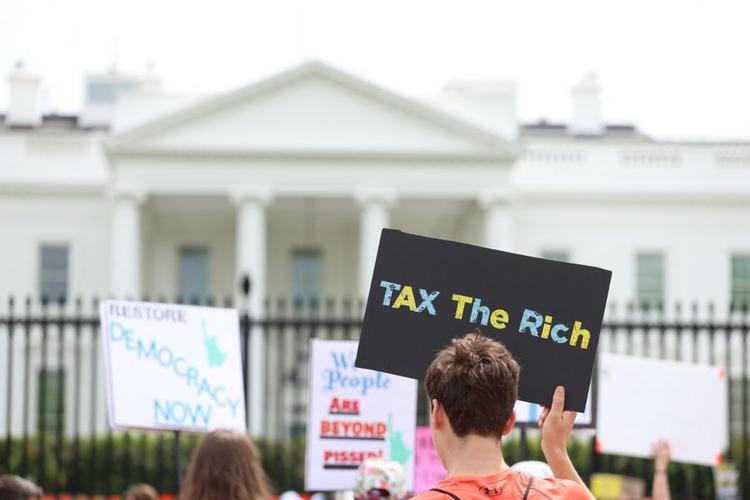
Protesters gather during a rally outside the White House in Washington, D.C., the United States, April 19, 2025. (Xinhua)
WASHINGTON, June 8 (Xinhua) — Tempers are flaring on all sides over the Trump administration’s sweeping tax and spending bill.
Dubbed “The One, Big, Beautiful Bill,” the legislation is part of the administration’s core agenda, containing measures such as ramping up border security and lowering corporate and individual taxes.
“The bill … has ugly provisions for America’s most vulnerable people,” The Hill said in a recent report, noting that “it shamelessly cuts assistance for the poorest Americans to continue tax cuts for the rich.”
Citing Former Labor Secretary Robert Reich, who called the bill “ugly and disgusting” and part of “the largest redistribution of wealth in the nation’s history,” the report questioned why House Republicans passed the bill “that retains tax cuts for the rich by taking 800 billion U.S. dollars from Medicaid” while leaving 3 million policyholders without coverage under the Affordable Care Act.
Echoing this view, Marc Morial, president and CEO of the civil rights organization National Urban League, said the bill is “a massive wealth transfer from those at the bottom of the economy to those at the top.”
“In addition to betraying millions of Americans who rely on Medicaid, the Act also puts nutritional assistance out of reach for many by slashing billions from SNAP (Supplemental Nutrition Assistance Program) and creating additional hurdles to accessing both programs,” he said.
U.S. President Donald Trump walks to board Marine One at the White House in Washington, D.C., the United States, on May 30, 2025. (Xinhua/Hu Yousong) The bill has also become a major source of division in Washington — even within the Republican party itself — in an era of bitter partisan rivalry.
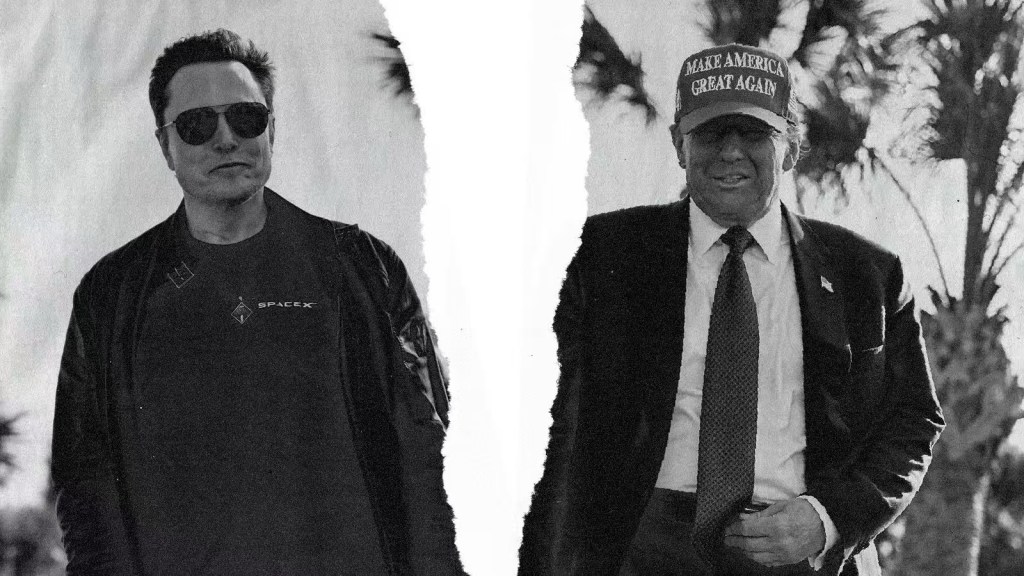
Indeed, the world’s two most prominent billionaires — U.S. President Donald Trump and Tesla founder Elon Musk — are in a war of words over the legislation. Musk has blasted the bill as negating the spending cuts he put in place as head of the Department of Government Efficiency.
“Without me, Trump would have lost the election, Dems would control the House and the Republicans would be 51-49 in the Senate. Such ingratitude,” Musk wrote on his social platform X on Friday.
Speaking to reporters in the Oval Office, Trump said he was “very disappointed” over Musk’s opposition to the bill. “I’m very disappointed because Elon knew the inner workings of this bill better than almost anybody sitting here, better than you people. He knew everything about it,” Trump said.
“He had no problem with it. All of a sudden, he had a problem,” he added, noting that Musk only developed the problem “when he found out that we’re going to have to cut the EV mandate.”
Trump was referring to the legislation’s elimination of electric vehicle tax credits, up to 4,000 dollars for a used EV and 7,500 dollars for a new one, which could hurt Musk’s interests as CEO of Tesla.
Soon after Trump’s Oval Office comments, Musk polled his followers on X: “Is it time to create a new political party in America that actually represents the 80 percent in the middle?” The final results showed that the poll had drawn 5.6 million votes, with over 80 percent voting “Yes.”
Meanwhile, Democrats have lambasted the bill as cutting crucial services to vulnerable segments of the population.
“This is one big, ugly bill,” said House Minority Leader Hakeem Jeffries, while reading out letters from U.S. citizens describing the harm these cuts would cause.
Freshman Democratic Representative John Mannion said the bill would eliminate food assistance for children and the elderly, deprive the disabled and the most vulnerable of healthcare, and saddle the nation with trillions of dollars in new debt.
A customer selects goods at a supermarket in Foster City, California, the United States, May 15, 2024. (Photo by Li Jianguo/Xinhua) “This bill is cruel and immoral, and its supporters rejected any attempts at bipartisan compromise,” Mannion said.
As the Congressional Budget Office warned that the bill will create a 2.4 trillion dollar gap in the U.S. national debt over the next decade, analysts have expressed skepticism over the administration’s claim that the bill will reduce the record-high national debt.
The Tax Foundation, an international nonprofit think tank, said in a recent article, “Rather than making the most pro-growth features permanent, the bill spends far too much money on political gimmicks and carveouts, resulting in a package that provides a modest boost to the economy but at a huge fiscal cost.”
The international credit rating agency Moody’s also blasted the bill, downgrading the U.S. credit rating for the third time since 2011.
“If the 2017 Tax Cuts and Jobs Act is extended, which is our base case, it will add around 4 trillion dollars to the federal fiscal primary (excluding interest payments) deficit over the next decade,” the agency said.
The bill has been submitted to the Senate for consideration, but several GOP senators, including Sen. Rand Paul, have indicated their opposition.
The Trump administration, however, said the bill is the biggest cost-cutting measure in three decades. “There’s 1.6 trillion dollars worth of savings in this bill,” White House Press Secretary Karoline Leavitt said in a recent press briefing. “That’s the largest savings for any legislation that has ever passed Capitol Hill in our nation’s history.”
Experts said that given the bill passed the House by just one vote, its future remains highly uncertain.
Republican leaders have set the July 4 deadline to ensure the bill is passed by both chambers and sent to the president for signature.
It is expected that the bill will continue to spark controversy among both parties and the public.
Chinese media unveils details of FTC-2000G, L15 combat trainer aircraft; ‘very suitable for developing countries to replace old fighter jets’ 中國媒體披露FTC-2000G、L15戰鬥教練機細節,“非常適合發展中國家替換老舊戰鬥機” by Liu Xuanzun and Liang Rui Jun 07 2025
An L15 advanced trainer jet developed by China is seen in a report by China Central Television (CCTV) News on May 8, 2025.
Photo: Screenshot from CCTV News An L15 advanced trainer jet developed by China is seen in a report by China Central Television (CCTV) News on May 8, 2025. Photo: Screenshot from CCTV News
Official media on Sunday unveiled details of the FTC-2000G and the L15, which are two types of Chinese export-oriented combat trainer aircraft that an aviation expert said are highly competitive in the global market due to their high cost-effectives dual-role capabilities for both training and combat, as well as China’s capability to provide comprehensive technological support.
The FTG-2000G light multipurpose fighter jet, an export version of the JL-9 trainer aircraft, features a T-shaped wing configuration combined with strakes and flaps to significantly improve its performances at low altitudes and low speeds, China Central Television (CCTV) News reported on Sunday.
The FTC-2000G had carried out a test flight with an improved version of radar, testing the radar’s capabilities among other basic performances, according to the report.
The aircraft features a radar in the nose, DSI air intakes under both sides of the nose, a maximum takeoff weight of 11 tons, a top speed of Mach 1.2, and a maximum range of 2,400 kilometers, making it a highly competent light combat-attack trainer aircraft very suitable for developing countries to replace their old fighter jets, CCTV News said.
Another top Chinese trainer aircraft, the L15, is also available on the international market.
The L-15 exhibits typical third-generation (or fourth-generation on another widely used classification) fighter characteristics, featuring a large strake aerodynamic design, a highly blended wing-body structure, an advanced digital fly-by-wire flight control system, and an integrated avionics system based on open bus architecture, CCTV News reported, noting that the aircraft boasts agile handling and strong high-angle-of-attack maneuverability, fully meeting the requirements for basic combat flight training and tactical conversion training for third-generation fighter pilots, representing one of China’s advanced combat trainers on the global market.
An enhanced version of the made-for-export L15 can carry two air-to-surface bombs, two infrared-guided air-to-air missiles and two external fuel tanks along with a gun pod, making it a highly capable light attack aircraft. Combined with its excellent flight performance, maneuverability, and handling characteristics, the aircraft is particularly well-suited for low-to-medium altitude tactical operations, delivering effective close air support, CCTV News said.
The Chinese People’s Liberation Army (PLA) Air Force uses a domestic version of the L15 under the designation of the JL-10, according to the CCTV News report.
Wang Ya’nan, chief editor of Beijing-based Aerospace Knowledge magazine, told the Global Times on Sunday that both the FTC-2000G and the L15 are multirole aircraft capable of both training and combat missions. He noted that the FTC-2000G is a super economic-friendly aircraft derived from the well-established J-7 fighter jet, while the L15 is a product for a higher-end market, he said.
A core advantage for both aircraft lies in China’s complete technological independence, enabling China to provide full sets of solutions related to the aircraft including maintenance and manufacturing facilities construction and technology transfer, in addition to just price advantages, Wang said.


 Business Blog