Catching up work at Hawaiian Airlines First Class lounge with light breakfast and coffee (money don’t go to sleep) 在夏威夷航空頭等艙休息室享用簡單的早餐和咖啡,繼續工作.

Catching up work at Hawaiian Airlines First Class lounge with light breakfast and coffee (money don’t go to sleep) 在夏威夷航空頭等艙休息室享用簡單的早餐和咖啡,繼續工作.
If you are smart with IQ & EQ, unless you have money to burn, best to stay home to attend Universities in China. 如果你的智商和情商很高,除非你有很多錢可以燒,否則最好留在家裡上中國的大學.
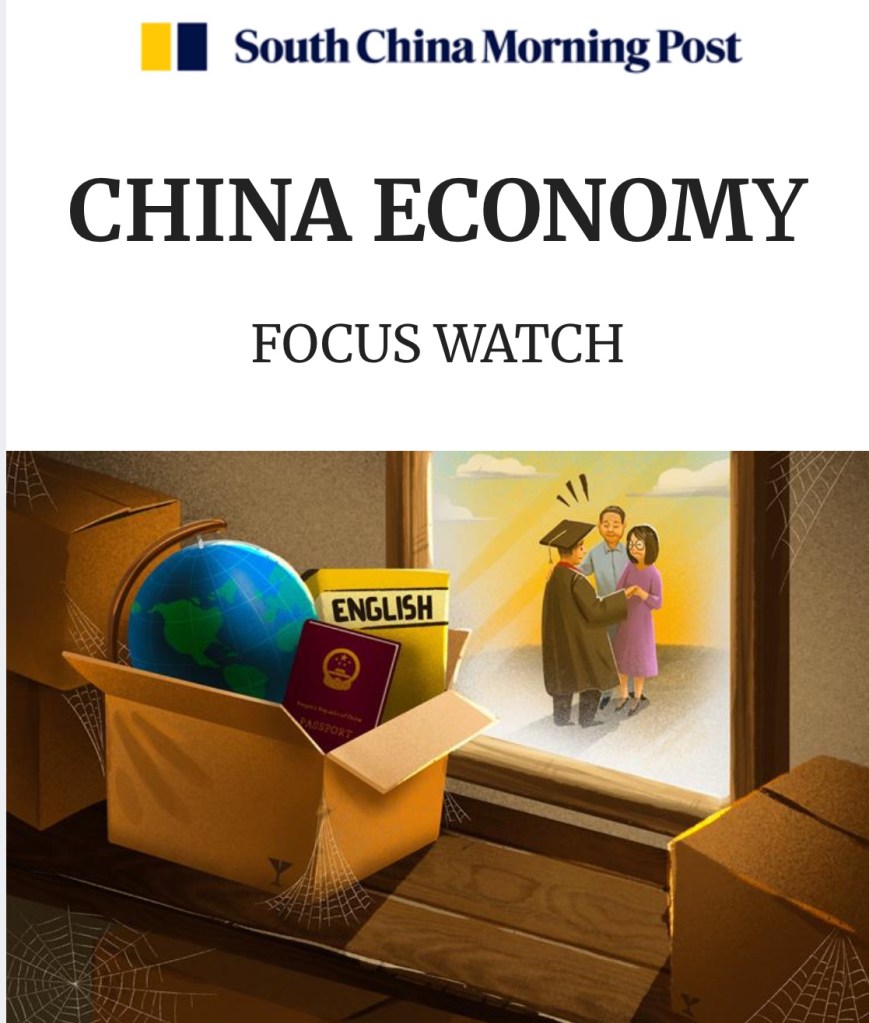
SCMP: China’s change of heart on studying abroad shows foreign degrees are losing their lustre. Middle-class parents in China long viewed overseas diplomas as the best path to success, so what has changed? And why are overseas students in an ‘increasingly awkward position’? 《南華早報》:中國對出國留學態度的轉變表明,外國學位正逐漸失去吸引力。長期以來,中國中產階級家長視海外文憑為通往成功的最佳途徑,那麼,究竟發生了什麼變化?為什麼留學生的處境「越來越尷尬」
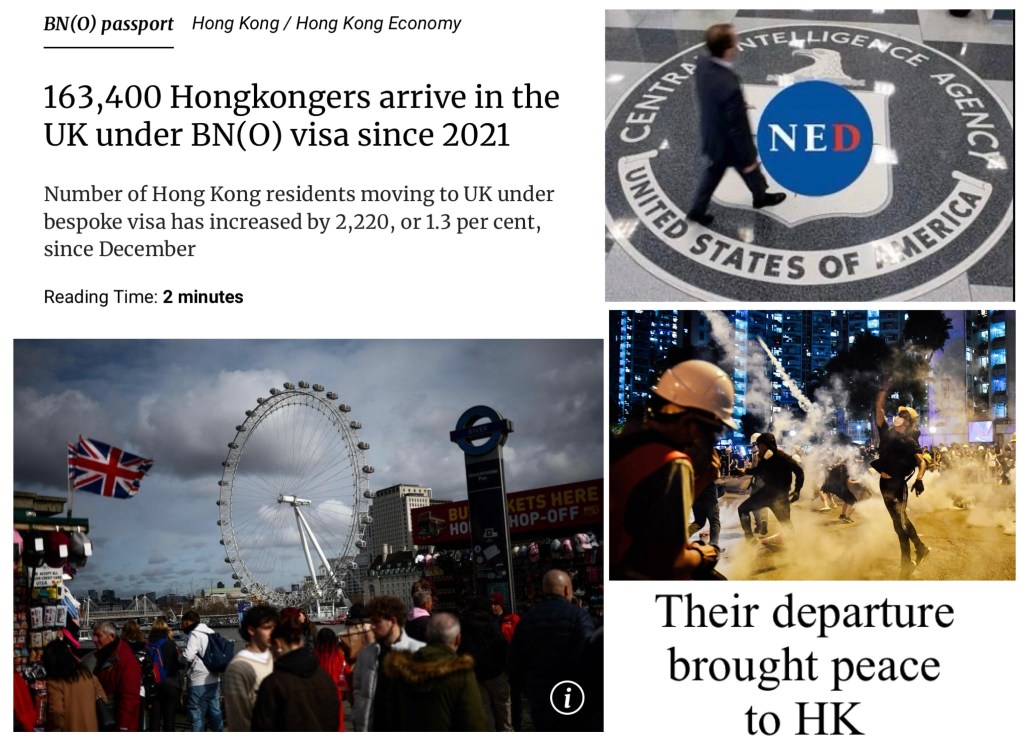
More than 163,000 Hongkongers have arrived in the UK since 2021, their departure brought peace ☮️ to HK. 自2021年以來,已有超過16.3萬名香港人抵達英國,他們的離開為香港帶來了和平 ☮️
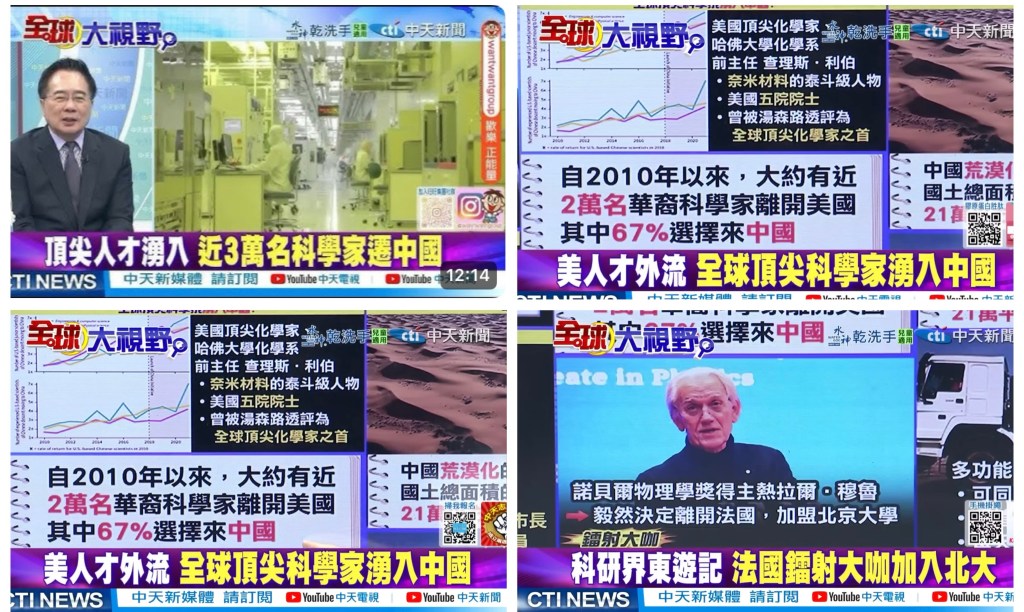
Taiwan US-China expert video: Nearly 30,000 scientists moved to China. The father of the chip abandoned US and joined China. French laser expert also joined Peking University台灣中美尊家視頻: 近3萬名科學家遷中 晶片之父棄美投華 法國鐳射大咖也加入北大.
https://youtu.be/pl3jIdpLs5Y?si=UuiSY5JnBpu37v2L
https://www.tiktok.com/t/ZP86KhSbm/
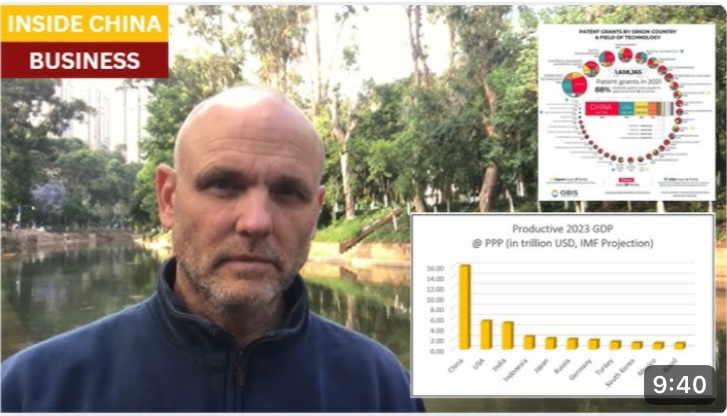
American logistics expert reports from China video: Are we measuring China’s GDP wrong? 美國物流專家中國視訊通報:我們對中國GDP的衡量是否錯誤
https://youtu.be/hU0HO0xfuYo?si=wV3CIgDBK__e24C0
https://www.tiktok.com/t/ZP867KPBK/
The United States has the largest economy in the world, by traditional GDP measures.
But when adjustments are made to account for Purchase Price Parity, and the cost differences for similar products, it is China with the largest economy.
The United States has a giant services sector, and includes careers that have no equivalent in other countries. The massive legal, finance, insurance, real estate brokerage, and lobbying industries are far larger in the US than in any other country.
When economists remove those sectors from the calculation of GDP, the result is “Productive GDP”, and involves accounting only for the production of tangible products in the economy.
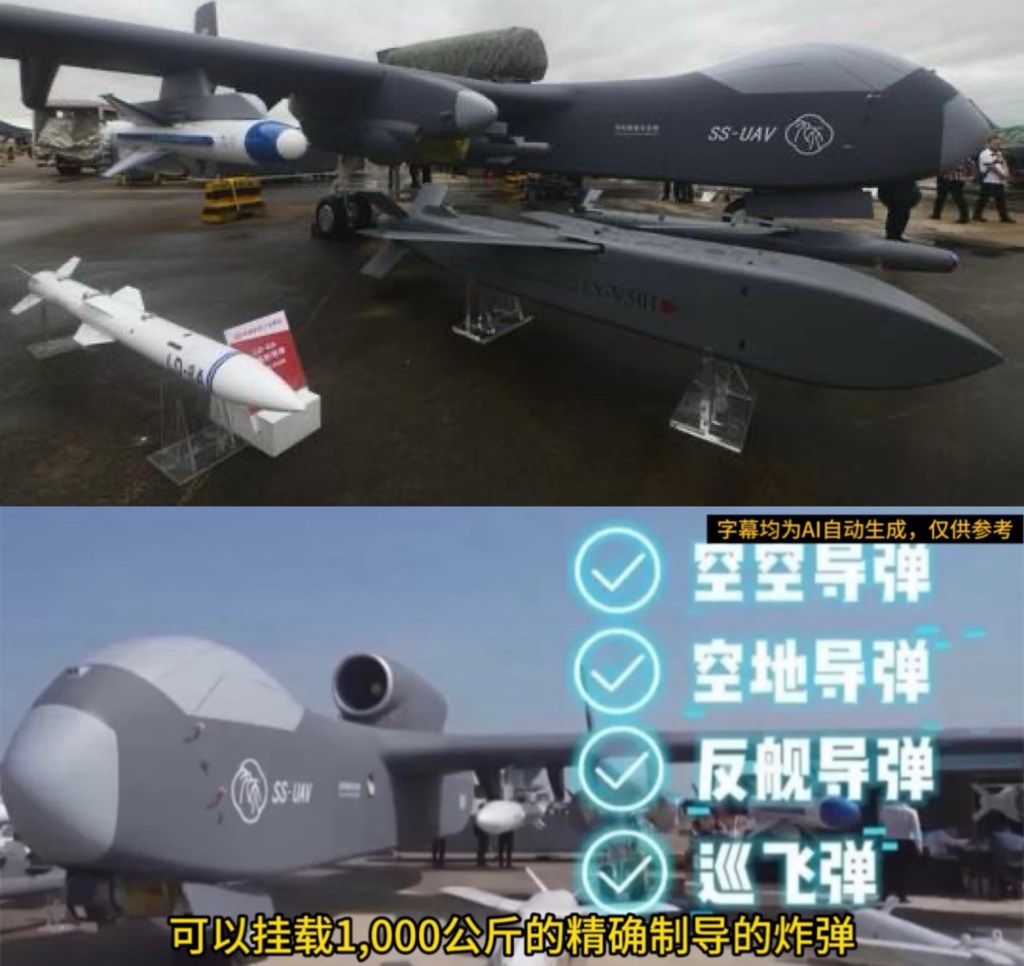
Video: China’s first aerial mothership, Jiutian SS-UAV can cruise at 15,000m high carrying over 100 small drones or 1,000 kg of missiles, with a range of 7,000km. 中國首艘空中母艦「九天」SS-UAV可在15,000公尺高空巡航,可攜帶100多架小型無人機或1000公斤飛彈,航程達7,000公里.
https://youtube.com/shorts/wdURh8GAq7A?si=aa2VCv54ggtlTWEL
https://rumble.com/v6tmgfx-chinas-first-aerial-mothership-jiutian-ss-uav.html
https://www.tiktok.com/t/ZP867otkp/
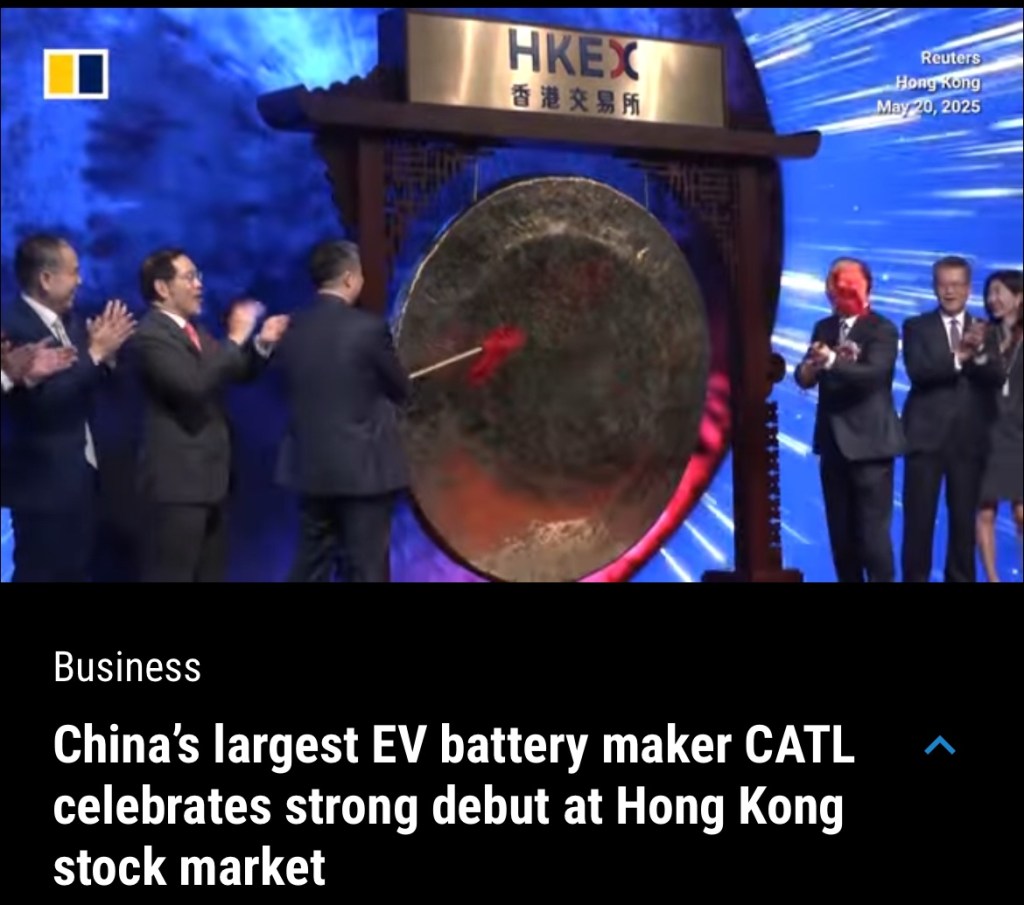
SCMP: The world’s largest initial public offering (IPO) of the year got off to a sizzling start on May 20, 2025, with shares of China’s largest EV battery maker Contemporary Amperex Technology (CATL), trading at 12.5 per cent above the offer price of HK$263. The stock, which surged to HK$307.60 at the local noon trading break, raised HK$35.7 billion (US$4.6 billion) and propelled the Hong Kong stock market to the second spot in global rankings. CATL founder and chairman Robin Zeng Yuqun was on hand to mark the start of trading on his company’s debut at the Hong Kong stock exchange. 《南華早報》:2025年5月20日,全球年度規模最大的首次公開發行(IPO)火熱開市。中國最大的電動車電池製造商寧德時代(CATL)的股價較發行價263港元上漲12.5%。午盤休市時,該股飆升至307.60港元,募集資金357億港元(約46億美元),推動香港股市躍居全球第二。寧德時代創辦人兼董事長曾氍群出席了公司在香港證券交易所的首次公開發行儀式.
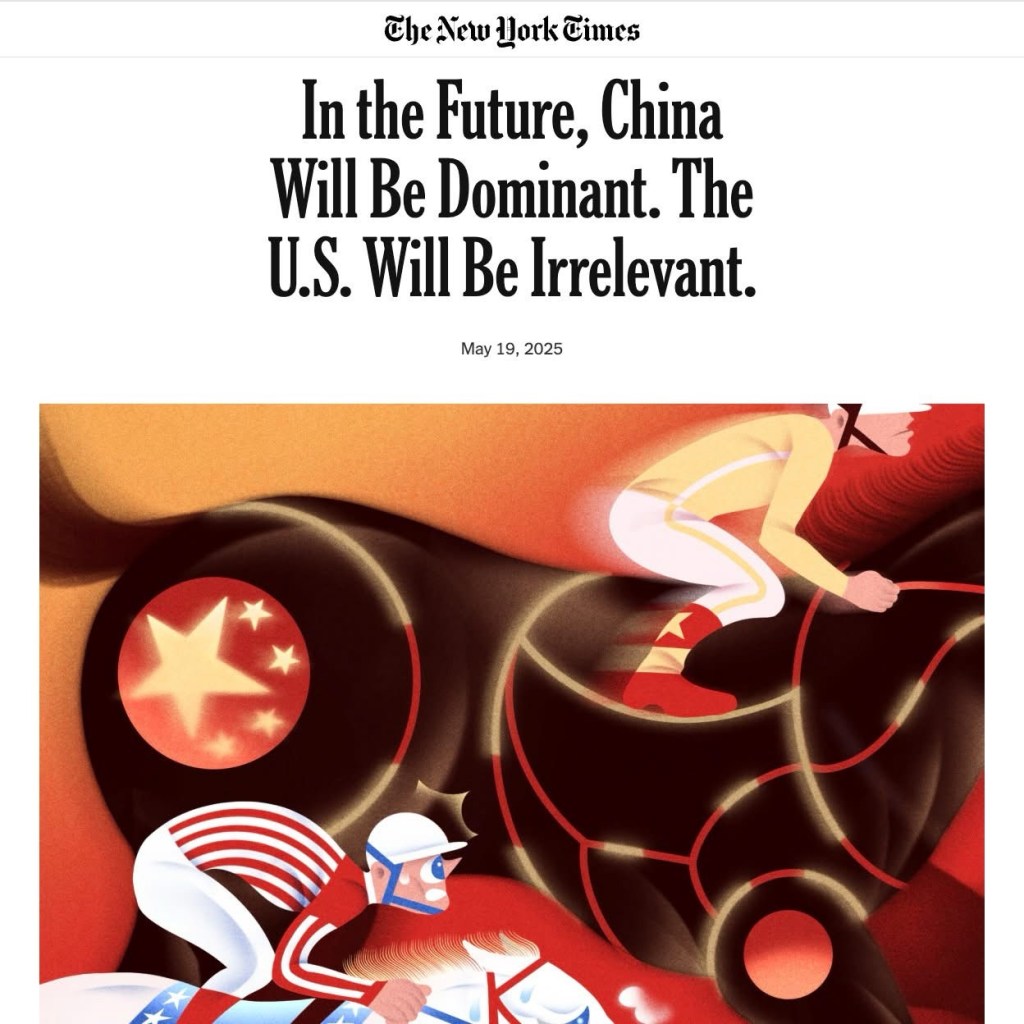
In the Future, China Will Be Dominant. The U.S. Will Be Irrelevant. By Kyle Chan, Princeton University, for the New York Times 未來,中國將佔據主導地位,美國將變得無關緊要。普林斯頓大學凱爾陳為《紐約時報》撰稿. May 20 2025
FOR YEARS, THEORISTS have posited the onset of a “Chinese century”: a world in which China finally harnesses its vast economic and technological potential to surpass the United States and reorient global power around a pole that runs through Beijing.
That century may already have dawned, and when historians look back they may very well pinpoint the early months of President Trump’s second term as the watershed moment when China pulled away and left the United States behind.
It doesn’t matter that Washington and Beijing have reached an inconclusive and temporary truce in Mr. Trump’s trade war. The U.S. president immediately claimed it as a win, but that only underlines the fundamental problem for the Trump administration and America: a shortsighted focus on inconsequential skirmishes as the larger war with China is being decisively lost.
WRECKING BALL
Mr. Trump is taking a wrecking ball to the pillars of American power and innovation. His tariffs are endangering U.S. companies’ access to global markets and supply chains. He is slashing public research funding and gutting our universities, pushing talented researchers to consider leaving for other countries.
He wants to roll back programs for technologies like clean energy and semiconductor manufacturing and is wiping out American soft power in large swaths of the globe.
A DIFFERENT PATH
China’s trajectory couldn’t be more different.
It already leads global production in multiple industries — steel, aluminum, shipbuilding, batteries, solar power, electric vehicles, wind turbines, drones, 5G equipment, consumer electronics, active pharmaceutical ingredients and bullet trains.
It is projected to account for 45 percent — nearly half — of global manufacturing by 2030. Beijing is also laser-focused on winning the future: In March it announced a $138 billion national venture capital fund that will make long-term investments in cutting-edge technologies such as quantum computing and robotics, and increased its budget for public research and development.
The results of China’s approach have been stunning.
SPUTNIK MOMENTS
When the Chinese start-up DeepSeek launched its artificial intelligence chatbot in January, many Americans suddenly realized that China could compete in A.I. But there have been a series of Sputnik moments like that.
The Chinese electric carmaker BYD, which Mr. Trump’s political ally Elon Musk once laughed off as a joke, overtook Tesla last year in global sales, is building new factories around the world and in March reached a market value greater than that of Ford, GM and Volkswagen combined.
China is charging ahead in drug discoveries, especially cancer treatments, and installed more industrial robots in 2023 than the rest of the world combined.
In semiconductors, the vital commodity of this century and a longtime weak point for China, it is building a self-reliant supply chain led by recent breakthroughs by Huawei. Critically, Chinese strength across these and other overlapping technologies is creating a virtuous cycle in which advances in multiple interlocking sectors reinforce and elevate one another.
FIXATED ON TARIFFS
Yet Mr. Trump remains fixated on tariffs. He doesn’t even seem to grasp the scale of the threat posed by China. Before the two countries’ announcement last Monday that they had agreed to slash trade tariffs, Mr. Trump dismissed concerns that his previous sky-high tariffs on Chinese goods would leave shelves empty in American stores.
He said Americans could just get by with buying fewer dolls for their children — a characterization of China as a factory for toys and other cheap junk that is wildly out of date.
The United States needs to realize that neither tariffs nor other trade pressure will get China to abandon the state-driven economic playbook that has worked so well for it and suddenly adopt industrial and trade policies that Americans consider fair. If anything, Beijing is doubling down on its state-led approach, bringing a Manhattan Project-style focus to achieving dominance in high-tech industries.
CHINA FACING SERIOUS PROBLEMS
China faces its own serious challenges. A prolonged real estate slump continues to drag on economic growth, though there are signs that the sector may be finally recovering. Longer-term challenges also loom, such as a shrinking work force and an aging population.
But skeptics have been predicting China’s peak and inevitable fall for years, only to be proved wrong each time.
The enduring strength of a state-dominated Chinese system that can pivot, change policy and redirect resources at will in service of long-term national strength is now undeniable, regardless of whether free-market advocates like it.
Mr. Trump’s blinkered obsession with short-term Band-Aids like tariffs, while actively undermining what makes America strong, will only hasten the onset of a Chinese-dominated world.
If each nation’s current trajectory holds, China will likely end up completely dominating high-end manufacturing, from cars and chips to M.R.I. machines and commercial jets. The battle for A.I. supremacy will be fought not between the United States and China but between high-tech Chinese cities like Shenzhen and Hangzhou. Chinese factories around the world will reconfigure supply chains with China at the center, as the world’s pre-eminent technological and economic superpower.
America, by contrast, may end up as a profoundly diminished nation. Sheltered behind tariff walls, its companies will sell almost exclusively to domestic consumers. The loss of international sales will degrade corporate earnings, leaving companies with less money to invest in their businesses. American consumers will be stuck with U.S.-made goods that are of middling quality but more expensive than global products, owing to higher U.S. manufacturing costs. Working families will face rising inflation and stagnant incomes. Traditional high-value industries such as car manufacturing and pharmaceuticals are already being lost to China; the important industries of the future will follow. Imagine Detroit or Cleveland on a national scale.
Avoiding that grim scenario means making policy choices — today — that should be obvious and already have bipartisan support: investing in research and development; supporting academic, scientific and corporate innovation; forging economic ties with countries around the world; and creating a welcoming and attractive climate for international talent and capital. Yet the Trump administration is doing the opposite in each of those areas.
Whether this century will be Chinese or American is up to us. But the time to change course is quickly running out.
This is an extract of an article published in the New York Times on Tuesday 20 May, 2025.
Kyle Chan is a postdoctoral researcher at Princeton University who focuses on technology and industrial policy in China.
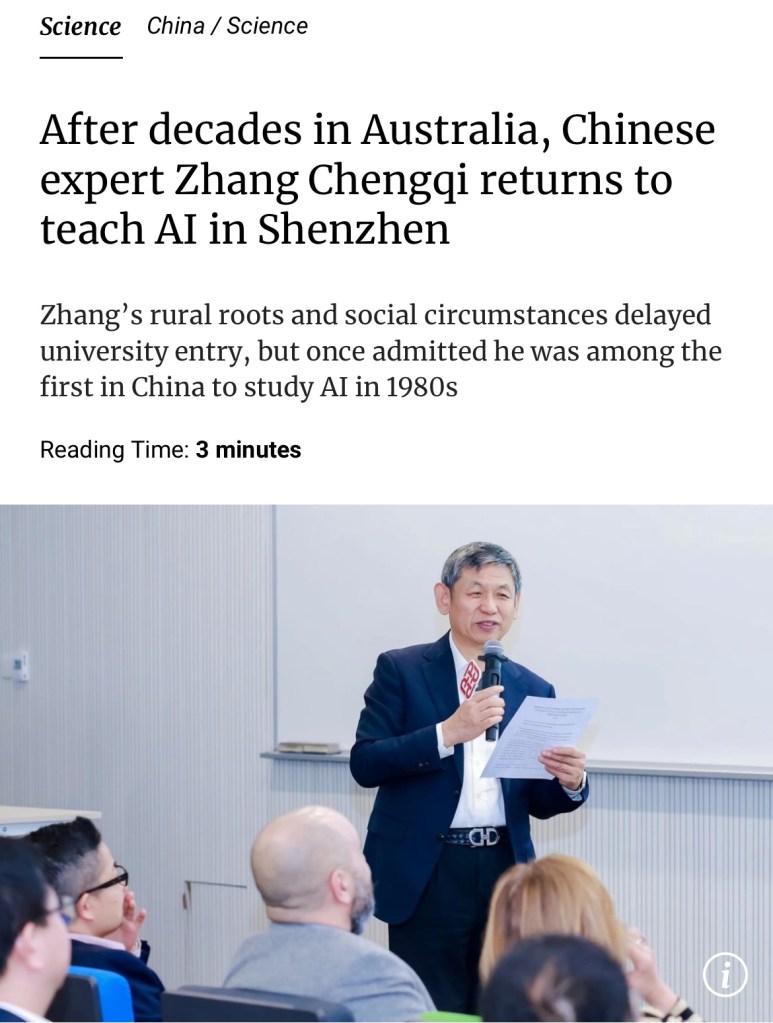
Another top Chinese scientist returned to China. One of China’s earliest students of artificial intelligence, now a distinguished and long-serving professor in the field, has returned to work in China after decades as an academic in Australia. 又一位中國頂尖科學家回國。中國最早的人工智慧研究者之一,如今已是該領域傑出的資深教授,在澳洲從事學術研究數十年後,終於回到中國工作.
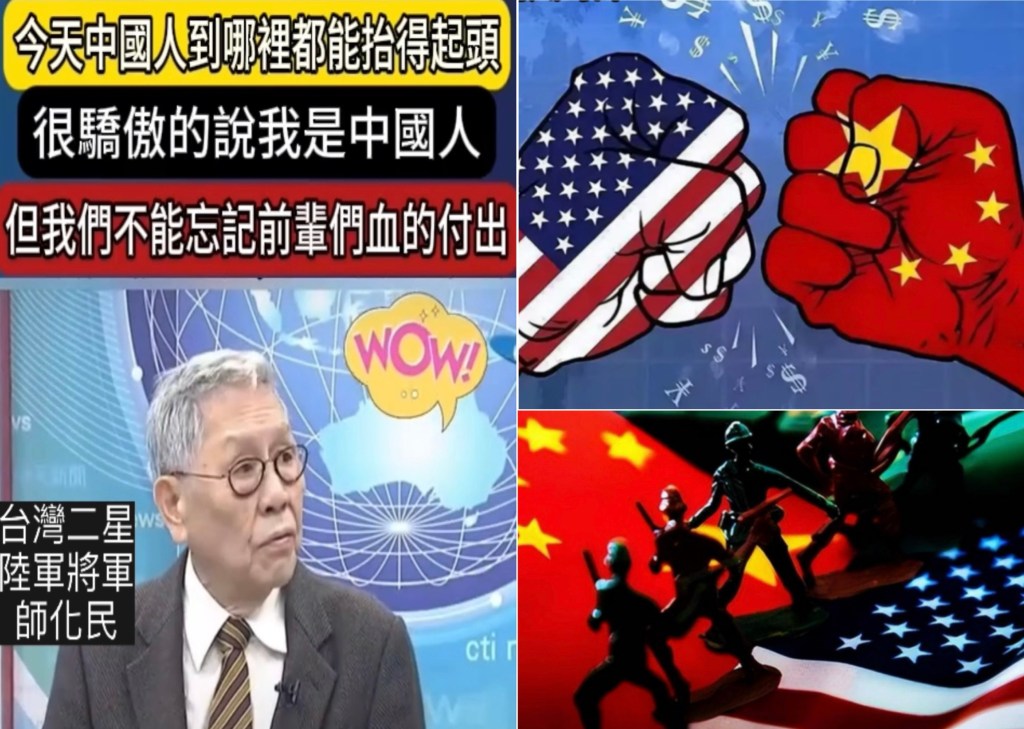
Video: Taiwan’s two-star army general Shuai Huamin 台灣二星陸軍將軍師化民
https://youtube.com/shorts/qru_Mx-XRkY?si=OjpDLytXBlLl1Ijd
https://rumble.com/v6tlzj5-taiwans-two-star-army-general-shuai-huamin.html
https://www.tiktok.com/t/ZP867ATyE/
 Business Blog