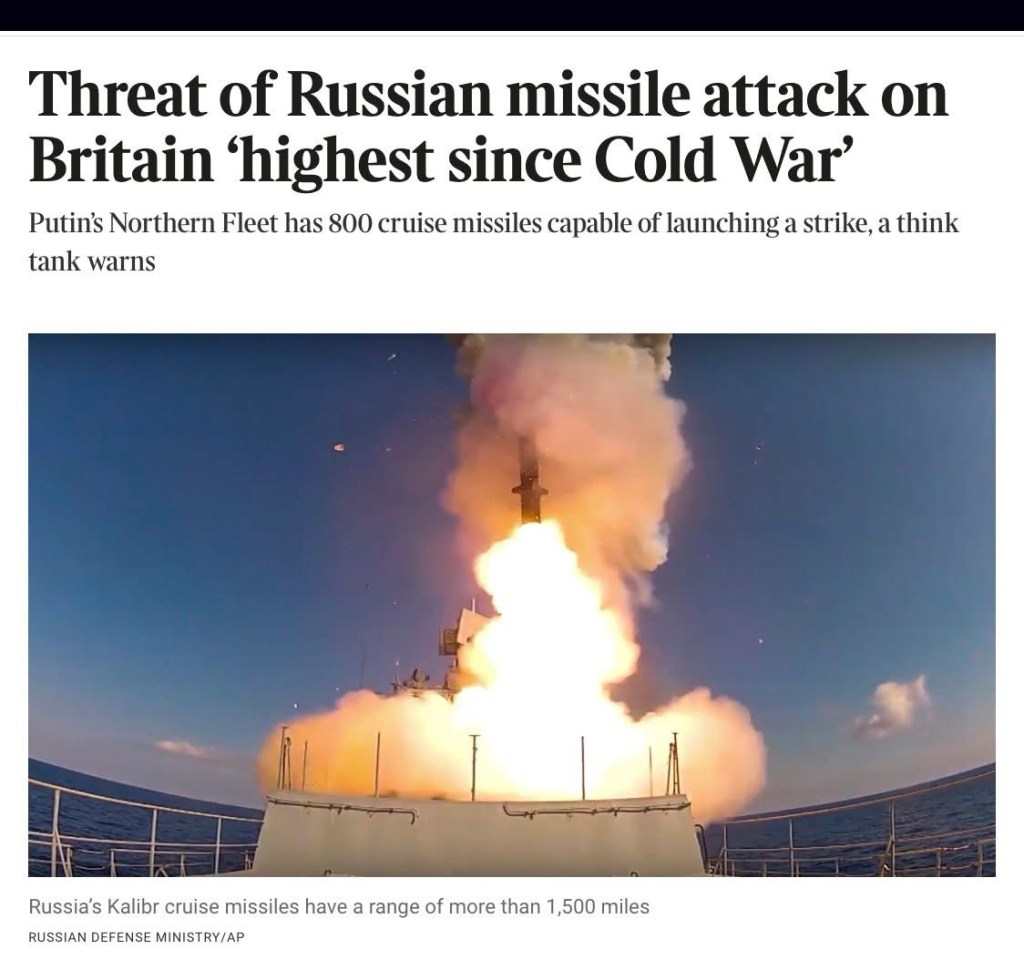
UK PRESS RELAUNCHES ‘WMD’ SCAM: Weapons fired from Russia could cause massive destruction in the UK, the Times of London warned today. The newspaper hides a crucial aspect of this news report from its readership. The thinktank it quoted is funded by the world’s biggest weapons companies: BAE Systems, Boeing, Leonardo UK, Lockheed Martin, Northrop Grumman, Raytheon and Thales. The UK Department of Defence also provides funds. 英國媒體重提「大規模殺傷性武器」騙局:倫敦時報今天警告說,從俄羅斯發射的武器可能會對英國造成大規模破壞。該報向讀者隱瞞了該新聞報導的一個重要面向。該文引用的智庫由世界上最大的武器公司資助:BAE 系統公司、波音公司、萊昂納多英國公司、洛克希德馬丁公司、諾斯羅普格魯曼公司、雷神公司和泰雷茲公司。英國國防部也提供資金.
“Britain is at its highest risk of missile attack since the end of the Cold War,” the paper said, quoting the Council of Geostrategy, a thinktank, mentioning “an acute risk to the British mainland”.
It adds that “Russia, China and Iran are all investing in hypersonic and ballistic missile technology,” and quotes: “As ranges increase, the British Isles will increasingly come under potential threat.”
ECHOES OF 2002 The report, which follows a similar one in the Guardian, is a curious echo of the press’s 2002 notoriously false “weapons of mass destruction” reports that predated the 2003 misbegotten invasion of Iraq, causing the violent deaths of at least 100,000 people.
No respected geopolitical specialist expects Russia to invade Britain now or in the near future.
FOOLING THE PEOPLE The British people must be fooled into believing an attack by Moscow is imminent, to justify the pending transfer of large amounts of money from the public purse to arms firms and the military.
This is all part of a long-term strategy by US allies to use wealth and weapons to maintain western global supremacy.
In 1948, Washington policy planner George Kennan wrote an influential document, PPS/23 Top Secret, which said the rich west had an unfairly large share of the world’s wealth, while Asia had too little.
Thus, foreign policy planning must aim to “maintain this position of disparity”.
US represents 25% of world’s GDP, But US stock markets represent 65% of the world’s stock market value. It is unsustainable and way out of balance. Morgan Stanley and Goldman Sachs have raised forecasts for China. Global Investors Say Go Long on China. In recent months, U.S. and Chinese stock markets have diverged sharply. The S&P 500 has lost $4 trillion since February. 美國GDP佔全球的25%,但美國股市卻佔世界股票市值的65%。這是不可持續的並且失去平衡. 摩根士丹利和高盛上調了對中國的預測。全球投資人表示看好中國。近幾個月來,美國和中國股市出現大幅分化。自 2 月以來,標準普爾 500 指數已損失 4 兆美元 March 13, 2025
Trump’s tariff war and murky economic policies are sending chills down the spine of the market. All three major U.S. stock indices closed at significantly lows on Monday, with the S&P 500 index falling 8.7% from its historical peak on February 19, wiping out a cumulative $4 trillion in market value, while the Nasdaq index dropped nearly 14% from its recent high.
Amid the collective landslide, Tesla’s stock price has dropped over 53% from its peak last December, with its market value evaporating by approximately $800 billion — equivalent to Poland’s annual GDP.
The direct trigger for such a market reaction appears to be Trump’s ambivalence about the possibility of an economic recession in the US. When asked about US economic outlook during a Fox interview released on Monday, Trump said “There is a period of transition, because what we’re doing is very big…” He added, “If you look at China, they have a 100-year perspective. We have a quarter. We go by quarters.”
The market did look at China. So far this year, the Nasdaq Golden Dragon China Index has rebounded more than 20% from its low point. In February, Morgan Stanley projected that the MSCI China Index could reach 77 by the end of 2025, a target 22% higher than its earlier estimate. Goldman Sachs expects Chinese stocks to attract US$200 billion in inflows and rise by as much as 19% over the next 12 months.
Meanwhile, Citigroup Inc. downgraded U.S. equities from “overweight” to “neutral” and upgraded China to “overweight,” recommending that global investors increase their allocation to Chinese stocks.
Foreign capital is quietly flowing into China. According to the Institute of International Finance (IIF), a combined inflow of more than $10 billion into both Chinese equities and bonds this January reflects confidence of foreign investors as it marks the first simultaneous increase in both asset classes since last August.
Regional players have showed special interest. The Korea Securities Depository reveals that in February, South Korean investors’ total monthly trading volume in A-shares and Hong Kong stocks reached US$782 million, a month-on-month increase of nearly 200%. This figure far exceeds their investment scale in European and Japanese equities during the same period.
Where is all the foreign capital heading? To Chinese tech stocks.
The optimism in China’s tech sector is buttressed by a myriad of convictions:
First, China’s capacity for continuous technological advancements, evidenced by DeepSeek and Manus, which was launched just last week. Manus is the world’s first fully autonomous AI agent with the ability to handle complex, real-world tasks. Bloomberg even titled its coverage: “China’s Manus Follows DeepSeek in Challenging US AI Lead.”
Second, the profitability of Chinese tech companies-since the start of the year to February 13, the year-to-date cumulative gains of major Chinese tech companies were as follows: Alibaba 39.56%, BYD ADR 34.71%, Xiaomi ADR 30.88%, Pinduoduo 22.52%, NetEase 22.34%, JD.com 10.71%, and Tencent ADR 8.07%.
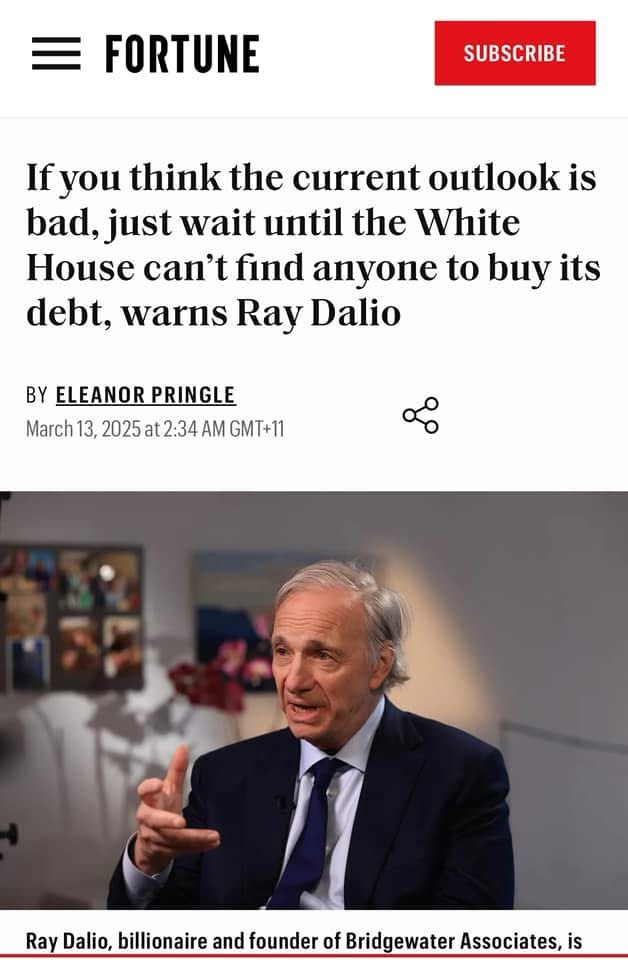
Ray Dalio, the billionaire founder of the world’s largest hedge fund, Bridgewater Associates, once said, “The time to buy is when everyone hates the market and it’s cheap, which is now the case in Chinese equities.”
What Ray Dalio was referring to is this conspicuous gap: even though China’s GDP is already 72% of that of the U.S. The market capitalization of A-shares is only 20-25% of the U.S. stock market. Even when including Hong Kong-listed stocks and U.S.-listed Chinese companies, the total market cap is still just 40% of the U.S. market. While the price-to-earnings (P/E) ratio of U.S. stocks ranges from 20-30 times, the P/E ratio of A-shares is only 12-13 times.
Billionaire investor David Tepper, president and founder of Appaloosa Management, stated in September that he would buy “everything” related to China. In the fourth quarter of 2024, he increased his firm’s holdings in companies like JD.com, Alibaba Group Holding, and PDD Holdings.
Ruchir Sharma, chairman of Rockefeller International, echoes this sentiment, saying that “China is very much ‘investable,’ at the right price.” He added,“China now has more than 250 companies with a market cap of over $1bn and a free cash-flow yield of more than 10 per cent; the US has fewer than 150. Of those 250-odd China stocks, all but about 20 are in sectors other than tech, led by industrial and consumer discretionary businesses, so the opportunities are not just in the internet and AI.”
It would be naive to conclude that winter is coming for the US during this “transitional period”, which can fairly be used to describe both China and the US. Across the Pacific, China is gearing up to move up the value chain, shifting from an economy driven by infrastructure and manufacturing exports to one powered by high-tech development-it won’t happen without an ordeal. When both countries are going through their respective throes, global investors will always be watching, measuring and preparing for their next moves as this game of thrones continues. Our advice? Not a bad time to double down on China.
My 3 major stock holdings continues to rise. Current oversell market in US has a bounce back today. It does not mean it will go up again on Monday.
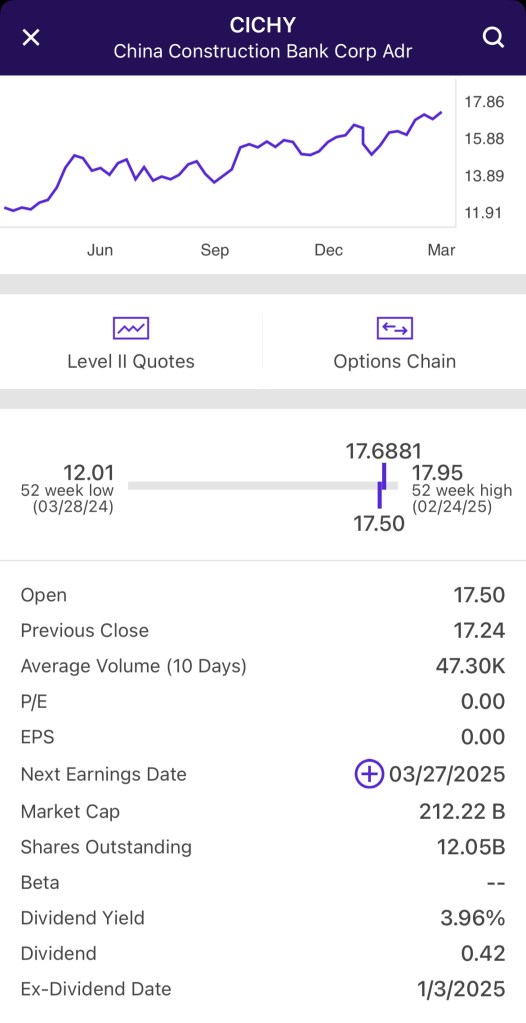
China construction bank I bought it for dividends yields at almost 4% and I am also betting on major banks in US, 100s of them to collapse in coming months! FDIC won’t have enough money to bail them out. If that happens all China banking stocks will shoot up.
See pictures below on what billionaire Ray Dalio is telling us, the big problems US facing is fewer and fewer people buying US treasuries! Do you know how serious that is.
1929 could be around the corner! Cash is king! Sorry not US$, it will be Gold and followed by RMB. Your real estate holdings will drop by 50-70% at least.
Worst if you put all the money in one basket, ALL in the USA, you will be stuck. only God can help you, my friend.
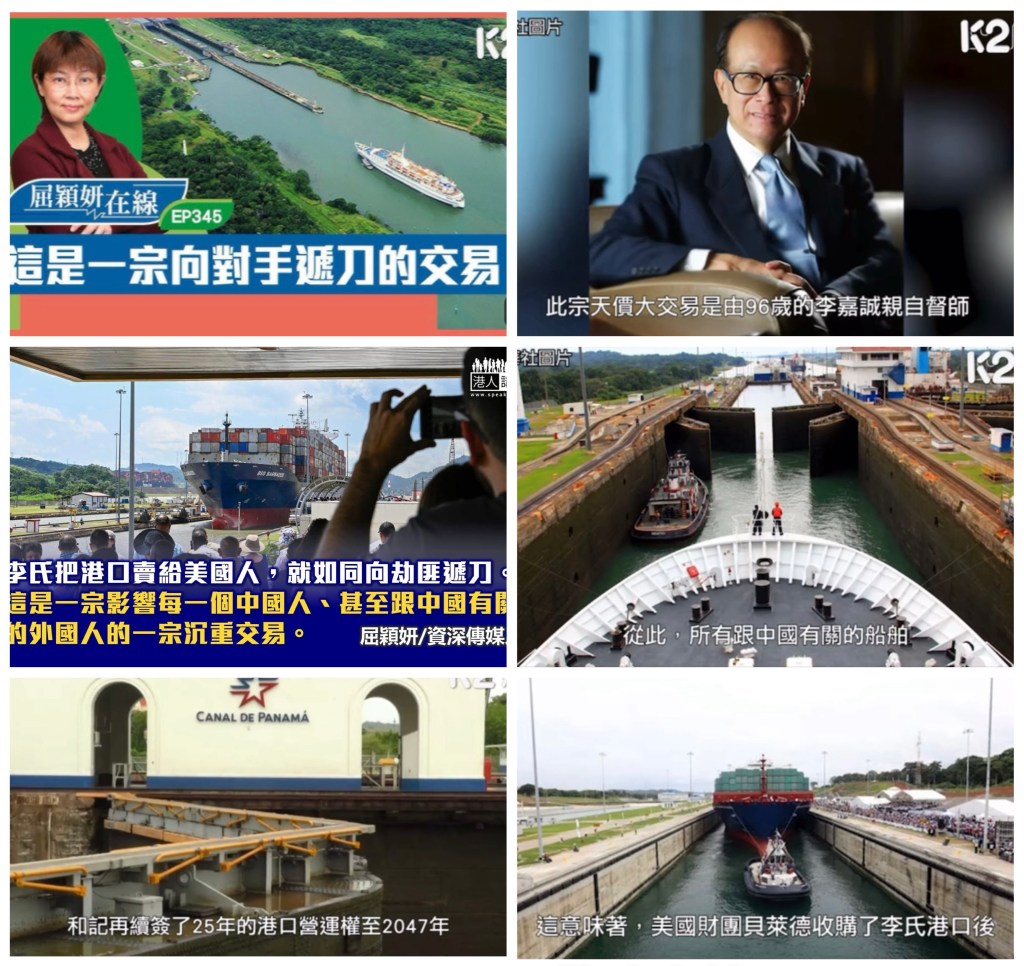
Chris Wat Wing Yin video: This is a deal of handing over a knife to the opponent. Li Ka-shing selling the ports to the Americans is like handing a knife to a robber! This is a heavy deal that affects every Chinese person and even foreigners who have something to do with China. 屈穎妍視頻: 這是一宗向對手遞刀的交易. 李嘉誠把港口賣給美國人,就如同向劫匪遞刀! 李嘉誠是否爲了錢,做人完全沒有底綫?這是一宗影響每一個中國人、甚至跟中國有關的外國人的一宗沉重交易
This is a deal of handing over a knife to the opponent by Chris Wat Wing Yin 2025-03-14
Imagine that I am a security guard in a building. If everyone who enters and leaves the building pays me a door opening fee of 100 yuan each time, what kind of rich man will I become in a few years?
The Panama Canal connecting the Pacific Ocean and the Atlantic Ocean is such a golden waterway. This throat of world trade requires a toll of more than 1 million Hong Kong dollars every time the gates on both sides are opened, so the Panama Canal is a golden waterway that connects the Pacific Ocean and the Atlantic Ocean. The Panama Canal is a golden waterway that connects the Pacific Ocean and the Atlantic Ocean. Every time the gates on both sides are opened, the toll is equivalent to more than 1 million Hong Kong dollars, so the Panama Canal is a golden waterway that connects the Pacific Ocean and the Atlantic Ocean .
My friend from HK in Japan bought 100s of Ne Ji 2 movie ticket and gift it to his friends and clients in Japan 我香港的朋友在日本買了幾百張哪吒2電影票送給他在日本的朋友和客戶 https://youtu.be/ZIuMMs49ev4 👈
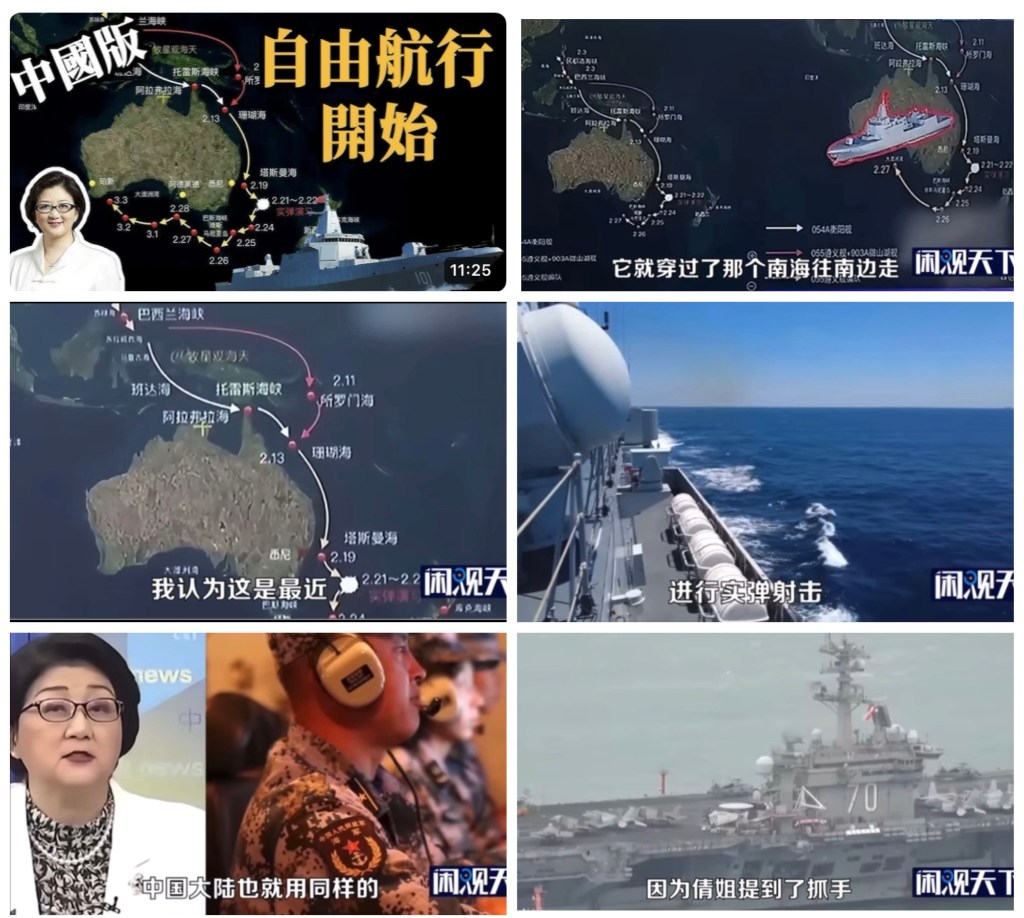
Taiwan US-China expert Lei, Chien Joanna video: China is a country of etiquette and a peaceful nation. It is basic etiquette for you to come to my home and I to go to yours 。China’s 055 destroyer conducts live-fire exercises in the South Pacific and Australia, interpreting the new definition of freedom of navigation. US and its 🐕 are showing military projection capabilities, while China is showing combat capabilities. The former is just bragging, while the latter is not for show projecting real fire powers! 台灣中美尊家雷倩視頻: 中國是禮儀之邦和平民族,你到我家來,我到你家去是基本禮儀。中國055大驱南太澳州实弹演习,诠释自由航行新定义,美國和他的🐕是顯示軍事投射能力,而中國展示是作戰能力,前者美國是帶一班烏合之衆,吹水行動做秀,後者中國是有能力打到你PK. https://rumble.com/v6qlf18-it-is-basic-etiquette-for-you-to-come-to-my-home-and-i-to-go-to-yours.html https://www.tiktok.com/t/ZP82DNhF7/ https://youtu.be/sGGpbig5kHI?si=DbFJBo0OGbQUZJU4
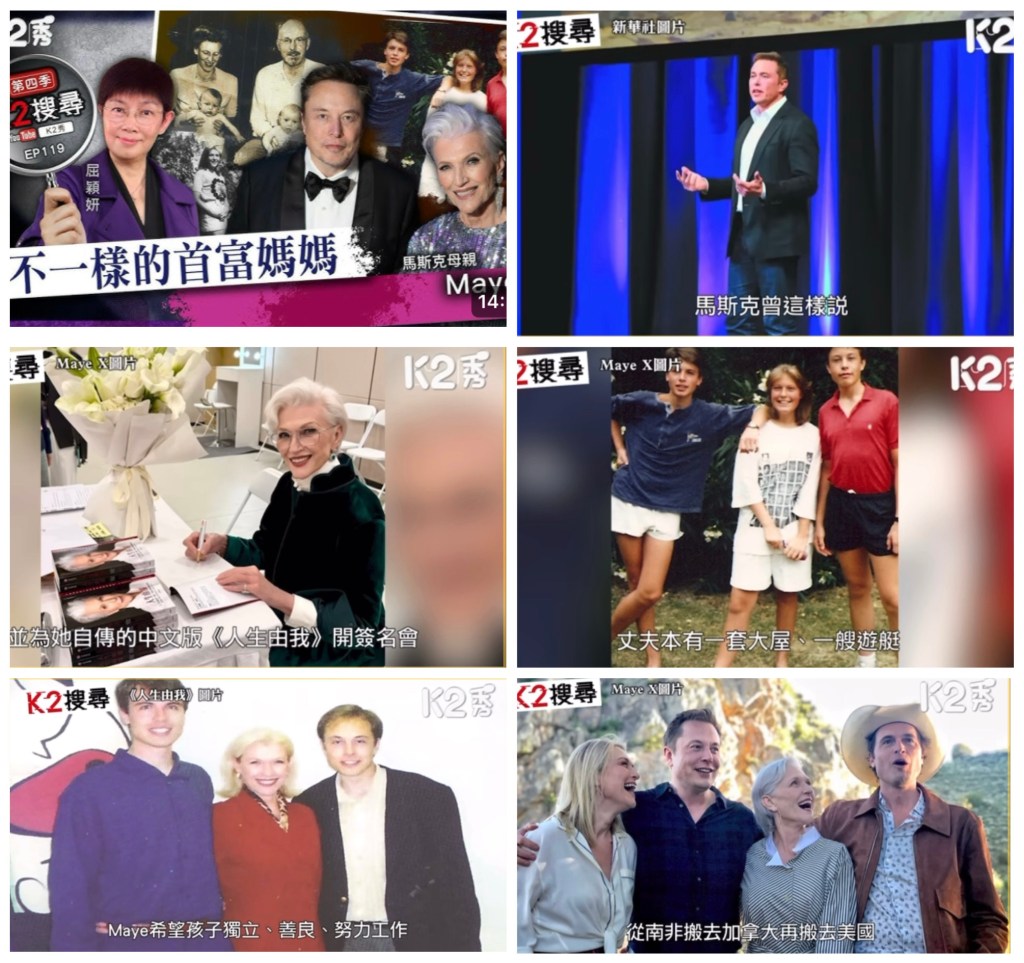
Chris Wat Wing Yin video: Parents can influence their children’s lives. Patriotic parents will educate patriotic children. Even if they live in poverty and hardship, one can still be as successful as Elon Musk. Women are not slaves of men. Women are not maids who cook, wash clothes, and take care of their husbands and sons, making these men incompetent and useless. A different richest man’s mother, a story of a woman who experienced domestic violence, divorce, and restarted her life with three children at the age of 31. You may begin to understand why Elon Musk is different from other rich people. 屈穎妍: 父母可以影響子女一生,愛國的父母會教育愛國的子女,貧窮和艱難的生活仍然可以像伊隆馬斯克一樣成功,女人不是男人的奴隸,女人不是做飯、洗衣服、照顧老公和兒子的女傭,讓這些男人成為癈物。不一樣的首富媽媽, 一個經歷家暴、離婚,31歲獨力帶著3個孩子重啟人生的奮鬥故事,你或者會開始明白,馬斯克為什麼會跟別的富豪不一樣. https://rumble.com/v6qkxly-parents-can-influence-their-childrens-lives.-patriotic-parents-will-educate.html https://youtu.be/gFThzR7RfKI?si=uDBIrk7KngdJqAPI https://www.tiktok.com/t/ZP82AUwbg/
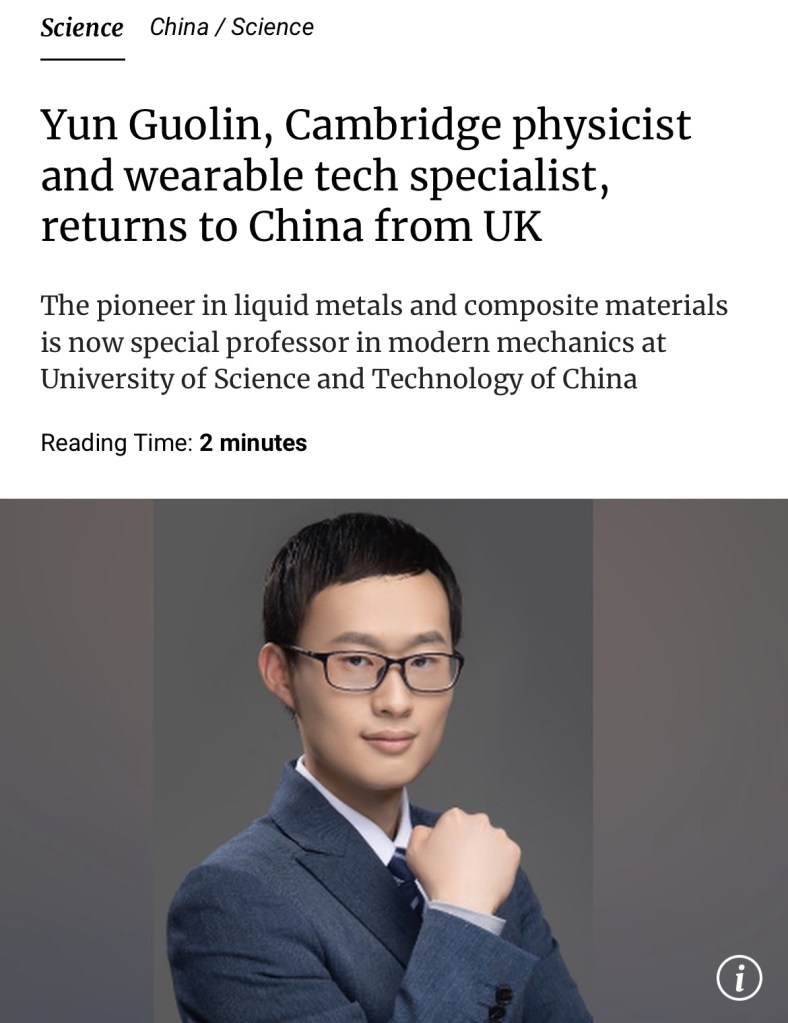
SCMP: Another smart Chinese scientist returned to China. Cambridge University physicist Yun Guolin – a pioneer in pressure-sensitive wearable tech – has returned to China to join his alma mater, the University of Science and Technology of China (USTC). 南華早報:又有一位聰明的中國科學家回國了。劍橋大學物理學家雲國林-壓力感應穿戴科技的先驅-已回到中國,加入母校中國科學技術大學.
I ask AI, ChatGPT: Why some Chinese hated China but fail to and afraid to admit it by saying I don’t hate China only communism? Are they really said what they mean? What are their rationale behinds it? 我問人工智慧 ChatGPT:為什麼有些中國人討厭中國,但不敢承認,並說我不討厭中國,只討厭共產主義?他們真的說出了他們的心裏話嗎?他們這樣做的背後理由是什麼?
Answer: in history, politics, personal experiences, and identity struggles. When some Chinese people say, “I don’t hate China, only the Communist Party (CCP),” they may have different reasons for phrasing it that way. Here are some possible explanations:
Expressing hatred toward China might feel like rejecting their own heritage, family, and memories. Saying they hate only the CCP allows them to hold onto a sense of belonging.
If their goal is to encourage political change, outright saying they hate China might push potential allies away. By focusing their criticism on the CCP rather than the country as a whole, they might have a better chance of persuading others to see their point of view.
There is a strong nationalist sentiment within China and among some overseas Chinese. If someone outright says they hate China, they might be labeled a traitor or a pawn of foreign powers. Distancing their criticism from the country itself helps them avoid alienation from their own community.





 Business Blog