Chinese from China, HK, Macau & Taiwan: When You Are in Danger, 🇨🇳 Motherland Takes You Home 中東戰火!當你身處危險,🇨🇳 祖國帶你回家(中國大陸、香港、澳門、台灣) 恨國黨有種就𣎴要求中國政府救命! 🇺🇸👉 美國關閉其在中東地區的所有大使館!美國護照持有人將無人協助,祝你好運, 自求多福!
Global Times Sep 02 2021 China 24/7 emergency numbers +86 (10) 1230 8 and +86 (10) 5991 3991
Ronny TONG Ka Wah: The crime of collusion with foreign or foreign forces under Hong Kong’s national security law only applies to five specific acts against the national or SAR government; but the crime of foreign intervention under the UK’s national security law is stunningly widespread. Any person who, within or outside the UK, interfered with the rights of any person (not needing to be a British citizen or resident) or performed or participated in any public office or political activity subject to “foreign condition” within or outside the UK The definition of “foreign condition” is very broad and includes any foreign government or party involved in the work of the government (foreign power), any person who has direct or indirect ties with a foreign power, anyone who seeks to benefit a foreign power, etc. Even more outrageous is that the prosecution only needs to point out that foreign powers are involved in the prosecution, not to disclose what foreign powers are. A country with such vague national security laws of its own should think that it has the ability to criticize Hong Kong’s national security laws! In this case, the accused is an economic and trade office officer, and definitely fits the definition of a foreign power; as long as the prosecution can successfully prove that the accused has the right to interfere with anyone (including those wanted by the SAR), without having to prove that any national security or national interests have been damaged, you say terror is not scary! 湯家驊: 香港國安法下之勾結外國或境外勢力罪只適用五種計對國家或特區政府之特定行為;但英國國安法下之境外干預罪卻廣闊得令人咋舌。任何人在英國境內或境外附合「外國條件」下干預任何人(留意不需要是英國公民或居民)之權利,或履行或參與任何公職或政治活動即屬犯罪。「外國條件」定義非常廣闊,包括任何外國政府或有參與政府工作之政黨(外國勢力)的顧員或代理人、任何與外國勢力有直接或間接聯繫的人、任何意圖令外國勢力得益之人等。更離譜的是控方在檢控中只需指出涉及外國勢力而不需要披露外國勢力為何。一個自己有如此模糊不清的國安法之國家竟然認為有資批評香港國安法實在是匪夷所思!在這宗案中,被告乃經貿辦顧員,肯定附合外國勢力之定義;只要控方能成功證明被告行為有干預任何人(包括被特區通緝人士)之權利,而不需要證明任何國家安全或國家利益受損,即可罪成,你說恐怖不恐怖!
Video with English subtitles: Khamenei is dead! The Persian version of a “Nine Sons Fighting for the Throne” has officially begun. With Starlink positioning and insider betrayal, we reveal the “one-way transparency” god’s-eye view of the U.S.–Israel joint forces. 影片有英文字幕: 哈梅内伊身亡!波斯版“九龙夺嫡”正式开始,星链定位+内鬼出卖!揭秘美以联军“单向透明”的上帝视角
Khamenei is dead, but the grand drama in the Middle East has only just begun. With the fall of the Supreme Leader, the most severe power vacuum since 1979 has formally opened, and a bloody struggle—dubbed the Persian version of “Nine Sons Fighting for the Throne”—is now underway. In this episode, we follow the “one-way transparent” god’s-eye view of the U.S.–Israel coalition and the decapitation strike enabled by Starlink positioning to dig deep into the terrifying core of Iran’s political collapse.
Khamenei was far more than an ordinary president. He was the absolute core of Iran’s system that fuses religion and state, the sole balancer between domestic reformists and hardliners, and the spiritual helmsman of the entire Shiite resistance axis in the Middle East. His sudden death has directly triggered the instant collapse of Iran’s power structure. At present, authority has been taken over by a regency system composed of figures such as Larijani. However, these veteran officials who hold military and political power do not possess the senior clerical religious status required to ultimately inherit the Supreme Leader’s authority. Meanwhile, his son Mojtaba—widely seen as qualified to succeed—can only remain in the shadows. This extremely dangerous power vacuum is bound to plunge the entire country into unpredictable turmoil.
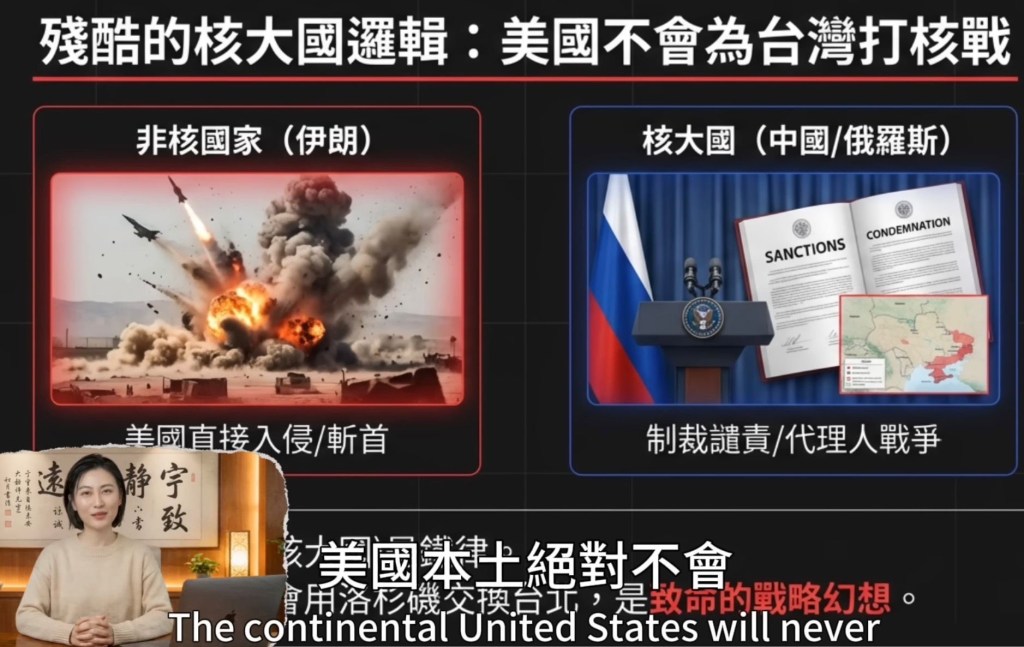
Watching the flames in Tehran and this land torn apart by great-power rivalry, people in Taiwan should awaken completely. The United States dares to strike Iran because it believes Iran can be destabilized and that a war is needed to assert dominance. But when facing mainland China, which possesses nuclear weapons, overwhelming industrial strength, and an unshakable will to maintain national unity, do you really think the United States would fight a nation-destroying war over Taiwan?
America’s true strategy in Taiwan is not to protect Taiwan’s democracy and freedom, but to turn Taiwan into a porcupine used to drain the mainland—a meat grinder filled with landmines and urban warfare weapons. They expect Taiwan’s young people to hold rifles and fight street by street to wear down the People’s Liberation Army, while not a single bomb would fall on American soil.
In the face of an absolute gap in power, Taiwan—without full sovereign status and entirely dependent on external support—if it continues to lean unilaterally toward a self-interested hegemon that could betray it at any time, then once war breaks out, Taiwan’s prosperous cities would be reduced to scorched earth, and the economic miracle built over decades would vanish in an instant.
Video: Moving North to Live in the China Greater Bay Area = Poverty/Being Forced? The Truth About Hong Kong’s “Middle-Class Kill Line”! After Living Here for 2 Years, Why Did I Choose to Move North? |Living in the Greater Bay Area|Moving North to Live|Hong Kong’s Kill Line 北上大灣區居住 = 窮/被迫?香港中產的「斬殺線」真相!住了2年,我為何選擇北上?|大灣區居住|北上居住|香港斬殺線
Recently, the term “middle-class kill line” has been very popular. Many people say that Hong Kong’s middle class is forced to “downgrade their lifestyle” and move to mainland cities in the Greater Bay Area to escape the high cost of living. Is moving north to live really about being poor? Is it truly a last resort?
As a Hong Konger with cross-border living experience, this is my first time making a video to directly address this question. In the video, I will break down whether the so-called “middle-class kill line” truly exists in Hong Kong and share my genuine experiences over the past two years.
You will discover that moving north to live is not about settling for second best, but rather a smart lifestyle strategy of “exchanging lower costs for a higher quality of life.” How can we use the same amount of money to buy a greater sense of happiness in other cities?
Life is your own; don’t let online labels and media terminology hijack your choices. If you are also considering life in the Greater Bay Area (such as in Zhongshan, Zhuhai, etc.), this video might offer you a completely new perspective!
Video has English subtitles: Chinese Americans and Canadians can learn from them—retiring in China’s Greater Bay Area might be the wisest choice of your life! 影片有英文字幕:在美國和加拿大華人可以向他們學習,在中國大灣區退休可能是你一生中最明智的選擇!
Consider the math: In the U.S., we live in San Francisco and work 50 miles away in Silicon Valley. With no public transit options, the daily round-trip commute consumes four hours of our lives, despite housing costs being identical in both locations.
In contrast, a 50-mile commute from Zhuhai to Hong Kong is far more manageable. Not only is the transit time shorter, but the financial logic is undeniable. Housing in Zhuhai is 80% cheaper than Hong Kong (one-fifth the price), and daily living expenses are roughly 66% lower (one-third the cost). The quality of life arbitrage is staggering.
With similar advantages listed above made retiring in China’s Greater Bay Area a wise decision. In recent years, many smart overseas Chinese left US and Canada now enjoying their safe and quality lives away from drug filled, homeless filled, racist filled with gun violence and Asian hates North America returns to their roots in China.
As my grandfather and father used to say, only smart people can make wise decisions. Interview with Yung Go and Hon Ma Li—Retiring decisively after 50 years in acting, moving to Zhongshan for a quality life – by Manling Wang像我爺爺和爸爸說只有聰明人才能做出明智的決定. 專訪杜燕歌、韓馬利演戲50年毅然退休 移居中山過高品質生活 – 汪曼玲
When you reach a certain stage in life, you need to plan for yourself. Yung Go and Hon Ma Li have been in the entertainment industry for over 50 years, and it’s time to make arrangements for the days they have left. With Lam Wai Shun’s connection, the couple finally rented a house they liked, which motivated them to make the move to Zhongshan. The couple has also started creating content for Douyin and Xiaohongshu. They work very hard, often posting videos online with a wide range of content. They don’t expect anything in return; they just want to keep up with the times and continue learning. After all, a slow and stress-free life is their ultimate goal.
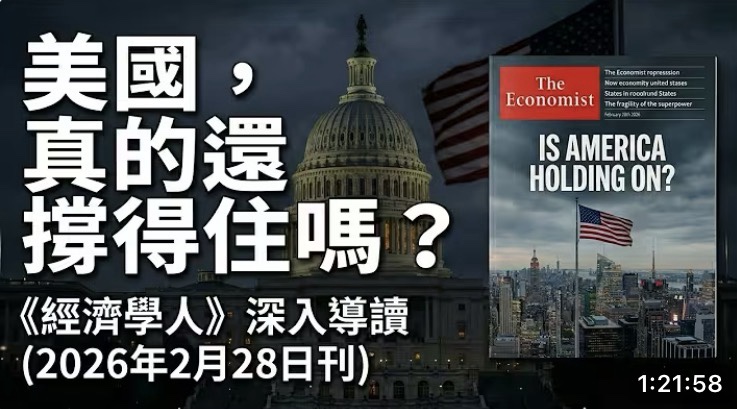
Economist Video: Is America Completely Losing Control? Warning Signs from the Mineral War, AI Bubble to Private Equity Freeze – February 28, 2026 Issue 經濟學人視頻:美國正在全面失控?從礦產戰、AI 泡沫到私募基金凍結的警訊2026年2月28日刊
This episode discusses the February 28, 2026 issue of The Economist:
00:00 America’s mineral scramble 06:35 The blind war on Iran 08:35 Warning signs in private markets 11:33 America’s mounting trade confusion 16:18 The AI productivity miracle has yet to arrive 19:00 Refuting online research reports claiming AI leads to economic collapse 21:01 Sharp drop in software stocks triggers credit market volatility 24:34 The welfare state phenomenon in U.S. states 27:24 The truth about global capital flows 28:44 Engel’s Law and Chinese consumers 30:00 Private equity moves into small-scale service industries 37:41 The global expansion of The Sphere 40:33 The rise of China’s Zijin Mining 43:05 U.S. Department of Defense vs. Anthropic 44:49 The battle for PDF’s survival 46:00 The plight of the lab-grown meat industry 47:31 Tony Robbins’ motivational empire 48:31 How to get rich in modern China 52:30 Anthropic accuses Chinese AI of plagiarism 55:33 Unfinished buildings and the property bubble 58:17 Spring Festival travel trends 01:00:20 Strained Sino-Japanese relations 01:01:50 AI’s “world model” 01:05:58 Complex markings from the Stone Age 01:07:21 Controversy over the effectiveness of cancer blood screenings 01:09:38 The high-fiber diet craze 01:11:56 The world’s hottest K-pop boy band, Stray Kids 01:13:45 The urban line dancing craze 01:14:50 Pokémon’s 30th anniversary 01:15:57 The fatal allure of Hannibal







 Business Blog