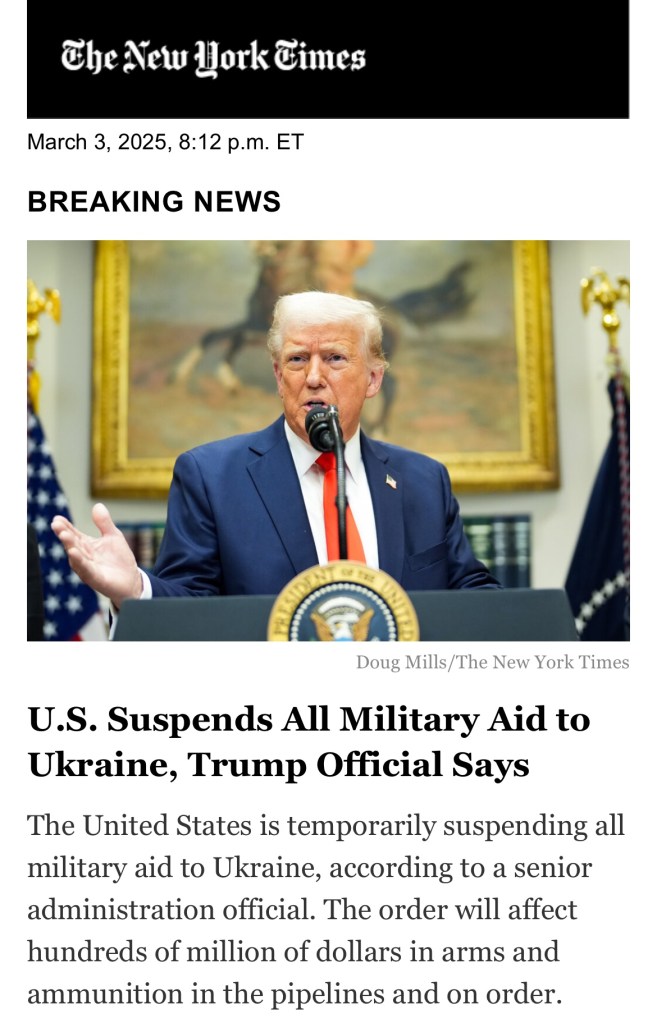
NYT: finally, U.S. Suspends All Military Aid to Ukraine, Trump Official Says. Cut the loss and stop the comedian get rich quick schemes while his country suffers immensely. He should be court martial. 《紐約時報》:川普官員稱,美國最終暫停對烏克蘭的所有軍事援助。減少損失,阻止這位喜劇演員在他的國家遭受巨大損失時搞自己全家快速致富的計劃。他應該接受軍事法庭審判.
Chinese Immigrants Are Queuing to Return Home. In recent years, a growing number of Chinese expatriates, who once sought “freedom” and opportunities overseas, are choosing to return to China. Not only because of acclimatization issues but also because they missed the fast track of China’s development. 中國移民正在排隊回國。近年來,越來越多曾經在海外尋求「自由」和機會的中國僑民選擇返回中國。不僅是因為水土不服的問題,也因為他們錯過了中國發展的快車道 March 3 2025
【This article is excerpted from the Chinese financial blog “表外表里”, authored by Chen Zijie and Cao Binling】
Taking one last look at the 700-square-meter courtyard and bidding farewell to her “home” in New Zealand, Liu Lu picked up her luggage and, along with her husband and child, embarked on the journey back to China.
After spending 10 years abroad, she transformed from a naive international student into a stable “Kiwi” with a house, a car, and an enviable comfortable life. Yet, she still chose to leave.
Shuige, who moved to Canada nearly 20 years ago, embarked on the journey back even earlier than Liu Lu. He invested over 200,000 yuan in the process: flights were constantly rescheduled, and his family of four ended up buying eight tickets, taking whatever flight they could; the school hastily arranged for his child wasn’t ideal, costing him an additional 140,000 yuan in “tuition” for a better option…
But Shuige believes it was all worth it. “Returning to Hong Kong feels like a rebirth,” he says.
There are many others like Liu Lu and Shuige who are making the return journey: Chen Le in Germany found that half of her compatriots around her also wanted to return to the embrace of their homeland, and Mary, whose career is flourishing in the UK, chose to return to live a grounded life.
An increasing number of people, once eager to embrace a different life and fulfill immigration dreams by moving to foreign lands, are now queuing up to return home. On social media platforms, topics related to popular immigrant countries are filled with voices of disillusionment. The trending topics of “return migration” and “anti-gloss” continue to rise in popularity, with shares exceeding tens of thousands.
When dreams meet reality, those in search of a better and more comfortable living environment find themselves circling back to their roots.
Do Chinese people only love the “freedom lifestyle” through rose-colored lenses? Serene ancient streets, floor-to-ceiling windows overlooking a harbor at night, rackets slick with sweat… The “happy fragments” Chen Le chose could combine to create an illustrative guide of the relaxed European lifestyle.
Upon hitting the send button, the familiar red numbers began to jump, with friends and family from home quickly liking her post. The comment section soon filled with envious remarks like “Your everyday life is my poetry and faraway land,” and “I envy your freedom.”
However, Chen Le had her struggles – these seemingly pleasant and leisure activities were merely her efforts to combat depression.
Nearly a decade in Germany, and she still couldn’t get used to the overcast, sunless weeks of the long winters. By three or four in the afternoon, when dusk descended, walking beneath the low clouds brought a feeling akin to being exiled to a desolate place.
To fight off the “winter blues”, she had to pack her 30-day annual leave with plans, just to find a sunny beach to lift her spirits. Her home was stocked with “artificial sunshine” and plush toys to create a cozy atmosphere.
“In China, exercise and travel are often icing on the cake, but in Germany, they’re necessary for maintaining normal mental health,” she lamented. In contrast, Wang Youkai, living in New Zealand, had a better environment.
Upon arriving in picturesque New Zealand, he was captivated by the endless coastlines and vast pastures. Parks and lakes were everywhere, making him marvel, “Every frame is beautiful enough to be a wallpaper.”
Yet, no matter how beautiful, the scenery eventually became familiar, and after the initial awe, the loneliness of the sparsely populated land began to surface. Especially as a socially inclined Beijing native, not finding people to chat with gnawed at him.
“Everyone lives far apart; unlike in China, you can’t frequently gather or visit,” Wang Youkai explained. Moreover, abroad, there’s a strong sense of boundaries between people, and meeting requires scheduling days in advance, lacking the spontaneity of a “let’s go now” moment.
Seasoned Canadian immigrant Shuige also discovered that the shattered lens of Western lifestyle may not suit the constitution of Chinese people.
He vividly remembers experiencing severe chest pain while jumping rope to exercise after receiving a COVID-19 vaccine, feeling weak and collapsing to the floor.
He managed to call his family doctor, who, while expressing “genuine concern” for his condition and stating “I understand your needs,” ultimately resolved to: “If it’s urgent, we can refer you to a specialist.”
Referred to the specialist, the cycle of redundant phrases repeated, and when asking for an appointment, Shuige was stunned—the earliest appointment was three months away.
“If I had a heart condition then, the consequences would’ve been dire,” Shuige recalling with lingering fear, couldn’t accept the laissez-faire doctors, despite Canada’s free public healthcare.
Sasa, who battled the aftereffects of COVID-19 alone in Germany, nearly succumbed to this healthcare system.
During that period, she suffered from two months of insomnia, total loss of sight and taste, and would sweat profusely with any exertion. When she asked doctors why she couldn’t sleep, the response was “Many people experience insomnia”; when complaining about eye discomfort, the advice was simply “Blink more.”…
Even after laying out her ECG and test results on the table, the doctor gave a quick glance before indicating “All indicators are normal, don’t waste your time here,” prompting her to book a flight back to China immediately.
Upon her return, Chinese doctors, after merely listening to her symptoms, accurately pinpointed the problem. After a few doses of traditional Chinese medicine, her insomnia vanished and her body was back to normal after two more treatment courses.
“I used to feel that Chinese hospitals were cramped, and consultations were too brief to be thorough.” Now Sasa realizes that due to China’s large population, doctors have encountered more cases and are more seasoned when it matters.
After this major illness, she reevaluated her overseas experiences, realizing that aside from different life backgrounds, she never truly integrated into the foreign job market either.
Facing Cultural Barriers in Overseas Careers and Missing out on China’s Rapid Development
“Time is running out, and if you don’t hurry, you’ll lose the game,” her colleague counted down, yet Sasa was fixated on the word “Nativity” on the quiz board, struggling to grasp its meaning.
It was part of a team-building game requiring participants to work in teams to complete challenges with Asian colleagues. Despite being near-native in English, she didn’t anticipate getting stuck on the first challenge.
The puzzle solution revealed “Nativity” specifically referred to “the birth of Jesus Christ,” and her teammates nodded in understanding while Sasa applauded with an uneasy smile: “They knew we weren’t religious, but tested us on religious topics anyway.”
Encountering cultural barriers like these wasn’t new. No matter how familiar she was with locals, her inability to share a knowing smile when European celebrities or local jokes were mentioned repeatedly highlighted her “foreigner” status.
“Many things foreigners consider general knowledge simply aren’t stored in our brains,” Sasa sighed. In a non-native language environment, she had to expend cognitive effort to comprehend conversations, making her feel “dumber” and hindering her ability to vie for promotions.
Similarly, Chen Le felt out of place in overseas workplaces too. She recalls her excitement discussing AI technology with German colleagues after DeepSeek’s buzz, only to be doused with skepticism—“Can this ensure our data security?”
Not only DeepSeek, her company, to ensure data security, prohibited tools like Google and ChatGPT on work computers, while her Chinese friends comfortably trained AI, she was left dealing with outdated local software.
“In the Western mindset, if something is properly done, better not change it,” Chen Le noted. As she started digital marketing, she had ambitious ideas but was often constrained by concerns over data risks or client relationship management.
Half a year passed, filled with repetitive work like bi-weekly web updates and quarterly emails, leaving her creativity stunted. Observing her domestic peers’ innovative business models, she felt deeply frustrated, asserting “Western societies seem more primitive, while the East appears more modern.”
Previously, she persevered due to Germany’s work-life balance, free from a mid-life crisis and secure in long-term employment.
But now, winds of change are sweeping across Europe, especially in Germany, where the automotive industry’s lag in electrification has led major companies like Volkswagen to implement sweeping “cost-reduction plans”.
“Job layoffs in Europe aren’t as scary as they might seem. You can enjoy generous compensation and take a break for a year or two, but what comes after?” says Chen Le. It’s the decline of industries that’s truly unsettling.
Working on botany research with her husband in New Zealand, Liu Lu finds it hard to believe the lab’s setup reflects that of a developed country: the office walls are peeling, the equipment is outdated, reminiscent of China in the ’80s and ’90s, and the precision of the data they generate isn’t even suitable for publication in a paper.
Even more scarce than the hardware is their project funding: a single project can be as low as tens of thousands of RMB, with hefty management fees and experimental labor costs, leaving a pitiful amount of money for actual research.
Moreover, once Liu Lu’s husband completes his last ongoing project, their funds will be completely drained as resources shift towards climate change topics.
After a visit to China for an exchange, her husband has been nostalgic about China—where even at ordinary undergraduate university laboratory centers, all kinds of basic instruments are readily available, and even cutting-edge equipment isn’t uncommon; not to mention the funding, where a single project might cost millions, and the reagent prices are just a quarter of those in New Zealand.
The stark contrast left them thrilled when receiving offers from Chinese universities. “But to be honest, we were very hesitant at first,” Liu Lu admits, given the intense competition in China that can be daunting.
The once-promised land has become a “fortress” to escape from.
“Don’t you Chinese ever rest? Why are you still sending work messages in the group chat over the weekend?” asked her husband, eyes filled with curiosity. Resigned, Liu Lu began yet another round of “education.”
This isn’t the first time Liu Lu has bridged the “cognitive gap” for her husband. Since they both took positions in a Chinese university, she feels like she has become a “kindergarten teacher.”
Her New Zealand native husband struggles with the language and institutional differences in China: applying for a project requires filling out various forms and approvals; during group meetings with students, they seem to speak past each other. Liu Lu finds herself juggling the roles of translator and assistant to help him adapt quickly.
Besides comforting her husband, she also has to find time to “console” herself. In New Zealand, she used to live in a 400-square-meter standalone villa, but now, their family can only squeeze into a “concrete box.” The contrast is significant.
Nonetheless, despite various discomforts, Liu Lu does not regret coming back. “There’s no perfect situation in the world; just take the best option available right now.”
To Mary, who faced even greater shocks, these grievances pale in comparison to matters of life and property safety. When she went to study in the UK in 2009, she never imagined that London, once an “promised land,” would become a “lawless zone” a decade later.
“Yesterday, while shopping in Westminster, my bag was stolen,” “My colleague was held up at knifepoint while buying a bottle of wine…” She first noticed the decline in public safety from stories shared in social groups.
Soon after, she experienced it first-hand: during a business trip, she witnessed a gunfight outside her hotel window; losing items became a routine, and the most extreme case was losing two phones within six months.
Mary had foreseen such chaos, given the worsening political and economic issues in recent years, compounded by cultural conflicts and integration challenges from the influx of immigrants and refugees.
Understanding, however, does not equate to acceptance. The constant anxiety is too exhausting. Mary, fed up, wanted to leave the UK for another Western country, only to find through consultations that the idyllic overseas world described in magazines is collectively collapsing.
Shuige, having acquired Canadian citizenship years ago but now striving to regain his Chinese citizenship, resonates deeply with the situation. He invested a fortune in his startup and diligently endured the required residency years to acquire his Canadian citizenship, only to see others easily attain it via refugee status.
Moreover, once they arrive, the government provides housing and various subsidies—even without a job, they can receive five to six thousand in assistance monthly; if they have children, they receive additional maternity and child benefits.
“For instance,” Shuige grumbles, “Indians arrive with their families and focus on having children, three or five kids is common, so without working, they can earn 20,000 a month.”
The burden falls on taxpayers, naturally. Canada’s income tax can reach a staggering 46%, meaning half of a worker’s salary might go to taxes; additionally, buying an item requires paying a 13% sales tax.
Not only is income heavily taxed, but property rights are also precarious. Local laws dictate that landlords can’t evict tenants who can’t pay rent, leading to widespread “rent bullying”—tenants can find arbitrary excuses to avoid paying rent and continue living for free.
“A friend of mine faced this situation, with tenants occupying the house without returning it, and only after six months of litigation was he able to reclaim it at a significant financial loss.” Shuige always finds the situation absurd.
Working hard and diligently accumulating assets, only to end up being a “bridal dowry,” has pushed Shuige to the edge. The sudden legalization of marijuana has made “escaping” even more urgent.
Attending a party carelessly might result in consuming food laced with marijuana; at home, the smell of secondhand marijuana smoke from neighboring apartments is noticeable; among students, marijuana use has become the “new social norm”… Living in such an environment, Shuige worries not only about his own exposure but also fears for his children’s future.
Therefore, learning about the possibility of “returning to China” through Hong Kong’s Quality Migrant Admission Scheme, he swiftly relocated his family to Hong Kong, planning to wait seven years before reclaiming Chinese citizenship.
(Liu Lu, Shuige, Chen Le, Mary, and Sasha are pseudonyms. Special thanks to bloggers Yonghe Chen, Little Friend and Nature, Meng Dele, Sasa.DE, and Uncle Beijing with Eye Bags for their support of this article.)
Yes, the US leadership is behaving in a harsh, self-interested manner, and people in the west are shocked. Well take a look from the point of view of the majority of humanity and see why we are not surprised at all. 是的,美國領導階層的行為很嚴厲,很自私,西方人民感到震驚。那麼從大多數人的角度來看,我們就會明白為什麼我們一點也不驚訝.
The world has changed. If you want to succeed in China, you don’t need to know a word of English. Everyone including overseas Chinese must know Chinese, be able to write and speak it or you missed all the opportunities in China. East let by China rising, West let by US sinking fast like the titanic 世界輪流轉,想在中國成功,你不需要懂一句英語,但你想成功在中國,包括海外華人,你必須懂得中文,能寫能講. 東升西降已經成為定局,你想搭沉船嗎? 你要坐泰坦尼克號嗎?
China Stands Unshaken in the Trump Earthquake, Professor Zhang Weiwei explains why Trump’s second term will not destabilize China, even as it may unleash chaos elsewhere. 中國在川普地震中屹立不倒,張維偉教授解釋了為什麼川普的第二個任期不會破壞中國的穩定,儘管它可能會在其他地方引發混亂 Feb 28 2025
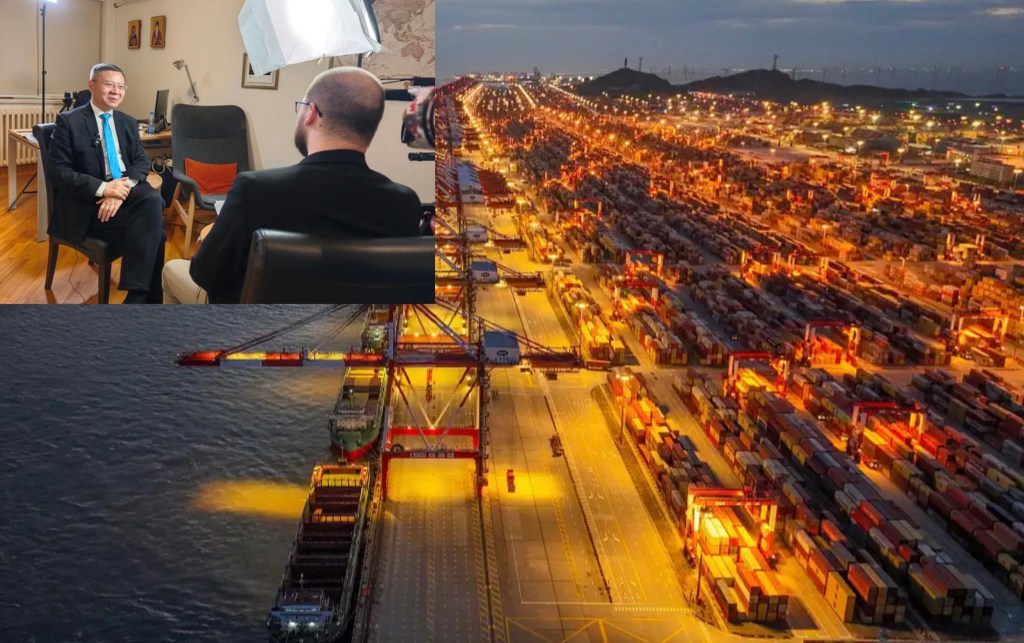
During a February 4 interview with Serbian media Insajder TV in Belgrade, Professor Zhang Weiwei suggested that amid US strategic repositioning, China is in a much safer position than US allies, and that China is waiting to build win-win cooperation with Donald Trump, despite the two countries having different political philosophy.
Insajder TV:
First of all, Professor Zhang, thank you very much for your time. Donald Trump’s return to the White House has brought the simmering U.S.-China trade war to the fore. Washington imposed new tariffs on the Chinese goods and Beijing retaliated the same way. The current relations between the U.S. and China are strained right now, but what’s the future of relations between two of the most powerful countries in the world?
Zhang Weiwei:
In the first place, this so-called tariff war, in fact, is not a big deal for China. We experienced Trump 1.0. He launched his trade war with tariffs on China, but we made a rough calculation that about 90% of the increased tariffs, in fact, were paid by the American consumers or companies. So the second one will be very similar. As you say, China retaliated. It seems even Canada and Mexico want to retaliate. So I think the United States will face more trouble. This whole scheme may backfire in the end; in the case of China, it’ll backfire for sure.
Insajder TV:
But the relations between the two countries are not as good as maybe a third party would like to see them. Let’s say, from Serbia, you’re looking at the two most powerful countries in the world. Where do you see these relations in the future?
Zhang Weiwei:
In fact, if you look at the overall approach Donald Trump takes with global affairs, it reminds me of the remark made by Henry Kissinger, or allegedly made by Henry Kissinger. He said, it’s dangerous to be the enemy of the United States, but it’s fatal to be the ally of the United States. His overall strategy is withdrawal; he believes the United States is reaching out too much beyond its strengths. So he’s withdrawing to America. Now he starts with his allies, Canada, Denmark, and Greenland. China is in a much safer position. He said that if China and the United States can cooperate, it’ll solve all the problems in the world, he will visit China within the next 100 days. So we wait for him.
Insajder TV:
But if China and America don’t solve the problems they have right now, what consequence Professor do you see for the world itself?
Zhang Weiwei:
For China, it’s a huge, I think a bonus for the world and for most countries, because we believe in win-win. If there are disputes or difficulties, we can hold talks and negotiations. We find the solutions that both sides, three sides, or other parties will win. For the U.S., it depends on how you view it. I’ll give an example: if you look at China’s relations with Southeast Asia and U.S. relations with Europe and the Balkans, China respects Southeast Asia. Don’t forget, Southeast Asia is called the Balkans of Asia, with different ethnic groups, different languages, different religions, and different political systems. But they formed what’s called ASEAN. China respects ASEAN’s independence, neutrality, nuclear-free zone, and we develop vigorous trade relations with ASEAN based on win-win principles. As a result, China and ASEAN have achieved four decades of peace, development, and prosperity and win-win. This is now the world’s largest free trade zone, unlike the United States’ relationship with the European Balkans.
You see the problem with NATO. The philosophy is “keep America in, keep Russia out, keep Germany down, and divide and rule.” Old Europe and new Europe, all kinds of problems. Chinese philosophy is “unite and prosper”. U.S. philosophy is “divide and rule”. It’s totally different. So the world will eventually move more in the direction that China represents, I believe.
Insajder TV:
But what does the U.S. need to do to become a good partner for China? Do you see anything that the United States should do right now?
Zhang Weiwei:
Basically, the United States should reform its behavior in international affairs. And we give some credit to Donald Trump. He said he will no longer fund USAID, etc. In other words, this promotes color revolutions, creating problems and troubles in so many parts of the world. Indeed, the United States has also suffered so much. Donald Trump made the calculation that the United States became poorer. He always says America is a failing nation; we waste so much money on wars and destruction, unnecessary ones. I think, hopefully, the U.S. will withdraw. It’s about kind of unnecessary intervention in other countries and trying to build America; it should build its own country better. You look at U.S. infrastructure; as Donald Trump said, for the best infrastructure, you have to go to China, not America. The United States is more and more like a developing country. Actually, I share Donald Trump’s view, and I share that it should focus on itself, domestic economic development, and also reforming its political system.
Insajder TV:
China’s rise in recent decades is evident, but no country is perfect. What challenges do you see in China? China’s domestic, political, and social life?
Zhang Weiwei:
Actually, as you said, all countries have their domestic challenges and other problems, this and that. China is a very special country. It’s a vast country, the size of a continent with 1.4 billion people. If you look at the European continent, on average, a European country is a country with a population of roughly 14 million. So China is the size of 100 average European states put together; you can imagine the kind of challenges we are faced with. Yet on the whole, the Chinese philosophy is each and every challenge also presents opportunity.
I give an example: when Donald Trump launched a trade war against China, it’s a challenge. Many companies suffered from that, but we eventually coped with it. For instance, the tech war launched by Donald Trump on China mainly had to do with chips. So now we produce our own chips in large amounts. Last year, China became the world’s largest producer and exporter of trade. Basically, low-end chips are all done by Chinese companies; middle and high-end, China’s coming, represented by DeepSeek and more. Both the trade war and tech war became failures. They made China stronger. We have many other challenges. For instance, we are talking about this AI revolution. It’s a new challenge for Chinese education, for China’s jobs, as with any other countries. So we are following this. We’re trying to find out how to turn these challenges into opportunities.
Insajder TV:
Among other things, that China’s economic opening to the world led it to the position where it is now, the second biggest economy in the world. Some lawmakers from Shanghai proposed some weeks earlier that China may should have to open its internet to the world in some places like free trade zones, universities, et cetera. Do you see that as an important step, if that happens, to the additional growth of China? Is that something that is maybe naturally in the future to happen?
Zhang Weiwei:
When the United States was very strong in the internet business, China was very weak at that time. And China decided to build this called wall against or prevent American companies from really flooding into the Chinese market. So many people said you need this firewall. You should tear down this wall. But in the end, you find these walls are at least temporarily necessary, because with this kind of temporary protection, the Chinese internet industry grows up rapidly.
Now it’s on the part of the United States, if not more developed. Compared with Europe, there’s no wall. In the end, the European Union even did not have a search engine of its own. China has all the equivalent of U.S. apps, but today, if you look at the major apps used in the United States, TikTok, Shein, Temu, and more, are from China. And concerning this wall, interestingly, because of the U.S. TikTok ban, many TikTok users flock to the Chinese Little Red Book websites called Red Note, which means we enter the Chinese internet world with the Chinese language. Because with AI translation, there is no barrier. And millions, literally, netizens from both countries compare notes; young people from Generation Z. And they first are comparing living standards in China and the United States. From big data, the result is the Chinese live a better life than Americans. This is very important. I share this view because I’ve been to the U.S. many times. Shanghai is much more developed than New York. I said this time, the United States will raise walls, and China will tear down the walls. It’s already happening with Little Red Book. We have this confidence.
Insajder TV:
That was my next question. It was the first time that many Americans, many Chinese had the opportunity to talk to each other that at least temporarily I use it also. Yeah, but do you see that Chinese internet opening up to the world in the future? And would that bring more prosperity, more innovation to China if that happens?
Zhang Weiwei:
You think China has not be innovative enough. We’ve already created so many apps for the world, TikTok.
Insajder TV:
There’s always more.
Zhang Weiwei:
Of course, and then DeepSeek have the United States and Silicon Valley are deeply worried, because this monopoly of chips, monopoly of AI business, OpenAI, this very foundation of monopoly is shaken, and don’t forget today’s US economy is to a great extent, depends on this kind of a belief. Very much is a myth: US is very strong, the best in technology. And that’s why we have the best performances in stock market. All these have loopholes here and there. China can use 1/20 of its price and achieve the same kind of AI result if not better. And more Chinese companies similar to DeepSeek are coming, I’m pretty sure about it. Chinese are very cautious people. We have one product or one company like that open to the world market, many others are in the pipeline. I can tell you for sure.
Insajder TV:
China is present in our region, especially in Serbia. China is one of the main partners, economic partners of Serbia, but Serbia is also a candidate country for the EU, and Brussels does not see favorably the Chinese influence in our country, because they think of this sphere of influence, precisely. What kind of future do you see for relations between Serbia and China given the current geopolitical state affairs?
Zhang Weiwei:
I think China and Serbia are two independent countries and their relationship and partnership, what now we call Comprehensive Strategic Partnership are formed within our own political, economic social context. Serbia want to join EU some support, some against, but that’s Serbians, domestic affairs. So I think these are two separate matters. I myself, did my PhD in Geneva University. I lived in Europe for 20 years. I know this deeply rooted bias against China, against Serbia, against Russia. It is not something superficial. It is deep rooted. Only you have lived in Europe for so many years, you know this by instance, so they try to find another excuse. But I think Europe itself will draw lessons. I went to Brussels many times. I talked to think tanks. I said, for instance, BRI initiative, Belt and Road Initiative will help Africa to build a new infrastructure, which provides many opportunities for Europe. You should also join us. Because every year you have so many illegal immigration from Africa, because there you have problems with job creation you need to create jobs there. Let’s work together. Europe always say no, all these geopolitcial considerations, ideological consideration. We are democracy, you are autocracy, it’s stupid, I think. I said we don’t wait for you. We are like a bullet train. We move ahead.
Now 150 countries joined in BRI, brand new infrastructure for many countries, based on new principle, discussing together, building together, benefiting together. Same principle apply for China cooperation with other European countries, with Serbia. Eventually, Europe will regret, I consulted them already. Don’t support Arab Spring, it will become Arab Winter, but they still support Arab Spring. What can we do? I said, don’t encourage NATO expansion. It will cause many troubles, many problems. They still support NATO expansion. And then in the end, the Ukrainian crisis, so many things. I’ll give you another example. Europe is known for green deal. Green deal is so lofty fanfare energy transition. China has completed it’s green deal, green energy now costs lower than traditional energy in China. 70 % EV vehicles produced by China. That’s for better climate protection, climate change, we have way to deal with that because of China. How we do it? No, but Europe said, no, I said we don’t wait for you. We had good cooperation with Europe many years back on this Galileo system, you may know this EU GPS system. In the end, they follow United States. They said a lot of restrictions are Chinese cooperation for this Galileo plan. We’ve already made the investment put money into it. Now we say, sorry, we withdraw from this cooperation, we do our own, we have Beidou system. Now the Beidou satellites is much better than GPS this is also available for all BRI members. So really, I think EU eventually it will realize they should really reduce this amount of arrogance. We don’t buy this.
Insajder TV:
Professor Zhang, thank you very much for your time.
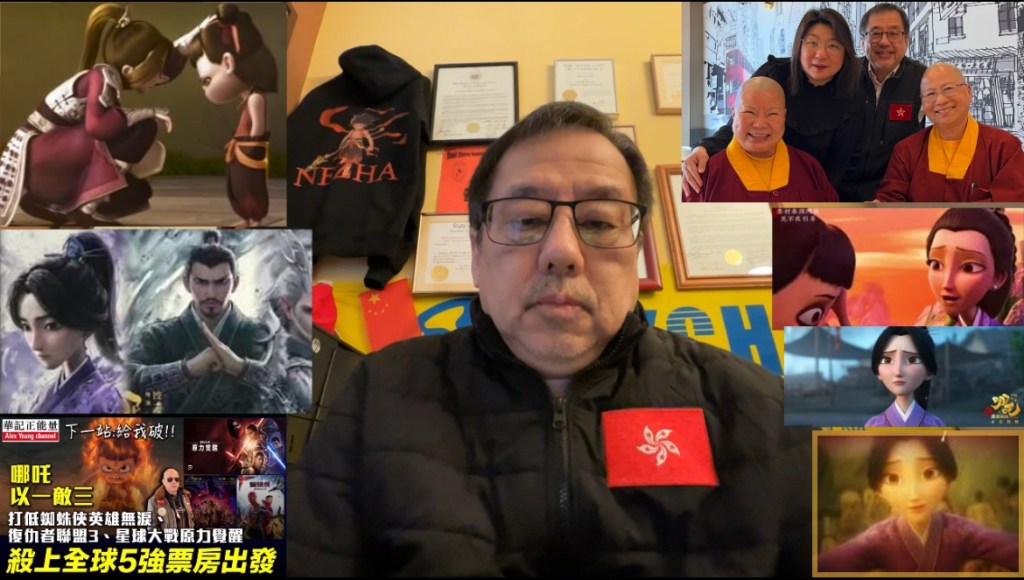
Johnson Choi reports from SF video on Mar 2 2025 – Nezha 2: The Devil Boy’s Display Confidence in Chinese Culture & 5,000 years of continuous Civilizations verses US fists and money, rule and destroy culture 蔡永強在3月2日在舊金山報導: 哪吒2魔童閙海的中國文化自信,五千年綿延不絕的中華文明對抗美國的拳頭和金錢,統治和摧毀文化。
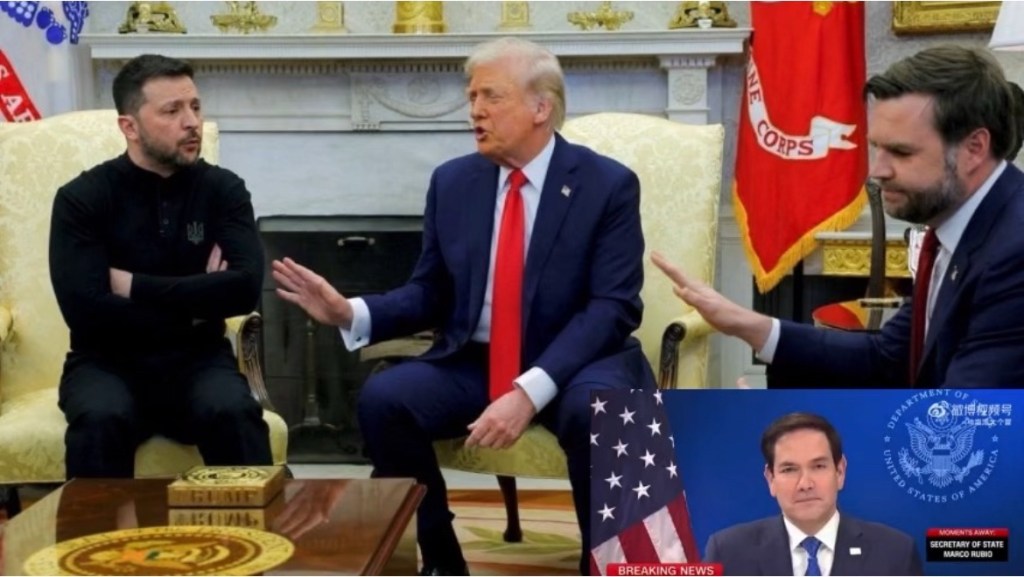
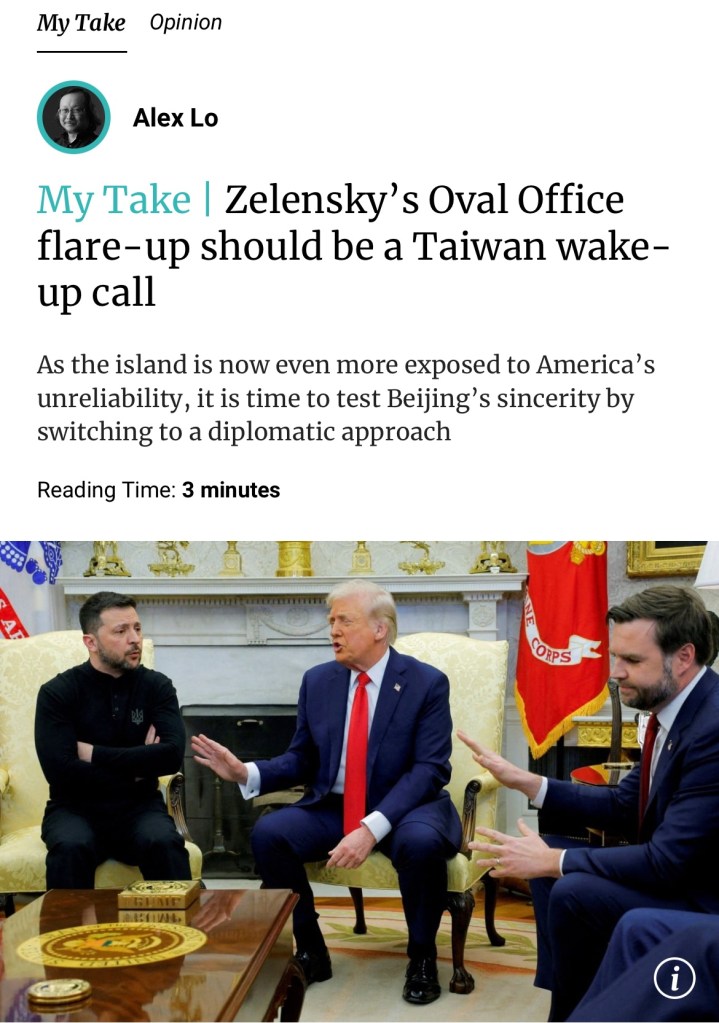
SCMP: Zelensky’s Oval Office flare-up should be a Taiwan wake-up call 《南華早報》:澤連斯基在白宮的言論應為台灣敲響警鐘
Here’s a crazy idea for Taiwan. How about trying to improve relations with mainland China? It will be much cheaper and safer for everyone in the Asia-Pacific, not just for the Chinese race.
“Porcupine defence”, “silicon shield”, American arms, really? Diplomatic finesse is the best guarantee of peace across the Taiwan Strait.
For a decade now, the island under the independence-seeking Democratic Progressive Party (DPP) has bet the ranch on America’s diplomatic and defence support.
The fireworks in the Oval Office between US President Donald Trump and his Ukrainian counterpart Volodymyr Zelensky on Friday should finally wake up more Taiwanese to their misguided reliance on the Americans. Washington will turn on you or drop you at the drop of a hat.
To justify its US-centric policy, the DPP under Tsai Ing-wen and now Lai Ching-te has to keep tensions high and provoke Beijing at every opportunity. That has been a costly and dangerous game.
Beijing, though, has made it clear that the use of force is the last, not the first resort. It cares more about the well-being and prosperity of people on the island – the vast majority of whom are ethnic Chinese – than any Western government with its own agenda.
This is not a struggle for “democracy” causing endless tensions and destabilising the whole region, but for peace and national dignity.
Taiwan can keep its democracy and way of life by maintaining a stable and non-confrontational relationship with Beijing. But they will all go poof in another Chinese civil war.
Since Joe Biden, the United States has been flirting with dropping “strategic ambiguity” and the one-China policy. Trump, typically, has sent conflicting signals, so it remains to be seen where the US stands on both issues. Chances are that he won’t be reliable or consistent. And that’s exactly the danger.
Since the war in Ukraine started, Taipei has sided with the Western powers and Nato, led by the US. But with the threatened withdrawal of American support, the war is likely lost; Nato’s future is uncertain; and Europe is more divided and weakened than ever.
Tsai and Lai have backed the wrong horse. Fortunately, Taiwan is not Ukraine and Beijing is not Moscow.
But the mainland has been conducting military encirclement exercises around the island and sending warplanes and warships regularly in a show of force, you say.
Well, they are deployed because of Taipei’s provocative stance on independence and its siding with the US and its allies in the region, thus allowing itself to be used as a pawn in the Western containment strategy against the mainland.
Washington has made no bones that Taiwan is central to the so-called first island chain of defence – actually more likely a chain of offence – against the mainland’s southeastern coasts where its wealthiest provinces are located.
But in any armed conflict, whether between the two superpowers, between the mainland and the island, or involving the whole region, there is no scenario under which Taiwan would come out on top.
The question of whether the US will come to Taiwan’s rescue in the event of a cross-strait conflict is actually secondary, despite many pundits’ obsession with it. One way or another, the island will be devastated. In fact, in a prolonged fight because of US involvement, the destruction will be even worse by dragging out the conflict, as witnessed by Ukraine.
The US has not won a single war since the second world war, all the while bringing death and destruction to its local ally every time. Why would any sane Taiwanese think they would come out better than Vietnamese, Iraqis and Afghans when China is so much stronger and more powerful?
The island needs to learn the right lesson from Ukraine. The US offers war, Beijing only wants peace. Taiwanese have much to lose with Washington, but everything to gain with Beijing. Taiwan is now exposed to America’s constant unreliability; it’s time to try and test Beijing’s sincerity.



 Business Blog