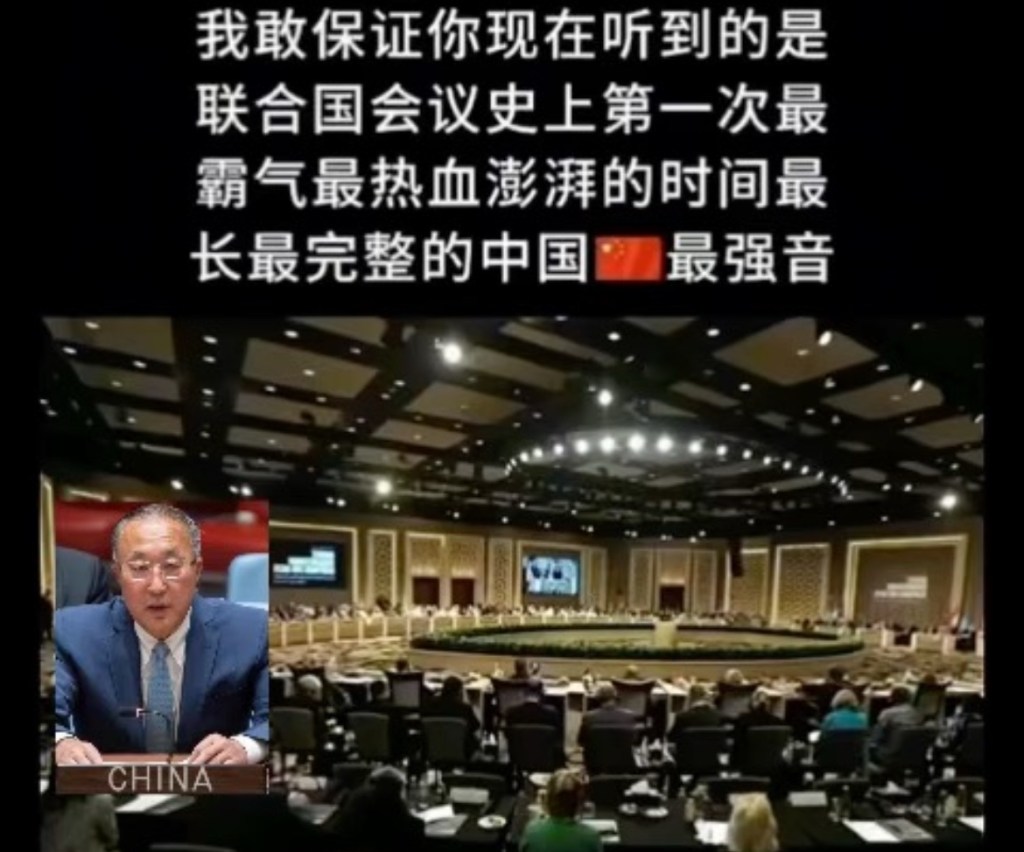
UN video: Fu Cong, China’s Permanent Representative to the UN Ambassador Extraordinary and Plenipotentiary, gave the most domineering, passionate and complete speech of China🇨🇳 at the UN meeting for the first time, pointed out when the former US President Obama said that US cannot let the Chinese people live as well as the Americans, his idiotic remarks are short-sighted and naive· 聯合國視頻:中國常驻联合国代表、特命全权大使傅聪是在聯合國會議上第一次最霸氣最熱血澎湃的最完整的中國🇨🇳最強者演講,尤其是針對像前美國總統歐巴馬說美國不能讓中國人活得和美國人一樣好的腦殘言論是目光短淺又天真. https://rumble.com/v6pptcr-fu-cong-chinas-permanent-representative-to-the-un.html https://www.tiktok.com/t/ZP8Y3qpn3/ https://youtu.be/qLmRfTJmIWk?si=9XDt-stZUKss9sqQ
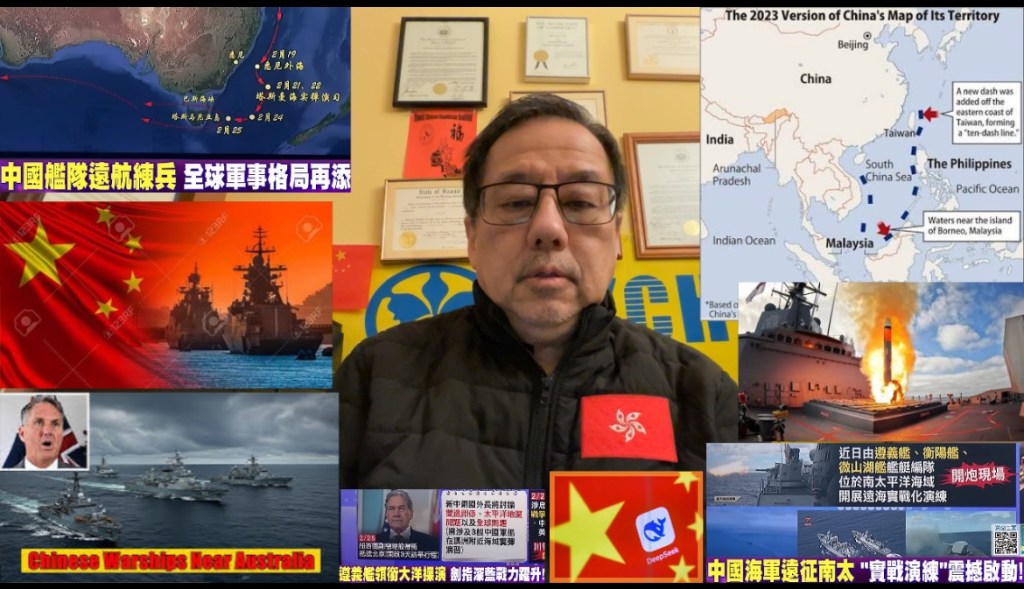
Australia Lost Its Balls to Chinese Navy. Freedom of navigation is a good thing, but you can’t just defend it when your own warships are parked at someone else’s doorstep, right? This weekend, the Chinese navy kindly raised this issue with Australia and received a satisfactory response. At least, their official reply was quite satisfying to the Chinese. 澳洲輸給了中國海軍。航行自由是好事,但不能把自己的軍艦停在別人家門口就去捍衛它吧?本週末,中國海軍向澳洲善意地提出了這個問題,並得到了滿意的回應。至少,他們的官方答覆讓中國人還是滿意的. Feb 26 2025
On February 21 and 22, the Chinese Navy conducted two live-fire exercises in the international waters between Australia and New Zealand.
By Western standards, military drills in international waters with prior notices are not just normal, but essential for safeguarding freedom of navigation, but they seem to have a problem when it was China who tries to have a shot at the noble task.
For instance, U.S. news agency Associated Press News falsely claimed that airliners were warned of flying over a “secret live-fire exercise.”
In contrast, the Sydney Morning Herald reported that the Australian military detected the ships a week before the exercise and that China had issued safety warnings in advance to Australian airlines including Qantas, Jetstar. These details are available to the public and not hidden behind any paywall.
Moreover, the Chinese Navy’s planned exercise was communicated through radio broadcasts, meaning anyone with access to a radio—whether fishermen, pilots, or divers—could receive the notice. It’s baffling how AP News can call it “secret.”
What’s even more perplexing is the reaction from certain Australian politicians. Shadow Minister for Defense Andrew Hastie labeled the Chinese military exercise as a “provocation.” Meanwhile, Andrew Wallace, the deputy chair of the Parliamentary Joint Committee on Intelligence and Security, pointed out the hypocrisy of Australia criticizing China’s actions while conducting its own military operations far from its shores.
For those at AP News who may have missed this “secret,” on February 7, warships from the U.S., the Philippines, Japan, and Australia participated in a joint maritime exercise in the South China Sea. On February 11, an Australian military aircraft entered Chinese airspace over the Xisha Islands without permission. As Wallace put it, “We can’t talk about freedom of navigation in the South China Sea and then criticize China over an exercise like this. They haven’t done anything wrong.”
Interestingly, Hastie also accused Beijing of using “gunboat diplomacy” to test U.S. allies like Australia. It’s a curious statement, considering that while Australia has tried hard to prove its loyalty to the United States, the U.S. has never truly regarded Australia as an equal ally.
Australia, a member of AUKUS, an alliance built on a contract of dealing second-hand nuclear submarines. To obtain three U.S. Virginia-class submarines, Australia will spend a staggering $368 billion. But despite Australia’s lofty expectations, a report published by the U.S. Congressional Budget Office (CBO) in January, titled An Analysis of the Navy’s 2025 Shipbuilding Plan, states that the larger Columbia class SSBNs are US Navy’s “highest acquisition priority”, and “the sale of SSNs to Australia could reduce the number of attack submarines available to the Navy.” Which translates as “we’re busy, don’t come bother us, just wait.”
Australian Greens Senator David Shoebridge called the report “damning,” arguing it further demonstrates that Australia’s nuclear-submarine plans are unraveling. Even though Australia has already invested about $3 billion in the first 4 years, the U.S. shipbuilding industry is nowhere near producing enough nuclear submarines to meet demand, with no clear solution in sight.
Buying submarine is not ordering Panda Express, and it’s hard to find an alternative supplier, especially after they tore up the contract with France in 2021.
On February 22, Australian PM Anthony Albanese reiterated that China had adhered to international law, emphasizing that no Australian assets were in danger. Defense Minister Richard Marles also clarified that Chinese ships did not enter Australia’s territorial waters.
New Zealand PM Christopher Luxon also said on February 24 that “there is nothing illegal here in terms of they are compliant with international law,” See? That $3 billion was not completely wasted. At least they learned a valuable lesson: America’s promises are unreliable, so behave yourself.
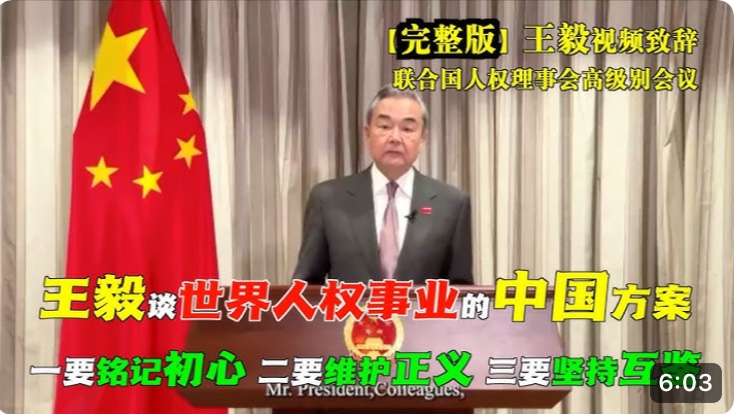
Video: China’s human rights don’t need anyone else to tell them what to do! Bearing in mind the original aspiration and mission, safeguarding fairness and justice, and insisting on exchanges and mutual learning, this is China’s position mentioned by Wang Yi in his speech at the 58th High-level Meeting of the United Nations Human Rights Council 中国人权不需要别人指手画脚!铭记初心使命、维护公平正义、坚持交流互鉴,这是王毅在联合国人权理事会第58届高级别会议致辞时提到的中国立场
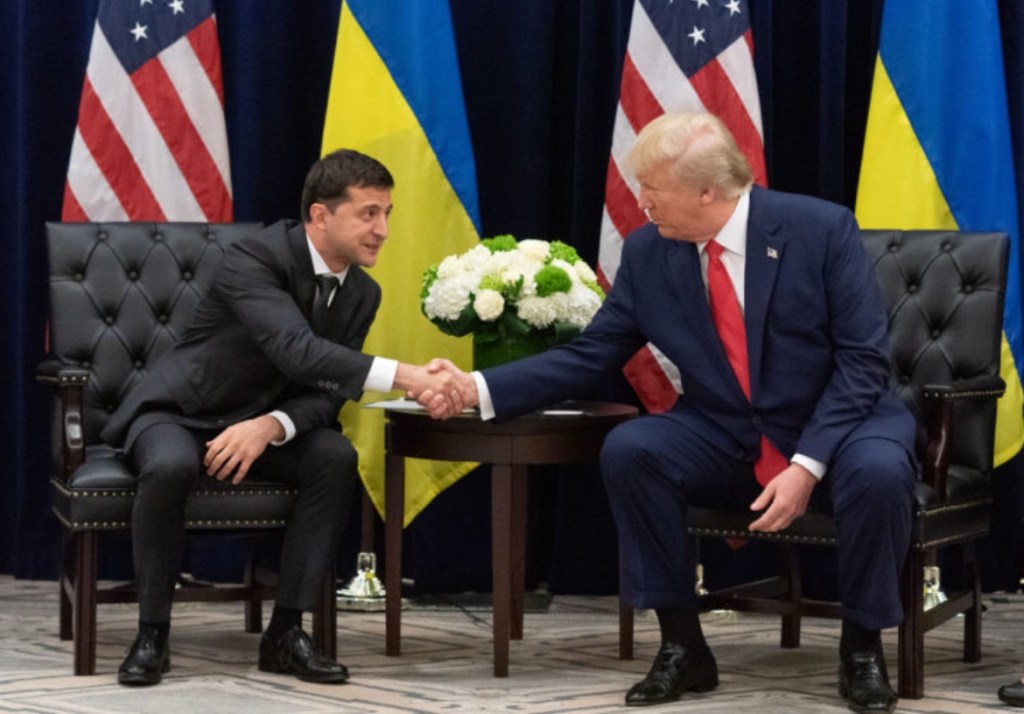
Yes, Ukraine Started the War: Donald Trump has been flayed alive by Western media and leaders for saying Ukraine started the war. Here are facts, not myths, says Joe Lauria. 是的,烏克蘭發動了戰爭: 唐納德·川普因聲稱烏克蘭發動了戰爭而遭到西方媒體和領導人的猛烈批評。喬·勞裡亞 (Joe Lauria) 說,這些都是事實,不是神話
The outcry spread quickly across the Western world: Donald Trump dared say Ukraine started the war.
The New York Times accused Trump of “rewriting the history of Russia’s invasion of its neighbor.” The paper’s White House correspondent wrote:
“When Russian forces crashed over the borders into Ukraine in 2022 determined to wipe it off the map as an independent state, the United States rushed to aid the beleaguered nation and cast its president, Volodymyr Zelensky, as a hero of resistance.
Three years almost to the day later, President Trump is rewriting the history of Russia’s invasion of its smaller neighbor. Ukraine, in this version, is not a victim but a villain. And Mr. Zelensky is not a latter-day Winston Churchill, but a ‘dictator without elections’ who somehow started the war himself and conned America into helping.”
The BBC reported:
“Ukraine didn’t start the war. Russia launched a full-scale invasion of Ukraine in February 2022, having annexed Crimea in 2014.
The annexation came after Ukraine’s pro-Russian president was ousted by popular demonstrations.”
CNN howled: “President Donald Trump has now fully adopted Russia’s false propaganda on Ukraine, turning against a sovereign democracy that was invaded in favor of the invader. … Trump wrongly accused Ukraine of starting the conflict.”
“In comments to reporters at his Mar-a-Lago resort in Florida, Trump falsely claimed Kyiv had started the conflict, the largest on European soil since the second world,” complained the Financial Times.
It was pretty much the same thing across the Western media landscape, which spoke with one voice.
The media takes speaking with one voice as confirmation that they are right. But it’s often just massive confirmation bias for the story Western intelligence services and political leaders tell them, rather than an independent examination of the facts.
In this case the facts show that Trump is right.
The central question in all this is: when did the Ukraine war actually start? The Western mainstream leads masses of people to believe it began Feb. 24, 2022, when the Russian regular army intervened in what was already an eight-year old civil war that was very much begun by Ukraine, with U.S. help.
That’s the part they don’t tell you.
The key to the falsehood is what the BBC calls “Ukraine’s pro-Russian president” being “ousted by popular demonstrations.” [Emphasis added.]
Of course Trump didn’t explain that. He’s not a great public speaker. He too often fails to lay out the context needed to understand what he’s talking about.
Trump’s fleeting remark at a press encounter at his Florida estate last Tuesday set off the international furor.
“Today I heard: ‘Oh, well, we weren’t invited’ [to the talks in Saudi Arabia with Russia],” Trump said about Ukrainian President Volodmyr Zelensky. “Well, you’ve been there for three years … you should have never started it. You could have made a deal.”
It was those six italicized words that ignited the firestorm. The rest of what he said in that sentence was ignored.
He was condemned by European leaders for those few words. Zelensky, who still leads Ukraine, accused Trump of spreading “a lot of disinformation coming from Russia.”
“Unfortunately, President Trump, with all due respect for him as the leader of a nation that we respect greatly, is living in this disinformation bubble,” Zelensky said.
The only way the West can deal with this is to call what happened Russian propaganda. As if a narrative is wrong, not because the facts are wrong, but because Russia is saying it. Essentially, Russia is never right, and the U.S. and its allies are never wrong.
It’s like the story of the American sitting next to a Russian on a flight from Moscow to Washington. “What brings you to Washington?” the American asks.
“I’m traveling to do research on American propaganda,” the Russian says.
“What American propaganda?”
“Exactly,” says the Russian.
Blowing a Deal
What was left out of the mainstream reporting was that Trump was highlighting opportunities to negotiate peace that Zelensky and Ukraine had squandered. “You could have made a deal,” he said.
But Trump fundamentally failed to explain how the Ukraine war began in 2014 and not on Feb. 22, 2022, three years ago Monday. That’s when Russia directly entered a war that had already been started by Ukraine and especially, Trump didn’t mention, by the United States.
How May China Help the World Break Free From US Tech Giants? 中國如何幫助世界擺脫美國科技巨頭的束縛 With DeepSeek’s democratization of AI, Global South nations face a historic opportunity. While India and Brazil leverage these tools to build sovereign AI, their dependence on U.S. digital infrastructure persists. The 2025 BRICS summit, hosted by Brazil, may redefine AI governance as countries explore partnerships with Chinese tech giants like Huawei to counter U.S. digital hegemony. Feb 21, 2025
The successive releases of the DeepSeek-R1 and Grok3 models have sparked a new wave of global interest in large language models (LLM) artificial intelligence. DeepSeek has managed to train models that perform close to, or in some cases even surpass, OpenAI’s GPT-4, but at a significantly lower cost. Additionally, by leveraging “distillation” technology, DeepSeek has developed a series of derivative models with relatively smaller parameter sizes, minimal performance degradation, and practical utility. Examples include the Qwen-7B and Qwen-32B models, which have been deployed on the Chinese SuperComputing Network SCNet and are freely available to the public.
Based on my experiments and estimates, deploying and running the DeepSeek-R1 671B model (commonly referred to as the “full-capacity model”) for internal research and experimentation incurs an approximate cost of over ¥300 ($41) per hour or more than ¥100,000 ($14,000) per month. If supervised fine-tuning (SFT) is applied to the model, the cost could increase several fold. While this expense may be beyond the reach of most individuals and small businesses, it is well within the budget of large enterprises and national entities. In comparison, the visible costs of training Elon Musk’s so-called most advanced large language model, Grok-3, include the use of 200,000 H100 high-performance GPUs and an annual electricity consumption equivalent to nearly 200,000 U.S. households. Despite these staggering investments, Grok-3’s performance scores in model benchmarks are only marginally higher than DeepSeek-R1’s—by less than 100 points.
This signifies that large language models have been significantly “democratized” by DeepSeek: any country can now train and deploy an AI model that is largely autonomous, aligned with its own values, and tailored to its specific realities—achieving performance close to or at the world’s most advanced level. Just a few months ago, this was a feat only within the reach of the United States and China.
Governments of several countries have already recognized the significance of this transformation. The Indian government has announced plans to invest in “computing infrastructure, data, and capital support to build AI-related applications in fields such as agriculture and climate change.” It is reported that India’s large language model will be developed based on DeepSeek-R1. Meanwhile, South Korea has declared its intention to accelerate the construction of national AI computing infrastructure, aiming to become the “world’s third-largest AI powerhouse.” This goal, proposed by the South Korean government in 2023, clearly reflects an awareness that nations can now build their own “sovereign AI” in the near term, a process significantly accelerated by DeepSeek’s open-source initiatives.
Sergio Amadeu, a professor at Brazil’s UFABC University and former director of the National Institute of Information Technology (ITI) under the Brazilian Presidency, highlights that DeepSeek’s open-source initiatives “enable countries that have been technologically dependent on the United States to formulate strategies that favor their own development… democratizing [large language model] technology and opening new possibilities for nations in the Global South.” However, he also cautions that “open-source alone cannot address the challenge of building sovereign infrastructure critical to local and national development.”
Amadeu’s insight underscores a significant issue in the realm of digital sovereignty: it is a systemic endeavor that cannot be achieved solely through a single piece of legislation or the breakthrough of a “killer app.”
Influenced by the EU’s General Data Protection Regulation (GDPR), discussions on digital sovereignty often center on the issue of data ownership—specifically, a nation’s right to use and manage data generated within its borders and to prevent its misuse by other countries. Corresponding solutions typically involve legislative measures to regulate local data storage and cross-border data transfers. For example, data generated within a country should be stored domestically, and any cross-border data transfers must comply with local laws.
Other researchers approach the issue from a communication studies perspective, focusing on the monopolization of information by U.S. internet giants and its subsequent impact on politics and national security. In response, they advocate for alternative internet platforms that operate independently of these major U.S. corporations. Concepts such as open-source development and decentralization are frequently highlighted in these proposals.
However, it turns out that data ownership is only one aspect of digital sovereignty, and to a large extent, it is a later-stage outcome rather than the root cause of a nation’s control over its digital future. The European Union realized this after implementing the GDPR for several years. Despite its strict regulations on data ownership, the reality remains that digital infrastructure—such as chips, servers, operating systems, and cloud platforms—is dominated by major U.S. corporations.
As a result, the EU has been left repeatedly investigating and penalizing U.S. tech giants for monopolistic behavior, yet it has been unable to stop the continuous one-way flow of data into the U.S., where agencies like the CIA and NSA maintain comprehensive surveillance. Recognizing this fundamental issue, the EU has begun developing Gaia-X, a cloud computing platform designed to compete with AWS. Of course, whether this initiative will achieve its intended goals remains an open question.
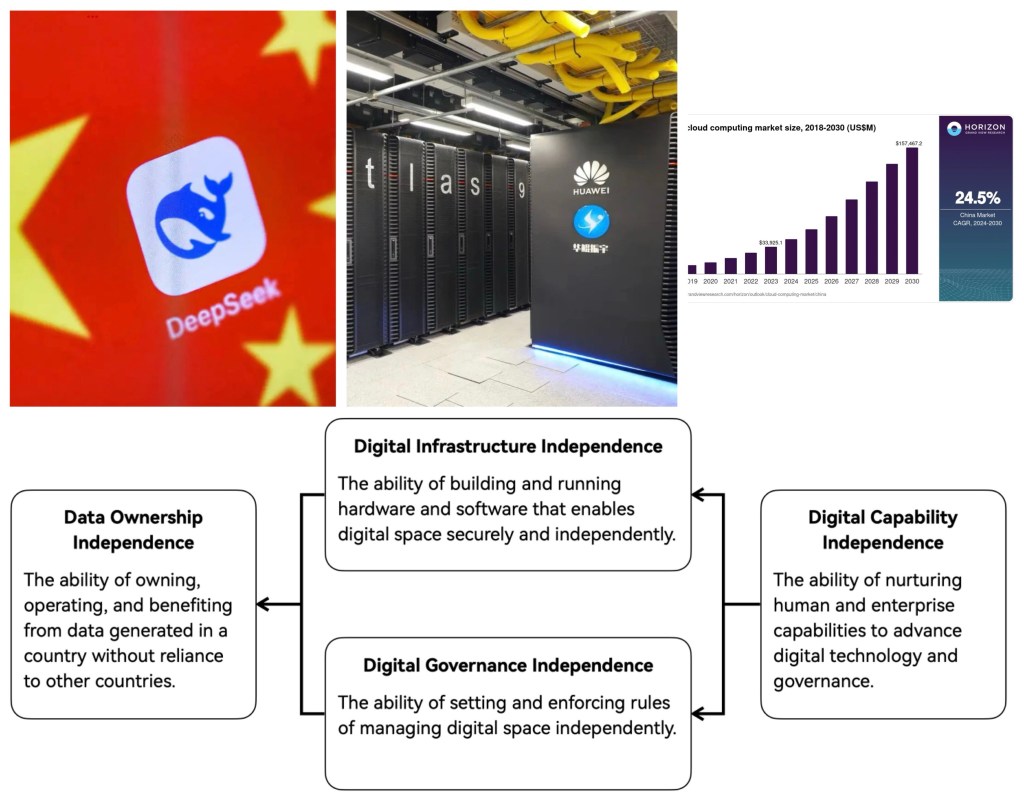
The Digital Sovereignty Index (DSI) framework argues that independent control over data ownership is the most visible manifestation of a nation’s overall digital sovereignty. However, without independence in digital infrastructure—the hardware and software that sustain digital ecosystems—restrictions on data ownership cannot be effectively enforced, as seen in the cases of the EU and Brazil. Similarly, without independent digital governance, the rules governing cyberspace will inevitably be dictated by U.S. tech giants.
Both digital infrastructure and digital governance independence rely on the capabilities of research institutions, enterprises, and talent engaged in the digital industry. Together, the four dimensions of digital sovereignty—independent control over data ownership, digital infrastructure, digital governance, and digital capabilities—form the complete framework of national digital sovereignty.
Because digital sovereignty is such a vast and complex system, attempting to reclaim it from U.S. digital hegemony solely through legislation on data ownership or by developing one or two “killer apps” is nothing more than an illusion. This reality also poses a significant challenge to the widely accepted “multi-stakeholder” theory in digital sovereignty research. According to this theory, beyond the state, corporations, communities, and even individuals are also stakeholders in digital sovereignty. Their interests do not necessarily align with those of the state, and all should be given equal consideration in discussions on digital sovereignty.
A closer look at the four dimensions of the Digital Sovereignty Index makes it clear that building digital infrastructure, digital governance, and digital capabilities goes beyond the capacity of any individual or community. Only sovereign states or mega-corporations have the resources to undertake such foundational work.
Given that a handful of U.S. tech giants—closely aligned with the U.S. government—dominate most of the global digital space (with the exception of China), emphasizing a “multi-stakeholder” approach in the Global South often has the unintended effect of diverting attention away from national digital sovereignty. In practice, this weakens, or even undermines, efforts to strengthen state control over digital sovereignty, thereby indirectly sustaining U.S. digital hegemony.
In the field of large language model AI, DeepSeek’s open-source approach has prompted many Global South countries to consider a previously unimaginable aspect of digital sovereignty: sovereign AI. As large language models become increasingly central to how people access and generate information, control over these models effectively translates into control over ideology and value systems.
If Global South countries do not independently train and operate their own sovereign AI, their citizens will inevitably rely on AI products provided by OpenAI or other major U.S. corporations. This dependence means that these countries will have to continuously pay U.S. tech giants, their data will keep flowing into the hands of these companies, and they will have no recourse against the ideological biases embedded in these AI systems.
But as Amadeu has pointed out, once Global South countries—including relatively advanced economies like Brazil—begin developing their own sovereign AI, they will soon face broader digital sovereignty challenges. For instance, most Global South nations looking to train and deploy their sovereign AI models based on DeepSeek’s open-source framework currently have limited choices—they are likely to rely on cloud services from AWS or Azure. If the U.S. decides to ban its companies from providing services related to DeepSeek, these countries’ sovereign AI initiatives would be severely hindered. This highlights the constraints imposed by a lack of independent digital infrastructure.
For most Global South countries, building a relatively independent digital infrastructure and digital capability system is already a daunting challenge given their current scientific, industrial, and educational foundations. Even for a major economy like Brazil, digital infrastructure remains heavily dependent on the United States.
Since the policy shifts of the 1990s, Brazil’s ability to sustain long-term growth in its digital industry has been undermined, which is a key reason for its current low level of digital sovereignty. The situation is even worse for most other Global South nations, where reliance on foreign digital infrastructure is even more pronounced. For most Global South countries, building a relatively independent digital infrastructure and digital capability system is already a daunting challenge given their current scientific, industrial, and educational foundations. Even for a major economy like Brazil, digital infrastructure remains heavily dependent on the United States. Since the policy shifts of the 1990s, Brazil’s ability to sustain long-term growth in its digital industry has been undermined, which is a key reason for its current low level of digital sovereignty. The situation is even worse for most other Global South nations, where reliance on foreign digital infrastructure is even more pronounced.
How can Global South countries break free from U.S. digital hegemony and achieve a relatively independent digital sovereignty? Could cooperation with China help accelerate this process? These are pressing challenges that governments must now confront.
This year (2025), Brazil holds the presidency of the BRICS nations, and one of its six “priority work agendas” includes “encouraging inclusive and responsible AI governance to promote development.” At the time Brazil proposed this agenda, DeepSeek-R1 had not yet been released, and the concept of “sovereign AI” still seemed out of reach for the vast majority of Global South countries.
Now, with the open-source release of DeepSeek-R1 and the growing activity around its related open-source projects, countries like Brazil and other BRICS members may need to fundamentally shift their perspective on AI governance. The focus could move from relying on U.S. companies to provide AI solutions to exploring the possibilities of sovereign AI and multilateral AI governance.
With the BRICS summit scheduled to take place in Brazil this July, it will be crucial to see how the BRICS nations assess the changes DeepSeek brings to the global landscape. Whether sovereign AI, and digital sovereignty in a broader sense, will become a clear demand for BRICS countries will be a key point of interest during this year’s summit.
Given the democratization of large language model (LLM) artificial intelligence driven by DeepSeek, I recommend that countries in the Global South, such as Brazil, take immediate action to gradually develop their own sovereign AI and digital sovereignty strategies. Here’s a proposed roadmap:
1.Establish dedicated teams to study DeepSeek’s technology, focusing on understanding how to enhance or fine-tune the performance of large models in specific domains or topics through post-training methods. Additionally, explore how to develop complementary software (e.g., chatbots, intelligent agents) tailored around these models. This research should culminate in actionable plans for deploying autonomous and controllable sovereign AI systems.
2.Leverage the iterative development of sovereign AI as a driving force to identify and prioritize the importance of all data generated within the nation’s digital space. For the most critical data, establish clear ownership and control mechanisms. This can be achieved through legislation and enforcement to ensure that such data is stored domestically and that cross-border transfers of important data are strictly regulated.
3.Wile securing data ownership, strengthen collaboration with Huawei and other Chinese ICT enterprises to gradually reduce reliance on U.S. tech giants. This will help enhance national control over digital infrastructure and increase self-sufficiency in critical technological domains.
4.Collaborate with China within the BRICS framework to promote a multilateral approach to AI governance. This initiative should emphasize respect for national sovereignty while encouraging open exchanges of technology and expertise. The goal is to foster an international environment where countries can engage in equitable, mutually beneficial cooperation and consultation in the field of AI.



 Business Blog