Video with English subtitles: “A $688 Billion Withdrawal: Why China Is Willing to Take Record Losses to Dump U.S. Treasuries?” 影片有英文字幕: 「6880億美元撤退:為何中國不惜創紀錄虧損,也要拋售美國國債?」
“The weaponization of the dollar in Ukraine was a wake-up call. Now, China’s strategy of ‘de-risking’ is mobilizing ASEAN, BRICS, and the Global South into a concerted dedollarization campaign. The silent verdict is in their vaults—central banks are buying gold, voting with their reserves for a less centralized financial future.” 美元在烏克蘭遭武器化,無異於一記警鐘。如今,中國的「去風險化」戰略正動員東協、金磚國家及全球南方,共同開展一場去美元化行動。無聲的判決藏在各國金庫中──央行正持續購入黃金,以儲備資產投票,迎向一個去中心化的金融未來。
In this in-depth report, we expose a signal that almost no one is paying attention to—yet it may be the most critical indicator of escalating global conflict: China is accelerating its sell-off of U.S. Treasury bonds.
While media headlines fixate on aircraft carriers, military drills, and weapons displays, the real pre-war preparations have long been unfolding quietly in the sovereign debt market—slow, restrained, yet nearly irreversible.
Using the latest U.S. Treasury TIC data, this analysis explains: • Why China has reduced its U.S. Treasury holdings to $688 billion, the lowest level since 2009; • And why this is not a simple portfolio rebalancing, but a strategic decoupling.
We break down: • Why sovereign debt reveals true intentions more clearly than military assets • How China has cumulatively sold over $600 billion in U.S. Treasuries • Why selling at a loss signals preparation, not panic • How sanctions on Russia fundamentally reshaped China’s risk calculations • Why U.S. allies are being forced to absorb China’s exit positions • The rise of the “bag-holder alliance” (the UK, Belgium, Japan) • Why the U.S. Treasury market is becoming a political market rather than an economic one • Why bonds are no longer risk-free assets • How China is converting paper claims into gold, oil, copper, and food • What it really means to shift from financial reserves to physical strategic stockpiles
This is not a market event. This is a geopolitical divorce.
When the world’s second-largest creditor begins to treat your debt as a liability, the system has already started to fracture— it’s just that no one has officially admitted it yet.
Sing Tao TV (California, USA) Current Affairs Observation video with English subtitles: The Puzzle of Middle-Aged and Elderly Mortality in the U.S.? “Deaths of Despair”
Johnson Choi: In light of this, many Chinese who have worked hard their entire lives and retired in the United States have decided to return to China to spend a safe and fulfilling retirement.
美國加州星島電視時事觀察視頻有英文字幕: 霍詠強: 美國中老年死亡率的謎思?「絕望之死」(Deaths of Despair)霍詠強
U.S. vs. Other Developed Countries 1990: U.S. life expectancy (75.4 years) was already slightly lower than Japan’s (78.😎 and close to Germany’s (74.5). 2022: The U.S. (77.5) lags behind Japan (84.7) by 7.2 years and behind Germany (81.2) by 3.7 years. Main reason: The U.S. has shown almost no improvement in reducing preventable deaths (e.g., from car accidents, firearms, drug overdoses, substance abuse).
“Deaths of Despair” This is a phenomenon unique to the United States, primarily referring to deaths caused by drug overdoses, alcohol-related liver disease, and suicide.
Opioid Crisis: The history of drug regulation in the U.S. has led to an extremely severe abuse of opioid painkillers, with annual overdose deaths reaching figures in the hundreds of thousands.
Social Stressors: With the decline of manufacturing and widening wealth inequality, the less-educated working class faces immense psychological pressure, leading to increased addictive behaviors.
Venezuela has never been a major drug-producing country nor a primary source of drugs for the United States. Compared to neighboring countries like Mexico, Colombia, and even Bolivia, Venezuela has made greater efforts and achieved higher success in combating drugs. It merely serves as a transit point for drug traffickers due to its complex coastline. However, Venezuela only accounts for about 8% of the illegal drug sources entering the U.S. Compared to the true major trafficker, Mexico, which accounts for a high of 80%, hasn’t the U.S. targeted the wrong country?
Behind this absurd pretext lies the reality of the devastating drug epidemic. Although the number of U.S. drug-related deaths decreased in 2024, it still exceeded 80,000. In 2023, the figure was as high as 110,037. To put this number into perspective, imagine a fully loaded Boeing 787 crashing every day in the United States, with all 300 passengers on board perishing. Drugs are the leading cause of death for people under 50 in the U.S. More realistically, the decline in drug-related deaths in 2024 is not due to effective drug enforcement or fewer drug users, but rather passive strategies such as expanding the use of substitutes like methadone and promoting “safe use.” Local governments have increased the distribution of naloxone, an emergency medication that reverses opioid overdoses, which has effectively reduced the fatality rate.
In recent years, because 60% of drug-related deaths involved fentanyl at some point, its high lethality has captured all of America’s attention. It seems there is a belief that simply cracking down on fentanyl could save many American lives. However, this ignores the most crucial point: the moment of going astray! American users of fentanyl and cocaine typically start with more easily accessible and cheaper painkillers.
Data based on the Global Burden of Disease Study (GBD 2021, released by IHME)
Why has healthcare security never received genuine attention? The “High Cost and Inequality” of the Healthcare System: The U.S. has the highest per capita healthcare spending in the world, yet the outcomes are poor.
Lack of Universal Primary Care: The U.S. does not have universal health insurance. Many low-income individuals cannot afford regular check-ups. The reality is that even if diseases (like hypertension, cancer) are detected, many cannot afford the treatment costs.
The consequence is that Americans must possess high wealth and high productivity; otherwise, the result of becoming part of the lower class is being excluded from the system.
A Tale of Two Chest Pains: Healthcare Contrasts experienced by my two clients in San Francisco and Zhongshan By Johnson Choi | January 14, 2026 兩種胸痛的故事:我的兩位客戶在舊金山與中山的醫療對比 作者:蔡永強 | 2026年1月14日
The Same Symptom, Two Worlds Apart Chest pain is a universal alarm bell. But the response it triggers depends entirely on where that bell rings. Recently, two of my clients, one in San Francisco, USA, and one in Zhongshan, China, lived out this stark reality.
The Journey in San Francisco: A Test of Patience
· Path to Care: HMO system → Online appointment (standard wait: 1-2 weeks). The ER is the sole alternative for immediate attention. · Timeline: · Day 1: Symptoms appear. · Day 7: Sees primary doctor. EKG is performed; results are unclear. · Week 4: Received a referral to see a heart specialist (3-week wait). · Status: Awaiting diagnosis, living with risk.
The Journey in Zhongshan: A Cascade of Action
· Path to Care: Major public hospital → Online appointment. · Timeline: · Day 1: Symptoms appear. · Day 2: Sees doctor at Zhongshan People’s Hospital. Immediately referred to a cardiologist. · Day 2 (Later): Diagnosis: Two arterial heart clots. Admission for urgent surgery. · Day 3: Undergoes operation. · Status: Problem identified and treated.
The Bottom Line This is more than just a comparison of speed. It’s a contrast in system design and clinical protocol. One system emphasized scheduled gatekeeping, leading to a prolonged period of uncertainty. The other prioritized rapid, specialist-led intervention for a critical symptom. For the patient in Zhongshan, “chest pain” triggered a swift, definitive pathway to treatment. For the patient in San Francisco, it began a marathon of waiting.
Video with English subtitles: The Core Code of China’s Rise Is Not Population or Policy! It’s the Chinese Language We Use Every Day? 影片有英文字幕: 中國崛起的核心密碼不是人口和政策!而是我們天天說的中文?
Mind-blowing! Many believe China’s rise is due to its population and policies, but they overlook the most crucial code—the Chinese language! Why is the literacy rate in the U.S. only 79%, while Chinese people can easily understand professional terms across different industries? How does Chinese enable high school graduates to adapt to countless professions? This in-depth analysis explores the unique advantages of Chinese in industrialization and uncovers China’s journey from adapting to English to dominating the discourse with Chinese. After reading this, you’ll fully understand the pivotal role of Chinese in China’s rise!
American from California lives in China video: China at Night Is Safer Than America (Here’s Proof). It is safe to retire in China. 來自加州的美國人居住在中國的影片:中國的夜晚比美國更安全(數據為證)。在中國退休生活是安全的。
China at Night Is Safer Than America (Here’s Proof). It is safe to retire in China.
China at Night Is Safer Than America (Here’s Proof) … That’s a bold claim — so instead of talking about it, I went out at night to test it myself. In this video, I walk the streets of Shenzhen, take the subway late at night, explore busy commercial districts, quiet residential neighborhoods, and public transportation to see what China is really like after dark.
What I experienced didn’t match the narrative many of us in the United States grow up hearing. When Americans think of large cities at night — especially places like New York or Los Angeles — we think of danger, crime, and staying constantly alert. But walking through one of China’s largest megacities at night felt completely different.
In this video, you’ll see real, unfiltered footage of life in China at night. Families walking together under city lights, women traveling alone on the subway, clean and well-lit metro stations, and calm residential streets that feel safe even late in the evening. No staged scenes. No propaganda. Just walking, observing, and showing what’s actually happening on the ground. I specifically focus on places many Americans consider the most dangerous at night: – Walking city streets after dark – Riding public transportation and the subway late at night – Quiet side streets and residential neighborhoods – Busy commercial districts and night markets
In the U.S., these are often the exact places where people feel the need to stay on guard. In China, the atmosphere is very different. The streets are active but calm. The subway is clean, bright, and orderly. Security and staff are visible, and people go about their lives without fear or anxiety.
This video is not about saying one country is “perfect.” No place on Earth is crime-free. But when it comes to violent crime, public safety, and how safe people feel at night, the contrast between China and America is striking — especially in large cities.
Many people outside China rely on headlines, social media clips, or second-hand opinions to form their views. This video shows what those narratives often leave out: the everyday reality. What it actually feels like to walk around China at night. What it’s like to take the subway alone. What normal life looks like when the sun goes down.
If you’ve ever wondered: – Is China dangerous at night? – Is it safe to walk around China after dark? – Is China safer than America? – What is China really like at night? – Is the subway in China safe at night?
This video gives you real-world answers, not talking points. I’ve lived in China for years, and experiences like this are a big reason why so many expats, travelers, and families say they feel safer here than in many Western cities. You’ll see why in this walk-through — from crowded night streets to empty platforms and quiet neighborhoods.
Watch the full video before forming an opinion and let me know what you think in the comments. Do you agree with what I experienced?
Have you been to China, or another country where nighttime safety surprised you?
The stepping up of violence by the Fed used to target people of color now extends to White Americans is a major concerns. Now wealthy White Americans are taking steps to leave US. Some are now looking at China as a safe place to retire. 聯邦政府暴力手段升級,昔日針對有色人種的行徑如今蔓延至美國白人,這已引發重大憂慮。以前美國華在入黑後不敢外出,現在連白天也不敢外出. 美國有錢白人也正逐步採取行動離開美國,有些白人開始將中國列入為安穩的退休居所之一.
Video with English subtitles: A nation is not measured by how many aircraft carriers it has, but by how it treats its own people! America’s greatest enemy is not China, but itself! 影片有英文字幕: 一個國家不是你有多少隻航母,而是如何看待自己人民! 美國最大的敵人不是中國,是它自己!
The U.S. constitutional system is collapsing! State police and federal agents nearly opened fire on each other? A passport cannot stop a bullet—citizens are being executed on the streets.
Just a few days ago, in Minnesota—yes, the same place where George Floyd’s tragedy occurred—gunfire rang out again. But this time, the story is even more unbelievable: ICE (Immigration and Customs Enforcement) did not kill an undocumented immigrant, but a native-born American citizen!
What followed was even more surreal: Trump and Vance immediately labeled the victim a violent rioter, while the FBI intervened forcefully, stripping the state government of its investigative authority. This is beyond investigation—it’s the federal government covering up the evidence!
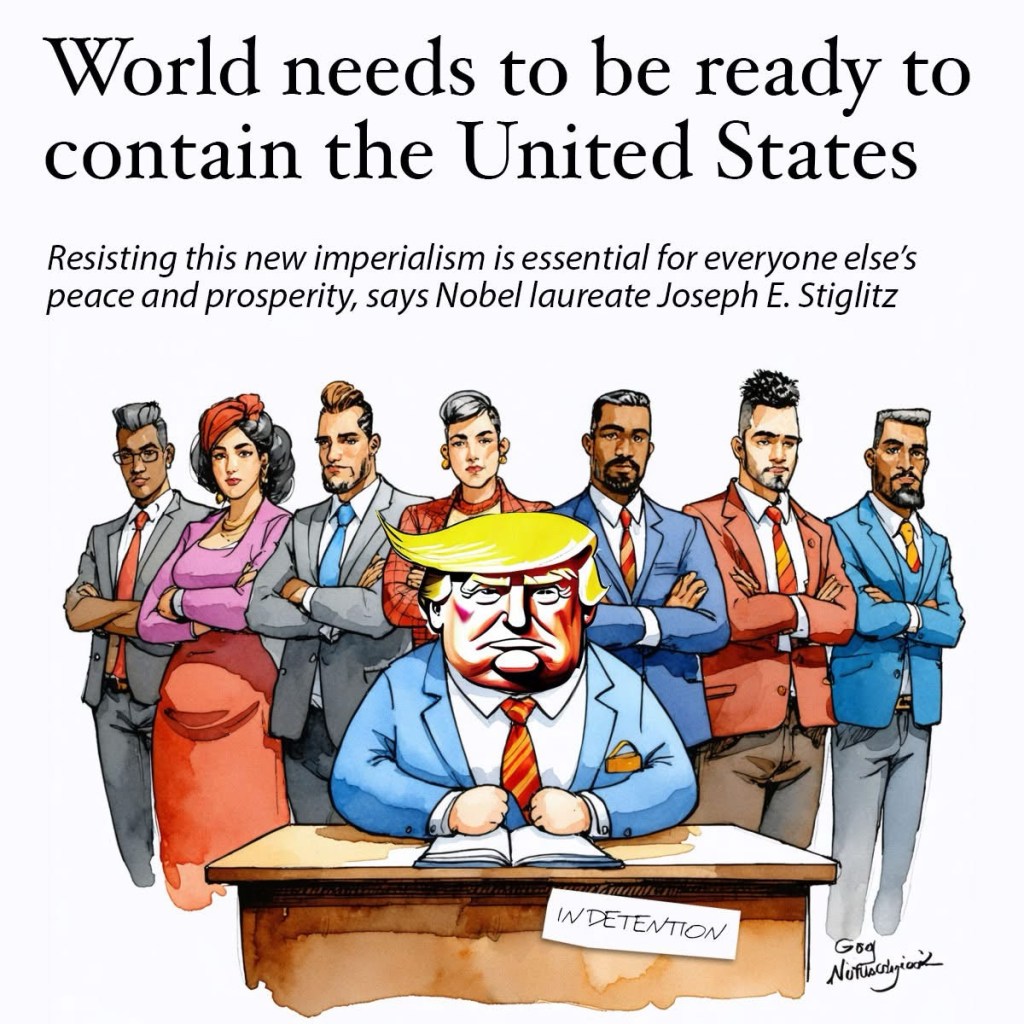
WORLD MUST PREPARE TO CONTAIN THE U.S. By Joseph Stiglitz 世界必須準備遏制美國, 約瑟夫.史提格里茲(Joseph Stiglitz)
MIGHT MAKES RIGHT, and nothing else matters. Moral questions – such as whether killing dozens of alleged drug smugglers without any pretense of due process – and the rule of law have been shunted aside, with barely a whimper from Republicans who once proudly touted American “values.”
Many commentators have already addressed the implications for global peace and stability. If the US claims the Western Hemisphere as its sphere of influence (the “Donroe Doctrine”) and bars China from accessing Venezuelan oil, why shouldn’t China claim East Asia and bar the US from accessing Taiwanese chips? Doing so would not require it to “run” Taiwan, only to control its policies, particularly those allowing exports to the US.
CO-OPERATING AGAINST IMPERIALISM
It is worth remembering that the great imperial power of the 19th century, the United Kingdom, did not fare well in the 20th. If most other countries cooperate in the face of this new American imperialism – as they should – the long-term prospects for the US could be even worse.
After all, the UK at least tried to export salutary governing principles to its colonies, introducing some modicum of the rule of law and other “good” institutions.
By contrast, Trumpian imperialism, lacking any coherent ideology, is openly unprincipled – an expression solely of greed and the will to power. It will attract the most avaricious and mendacious reprobates that American society can churn up. Such characters do not create wealth. They direct their energy to rent-seeking: plundering others through the exercise of market power, deception, or outright exploitation. Countries dominated by rent-seekers may produce a few wealthy individuals, but they do not end up prosperous.
LOSS OF RULE OF LAW
Prosperity requires the rule of law. Without it, there is ever-present uncertainty.
Will the government seize my assets?
Will officials demand a bribe to overlook some minor peccadillo?
Will the economy be a level playing field, or will those in power always give the upper hand to their cronies?
Lord Acton famously observed that, “Power corrupts, and absolute power corrupts absolutely.” But Trump has shown that one does not need absolute power to engage in unprecedented corruption. Once the system of checks and balances starts to fall apart – as indeed it has in the US – the powerful can operate with impunity. The costs will be borne by the rest of society, because corruption is always bad for the economy.
EUROPE, CHINA MUST DEVISE PLAN
One hopes that we have reached “peak Trump,” that this dystopian era of kakistocracy will end with the 2026 and 2028 elections. But Europe, China, and the rest of the world cannot rely on hope alone. They should be devising contingency plans which recognize that the world does not need the US.
What does America offer that the world cannot do without?
It is possible to imagine a world without the Silicon Valley giants, because the basic technologies they offer are now widely available. Others would rush in, and they may well establish much stronger safeguards.
It is also possible to imagine a world without US universities and scientific leadership, because Trump has already done his utmost to ensure that these institutions struggle to remain among the world’s best.
And it is possible to imagine a world where others no longer depend on the US market. Trade brings benefits, but less so if an imperial power seeks to grab a disproportionate share for itself. Filling the “demand gap” posed by the US’s persistent trade deficits will be a lot easier for the rest of the world than the challenge facing the US of dealing with the supply side.
HEGEMON MUST BE OSTRACIZED A hegemon that abuses its power and bullies others must be left in its own corner. Resisting this new imperialism is essential for everyone else’s peace and prosperity.
While the rest of the world should hope for the best, it must plan for the worst; and in planning for the worst, there may be no alternative to economic and social ostracism – no recourse but a policy of containment.
[Joseph Stiglitz won the Nobel Prize for Economics. This is an extract from an essay he published on 9 Jan 2026 in Project Syndicate – link to full text supplied.]
Video has English subtitles: Is the United States really daring to take action against China? What has China been doing these past 30 years? The results of the Pentagon’s war games: daring to act would be… 影片有英文字幕: 美國到底敢不敢對中國動手?中國這30年幹了什麼?五角大廈兵推結果:敢動手就是
Is the United States really daring to strike China? Honestly, it has never been a question of courage, but one of precise calculation.
If the think tanks and supercomputers at the Pentagon, after simulation assessments, believed the odds of success exceeded 60%, Tomahawk cruise missiles would have already torn through the night sky. Looking back over the past thirty years, from the Desert Storm in Iraq to the airstrikes in the Balkans, from the mountainous regions of Afghanistan to the regime change in Libya, when has this precise American war machine ever hesitated for a second while reaping benefits globally?
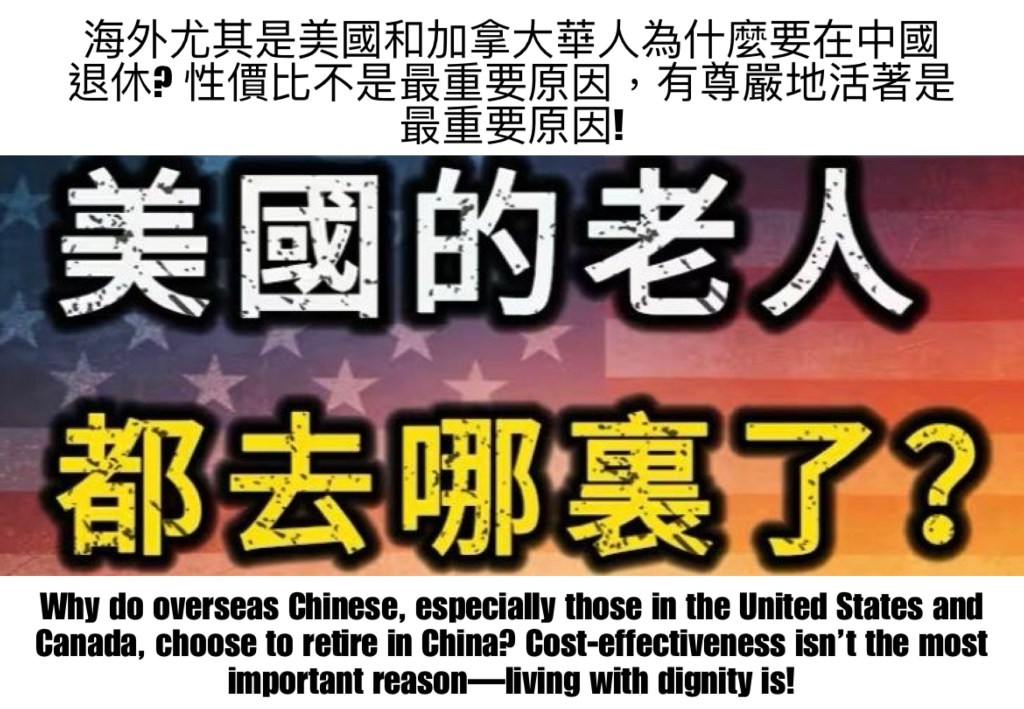
Video with English subtitles: Why do overseas Chinese, especially those in the US and Canada, choose to retire in China? Cost-effectiveness isn’t the most important reason – stay alive and living with dignity is! 影片有中文字幕: 海外尤其是美國和加拿大華人為什麼要在中國退休? 性價比不是最重要原因,有尊嚴地活著是最重要原因!
Why doesn’t the United States have an aging population? The chilling “population culling” mechanism… Could the truth be a half-century-long, precise elimination?
The more developed a country’s economy, the more severe its aging population tends to be. But the United States is a bizarre exception. Where did those 76 million baby boomers go? Are they diluted by immigrants, or have they “disappeared”?
From sky-high medical bills leading to bankruptcy, to the opioid crisis running rampant, and even the assassination attempt on UnitedHealth Group’s CEO—we will delve into this seemingly glamorous yet cold-blooded “population optimization” mechanism.







 Business Blog