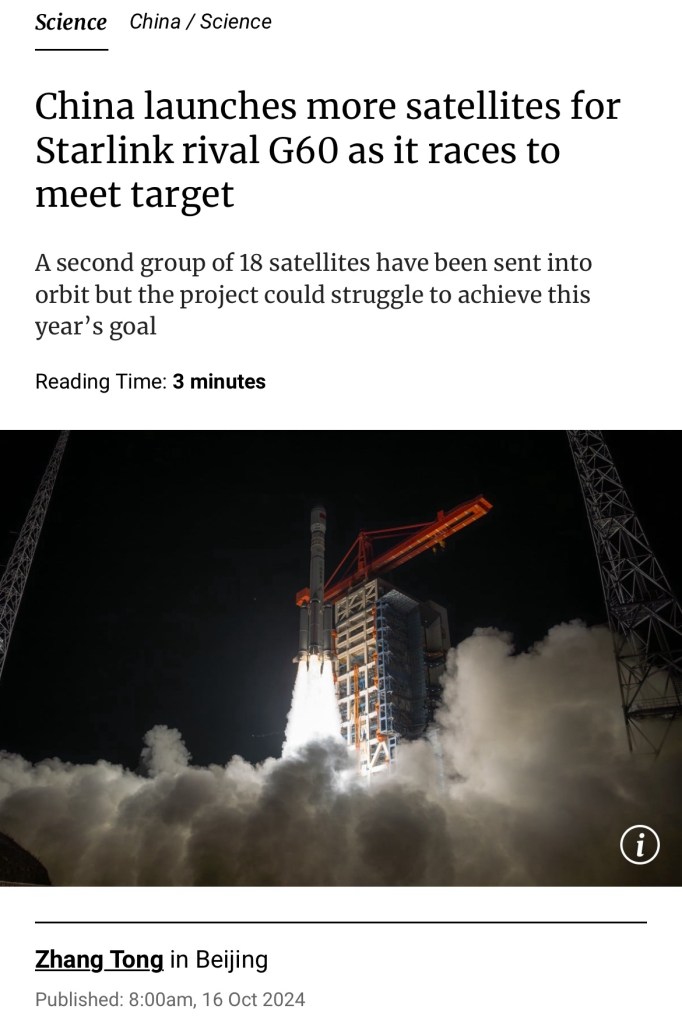
Sr VP Lu Ben told state CCTV in Aug that it aims to launch 108 satellites in 2024, 648 in 2025 & 15,000+ satellites by 2030 for regional network coverage. The goal is to complete the 1st stage of the project by 2027, with a constellation of 1,296 satellites for global coverage.
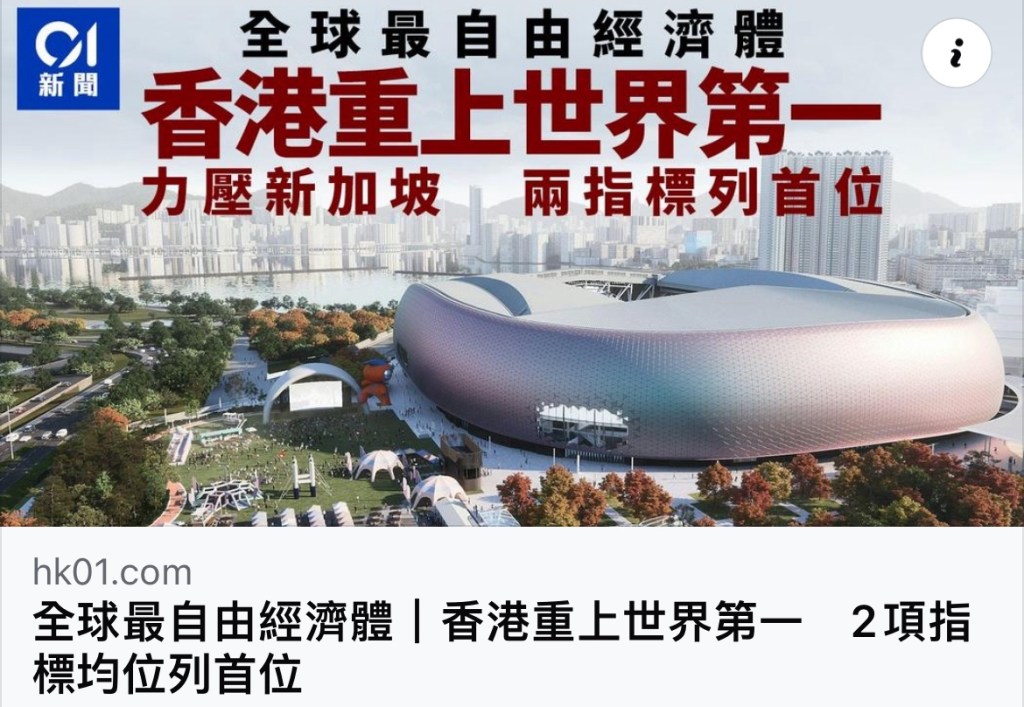
Why HK continue to beat Singapore, rank #1 in Asia? Important factors for Hong Kong’s distinction include our rule of law and judicial independence, as well as our unique advantages in currency circulation. This is the characteristic of “one country, two systems” and we must cherish it. 香港為何繼續擊敗新加坡,高居亞洲第一? 香港有此殊榮,其重要因素包括我們的法治和司法獨立及貨幣流通的獨特優勢。此乃「一國两制」的特點,我們要珍惜。
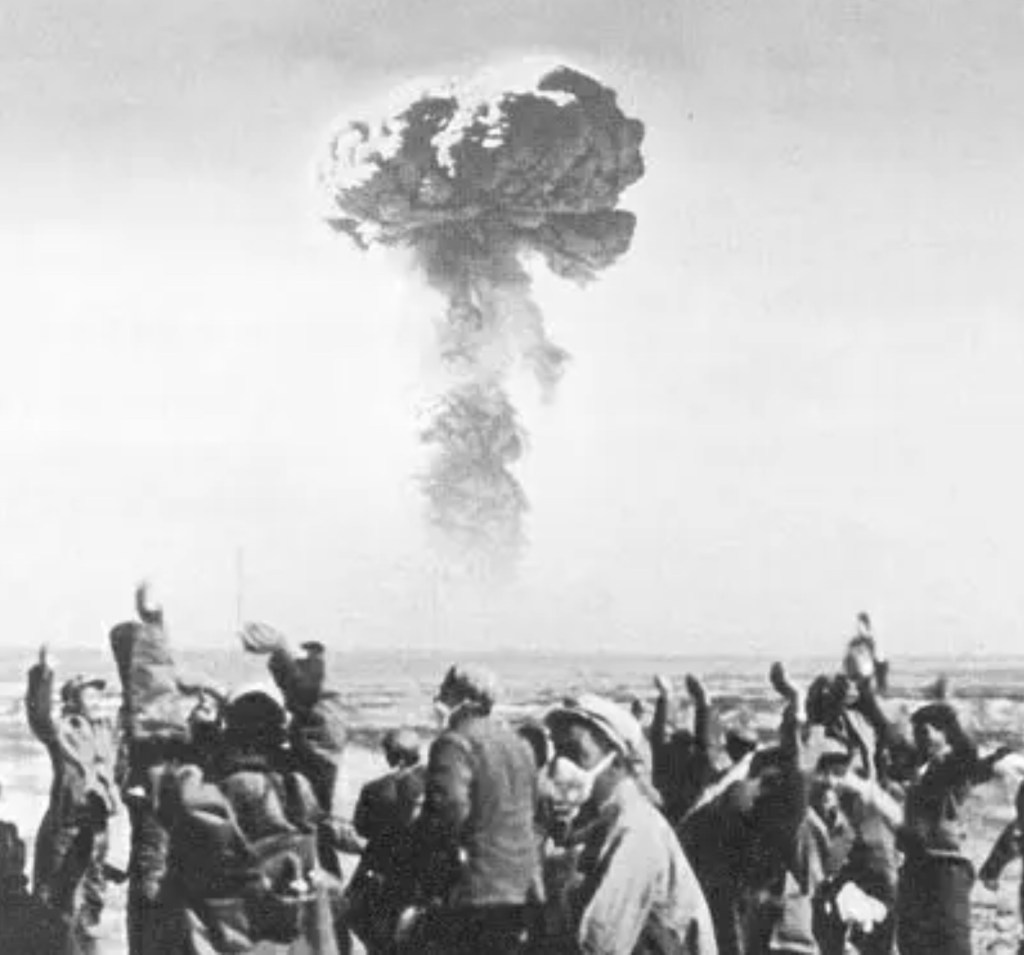
At 3 p.m. on October 16, 1964, a massive mushroom cloud rose over the Lop Nur Desert in China, marking the successful detonation of the country’s first atomic bomb. This bomb was affectionately named “Miss Qiu” 下午 3 點1964年10月16日,中國羅布泊沙漠上空升起巨大的蘑菇雲,標誌著中國第一顆原子彈爆炸成功。這顆炸彈被親切地命名為”邱小姐.”
The name came about because Chinese scientists thought the tangled web of cables on the control panel for the nuclear test looked like braids, leading them to code name the panel “dressing table.” Naturally, they imagined that anyone using such a “dressing table” should be an elegant lady. Additionally, due to the bomb’s spherical design, the term for “sphere” in Chinese sounds the same as the surname “Qiu,” which solidified the choice of name for this significant milestone in China’s nuclear history. 這個名字的由來是因為中國科學家認為核試驗控制面板上錯綜複雜的電纜網看起來像辮子,因此他們將面板代號為“梳妝台”。自然地,他們想像使用這樣的「梳妝台」的人都應該是一位優雅的女士。此外,由於炸彈的球形設計,中文中的“球”一詞與“丘”姓氏發音相同,這鞏固了中國核歷史上這一重要里程碑的名字選擇.
Chinese mathematicians break military standard encryption using quantum computer. 中國數學家利用量子電腦破解了軍用標準加密.
RSA is an industry standard (public key) cryptography protocol. At 2048 bit length, it’s estimated that someone trying to crack an encrypted message using a powerful digital computer would need millions (10’s-100’s of million) of years to crack it. Thus the entire architecture of the internet (secure data storage, private messaging, secure payments, private accounts, secure websites (the “s” of https), secure passwords, privacy in general) is built on the reliability of such encryption.
A Chinese research team has demonstrated that this encryption can be cracked using readily available quantum computers.
The research team, led by Wang Chao from Shanghai University, found that D-Wave’s quantum computers can optimize problem-solving in a way that makes it possible to attack encryption methods such as RSA.
In a potentially alarming development for global cybersecurity, Chinese researchers have unveiled a method using D-Wave’s quantum annealing systems to crack classic encryption, potentially accelerating the timeline for when quantum computers could pose a real threat to widely used cryptographic systems.
Published in the Chinese Journal of Computers under the title “Quantum Annealing Public Key Cryptographic Attack Algorithm Based on D-Wave Advantage,” the paper outlined how D-Wave’s machines were used to break RSA encryption and attack symmetric encryption systems, raising serious questions about the future of cybersecurity.
Han Kang’s Nobel Prize is a Cry for Palestine. The South Korean author is dedicated to witnessing the historical atrocities perpetrated by imperial colonial powers, 韓康獲得諾貝爾獎是對巴勒斯坦的吶喊. 這位韓國作家致力於見證帝國殖民列強所犯下的歷史暴行 writes KJ Noh. Oct 15, 2024
South Korean novelist Han Kang has won the Nobel Prize for Literature, beating short-listed literary heavyweights like Thomas Pynchon, Haruki Murakami, Salman Rushdie, Gerald Murnane, and the all-odds-favorite, Chinese author Can Xue. Han Kang was as shocked as anyone else after receiving the call notifying her that she had won. When asked what she would do next, she said she would quietly “have tea with her son.”
She has refused a press conference, saying that
“with the wars raging between Russia and Ukraine, Israel and Palestine, with deaths being reported every day, she could not hold a celebratory press conference. She asked for understanding in this matter.”
A brilliant, powerful writer, but clearly the literary dark horse in the race, Han Kang’s unexpected award is the closest the Nobel Committee could get to acknowledging the Palestinian genocide. Han Kang herself had not mentioned Palestine until her recent Nobel award. But it’s unmistakable that her award is a reflection of the current historical moment.
Of course, we cannot presume what the Nobel Committee’s position on the Palestinian genocide is. Certainly, the Nobel Committee would have been crucified by institutional powers if they had awarded the prize to a deserving Palestinian writer or poet; nor could they have risked a redux of Harold Pinter’s public takedown of Western brutality and hypocrisy.
But the Nobels are always political statements, situated in the political moment, and across a backdrop of live-streamed genocide and daily atrocity, it’s unthinkable that that Palestinian genocide could have been far from their minds or ignored in their deliberations.
The awarding of the Nobel to Han Kang is that oblique acknowledgment. Of the short and long lists, she is the only contemporary writer dedicated to witnessing and inscribing the horrors of historical atrocity and mass slaughter perpetrated by the imperial colonial powers and their quislings.
The Nobel committee suggests this by praising her for “her intense poetic prose that confronts historical traumas and exposes the fragility of human life” and characterizes her work as “witness literature,” “a prayer addressing the dead”and as artworks of mourning that seek to prevent erasure.
Echo of Palestine
The echo of Palestine is not lost in that description of her major works:
In Human Acts (also known as “The Boy is Coming” in Korean), she wrote about the effects of the U.S.-greenlighted massacres of civilians in the city of Gwangju by a U.S.-backed military dictatorship.
At the time, the U.S. did not want a redux of the fall of the shah of Iran, where popular protest brought down a U.S.-backed dictator. Instead, the Carter administration authorized the deployment of South Korean troops (at the time under full U.S. operational control) to fire on and slaughter students and citizens protesting the recent U.S.-backed military coup.
And exactly as in the current moment, the U.S. portrayed itself as a hapless bystander to mass murder, enmeshed but incapable of preventing it, when in fact, it was the underwriter and the agent of the massacres.
Tim Shorrock clearly documented the doublespeak: “Gwangju was an unspeakable tragedy that nobody expected to happen,” Shorrock quotes a State Department official, who added that the State Department continues to believe the United States “has no moral responsibility for what happened in Gwangju.”
Han Kang’s book doesn’t bother to accuse the U.S. Her book is not a political tract, and most people in South Korea know these facts backwards and forwards. Instead, she reanimates the human suffering of this massacre from the standpoint of multiple characters: the grieving, the dead, the tortured, the resisting, the guilty living — including herself.
Unfiltered Massacre
Starting with a pile of hundreds of decomposing bodies in a makeshift morgue, tended to with exquisite care by a young boy, Dong Ho, she shows us what it smells and feels to contact an unfiltered massacre. Dong Ho is actually a stand-in for a real person, Moon Jae-Hak, a high school student shot dead in Gwangju.
Han Kang reveals that Dong Ho/Jae-Hak had moved into a room of the home that Han Kang herself had vacated four months earlier as her family serendipitously moved out of the city of Gwangju. It’s clear that had it not been for fate, Han Kang herself could very easily have been that dead child: Dong Ho is a stand-in for both Jae-Hak and Han Kang. That trope becomes obvious as Dong Ho survives a first skirmish, runs away from a shooting, while his comrade falls. Han Kang writes:
“I would have run away… you would have run away. Even if it had been one of your brothers, your father, your mother, still you would have run away…There will be no forgiveness. You look into his eyes, which are flinching from the sight laid out in front of them as though it is the most appalling thing in all this world. There will be no forgiveness. Least of all for me.”
It may not be possible to write herself into forgiveness for surviving, and Han Kang does not attempt it.
“You’re not like me…You believe in a divine being, and in this thing we call humanity. You never did manage to win me over…I couldn’t even make it through the Lord’s Prayer without the words drying up in my throat. Forgive us our trespasses, as we forgive those who trespass against us. I forgive no one, and no one forgives me.”
She simply bears witness:
“I still remember the moment when my gaze fell upon the mutilated face of a young woman, her features slashed through with a bayonet. Soundlessly, and without fuss, some tender thing deep inside me broke. Something that, until then, I hadn’t realised was there.”
And she mourns the unmournable:
“After you died I couldn’t hold a funeral, So these eyes that once beheld you became a shrine. These ears that once heard your voice became a shrine. These lungs that once inhaled your breath became a shrine…After you died I could not hold a funeral. And so my life became a funeral.”
And she denounces, what could easily be an echo of current Israeli “Amalek” doctrine:
“At that moment, I realized what all this was for. The words that this torture and starvation were intended to elicit. We will make you realize how ridiculous it was, the lot of you…We will prove to you that you are nothing but filthy stinking bodies. That you are no better than the carcasses of starving animals.“
In another novel, I do not part (“I won’t say farewell”; “Impossible Partings”), she tells the story of those who perished, disappeared, were buried, without a farewell. The title is a message to those who disappeared, perished under rubble, or vanished into mass graves without so much as a farewell, a stubborn assertion that they will not be lost, abandoned, forgotten.
Jeju Island, 1948
Drawing from an image from a relentless dream, and a line gleaned from a pop song overhead in a taxi, she tells the story of the U.S.-instigated genocide of Jeju Island in 1948, where 20 percent of the population were wiped out, bombed, slaughtered, starved to death under the command of the U.S. military government in Korea. This is Gaza — with snow:
“Even the infants? Yes, because total annihilation was the goal.”
After the surrender of Japan in WWII, post-colonial Korea had been assigned to the shared trusteeship of the U.S.S.R. and the U.S. On Aug. 15, 1945, the Korean people declared liberation and the establishment of the Korean People’s Republic, a liberated socialist state consisting of thousands of self-organized workers’ and peasant collectives.
The U.S.S.R. was supportive, but the U.S. declared war on these collectives, banned the Korean People’s Republic, forced a vote in the South against the will of the Koreans who did not want a divided country, and unleashed a campaign of politicide against those who opposed or resisted this.
Jeju Island was one of the places where the carnage reached genocidal proportions, before cresting into the full-scale omnicide of the Korean war. That genocide was covered up and erased for half a century, where not even a whisper of truth was permitted. For this, Han Kang uses over and over again the metaphor of snow:
A cluster of forty houses, give or take, had stood on the other side, and when the evacuation orders went out in 1948, they were all set on fire, the people in them slaughtered, the village incinerated.
She told me about how, when she was young, soldiers and police had murdered everyone in her village …
The next day, having heard the news, the sisters returned to the village and wandered the grounds of the elementary school all afternoon. Searching for the bodies of their father and mother, their older brother and eight year old sister. They looked over the bodies that had fallen every which way on top of one another and found that, overnight, a thin layer of snow had covered and frozen upon each face. They couldn’t tell anyone apart because of the snow, and since my aunt couldn’t bring herself to brush it away with her bare hands, she used a handkerchief to wipe each face clean…
Snow, for Han Kang “is silence.” Rain, she says, “a sentence.”
This is a theme in her books: cleaning bodies, brushing away blood and snow with precision, to see things clearly, trying to recover some dignity and truth, no matter how excruciatingly painful. The book itself is an excavation — a relay race, as she put it — passed along through three women characters, each one excavating further into the harrowing truth — “to the bottom of the ocean” of horror.
“The snow that fell over this island and also in other ancient, faraway places could all have condensed together inside those clouds. When, at five years old, I reached out to touch my first snow in G—, and when, at thirty, I was caught in a sudden rain shower that left me drenched as I biked along the riverside in Seoul, when the snow obscured the faces of the hundreds of children, women and elders on the schoolyard here on Jeju seventy years ago…. who’s to say those raindrops and crumbling snow crystals and thin layers of bloodied ice are not one and the same, that the snow settling over me now isn’t that very water?”
As she uncovers — like “a tough homework assignment” — the Bodo League massacres, the Jeju massacres, Vietnam massacres, Gwangju, she tries to thread all of them together in an unbroken thread using “an impossible tool” —the flickering heart of her language — animated by an “extreme, inexhaustible love” and the stubborn refusal to turn away:
Han Kang recalls her very young self when she first became aware of the atrocities in a secret chapbook, and thus formed the question that centers her writing:
After it had been passed around the adults it was hidden away in a bookcase, spine facing backwards. I opened it unwittingly, having no idea what it contained. I was too young to know how to receive the proof of overwhelming violence that was contained in those pages. How could human beings do such things to one another? On the heels of this first question, another swiftly followed: what can we do in the face of such violence?
Han Kang’s question is the question that should animate all of us, as we, too, are confronted with what is happening.
None of us can unsee what is unfolding in front of our eyes. The French have an appropriate wording:
Nous sommes en train d’assister à un genocide: we are witnessing—that is to say, assisting, in smaller or greater ways—a genocide.
As Jason Hickel puts it:
“The images that I see coming out of Gaza each day—of shredded children, piles of twisted corpses, dehumanisation in torture camps, people being burned alive—are morally indistinguishable from the images I have seen in Holocaust museums. Pure evil on a horrifying scale.”
What can we do? Each of us must confront this question individually and collectively, and all of us, together, must take action. None of us will be forgiven for turning away.
K.J. Noh is a peace activist and scholar on the geopolitics of the Asian continent who writes for Counterpunch and Dissident Voice. He is special correspondent for KPFA Flashpoints on the “Pivot to Asia,” the Koreas and the Pacific.
This article was originally published in The Hollywood Progressive.
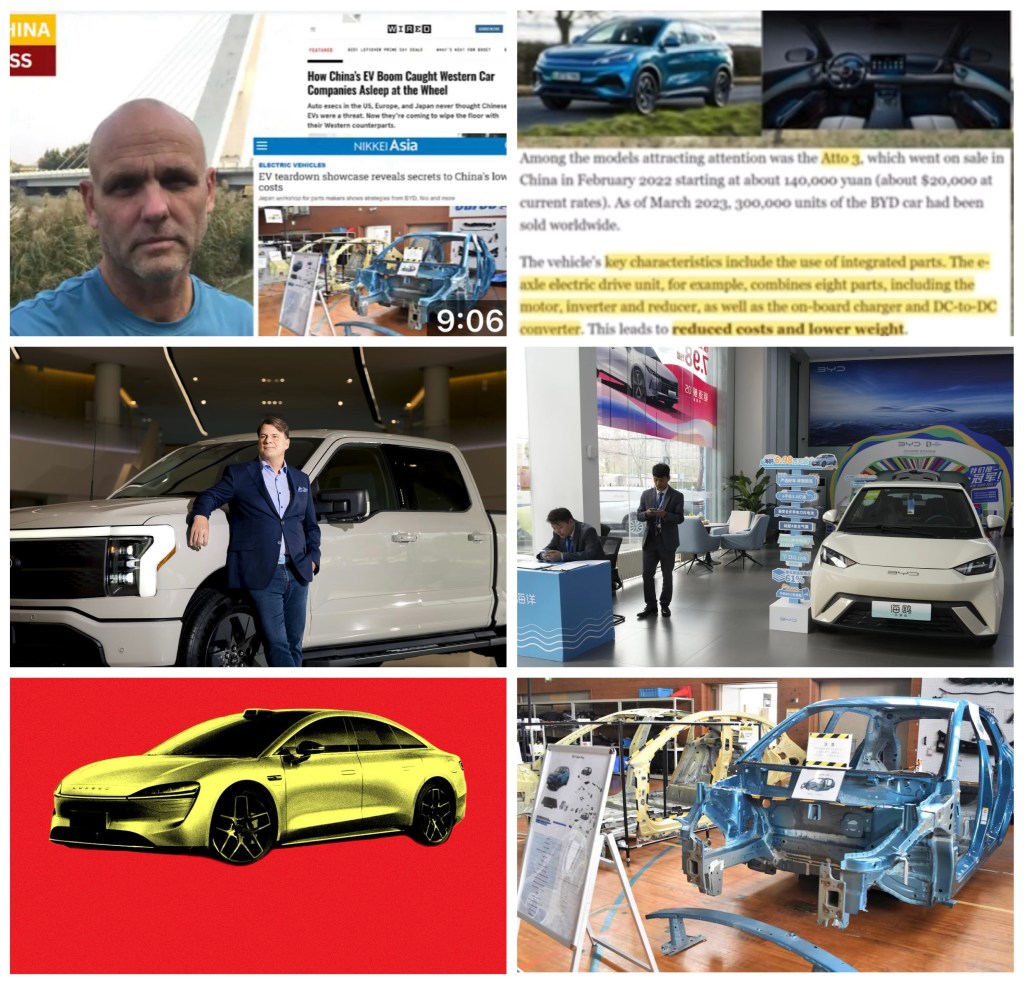
Video: Japanese teardowns of Chinese electric vehicles by BYD and Nio stun car parts executives in Nagoya. US CEO & Engineers overpaid & sleeping on the job, EU & Japanese car makers included. 比亞迪和蔚來汽車在日本拆解中國電動車的事件震驚了名古屋的汽車零件高層。美國汽車公司執行長和工程師的薪酬過高並且在夢中工作,無x用,這也包括歐盟和日本汽車製造商在內.
An exhibition in central Japan showcases tens of thousands of parts, stripped from the world’s top-selling models. Japanese car parts manufacturers were stunned at the advances of Chinese brands BYD and Nio.
Chinese carmakers hold costs down through engineering advances in parts assembly, and with a far higher degree of vertical integration of production. Chinese companies integrate multiple components into one part, and then standardize those integrated parts across multiple car models. This results in far fewer parts per car, faster manufacturing time, and lower vehicle weight.
Industry insiders are increasingly critical of top executives in the US, Europe, and Japan who have been blindsided by Chinese ascent and near-domination of the global car industry. Consultants and engineering experts in China have reported for years on Chinese monopolies of supply chains, engineering breakthroughs, and product quality. Yet the CEO’s and top officers of legacy car brands were seemingly unaware of key developments that were upending their own industry, and which now threaten their survival.
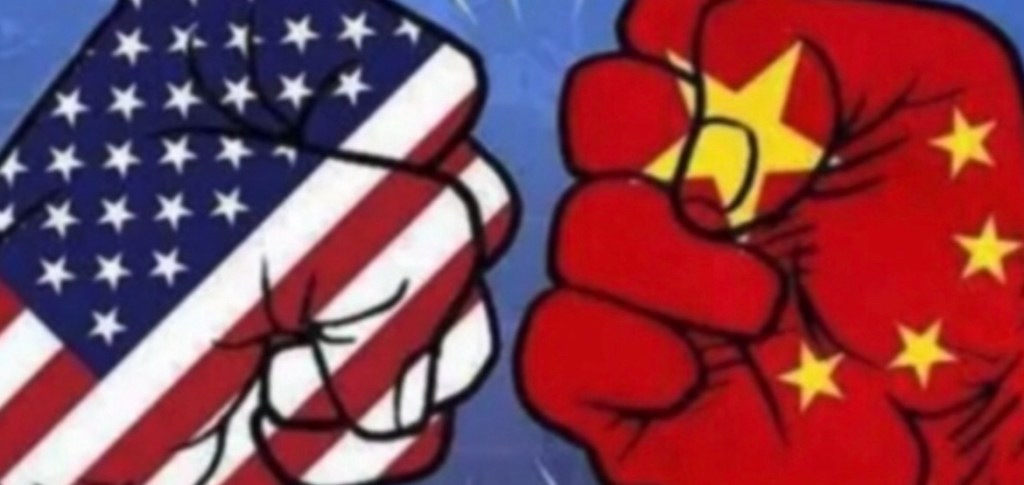
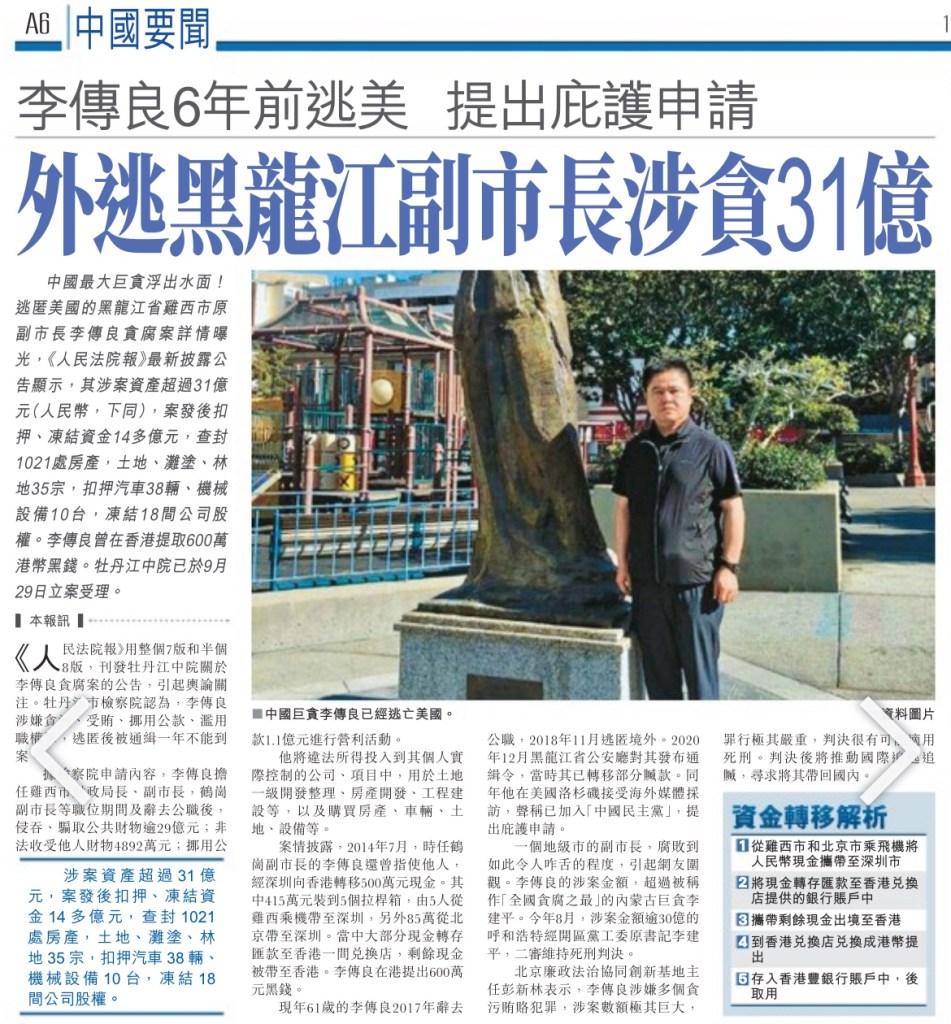
Why corrupt Chinese Gov’t officials love America? Because US legalize corruption. You can bribe any government official by following the law! 中国全球抓捕外逃贪官 美国是头号避难天堂. 为什么贪官富豪往美国跑?并不因为美国是谁的希望,而是因为这些跑到美国的人有钱。有钱就任性吖!想住哪就住哪儿,不需要为找不找得到工作烦恼. 最重要的是美國把各様貪污合法化,在香港,新加坡的貪污行動,美國都把它合法化.


 Business Blog