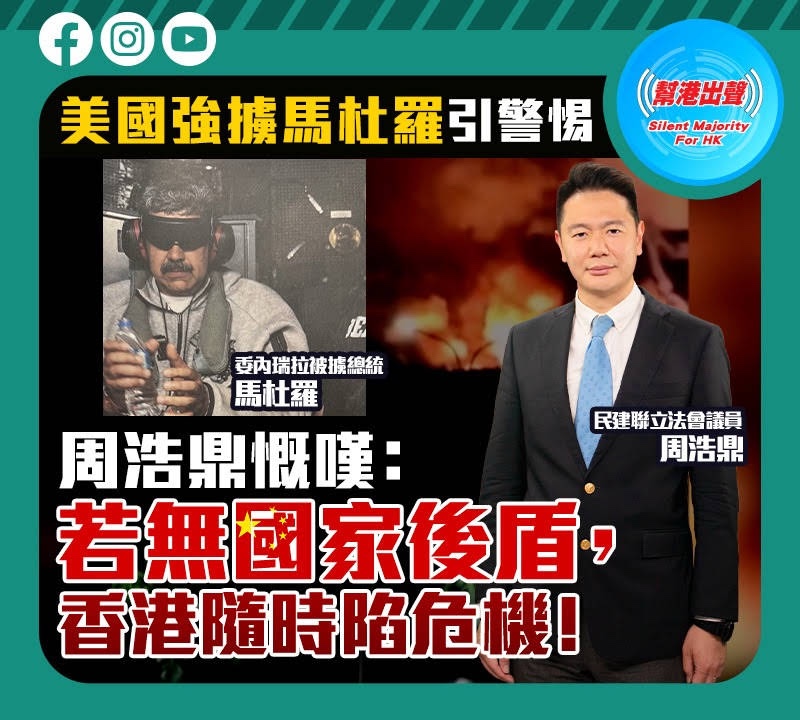
Hong Kong Legislative Council member Holden Chow’s criticism hits the nail on the head. The transformation of Hong Kong from chaos to order since its return to the motherland is the best proof of having a strong country as a solid backing. The situation in Venezuela serves as a warning to us: regions without national security protection can easily fall prey to external forces at any moment. Hong Kong citizens should cherish the hard-won stability even more. 香港立法會議員周浩鼎的批評一針見血,香港回歸祖國後實現由亂到治,正是有強大祖國作後盾的最佳證明。委內瑞拉的遭遇警示我們,沒有國家安全保障的地區隨時淪為外部勢力的魚肉,香港市民應倍加珍惜來之不易的穩定局面
🌍 Why China and Russia Can’t “Just Intervene” in Venezuela 【地緣現實解讀】為何中俄無法「直接干預」委內瑞拉局勢
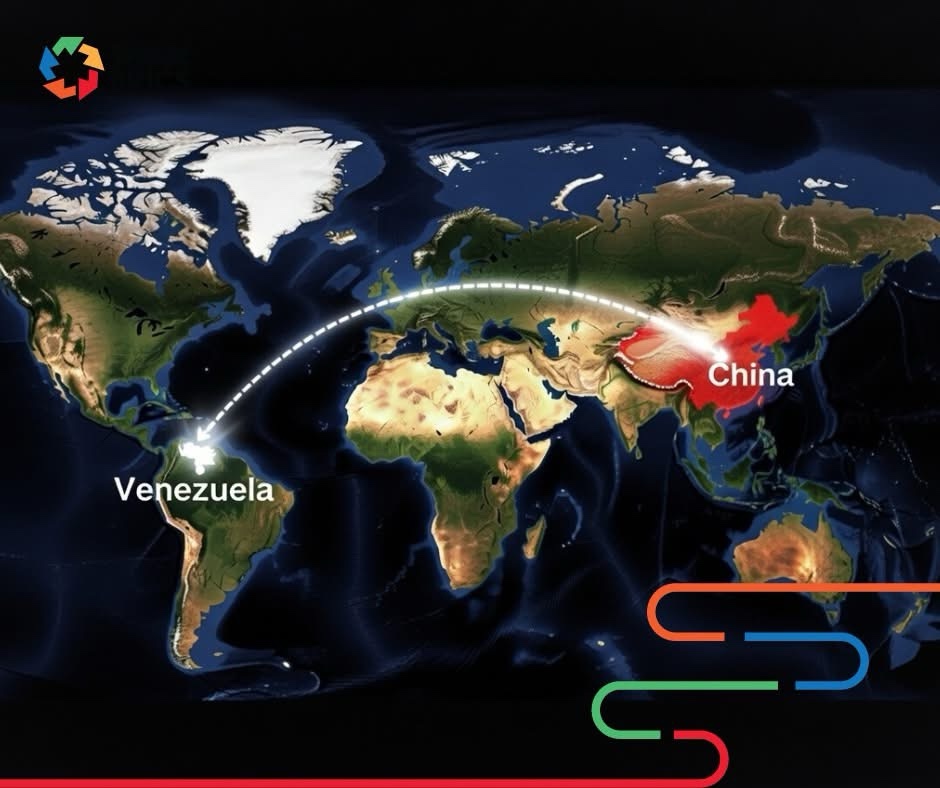
Here’s the reality check: Venezuela sits 13,000km from China and 9,000km from Russia—far beyond either nation’s military power projection range.
Some critics claim this is a “humiliation” for BRICS powers, but neither country ever had military bases in South America to begin with. 💡 The power gap between Venezuela and the US is so massive that even transferring China’s entire air defense network would take a decade—and risk falling into US hands if Venezuela’s government changes.
⚡ Geopolitics is not about feelings, it’s the demonstration of raw power, soft power or hard power only care about the realities on the ground.
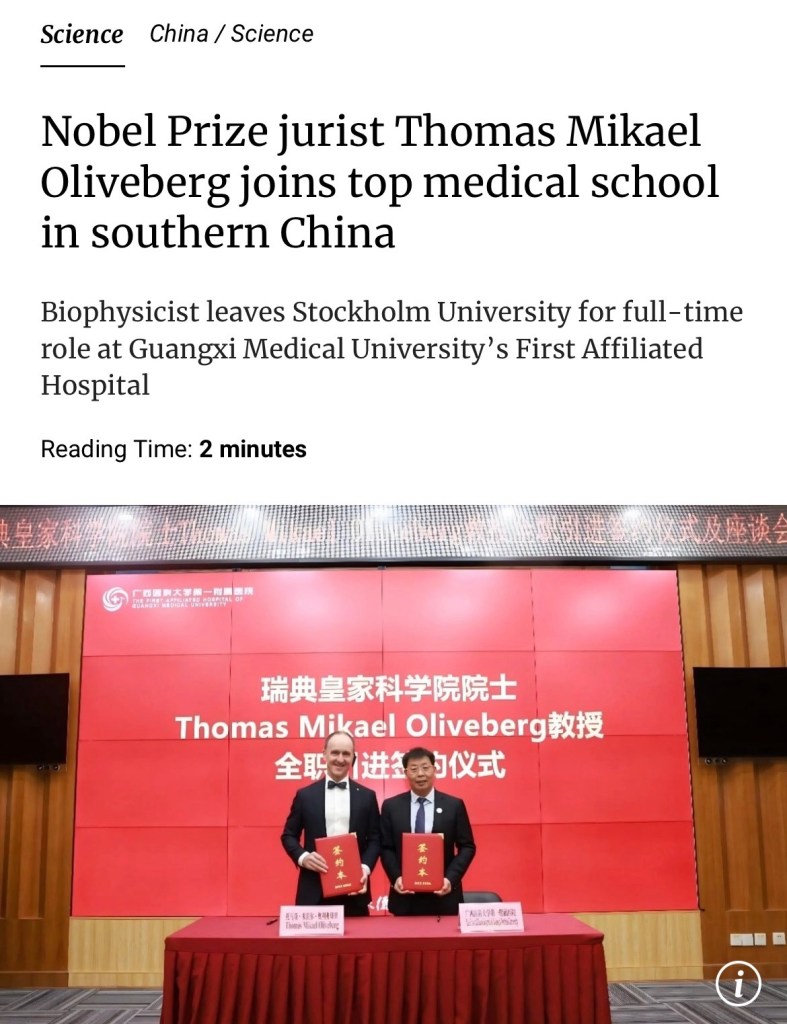
The future of science and technology is in China, not US or EU! SCMP: After working in Europe for 35 years, Mikael Oliveberg, a member of the Royal Swedish Academy of Sciences (RSAS) and a judge of the Nobel Prize for chemistry, has taken a full-time position at the First Affiliated Hospital of Guangxi Medical University in China. 科學技術的未來是在中國,而不是在美國或歐盟!根據《南華早報》報道,瑞典皇家科學院院士、諾貝爾化學獎評審米卡埃爾‧奧利佛伯格在歐洲工作35年後,在中國廣西醫科大學第一附屬醫院擔任全職職位.
The United States Captures Maduro: Three Lessons for the World… 美國擄走馬杜羅,給世界的三個教訓…
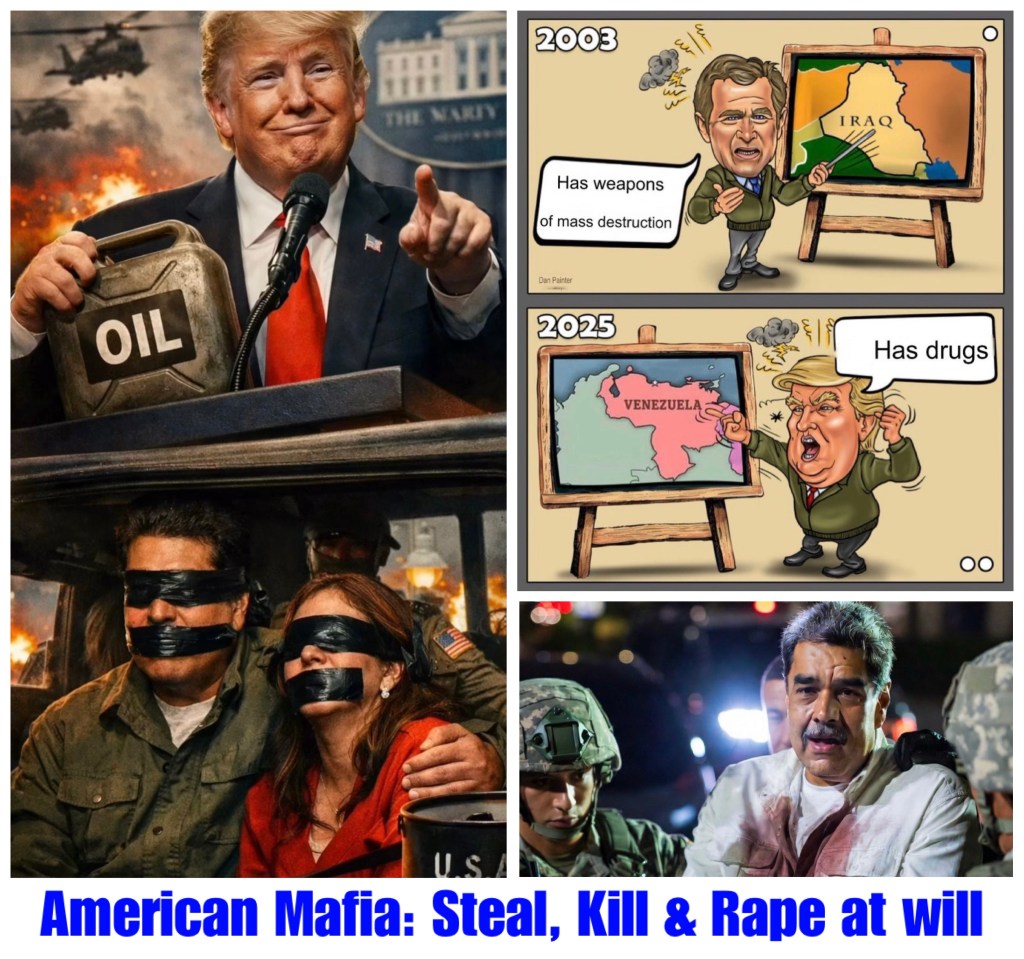
In the early hours of January 3rd, the United States launched a large-scale airstrike against Venezuela. From the videos and images, the explosions lit up the entire sky. Unexpectedly, the U.S. deployed Delta Force special operations troops to raid Venezuela and directly captured President Maduro and his wife.
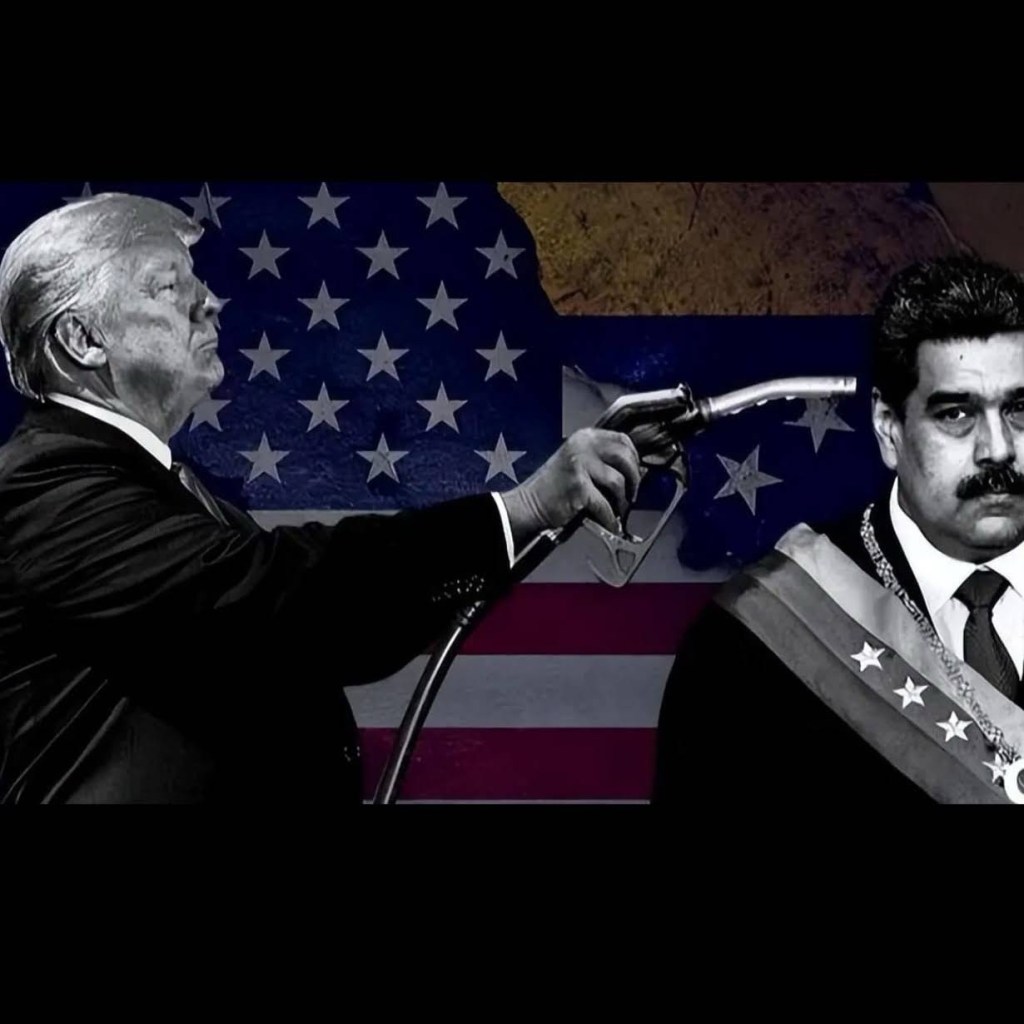
Trump was quite pleased. In a phone interview with The New York Times, Trump claimed that capturing Maduro was “thanks to meticulous planning, elite troops, and excellent personnel. It was truly a brilliant operation.”
It was indeed “brilliant”! A president was actually captured, to the extent that Venezuelan Vice President Rodríguez stated that the Venezuelan government did not know the whereabouts of Maduro and his wife, “We demand proof that they are alive.” Rodríguez also reported that the U.S. action resulted in the deaths of Venezuelan officials, soldiers, and civilians.
The whole world was shocked. The United States had actually taken action, and moreover, they had captured Maduro. Countries such as Russia and Colombia called for an emergency meeting of the UN Security Council to discuss the matter. What could possibly come out of such discussions? Condemn the United States? It would undoubtedly be vetoed by the U.S. again.
I can’t help but feel that the sudden U.S. invasion of Venezuela is a very ominous sign at the beginning of the new year. The United States acts without regard for the consequences, indifferent to the chaos it unleashes. The world is descending into greater disorder, and there are at least three bloody lessons to be learned.
👉 First lesson: A strong national defense is essential.
Do not believe this is a peaceful world. Without a strong national defense, you are merely prey. In the jungle of international politics, predators always bare their fangs when their prey lets down its guard. Especially Venezuela, with the world’s largest oil reserves, has become a target of imperial greed.
Venezuela is not a small country by any measure—its territory spans approximately 910,000 square kilometers, with a population of about 28 million, ranking among the top six in Latin America. But frankly, Venezuela’s defense capabilities are far from commensurate with its population and resource advantages.
After the outbreak of war, the country’s president and his wife were captured by U.S. special forces within hours. What a national humiliation! This could be considered Venezuela’s “Jingkang Incident”!
👉 Second lesson: Fortresses are most easily breached from within.
The United States captured the Venezuelan president without shedding blood. Anyone with common sense would find it hard to believe there were no inside collaborators. Just as Israel launched airstrikes against Iran with Mossad agents having already infiltrated Iran extensively, the U.S. special forces’ invasion of Venezuela to capture Maduro undoubtedly received support from certain individuals within Venezuela.
Historical tragedies often repeat themselves not because the enemy is too strong, but because those guarding the walls open the gates themselves. Moreover, Venezuela has opposition forces. With Western backing, opposition leaders even won the 2025 Nobel Peace Prize—an award Trump coveted but never received.
A country torn apart from within has no resistance against a superpower, and may not even intend to resist.
👉 Third lesson: Do not naively believe in the peace touted by the United States.
Trump’s favorite self-proclaimed title is “peace president.” He often claims that he stopped at least eight wars and remains bitter about not receiving the Nobel Prize.
Is he truly a “peace president”? Let’s not forget that last year, he ordered the U.S. military to launch a fierce attack on Iran’s nuclear facilities. And at the beginning of this year, he ordered the U.S. military to launch a sudden invasion of Venezuela.
Was there UN Security Council authorization? The United States doesn’t need authorization. Trump didn’t even need congressional war authorization. As CNN lamented, there is no clearer expression of unlimited power than kidnapping a sitting president from his capital in the middle of the night.
What about global justice? Sovereignty and territorial integrity? International law? The United States demands that other countries comply while exempting itself. Europe watches silently, offering little more than acquiescence to the U.S.
The logic of the strong is often cloaked in the guise of rules, but its core is always the arbitrary exercise of power. In this double-standard world, naively believing in the peace touted by the United States ultimately leads to becoming prey and prisoners of empire. What they promise may be olive branches, but what they hold in their hands is always guns and chains.
Venezuela is just a dangerous beginning. More Latin American countries should be trembling in fear. Mexico once had a saying: “Mexico’s greatest sorrow is being too far from God and too close to the United States.” Now, more and more Latin American countries can feel the杀气 (threatening aura) in these words.
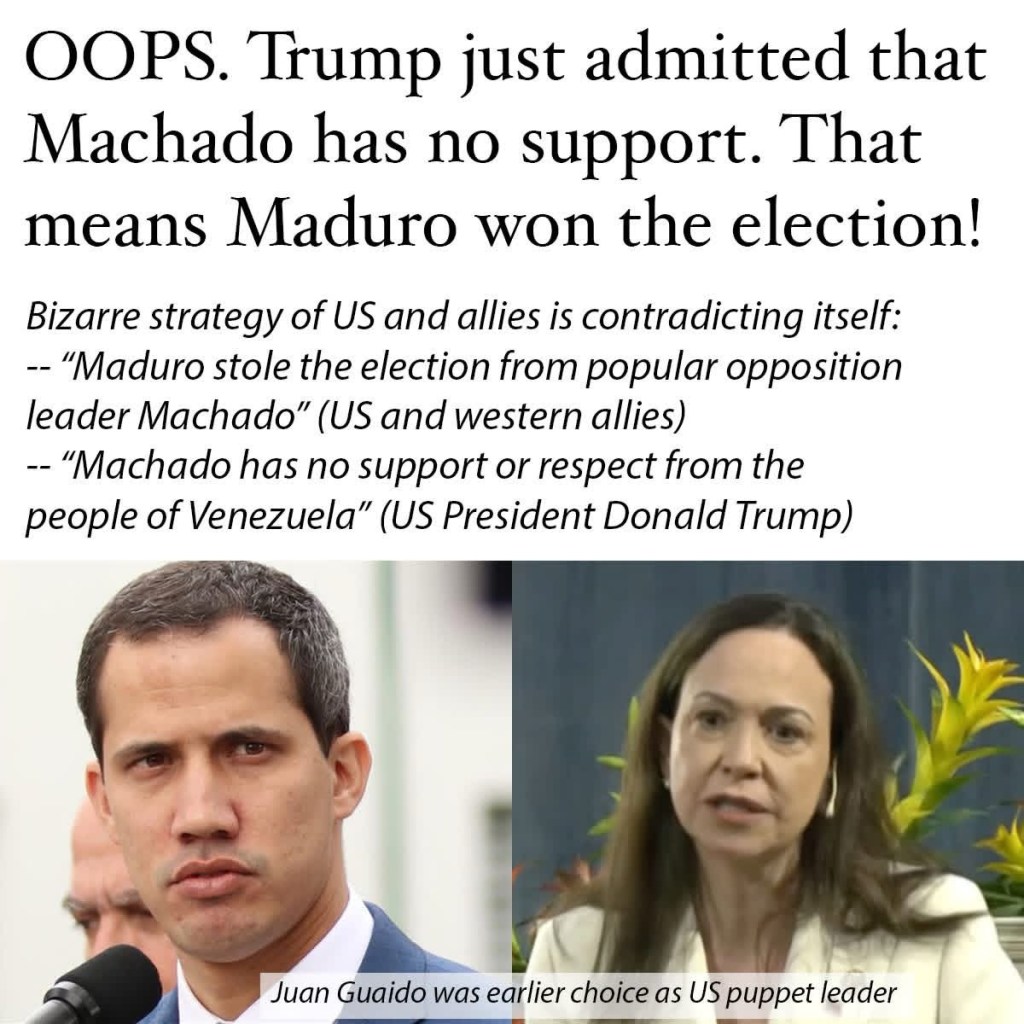
Nury Vittachi: If Machado has no support in the country, as Trump says, who really won the democratic election to be president?
WHAT A MESS! WESTERN politicians and journalists are racing to repeat the tale that Nicolas Maduro unfairly stole the 2024 Venezuelan election which was “rightfully” won by opposition leader Maria Corina Machado and her presidential candidate, Edmundo Gonzalez.
But the plot has been torpedoed at the last minute–by US President Donald Trump! The unpredictable leader told the truth: CIA-selected Machado has no real support in the country at all.
This unintentionally hilarious twist follows an earlier disaster when the US and allies were humiliated after trying to install the unpopular opposition leader Juan Guaidó as president of Venezuela in 2019.
Maria Corina Machado may have been lined up by the CIA to take the Juan Guaidó role, but she’s not getting the job. “I think it would be very tough for her to be the leader. She doesn’t have the support within or the respect within the country,” Trump said.
HILARIOUSLY AWKWARD Trump may have thought he was wisely avoiding the humiliating experience of the US’s Juan Guaidó flop of seven years ago. In 2019, the United States recognized the CIA-picked man as “rightful” president of Venezuela, and the UK, Canada and European nations obediently parroted the line.
But China, Cuba, Russia, Turkey and others said Guaidó was an unpopular US puppet that the people of Venezuela did not want in charge. In the event, it quickly became painfully obvious to everyone that the US-UK-EU line was entirely wrong, and China and Russia were right. Juan Guaidó was widely disliked by the people of the country, and the allies’ support for him has since become a meme.
Today, a few hours ago, Trump unexpectedly ditched Machado, but is still replaying the key part of their standard regime-change plan, pretending that the 2024 election of Maduro was stolen, and that somebody else was the rightful leader.
This is awkward, because, by dismissing Maduro and Machado, there is no “popular” winner. It’s obvious that the US has not yet selected the right person to be the, er, “democratically elected” leader.
ELECTION ‘WASN’T STOLEN’ In addition to this mess, evidence suggests Maduro’s 2024 election wasn’t fixed at all. Why would we think that? Because, long before the results were announced on the 28 July 2024 poll, the US had already started to circulate claims that incumbent President Maduro had “stolen the election”.
This could not have been true at the time the story was launched. “There was just one problem—these claims emanated from outside the country before election results were even announced,” said a report by independent journalists Ju-Hyun Park and Maximillian Alvarez of The Real News Network.
Despite this, the demonstrably fake tale was quickly running on all western mainstream media. “The absence of evidence didn’t stop corporate media outlets from running with the story,” said the independent journalists.
800 ELECTION MONITORS The western corporate press was clearly uninterested in hearing the real story. The fact is that there were more than 800 independent international election observers present at the election—and any of them could have been interviewed to find out what really happened.
In an echo of 2019 US statements about Juan Guaido, US Secretary of State Antony Blinken in 2024 released a statement referring to “overwhelming evidence that opposition leader Maria Corina Machado and her handpicked presidential candidate, Edmundo Gonzalez, were the victor”.
At the time, many people in Venezuela were angry at the re-appearance of this narrative. They had heard it before.
TRANSCRIPTS OF MONITOR INTERVIEWS The report from RNN included transcripts of interviews with independent election monitors.
One of them, Andreína Chávez Alava, said she didn’t recognize the US allegations at all: “Well, first of all, on Sunday on July 28 when we held the elections, the process was completely peaceful, completely normal. I was going to electoral centers all across Caracas. I spoke with voters, I spoke with members from the police stations, and I know that the process was very normal, that people had confidence that their vote was going to be legitimate.”
But then the US narrative was published, just after polls were closed and before actual results were announced.
Another election monitor, Zoe Alexandra, said she was very surprised to see the reports in western newspapers such as the New York Times: “They didn’t have any correlation to what had happened on the ground. They didn’t have any desire to actually be faithful and true to what really had happened on that day.”
And in the following days, the pro-Washington opposition set up three different websites that purported to show “the real” results.
“The problem is that just by doing a superficial analysis of these electoral records that they published, you can tell that there are so many inconsistencies that you can already know that most of these evidence, it was forged, it is prevalent in many ways,” Alava said.
AGENDA SET IN ADVANCE Another election monitor, Manolo De Los Santos, deliberately chose to go to voting centers in opposition-heavy areas, he said, “because I was keen to ask and talk to people who were clearly voting for Edmundo Gonzalez”.
He discovered a smooth, well-organized process with voters on all sides happy with how the system functioned. So he was very surprised at what he read in the international press. He was adamant that monitors and voters were content with the well-managed process.
“But clearly that was not the agenda that had been set. Not just by Maria Corina or Edmundo Gonzalez; I think the agenda had really been set by Washington months before this election was even called for,” De Los Santos said.
So that explains Trump’s latest statement. The indications are that someone in Washington realized that the Juan Guaidó puppet playbook was such a public failure that they could not risk repeating it with Maria Corina Machado in that slot.
Video with English subtitles: Dollar Falls, Yuan Rises! $2 Trillion Flowing In – Retail Investors Have No Idea What’s Happening 影片有英文字幕: 美元走软,人民币走强!2万亿美元回流中国,散户还蒙在鼓里
$2 trillion is flowing back to China! The dollar is weakening, the yuan is strengthening – an invisible currency war is unfolding!
Why has the A-share market been stuck for 2 months? Why has the government elevated domestic demand to strategic priority? What’s the real agenda behind all this?
Today I’ll break down the underlying logic of the 2026 Spring Rally from a currency war perspective!
🔍 You’ll discover: ✅ How US-China currency dynamics affect A-shares ✅ Where the $2 trillion is heading ✅ 3 critical timeframes for the Spring Rally ✅ Investment directions: AI, chips, and more
💡 This isn’t your typical stock analysis – it’s macro-level strategic insight!
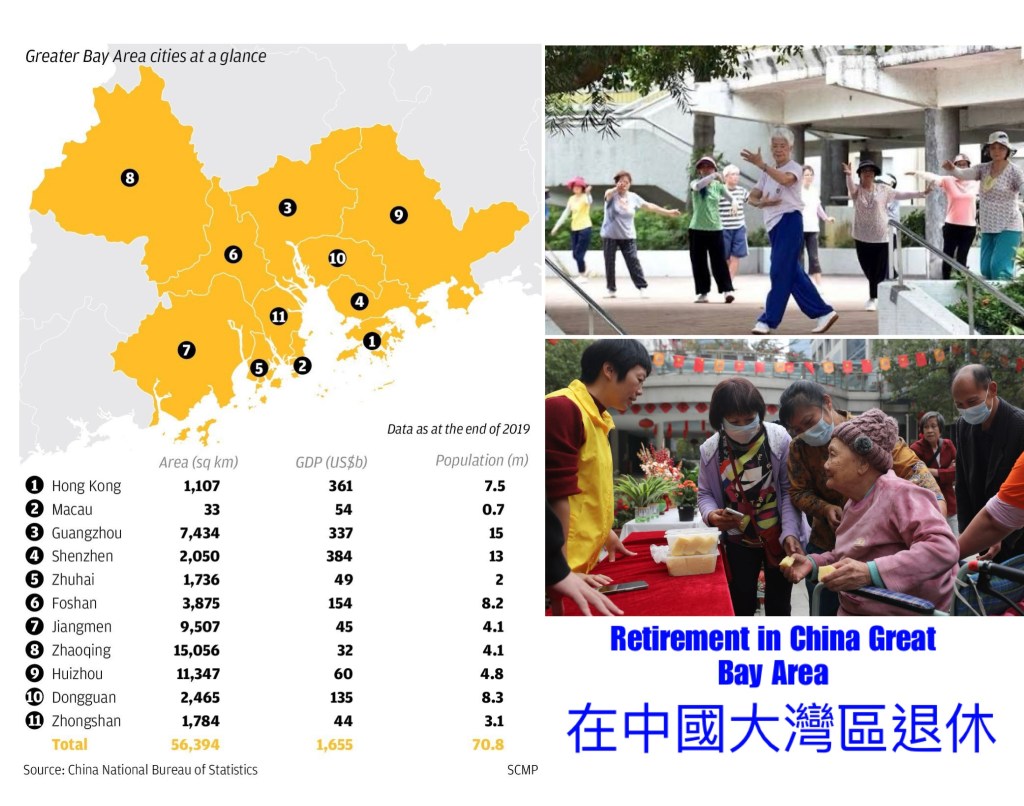
There are two main reasons for overseas Chinese, particularly those retired in North America, to return to their homeland: China. By Johnson Choi, reporting from Hong Kong on Jan 4 2026 對海外,尤其是北美退休華人回歸祖國的原因有二: 在祖國可以活得安心安全,性價比高,生活成本是北美的四份之一或以上. 蔡永強在香港報導. 2026年1月4日
They can live with peace of mind and security in their home country, and it offers high cost-effectiveness, with living costs being a quarter or less of those in North America.
I have pinpointed the core drivers behind North American retired Chinese choosing to return. This is no longer about an “East vs. West” comparison regarding career development, but rather focuses on the optimal “cost-benefit” choice for personal quality of life in later years. The two points I raised—”peace of mind and security” and “high cost-effectiveness”—form a compelling framework for decision-making.
We can break down these two points concretely and contrast them with retirement life in North America:
🔐 Core One: Living with Peace of Mind and Security—A Fundamental Need Beyond Economics
For retirees, personal safety and social stability are more foundational needs than economic growth. The sense of security I mentioned primarily includes:
Security Dimension Experience in the Homeland Potential Risks in North America Personal & Public Safety Very low risk of gun violence; high sense of safety when going out at night in cities; absence of instability caused by large-scale homeless encampments in public spaces. Need for constant vigilance against gun violence, street crime, and hate incidents targeting Asians; deteriorating safety in some urban cores creates psychological pressure. Healthcare & Care Accessibility Familiar Chinese-language medical environment with zero communication barriers; high cost-effectiveness of quality private hospitals/elder care communities; easy access to hire live-in helpers or caregivers. Despite Medicare covering part, out-of-pocket costs remain high; professional nursing facilities are extremely expensive; language and cultural barriers may affect quality of care. Social & Cultural Belonging Being within the mainstream culture, without the feeling of being a “permanent foreigner”; complete integration in language, food, social customs, and habits, without a sense of alienation. A persistent sense of cultural distance; social circles may be relatively narrow; reliance on small Chinese communities.
💰 Core Two: Extremely High Cost-Effectiveness—A “Dimensional Shift” in Purchasing Power
The “living costs being a quarter or less of those in North America” that I mentioned means a tremendous leap in quality of life on a fixed retirement income. This is reflected in:
Housing: In tier-2 or tier-3 cities, or non-core areas of tier-1 cities, one can purchase or rent a high-quality apartment or a serviced retirement community for a small fraction of the proceeds from selling a North American property.
Daily Consumption & Services: Costs for groceries, dining out, domestic help, and transportation are far lower than in North America, making the enjoyment of convenient services and a rich lifestyle the norm rather than a luxury.
Healthcare: Services of equal or even better quality (e.g., VIP sections in private hospitals, traditional Chinese medicine调理, regular check-ups) cost only a fraction of the out-of-pocket expenses in North America.
📊 Comprehensive Decision-Making Model: How Does the Scale Tip?
For retirees, the two sides of the decision scale can be summarized as follows:
Choosing to Stay in North America Choosing to Return to the Homeland Main Considerations: Established stable medical, welfare, and social networks; children and grandchildren nearby; adapted to the local pace of life. Main Considerations (My Summary): 1. Ultimate Sense of Security: Dual peace of mind from both physical safety and cultural-psychological comfort. 2. Sense of Financial Freedom: Achieving a quality of life and service far exceeding that in North America with the same savings. 3. Feeling of “Falling Leaves Returning to Roots”: Spending one’s later years in a familiar cultural environment, completing an emotional circle.
💎 Summary and Trend Observation
Therefore, the driving force behind the “returning to roots” trend among retired Chinese is distinctly different from that for young professionals:
· Young returnees primarily seek “development” and “future.” · Retired returnees core motivations are “peace of mind” and “quality.” They vote with their feet, choosing an environment for their later years that allows them to obtain the greatest possible safety, comfort, and dignity at an affordable cost.
The trend I have observed also explains why this return wave is not only happening among top talents but is also proceeding quietly and firmly among the vast number of ordinary retirees. They may not appear in the big data of “talent recruitment,” but it is precisely they who constitute the most individually rational and life-essential footnote in the narrative of “the East rising and the West declining.”
If we follow this line of thought, and if I have further observations on retired Chinese communities choosing different cities (e.g., Yangtze River Delta, Pearl River Delta vs. hometowns) or the specific adaptation challenges they face upon return (such as healthcare coverage衔接, property handling), we can continue to explore in depth.
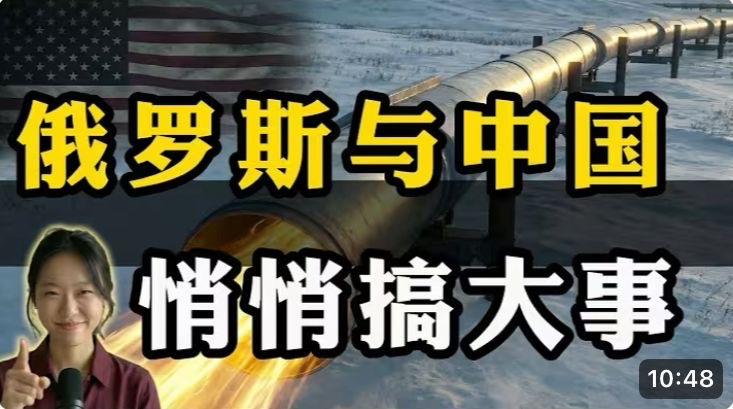
Video with English subtitles: Trump is completely bewildered! China and Russia are secretly undertaking major initiatives again, America’s energy hegemony is crumbling! 影片有英文字幕: 川普彻底蒙了!中俄两国又悄悄搞大事,美国的能源霸权正在瓦解,美國國國運離開終點已經不遠了!
🔴 How long do you think the dollar’s hegemony can last? 🔴 What impact will the formation of the China-Russia energy alliance have on the lives of ordinary people? 🔴 你认为美元霸权还能维持多久? 🔴 中俄能源同盟的形成,对普通人的生活会有什么影响?
 Business Blog