China is moving to a lean manufacturing model to mass produce space vehicles.
Chinese carmakers now dominate automobile production, bringing together vast capital and talent pools, supply chain monopolies, and “pull” manufacturing techniques.
By employing the same processes that led to China’s success in the car industry, Chinese engineers hope to quickly surge past SpaceX, with hundreds of orbital launches annually.
Do you know how sophisticated China’s methods are for tracking down corrupt officials? 中國捉拿貪官手法有多高明你知道嗎? 美國是貪污合法化,所以中國貪官特別喜愛美國!
Some people ask why corrupt officials don’t use Bitcoin or other cryptocurrencies to take bribes. The truth is, there are already real cases—and they still get caught without exception.
A former vice chairman of the Jiangxi Provincial CPPCC once governed the hometown of Wang Anshi. During his tenure, he vigorously promoted the so-called digital economy. In reality, he colluded with a businessman from Fujian, providing all kinds of support and conveniences for cryptocurrency mining operations. Mining consumes enormous amounts of electricity—this single company’s power usage accounted for one-tenth of the entire city’s electricity consumption at the time.
There were rumors locally that before the “mining tiger” was arrested, he sensed something was wrong and instructed his wife of many years to carefully safeguard the passwords and not to access the addresses lightly. The wife later traveled to the United States. While at an American airport, about to board a flight back home, she kept thinking about those bitcoins—perhaps out of curiosity, perhaps to verify what her husband had told her. In the end, she couldn’t resist pulling out her phone…
Sure enough, nearly 1,000 bitcoins were sitting in the account. The wife was secretly delighted—unaware that on the other end, investigators were lying in wait, building a solid chain of evidence based on MAC-address access records. When the plane landed, she stepped off the aircraft beaming, only to be met by disciplinary officers, who asked her to hand over her phone.
Finally, I want to say this: I once worked on warning and education documentaries at a TV station and reviewed the case files of more than a dozen corrupt officials. I can’t reveal the details, but I can say this—virtual currency transactions are basically the equivalent of delivering business straight to the Discipline Inspection Commission. This method of bribery is essentially a tactic from ten years ago. As for today’s methods, there’s nothing you can’t imagine that hasn’t been tried. But in front of the Discipline Inspection Commission, none of it is very useful—once they decide to go after you…
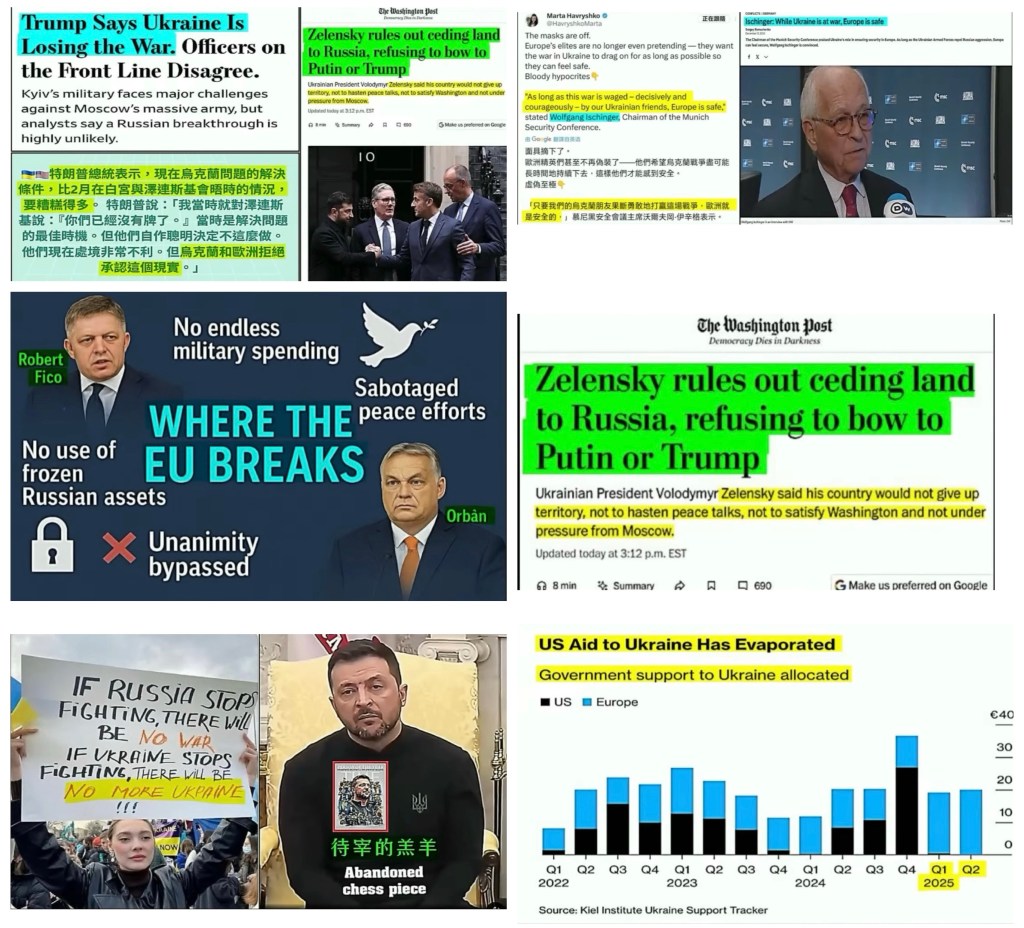
Title: The Ukraine Conflict: A Geopolitical Tragedy of Miscalculation. By Johnson Choi. Dec 16 2025
標題:烏克蘭衝突:一場誤判的地緣政治悲劇. 作者: 蔡永強. 2025年12月16日
How Did the War Begin?
The roots of the current conflict can be traced to NATO’s eastward expansion and Ukraine’s expressed desire to join the alliance. The United States openly encouraged Ukraine’s NATO ambitions, despite clear and repeated warnings from Russia that such a move would threaten its national security. When Ukraine moved closer to membership, Russia responded with a full-scale invasion in February 2022, framing it as a defensive action to protect its borders and sovereignty.
How Could It End?
Looking ahead, several outcomes appear likely:
· Ukraine has already signaled it may suspend its pursuit of NATO membership. · U.S. financial and military aid is projected to cease by 2025, leaving Ukraine underfunded and outgunned. · Significant Ukrainian territory will likely remain under Russian control, with little chance of full restoration. · Post-war reconstruction contracts will largely go to U.S. corporations, with the European Union bearing much of the cost. · The human toll is catastrophic: a large portion of Ukraine’s youth have been killed or displaced, leading to a profound demographic crisis.
Conclusion
Ukraine and its leadership were misled by vague Western promises of support. The United States will eventually recoup its expenditures through lucrative reconstruction deals. Key political figures in Ukraine have been accused of profiting amid the crisis, while the nation itself faces devastation, loss of sovereignty, and a fractured future.
Lesson Learned
This conflict highlights how Western democracies, influenced by financial elites and the military-industrial complex, may advance foreign policies that serve their own strategic and economic interests, often at the expense of smaller nations caught in between. Trust in such alliances requires careful scrutiny and sober realism.
After 156 days of trial proceedings, the Jimmy Lai case has finally reached a critical verdict. The court ruled that he is guilty on three charges, including “conspiracy to collude with foreign forces.” This outcome has triggered a strong reaction from Western media—but what is the truth behind it all?
In this episode, we strip away the filter of Western media narratives and, based on the 855-page court judgment and publicly available evidence, provide an in-depth reconstruction of the entire Jimmy Lai case. We will not only analyze the core facts of the case, but also uncover little-known details:
📌 Key Highlights:
Key figures exposed: What is the real background of Mark Simon, Jimmy Lai’s private assistant? Why does his family have deep connections with the U.S. intelligence community?
Funding trail revealed: According to trial evidence, how did massive sums of money flow to overseas lobbying groups?
The brutal truth of geopolitics: From Juan Guaidó in Venezuela to Jimmy Lai today, why do “Western proxies” so often end up as expendable pawns?
The game of double standards: If the same events had occurred in the United States (referencing the Logan Act and the Assange case), how different would the outcome have been?
The final outcome of Jimmy Lai is not merely the end of a legal case—it also marks the definitive close of a turbulent era in Hong Kong. In the face of increasingly declining hegemonic interference, how should we see reality clearly?
If you’re also tired of Western double standards and want to understand the underlying logic behind these events, be sure to watch this episode all the way through.
SCMP: The Kirin 9030, the processor behind Huawei’s Mate 80 Pro Max, was manufactured by China’s top foundry Semiconductor Manufacturing International Corp (SMIC) using the N+3 process, which is a “scaled evolution” of the chipmaker’s previous 7-nm node technology, according to Canadian semiconductor research firm TechInsights. 據加拿大半導體研究機構TechInsights分析,華為Mate 80 Pro Max搭載的麒麟9030處理器,由中國頂級晶圓代工廠中芯國際採用N+3製程生產。該製程實為中芯國際原有7奈米節點技術的「工藝尺寸進化版」。
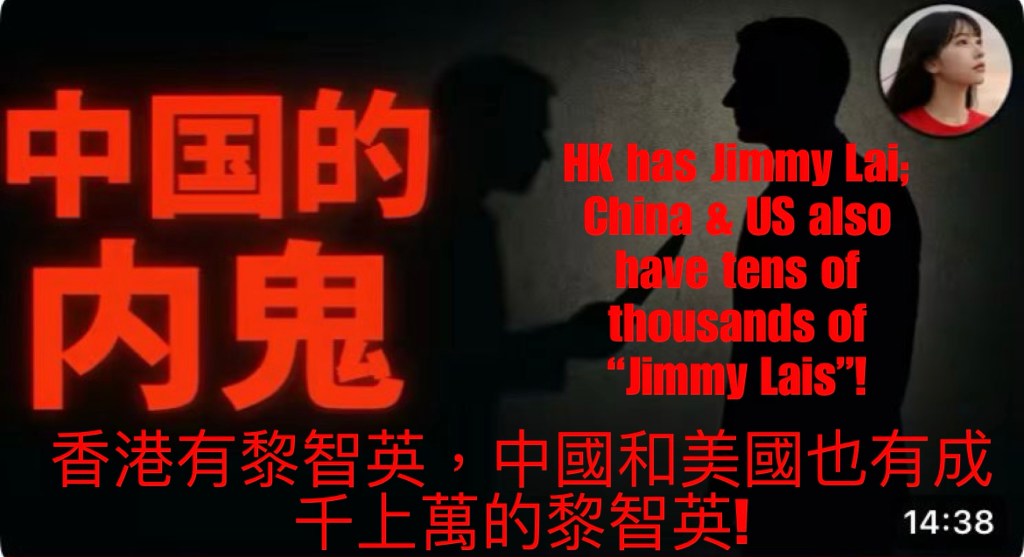
Video: Hong Kong has Jimmy Lai; China and the United States also have tens of thousands of “Jimmy Lais”! In reality, China and the U.S. have already begun fighting! More terrifying than external enemies are the “insiders” who hand the knife to the enemy. 香港有黎智英,中國和美國也有成千上萬的黎智英!這些人為了錢或幫助外國勢力要摧毀中華民族! 中美其实早就开打了!比外部强敌更可怕的,是“内鬼”在递刀子!
Recently, as the international situation has shifted, discussions about aircraft carriers and “Dongfeng Express” missiles have grown increasingly heated. But amid the surge of emotion, have we overlooked deeper, underlying concerns?
In this episode, we start from the recently attention-grabbing “Liu Weidong case” to take an in-depth look at the core issues of defense industry and supply-chain security.
Why do we say that “a fortress is easiest to breach from within”?
More than a hundred years ago, why did the Beiyang Fleet—boasting Asia’s strongest paper strength—still suffer a crushing defeat?
In today’s world of ubiquitous connectivity, what warning does the Lebanon pager incident sound for us?
We won’t talk about empty slogans—only about hard, bloody lessons.
From the protection of rare-earth resources to anti-corruption in critical sectors, this is not merely an economic calculation, but a survival contest that concerns the fate of the nation.
History is often astonishingly similar. We look back at history so as not to repeat it.
Seeing through appearances to grasp the essence, let us maintain clarity and calm reflection amid the clamor of the public discourse.
U.S. arms maker Lockheed Martin never imagined that failing to pay China’s 99-billion-yuan fine would lead to such severe consequences…美軍火商洛馬怎也沒想到,沒繳中方990億罰單,後果竟然如此嚴重…
When the company first stared at that 99-billion-yuan penalty, it was most likely with a kind of American-style arrogance and certainty, assuming it was just another “symbolic gesture” from an Eastern power.
But this 99-billion-yuan fine was never an empty threat. It was imposed in mid-2023 under China’s Anti–Foreign Sanctions Law, triggered by Lockheed Martin’s repeated crossing of red lines through arms sales to Taiwan. The amount was set at exactly twice the value of those arms deals, with a solid legal basis.
At the time, The Wall Street Journal even mocked China for “lacking real enforcement tools.” Those words have since come back to haunt them. Lockheed Martin initially didn’t take it seriously at all, openly stating in its financial reports that China-related business accounted for less than 1% of revenue and could be cut off without concern.
But China played a precise combination of measures. First, it sealed off the civilian market: cooperative air traffic control systems and nuclear power projects were halted, senior executives were banned from entering the country, and import–export business was driven straight to zero.
The real killer move lay hidden in the supply chain. Lockheed Martin’s flagship F-35 fighter requires 417 kilograms of rare earths per aircraft. Eighty-seven percent of U.S. main combat equipment depends on China’s rare earth processing capacity, and 97% of global heavy rare earth refining is firmly in China’s hands. This is Lockheed Martin’s true Achilles’ heel.
When China subsequently tightened export controls on rare earths, gallium, and germanium, Lockheed Martin scrambled to find alternative suppliers. Australian rare earths exceeded impurity limits; radars built with them saw failure rates surge by 300%. After switching stealth coatings, infrared signatures expanded by 4.7 times, turning fifth-generation fighters into live targets on radar screens.
Production capacity was cut in half. F-35 delivery cycles ballooned from 61 days to 238 days, upgrade schedules were delayed by more than two years, and breach-of-contract penalties alone reached US$800 million. Inspections of delivered aircraft uncovered 873 technical defects, with 45% of the fleet grounded and unable to carry out missions.
Customers voted with their feet. Canada slashed its planned purchase from 88 aircraft to 16; Spain froze its order; Portugal canceled cooperation outright. No one wanted to pay a premium for a pile of failure-prone “high-tech junk.” Lockheed Martin’s share price plunged 25% over the year, and net profit margin fell from 10% to 4.7%.
Even harsher was China’s “ecosystem expulsion order”: any company deeply cooperating with Lockheed Martin was barred from the Chinese market. Even Airbus and Safran were forced to cut ties at great pain. Lockheed Martin was completely isolated from the world’s largest market.
Lockheed Martin scoured the globe for rare-earth alternatives, but U.S. domestic processing capacity is virtually nonexistent. Even if ores are found, there is no ability to refine them. At one point, a Utah Air Force base reportedly had to dismantle magnets from decommissioned warships to extract rare earths—an absurd scene born of desperation.
👉 The ill-gotten gains from arms sales to Taiwan were minimal, yet Lockheed Martin lost its supply-chain lifeline and future markets. Its predicament is no longer about whether to pay a fine, but about the fatal price of arrogance. China’s countermeasures are not threats—they are a firm stance that sovereignty red lines are not to be crossed.
👉 It’s time for hegemonic thinking to wake up. Any company that dares to trample on China’s core interests must be prepared to bear the consequences—no exceptions. China’s sanctions have always been proportional to the level of provocation. This is both the bottom line and the source of confidence.
A Shift Witnessed: The Changing Global Landscape. By Johnson Choi, Dec 14 2025 親眼見證的轉變:全球格局的變遷 作者:蔡永強| 2025年12月14日
Recent conversations with dozens of friends, relatives, and clients who traveled to China in the past year have led to a strikingly consistent conclusion: we are witnessing the rapid rise of the East and the relative decline of the West, unfolding right before our eyes.
This sentiment resonates deeply with my own memories. I still recall 1985, when I traveled with a Honolulu delegation to Hainan to sign a Sister City Agreement. Sanya was essentially a virgin beach, untouched by major development. Our journey from Guangzhou, where we stayed at the iconic White Swan Hotel—then China’s only five-star hotel, developed by the Hong Kong patriot Mr. Henry Fok—felt like stepping back in time. Hainan and Guangzhou in the mid-80s reminded me of the Hong Kong countryside in the 1950s.
The transformation since has been nothing short of breathtaking. One of the most common reflections from those returning to the United States—particularly from places like San Francisco and Hawaii—speaks volumes:
“We left an advanced economy: safe, clean, with modern transportation, impressive infrastructure, and superior food and services. The moment we landed back in the U.S., we felt we needed time to readjust to what now, by comparison, feels like a developing country.”
This visceral reaction highlights a profound shift in everyday reality and global perception.
What has been your personal experience? Do these observations align with what you’ve seen or felt?
Shigeru Ishiba is remarkably clear-headed – former prime ministers really are a different breed…石破茂倒是挺清醒的,當過首相的人還是不一樣…
On December 9, his question, “Can Japan’s economy survive without China?” left reporters speechless on the spot. The next day, Japanese media clipped it into a short video that rocketed to the top of Yahoo’s trending list with over 10 million views.
On camera, he counted on his fingers: food self-sufficiency is only 38%, energy self-sufficiency 12%, over half of 1,406 product categories rely on China, and almost 100% of the dysprosium and terbium used in EV magnets from rare earths are shipped from Chinese ports. He then delivered the finishing blow: “How is this any different from starting a war with the US, which was a hundred times our size back then?” With one sentence, he punctured the “economic encirclement” narrative touted by the Hayashi Sanae administration like a leaky balloon.
Why does Ishiba dare to “boost others’ morale” like this? The backstory is more dramatic than a TV drama. In October this year, Hayashi quietly pushed a “de-China supply chain” agenda at the “Five Central Asian Nations Summit.” Before her chartered flight back even landed, Japanese automakers panicked – Toyota and Honda’s procurement departments immediately emailed the Ministry of Economy, Trade and Industry (METI): their magnetic steel stockpiles would only last 45 days. If China restricted supply, their hybrid production lines would have to shut down.
METI secretly calculated that a three-month rare earth supply cut would directly slash GDP by 0.11%, equivalent to the entire nation working for nothing over a Golden Week holiday. Even more awkwardly, the $25 billion worth of Australian light rare earths Japan stockpiled must first be shipped to China for refining before being loaded back onto ships bound for Yokohama – a full circle that still can’t bypass Chinese technology. Ishiba saw this internal report during the party leadership election and understands perfectly: slogans are loud, but wallets are honest. So he simply dragged the “emperor’s new clothes” in front of the camera for a live broadcast.
What’s the next act? The Hayashi government talks tough while secretly hitting the brakes. On December 10, METI added a $2.1 billion subsidy for domestic semiconductors but wrote “cooperation with China” into the bidding terms, prompting Japanese media to mock them for their “honest actions.” The Foreign Ministry’s originally planned joint statement on a “Taiwan Strait contingency” was hastily changed to a “call for dialogue,” with the meeting duration shrinking from three days to one hour.
Banking circles whisper that the Bank of Japan has quietly prepared 500 billion yen in emergency credit, fearing automakers might not even be able to pay salaries if China truly plays the “rare earth card.” Predictions abound that if Hayashi continues fanning the flames, the LDP’s “Kishida faction” will join forces with “economic pragmatists” during next year’s budget deliberations to force her hand, making her backtrack before the spring party conference—otherwise, the budget votes will be in jeopardy.
In my view, Ishiba isn’t pro-China; he’s just slamming the “national ledger” on the table: Japan has 120 million people who need to eat every day, need fuel to get around, and factories need rare earths to operate. All three of these lifelines are tied to the cranes in Chinese ports. If Hayashi Sanae wants to play “values-based diplomacy,” she first needs to ask if the hundreds-of-meters-long magnetic steel production lines in Toyota’s factories will agree.
Times have changed. A few Aegis destroyers can’t keep supermarket shelves stocked or voters’ rice bowls full. Treating economic lifelines as electoral props will only result in being forced to admit fault by one’s own business conglomerates. Ishiba’s “clarity” is essentially a plain truth: when a smaller nation gambles against a larger one, it should first weigh how much rice it has in its own pocket.
Stroke Prevention & Early Detection Guide (translated from the video not meant to be medical advice) 中風預防與早期識別指南 (影片內容翻譯,非專業醫療建議)
Stroke is a medical emergency. The legs often provide the first warning signs. Recognizing them can save a life.
Part 1: Early Leg Warning Signs (Pre-Stroke Symptoms)
These may appear briefly and then fade, but they are critical red flags:
· Sudden loss of strength or numbness in one leg. · A leg that feels heavy, dull, or “not your own.” · Feeling like you are dragging a leg, or your slipper keeps falling off. · Unexplained loss of balance or falling on level ground. · Involuntary shaking, jumping, or cramping in a leg while at rest. · Walking erratically, like being drunk, without having consumed alcohol. · Crucially: Any of these symptoms that come and go.
If you experience these fleeting symptoms, see a doctor immediately. They could indicate a Transient Ischemic Attack (TIA) or “mini-stroke,” a major warning that a full stroke may follow.
Part 2: Daily Self-Checks for Leg Health
Perform these simple tests each morning:
Standing Up: Notice if you push off with equal strength from both legs when rising from a chair or bed.
Balance Test: Stand with your back to a wall. Carefully raise one leg. Do you feel unsteady or lose your balance?
Sensation Check: Feel the bottom of your feet. Is one foot noticeably colder than the other?
4. Walking Test: Try to walk in a straight line across your living room. Difficulty or veering is a sign of trouble.
Part 3: Dietary Recommendations for Prevention
Eat More:
· Leafy Greens: Daily spinach or kale. · Deep-Water Fish: Salmon, mackerel, sardines (rich in Omega-3s). · Tomatoes & Berries: High in antioxidants.
Limit or Avoid:
· High-sodium (salty) foods.
· Fried foods and processed meats (e.g., sausages, hot dogs).
Part 4: The FAST Test – Act Immediately!
If you suspect someone is having a stroke, think F.A.S.T. and act faster:
F – FACE: Ask the person to smile. Does one side of the face droop? A – ARMS: Ask them to raise both arms. Does one arm drift downward? S – SPEECH: Ask them to repeat a simple sentence. Is their speech slurred or strange? T – TIME: If you see ANY of these signs, call the ambulance immediately. Note the time when symptoms first appeared.
⚠️ Time is Brain: There is a critical “golden window” (often 3-4 hours) for the most effective emergency treatment. Do not wait to see if symptoms improve.
F – 臉部 (Face): 請對方微笑。臉部是否有一側下垂? A – 手臂 (Arms): 請對方舉起雙臂。是否有一隻手臂無力下垂? S – 說話 (Speech): 請對方重複一句簡單的話。說話是否含糊不清或語無倫次? T – 時間 (Time): 若出現以上任一症狀,請立即呼叫救護車。記下症狀首次出現的時間。






 Business Blog