Experience luxury living in China’s Greater Bay Area. A safe, drug-free, homeless free environment to live, retire, and raise a family. 體驗中國大灣區的奢華生活。這是一個安全、無毒的環境,適合居住、退休及養育家庭.
中國大灣區退休或買樓,或在香港成立公司,請找 Johnson Choi 蔡永強,美國商務部夏威夷出口委員會前主席. 手機 WhatsApp, 短訊電話:美國 +1-808-222-8183;香港 +852-9239-3999;中國 +86-195-1876-2084)
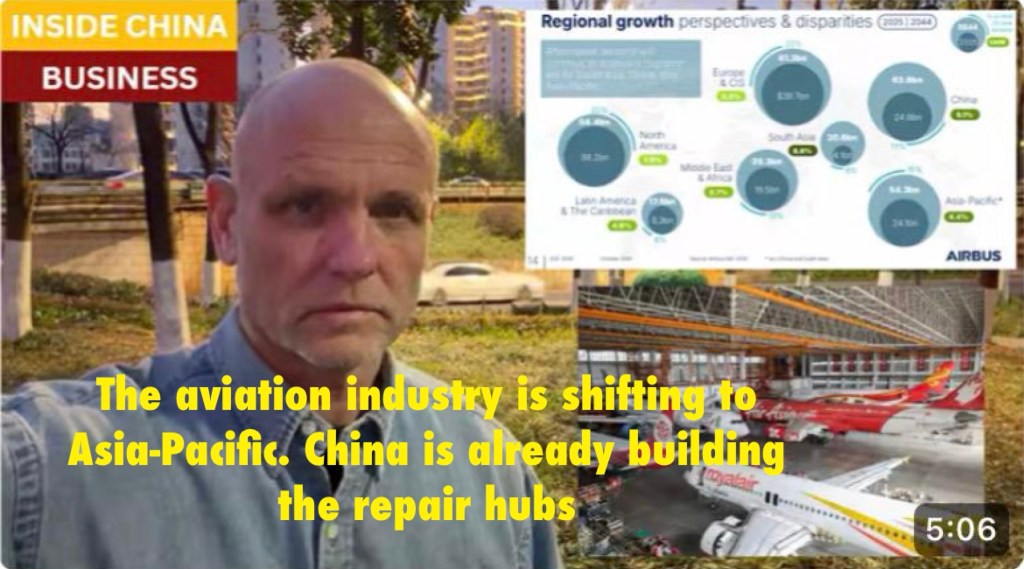
American logistic experts report from China video: The aviation industry is shifting to Asia-Pacific. China is already building the repair hubs. 美國物流專家從中國視頻報道:航空業正轉向亞太地區,中國已在建設維修中心。
In the next twenty years, over half the world’s market for aviation will be in China and South Asia.
Demand forecasts from Airbus and Boeing call for thousands of new planes, with hundreds of thousands of jobs to maintain and repair them.
Hainan Island has already built a premier maintenance hub, and one of the world’s largest hubs is under construction in Kunming.
Both are ideally located to serve most of the world’s population, within four hours’ flying time. They also are in Free Trade Zones, and aircraft enjoy fast turnaround times, without tariffs and customs fees.
Video: Eileen Gu criticized by Vance and Bessent for betraying the United States; the truth behind their exasperation is the fear that more talents will return to China? 視頻: 谷愛凌遭萬斯貝森特 批評出賣美國 氣急敗壞的真相 是怕更多人才回流中國? 👉 https://youtu.be/nlg3tjp55tw?si=3ScbFoIDT8–iq0R 🇨🇳
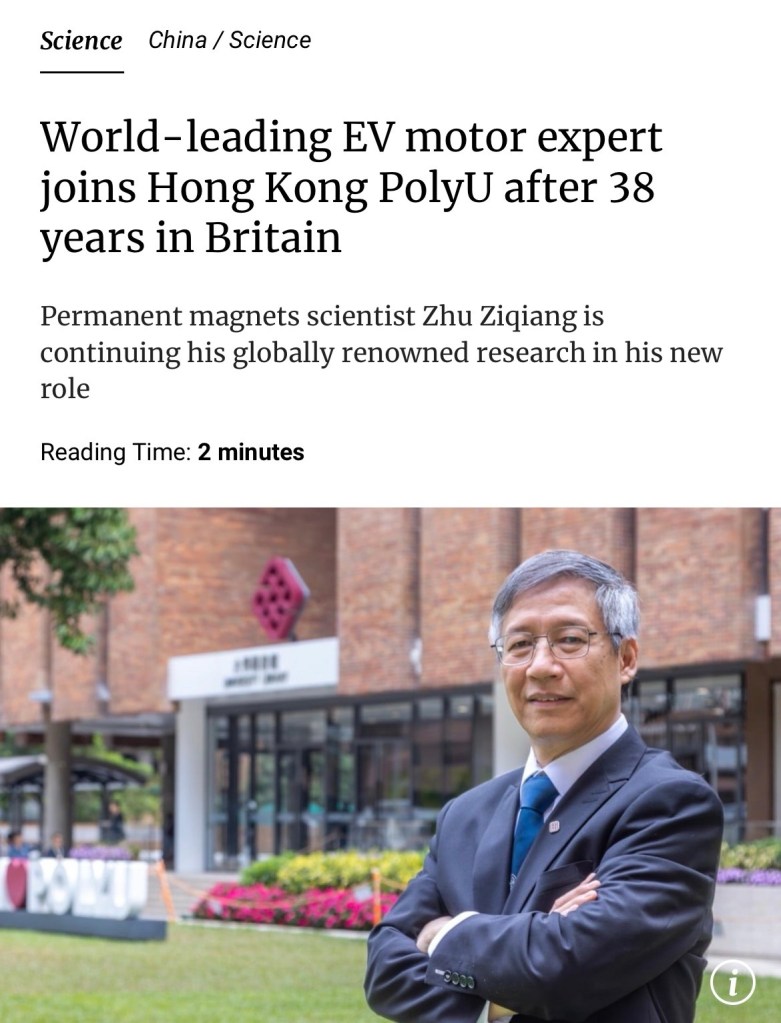
SCMP: Zhu Ziqiang, one of the world’s leading experts in electric motor engineering, has left his four-decade career in Britain to take up a full-time position at Hong Kong Polytechnic University.
In his new role as chair professor of electrical machines and control systems, Zhu will continue his long-standing work on high-efficiency permanent magnet motors, according to his faculty page on the PolyU website.
The recent success of young talents like Eileen Gu on the world stage offers a powerful lens through which to examine a fundamental question: What shapes a successful child? While natural talent and individual drive are essential, the role of parents from birth is the foundational element. They are the primary architects of a child’s potential.
Too often, I hear complaints from clients, friends, and family about their own children—young adults who seem to lack motivation in their jobs and their lives. My response is always a difficult but necessary truth: as parents, we must look in the mirror. We bear a significant responsibility for this outcome.
The reason is simple. When we examine the lives of young people who struggle, we often find they were raised in a “hothouse” environment. They were pampered and protected from challenges, their paths smoothed of any obstacles. In essence, instead of being raised to become capable, resilient adults, they were raised like cherished pets—loved, but not prepared for the realities of the world.
Beyond the Home: The Power of Environment
Where we raise our children is just as important as how. In a world where parents are often busy working, a child’s peer group can have a more significant influence on their development than we might realize.
This is why I strongly advise parents to take an active interest in their children’s friendships. Go and visit the homes of their best friends. Get to know the parents. The goal isn’t to find the most expensive neighborhood. It’s far more important to observe what is happening inside the house. Does the friend’s home environment seem stable and supportive? Does the friend’s own room look like a space where a responsible young person could live, study, and thrive? These observations offer invaluable insights into the influences shaping your child.
Ultimately, the window for this kind of active, intentional shaping is finite. If we fail to instill resilience, responsibility, and a strong work ethic during childhood, we may reach a point of no return by the time they reach maturity.
Warning Signs: What to Look For
For parents still in the process of shaping their children, or for those whose successful children are now choosing a life partner, here are some key indicators that a young person may not have been raised with the “champion” mindset:
Lack of Educational Initiative: They haven’t completed a bachelor’s degree by age 23, not due to circumstance, but from a lack of direction or follow-through.
Poor Planning: They failed to investigate whether their chosen degree leads to a viable job market, indicating a lack of foresight.
Post-Graduate Stagnation: They return to living with their parents after college without a clear, active plan for their next steps in life and career.
Poor Work Ethic: They constantly complain about working hard, seeing effort as a burden rather than a path to achievement.
Prolonged Dependency: They have passed the age of 30 and are still living with their parents, showing a pattern of lifelong dependency rather than adult independence.
These signs are not about passing judgment, but about recognizing the long-term outcomes of different parenting philosophies. The goal is to raise not just a successful child, but a self-sufficient, resilient adult.
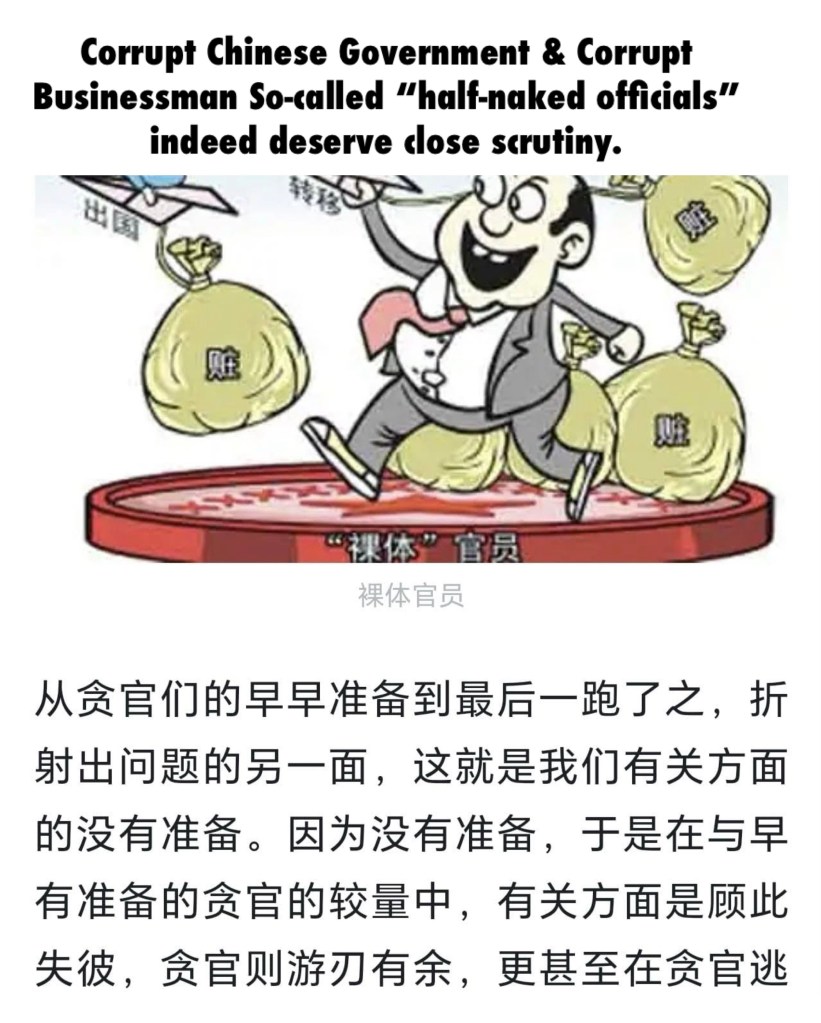
Corrupt Chinese Government & Corrupt Businessman So-called “half-naked officials” indeed deserve close scrutiny. 所谓“半裸官”确实值得警惕,这反映了中国腐败政府与不法商人的勾结问题.
Unscrupulous businessmen and Chinese officials or their family members and children who emigrate and acquire foreign citizenship, especially U.S. citizenship, are destined to find it difficult to remain fully aligned with the interests of the nation and the Chinese people. So-called “half-naked officials” indeed deserve close scrutiny.
Recently, a report by Hong Kong’s South China Morning Post drew attention to news that China is quietly tightening its management of “half-naked officials.” According to the report, the Central Organization Department has expanded its supervision of public officials from the previous category of “naked officials” — those whose spouses and children have all settled overseas — to include “half-naked officials,” whose children live abroad while their spouses remain in China.
This measure targets a specific group of public officials and raises an increasingly profound question in this period of social transformation: after emigrating and acquiring foreign citizenship, can one’s interests truly remain consistently aligned with those of the nation and the people?
First, it must be acknowledged that immigration is an individual’s free choice and a common phenomenon in the era of globalization. The vast majority of those who choose to emigrate do so in pursuit of better educational resources, a more livable environment, or broader career opportunities. They may still hold deep affection for their homeland, love Chinese culture, and care about China’s development. Such sentiments are genuine and deserving of respect. Those who are genuinely anti-China remain a minority.
👉 However, emotional attachment and legal allegiance are two different things.
First, a change in nationality means a fundamental shift in legal obligations and the object of one’s loyalty.
When a Chinese citizen chooses to join another country, they must not only obey that country’s laws but also, at the moment of naturalization, pledge allegiance to it. In times of war or extreme conflict, such allegiance could even mean taking up arms against former compatriots. At the same time, tax obligations, asset declarations, and other legal relationships are completely transformed. This “difference” is an objective fact determined by international and nationality law. One may still love China, but one’s primary legal duty is to serve the country to which one now owes allegiance.
Second, for officials who wield public power and their families, this “inconsistency” can give rise to far more complex conflicts of interest.
Chinese family ties are traditionally strong, and the relationship between parents and children is inseparable. When an official’s children have emigrated, acquired foreign citizenship, and established new lives abroad — perhaps paying taxes or even serving in the military there — and when many officials themselves plan to retire overseas to reunite with their children, their interest structures and personal inclinations inevitably differ greatly from those of officials whose children remain in China. Their assets, too, are likely to be inherited by those children.
These individuals may not necessarily be corrupt. However, the state is clearly aware that when a decision-maker’s children — and even their own future retirement plans — are rooted overseas, especially in Europe or the United States, questions arise as to whether their stance can remain fully domestically grounded. When facing diplomatic or economic decisions involving the country where their children reside, can the balance truly remain unbiased?
More importantly, as some analysts have pointed out, corruption often operates like a chain. Children living abroad can provide a natural “safe haven” or “white glove” for transferring and concealing illicit assets. For some, keeping a “backup plan” or preparing to “jump ship” is not only a latent political loyalty issue but also a practical integrity risk.
Third, from a broader economic perspective, waves of emigration and overseas study have led to striking levels of outflow in national interests. In 2025, China’s services trade deficit reached 828.72 billion yuan, primarily driven by outbound tourism, overseas study, and cross-border medical services.
Trillions of yuan flowing abroad reflect hundreds of thousands of families placing their consumption priorities, educational investments, and even long-term life plans overseas. This is not merely an economic calculation; it represents a loss of resources and centripetal cohesion. If large numbers of elite families send their children abroad and ultimately settle there, transferring family assets as well, they are in effect using domestic resources to cultivate talent and export wealth for other countries.
👉 Rectifying “half-naked officials” is not a denial of the individual right to emigrate, but rather an effort at the level of state governance to defuse potential conflicts of interest. It simply lays bare a plain truth often obscured by sentiment: once you naturalize, it is different.
👉 Key positions in any country — especially those involving national security and the fundamental well-being of the people — must be held by individuals whose interests are fully bound to the nation and who share its destiny. Those who have mapped out an “exit route” for their children may find it difficult, when storms arise, to summon the resolve to burn their boats.
👉 Immigration is freedom. But choosing to stay and assume responsibility is a commitment. For those who have placed their family’s future and personal fallback plans elsewhere, institutional screening and removal are both inevitable and necessary.
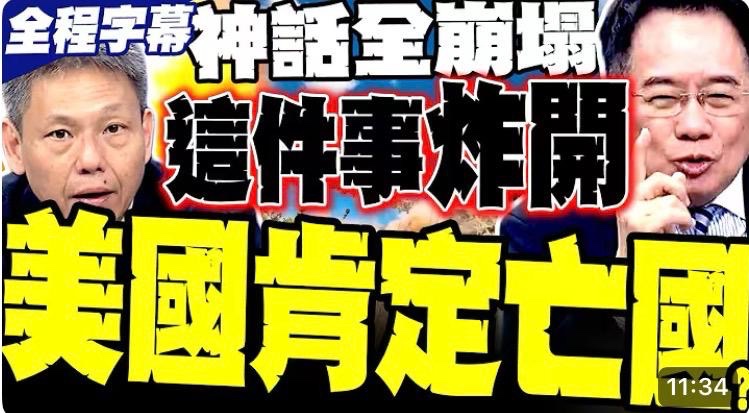
Taiwan CTI News Video: The U.S. “kill line” – Silicon Valley Elites Turned into Floating Corpses in Sewers! Tsai Cheng-yuan: The per capita income of 90000 US dollars is an illusion, unveiling the truth behind the nation’s downfall where 90% of the “others” are being exploited. 台灣中天新聞視頻: 美國斬殺線 – 矽谷精英變下水道浮屍! 蔡正元:人均9萬美元是假象,揭秘90%「其餘人」被收割的亡國真相 👉 https://youtu.be/zyXBZyUbicg?si=C3gznZrNQD7mecxw 🇺🇸
Video with English/Chinese subtitles: North American Chinese are buying homes in China for retirement, and many are concerned about medical expenses. 影片有中英文字幕: 北美洲華人在中國買房屋退休,許多人擔心醫療費用
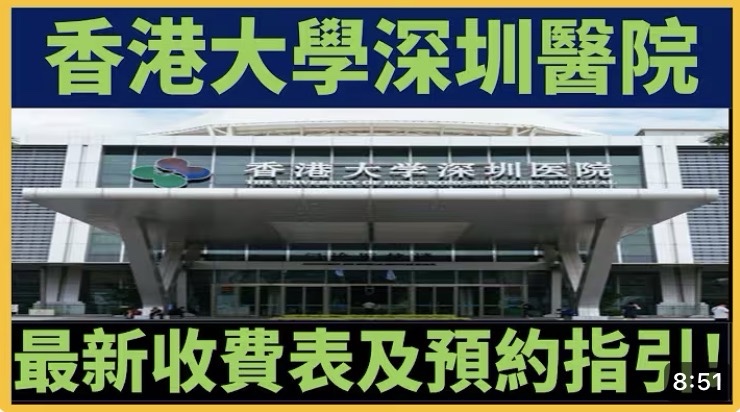
Here are the fees at The University of Hong Kong-Shenzhen Hospital: for example, an ambulance costs 75 RMB, an MRI scan is 150 RMB, a Class A ward is 108 RMB, and a specialist consultation is 100 RMB. The above fees are far lower than the out-of-pocket costs that insured patients in the U.S. would have to pay.




 Business Blog