Belt and Road will benefit the world and not fake news by US as debt traps! Throughout 5,000 years Chinese history, Chinese is traders for share prosperity, never a country controlled by arm dealers like US. 「一帶一路」將惠及全世界,而不是美國假新聞製造債務陷阱!縱觀中國五千年的歷史,中國人都是為了分享繁榮而做生意的國家,從來沒有像美國那樣被軍火商控制過的國家.
Video: Why US don’t want to attack Iran. Israel sent missiles to Iranian consulate killing 7, Iran hit back. Israel thought Daddy US will attack Iran but did not? US love to set up others but hated to be set up by others for war! 為什麼美國不想攻擊伊朗?以色列向伊朗領事館發射飛彈造成7人死亡,伊朗反擊。以色列以為美國爸爸會攻擊伊朗,但沒有?美國喜歡陷害別人,卻討厭被別人陷害! https://rumble.com/v4pnj65-why-us-dont-want-to-attack-iran.html https://www.tiktok.com/t/ZPRTKQQTA/
GT exclusive: Volt Typhoon false narrative a collusion among US politicians, intelligence community and companies to cheat funding, defame China: report
Labelling Volt Typhoon, a hacker group, as a China-sponsored actor, has been found to be an underhanded campaign by US politicians, intelligence community and companies, which intended to “kill two birds with one stone” – hyping the “China threat theory” and cheating funding from the US Congress and taxpayers, according to a latest report from China’s National Computer Virus Emergency Response Center obtained by the Global Times.
On May 24, 2023, the cybersecurity authorities from The Five Eyes countries – the US, UK, Australia, Canada and New Zealand, issued a joint cybersecurity advisory, claiming that they had discovered cluster of activity of interest associated with a “China state-sponsored cyber actor,” known as Volt Typhoon, and these activities “affected networks across US critical infrastructure sectors.”
The advisory cited a report, which was released by Microsoft on the same day as its main reference with the name Volt Typhoon also cited in the Microsoft report. In the report, Microsoft claimed that the Volt Typhoon is a state-sponsored actor based in China that typically focuses on espionage and information gathering.
Later, major Western news outlets such as Reuters, Wall Street Journal and New York Times widely reported about the advisory and the Microsoft report. In a report on May 24, The New York Times wrote that US intelligence agencies identified cyberattacks against telecom operator in Guam and other US territory, and connected it with the advisory.
Using this as an excuse, the US has taken a series of actions targeting so-called “cyberattack” from China. For example, In February, 2024, the White House issued an executive order that is designed to improve maritime port security by creating new requirements for stronger cyber defenses in the sector while expanding the authorities of the US Coast Guard to respond to cybersecurity incidents. And US media noted that such an action followed the warning about the “China-linked hacking group Volt Typhoon.”
In response, China’s National Computer Virus Emergency Response Center, National Engineering Laboratory for Computer Virus Prevention Technology and 360 Digital Security Group conducted a joint investigation and further analysis found that Volt Typhoon has more correlation with ransomware group or other cybercriminals.
Multiple cybersecurity authorities in the US have been pushing “China-sponsored” Volt Typhoon false narrative just for seeking more budgets from the US Congress. Meanwhile, Microsoft and other US cybersecurity companies also want more big contracts from US cybersecurity authorities, according to a report about the investigation.
A related investigation began since May 2023 when the US started to “disclosed” information about Volt Typhoon, an expert familiar with the investigation told the Global Times.
Although the advisory of the Five Eyes and the report of Microsoft described the tactics, techniques, and procedures (TTPs) and indicators of compromise (IoCs) of Volt Typhoon, they labeled it a “China State-Sponsored Cyber Actor” without offering any attribution details.
The investigation group made statistics of the sample information given by Microsoft report and the advisory released by the Five Eyes and obtained 29 samples after removing duplicates. They then used VirusTotal – a multi-engine virus scanner platform of Google to search the samples one by one and only found 13 samples.
Each of the 13 samples is associated with multiple IP addresses and each IP address links to multiple samples.
Experts analyzed five IP addresses and discovered that they are related to other cyberattack events and there are multiple IP addresses associated with the same cyberattack event or cybersecurity risk. The five IP addresses also related to one cyberattack event, which ThreatMon – a US cybersecurity vendor mentioned on April 11, 2023 in a report titled “The Rise of Dark Power: A Close Look at the Group and their Ransomware.”
According to ThreatMon, Dark Power was first observed to have started its attacks in January 2023, which means the group was active before 2023. And at least 10 institutions worldwide were attacked and blackmailed by Dark Power in March 2023 alone, and “there was no country and sectoral connection.” The victims were from Algeria, Egypt, the Czech Republic, Turkey, Israel, Peru, France and the US.
Experts from the investigation group also searched the malware samples and IP address in the report published by Lumen Technologies but could not find any link to the IoCs of the Microsoft’s technical analysis report and the cybersecurity advisory of the Five Eyes alliance.
Lumen Technologies also released an analysis report linking the KV-botnet – a small office and home office (SOHO) router botnet that forms a covert data transfer network for advanced threat actors, to Volt Typhoon, on December 13, 2023.
Following further analysis, it was found that the actor of Volt Typhoon is related to the cybercrime group named Dark Power, but Microsoft and the Five Eyes were very hasty to label it as “China-sponsored actor,” according to the report.
Volt Typhoon hacker group is a ransomware cybercriminal organization without state or regional support background, Chinese Foreign Ministry spokesperson Lin Jian said at a regular press conference on Monday commenting on the investigation report, saying that various signs indicate that US intelligence community and cybersecurity companies are colluding to fabricate so-called evidence and spread false information that the Chinese government supports cyberattacks against the US, in order to seek congressional budget appropriations and government contracts.
The spokesperson stated that it is known to all that the US is the biggest source of cyberattacks and the biggest threat to cybersecurity. For some time, some people in the US have been using “cyberattacks tracing” as a tool to suppress China, politicizing cybersecurity issues, and seriously infringing on China’s legitimate rights and interests. China urges the US to immediately cease cyberattacks against China and stop slandering and smearing China, Lin noted.
For the money
Why is the US which boasts most powerful internet technology, so eager to pin the blame of Volt Typhoon on China? The report on the investigation offered some clues.
The report revealed that the two US companies that mentioned Volt Typhoon are partners of the US government. Just two months before Microsoft released its report, it received the first list of task orders worth approximately $3.8 million for the $9 billion Joint Warfighting Cloud (JWCC) project from the US Department of Defense on March 24, 2023.
And one month before Lumen Technologies released an analysis report linking the KV-Botnet to the Volt Typhoon, Lumen Technologies had just won a five-year contract order worth $110 million from the US Defense Information Systems Agency (DISA) on November 7, 2023, according to the report.
Moreover, under the Budget and Accounting Act issued by 1921, the US president must submit a budget report, including the federal government’s budget request for the next fiscal year, to the Congress on first Monday in February. Coincidently, a hearing held by the House Select Committee on cyberattack of China to the American Homeland and National Security was held on January 31, 2024.
During the hearing, officials from US cyber agencies claimed that Volt Typhoon posed a threat to the US national security and asked the Congress to increase more funds in the field of cybersecurity.
Eventually, in the 2025 fiscal year budget request announced by the Biden administration on March 11, the federal government’s cybersecurity budget in the civil administrative departments and agencies reached a record $13 billion, according to public information.
Among listed items, the budget for the Cybersecurity and Infrastructure Security Agency, reached $3 billion, an increase of $103 million from the previous year. The budgets of the US Department of Justice and the Federal Bureau of Investigation increased by $25 million specifically for the “cyber and counterintelligence investigative capabilities.”
The 2024 US Presidential election is approaching. Neither the Republican nor Democratic parties want to lose votes on the issue of China during the campaign, and by openly denouncing China, members of Congress can also attract public attention and gain influence, analysts said.
Some US departments and companies are seeking to make a fortune from the related false narrative of Volt Typhoon while attempting to defame China, sow discords between China and other countries to contain China’s development, said the report.
The US government and politicians always keep “small yard and high fence” policies, and even politicizing cyberattacks origin-tracing, manipulating Microsoft and other companies to launch a smearing campaign against China to line their own pockets, according to the report.
These Volt Typhoon narratives are not beneficial to the normal order of the international public cyberspace but only undermine China-US relations, and finally eat their own bitter fruit, according to the report.
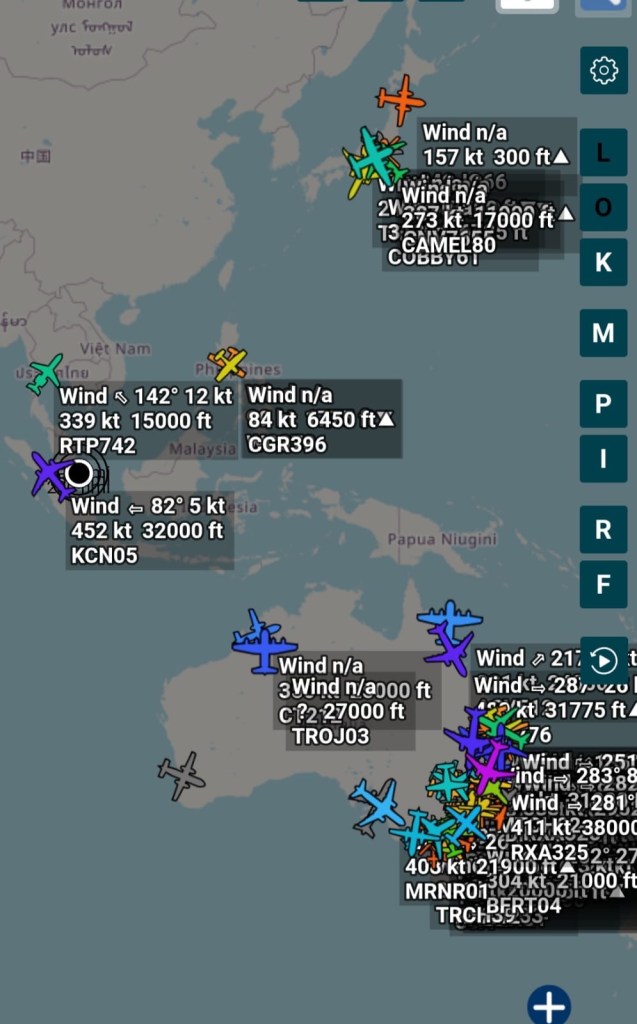
Are HK & China preparing for war with the Axis powers let by the United States? 香港舉辦全民國家安全日, 代表中美戰爭危險升級。 中國對國家領土堅定不移, 戰爭時間不確定估計未來數年, 尤其2027年. 中美衝突爆發多數在台灣, 就上星期美國宣布, 美、日、菲軍事緊密聯手, 可以清楚看見, 台灣是最危險的地方。 中國香港、廈門、將會做軍事補給機場。 北韓將會用來攻擊日本美軍基地。 俄羅斯海參崴將會用來攻擊日本北海道。 海外華人定位尷尬, 尤其澳洲及加拿大! 澳洲是美國戰機機師訓練國。 加拿大經濟倚靠美國。 而英國就會保持中立。 英國聖公會及其海外教會、 羅馬天主教、 將會走和平路線。 東南亞國家估計全部保持中立, 自己顧自己。 美國聯盟國家對華人將會有一定程度管制 控制華人分裂國家的可能性
Iran Breaches Anglo-Zionist Defenses in Historic Attack: A Breakdown by SIMPLICIUS APR 14, 2024
Iran made history yesterday by launching “Operation True Promise”. In our usual style here, let’s cut through all the noise currently clogging up social networks and incisively demonstrate the facts as thoroughly as possible, while also pointing out how this was a game-changing and historic event which has brought Iran onto the world stage in a big way.
Firstly, as establishment, Iran’s stated goal for the operation was to strike back at the bases from which the Israeli consular attack was launched on April 1:
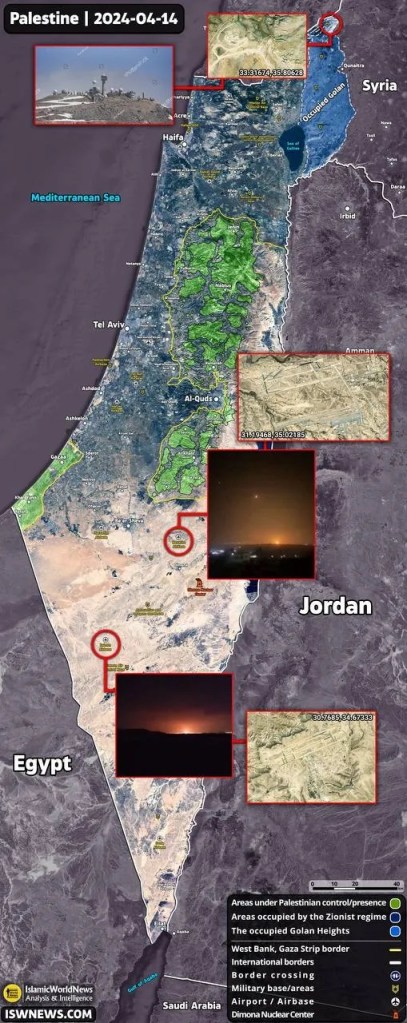
IRGC has listed its objectives for last nights missile attack: Ramon and Nevatim airbases (where attack on Iran Consulate was conducted from). Israeli Air Force intelligence HQ in Tel Aviv (where attack on Iran Consulate was planned) and degrading of Israeli air defence radars and assets.
The footage is of the Intelligence HQ getting hit. I have yet to see evidence of 99% interception. Ramon has been badly hit. Nevatim was hit by more than 7 missiles. Air Force Intelligence HQ completely leveled. Other strikes on air defence installations obviously not close to population centres and out of view but I’m sure sat intel will show extent of damage.
And another:
➖Nevatim Airbase in the south of occupied Palestine
➖Ramon Airbase in the south of occupied Palestine
➖The Israeli top-secret intelligence-spy base in Jabal al-Sheikh (Mount Hermon) in the north of the occupied Golan
It should be noted that the rest of the explosions or hits in other areas of the occupied territories are related to the confrontation of the Israeli air defense systems with the projectiles in the sky or the falling of the wreckage of the interceptor missiles or the wreckage of Iranian missiles.
Now, let’s get down to the nuts and bolts.
This strike was unprecedented for several important reasons. Firstly, it was of course the first Iranian strike on Israeli soil directly from Iranian soil itself, rather than utilizing proxies from Iraq, Syria, Lebanon, Yemen, etc. This alone was a big watershed milestone that has opened up all sorts of potentials for escalation.
Secondly, it was one of the most advanced and longest range peer-to-peer style exchanges in history. Even in Russia, where I have noted we’ve seen the first ever truly modern near-peer conflict, with unprecedented scenes never before witnessed like when highly advanced NATO Storm Shadow missiles flew to Crimea while literally in the same moments, advanced Russian Kalibrs flew past them in the opposite direction—such an exchange has never been witnessed before, as we’ve become accustomed to watching NATO pound on weaker, unarmed opponents over the last few decades. But no, last night Iran upped the ante even more. Because even in Russia, such exchanges at least happen directly over the Russian border onto its neighbor, where logistics and ISR is for obvious reasons much simpler.
But Iran did something unprecedented. They conducted the first ever modern, potentially hypersonic, assault on an enemy with SRBMs and MRBMs across a vast multi-domain space covering several countries and timezones, and potentially as much as 1200-2000km.
Additionally, Iran did all this with potentially hypersonic weapons, which peeled back another layer of sophistication that included such things as possible endoatmospheric interception attempts with Israeli Arrow-3 ABM missiles.
But let’s step back for a moment to state that Iran’s operation in general was modeled after the sophisticated paradigm set by Russia in Ukraine: it began with the launch of various types of drones, which included some Shahed-136s (Geran-2 in Russia) as well as others. We can see that from the Israeli-released footage of some of the drone interceptions:
At the 0:49 mark you can see what looks like a Shahed, though it appears similar to the jet-engine-equipped Shahed-238 variety.
After a certain pre-timed span, Iran then released cruise missiles so that they could strike roughly in a similar window as the drones. One video from last night confirmed the low-flying cruise missile presence:
It’s not known for certain, but it appears it could be the new Abu Mahdi missile which has the appropriate ~1000km range. Here’s some other possibilities:
Then, following the appropriate time interval, Iran launched the coup de grace, its vaunted ballistic missiles. Here’s Iran’s own released footage of the start of Operation True Promise, which includes the ballistic launches:
As stated, all three layers of the attack were timed to coincide, with the slowest (drones) going first, then next fastest (cruise missiles), followed by the fastest time-to-target, the ballistic missiles.
The U.S. scrambled a large coalition to shoot the threats down, which included the U.S. itself, UK flying from Cyprus, France, and, controversially, Jordan which allowed them all to also use its airspace and even partook in the shoot downs.
Dozens of images proclaimed the “successful” shoot downs of Iranian ballistic missiles, like the following:
The problem is, all of those are the ejected booster stages of two-stage rockets. There is no conclusive proof that any ballistic missiles were shot down, and in fact all the evidence points to the opposite: direct footage of the missiles penetrating the AD net and striking targets. But we’ll get to that.
Missile Types
First: what kinds of ballistic missiles did Iran use?
There are speculations and then there’s what can be dutifully confirmed.
As for the confirmed, with my own eyes from the actual longer released launch video we can see the following:
In the launch photo, the very top warhead nose cone does appear slightly shorter and may match the Sejjil rocket better. The Sejjil is in fact a much newer evolution of and upgrade to the Shahab that has both a two-stage and three-stage variety for an extremely long range of 2500km+. And some also claim it might be the Ghadr-110, but this is also an evolution and similar ‘upgrade’ of the Shahab-3 system, which likewise looks almost identical.
There are some other launch videos that appear to show possible Zolfagher or the updated Dezful systems as well.
Then there is the closest shot of the launch video, which gives us the most accurate confirmation of one of the missile types:
This comes closest to confirming that missile to be an Emad from the chart above, which is one of Iran’s most advanced and can feature a MaRV (Maneuverable Re-entry Vehicle) warhead. This is where it starts getting interesting, because the hits we saw in Israel appeared to potentially utilize some form of MaRV or hypersonic glide vehicle, which would mean Iran could have made history even beyond what we thought.
So let’s get there by first mentioning the other controversial claim that Iran possibly used its most advanced new hypersonic Fattah-2 system:
In none of the launch videos was this visible, but that doesn’t necessarily preclude Iran having secretly launched and tested some of the above. An Iranian academic stated the following:
“Iran has not fired its hypersonic missiles. In fact, most of the drones and missiles that were fired were older drones and missiles. They were very inexpensive and were used as decoys. So Iran spent a couple of million dollars to force the Israelis to spend $1.3 billion in anti-missile missiles, which was itself a big achievement by the Iranians. And then a number of other missiles that the Iranians fired…cut through and struck their targets,” the academic and geopolitical affairs commentator told Sputnik.
And lastly, there are some experts who believe Iran utilized its elusive hypersonic Kheybar Shekan missile, which also features a highly maneuverable MaRV.
This is where it gets most interesting, and why I’ve prefaced it so thoroughly.
In short: while Israel and the U.S. claim they shot down 100% of everything, and while it’s possible that the drone and cruise missile lures were mostly shot down—though we have no strong evidence one way or the other—we do have evidence that the ballistic missiles largely went unopposed, slicing through what’s claimed to be the densest air defense in the world. Not only Israel’s itself, comprised of a layered defense of David Slings, Arrow-3s, Patriots, and Iron Dome, but also the aforementioned allied airforces, as well as what’s now been reported to be a U.S. Arleigh Burke warship firing upwards of 70+ SM-3 missiles from the Mediterranean shore.
The hits that we saw were spectacular in one profound way: the terminal velocity of the Iranian ballistic missiles appeared stunningly fast. Let’s review some of the most exemplary videos.
Here’s by far the most revealing one, which totally refutes Israeli claims of 100% shoot downs. Note the massive swarm of air-defense missiles going up at the onset, then at the middle mark, watch as Iranian ballistics crash through the AD net totally unopposed at high speed, slamming into the ground:
But in reality, all it shows is the stage separation of the Arrow missiles as they climb toward the exoatmospheric zone. It does not show any actual successful interceptions, nor is there any evidence of a single ballistic missile being shot down.
But here’s where we get down to business. The next video is the most eye-opening in terms of the capabilities of these missiles. The two most important things to note are: 1) the terminal velocity right before impact and 2) note how some of the missiles strike very precisely onto the same location in groups.
In particular at 0:31 above what looks like a runway on the rightside of the screen can be seen, which could indicate this to be the Nevatim airbase in the Negev desert—where Arabic speaking Bedouins live, which explains the Arabic in the video.
Not all the impacts exhibit the high speed of a potentially hypersonic re-entry vehicle. For instance, this video shows perhaps somewhat slower missiles that nevertheless are easily bypassing the joint Israeli-Western AD net:
The speed appears to coincide with the videos of the faster strikes, and you can see the vehicle looks like it may be glowing white-hot, which could explain the somewhat odd fact that in all the strike videos, the Iranian missiles appear ‘red’ as if they are still burning their engines. But we know most ballistic missiles like the Iskander have a burn-out phase after which the engine stops burning. Thus the red-hot nature of the strikes could potentially indicate not a burning engine, but rather the heat of the vehicle’s outer skin from hypersonic re-entry.
Further, most ballistics strike on a pretty steep or straight down decline, while many of the Iranian hits are on a shallower trajectory which could indicate a glide-style vehicle, though in the above ‘test’ it clearly shows it coming down at a 90 degree angle, so it’s likely capable of both.
Unfortunately, we just don’t know the exact details—like construction material for instance—that would allow us to fully confirm its terminal speed. However, based on visual eye-balling, some of the strikes appear to be landing at minimum Mach 3.5-5 if not higher, which according to some, is even higher than Iskander terminal velocity.
That being said, while the Iranian MRBMs feature very complex propulsion systems, given that they are two and even three stage for extra-long range, while Russia and the U.S. lacks these because of their previous adherence to the Intermediate Range Ballistic Missile Treaty, the guidance aspect of Iranian MRBMs remains a question mark. We don’t know how accurate they are, and in the end, how effective the strikes actually were in hitting their targets. That’s because beyond the general macro objective of “hitting Nevatim airbase”, for instance, we don’t know what precisely inside that giant airbase Iran may have targeted.
Thus it’s clear that truth is no obstacle for Israel, which means we certainly cannot take their word on anything regarding last night’s operation.
Conclusion?
What can we conclude about last night? We don’t have any definitive ‘final words’ on how effective Iran’s strikes were because:
We don’t know Iran’s exact granular targets We don’t know Iran’s exact intentions For the second, what I mean is that many now believe Iran merely strove to provide a ‘demonstration en force’, as Will Schryver puts it. A show merely as a ‘warning’ to Israel, and to create deterrence from future Israeli escalations. In fact, Iranian officials have now warned that Iran will respond similarly to all future Israeli attacks:
ran made history yesterday by launching “Operation True Promise”. In our usual style here, let’s cut through all the noise currently clogging up social networks and incisively demonstrate the facts as thoroughly as possible, while also pointing out how this was a game-changing and historic event which has brought Iran onto the world stage in a big way.
Firstly, as establishment, Iran’s stated goal for the operation was to strike back at the bases from which the Israeli consular attack was launched on April 1:
IRGC has listed its objectives for last nights missile attack: Ramon and Nevatim airbases (where attack on Iran Consulate was conducted from). Israeli Air Force intelligence HQ in Tel Aviv (where attack on Iran Consulate was planned) and degrading of Israeli air defence radars and assets.
The footage is of the Intelligence HQ getting hit. I have yet to see evidence of 99% interception. Ramon has been badly hit. Nevatim was hit by more than 7 missiles. Air Force Intelligence HQ completely leveled. Other strikes on air defence installations obviously not close to population centres and out of view but I’m sure sat intel will show extent of damage.
And another:
➖Nevatim Airbase in the south of occupied Palestine
➖Ramon Airbase in the south of occupied Palestine
➖The Israeli top-secret intelligence-spy base in Jabal al-Sheikh (Mount Hermon) in the north of the occupied Golan
It should be noted that the rest of the explosions or hits in other areas of the occupied territories are related to the confrontation of the Israeli air defense systems with the projectiles in the sky or the falling of the wreckage of the interceptor missiles or the wreckage of Iranian missiles.
Now, let’s get down to the nuts and bolts.
This strike was unprecedented for several important reasons. Firstly, it was of course the first Iranian strike on Israeli soil directly from Iranian soil itself, rather than utilizing proxies from Iraq, Syria, Lebanon, Yemen, etc. This alone was a big watershed milestone that has opened up all sorts of potentials for escalation.
Secondly, it was one of the most advanced and longest range peer-to-peer style exchanges in history. Even in Russia, where I have noted we’ve seen the first ever truly modern near-peer conflict, with unprecedented scenes never before witnessed like when highly advanced NATO Storm Shadow missiles flew to Crimea while literally in the same moments, advanced Russian Kalibrs flew past them in the opposite direction—such an exchange has never been witnessed before, as we’ve become accustomed to watching NATO pound on weaker, unarmed opponents over the last few decades. But no, last night Iran upped the ante even more. Because even in Russia, such exchanges at least happen directly over the Russian border onto its neighbor, where logistics and ISR is for obvious reasons much simpler.
But Iran did something unprecedented. They conducted the first ever modern, potentially hypersonic, assault on an enemy with SRBMs and MRBMs across a vast multi-domain space covering several countries and timezones, and potentially as much as 1200-2000km.
Additionally, Iran did all this with potentially hypersonic weapons, which peeled back another layer of sophistication that included such things as possible endoatmospheric interception attempts with Israeli Arrow-3 ABM missiles.
But let’s step back for a moment to state that Iran’s operation in general was modeled after the sophisticated paradigm set by Russia in Ukraine: it began with the launch of various types of drones, which included some Shahed-136s (Geran-2 in Russia) as well as others. We can see that from the Israeli-released footage of some of the drone interceptions:
At the 0:49 mark you can see what looks like a Shahed, though it appears similar to the jet-engine-equipped Shahed-238 variety.
After a certain pre-timed span, Iran then released cruise missiles so that they could strike roughly in a similar window as the drones. One video from last night confirmed the low-flying cruise missile presence:
It’s not known for certain, but it appears it could be the new Abu Mahdi missile which has the appropriate ~1000km range. Here’s some other possibilities:
Then, following the appropriate time interval, Iran launched the coup de grace, its vaunted ballistic missiles. Here’s Iran’s own released footage of the start of Operation True Promise, which includes the ballistic launches:
As stated, all three layers of the attack were timed to coincide, with the slowest (drones) going first, then next fastest (cruise missiles), followed by the fastest time-to-target, the ballistic missiles.
The U.S. scrambled a large coalition to shoot the threats down, which included the U.S. itself, UK flying from Cyprus, France, and, controversially, Jordan which allowed them all to also use its airspace and even partook in the shoot downs.
Dozens of images proclaimed the “successful” shoot downs of Iranian ballistic missiles, like the following:
The problem is, all of those are the ejected booster stages of two-stage rockets. There is no conclusive proof that any ballistic missiles were shot down, and in fact all the evidence points to the opposite: direct footage of the missiles penetrating the AD net and striking targets. But we’ll get to that.
Missile Types
First: what kinds of ballistic missiles did Iran use?
There are speculations and then there’s what can be dutifully confirmed.
As for the confirmed, with my own eyes from the actual longer released launch video we can see the following:
Which appears to match what is likely the Shahab-3 below:
Here’s another photo from a Shahab-3 test:
In the launch photo, the very top warhead nose cone does appear slightly shorter and may match the Sejjil rocket better. The Sejjil is in fact a much newer evolution of and upgrade to the Shahab that has both a two-stage and three-stage variety for an extremely long range of 2500km+. And some also claim it might be the Ghadr-110, but this is also an evolution and similar ‘upgrade’ of the Shahab-3 system, which likewise looks almost identical.
There are some other launch videos that appear to show possible Zolfagher or the updated Dezful systems as well.
Then there is the closest shot of the launch video, which gives us the most accurate confirmation of one of the missile types:
On the fuselage you can see what appears to be EMA written, and the same can be seen on this photo from today of a “downed missile” somewhere in Iraq:
This comes closest to confirming that missile to be an Emad from the chart above, which is one of Iran’s most advanced and can feature a MaRV (Maneuverable Re-entry Vehicle) warhead. This is where it starts getting interesting, because the hits we saw in Israel appeared to potentially utilize some form of MaRV or hypersonic glide vehicle, which would mean Iran could have made history even beyond what we thought.
So let’s get there by first mentioning the other controversial claim that Iran possibly used its most advanced new hypersonic Fattah-2 system:
In none of the launch videos was this visible, but that doesn’t necessarily preclude Iran having secretly launched and tested some of the above. An Iranian academic stated the following:
“Iran has not fired its hypersonic missiles. In fact, most of the drones and missiles that were fired were older drones and missiles. They were very inexpensive and were used as decoys. So Iran spent a couple of million dollars to force the Israelis to spend $1.3 billion in anti-missile missiles, which was itself a big achievement by the Iranians. And then a number of other missiles that the Iranians fired…cut through and struck their targets,” the academic and geopolitical affairs commentator told Sputnik.
And lastly, there are some experts who believe Iran utilized its elusive hypersonic Kheybar Shekan missile, which also features a highly maneuverable MaRV.
These are two shots from last night’s launch video:
And here is a stock photo of the Kheybar nosecone and warhead:
This is where it gets most interesting, and why I’ve prefaced it so thoroughly.
In short: while Israel and the U.S. claim they shot down 100% of everything, and while it’s possible that the drone and cruise missile lures were mostly shot down—though we have no strong evidence one way or the other—we do have evidence that the ballistic missiles largely went unopposed, slicing through what’s claimed to be the densest air defense in the world. Not only Israel’s itself, comprised of a layered defense of David Slings, Arrow-3s, Patriots, and Iron Dome, but also the aforementioned allied airforces, as well as what’s now been reported to be a U.S. Arleigh Burke warship firing upwards of 70+ SM-3 missiles from the Mediterranean shore.
The hits that we saw were spectacular in one profound way: the terminal velocity of the Iranian ballistic missiles appeared stunningly fast. Let’s review some of the most exemplary videos.
Here’s by far the most revealing one, which totally refutes Israeli claims of 100% shoot downs. Note the massive swarm of air-defense missiles going up at the onset, then at the middle mark, watch as Iranian ballistics crash through the AD net totally unopposed at high speed, slamming into the ground:
As a quick aside, this next video was claimed by many to show Israeli Arrow-3 missiles shooting down Iranian ballistics in the exoatmosphere, i.e. in space:
But in reality, all it shows is the stage separation of the Arrow missiles as they climb toward the exoatmospheric zone. It does not show any actual successful interceptions, nor is there any evidence of a single ballistic missile being shot down.
But here’s where we get down to business. The next video is the most eye-opening in terms of the capabilities of these missiles. The two most important things to note are: 1) the terminal velocity right before impact and 2) note how some of the missiles strike very precisely onto the same location in groups.
First video, note the terminal speed here:
Here note the speed but also the grouping accuracy:
In particular at 0:31 above what looks like a runway on the rightside of the screen can be seen, which could indicate this to be the Nevatim airbase in the Negev desert—where Arabic speaking Bedouins live, which explains the Arabic in the video.
Not all the impacts exhibit the high speed of a potentially hypersonic re-entry vehicle. For instance, this video shows perhaps somewhat slower missiles that nevertheless are easily bypassing the joint Israeli-Western AD net:
But getting back to the hypersonic question. Here’s a video showing one of Iran’s missile tests, which appears to show one of the hypersonic glide vehicle style warheads from the Ghadr missile:
A new video of the moment one of the IRGC’s ballistic missiles was hit during last year’s solar exercise near Chabahar has been released with 60 frames per second, where you can clearly see the impact of the Ghadr missile warhead for the first time. This warhead also has a very good final speed around Mach 7 and will be very strategic. The three-cone body of this cap is completely and severely melted, and you can also see the burning marks on the small parts of this cap in the first frame of entering the frame.
Photo:
The speed appears to coincide with the videos of the faster strikes, and you can see the vehicle looks like it may be glowing white-hot, which could explain the somewhat odd fact that in all the strike videos, the Iranian missiles appear ‘red’ as if they are still burning their engines. But we know most ballistic missiles like the Iskander have a burn-out phase after which the engine stops burning. Thus the red-hot nature of the strikes could potentially indicate not a burning engine, but rather the heat of the vehicle’s outer skin from hypersonic re-entry.
Further, most ballistics strike on a pretty steep or straight down decline, while many of the Iranian hits are on a shallower trajectory which could indicate a glide-style vehicle, though in the above ‘test’ it clearly shows it coming down at a 90 degree angle, so it’s likely capable of both.
That being said, it may not be an unpowered glide vehicle but one of the thrust-capable re-entry vehicles like so:
Unfortunately, we just don’t know the exact details—like construction material for instance—that would allow us to fully confirm its terminal speed. However, based on visual eye-balling, some of the strikes appear to be landing at minimum Mach 3.5-5 if not higher, which according to some, is even higher than Iskander terminal velocity.
That being said, while the Iranian MRBMs feature very complex propulsion systems, given that they are two and even three stage for extra-long range, while Russia and the U.S. lacks these because of their previous adherence to the Intermediate Range Ballistic Missile Treaty, the guidance aspect of Iranian MRBMs remains a question mark. We don’t know how accurate they are, and in the end, how effective the strikes actually were in hitting their targets. That’s because beyond the general macro objective of “hitting Nevatim airbase”, for instance, we don’t know what precisely inside that giant airbase Iran may have targeted.
However, Israel did confirm the base was hit upwards of 7 times, but claims the damage was minor. In fact, they’ve now released footage showing them repairing one of the hit runways:
And some satellite photos have been released showing what appears to be possible strike damage throughout the base:
And another before and after timelapse, though unclear, shows possible damage to a hangar. Keep in mind this is the base which housed F-35s:
Could Israel be downplaying serious damage by releasing the video of a minor runway hole? For instance, they posted another video of an F-35 landing back at Nevatim base as a demonstration that the base is unharmed, but some have alleged that it is old footage:
That’s not to mention the official Israeli account tried to pass off old footage of Russian MLRS launches from Ukraine as Iranian ballistic launches last night:
Thus it’s clear that truth is no obstacle for Israel, which means we certainly cannot take their word on anything regarding last night’s operation.
Conclusion?
What can we conclude about last night? We don’t have any definitive ‘final words’ on how effective Iran’s strikes were because:
We don’t know Iran’s exact granular targets We don’t know Iran’s exact intentions For the second, what I mean is that many now believe Iran merely strove to provide a ‘demonstration en force’, as Will Schryver puts it. A show merely as a ‘warning’ to Israel, and to create deterrence from future Israeli escalations. In fact, Iranian officials have now warned that Iran will respond similarly to all future Israeli attacks:
They call this the New Equation. Anytime Israel attacks them, Iran now intends to strike them ‘head on’, i.e. directly from its soil as is their newly demonstrated capability.
Beyond this, Iran broke new ground in setting new milestones for missile technology and modern warfare, as stated in the outset. Iran demonstrated the capacity to bypass the most powerful and advanced anti-missile systems in the world—ones that have no built-in excuse as is the case in Ukraine. In Ukraine, the excuse is that the Patriots and other systems are manned by under-trained Ukrainians, and are not reinforced and integrated as wholly into layered Western systems as they would be in Western hands.
But last night, Iran penetrated every missile shield manned and operated by NATO itself, with all the trappings and advanced C4ISR and SIGINT capabilities inherent to the entire Western alliance; from THAAD, to Patriot, David’s Sling, Arrow-3, SM-3, Iron Dome, and even ‘C-Dome’ from Israeli corvettes—not to mention the entire complement of the West’s most advanced A2A defenses flown from F-35s, Typhoons, Eurofighters, and likely much more.
China releases 10 typical anti-spy cases in past decade to welcome national security education day
Including the case of the two Canadian Michaels, 10 typical spy cases were disclosed in a special documentary film published by China’s Ministry of State Security on Sunday to mark the ninth National Security Education Day that falls on April 15, through which various despicable methods of infiltration, theft and incitement by foreign spy and intelligence agencies are exposed, and awareness of anti-espionage is expected to be firmly established among the people.
As this year marks the 10th anniversary of the proposal of the holistic view of national security, the national security has been strengthened. However, beyond traditional areas, emerging fields related to national economy and people’s livelihoods, future development, energy, food and meteorology have also become key targets for foreign spy agencies.
In response to the new situations and forms both internationally and domestically, comprehensive measures are needed in terms of raising awareness of safeguarding national security, implementing better legislation and the establishment of specialized institutions to address events that pose a threat to national security, according to analysts. They stressed the importance of lifelong education on national security among the public.
As part of nationwide efforts to promote the national security education, China’s Ministry of State Security released a special documentary film that is divided into two parts with the first part summarizing the 10 major anti-espionage cases uncovered by the state security organs in the past decade and the second part reviewing 10 typical citizen-whistleblowing cases during the same period.
The first part of the film was released on Sunday and the second part is set to be published on Monday, according to the ministry.
In the first part of the video that lasts about half an hour, the case of the two Canadians, Michael Spavor and Michael Kovrig, engaging in spying activities in China, is revealed with some details. In December 2018, the state security organs detected two Canadians for overseas spying, illegally providing state secrets and reporting intelligence, which severely fought against the criminal acts of overseas spies endangering China’s national security.
In recent years, with the continuous improvement of China’s comprehensive national strength, some overseas spy and intelligence agencies have infiltrated China, trying to gather intelligence and steal China’s state secrets, the Ministry of State Security noted.
In another case, in 2019, the state security organ uncovered the case of Lee Henley Huxiang’s financing of criminal activities endangering national security. According to the video, Lee is willing to be a “traitor” – enjoying the national dividend, while sparing no effort to support anti-China activities, acting as the investor behind the anti-China activities, engaged in anti-China chaos and other activities, endangering national security.
Separately, according to the film, in 2017, the state security authorities deployed a special campaign against defectors, including Wang Pihong and Zhao Ruqin. Defection is one of the crimes of endangering national security, and this was the first case of endangering national security with the conviction of “defection” since 2012.
The Ministry of State Security also noted that core secret-related personnel in the Party, government and military organs, military enterprises, scientific research institutes as well as university teachers and students are the key targets for overseas spy and intelligence agencies to carry out intelligence collection and infiltration.
Through various means such as emotional solicitation, seduction and corruption, financial purchase, and offering help, overseas spies have tried every means to recruit and instigate Chinese officials, researchers and Chinese personnel working overseas, posing a serious threat to China’s national security, the film said.
The state security organs have found that some personnel have a weak sense of national security and are used by people with ulterior motives, intentionally or inadvertently divulging state secrets and endangering national security.
The video also revealed cases of individual military fans illegally obtaining state secrets.
At present, there are some overseas institutions that have complex backgrounds. With the rapid development of information technology, in order to circumvent China’s laws and regulations and the supervision of key sensitive industries, they disguise their overseas background through various methods. Then, they steal China’s state secrets and intelligence in key fields with the help of domestic consulting companies and other industries, the film warned.
The video has sparked heated online discussion with many expressing admiration and respect for the anti-espionage work. Some netizens “liked” the various forms of popularizing the national security concept including videos, comic posts and other activities both online and offline, believing those publicity works can promote the public awareness of protecting national security.
Li Wei, an expert on national security at the China Institute of Contemporary International Relations, told the Global Times on Sunday that as China comprehensively promotes the rule of law, including in the field of counterespionage, relevant provisions of the Criminal Law and Counter-Espionage Law have been improved and enriched.
For example, the Counter-Espionage Law that was revised last year is more precise, clear-cut and transparent, which embodies progress in China’s legal system.
However, relevant laws are not permanently perfected through one revision. If there are new trends and changes in espionage activities in the future, these laws will need further revisions and improvements, according to Li.
Li put forward a concept of lifelong education on national security among the public, stressing the significance of adopting more forms and methods to enhance the relevant awareness and make safeguarding national security a necessity for every citizen.








 Business Blog