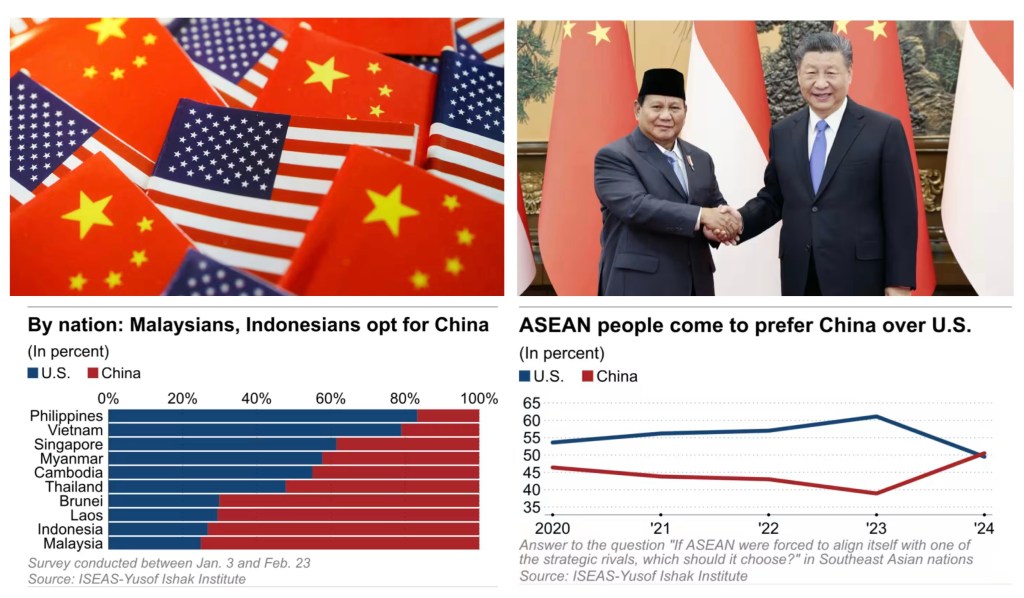
Pulse Asia: President Ferdinand Marcos Jr. 38% trust rating in Mindanao, down from 70% in Dec 2023. His Hollywood show with US at South China Seas hurts his rating. He tried to appease US so his family ill gotten wealth of US$600 millions locked up in US banks could be saved for selfish reasons. 亞洲脈搏:小費迪南德·馬科斯總統在棉蘭老島的信任度為 38%,低於 2023 年 12 月的 70%。他與美國在南中國海的好萊塢表演損害了他的信任度。他試圖安撫美國,希望他的家族因貪污原因被鎖在美國銀行的6億美元不義之財可以取回. https://www.rappler.com/philippines/marcos-jr-trust-rating-pulse-asia-survey-march-2024/
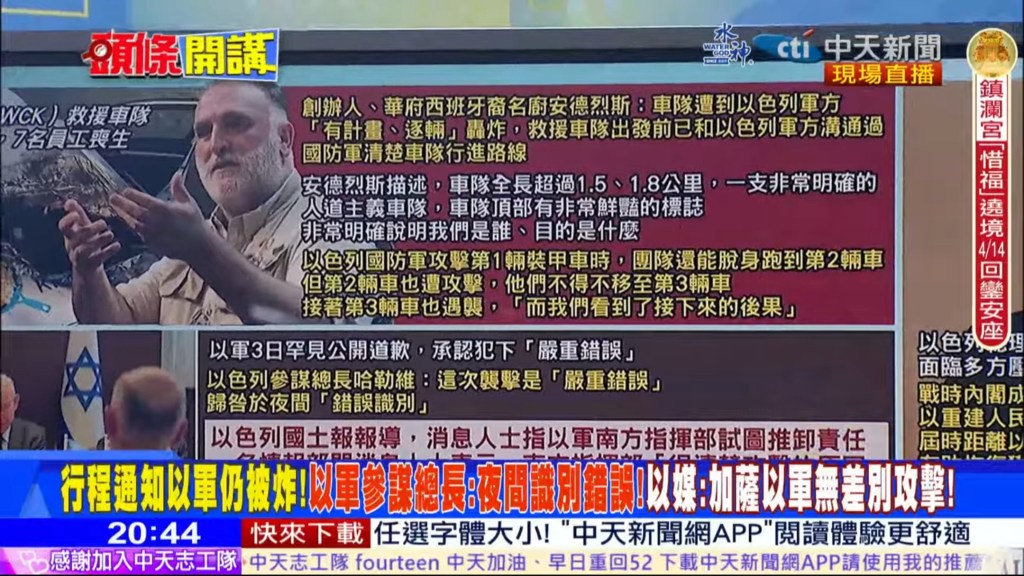
Taiwan International Experts: Israel precision attacks on humanitarian convey to set an example anyone dare to send in humanitarian aids to Gaza shall receive equal treatment. 台灣國際專家:以色列精準攻擊人道運輸車隊, 樹立榜樣 任何敢於向加薩運送人道援助的人都應受到平等對待.
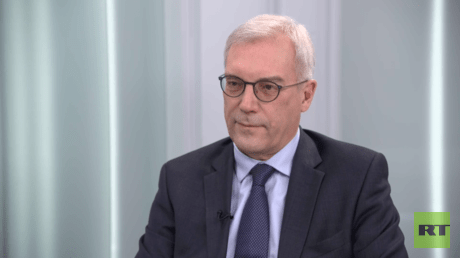
NATO needs ‘Russian threat’ to justify its existence – deputy foreign minister. Former powerful US Senator Dan Inouye from Hawaii said the same to keep US huge war machine. The Military Industrial Complex controlled US Government. 北約副外長稱,北約需要「俄羅斯威脅」來證明其存在的合理性。夏威夷前美國參議員丹·井上也說過同樣的話,以保持美國龐大的戰爭機器。 軍事工業複合體現在完全控制美國政府.
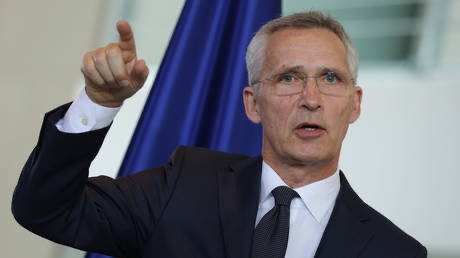
Ukraine aid must be a multi-year financial commitment for NATO – Stoltenberg. There is an old Chinese saying “精人出口, 笨人出手” “Clever ones speaks, Dumb ones take action”. NATO wants Ukraine be the cannon balls on US proxy war against Russia.
New hacking allegations against China aren’t what they seem, largely driven by the US, seeks to slander China for diplomatic and political gain By Timur Fomenko, political analyst
These accusations by the Five Eyes nations are not so much genuine concerns as they are a deliberate and opportunistic act of political theatre which, largely driven by the US, seeks to slander China for diplomatic and political gain. The sanctions, although narrow in scope and thus meaningless, are designed to try and send a message to and about China. It is essentially a fearmongering campaign, which seeks to both undermine Beijing’s engagement with other countries and serve domestic political purposes in the US.
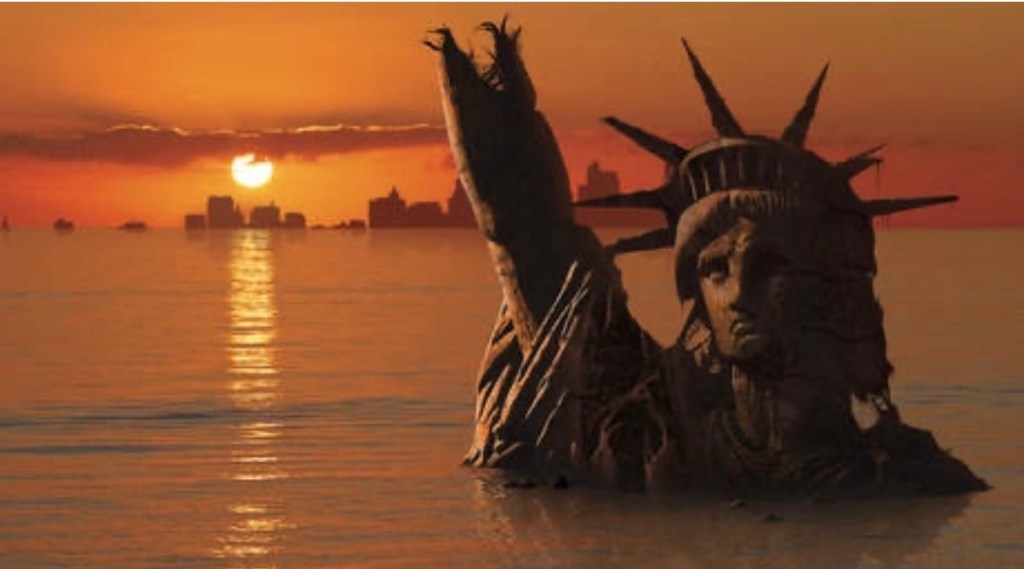
Death of empires: The collapse of the US and what will follow is inevitable. The turn away from expansion, production and trade toward lending and speculation has precipitated decline for centuries. 帝國之死:美國的崩潰以及隨之而來的後果是不可避免的。 幾個世紀以來,從擴張、生產和貿易轉向借貸和投機,導致了經濟衰退.
One of the curious features of the American landscape is the fact that these days the financialization of the economy is widely condemned as unhealthy, yet little is being done to reverse it. There was a time, back in the 1980s and ‘90s, when finance-driven capitalism was supposed to usher in a time of better capital allocation and a more dynamic economy. This is not a view one hears often anymore.
So, if such a phenomenon is overwhelmingly viewed negatively but isn’t being amended, then perhaps it’s not merely a failure of policymaking but rather something deeper – something more endemic to the very fabric of the capitalist economy. It is of course possible to lay the blame for this state of affairs at the feet of the current crop of cynical and power-hungry elites and to stop one’s analysis there. But an examination of history reveals recurrent instances of financialization that bear remarkable similarities, which invites the conclusion that perhaps the predicament in the American economy in recent decades is not unique and that the ever-rising power of Wall Street was in a sense preordained.
Introducing Giovanni Arrighi: Financialization as a cyclical phenomenon It is in this context that it pays to revisit the work of the Italian political economist and historian of global capitalism Giovanni Arrighi (1937-2009). Arrighi, who is often simplistically pigeonholed as a Marxist historian, a label far too constricting given the breadth of his work, explored the origins and evolution of capitalist systems dating back to the Renaissance and showed how recurrent phases of financial expansion and collapse underpin broader geopolitical reconfigurations. Occupying a central place in his theory is the notion that the cycle of rise and fall of each successive hegemon terminates in a crisis of financialization. It is this phase of financialization that facilitates the shift to the next hegemon.
Arrighi dates the origin of this cyclical process to the Italian city-states of the 14th century, an era that he calls the birth of the modern world. From the marriage of Genoese capital and Spanish power that produced the great discoveries, he traces this path through Amsterdam, London and, finally, the United States.
In each case, the cycle is shorter and each new hegemon is larger, more complex and more powerful than the previous one. And, as we mentioned above, each terminates in a crisis of financialization that marks the final stage of hegemony. But this phase also fertilizes the soil in which the next hegemon will sprout, thus marking financialization as the harbinger of an impending hegemonic shift. Essentially, the ascending power emerges in part by availing itself of the financial resources of the financialized and declining power.
Arrighi detected a first wave of financialization starting around 1560, when the Genoese businessmen withdrew from commerce and specialized in finance, thereby establishing symbiotic relations with the Kingdom of Spain. The subsequent wave began around 1740 when the Dutch began to withdraw from commerce to become “the bankers of Europe.” The financialization in Great Britain, which we will examine below, emerged around the end of the 19th century; for the United States, it began in the 1970s.
Hegemony he defines as “the power of a state to exercise functions of leadership and governance over a system of sovereign states.” Central to this concept is the idea that historically such governance has been linked to the transformation of how the system of relations among states functions in itself and also that it consists of both what we would call geopolitical dominance but also a sort of intellectual and moral leadership. The hegemonic power not only rises to the top in the jockeying among states but actually forges the system itself in its own interest. Key to this capacity for the expansion of the hegemon’s own power is the ability to turn its national interests into international interests.
Observers of the current American hegemony will recognize the transformation of the global system to suit American interests. The maintenance of an ideologically charged ‘rules-based’ order – ostensibly for the benefit of everyone – fits neatly into the category of conflation of national and international interests. Meanwhile, the previous hegemon, the British, had their own version that incorporated both free-trade policies and a matching ideology that emphasized the wealth of nations over national sovereignty.
Returning to the question of financialization, the original insight into its epochal aspect first came from the French historian Fernand Braudel, of whom Arrighi was a disciple. Braudel observed that the rise of finance as the predominant capitalist activity of a given society was a sign of its impending decline.
Arrighi adopted this approach and, in his major work called ‘The Long Twentieth Century,’ elaborated his theory of the cyclical pattern of ascendency and collapse within the capitalist system, which he called the ‘systemic cycle of accumulation.’ According to this theory, the period of ascendency is based on an expansion of trade and production. But this phase eventually reaches maturity, at which point it becomes more difficult to profitably reinvest capital in further expansion. In other words, the economic endeavors that propelled the rising power to its perch become increasingly less profitable as competition intensifies and, in many cases, much of the real economy is lost to the periphery, where wages are lower. Rising administrative expenses and the cost of maintaining an ever-expanding military also contribute to this.
This leads to the onset of what Arrighi calls a ‘signal crisis,’ meaning an economic crisis that signals the shift from accumulation by material expansion to accumulation by financial expansion. What ensues is a phase characterized by financial intermediation and speculation. Another way to think about this is that, having lost the actual basis for its economic prosperity, a nation turns to finance as the final economic field in which hegemony can be sustained. The phase of financialization is thus characterized by an exaggerated emphasis on financial markets and the finance sector.
How financialization delays the inevitable However, the corrosive nature of financialization is not immediately evident – in fact, quite the opposite. Arrighi demonstrates how the turn to financialization, which is initially quite lucrative, can provide a temporary and illusory respite from the trajectory of decline, thus deferring the onset of the terminal crisis. For example, the incumbent hegemon at the time, Great Britain, was the country hardest hit by the so-called Long Depression of 1873-1896, a prolonged period of malaise that saw Britain’s industrial growth decelerate and its economic standing diminished. Arrighi identifies this as the ‘signal crisis’ – the point in the cycle where productive vigor is lost and financialization sets in.
And yet, as Arrighi quotes David Landes’ 1969 book ‘The Unbound Prometheus,’ “as if by magic, the wheel turned.” In the last years of the century, business suddenly improved and profits rose. “Confidence returned—not the spotty, evanescent confidence of the brief booms that had punctuated the gloom of the preceding decades, but a general euphoria such as had not prevailed since…the early 1870s….In all of western Europe, these years live on in memory as the good old days—the Edwardian era, la belle époque.” Everything seemed right again.
However, there is nothing magical about the sudden restoration of profits, Arrighi explains. What happened is that “as its industrial supremacy waned, its finance triumphed and its services as shipper, trader, insurance broker and intermediary in the world’s system of payments became more indispensable than ever.”
In other words, there was a large expansion in financial speculation. Initially much of the expanding financial income derived from interest and dividends being generated by previous investments. But increasingly a significant portion was financed by what Arrighi calls the “domestic conversion of commodity capital into money capital.” Meanwhile, as surplus capital moved out of trade and production, British real wages began a decline starting after the mid-1890s – a reversal of the trend of the past five decades. An enriched financial and business elite amid an overall decline in real wages is something that should ring a bell to observers of the current American economy.
Essentially, by embracing financialization, Britain played the last card it had to stave off its imperial decline. Beyond that lay the ruin of World War I and the subsequent instability of the interwar period, a manifestation of what Arrighi calls ‘systemic chaos’ – a phenomenon that becomes particularly visible during signal crises and terminal crises.
Historically, Arrighi observes, these breakdowns have been associated with escalation into outright warfare – specifically, the Thirty Years’ War (1618-48), the Napoleonic wars (1803-15) and the two World Wars. Interestingly and somewhat counterintuitively, these wars have typically not seen the incumbent hegemon and the challenger on opposing sides (with the Anglo-Dutch naval wars a notable exception). Rather, it has typically been the actions of other rivals that have hastened the arrival of the terminal crisis. But even in the case of the Dutch and British, conflict co-existed with cooperation as Dutch merchants increasingly directed their capital to London, where it generated better returns.
Wall Street and the crisis of the last hegemon The process of financialization emerging from a signal crisis was repeated with startling similarities in the case of Britain’s successor, the US. The 1970s was a decade of deep crisis for the US, with high levels of inflation, a weakening dollar after the 1971 abandonment of gold convertibility and, perhaps most importantly, a loss of competitiveness of US manufacturing. With rising powers such as Germany, Japan, and, later, China, able to outcompete it in terms of production, the US reached the same tipping point and, like its predecessors, it turned to financialization. The 1970s was, in the words of historian Judith Stein, the “pivotal decade” that “sealed a society-wide transition from industry to finance, factory floor to trading floor.”
This, Arrighi explains, allowed the US to attract massive amounts of capital and move toward a model of deficit financing – an increasing indebtedness of the US economy and state to the rest of the world. But financialization also allowed the US to reflate its economic and political power in the world, particularly as the dollar was ensconced as the global reserve currency. This reprieve gave the US the illusion of prosperity of the late 1980s and ‘90s, when, as Arrighi says “there was this idea that the United States had ‘come back’.” No doubt the demise of its main geopolitical rival, the Soviet Union, contributed to this buoyant optimism and sense that Western neoliberalism had been vindicated.
However, beneath the surface, the tectonic plates of decline were still grinding away as the US became ever more dependent on external funding and increasingly ramped-up leverage on a diminishing sliver of real economic activity that was rapidly being offshored and hollowed out. As Wall Street rose in prominence, many quintessential American economies were essentially asset-stripped for the sake of financial profit.
But, as Arrighi points out, financialization merely stalls the inevitable and this has only been laid bare by subsequent events in the US. By the late 1990s, the financialization itself was beginning to malfunction, starting with the Asia crisis of 1997 and subsequent popping of the dotcom bubble, and continuing with a reduction in interest rates that would inflate the housing bubble that detonated so spectacularly in 2008. Since then, the cascade of imbalances in the financial system has only accelerated and it has only been through a combination of increasingly desperate financial legerdemain – inflating one bubble after another – and outright coercion that has allowed the US to extend its hegemony even a bit longer beyond its time.
In 1999, Arrighi, in a piece co-authored with American scholar Beverly Silver, summarized the predicament of the time. It has been a quarter century since these words were penned, but they might as well have been written last week:
“The global financial expansion of the last twenty years or so is neither a new stage of world capitalism nor the harbinger of a ‘coming hegemony of global markets’. Rather, it is the clearest sign that we are in the midst of a hegemonic crisis. As such, the expansion can be expected to be a temporary phenomenon that will end more or less catastrophically… But the blindness that led the ruling groups of [hegemonic states of the past] to mistake the ‘autumn’ for a new ‘spring’ of their…power meant that the end came sooner and more catastrophically than it might otherwise have…A similar blindness is evident today.”
An early prophet of a multipolar world In his late work, Arrighi turned his attention to East Asia and surveyed the prospects for a transition to the next hegemony. On the one hand, he identified China as the logical successor to American hegemony. However, as a counterweight to that, he did not see the cycle he outlined as continuing in perpetuity and believed there would come a point where it is no longer possible to bring into existence a state with larger and more comprehensive organizational structures. Perhaps, he speculated, the US represents just that expansive capitalist power that has taken the capitalist logic to its earthly limits.
Arrighi also considered the systemic cycle of accumulation to be a phenomenon inherent to capitalism and not applicable to pre-capitalist times or non-capitalist formations. As of 2009, when he died, Arrighi’s view was that China remained a decisively non-capitalist market society. How it would evolve remained an open question.
While Arrighi was not dogmatic on how the future would shape up and did not apply his theories deterministically, especially with regard to the developments of recent decades, he did speak forcefully about what in today’s language could be called the necessity of accommodating a multipolar world. In their 1999 article, he and Silver predicted “a more or less imminent fall of the West from the commanding heights of the world capitalist system is possible, even likely.”
The US, they believe, “has even greater capabilities than Britain did a century ago to convert its declining hegemony into an exploitative dominion.” If the system does eventually break down, “it will be primarily because of US resistance to adjustment and accommodation. And conversely, US adjustment and accommodation to the rising economic power of the East Asian region is an essential condition for a non-catastrophic transition to a new world order.”
Whether such accommodation is forthcoming remains to be seen, but Arrighi strikes a pessimistic tone, noting that each hegemon, at the end of its cycle of dominance, experiences a “final boom” during which it pursues its “national interest without regard for system-level problems that require system-level solutions.” A more apt description of the current state of affairs cannot be formulated.
The system-level problems are multiplying, but the sclerotic ancien régime in Washington is not addressing them. By mistaking its financialized economy for a vigorous one, it overestimated the potency of weaponizing the financial system it controls, thus again seeing ‘spring’ where there is only ‘autumn.’ This, as Arrighi, predicts, will only hasten the end.
By Henry Johnston, an RT editor. He worked for over a decade in finance and is a FINRA Series 7 and Series 24 license holder.
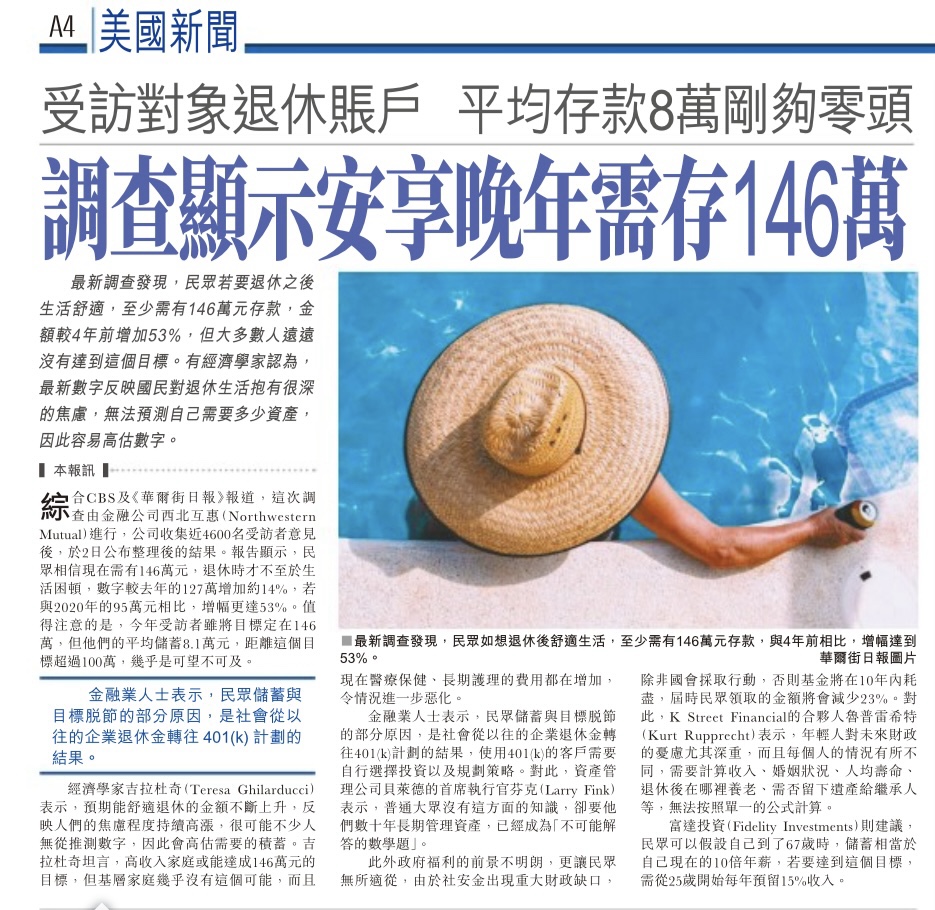
Asians retiring in US to live comfortably, you need US$1.46 millions assuming you could survive hate crimes, streets flooded with guns, marijuana, cocaine etc. If you are holding a HKID card, you could retire and lives in China’s greater Bay Area without worrying your safety. All you need is US$ half million. 在美國安享晚年(假設在美國犯罪,仇恨中國人和槍支毒品泛濫天堂可以活下去的話)需存146萬, 但拿著香港身分證在中國大灣區退休祇需要50萬而且不用擔心像在美國除時會死於非命.
Global Times Editor’s Note: US-led NATO is military, nuclear fist of expansionist strategy Apr 02 2024 環球時報編: 主美國領導的北約是擴張主義戰略的軍事核拳頭
April 4, 2024, marks the 75th anniversary of the founding of NATO. As a product of the Cold War, NATO should have been disbanded, but over the years, it has served as a war machine and facilitated US hegemony. The Global Times talked to a number of experts and scholars to reveal how the US exploits NATO to serve its geopolitical purposes and how NATO destabilizes the world, exacerbates nuclear threats and brings confrontation to Asia. 2024年4月4日是北約成立75週年。 北約作為冷戰產物,本應解散,但多年來,它卻充當戰爭機器,為美國霸權提供便利。 《環球時報》訪問多位專家學者,揭秘美國如何利用北約服務其地緣政治目的,以及北約如何破壞世界穩定、加劇核威脅、為亞洲帶來對抗。
In the first interview of the series, Global Times (GT) reporter Wang Wenwen talked to Zivadin Jovanovic (Jovanovic), president of the Belgrade Forum for a World of Equals who served as the minister of foreign affairs of the Federal Republic of Yugoslavia between 1998 and 2000. Serbia recently marked the 25th anniversary of the NATO bombing of what was then Yugoslavia. He recalled this brutal operation of NATO and how the US and NATO obstruct a just world order.
GT: How does the NATO bombing in 1999 still affect people in Serbia today?
Jovanovic: Serbia mourned and paid respect to around 2,000 civilians killed by NATO 25 years ago. We also remembered that NATO bombed the Chinese embassy in Belgrade killing three Chinese journalists. We recall that NATO used missiles with depleted uranium, cluster bombs and other forbidden means and methods. This resulted in maligned diseases and deaths of people even today, and material damage amounting to over $100 billion.
The objective of the US-led NATO was to take the Province of Kosovo and Metohija from Serbia, transform it into the Balkans carrier of US troupes for expansion to the East, topple the government of former president Slobodan Milosevic, and make a precedent for future military interventions violating the UN Charter and the supremacy of the UN Security Council and International Law, in general. The aim was also to firmly discipline European allies behind the concept of unipolar world order, supporting US geostrategic interests. In 1999, NATO went beyond its founding treaty, abandoning its defensive and adopting an offensive, aggressive character.
The US-led NATO pursues these interests today. Military aggression has been replaced by other means. Right now, they use pressure, including blackmailing Serbia to recognize the secession of its autonomous province of Kosovo and Metohija and accept its membership in the international organizations. Serbia, of course, will not submit. Economically, Serbia has not as yet fully recovered. Ruins from the aggression could be seen even in the heart of Belgrade, but Serbia’s GDP nevertheless maintains a constant rise, even above the European average. Unfortunately, the Balkans are far from stable. It is divided, dependent and militarized.
GT: You attended an international conference in Belgrade a few days ago that marked the anniversary. The theme of the conference was “From the Aggression to a New Just Order.” What are the obstacles to a new just world order?
Jovanovic: The main obstacle to the new world order based on the principle of sovereign equality and non-interference in internal affairs is the policy of expansion and global domination of the minority of Western countries led by the US. It seems that they do not understand the global changes and trends of multi-polarization and tend to believe that they can stop those historic trends, even reverse them, by force, including nuclear. These doctrines represent the main source of serious threats to global peace and development. This is a threat to humanity.
GT: Taking into consideration NATO actions from NATO bombing Yugoslavia 25 years ago to the ongoing Russia-Ukraine conflict, what role does NATO play in facilitating US hegemony?
Jovanovic: The NATO aggression on Yugoslavia in 1999 was the beginning of the globalization of military interventionism of the US-led NATO. Afterward, we saw many interventions and aggressions based on the 1999 NATO precedent on Yugoslavia. German politician Willy Wimmer said in 2022 that the first bombs fell on Ukraine in 1999.
The US-led NATO, in my opinion, is the military, nuclear fist of expansionist strategy, of global domination within unipolarity.
GT: The US has leveraged NATO to sustain dominance over Europe. Do you think Europe has the will and ability to reflect on its position? Is Europe feeling more secure or less secure?
Jovanovic: European autonomy at present is at its lowest point since World War II, this includes its dignity, identity and morality. It is not because of the people, European nations or cultural heritage. It is, first of all, because of the quality of the present political elite which has lost its sense of traditional civilization values, which seems to have abandoned morality, solidarity, justice and legality and which has practically reduced everything and everybody to the profit by all means. I don’t know, really, what term would best express such characteristics, but perhaps, it is not far from – corruption, one way or the other. Global changes could hardly leave Europe untouched. Some changes toward autonomy, dignity and sovereignty are taking place, particularly in some European countries, like Hungary, Slovakia and others. We shall see what the elections for the European Parliament in June will show. I hope it will be the beginning of changes, changes for the better. One election may not be sufficient, but the trends matter.
GT: China was also a victim of the NATO bombing 25 years ago. In the past two years, NATO has declared China a security challenge. The NATO chief also linked what’s happening in Ukraine to the Taiwan question. What do you think of the NATO moves against China?
Jovanovic: It is true. China was not only the victim, but also the target of NATO military aggression in 1999. Just minutes later, I was at the scene seeing public services rescuing survivors from the debris. Bombs were still hitting a nearby hotel and the surrounding park, when then-Chinese ambassador Pan Zhanlin was freed out of the ruins. I expressed my condolences and assured him of my government’s solidarity and support.
Should anybody wonder why Serbia and China are “iron friends” and comprehensive strategic partners ever since?
Who, what and why represents the challenge depends on who is assessing it and from positions of which values. Learning from recent history, I suppose, countries demanding equal security and sovereignty over natural resources, such as oil and gas reserves, uranium and other strategic minerals deposits, huge markets, and geostrategic connectivity lines have always been a challenge for NATO and Western power centers.
What we have been witnessing over the past decades is that the US and NATO have for years now been expanding and reinforcing their presence through their branches in the Far East and Indo-Pacific like Quad and some newly born alliances. Seen from Europe, the US-NATO expansionist strategy is directed to the East, to Russia, the Caspian Sea and the Middle East. Asia and Siberia seem to be real objectives, from both geographic positions. US-NATO exploits similar, or the same means and methods: spreading fear, insecurity and disorientation, demonstrating power through a series of massive “defenders” exercises, offering protection of scarred ones, use of separatism, terrorism and human rights. We know from their rhetoric that China represents a “systemic” challenge and Russia a “malign influence.” This only means that they have no solutions for their own problems nor do they have the courage to face today’s reality. So far, they opt to continue living in the past, instead of accepting a new reality called equality and living in togetherness.



 Business Blog