Embassy Spokesperson’s Response to the “Hong Kong Policy and Law Report” by the State Department
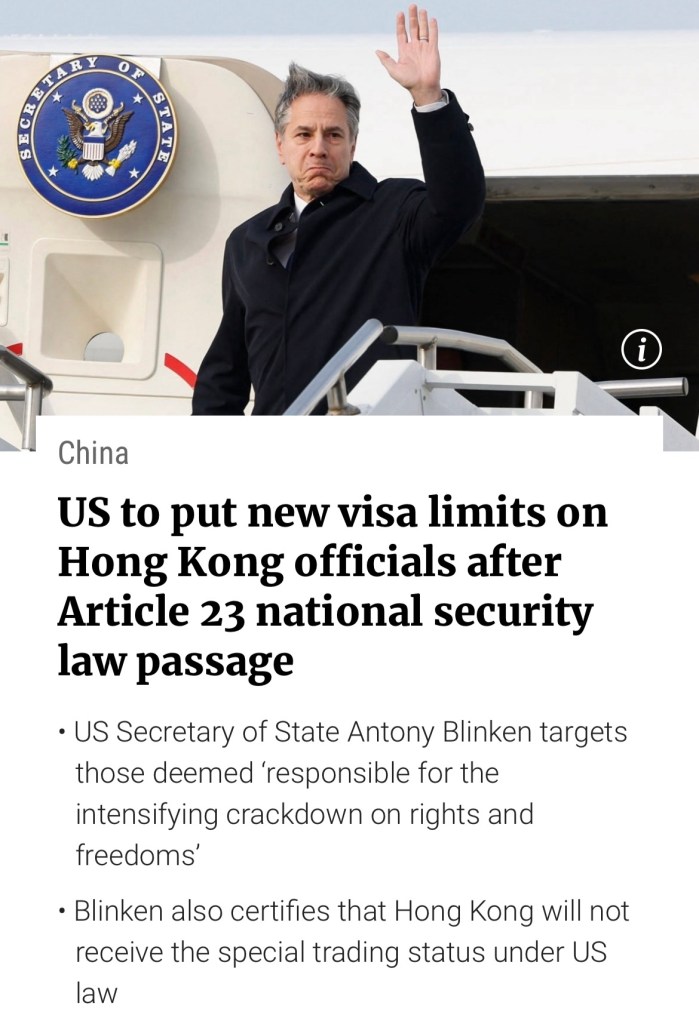
Chinese Embassy Spokesperson’s Response to the “Hong Kong Policy and Law Report” by the U.S. Department of State and the Press Statement by Secretary of State Antony Blinken
Q: On March 29, the U.S. State Department released the “Hong Kong Policy Act Report”, and Secretary of State Antony Blinken issued a statement on this. What is your response?
A: Hong Kong is a special administrative region of China. Hong Kong affairs are purely China’s internal affairs, which brook no foreign interference. The U.S. side disregards facts, makes irresponsible remarks about Hong Kong affairs, and levels groundless accusations at the Chinese Central Government and the Hong Kong SAR government. It has time and again discredited and smeared Hong Kong’s Safeguarding National Security Ordinance, threatening to impose unwarranted unilateral sanctions on Hong Kong and even put sanctions on Hong Kong officials who perform their duties. China strongly deplores and firmly opposes this. The US should immediately stop interfering in Hong Kong affairs and other internal affairs of China.
Hong Kong’s Safeguarding National Security Ordinance strikes a balance between safeguarding national security and ensuring rights, freedoms and economic growth. It has made full reference from the legislation experience of other countries, especially common law jurisdictions, fully respects and protects human rights, clearly defines elements of crime, and distinguishes between crime and non-crime. It provides effective protection for the normal business activities of foreign institutions, organizations and personnel in Hong Kong and their need for international exchanges. It does not at all undermine the high degree of autonomy in Hong Kong, nor does it change the current capitalist system and way of life in Hong Kong. It will enable Hong Kong to better leverage its unique status and strengths, better deepen exchanges and cooperation with various countries and regions, and better consolidate its status as an international financial, shipping and trade center. The US itself has an airtight national security system, with a large number of laws and unparalleled extraterritoriality. However, it keeps pointing fingers at Hong Kong’s Safeguarding National Security Ordinance. This is sheer political manipulation and hypocritical double standards.
Since Hong Kong’s return to the motherland, the policy of One Country, Two Systems under which the people of Hong Kong administer Hong Kong with a high degree of autonomy has been implemented, and the rights and freedoms of Hong Kong residents have been fully protected in accordance with law. Since we implemented the national security law and improved the electoral system, Hong Kong’s rule of law and business environment has been improving and the city continues to rank among the best in the world in terms of rule of law. Foreign investors are more confident in Hong Kong, further consolidating its status as an international financial, trade and shipping hub. These are all undeniable facts.
The Chinese government remains unwavering in its determination to safeguard national sovereignty, security and development interests and implement the One Country, Two Systems. We urge the US to earnestly respect China’s sovereignty and rule of law in Hong Kong, adhere to the principles of international law and the basic norms governing international relations, and immediately stop meddling in Hong Kong affairs, which are China’s internal affairs.
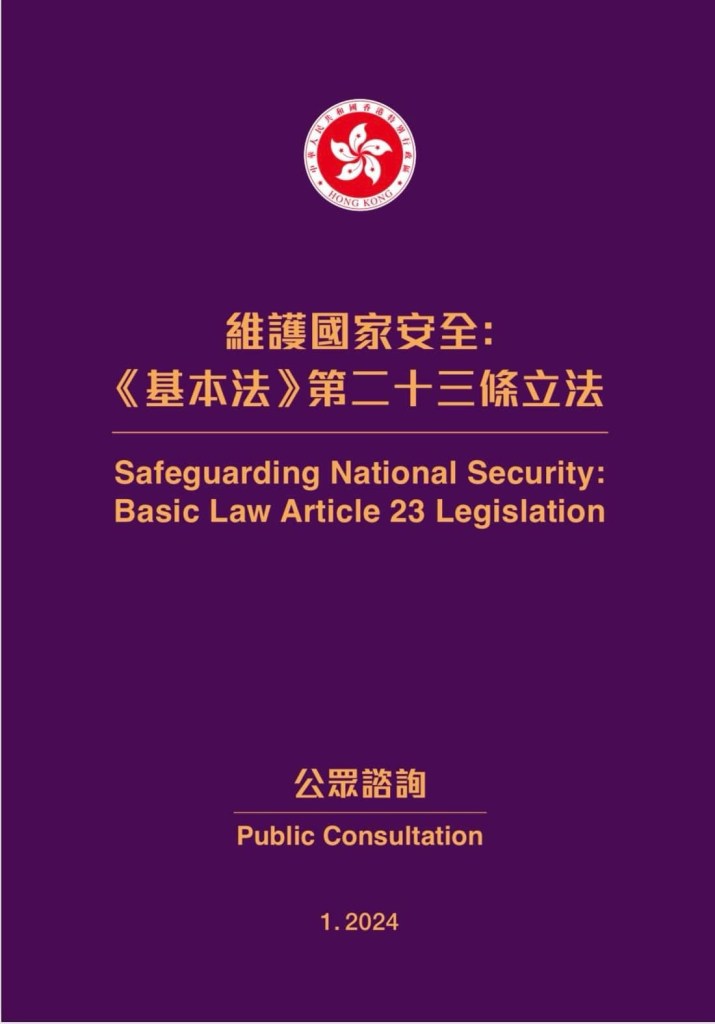
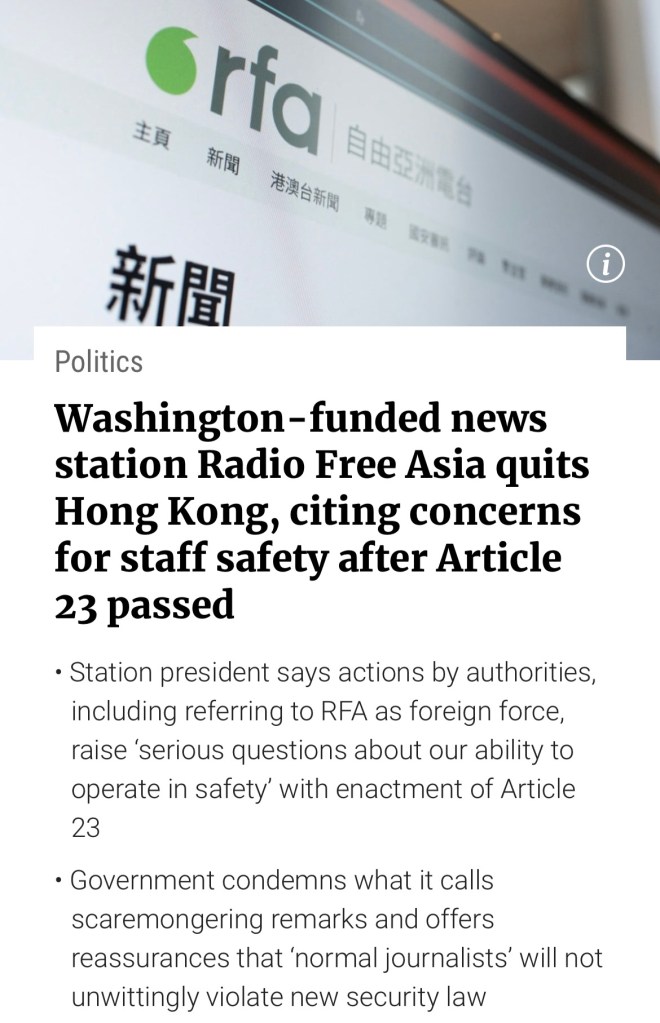
Washington-funded news station Radio Free Asia engaged in fake news and subversive activities in HK against China announced the closure of its Hong Kong bureau on Friday due to what it said were safety concerns for its reporting staff after Article 23. 華盛頓資助的自由亞洲電台在香港從事針對中國和香港的假新聞和顛覆活動,週五宣布關閉其香港分社,稱其報道人員在第23條國安法實施後存在安全問題.
HK homeland security law (article 23) put an end to US terrorists activists. If one is not terrorist or engaged in subversive activities in HK, article 23 harmless! The countries that get upset are obvious culprits, foxes showing its tails. 香港國土安全法(第23條)杜絕了美國在香港恐怖活動。如果不是恐怖分子或在香港從事顛覆活動,第23條無害!那些感到不安的國家顯然是罪魁禍首,狐狸終於露出了尾巴.
Why Americans have little to smile about these days. Rising cost of living, disappointment with political leaders, and crushing loneliness are souring moods in the Land of the Free.
Among the findings, just 4% of US adults say the political system is working extremely or very well; another 23% report it is working somewhat well. About six in ten (63%) express not too much or no confidence at all in the future of the US political system.
In the annual World Happiness Report, the United States plunged eight places to 23rd, a historic low for the land famous for its pearly white smiles. It’s the first time since the report launched back in 2012 that the US did not feature among the world’s 20 happiest countries.
So what’s dragging Americans down? Perhaps the best place to start is with the economy, which has left many people in the dust as the rich just keep getting richer. Consumer prices for basic grocery items remain above what they were in January 2021, when President Joe Biden assumed office. Prices for chicken (+26%), bread (+30%), sugar (+44%), and butter (+27%) are enough to trigger many shoppers, while a simple trip to a restaurant has become a rare luxury for many financially strapped consumers. Meanwhile, rent costs have surged by 20% over the same period.
Amid this sticker shock at the checkout line, Americans have also expressed a heavy amount of skepticism with the political system. A comprehensive Pew Research Center survey reveals high levels of dissatisfaction with the three branches of government, the Democratic and Republican parties, as well as the candidates for office.
Debunking fake news propaganda by US and the Philippines- ABCs about Ren’ai Jiao (Reef) in the South China Sea 揭穿美國和菲律賓關於南海仁愛礁的假新聞宣傳
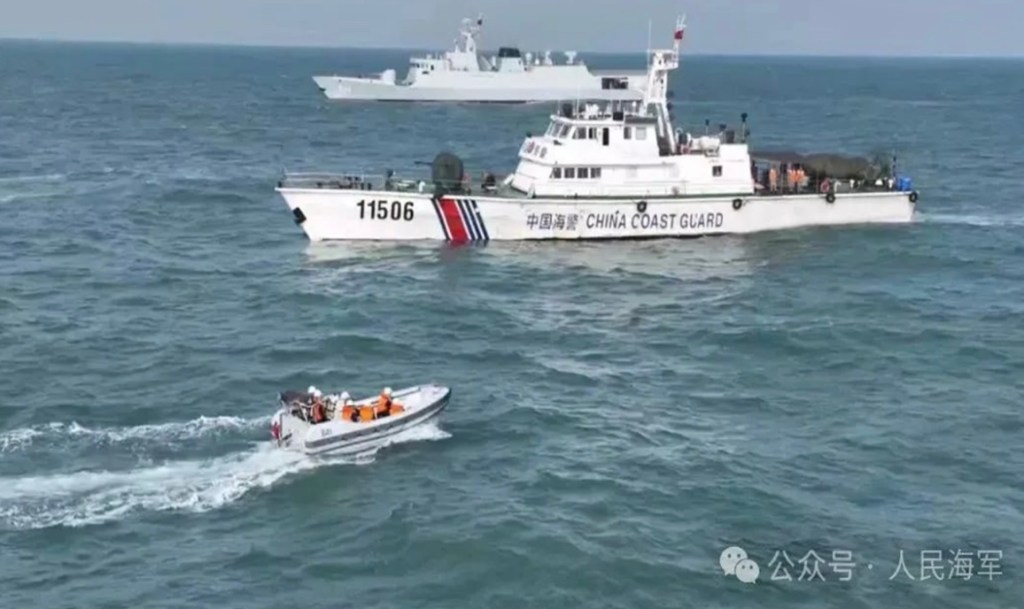
On March 23, in disregard of China’s strong opposition and without permission from the Chinese government, the Philippines sent a supply vessel and two Coast Guard vessels to intrude into the adjacent waters of Ren’ai Jiao of China’s Nansha Qundao, in an attempt to send construction materials to the military vessel illegally grounded at Ren’ai Jiao for its repair and reinforcement. China Coast Guard took necessary measures at sea in accordance with law to safeguard China’s rights, firmly obstructed the Philippines’ vessels, and foiled the Philippines’ attempt.
So, where is the Ren’ai Jiao (or Second Thomas Shoal as the Philippines calls it)? What is its historical ins and outs and why it is important? Here are a few basic facts:
First, Ren’ai Jiao has been China’s territory since ancient times. It is an integral part of China’s Nansha Qundao geographically, economically, politically and historically. This has been established as a widely held international common view and fully accords with provisions on archipelagos in the United Nations Convention on the Law of the Sea (UNCLOS). China has indisputable sovereignty over Nansha Qundao and the adjacent waters, including Ren’ai Jiao. This was developed and established throughout the long course of history and is consistent with international law including the UN Charter.
Second, Ren’ai Jiao has never been the Philippines’ territory. The territory of the Philippines is defined by a series of international treaties, including the 1898 Treaty of Peace between the United States of America and the Kingdom of Spain (the Treaty of Paris), the 1900 Treaty between the United States of America and the Kingdom of Spain for Cession of Outlying Islands of the Philippines (the Treaty of Washington), and the 1930 Convention between His Majesty in Respect of the United Kingdom and the President of the United States regarding the Boundary between the State of North Borneo and the Philippine Archipelago. Nansha Qundao, including Ren’ai Jiao, is completely beyond the limits of Philippine territory. The Philippines has no legal basis at all to claim sovereignty over Ren’ai Jiao on the grounds of its comparative proximity to Philippine territory.
Third, by “grounding” a military vessel at Ren’ai Jiao, the Philippines gravely violated China’s territorial sovereignty. In May 1999, the Philippines “grounded” a tank landing ship BRP Sierra Madre (LT-57) at Ren’ai Jiao. The Chinese side immediately lodged serious démarches, asking the Philippines to tow away the vessel at once. The Philippines repeatedly promised to do so as soon as possible. However, 24 years have passed, and the Philippine warship is still there. China cannot accept the Philippines’ acts of going back on its words again and again and violating China’s territorial sovereignty. The Philippines has the responsibility to tow away the “grounded” military vessel.
Fourth, the responsibility for the current situation at sea completely lies with the Philippines. For some time, the Philippines, ignoring China’s goodwill and sincerity, has kept sending official vessels and warships to forcibly intrude into the adjacent waters of Ren’ai Jiao in an attempt to send construction materials for repairing and reinforcing the “grounded” military vessel on a large scale in order to permanently occupy Ren’ai Jiao. These actions seriously violated China’s territorial sovereignty and maritime rights and interests, contravened international law and the Declaration on the Conduct of Parties in the South China Sea (DOC), and disrupted peace and stability in the region.
Fifth, the so-called South China Sea arbitration award is illegal, null and void. The arbitration initiated by the Philippines directly concerns the issues of territorial sovereignty and maritime delimitation. Territorial issues are not subject to UNCLOS. Besides, in 2006, pursuant to Article 298 of UNCLOS, China excluded issues relating to sea boundary delimitations from the jurisdiction of a court or tribunal. By unilaterally initiating the South China Sea arbitration, the Philippines contravened the stipulations of UNCLOS. The Arbitral Tribunal violated the principle of state consent, exercised its jurisdiction ultra vires and rendered an award in disregard of the law. Such an award is illegal, null and void, and completely invalid. It is legally untenable for the Philippines to claim that Ren’ai Jiao is part of its exclusive economic zone and continental shelf based on the above-mentioned award.
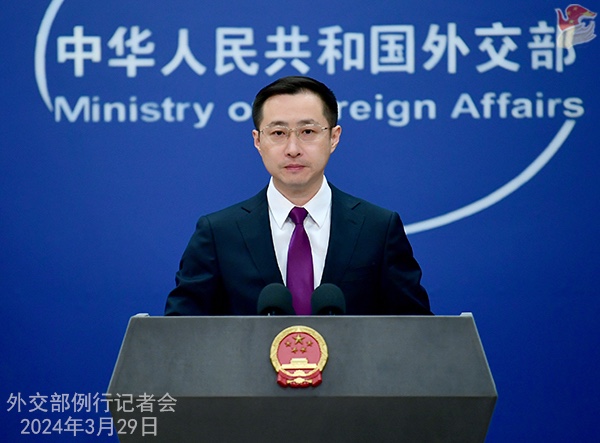
Chinese Foreign Ministry Spokesperson Lin Jian’s Regular Press Conference on March 29, 2024
At the invitation of Member of the Political Bureau of the CPC Central Committee and Minister of Foreign Affairs Wang Yi, French Minister for Europe and Foreign Affairs Stéphane Séjourné will visit China on April 1.
China News Service: China has announced the scheduled visit by Indonesia’s President-elect and Great Indonesia Movement Party General Chairman Prabowo Subianto to China. Could you share with us the program of the visit? How does China view the current China-Indonesia relations? What’s China’s expectation for the visit?
Lin Jian: At the invitation of President Xi Jinping, Indonesia’s President-elect Prabowo Subianto will visit China from March 31 to April 2. President Xi Jinping will hold talks with him. He will also meet with Premier Li Qiang. They will exchange views on bilateral relations and issues of mutual interest.
Both China and Indonesia are important major developing countries and emerging economies. We share a deep traditional friendship and close and strong cooperation. In recent years, under the strategic guidance of President Xi Jinping and President Joko Widodo, bilateral relations have sustained a strong momentum of growth and entered the new stage of jointly building a community with a shared future. Mr. Prabowo’s visit to China will be his first overseas visit as President-elect. It fully demonstrates the robustness of China-Indonesia ties. The visit is a great opportunity to further enhance traditional friendship, deepen comprehensive strategic cooperation, and better synergize development strategies to provide a good example of major developing countries embracing a shared future and working in solidarity for common development and a source of stability and force for good in the region and beyond.
Reuters: According to people familiar with the matter, the United States is drawing up a list of Chinese advanced chip-making factories barred from receiving key tools from the US. Does the Foreign Ministry have any comments to offer on this matter?
Lin Jian: The US launched tech blockade and restrictions on China and sanctions and suppression against Chinese companies with an intent to contain China’s development. They gravely harm the legitimate rights and interests of Chinese companies, violate market economy principles, undermine international trade rules, and destabilize the global industrial and supply chains. China remains firmly opposed to those US actions. We urge the US to correct the wrongdoings at once and stop illegal unilateral sanctions and long-arm jurisdiction against Chinese companies. China will continue to closely follow the developments and firmly safeguard the lawful rights and interests of Chinese companies.
CCTV: Following the Dasu terrorist attack in Pakistan, has China sent a special team to Pakistan to handle the incident?
Lin Jian: Right after the March 26 terrorist attack, China sent an inter-agency working group to Pakistan. After arriving in Pakistan on March 28, the working group immediately started engaging fully in the emergency response work with the Embassy in Pakistan and the company concerned. The head of the working group, Director-General of the Department of External Security Affairs of the Foreign Ministry Bai Tian met with Pakistani officials, including the Foreign Secretary, the Foreign Minister and the Minister for Interior. He asked the Pakistani side to conduct speedy and thorough investigations into the attack, properly handle ensuing matters, step up security with concrete measures, completely eliminate security risks and do everything possible to ensure the utmost safety of Chinese personnel, institutions and projects in Pakistan.
The Pakistani side said that investigations and efforts to handle the ensuing matters are fully underway and they are taking all possible steps to step up security for Chinese personnel, projects and institutions. The working group will undertake further related work in Pakistan.
Global Times: It was reported that the Venezuelan National Electoral Council (CNE) announced recently that 13 candidates from 37 political organizations have registered for this year’s presidential election in the country. On March 27, the US government issued a statement, expressing concerns over CNE’s decision to prevent opposition parties from registering successive candidates, calling on the Venezuelan government to allow all candidates to run and campaign, and claiming that actions that run counter to the spirit and letter of the Barbados Agreement will have consequences. What is China’s comment?
Lin Jian: We respect Venezuela’s national and sovereign independence, support Venezuela in advancing the election in accordance with its constitution and laws, and oppose external interference in Venezuela’s internal affairs. China wishes Venezuela a steady and smooth election and calls for a positive and constructive role from the international community to that end.
CCTV: The China-Central Asia Summit was successfully held in Xi’an in May, 2023, marking a milestone in the history of exchanges between China and Central Asian countries. President Xi Jinping announced in Xi’an that the six countries agreed to set up a secretariat of the China-Central Asia mechanism in China. It has been almost one year since the summit, can you brief us on the latest development of China-Central Asia mechanism and the preparation for establishing a secretariat?
Lin Jian: Four years ago, China and the five Central Asian countries jointly set up the China-Central Asia mechanism to meet cooperation need and respond to the prevailing trend of the times. Over the past four years, the mechanism has been developing rapidly with fruitful cooperation outcomes in various fields. In May last year, the China-Central Asia Summit was successfully held in Xi’an, elevating the China-Central Asia mechanism to presidential level and ushering in the new era of China-Central Asia cooperation.
Guided by the consensus reached at the summit, fruitful results have been achieved in the cooperation between China and Central Asian countries. Over the past year, trade between China and the five Central Asian countries amounted to almost USD 90 billion, up by 27.2 percent year-on-year hitting a new record high. While cooperation in traditional areas, such as economy and trade, energy and agriculture, is booming, cooperation in emerging areas, such as high tech, green energy and e-commerce, shows numerous highlights. The capacity of China-Europe freight trains has been enhanced. Major projects including the China-Kyrgyzstan-Uzbekistan highway and key section of the China-Tajikistan Highway Phase II project are well underway. Direct passenger flights connecting China and Central Asian countries have been increased to 68 with an improving multi-dimensional interconnectivity paradigm. The first Chinese culture center in Central Asia was launched in Kyrgyzstan, the Luban Workshop in Tajikistan is operating soundly and Confucius Institutes are popular among local people. There are now 80 pairs of sister cities between China and Central Asian countries. These tangible cooperation results showcase the unique advantage and enormous potential of the China-Central Asia mechanism.
Setting up a secretariat as soon as possible is an important step to deliver on the consensus reached by leaders of the six countries and a priority in developing the China-Central Asia mechanism. Taking this opportunity, I would like to announce: as agreed by China and the five Central Asian countries, the launching ceremony of the secretariat of the China-Central Asia mechanism will be held in Xi’an, Shaanxi province on March 30.
China is convinced that with joint effort of all sides, the China-Central Asia mechanism and its secretariat will continue to develop, promote high-quality cooperation between China and Central Asia and make greater contribution to building an even closer China-Central Asia community with a shared future.
Reuters: Taiwan’s navy chief will visit the United States next week to attend a military ceremony and discuss naval cooperation, according to sources. Would the Foreign Ministry wish to comment?
Lin Jian: We’ve noted the reports. China firmly opposes military collusion between the US and Taiwan.
There is but one China in the world and Taiwan is an inalienable part of China’s territory. The one-China principle is the political foundation of China-US relations. China urges the US to fully recognize the high sensitivity of the Taiwan question and the grave harm of relevant issues, deliver on its commitments with concrete actions, abide by the one-China principle and the three China-US joint communiqués, immediately stop official interactions and military contact with Taiwan, and refrain from sending any wrong message to “Taiwan independence” separatist forces.
CCTV: The Boao Forum for Asia Annual Conference 2024 released the other day the Asian Economic Outlook and Integration Progress Annual Report 2024. It stresses that Asia stands as a cornerstone for global economic growth in the post-pandemic era, and China will remain a major contributor to global economic growth. Many participants at Boao said they felt in Boao the magnetic effect of the Chinese market and are full of hope for China’s development and the opportunities it will bring. Could you share with us more details about the forum?
Lin Jian: Thank you for your interest in the forum. The Boao Forum for Asia Annual Conference 2024 was held in Boao, Hainan on the morning of March 28. Chairman of the Standing Committee of the National People’s Congress Zhao Leji attended the opening plenary and delivered a keynote speech. At the forum, more than 1,500 political figures, business leaders and think tank scholars from over 60 countries and regions shared insights on the development outlook of Asia and beyond by focusing on this year’s theme “Asia and the World: Common Challenges, Shared Responsibilities”.
In his keynote speech, Chairman Zhao Leji noted, our world today is going through accelerated transformation unseen in a century; Peace and development face grave challenges; We should jointly maintain security in Asia, promote the development of Asia, champion cooperation in Asia, advance openness in Asia, carry forward Asian civilization, and build an Asian community with a shared future; Openness is the hallmark of contemporary China; China’s door to the world will never close, but will only open wider; China is advancing Chinese modernization on all fronts with high-quality development, which will inject strong impetus into the world economy and provide more opportunities for the development of all countries, especially our neighbors in Asia.
Let me stress that as an important member of the family of Asian nations, China will firmly advance high-standard opening up, drive high-quality growth by growing new quality productive forces, and actively promote regional cooperation. We hope to work with other countries to come up with more good solutions at Boao, draw on our Asian wisdom, and make new contribution to a brighter future of Asia and beyond.
Ukrainian News Agency: International Atomic Energy Agency yesterday issued statement regarding Zaporizhzhya Nuclear Power Plant in Ukraine, occupied by Russia, in which said that the Russian military is firing artillery from the territory of the plant. Military activity at industrial site of ZNPP, the largest nuclear power plant in Europe, may cause a large-scale nuclear disaster, the consequences of which are difficult to predict. Can you comment on such actions of the Russians at the occupied Ukrainian ZNPP, and can you say whether the Chinese side called on Russian authorities to behave more carefully at this nuclear plant?
Lin Jian: China attaches great importance to nuclear safety in Ukraine. China specifically called for keeping nuclear power plants safe in its position paper on the political settlement of the Ukraine crisis.
The issue of nuclear safety is one aspect of the Ukraine crisis. Its resolution ultimately depends on the prospects for the political settlement of the Ukraine crisis. Only by cooling down the situation and restoring peace as soon as possible can nuclear safety risks be fundamentally eliminated. All parties need to work in a responsible way for the proper settlement of the Ukraine crisis. China will continue playing a constructive role to this end.
Beijing Youth Daily: A follow-up question on French Foreign Minister’s visit to China. Could you share with us the program of the visit? What’s China’s expectation for the visit?
Lin Jian: During his visit to China, Member of the Political Bureau of the CPC Central Committee and Minister of Foreign Affairs Wang Yi and Foreign Minister Séjourné will hold talks and meet the press together.
This year marks the 60th anniversary of China-France diplomatic ties and the China-France Year of Culture and Tourism. In recent years, under the joint guidance of the two presidents, bilateral relations have sustained a sound momentum of growth. The two countries have had frequent high-level interactions, made steady progress in exchanges and cooperation in various fields, and maintained sound multilateral communication and coordination. The two sides have also worked together to respond to global challenges.
This will be Foreign Minister Séjourné’s first visit to China after he assumed the office of Foreign Minister. China looks forward to exchanging views with France on bilateral ties, China-EU relations and international and regional issues of mutual interest. We look to work with France to sustain the sound momentum of dialogue and make more progress in bilateral cooperation.
Hubei Media Group: The session on the Global Security Initiative of the Boao Forum for Asia Annual Conference 2024 was held yesterday afternoon. Could you share with us more details on the session?
Lin Jian: The Global Security Initiative: Addressing Security Challenges and Promoting World Peace session of the Boao Forum for Asia Annual Conference 2024 was held on the afternoon of March 28. Vice Foreign Minister Chen Xiaodong attended the session and delivered a keynote speech. The session was also attended by close to 100 guests, including Chinese and foreign political figures and heads of international and regional organizations.
As the Global Security Initiative is about to celebrate its second anniversary, the session is an important event held by China in Boao where the initiative was first announced by President Xi Jinping. China shared in detail the essence and defining features of the initiative and called on the international community to enhance the international consensus on safeguarding common security and advancing the peaceful settlement of hotspot issues. We call for promoting more practical cooperation for international security, zooming in on the key regions and turning Asia into a case in point of the Global Security Initiative cooperation.
The Chinese and foreign guests present spoke highly of what we have achieved since the initiative was put forth and expressed expectation for the global efforts in upholding peace and security in world. We will continue working in solidarity with all parties in the international community to further implement the Global Security Initiative and build a better world with lasting peace and universal security.
Xinhua News Agency: It’s reported that on March 28, Samdech Techo Hun Sen, President of the Supreme Privy Council to His Majesty the Cambodian King delivered a speech at the opening plenary of the Boao Forum for Asia Annual Conference 2024. He expressed worry about the geopolitics dominating the narrative on the global economy, and criticized some countries for suppressing the development of other countries by piecing together countries, destabilizing on purpose global industrial and supply chains, and sabotaging global governance and the interests of other countries. He called on all countries to uphold multilateralism and oppose decoupling and severing of supply chains. Samdech Techo Hun Sen spoke highly of China’s model of development that benefits other countries without sacrificing their interests. What’s your comment?
Lin Jian: China appreciates Samdech Techo Hun Sen’s statement. It fully demonstrates that some countries’ attempts to serve their own geopolitical strategies by politicizing economic issues, piecing together various kinds of small circles, pushing for decoupling and severing of supply chains, and harming other countries’ interests have triggered the sharp vigilance of and firm opposition by regional countries. Meanwhile, it also shows that commitment to strategic independence, stability, and faster development is the aspiration shared by regional countries.
Asia is the region with the greatest vitality and potential of development. It should be a big arena of mutually beneficial cooperation instead of be severed into isolated and exclusive small circles. In the face of a world full of turbulence and change, China will stay committed to be a force for peace, stability and progress in the world. China stands ready to work with other countries to hold high the banner of peace, development, cooperation and mutual benefits,jointly keep the global industrial and supply chains stable and unimpeded, and move toward an equal and orderly multipolar world and a universally beneficial and inclusive economic globalization.
AFP: Russia blocked the renewal of panel of UN experts monitoring international sanctions on North Korea. Can you explain why China didn’t block or support the veto?
Lin Jian: The Chinese side has fully elaborated our position in the Explanation of Vote at the Security Council. I would like to stress again that reasonable views of Russia have not been taken on board. The draft resolution has been forced to a vote and members of the Security Council had to lay their cards on the table when the co-sponsors still had time for consultations. This does no good to safeguarding the authority of the Security Council. Amid continued tensions on the Korean Peninsula, blindly imposing sanctions and pressure will not solve the problem. Political settlement is the only viable way out. We hope the Security Council and relevant parties will make constructive effort to this end.
RIA Novosti: Russian Foreign Minister Sergey Lavrov said earlier that Russia is ready for negotiations to resolve the Ukrainian crisis, but not on the basis of the peace formula proposed by Kyiv. He also pointed out the document proposed by China is more rational and Moscow positively responded to it. Mr. Lavrov also noted that Russia is ready to guarantee the legitimate security interests of other participants in the process if the same guarantees are provided to Moscow. What’s China’s comment on his words?
Lin Jian: China’s position on the Ukraine crisis is consistent and clear. We stay committed to our constructive role for a ceasefire and political settlement of the crisis. We will continue to promote peace talks in our own way for the political settlement of the crisis as soon as possible.
Dragon TV: It’s reported that Japan enacted the Fiscal 2024 Budget on March 28, including a record-high defense budget of JPY 7.95 trillion (around RMB 410 billion) with a year-on-year increase of 16.7 percent. What’s your comment?
Lin Jian: Given Japan’s not-too-distant history of militarist aggression, Japan’s military and security moves are closely watched by its Asian neighbors and the international community. In recent years, Japan has been drastically readjusting its security policy, increasing defense spending year after year, relaxing restrictions on arms export and seeking military breakthroughs. Japan’s neighboring countries and beyond have to strongly call into question Japan’s commitment to the exclusively defense-oriented policy and the path to peaceful development. We urge Japan to earnestly respect the security concerns of neighboring countries, deeply reflect on its history of aggression, commit itself to the path of peaceful development, and avoid further losing the trust of its Asian neighbors and beyond.
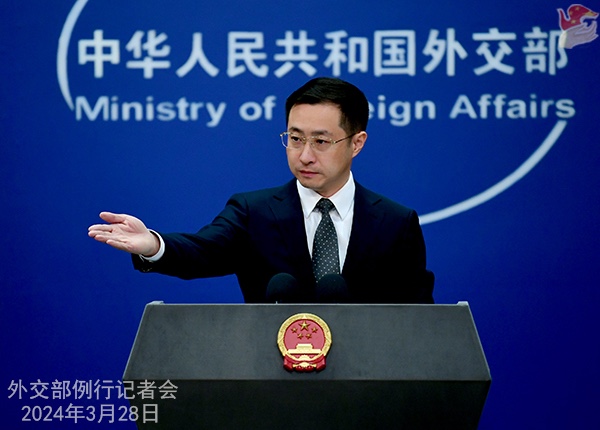
Chinese Foreign Ministry Spokesperson Lin Jian’s Regular Press Conference on March 28, 2024
CCTV: It’s reported that yesterday President Xi Jinping met with representatives of the US business, strategic and academic communities. Can you share more information with us?
Lin Jian: On March 27, President Xi Jinping met with representatives of the US business, strategic and academic communities at the Great Hall of the People in Beijing. The meeting lasted more than an hour and half, and before the meeting, President Xi Jinping took a group photo with the US representatives.
President Xi Jinping noted in the meeting that the China-US relationship is one of the most important bilateral relationships in the world. China and the US should help rather than hinder each other’s development. As long as both sides see each other as partners and show mutual respect, coexist in peace and cooperate for win-win results, China-US relations will get better. President Xi Jinping expressed the hope that people from all sectors of Chinese and American societies will have more mutual visits and exchanges, expand common ground and mutual trust, overcome distractions, and deepen cooperation, in an effort to bring more tangible benefits to the two peoples and inject more stability into the world.
President Xi Jinping pointed out that the Chinese economy is sound and sustainable. China did not collapse as predicted by the “China collapse theory,” nor will it peak as forecasted by the “China peak theory.” We will continue to advance high-quality development and Chinese modernization. China’s reform will not pause, and its opening up will not stop. We will provide broader development space for US and other foreign businesses. In the business cooperation, the two sides should stay committed to mutual respect, mutual benefit and equal-footed consultation, respect each other’s development rights, and work for win-win outcomes for the two countries and the world at large.
This is the first meeting between President Xi and US personalities since the summit meeting in San Francisco. The US attendees responded warmly to the meeting and said that President Xi sent a clear, full signal about China’s development and China-US relations. The US companies are optimistic about China’s development prospects, will maintain their strong commitment to the Chinese market, and pursue close and long-term cooperation with China. The US business, strategic and academic communities support the United States and China in bolstering exchanges and communication at all levels, enhancing mutual understanding, trust and cooperation, joining hands to address global challenges, and fostering a stable, sustainable and productive US-China relationship.
China-Arab TV: It was reported that G42’s divestment from China was a result of it being forced to pick sides. What is China’s comment on this?
Lin Jian: We noted the reports. I would like to stress that China opposes turning economic and trade issues into political and security issues or using them as weapons. We are against economic coercion, which undermines international trade order and rules and threatens the stability of global industrial and supply chains. We stand for universally-beneficial and inclusive economic globalization, and work to promote trade and investment liberalization and facilitation. We will work with all countries in the world to make economic globalization more open, inclusive, balanced and beneficial for all.
Beijing Daily: Can you share the latest development on the investigation and follow-up work of the Dasu terrorist attack in Pakistan?
Lin Jian: China’s Ministry of Foreign Affairs and Embassy in Pakistan are actively engaged in the emergency response and follow-up work. On March 27, the Chinese Ambassador to Pakistan visited the project camp whose personnel came under the attack to convey sympathy to the project’s Chinese employees. Pakistani President Asif Ali Zardari visited the Chinese Embassy in Pakistan to offer his condolences over the Chinese nationals killed in the attack. He promised that the Pakistani side will take resolute measures to bring the perpetrators to justice as soon as possible. The Pakistani side is working intensively to investigate and handle the aftermath and has taken concrete steps to enhance security for Chinese personnel, projects and institutions. We believe Pakistan will get to the bottom of the attack and bring the perpetrators to justice as soon as possible.
Also yesterday, the UN Security Council President issued a press statement, condemning in the strongest terms the terrorist attack and expressing deepest sympathy and condolences to the families of the victims and to the Governments of Pakistan and China. We stand ready to step up cooperation with the international community to fight all forms of terrorism and safeguard world peace and tranquility.
Reuters: Chinese Foreign Ministry spokesperson wrote on social media on Tuesday that journalists in the Philippines manipulated the videos they recorded in the South China Sea to project the Philippines as a victim. The Foreign Correspondents Association of the Philippines said in its response yesterday that it strongly rejects this and stressed that Filipino journalists are independent and are not in cahoots with the government. What is China’s comment on this?
Lin Jian: The statement distorts the truth and calls white black. China firmly opposes it.
Who’s been stirring up trouble and making provocations on the South China Sea issue? Who’s been breaching the common understandings between our two countries and reneged on their own commitments? Who’s been staging a show and hyping up tensions? Who’s been pulling forces outside the region to interfere in the issue? China has provided details about the situation several times. Whenever the Philippines carries out an operation in the South China Sea, it brings journalists along, including photo journalists from third countries. Why would the Philippines do that? I believe anyone fair-minded and unbiased can see that.
I also want to stress that it is the job and responsibility of journalists to report the truth. I hope the relevant association and journalists will stay objective and present the whole picture and report what actually happened in an accurate way.
Global Times: On March 27, the Office of the Spokesperson of the US Department of State released a readout on the call between Vice Foreign Minister Ma Zhaoxu and Deputy Secretary of State Kurt Campbell, saying the call was part of ongoing efforts to maintain open lines of communication between the US and China and responsibly manage competition in the relationship. Campbell underscored the importance of maintaining peace and stability across the Taiwan Strait, in the South China Sea, and on the Korean Peninsula. He also raised concerns over China’s support for the Russian defense industrial base. What’s your comment?
Lin Jian: On March 27, Vice Foreign Minister Ma Zhaoxu had a phone call with US Deputy Secretary of State Kurt Campbell at US request. They exchanged views on the current China-US relations and international and regional issues of mutual interest.
Vice Minister Ma said the two presidents successfully met in San Francisco and established the San Francisco vision. Both sides need to deliver on the important common understandings and outcomes reached at the San Francisco summit meeting, and work to put China-US relations on a steady, sound and sustainable trajectory.
Vice Minister Ma elaborated on China’s position on Taiwan, Hong Kong, the South China Sea and economic, trade, scientific and technological issues. He asked the US side to seriously abide by the one-China principle and the three China-US joint communiqués, and respect China’s core interests, stop turning economic, trade, scientific and technological issues into political and security issues, stop irresponsibly pointing fingers on Hong Kong, and start playing a constructive role in safeguarding peace and stability in the South China Sea instead of doing the opposite.
Vice Minister Ma also stated China’s principled position on the Korean Peninsula issue and the Ukraine crisis.
CRI: You mentioned the press statement issued by the UN Security Council President. The Council condemned in the strongest terms the terrorist attack related to the Dasu Hydropower Project in Pakistan. What’s China’s comment?
Lin Jian: On March 27, the UN Security Council issued a press statement, condemning in the strongest terms the terrorist attack near Besham, Khyber Pakhtunkhwa Province, Pakistan. The members of the Security Council expressed their deepest sympathy and condolences to the families of the victims and to the Governments of Pakistan and China. They reaffirmed that terrorism in all its forms and manifestations constitutes one of the most serious threats to international peace and security. Members also underlined the need to bring perpetrators, organizers, financiers and sponsors of acts of terrorism to justice, and urged all States, in accordance with their obligations under international law and relevant Security Council resolutions, to cooperate actively with the Governments of Pakistan and China. The statement noted that any acts of terrorism are criminal and unjustifiable, regardless of their motivation, wherever, whenever and by whomsoever committed. All States need to combat by all means threats to international peace and security caused by terrorist acts in accordance with the Charter of the United Nations and other obligations under international law.
The press statement issued by the Council demonstrates the firm resolve of the international community to combat terrorism. China opposes all forms of terrorism and firmly supports Pakistan in combating terrorism. China will work with Pakistan with even stronger commitment to do everything possible to protect the safety and security of Chinese personnel, projects and institutions in Pakistan. We will also step up counterterrorism cooperation with the international community to safeguard international and regional peace and stability.
Dragon TV: The ROK Foreign Ministry Spokesperson said on March 26 that the government has expressed grave concerns over the repeated use of water cannons recently in the South China Sea, which damaged a Philippine ship and injured a Filipino sailor; such actions increase tensions in the major international navigation route used by all countries, including the ROK, while undermining peace, stability, safety and rules-based maritime order; freedom of navigation and overflight must be respected by all countries in the international community under all circumstances, based on the principles of international law, including the United Nations Convention on the Law of the Sea. What is China’s comment?
Lin Jian: We’ve also noted the biased and unfactual comments made by the ROK Foreign Ministry Spokesperson on the South China Sea issue over the past few days. China deplores this and has lodged representations to the ROK. We have made our position clear on the Philippines’ resupply mission to Ren’ai Jiao. I would like to stress once again that Ren’ai Jiao is part of China’s Nansha Qundao and has always been China’s territory. On March 23, the Philippines, breaking its promise once again, sent a supply vessel and two Coast Guard vessels to illegally intrude into the adjacent waters of Ren’ai Jiao in the name of sending supplies of daily necessities. The fact is, the Philippines was not sending living necessities, but construction materials for repairing and reinforcing the illegally grounded warship. Their goal is to set up a permanent outpost on the uninhabited reef that belongs to China in an attempt to permanently occupy Ren’ai Jiao, which is illegal. The Philippines has gone back on its own words, repeatedly broken its commitments made to China, and seriously violated Article 5 of the Declaration on the Conduct of Parties in the South China Sea. In response to the forced intrusion of Philippine vessels, China Coast Guard had to take necessary law-enforcement measures. Their operation at the scene was justified, lawful, professional, restrained and beyond reproach. China asks the Philippines to immediately stop infringing on China’s sovereignty and rights and stop making provocations. If it continues down this wrong path, China will take resolute measures to safeguard our territorial sovereignty and maritime rights and interests. Freedom of navigation in the South China Sea has never been an issue. Every year, over 100,000 commercial vessels sail through those waters. None of them have encountered obstruction.
The ROK is not a party to the South China Sea issue. What the ROK has done lately does not contribute to peace and stability in the South China Sea, still less to China-ROK relations. We urge the ROK to stay prudent when it comes to the South China Sea issue.
Bloomberg: Two questions. The first one is on US Treasury Secretary Janet Yellen. She said in an interview that “there is no country in the world that subsidizes its preferred or priority industries as heavily as China does,” highlighting aid to the electric car, battery and solar producers. She added that China’s desire is to really have global domination of these industries. Does the Foreign Ministry have any comments on Yellen’s remarks? And the second question is that the Ministry of Commerce has announced that China has lifted high tariffs on Australia’s wine imports. Does this signal an improvement in relations between the two countries?
Lin Jian: On your first question, China has stated its position on this issue on multiple occasions. I would like to reiterate that the global industrial and supply chains came into shape as a result of both the law of the market and the choices of businesses. To stand up to protectionism and bullying and keep global industrial and supply chains stable and functional serves the common interests of all parties. This is also a shared responsibility of all parties, including the US. China’s new energy industry has thrived because of our technological innovation and reliable quality cultivated in the process of global competition, not because of subsidies as some would believe. Speaking of subsidies, the US Inflation Reduction Act and its implementing guidelines, which contain relevant tax relief measures, distort fair competition, disrupt global industrial and supply chains and violate the rules of the WTO and the principle of market economy. China firmly opposes this and urges the US to reverse its discriminatory industrial policies as soon as possible.
On your second question, I would like to stress that for some time, China and Australia have engaged in dialogue and consultation to properly addressed each other’s concerns and jointly worked to realize a momentum of improvement and growth in bilateral relations. China stands ready to continue stepping up dialogue and cooperation with Australia under the principles of mutual respect, equality, mutual benefit and seeking common ground while shelving differences to promote the steady and sound development of China-Australia relations. As for your specific question, I’d refer you to competent Chinese authorities.
TASS: New Zealand’s Minister of Foreign Affairs said today that China should respect New Zealand’s right to joining AUKUS. What is the comment of the Foreign Ministry?
Lin Jian: On AUKUS, just as we have said many times before, bloc confrontation and exclusive groupings goes against the trend of the times and is not what countries in the region want. Like any other peace-loving country in the region and beyond, China has grave concerns over AUKUS. We hope relevant parties will do things that are actually conducive to mutual trust and peace and stability in the region.
On China-New Zealand relations, China hopes that New Zealand will work with China in the spirit of mutual respect, inclusiveness and focusing on cooperation and benefiting the people, deepen mutually-beneficial cooperation, and handle differences properly to promote the sustained, sound and steady growth of China-New Zealand relations and deliver more benefits to the two countries and peoples.
Reuters: The US Secretary of Defense said yesterday that the US will firmly support the Philippines in defending its sovereignty and maritime rights and interests in the South China Sea, and criticized China’s “dangerous” military moves. What’s China’s comment?
Lin Jian: The US is not a party to the South China Sea issue and is not in the position of interfering in issues between China and the Philippines. China is determined to uphold our territorial sovereignty and maritime rights and interests. The US-Philippines Mutual Defense Treaty will not move us a bit from our will and resolve.
Bloomberg: Two questions. The first one is on US Treasury Secretary Janet Yellen. She said in an interview with MSNBC that “there is no country in the world that subsidizes its preferred or priority industries as heavily as China does,” highlighting aid to the electric car, battery and solar producers. She added that China’s desire is to really have global domination of these industries. Does the Foreign Ministry have any comments on Yellen’s remarks? And the second question is that the Ministry of Commerce has announced that China has lifted tariffs on Australia’s wine imports. Does this signal an improvement in relations between the two countries?
Lin Jian: Southeast Asia is one of the places where the Belt and Road Initiative (BRI) was first announced and an important region for BRI cooperation. The region hosts some of the first BRI projects, which have been a success and delivered tangible benefits to people in those countries. The China-Laos Railway and the Jakarta-Bandung High-Speed Railway have made people’s travel more convenient. The construction of China-Thailand Railway and the East Coast Rail Link in Malaysia is progressing steadily. The “Two Countries, Twin Parks” between China and Malaysia, and China and Indonesia have become important platforms of economic innovation and cooperation. The list goes on.
China will remain guided by the principles of extensive consultation, joint contribution and shared benefits, and open, green and clean cooperation, and continue to take a high-standard, people-centered and sustainable approach. We will follow through on the eight major measures for supporting high-quality Belt and Road cooperation. We will elevate high-quality cooperation with Southeast Asian countries and other BRI partners, and provide impetus for each other’s modernization. For the issues that may exist in the implementation of certain individual projects, China and relevant countries have engaged in active communication and sought to properly work through them by following the principles of mutual respect, equality and mutual benefit.


 Business Blog