US Gov’t mouthpiece medias as well as Philippines spreading fake news about Ren’ai Jiao. The facts and truth about Ren’ai Jiao by Zong Haiping Mar 27 2024
Since last year, the Philippines has repeatedly provoked and disrupted the peace in the South China Sea by exploiting a dilapidated military vessel illegally grounded at Ren’ai Jiao in the Nansha Qundao for over 20 years.
On March 23, the Philippines once again dispatched vessels to send construction materials to the illegally grounded military vessel, attempting to reinforce the vessel so as to achieve permanent occupation of Ren’ai Jiao. In the face of the intrusion by the Philippine vessels, China Coast Guard had to take necessary measures to safeguard rights and enforce the law. Subsequently, some Philippine officials and media as well as Western media distorted facts and accused China of “bullying the weak,” supporting the Philippines’ provocative acts of encroachment. Who is actually creating disturbances and altering the status quo? Who is violating international law and undermining peace and stability in the South China Sea? Let us expose the false information spread by the Philippines and present the truth to the international community.
Who owns Ren’ai Jiao?
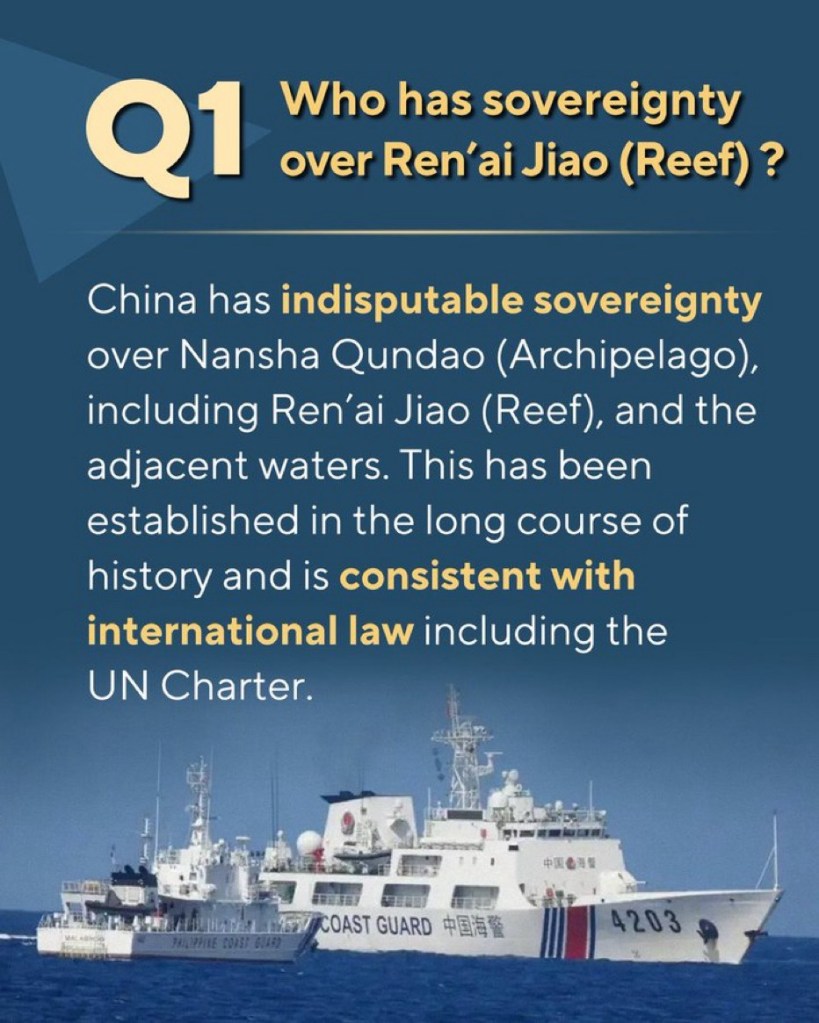
Ren’ai Jiao is an integral part of China’s Nansha Qundao. China has indisputable sovereignty over Nansha Qundao, including Ren’ai Jiao and their adjacent waters, this is solidly grounded in history and law.
Ren’ai Jiao is neither “terra nullius,” nor Philippine territory, nor is it within the Philippine exclusive economic zone and continental shelf. The territorial boundaries of the Philippines were established by a series of international treaties, and the Nansha Qundao, including Ren’ai Jiao, fall outside of this scope. The so-called “contiguity or proximity” is not a valid reason for asserting sovereignty. Territorial sovereignty is a prerequisite for claiming maritime rights, and to deny territorial sovereignty based on maritime rights is to reverse cause and effect. The Philippines’ denial of China’s territorial sovereignty over Ren’ai Jiao, based on the invalid and illegal ruling of the so-called South China Sea arbitration, violates the ancient yet enduring principle of “the land dominates the sea” in international law and is fundamentally untenable.
Who is changing the status quo of Ren’ai Jiao?
Ren’ai Jiao is an uninhabited island reef in the Nansha Qundao in the South China Sea, and this is the original condition of Ren’ai Jiao. The fifth article of the Declaration on the Conduct of Parties in the South China Sea signed by China and ASEAN countries, including the Philippines, clearly stipulates that the Parties should refrain from “action of inhabiting on the presently uninhabited islands, reefs, shoals, cays, and other features.”
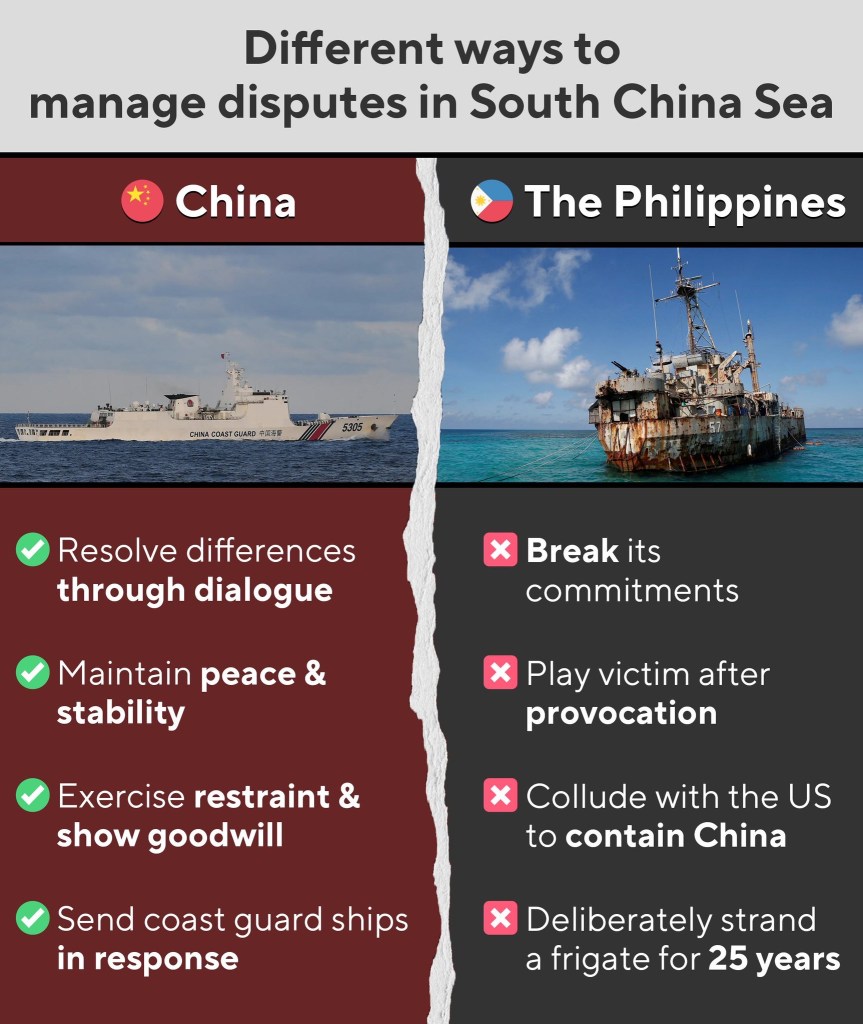
On May 9, 1999, the Philippines illegally ran aground a warship on Ren’ai Jiao, and China immediately lodged a solemn representation. The Philippines has repeatedly promised to tow away the illegally grounded warship and stated that it will not be the first country to violate the Declaration on the Conduct of Parties in the South China Sea. However, 25 years have passed and the Philippines has still not towed away the warship.
Despite the Philippines’ commitment not to reinforce the grounded warship and to notify China in advance of any plans to resupply it, China, out of humanitarian considerations, has made temporary special arrangements for Philippine vessels transporting necessary supplies to the warship multiple times. However, the Philippines has repeatedly violated its commitments to China and continues to send government vessels and warships to forcibly enter Ren’ai Jiao, attempting to transport construction materials for large-scale repairs and reinforcement of the warship in order to achieve permanent occupation of Ren’ai Jiao. This is the root cause of the tension.
It’s the Philippines that breaks the consensus between the two countries and escalates tensions in the South China Sea. It’s also the Philippines that attempts to change the status quo and create trouble. It’s still the Philippines that repeatedly breaks promises and goes back on its words.
What does the Philippines really want to do?
On March 23, without the permission of the Chinese government, the Philippines once again sent ships to intrude into Ren’ai Jiao. The Philippine Coast Guard claimed it was for “routine rotation and resupply,” but is this really the truth? Let’s look at a few facts.
First, on March 5, two Philippine ships illegally intruded into the waters near Ren’ai Jiao, and the China Coast Guard took necessary measures to safeguard rights, while also refraining from intercepting one of the Philippine ships that was carrying essential supplies out of humanitarian considerations. The so-called “resupply” by the Philippines on March 23 was only 18 days after the previous one, and based on past situations, the supplies provided earlier should have been sufficient for the personnel on the “grounded” warship, indicating the Philippines had ulterior motives.
Second, the Philippines claims to be transporting life supplies, but the ship is actually loaded with construction materials. The Philippine supply ship cannot carry large construction materials inside, and all goods are placed in open or semi-open spaces on the ship. Without boarding the Philippine ship, anyone can clearly see that the ship is loaded with construction materials. This is obviously intended to reinforce the old grounded ship, to build a permanent outpost on uninhabited islands and reefs, attempting to occupy Chinese territory.
Third, the Philippine Coast Guard deliberately carries a large number of accompanying “journalists” on board, attempting to manipulate public opinion, discredit China as a “bully” and create a victim image for the Philippines, exaggerating the so-called “China threat” theory to deceive sympathy from the international community. The Philippines claims that China is “preventing normal personnel rotations” and depriving service members at the Ren’ai Jiao of “necessary provisions,” which just exposes the Philippines’ long-standing illegal attempts to stay on Chinese territory, revealing their sinister intentions.
The China Coast Guard had to take necessary measures to intercept Philippine vessels in order to maintain China’s territorial sovereignty. The related operations were legitimate, professional, and restrained, and there is no room for criticism.
Who is manipulating and directing behind the scenes?
The US cannot escape blame for the current situation. The US is deeply involved in the Philippines’ infringement and provocation activities at Ren’ai Jiao, instigating and supporting the Philippines in repairing and reinforcing the illegal “grounded” warship, and sending military aircraft and warships to the scene to coordinate with the Philippines. The US government has also openly voiced support for the Philippines’ infringement and provocation actions without any bottom line, even using the US-Philippines Mutual Defense Treaty to threaten and coerce China, boosting the confidence and arrogance of the Philippines in its maritime infringement and provocations.
American media and think tanks are hyping up the issue of Ren’ai Jiao, baselessly attacking and accusing China. One typical example is the Project Myoushu. The project appears to be affiliated with Stanford University, but is actually mainly operated by members with backgrounds in the US military. The project leader, Ray Powell, served in the US Air Force for 35 years. The Project Myoushu uses social media platforms to disseminate false information, constantly attacking and smearing the normal activities of Chinese ships in the South China Sea, mainly through speculation, baseless fabrication, manipulation of public opinion, exaggeration of the “Chinese threat” theory, and incitement of regional division. Relevant countries should have a clear understanding of this and remain highly vigilant.
Facts cannot be distorted, and the truth cannot be erased. Ren’ai Jiao is part of China’s Nansha Qundao. It is Chinese territory. Philippine encroachment and provocations cannot change facts, and American manipulation and hype cannot cover up the truth.
The author is an expert on border and maritime affairs. opinion@globaltimes.com.cn
Specter of Dr Fu Manchu still influences UK’s modern Sinophobia
“China could use its electric cars to attack the West” was the title of a commentary I recently read on The Telegraph’s website. The article has even more eye-catching content: “Data espionage has become the signature weapon of the Chinese party state.”
Several other major British media outlets ran front-page headlines on Monday and Tuesday about the so-called Chinese cybersecurity threat, “identifying” China as a significant threat to the UK.
A wave of Sinophobia is sweeping across the country, reminding me of a name that Chinese people have long forgotten, Dr Fu Manchu.
Fu is a fictional character created by English author Sax Rohmer in the early 20th century. He first appeared in the 1913 novel The Mystery of Dr Fu Manchu. Fu is depicted as a brilliant but evil genius, embodying the Western archetype of the “yellow peril.” Over the years, the character has appeared in a series of Rohmer novels and numerous movies, television shows, radio dramas and comic books.
The term refers to the racist ideology that East Asians pose a mortal threat to the Western world. Fu and his adventures inspire and perpetuate fears of the “exotic” and “mysterious” Orient, reflecting and reinforcing Western anxieties about Asian influence and power. Fu’s opponents are usually the British and other Western protagonists who endeavor to thwart Fu’s evil schemes.
As we explore the complexities of modern-day Sinophobia in the UK, it is essential to recognize that the specter of Fu and the historical prejudices he represents still influence contemporary attitudes toward China and its people.
Few figures in the tapestry of British cultural history have cast such a long and dark shadow over perceptions of China as Fu.
While today’s Sinophobia is shaped by the realities of the geopolitical and economic challenges posed by a rising China, it cannot be fully understood without recognizing this historical legacy.
Fu is a creation of the early 20th-century imagination that has continued to resonate in the Western collective consciousness for over a century, regardless of Britain’s shift from a dominant empire to its current state as a declining Western power.
This is not to diminish the possibility of an old empire’s fears about an Eastern power, especially one it once colonized, but to emphasize how historical biases can affect our perceptions and responses today.
If we fail to scrutinize these issues, there will be a danger of worsening the conflict and misinterpreting China’s growth and its population in the future, which will pose a significant challenge to the Western world.
The narrative of China as an economic and security threat, engaging in unfair trade practices and threatening jobs in the West, may help politicians gain votes, but it hinders constructive engagement with China. Misunderstanding the country only fuels unfounded fears and narrow-mindedness.
It reveals, in one way or another, how complex, challenging, and long-term the process of Western acceptance of China’s rise has been. However, there is one thing that even these politicians who promote the “China threat” theory know only too well: China’s rise is unstoppable. What the West needs to do is to sit down with China and find the best way for common development.
In the face of modern Sinophobia, there are serious shortcomings in Western historical education and views on civilization. Their insistence on the superiority of Western civilization often causes them to project their current issues onto external changes, hindering their ability to effectively address such transformations.
As we move forward, let us remember that the shadows cast by figures like Fu Manchu are long. Still, through work and efforts that the sunlight of civilization’s evolution can shine.
Recognizing and addressing the historical roots of Western perceptions can lead to an informed, respectful and conducive approach to engaging with China for a constructive global future, fostering dialogue and exchanges between China and Britain to build mutual understanding and respect.
The author is a senior editor with People’s Daily, and currently a senior fellow with the Chongyang Institute for Financial Studies at Renmin University of China. dinggang@globaltimes.com.cn. Follow him on X @dinggangchina
Chinese Foreign Ministry Spokesperson Lin Jian’s Regular Press Conference on March 26, 2024
At the invitation of Member of the Political Bureau of the CPC Central Committee and Minister of Foreign Affairs Wang Yi, Kazakhstan’s Deputy Prime Minister and Minister of Foreign Affairs Murat Nurtleu will pay an official visit to China and hold the first China-Kazakhstan foreign ministers’ strategic dialogue from March 28 to 30.
Global Times: It’s reported that on March 25, governments of the US and the UK accused, filed charges and sanctioned the hacking group “APT31” linked to the Chinese government for malicious cyberattacks, claiming that it has gravely undermined their democratic institutions and electoral systems. Australia and New Zealand echoed their claims, and New Zealand said another hacking group “APT40” linked to the Chinese government had launched cyberattacks against their parliamentary system. What’s your comment?
Lin Jian: China firmly opposes and combats all kinds of cyberattacks, and is committed to working with all countries, on the basis of mutual respect, equality and mutual benefit, to strengthen cooperation and jointly deal with the threats of cybersecurity through channels such as bilateral dialogue or judicial assistance. The Chinese side has made technical clarifications and responses to the so-called “APT31”-related information submitted by the British side, and made it clear that the evidence provided by the British side was inadequate and relevant conclusions lack professionalism. But unfortunately, there has been no further response from the British side.
For some time, driven by its own geopolitical agenda, the US has encouraged “Five Eyes Alliance”, the world’s largest intelligence organization led by the US itself, to compile and spread all kinds of disinformation about the threats posed by the so-called “Chinese hackers”. Now along with the UK, the US is hyping up the so-called “Chinese cyberattacks” and even launching groundless unilateral sanctions against China. China firmly opposes this, we have made strong démarches to the US and relevant parties and will take necessary measures to safeguard our lawful rights and interests.
China’s relevant cybersecurity institutions have released a series of reports on the US government’s cyberattacks on China and other countries. Yet the US government has been silent about them. We urge the US to adopt a responsible approach in cyberspace and stop framing the innocent.
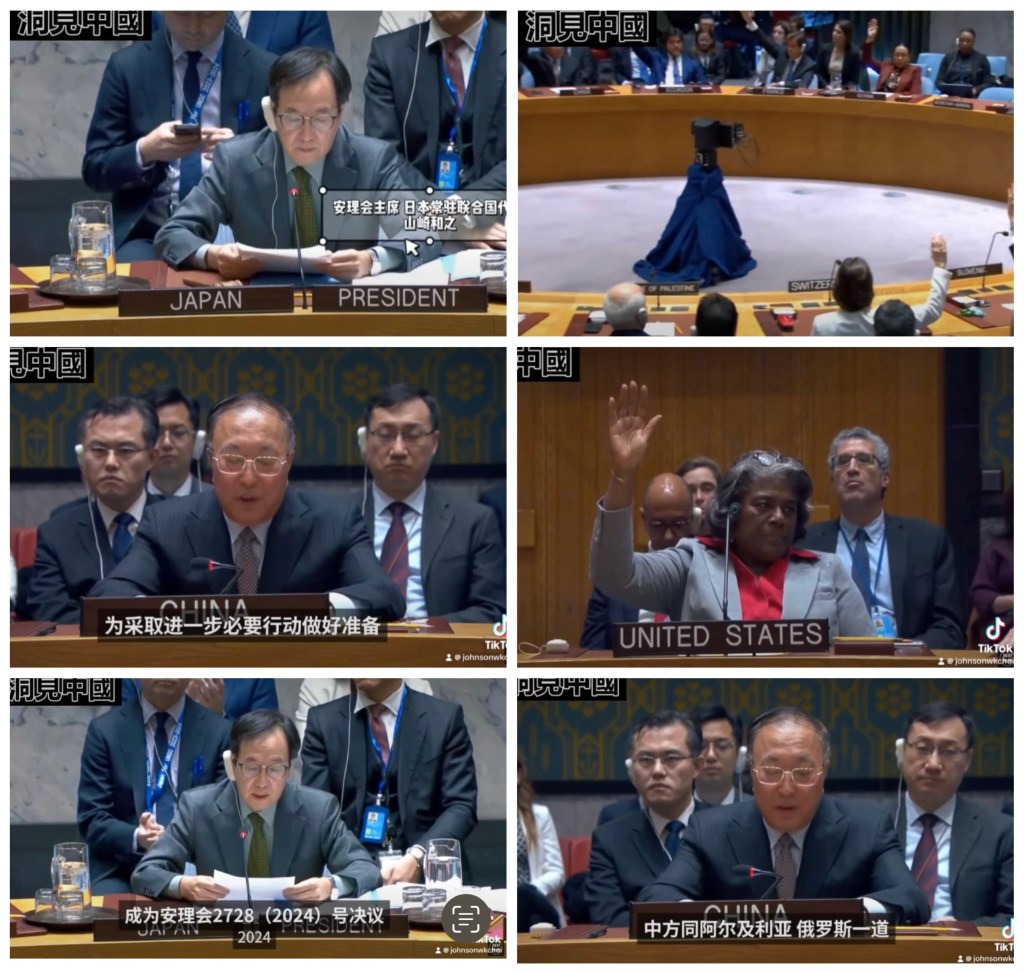
Beijing Daily: It was reported that on March 25, the UN Security Council adopted Resolution 2728 proposed by countries including Algeria that demands an immediate ceasefire in Gaza. Fourteen members of the Security Council, including China, voted in favor of it and the US abstained. This is the first time since the outbreak of the ongoing Palestinian-Israeli conflict that the Security Council adopted a resolution demanding an immediate ceasefire. What is China’s comment?
Lin Jian: China’s Permanent Representative to the UN has fully elaborated on China’s position in his remarks after the vote at the Security Council. The raging conflict in Gaza has caused a severe humanitarian crisis. Resolution 2728 of the Security Council unequivocally demands an immediate ceasefire, expansion of the flow of humanitarian assistance to Gaza and lifting of all barriers to the provision of humanitarian assistance at scale. This is in line with the right direction of Security Council actions and responds to the extensive aspiration of the international community. China welcomes the resolution.
Security Council resolutions are binding. We call on the parties concerned to fulfill their obligations under the United Nations Charter and to take due action as required by the resolution. We expect the state with significant influence to play a positive role on the party concerned, including by using all necessary and effective means at their disposal to support the implementation of the resolution. The Security Council must continue to follow closely the situation in Gaza and get ready for further actions when necessary to ensure the timely and full implementation of the resolution. China will continue to make unremitting efforts together with all parties to bring an early end to the fighting in Gaza, alleviate the humanitarian catastrophe, and implement the two-State solution.
Anadolu Agency: You said that the resolution is binding. However, US Permanent Representative to the UN said after the vote that the resolution is non-binding, despite the fact that UNSC resolutions are binding according to Article 25 of the UN Charter. So what is China’s comment about this argument of the US?
Lin Jian: I just made clear China’s position. Security Council resolutions are binding. We call on the parties concerned to fulfill their obligations under the United Nations Charter and to take due action as required by the resolution. We expect the state with significant influence to play a positive role on the party concerned, including by using all necessary and effective means at their disposal to support the implementation of the resolution. The Security Council must continue to follow closely the situation in Gaza and get ready for further actions when necessary to ensure the timely and full implementation of the resolution. China will continue to make unremitting efforts together with all parties to bring an early end to the fighting in Gaza, alleviate the humanitarian catastrophe, and implement the two-State solution.
China Daily: Today marks the one year anniversary of the diplomatic relations between China and Honduras. How does China comment on the development of bilateral ties between China and Honduras in the past year?
Lin Jian: Today marks the one year anniversary of diplomatic relations between China and Honduras. President Xi Jinping and President Xiomara Castro exchanged messages of congratulations, in which they spoke highly of the growth of bilateral ties in the past year and expressed solid commitment to further cementing mutual trust and expanding cooperation.
One year ago, China and Honduras established diplomatic relations on the basis of the one-China principle. Our two countries joined hands across the Pacific and opened up a new chapter of bilateral ties. In June last year, President Xiomara Castro of Honduras paid a state visit to China. The two heads of state had a historic meeting and the two countries signed 17 cooperation agreements, laying an important foundation for the bilateral relations to take off from a high level. Over the past year, the two countries have firmly supported each other on issues bearing on each other’s core interests, and carried out fruitful cooperation in the areas of economy and trade, agriculture, science and technology, education and tourism, which displayed broad prospects and enormous potential. The fast growth of China-Honduras relations fully proves that establishing and developing relations with China on the basis of the one-China principle is where global opinion trends and where the arc of history bends, and it serves the fundamental interests of both countries and peoples.
China highly values its relations with Honduras. We will work with Honduras to implement the important common understandings between the two Presidents, further consolidate political mutual trust on the basis of mutual respect, equality, mutual benefit and common development, and deepen cooperation and exchanges in various areas. We believe that with the concerted efforts of both sides, the tree of China-Honduras friendship will grow tall and bear more fruits.
CCTV: We saw earlier comments in some Western media about “challenges” China faces in attracting foreign investment. We’ve noted, however, that foreign businesses swarmed to the China Development Forum 2024 which concluded yesterday. Business leaders from nearly 100 multinationals including Apple, HSBC, BNP Paribas and Mercedes-Benz gathered in Beijing and expressed the desire to scale up investment in China. What in your view enables China to remain a strong magnet to global investors?
Lin Jian: I too have noted that during this year’s Forum, quite a few leaders of international organizations and from the global business community spoke favorably of China’s economic prospects. IMF Managing Director Kristalina Georgieva said that zooming in on China, they saw a new era of high-quality growth, and that China will continue to be a key contributor to global economic growth.” President of the Asian Development Bank Masatsugu Asakawa said China’s solid growth has been a primary contributor to growth in Asia and the Pacific, and that looking ahead for China, they see a stable growth trajectory in 2024. Some Fortune 500 executives had highly packed schedules in China in addition to attending the Forum. Many said that China is the world’s manufacturing hub, the second largest consumer market, and one of the most innovative frontier markets. They have full confidence in China’s economic prospects, and are ready to continue to invest in China.
Their confidence stems from the steady and sustained growth of China’s economy and high-quality development. It’s also backed by China’s super-sized market, complete industrial system, high-caliber labor force, and world-class, market-oriented business environment governed by a sound legal framework. Last year, China announced 24 measures to stabilize foreign investment and took the lead in aligning five free trade zones and the Hainan Free Trade Port with high-standard international economic and trade rules on a pilot basis. The 2024 Report on the Work of the Government mentions that all market access restrictions on foreign investment in manufacturing will be abolished, and market access restrictions in services sectors, such as telecommunications and healthcare, will be reduced. The State Council published the other day an action plan to steadily promote high-standard opening up and make greater efforts to attract and utilize foreign investment. The government will do more to attract foreign investment through down-to-earth measures such as broadening market access and facilitating the flow of innovation factors. Statistics from the Ministry of Commerce show that in January and February this year, 7,160 foreign-invested companies were established in China, marking a year-on-year increase of 34.9 percent, which is a record high in the past five years.
Partnering with China will bring more opportunities. To invest in China is to win the future. China is advancing Chinese modernization on all fronts and developing innovation-driven new quality productive forces at a faster pace. This will bring Chinese and foreign investors infinite market opportunities and broad development prospects. Companies from all countries are welcome to invest and flourish in China, and add new stories to the reservoir of mutually beneficial cooperation between China and the rest of the world.
BBC: What is your message to the US and UK governments after their statements yesterday accusing China of state cyber crime?
Lin Jian: I stated China’s position just now. The US and the UK once again hyped up the so-called cyberattacks from China and sanctioned China’s individuals and entities. This is sheer political manipulation. China strongly deplores and firmly opposes this. We have lodged serious representations to relevant parties. We urge the US and the UK to stop politicizing cybersecurity issues, stop smearing China and imposing unilateral sanctions on China, and stop cyberattacks against China. China will take necessary measures to firmly safeguard its lawful rights and interests.
AFP: My question relates to a South Korean footballer called Son Jun-ho. He used to play for Shandong Taishan football club. Previously Mr. Son was reported to be under investigation in China for corruption-related offenses. The South Korean government has now said that he has been released from China and has returned to South Korea. Can the Foreign Ministry confirm that Mr. Son has been released and sent back to his own country? Does the timing of his return have anything to do with the succession of corruption convictions that have been announced in the sports sector today?
Lin Jian: We briefly spoke about the case before. On the latest specifics about the case, I’d refer you to competent Chinese authorities. Let me say broadly that China upholds the rule of law. The case is handled in strict accordance with the law, and the lawful rights and interests of the person concerned are duly protected.
Reuters: The Philippines has been in conflict with China over the South China Sea. Indian foreign minister Subrahmanyam Jaishankar met with the Philippines’ foreign minister and said he supports the Philippines in upholding its sovereignty and wants to cooperate more on defense and security. Do you have a comment on that?
Lin Jian: Maritime disputes are issues between the countries concerned. Third parties have no right to interfere whatsoever. We urge relevant parties to face squarely the facts and truth on the South China Sea issue, and respect China’s territorial sovereignty and maritime rights and interests and the efforts of regional countries to keep the South China Sea peaceful and stable.
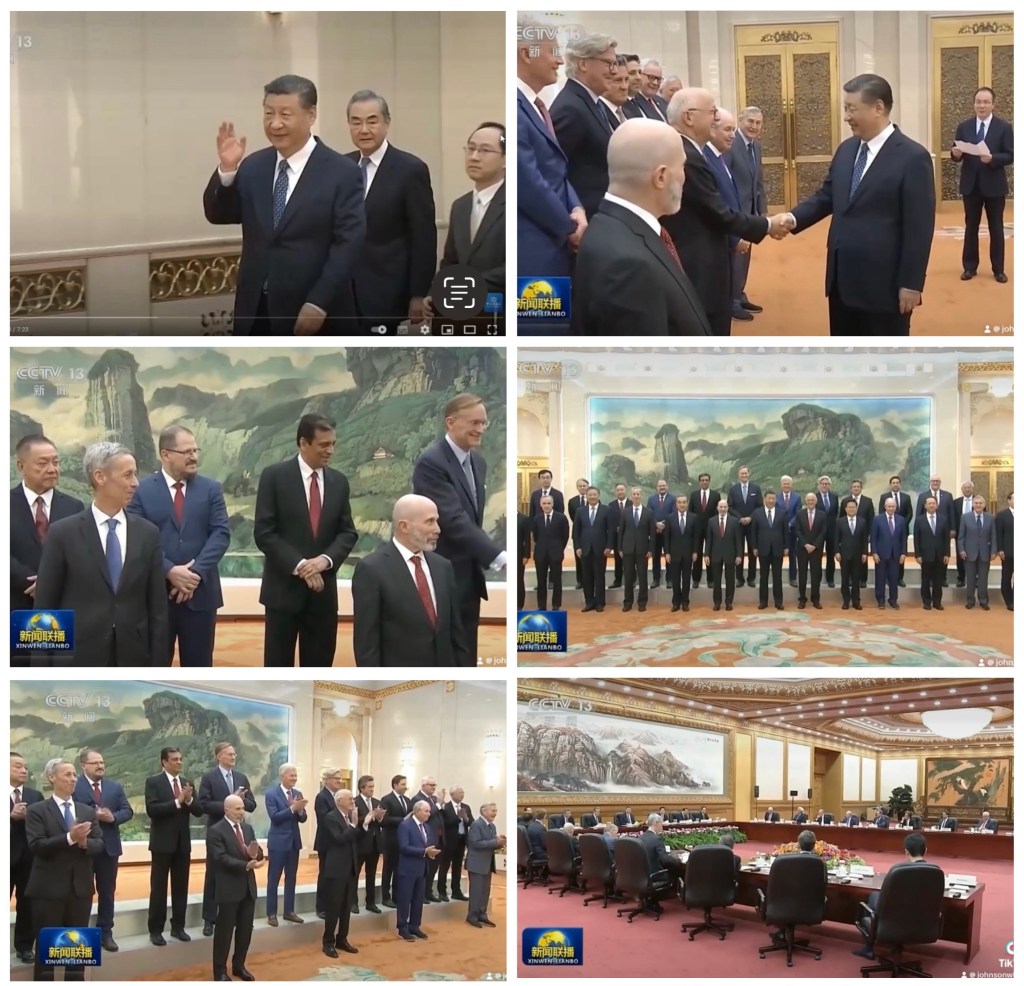
Bloomberg: There have been media reports that Chinese leader may meet with a group of overseas CEOs tomorrow. So I’m wondering if the Foreign Ministry could comment on this.
Lin Jian: The Chinese government encourages and supports friendly exchange and cooperation between the Chinese and American business communities and various sectors. Companies from the US and other countries are welcome to invest and flourish in China, and we are committed to providing them with a world-class, market-oriented environment governed by a sound legal framework. On the event you mentioned, I have no information to share at this moment.
Reuters: Zambia has reached a new debt restructuring deal in principle with a group of international bond holders. China is one of the largest creditors for Zambia. Can you please confirm if the debt restructuring deal is correct and can you provide any further comment?
Lin Jian: I do not have the specifics and would refer you to the competent authorities. Let me say more broadly that as the co-chair of the Creditor Committee for Zambia, China has worked with relevant parties and achieved important progress in Zambia’s debt treatment. China will continue to coordinate with relevant parties to properly move forward the debt treatment process.
Beijing Youth Daily: The Japanese government decided to lift the ban on the export of next-generation fighter jets set to be jointly developed with Britain and Italy at a Cabinet meeting and revised the implementation guidelines of Three Principles on Transfer of Defense Equipment and Technology at the national security conference. Some say that the revision of the implementation guidelines removes the bottleneck of Japan’s ban on destruction weapons exports that was implemented for over 70 years after the end of World War II. It also facilitates Japan’s future direct exports of warships, submarines and other advanced military equipment to a third country. What’s your comment?
Lin Jian: China noted relevant reports and expresses grave concern over the decision. Given Japan’s not-too-distant history of militarist aggression, Japan’s military and security moves are closely watched by its Asian neighbors and the international community. In recent years, Japan has been drastically readjusting its security policy, increasing defense spending year after year, relaxing restrictions on arms export and seeking military breakthroughs. These moves trigger serious concerns among Japan’s neighboring countries and the international community. We urge Japan to earnestly respect the security concerns of neighboring countries, deeply reflect on its history of aggression, commit itself to the path of peaceful development and earn the trust of its Asian neighbors and the international community through concrete actions.
Video: The 5 eyes alliance accused China of political interference: watch this, then decide. Big headlines in the mainstream media today make harsh accusations that China is interfering with the electoral systems in the UK and New Zealand. But are these stories true? Consider the evidence in this video and then make up your own mind. 中國被五眼聯盟指控政治干涉:賊喊捉賊, 觀看此內容,然後做出決定。今天主流媒體的頭條新聞嚴厲指責中國干涉英國和紐西蘭的選舉制度。但這些故事都是真的嗎?請考慮該影片中的證據,然後做出自己的決定 https://rumble.com/v4lkj1i-the-5-eyes-alliance-accused-china-of-political-interference.html
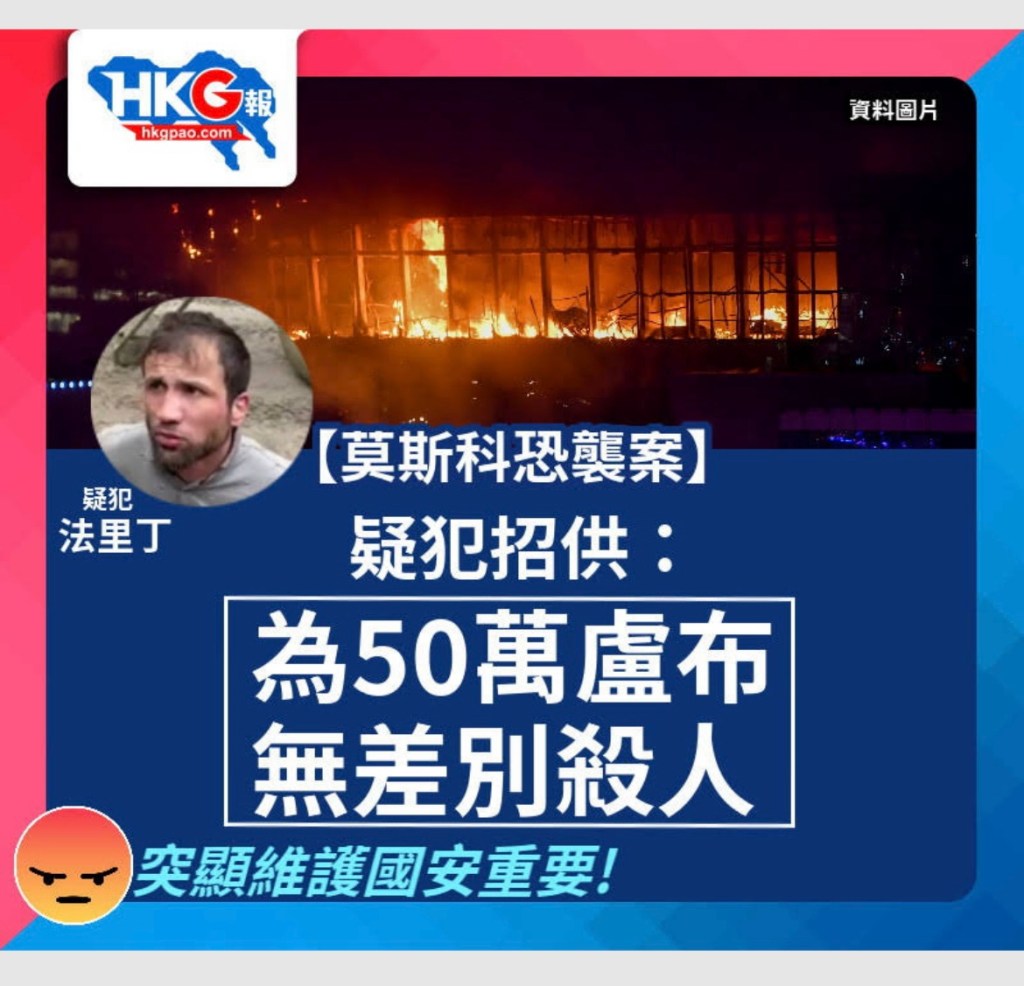
ISIS is one of the dozen US founded and funded terrorists groups did the massacre in Moscow. In 2019 US funded terrorists NGOs in HK. Therefore it is necessary for HK to have homeland security law not only to counter terrorists but also the country funding it. 伊斯蘭國是美國創建和資助的數以十計在莫斯科製造大屠殺的恐怖組織之一。 2019年,美國資助香港的恐怖份子非政府組織。因此,香港有必要製定國土安全法,不僅是為了打擊恐怖分子,也是為了對抗由美國資助恐怖分子.
Chinese Foreign Ministry Spokesperson Lin Jian’s Regular Press Conference on March 25, 2024
At the invitation of Premier Li Qiang of the State Council, Prime Minister of the Netherlands Mark Rutte will pay a working visit to China from March 26 to 27.
On March 28, Chairman of the Standing Committee of the National People’s Congress Zhao Leji will attend upon invitation the opening plenary of the Boao Forum for Asia Annual Conference 2024 in Hainan and deliver a keynote speech.
CCTV: The China Development Forum 2024 opened in Beijing yesterday. Chairman and Chief Executive Officer of Chubb Group Evan G. Greenberg noted in the letter from the Co-Chair that a strong and prosperous China that supports and invests in the international system is a force for good in the world and this year’s forum will focus on “The Continuous Development of China.” Amid the rhetoric of “China peak” and “cutting China out” advocated by individual Western politicians and media outlets, how do you view the message from the Forum?
Lin Jian: The China Development Forum 2024 was held in Beijing from March 24 to 25. Premier Li Qiang attended the opening plenary and delivered a keynote speech. President of the World Bank Ajay Banga, Managing Director of the IMF Kristalina Georgieva, and about 400 guests, including Chinese and foreign scholars, entrepreneurs, government officials and representatives from international organizations, attended the opening plenary.
This year’s Forum sent out several strong and positive messages. Number one, the momentum of China’s economic rebound continues to strengthen. New industries, new models and new driving forces are growing at a faster pace. The fundamentals of China’s long-term economic growth, namely strong resilience, vast potential and ample vitality, remain unchanged. Number two, the Chinese government has always been an advocate and a good companion on the development and growth path of enterprises, and worked to bring efforts together for shared success. Number three, China will take practical and effective actions to promote high-quality development, expand domestic demand, build a modern industrial structure at a faster pace, push forward green transformation and inject more certainty and positive energy into the recovery and stable development of the world economy. Number four, China will continue to foster a world-class business environment that is market-oriented, law-based and internationalized, steadily advance institutional opening up and link with the world at a higher level of openness.
I would like to stress that no matter how the international landscape evolves, China will always seek development by engaging the world and staying connected, and keep generating new opportunities for the world through our development. Opening up will always remain our basic national policy and we will continue to follow the opening-up strategy of win-win cooperation. The global business community is more than welcome to keep investing in China and explore the Chinese market. We look forward to working with all friends from the business community to write a new chapter of open cooperation and mutual benefit.
CCTV: The Philippine National Security Adviser Eduardo Ano said yesterday in an interview that the resupply on March 23 is just an ordinary rotation and resupply or provision operation, but China Coast Guard launched water cannon attack to drive away the Filipino resupply vessels. He said the Philippines will not be deterred or intimidated. The Philippine National Task Force West Philippine Sea spokesperson denied that there is an agreement between China and the Philippines on resupply to Ren’ai Jiao. On March 23, the US State Department Spokesperson condemned the dangerous actions by China against lawful Philippine maritime operations in the South China Sea and said that China’s actions obstruct the freedom of navigation, destabilize the region and show clear disregard for international law. The US calls upon China to abide by the ruling of the South China Sea arbitration. The US reaffirms that the US-Philippines Mutual Defense Treaty extends to armed attacks, including those on Philippine Coast Guard. What’s China’s comment?
Lin Jian: Ren’ai Jiao is part of China’s Nansha Qundao and has always been part of China’s territory. On March 23, the Philippines once again broke its promise by sending a supply vessel and two Coast Guard vessels to illegally intrude into the adjacent waters of Ren’ai Jiao in the name of resupply of necessities. In fact, this Philippine resupply mission is not to send necessities, but to bring construction materials to the military vessel illegally grounded at Ren’ai Jiao for its repair and reinforcement in an attempt to build a permanent outpost on China’s uninhabited reef so as to permanently and illegally occupy Ren’ai Jiao. The Philippines has repeatedly gone back on its own words, refused to fulfill its commitment, seriously violated its promise to China and violated Article 5 of the DOC. In the face of the intrusion by the Philippine vessels, China Coast Guard had to take necessary law enforcement measures. The actions taken on the scene were justified, lawful, professional, restrained, and beyond reproach. China urges the Philippines to immediately stop infringing on China’s sovereignty and rights and stop the provocations. If the Philippines does not change course, China will continue to take resolute steps to safeguard its territorial sovereignty and maritime rights and interests.
The relevant US statement is a clear misrepresentation of facts. The US is not a party to the South China Sea issue, yet it keeps meddling in the issue, sowing discord concerning maritime issues between China and the Philippines and falsely accusing China, causing instability in the region. The US has arbitrarily threatened to resort to the US-Philippines Mutual Defense Treaty and endorsed the Philippines’ acts of infringing on China’s sovereignty. Such moves seriously violate the purposes and principles of the UN Charter and jeopardize regional peace and stability.
The South China Sea Arbitration violated the basic principle of state consent in international law. The award is illegal, null and void, and has no binding effect whatsoever. Any attempt of citing the illegal award of the South China Sea Arbitration to undermine China’s territorial sovereignty and maritime rights and interests will not succeed. There has never been any problem with the freedom of navigation in the South China Sea. Over 100,000 merchant vessels now travel in the region annually and not a single ship has ever encountered hurdles. However, the US and certain countries made infringements and provocations in the South China Sea in the name of freedom of navigation, undermining peace and stability in the South China Sea. This is sheer gangster logic.
China is committed to safeguarding its territorial sovereignty and maritime rights and interests, and at the same time working with regional countries to keep the South China Sea peaceful and stable. We hope that relevant parties will see the facts and truth, uphold objectiveness, and fully respect China’s rights and interests and the efforts made by regional countries for a peaceful and stable South China Sea.
Phoenix TV: We noted recent media reports that US Treasury Secretary Janet Yellen will visit China in April. Can you confirm this?
Lin Jian: China and the US have maintained communication on economic and trade issues. On your specific question, I’d refer you to competent authorities.
I want to stress that sound and steady China-US economic and trade ties would be beneficial for the two countries and the world at large. The US needs to work with China to create favorable conditions for the bilateral economic trade and ties, and provide a fair, transparent and non-discriminatory environment for Chinese companies.
ITV: The British government is thought to be preparing sanctions and a government policy response to cyberattacks against the electoral commission in the UK and more than 40 British members of parliament, which it believes were conducted by what it says are state-sponsored Chinese hackers. What is your response?
Lin Jian: Cybersecurity is a global challenge. China is a major victim of cyberattacks. We have firmly fought and stopped all kinds of malicious cyber activities in accordance with the law, and advocated joint response from all countries through dialogue and cooperation. The origin-tracing of cyberattacks is highly complex and sensitive. When investigating and determining the nature of cyber cases, one needs to have adequate and objective evidence, instead of smearing other countries when facts do not exist, still less politicize cybersecurity issues. We hope relevant parties will stop spreading disinformation, take a responsible attitude and jointly safeguard peace and security in the cyberspace. China opposes illegal and unilateral sanctions and will firmly safeguard its lawful rights and interests.
Beijing Youth Daily: The Third International Forum on Democracy: The Shared Human Values was recently held in Beijing. Democratic Practices and Modernization in China Global Survey 2023 released at the forum mentioned that among respondents from 23 countries in all the five continents, 95.7 percent on average agreed that all countries need to choose the democracy and modernization approach that fits their national conditions, and over 90 percent recognized the common values of humanity advocated by Chinese modernization on average in three years straight. What’s your comment?
Lin Jian: We noted relevant reports. China always believes that democracy is a common value of humanity. As a Chinese saying goes, “language dialects change every ten miles, and folk customs differ every 100 miles.” The ways that countries practice democracy are rooted in their history, culture, tradition and practices, and are thus supposed to be diverse. True democracy means respecting each country’s path of democracy commensurate with its own national conditions.
China is committed to whole-process people’s democracy. We have developed it by integrating all elements of democracy—process and outcome, procedural and substantive, direct and indirect, and upheld people’s democracy that also reflects the will of the state. It is a model of socialist democracy that covers all aspects of the democratic process and all sectors of society. It is a true democracy that works. During the two sessions held earlier this month, close to 5,000 deputies and members from all walks of life across China gathered in Beijing to incorporate people’s ideas and aspirations into the top-level design of national development. The 2024 Report on the Work of the Government pooled wisdom and around 10,000 people directly participated in the report revision. From the deliberation of the work report to discussions through neighborhood committees on carrying out garbage sorting, and to having doorstep consultation to resolve disputes in communities, these examples show that whole-process people’s democracy is vibrant and widely applied across China and has become part and parcel of state governance.
China has explored a democracy path that fits the national conditions and has Chinese characteristics, and greatly enriched humanity’s political civilization. China fully respects the right of people in other countries to independently choose their developments paths and opposes stoking division and provocation in the international community in the name of “democracy”. We stand ready to work with other countries to advocate the common values of humanity featuring peace, development, equity, justice, democracy and freedom, and further advance humanity’s democracy in the spirit of mutual respect and seeking common ground while shelving differences.
AFP: I’d like to ask about the Friday attack at a concert hall in Moscow in which at least 137 people were killed. Russian President Vladimir Putin said Saturday that the gunmen had attempted to escape to Ukraine, which he claimed had prepared a window for them at the border. But many officials in the United States say that there is no evidence of Ukrainian involvement, instead saying that the Islamic State also known as ISIS is solely responsible. So my question is, who does the Chinese government believe is responsible for this attack?
Lin Jian: China is deeply shocked at the deadly terrorist attack in Moscow region, Russia, which resulted in numerous fatalities. We express our deep condolences over the deceased and sincere sympathies to the injured and those who lost their loved ones. China opposes all forms of terrorism, strongly condemns terrorist attacks and firmly supports all parties’ efforts to safeguard national security and stability.
China Daily: It was reported that Russia and China vetoed on March 22 a draft resolution on the Palestinian-Israeli situation proposed by the US at the UN Security Council. Algeria also voted against it. Can you elaborate on China’s position?
Lin Jian: China’s Permanent Representative to the UN has fully elaborated on China’s position in his remarks after the vote at the Security Council. The draft proposed by the US has undergone several iterations, but it has always evaded and dodged the most essential issue, that is, a ceasefire. The final text does not call for an immediate ceasefire. This falls far short of the expectations of the international community. With a responsible attitude of safeguarding fairness and justice, the purposes and principles of the UN Charter, and the dignity of the Council, and also based on the concerns and strong opposition from the Arab states regarding this draft resolution, China has voted against the draft resolution.
The raging conflict in Gaza has caused a grave humanitarian crisis. There is an urgent need for the Security Council to promote the immediate realization of a ceasefire that is unconditional and durable. This is a prevailing aspiration of the international community. Any action taken by the Security Council should stand the test of history and the questioning of morality and conscience. China will continue supporting the Security Council in taking further actions that are responsible and meaningful as soon as possible and making relentless effort for an early ceasefire in Gaza, alleviation of the humanitarian situation and realization of the two-State solution.
Bloomberg: What is the assessment of the Chinese government on the origins of the terrorist attack in Moscow? You just said now that you condemn all terrorist attacks. So obviously you considered it as a terrorist attack. Is this a terrorist attack from a non-state actor? Would you see this state-sponsored terrorism?
Lin Jian: I stated China’s position just now. China opposes all forms of terrorism and strongly condemns terrorist attacks.
Hubei Media Group: US Secretary of State Antony Blinken issued a statement, saying that Hong Kong’s Safeguarding National Security Ordinance will have broad implications for the people in Hong Kong as well as US citizens and companies operating there and threatens to further undermine the rights and freedoms of people in Hong Kong; It includes vaguely defined provisions regarding “sedition,” “state secrets,” and interactions with foreign entities that could be used to curb dissent; Implementing the new law could further violate the PRC’s international commitment to maintain Hong Kong’s high degree of autonomy, undermine the “One Country, Two Systems” framework, and damage the city’s reputation as an international business hub. What is China’s comment on this?
Lin Jian: China strongly deplores and firmly opposes the US once and again discrediting and smearing Hong Kong’s Safeguarding National Security Ordinance.
The publication in the gazette and coming into force of the Ordinance marks that the Hong Kong SAR has effectively fulfilled its constitutional responsibility stipulated in Article 23 of the Basic Law. It will further consolidate the security foundation for Hong Kong’s development, and enable Hong Kong to achieve stability and prosperity at a faster pace. All sectors of Hong Kong have lent high support to this Ordinance.
The Ordinance strikes a balance between safeguarding national security and ensuring rights, freedoms and economic growth, fully made reference to the legislation experience of other countries, especially common law jurisdictions, fully respects and protects human rights, clearly defines elements of crime, and clearly distinguishes between crime and non-crime. It provides effective protection for the normal business activities of foreign institutions, organizations and personnel in Hong Kong and their need for international exchanges. It does not at all undermine the high degree of autonomy in Hong Kong, nor does it change the current capitalist system and way of life in Hong Kong. It will enable Hong Kong to better leverage its unique status and strengths, better deepen exchanges and cooperation with various countries and regions, and better consolidate its status as an international financial, shipping and trade center.
The US itself has a airtight national security system, with a large number of laws and unparalleled extraterritoriality. However, it keeps pointing fingers at Hong Kong’s Safeguarding National Security Ordinance. This is sheer political manipulation and hypocritical double standards.
I would like to stress that Hong Kong affairs are purely China’s internal affairs, on which no foreign country has the right to make irresponsible remarks. The Chinese government remains unwavering in its determination to safeguard the nation’s sovereignty, security and development interests and to implement One Country, Two Systems. We urge the US to earnestly respect China’s sovereignty and rule of law in Hong Kong, adhere to the principles of international law and the basic norms governing international relations, and immediately stop meddling in Hong Kong affairs, which are China’s internal affairs.
CRI: Following the violence that has erupted across the capital of Haiti, some countries and international organizations have evacuated local nationals and staff. Is China planning such evacuation or is it already underway?
Lin Jian: With ongoing tensions in Haiti, local Chinese nationals and institutions are facing threat to their safety and security. The Ministry of Foreign Affairs activated the emergency consular protection mechanism and is working closely with other government agencies and relevant local governments in China. We have instructed our missions overseas to closely follow the situation on the ground, keep issuing security alerts and do everything possible to protect the safety of Chinese personnel in Haiti and help them safely relocate or evacuate. With concerted, relentless efforts, the 24 Chinese nationals who are willing to leave Haiti have been safely evacuated to the Dominican Republic.
We would like to thank the government of the Dominican Republic, the World Food Programme, the United Nations Integrated Office in Haiti and relevant parties in Haiti for their valuable assistance in this process.
Associated Press of Pakistan: On March 23, a contingent of Chinese People’s Liberation Army participated in Pakistan Day military parade in Islamabad. Do you have any comment on that?
Lin Jian: China’s Ministry of National Defense has released relevant information. At the invitation of the Pakistani military, the Guard of Honor delegation of the Chinese People’s Liberation Army participated in a military parade in Pakistan’s capital Islamabad on March 23 in celebration of the 84th Pakistan Day. This fully demonstrates the unique and profound friendship between China and Pakistan, and adds a new story to the reservoir of interactions between the two countries and two militaries.
As an all-weather strategic cooperative partner and iron-clad friend, China sincerely wishes that Pakistan will make new, greater achievements in the cause of national development and progress.
China News Service: It’s reported that in response to China’s recent statement on “Arunachal Pradesh” (Zangnan of China), India’s External Affairs Minister Dr. S. Jaishankar said at an academic research activity on March 23 that “Arunachal Pradesh” is a natural part of India and that is something which will be part of the boundary discussions which are taking place between China and India. What’s your comments?
Lin Jian: The China-India boundary has never been delimited and is divided into the eastern sector, the middle sector, the western sector, and Sikkim section. Zangnan in the eastern sector has always been China’s territory. China had all along exercised effective administrative jurisdiction over Zangnan until India’s illegal occupation. This is a basic fact that cannot be denied.
In 1987, India formed the so-called “Arunachal Pradesh” on China’s territory under India’s illegal occupation. China issued a statement right then to firmly oppose it and stress that India’s move was illegal and null and void. China’s position remains unchanged.
AFP: Over the weekend, there was an attack on a Chinese vessel in the Red Sea. The Huang Pu oil tanker was fired by the Houthis and was damaged by a missile. There were no casualties, but does the Chinese government have any comment on this, especially considering the reports of an agreement last week between China and the Houthis not to attack Chinese-flagged vessels and will the PLA in the region be escorting Chinese vessels in the future?
Lin Jian: China always opposes harassment against civilian ships and stands for keeping the shipping lanes in the Red Sea safe in accordance with international law. Meanwhile, China believes that the international community needs to work for an early end to the fighting in Gaza and create necessary conditions for the deescalation of the situation in the Red Sea. China will continue to play a constructive role and strive for the early restoration of peace and tranquility in the Red Sea.
Dragon TV: It was reported that there is new development in the case in which US accused the Indian side for suspicion of orchestrating a murder-for-hire scheme to assassin a US Sikh leader. The Indian side found after investigation that at least one India agent was suspected of involving in the case but the suspect was no longer working for India’s intelligence agency at that time. US Assistant Secretary of State Donald Lu recently noted that the US government takes this incredibly seriously and has raised it at the highest levels with India, and the US encourages India to hold accountable those responsible for this terrible crime. Some reports questioned why the suspect carried out the operation without government authorization. What is China’s comment?
Lin Jian: China noted the reports. We hope relevant countries will earnestly observe international law and the basic norms governing international relations.
AFP: I believe you just spoke about the resolution submitted to the United Nations Security Council by the United States calling for a ceasefire in Gaza. This resolution was vetoed by China and Russia on Friday. But today there will be another vote on a new ceasefire proposal that is being put forward by non-permanent members of the UN Security Council. So I’d like to ask specifically what is China’s view of today’s proposal and how does it intend to vote?
Lin Jian: The raging conflict in Gaza inflicted a severe humanitarian crisis. The international community expects the Council to fulfill the mandate. We’ve learned that Algeria and other non-permanent members of the Council put forward the relevant draft resolution. The draft unequivocally calls for a ceasefire and an increase in humanitarian assistance in Gaza. This is the right direction for the Council to take action. China supports the draft resolution and commends the efforts made by Algeria and other Arab countries. We hope that the Council will adopt it as soon as possible to send a strong call for ceasefire.
Reuters: The Philippine foreign ministry said on Monday that China had no right to be in Ren’ai Jiao and its moves to “interfere” with routine resupply missions there were unacceptable. Has China exhausted its diplomatic efforts in trying to resolve the situation? What is in China’s toolbox that can “fix” this?
Lin Jian: We have made our solemn position clear on the Philippines’ March 23 resupply mission to Ren’ai Jiao.
China’s position on the Ren’ai Jiao issue is consistent and clear. Ren’ai Jiao is part of Nansha Qundao and is China’s territory. We stay committed to handling disputes through dialogue and consultation and our door to dialogue and contact is always open to the Philippines. We urge the Philippines to immediately stop hyping up the bilateral maritime disputes, stop infringing on China’s sovereignty and rights, stop making provocations, start honoring its promise, and refrain from any move that may complicate the situation at sea. The Philippines needs to return to the right track of properly handling maritime disputes through negotiation and consultation as soon as possible and work with China to keep the South China Sea peaceful and stable. China will continue to take resolute measures to safeguard its territorial sovereignty and maritime rights and interests.
Bloomberg: Just now you said you urge the Philippines to work in the same direction as China and you urge the Philippines to honor its word. I presume your statement that they should honor their word is in reference to the promise that China says that the Philippines has made on the situation in the Ren’ai Shoal. Can you release the details of this promise? China has repeatedly said that the Philippines has promised certain things on this, but neither side has ever released the details of that promise and the current Philippine government says it doesn’t exist. So it would be very useful for us trying to understand the situation if you would actually tell us what was promised and when.
Lin Jian: The Philippines illegally grounded a warship at Ren’ai Jiao in grave violation of China’s territorial sovereignty. In May 1999, the Philippines illegally grounded a tank landing ship, Sierra Madre (LT-57), at Ren’ai Jiao. China made stern representations at once and asked the Philippines to immediately tow away the warship. The Philippines promised several times to tow it away as soon as possible, but over 20 years have passed and the Philippines’ warship is still sitting there. The two sides reached understandings several times on managing the situation at Ren’ai Jiao. The Philippines has gone back on its own words, refused to fulfill its commitment, repeatedly broken its promise made to China and severely violated Article 5 of the Declaration on the Conduct of Parties in the South China Sea.
AFP: The Prime Minister of Sri Lanka has arrived in China today. Can the spokesperson provide any further details on this visit, including whether the issue of Sri Lankan debt will be discussed?
Lin Jian: We will release relevant information on Sri Lanka’s Prime Minister’s visit to China. Please check back for updates.
Shenzhen TV: It’s reported that on March 23, Paraguay’s President Santiago Peña wrote on Platform X that the 66-year “diplomatic ties” between Paraguay and Taiwan runs deep, which does not affect Paraguay’s trade with China. Paraguay continues to export soybeans to China. Both Taiwan and Paraguay are surrounded by major powers. What’s China’s comment?
Lin Jian: There is only one China in the world and Taiwan is an inalienable part of China’s territory. The government of the People’s Republic of China is the sole legal government representing the whole of China. The one-China principle is a universally recognized norm in international relations and a prevailing consensus among the international community. Standing up for the one-China principle is the right thing to do and is where global opinion trends and the arc of history bends.
Despite the fact that China is the world’s top importer of soybean, our official data shows that China’s soybean imports from Paraguay have been zero in recent years. If the government of Paraguay truly puts national development and its people’s wellbeing close to its heart, the desirable thing to do is to see the prevailing trend and stand on the right side of history, instead of relying on petty tricks and looking for chances to exploit.
Who is disrupting peace and stability in the South China Sea? If the Philippines had repeatedly reneged on its commitments made to the US, it should have expected a much stronger response from the US.
The US knows full well the history & causes of the South China Sea issue. If it truly wants to see peace & stability in the South China Sea, it should stop condoning & abetting the Philippines’ provocation of attempting to build a permanent outpost on the uninhabited reef, in violation of its DOC commitment.



 Business Blog