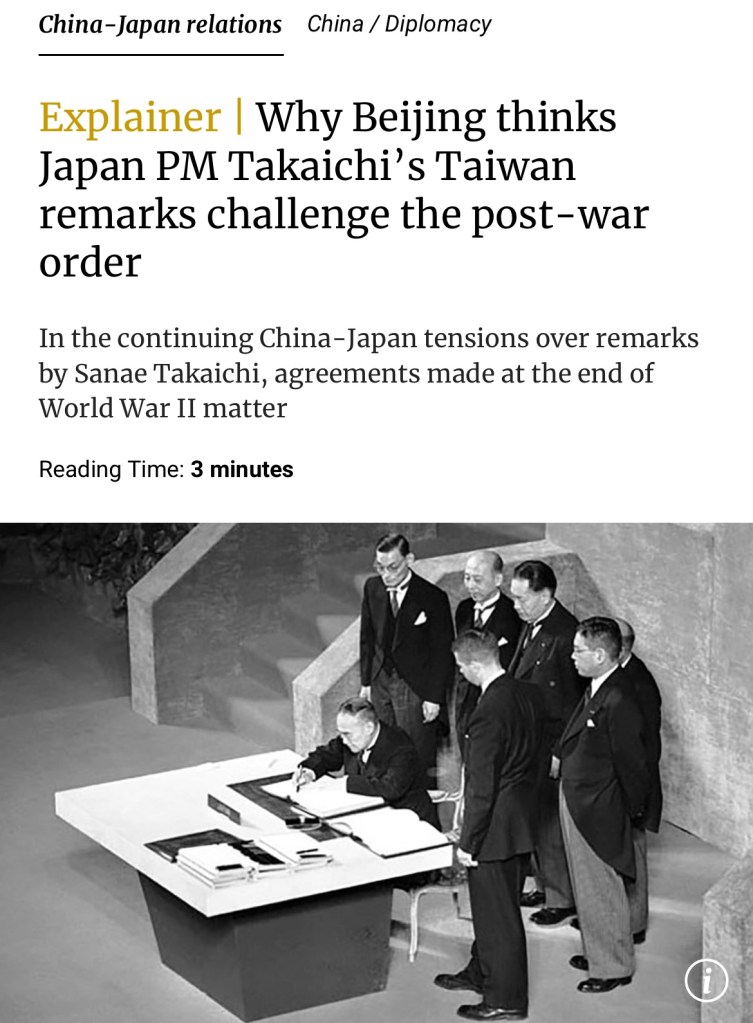
SCMP: Beijing has condemned Japanese Prime Minister Sanae Takaichi’s remarks on Taiwan, not only as a violation of the one-China principle but also as a challenge to the post-war international order. 香港南華早報: 北京譴責日本首相高市早苗有關台灣的言論,不僅違反一個中國原則,也是對戰後國際秩序的挑戰。
Takaichi suggested on November 7 that Tokyo could respond militarily to a potential attack on the island, making her the first sitting Japanese leader since World War II to publicly link a Taiwan contingency with the possible deployment of Japan’s Self-Defence Forces.
Why does it matter?
Taiwan was a colony of Japan from 1895 to 1945, along with the Penghu Islands, after China’s Qing government was forced to cede them under the Treaty of Shimonoseki, or the Treaty of Maguan, signed after China lost the first Sino-Japanese war.
In the 1943 Cairo Declaration, the US, Britain and China stated explicitly that “all the territories Japan [had] stolen from the Chinese” were to be restored, including Taiwan and the Penghu Islands.
The Potsdam Declaration of 1945 reaffirmed this position and set the conditions for Japan’s surrender. Later that year, Japan formally accepted these terms in its surrender instrument.
“Japan has an obligation under international law to observe those documents, which was the prerequisite for Japan to be readmitted to the international community after the war,” ministry spokesman Lin Jian said.
Beijing says the question of Taiwan’s status was effectively settled in 1945, following China’s victory in what it calls the “war of resistance against Japanese aggression” and Japan’s surrender.
How does Ryukyu fit in?
Ryukyu is the ancient Chinese name for a chain of islands that includes Okinawa – under Japan’s administration today but once part of an independent kingdom and tributary state of the Chinese dynasties.
The San Francisco treaty – which Beijing claims is invalid – put the Ryukyu Islands under the temporary administration of the United States, which handed the authority to Japan in 1972.
According to state media and some scholars in China, the 1972 action violated the UN Trusteeship Council’s fundamental principles on national self-determination, leaving the sovereign status of the Ryukyu Islands unresolved under international law.
“China stressed the undetermined status of the Ryukyu Islands on top of reaffirming that Taiwan is an inalienable part of China,” Yu wrote in an article published by the state-owned Beijing Daily on Tuesday.
“This is a concrete manifestation of proactively transforming academic discourse into strategic initiative, which helps to foster a correct understanding of historical issues worldwide and enhances collective vigilance against Japan’s right-wing forces.”
Nury Vittachi: As soon as the U.S. said their reason for the second strike to take out survivors was “self-defence”, I knew I had to do a cartoon 努里·維塔奇:美國聲稱第二次打擊倖存者的理由是「自衛」時,我就知道我必須畫一幅漫畫
Smoking bad and not drinking bad too, both could cost your jobs! 吸煙不好,不喝酒也不好,這兩種情況都可能讓你丟掉工作!
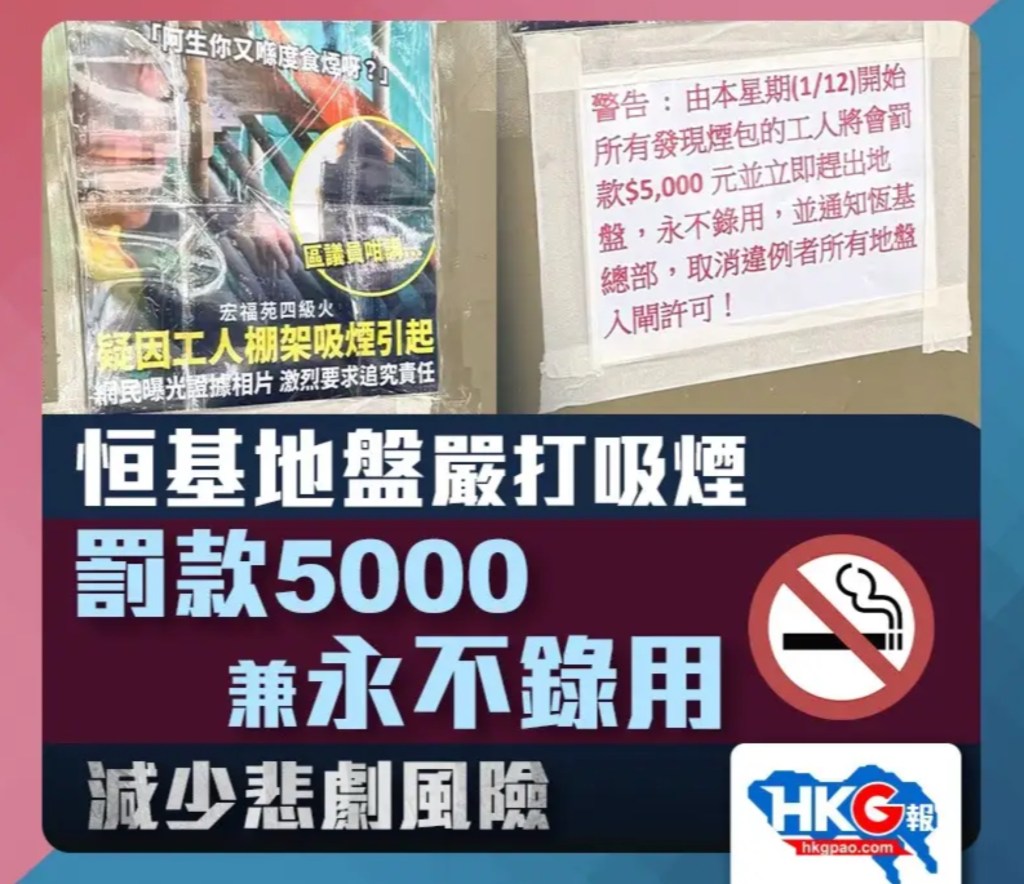
One of Hong Kong’s major property developers has finally adopted a strict no-smoking policy across all construction sites. Anyone who violates the rule will face fines—and even dismissal. 香港一家主要地產發展商終於在其所有建築工地實施嚴格的禁菸政策。任何違規者都將面臨罰款,甚至被解僱.
This reminded me of a policy implemented by one of Hong Kong’s largest food groups: a complete ban on smoking for all chefs and kitchen staff. The reason is simple—smoking dulls the taste buds. If you’ve ever eaten at a restaurant where the dishes were excessively salty, there’s a good chance the chef or cook was a smoker.
Interestingly, the same food group also enforces another unusual rule: in all of their fine-dining restaurants, servers are required to drink or at least learn to drink after they are hired. Those who refuse may lose their jobs. In the restaurant industry, alcohol sales often match—or even exceed—food sales in profitability. A server who does not drink is far less likely to encourage customers to order wine or cocktails, which directly impacts revenue.
American logistic expert report from China video: China’s export juggernaut: low prices and booming trade to rest of world, while Americans buy less 影片有中文字幕: 中國出口巨獸:在全球市場以低價狂飆,美國人卻買得更少
High tariffs in the United States resulted in a sharp $38 billion reduction in Chinese imports in the 3rd quarter, compared to the same period in 2024.
Americans are buying less of almost everything from China, and either paying more or going without for products sourced elsewhere.
But China has more than offset their deep losses in the American market, with booming exports to the rest of the world.
The biggest beneficiaries of the trade wars may be the developing world, as Chinese export companies have ramped up business in Africa, South America, and South Asia.
Though Chinese firms do not enjoy the high per-unit profit margins they get from American buyers, they are selling in much larger volumes to these new markets.
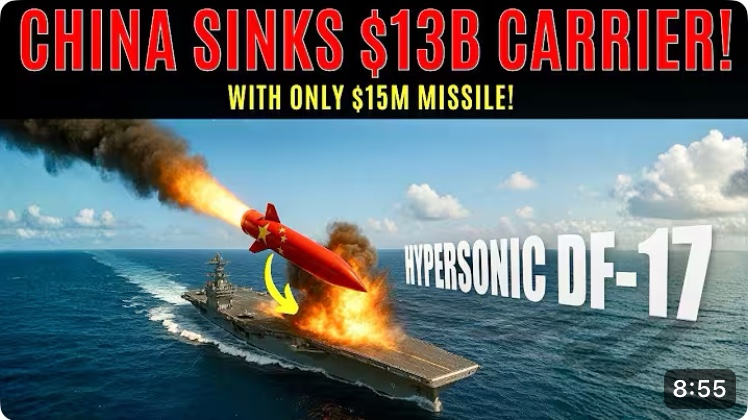
China’s newest long-range missile systems have created global discussion by challenging the traditional role of the U.S. Navy’s $13 billion aircraft carriers.
These precision missiles, reportedly costing around $15 million, combine extended reach, guidance updates, and high mobility to influence how close carriers can operate in the Pacific. Their real impact, however, depends on whether China can maintain accurate tracking on moving vessels across vast ocean areas. Meanwhile, the United States continues advancing layered defenses, electronic support, and distributed carrier operations to stay ahead.
In this episode, we explain how China’s $15M missile systems work, why they matter, how targeting networks influence their effectiveness, and what this evolving technology race means for the future of maritime strategy and carrier operations.
Watch to understand the full picture behind this $15M vs. $13B challenge.
HOW CHINA OUTSMARTED U.S. ON DRONE EXPORTS 《中國如何在無人機出口上智勝美國》
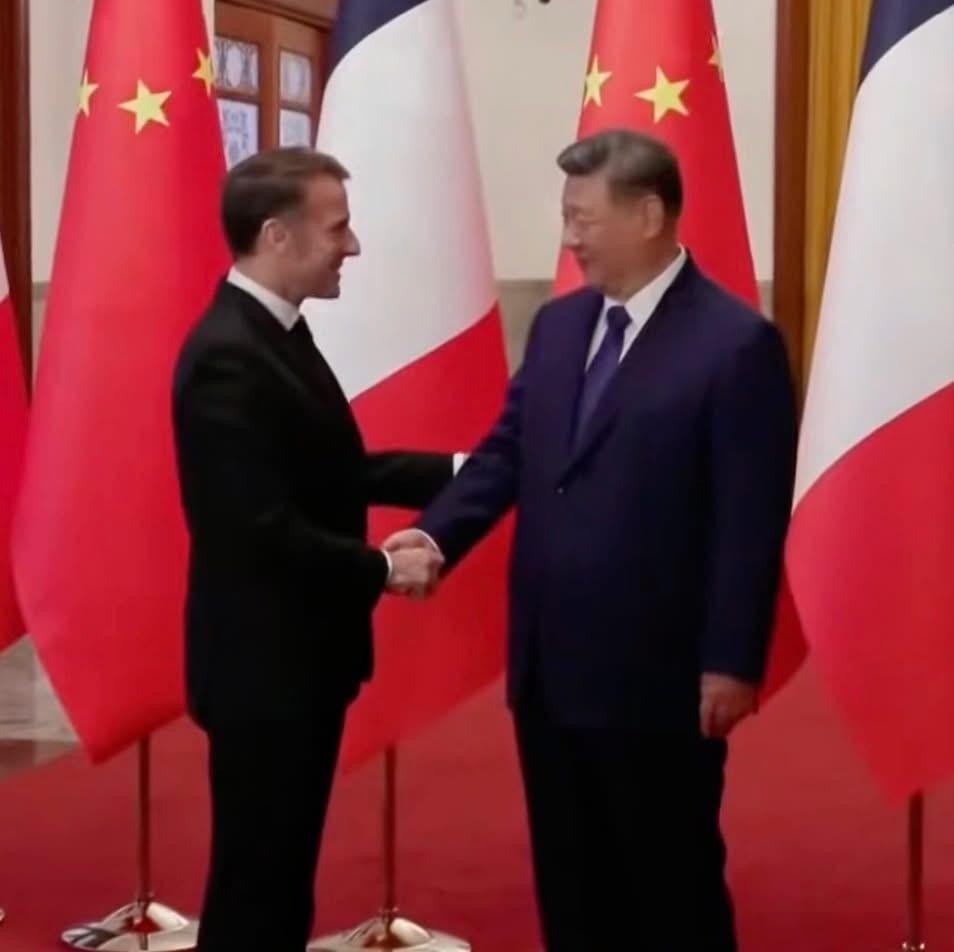
Chinese leader Xi Jinping is meeting French equivalent Emmanuel Macron in Beijing today.
But the Le Monde newspaper was quick to criticize the host country.
“China continues to deliver drone parts that give Moscow an advantage on the ground,” it says. In other words, the report gives the false impression that China is supporting Russia’s war efforts, as other western mainstream media have said.
The report raised the eyebrows of French author and China specialist Laurent Michelon, who has been tracking the issue.
He realized that this misrepresented the position of China—which has been carefully allowing both sides in the Ukraine war to buy drone parts, so that it can stay neutral.
“The reality is far more complex, and Le Monde would like you to ignore the fact that in 2024, almost 97% of Ukraine’s drone-related imports came also from China,” Laurent said in a post on X.
But after the issue came to light, the story became even more curious, he said.
The US pressurized China, which is the world capital of drone design and production, to reduce the sale of drone parts to Russia.
China obediently did what the US asked.
And then, to stay neutral, the Chinese reduced their drone exports to Ukraine!
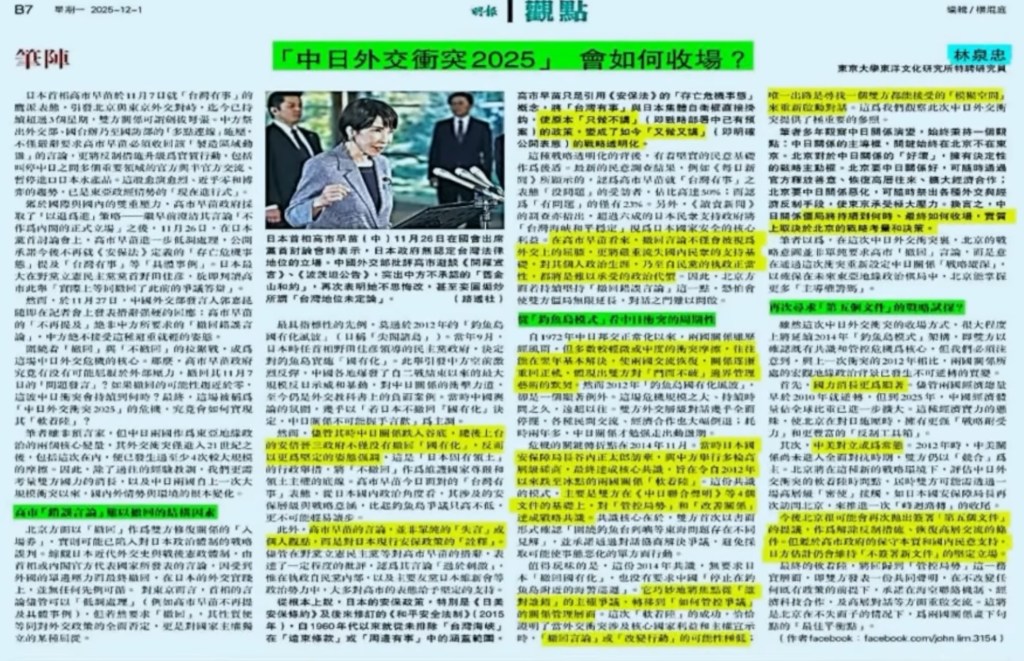
Possible Outcomes of What Ming Pao Calls the “2025 China–Japan Diplomatic Confrontation” — Based on Ming Pao and Other Public Reports/Commentaries
🔎 Origins of the Conflict and Current Situation (Quick Overview) • The confrontation began when Japanese Prime Minister Sanae Takaichi stated in parliament on November 7, 2025, that if China used force against Taiwan, Japan might consider military involvement under the framework of collective self-defense — a remark Beijing viewed as a serious provocation. • China immediately launched a series of countermeasures, including diplomatic protests, tightened media and social controls, travel and study-abroad warnings, bans or restrictions on Japanese seafood imports, and calls urging Chinese citizens to avoid traveling to Japan. • Despite escalating rhetoric and diplomatic tension, there has been no immediate collapse on the economic and trade front; the long-standing pattern of “cold politics, hot economics” continues to hold.
Based on this, the two countries are in a state of high confrontation, but there has been no full diplomatic rupture or military clash — meaning there are multiple possible ways the situation could end.
📈 Five Possible End-Game Scenarios
Below are several outcomes or trends that appear plausible — each dependent on current political, economic, and geopolitical variables.
Cooling Off / Partial De-escalation — Tension Remains but Full Confrontation Avoided Economic interests and trade interdependence will push both sides to avoid a total breakdown. Japan may tone down certain sensitive remarks, while China may maintain sanctions but refrain from major escalation. The result: diplomatic “cooling,” with limited but continued interaction — especially in the economic and commercial sphere.
Prolonged Stalemate, Continuing the “Political–Economic Separation” Model Even if political confrontation continues, economic and people-to-people exchanges (business, tourism, culture) may partially resume or continue. However, official and high-level political engagement will be restricted. The bilateral relationship remains cool for the long term but does not completely collapse.
Limited Japanese Concessions (Verbal / Diplomatic Gestures) in Exchange for De-escalation If the Japanese government (or the prime minister herself) believes the diplomatic and economic costs have become too high, Tokyo may make tactical “adjustments,” such as issuing diplomatic statements, softening its Taiwan-related rhetoric, or making partial compromises to ease tensions.
Continued Chinese Pressure — Expanded Countermeasures / Institutionalized “Punitive Mechanisms” If Beijing believes Japan’s statements touch too deeply on China’s core interests (especially Taiwan and sovereignty), China may normalize or escalate sanctions and restrictions, or take tougher actions against Japanese companies, investments, and cultural exchanges. The relationship would shift into a long-term adversarial / containment mode.
Influenced by Third Parties / Geopolitical Shifts — Possible Reconciliation or Reset If the United States, France, or other major powers act as mediators or apply pressure — or if Asia’s broader security/economic landscape shifts (e.g., new regional security initiatives, reconfigured economic cooperation) — a new round of diplomacy could emerge. This may reset the relationship, bringing it back to a pre-crisis but stable state.
🧮 Key Factors That Matter Most • Political and Rhetorical “Red Lines”: For Beijing, Taiwan is a core sovereignty issue. If Japan continues making public statements about “intervention” or “military involvement,” confrontation could flare up again. Japan toning down its rhetoric is a prerequisite for de-escalation. • Economic and Trade Interdependence: After years of mutual trade, investment, and supply-chain integration, both sides benefit from economic ties. This interdependence is a major force preventing extreme confrontation. • Role of Major Powers and Regional Security Dynamics: External actors (such as the U.S. and European countries) and their positions on Taiwan and Asian security can significantly shape China–Japan interactions — either as mediators or as pressure sources. • Domestic Political Pressures and Public Opinion: Both governments must weigh domestic sentiment and nationalism. Strong domestic support for hardline stances can make compromise more difficult.
🎯 Most Likely Outcome: Cold Politics, Hot Economics + Long-Term Stalemate
Overall, the most probable trajectory is a cooled but entrenched stalemate — neither a full breakdown nor quick reconciliation.
More specifically: • The two sides will not easily return to the normal, close engagement seen in 2023–2024. • Economic/trade/business interactions may partially recover or continue, but official political and security cooperation will sharply decrease. • China–Japan relations will enter a new “normal”: avoiding sensitive issues, maintaining low-profile exchanges, yet still vulnerable to sudden diplomatic or economic flare-ups.
✅ Key Turning Points / Indicators to Watch
To determine whether the conflict is ending or escalating, pay special attention to: • Whether Japan or its leadership clearly tones down or re-clarifies its stance on “a Taiwan contingency / collective self-defense.” • Whether China lifts its restrictions on Japanese seafood, tourism, and cultural exchanges — or expands such measures. • Whether the U.S., Europe, or regional actors intervene through mediation, security proposals, or actions affecting the Taiwan Strait. • Whether economic data, trade flows, or investment patterns show sharp declines — reduced interdependence could accelerate a diplomatic reset or, conversely, deepen confrontation.
Video: A star-studded chorus performed “True Heroes” as a tribute to the HK firefighters who battled the blaze at Wang Fuk Court in Tai Po. 群星合唱《真的英雄》獻予向參與撲救大埔宏福苑火災的香港消防員致敬.
We wish everyone a safe return home. Stay strong. The Grade 5 fire at Wang Fuk Court in Tai Po has touched the hearts of countless citizens, with people contributing money and effort across races for days, embodying the Lion Rock Spirit.
American logistic expert report from China video: More US farm in troubles: Global fertilizer markets seize up after China, Russia keep theirs at home 美國物流專家從中國報導視訊有中文字幕: 更多美國農場陷入困境:中俄限制化肥出口導致全球市場緊縮
Fertilizer prices are soaring again, after Chinese and Russian suppliers sharply reduce exports.
Both are top producers of fertilizers, and previously supplied export markets. But China is locking up its supplies for its surging domestic market, as well as for its factory sector.
Russian fertilizers are now under sanction by the European Union, and farmers in the Eurozone are struggling to find suppliers elsewhere across the world. Since 2022, Russian exports of fertilizers are down over 80%.
American farmers are not nearly as reliant on imported fertilizers. But the shortages caused by Chinese and Russian export policy are pushing up prices by double-digits, even on US farms, as domestic fertilizers suppliers can freely raise prices to meet new market demand from Europe.
Johnson Choi Looking back and forward 蔡永強思前想後 Dec 3 2025
1974 to 1980, I studied hotel and restaurant management at the University of Hawaii, later pursuing an MBA degree. During that time, I held two jobs simultaneously: one as an Assistant Food & Beverage Manager at the Lobster House Restaurant in Hilton Hawaiian Village, and the other as an assistant manager and waiter at Maple Garden Restaurant. I was taking 21 credit hours per semester, averaging only four hours of sleep per day! At Hilton, the job offered reputation but little financial gain—a monthly salary of just one thousand dollars for 50 hours of work per week. Meanwhile, at Maple Garden, working four hours each night, I earned around eighty dollars in tips, totaling over two thousand dollars per month, all tax-free! Back then, a house cost only twenty-five thousand dollars, and I could have bought two or three—each of which is now worth two million dollars. Some of my classmates worked as waiters at the French restaurant Michelle, where they averaged 200 to 300 dollars in tips per night!
As a waiter, I detested the “tip pooling” system. Because I worked quickly, I could handle 5 to 8 tables at once, with a high turnover rate. When tips weren’t pooled, I often earned over a hundred dollars in a single night. In the 1970s, a hundred dollars was a significant amount of money! Whenever the boss was short-staffed, they would always call on me.
I have two major regrets in life: first, not using the money I earned to buy property; second, foolishly—extremely foolishly—choosing to stay in the United States!
In the 1970s, Hong Kong was more advanced than the United States, while mainland China lagged behind. Therefore, it was understandable for people from mainland China to aspire to come to the United States back then. But today, China’s development surpasses that of the United States tenfold, yet some are still willing to spend 500,000 to one million dollars to buy a U.S. passport! Your children will inevitably abandon their ancestral roots and forget their heritage—is it truly worth it?
Thirty years east of the river, thirty years west of the river. The next three hundred years will undoubtedly be an era dominated by the Chinese nation. As descendants of the Chinese people, we should take immense pride in this!




 Business Blog