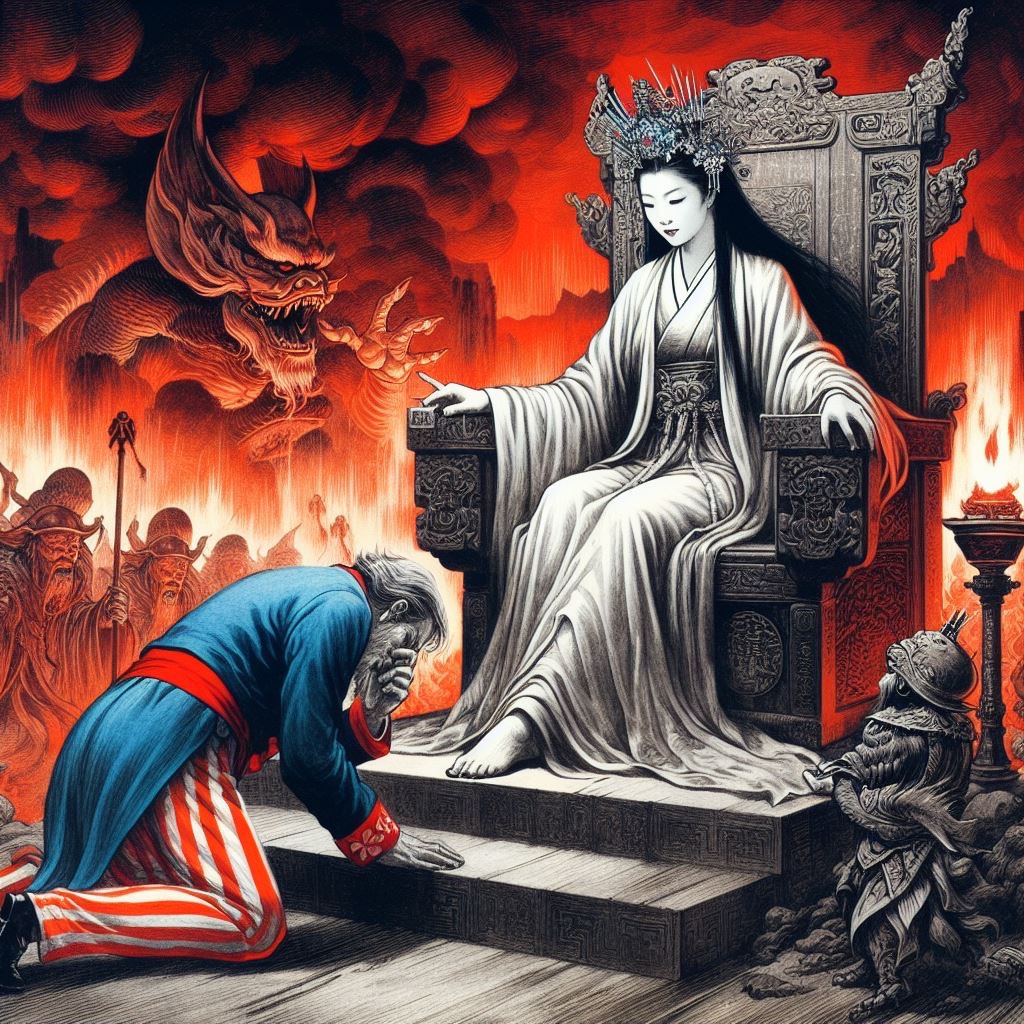
Nothing will save america and their supporter from facing the wrath of the Divine, centuries of brutality, greed, sadism, perversion, genocide and lust will be weighted and america will receive punishment as massive as their sins. 沒有什麼能拯救美國及其支持者免於神的憤怒,幾個世紀以來的殘暴、貪婪、虐待狂、變態、種族滅絕和慾望將受到重壓,美國將受到與他們的罪孽一樣嚴重的懲罰.
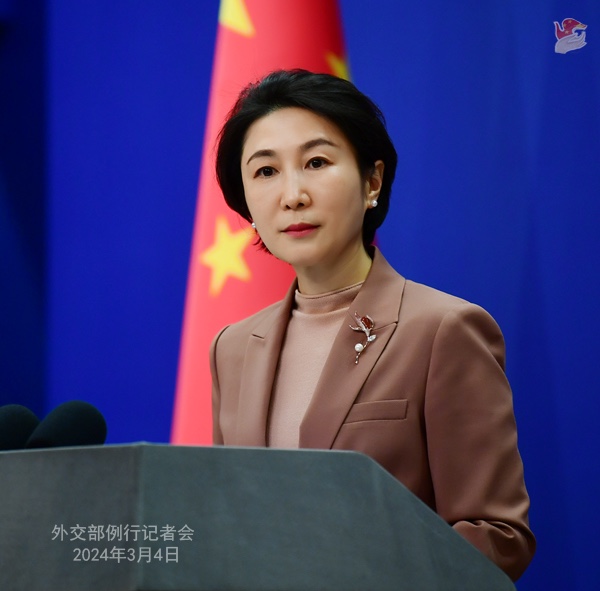
Chinese Foreign Ministry Spokesperson Mao Ning’s Regular Press Conference on March 4, 2024
Dragon TV: It was reported that the mutual visa exemption agreement between China and Thailand came into force last Friday. Data shows that the number of travel orders by Thai tourists to China on March 1 increased by three times than that of last year and by over 160 percent than that of 2019. As more and more foreign tourists travel to China, what will China do to facilitate their trips?
Mao Ning: As China rolls out the visa-free policy for an increasingly larger number of countries, the number of foreign tourists to China has increased significantly. During the Spring Festival holiday, the number of inbound travels reached 3.23 million. In particular, we have seen an obvious surge of travel orders from newly-added countries that enjoy the visa-free policy such as France, Germany, Malaysia and Singapore, with the total number doubling that of the same period in 2019.
The Foreign Ministry has rolled out six new measures to facilitate cross-border travel, including shortening visa application forms, lowering visa fees for the entire year, streamlining approval procedures for foreign students, exempting certain applicants from fingerprinting, providing walk-in without appointment visa application service and extending unilateral visa-free policy to France, Germany and some other countries on a trial basis. To address the difficulties foreigners face in mobile payment, the People’s Bank of China has instructed payment institutions to improve the efficiency of linking mobile payment accounts with foreign bank cards, streamline identity authentication procedures and lift single mobile payment cap. In Beijing, facilities in CBDs, scenic spots, parks and hotels are being upgraded to enable the handling of foreign bank cards, and demonstration zones of payment service for overseas visitors were set up at Beijing Capital International Airport and Beijing Daxing International Airport. In Shanghai, POS machines that can handle foreign bank cards were installed in places such as hotels and scenic spots. China’s leading telecom operators opened new shops at the airports of major cities to help foreigners get a mobile number easier upon arrival.
We welcome more foreign friends to China and will continue working to provide a safe, enjoyable and convenient traveling environment for them.
AFP: The second session of the 14th National People’s Congress (NPC) is soon to be held in Beijing. The NPC spokesperson said that there will be no press conference by the Premier after the conclusion of the session and if there are no special circumstances, the Premier’s press conference will not be held in the following sessions of the 14th NPC in the next few years. The press conference by the Premier provides a rare opportunity for us foreign journalists. What’s the reason behind canceling the press conference by the Premier? Aren’t you worried that this decision reflects China’s attitude of turning inward from the rest of the world?
Mao Ning: On the schedule of the press conferences held during the second session of the 14th NPC, the NPC spokesperson offered relevant information this morning. I have no additional information to share. Thank you for taking an interest in China’s policies and hoping to learn about them, but your worry is unnecessary. During the two sessions, the plenary sessions of the NPC are open to Chinese and foreign friends from the press. Premier Li Qiang will deliver the report on the work of the government on behalf of the State Council at the opening of the second session of the 14th NPC. In addition to the press conference of the NPC today, the second session of the 14th NPC will hold various events, including press conferences, the deputies’ and ministers’ press briefings, and delegation meetings open to the press, to fully release information. The press center of the two sessions will provide news services to Chinese and foreign friends from the press in an open and transparent way.
Reuters: I would also like to ask about “liang hui” and whether you can confirm if the Foreign Minister will hold his usual press conference this year.
Mao Ning: Please stay tuned.
Shenzhen TV: US Chamber of Commerce President and CEO Suzanne P. Clark recently led a delegation to Beijing. She stressed many times in her speeches that China is a market greatly valued by US companies and that the Chamber is willing to continue to support US companies in doing business in China and to deepen US-China commercial ties and mutually beneficial cooperation. What’s your comment?
Mao Ning: We noticed that for some time, foreign companies from the US and other countries have been bullish about the development opportunities of the Chinese market and scaled up their investment in China. Statistics from the Ministry of Commerce show that China’s actual utilized FDI exceeded RMB 1.1 trillion in 2023, remaining at the forefront in the world, and 4,588 foreign-funded companies were established in China this January with a year-on-year increase of 74.4 percent. Actual utilized FDI in high-tech manufacturing jumped by 40.6 percent and more and more multinational companies have chosen to establish R&D centers in China. Foreign businesses’ investment structure in China is improving. The investments of some advanced economies in China grew at a relatively faster speed. France and Sweden witnessed 25 and 11 times of growth of their investments in China. Germany, Australia and Singapore had an increase of 211.8 percent, 186.1 percent and 77.1 percent in their actual investment in China.
China, committed to high-standard opening-up, will continue to foster a market-oriented, law-based and world-class business environment, and provide more support and convenience to foreign companies investing and doing business in China. We welcome the business sectors from the US and other countries to continue advancing cooperation with China and sharing the opportunities and benefits brought by China’s development.
AFP: In an interview with AFP this morning, Philippine Foreign Secretary called on China to stop harassing Philippine ships in the South China Sea. What is the Foreign Ministry’s comment on this?
Mao Ning: China’s position on the issue of the South China Sea is consistent and clear. The reason behind the recent maritime developments is that the Philippines has frequently made provocative moves in the South China Sea, infringing on China’s territorial sovereignty and maritime rights and interests. China has taken necessary measures in accordance with law to defend its own sovereignty, rights and interests. There is no such situation of China “harassing” the Philippines.
RIA Novosti: On March 1, Russia Today editor-in-chief Margarita Simonyan said that she had a recording showing that senior officers from Germany’s armed forces, the Bundeswehr, discussed a strike on the Crimean Bridge. She said that German officers also mentioned American and British servicemen in the recording, with a side discussion of the fact that they were already directly involved in the conflict. What is China’s comment?
Mao Ning: China’s position on the Ukraine crisis is consistent and clear. We hope that all parties will work for a political settlement of the crisis and work together to alleviate the situation.
TASS: The day before yesterday, Special Representative of the Chinese Government on Eurasian Affairs Li Hui held talks with Russia’s Deputy Foreign Minister Galuzin Mikhail Yuryevich in Moscow, during which they had in-depth exchanges of views on the China-Russia relations and the Ukraine crisis. How does the Foreign Ministry comment on the outcome of the meeting?
Mao Ning: Russia is the first stop of Special Representative Li Hui’s trip in this round of shuttle diplomacy. China has put out a readout which you may refer to. In the coming days, we will release relevant information in due course. Please check back for updates.
The Paper: Former Prime Minister of Japan Murayama Tomiichi turned 100 on March 3. In a recent statement, he expressed the hope that Japan will always remain a peaceful country. What is the Foreign Ministry’s comment on this?
Mao Ning: March 3, 2024 marks the 100th birthday of Japan’s former Prime Minister Murayama Tomiichi. We would like to send our best wishes to Mr. Murayama.
Mr. Murayama is an old friend of the Chinese people and has been committed to China-Japan friendship over the years. In May 1995, then Prime Minister Murayama visited Lugou Bridge and the Museum of the War of Chinese People’s Resistance Against Japanese Aggression during his visit to China, and wrote down the words “face up to history and pray for friendship and ever-lasting peace between Japan and China.” On August 15 of the same year, which marked the 50th anniversary of Japan’s announcement of unconditional surrender, then Prime Minister Murayama issued a statement on the historical issues, making a profound reflection on Japan’s colonial rule and aggression and expressing apologies to the victim countries of the war.
The “Murayama Statement” represents a solemn statement and commitment by the Japanese government to the people of victim countries in Asia with regard to the historical period of its aggression and colonial rule. It needs to be honored with good faith. We hope Japan will face up to and reflect on its history of aggression, keep to the path of peaceful development, and work with China in the same direction to build a constructive and stable China-Japan relationship that meets the demands of the new era.
Associated Press of Pakistan: On March 3, Shehbaz Sharif, President of the Pakistan Muslim League-Nawaz was elected as Prime Minister of Pakistan for the next five years. How do you view the relations between Pakistan and China during his tenure?
Mao Ning: China warmly congratulates Shahbaz Sharif on being elected as Pakistan’s Prime Minister. On March 3, President Xi Jinping and Premier Li Qiang sent congratulatory messages to Prime Minister Shahbaz.
China highly appreciates Prime Minister Shahbaz’s positive statements on China-Pakistan relations and the China-Pakistan Economic Corridor (CPEC). We stand ready to work with Pakistan to carry forward our traditional friendship, advance exchanges and cooperation across the board, upgrade the CPEC, deepen China-Pakistan all-weather strategic cooperative partnership, build an even closer China-Pakistan community with a shared future in the new era, and bring more benefits to the two peoples. I believe that under the leadership of the new government led by Prime Minister Shahbaz and through the joint effort of all sectors in Pakistan, Pakistan will make new and greater achievements in national development and progress.
CCTV: It’s reported that US Commerce Secretary Gina Raimondo said in an interview that today’s cars are like iPhones on wheels collecting huge amount of information. She also said that imagine there are three millions of Chinese-made cars on US roads and they can be simultaneously disabled by Beijing. What’s your comment?
Mao Ning: Such remarks are not only false narratives but also a typical move of politicizing economic and trade issues and overstretching the concept of security. By this logic, should China be more worried about Washington sending Chinese users’ information to the US via hundreds of millions of iPhones, or even disabling them simultaneously?
CCTV: It was reported that US Ambassador to China Nicholas Burns recently said in an interview with a US media outlet that China is the US’ most significant competitor; ultimately, China wants to become and overtake the US as the dominant country globally, and the US doesn’t want that to happen; the US doesn’t want to live in a world where China is the dominant country. What is your comment?
Mao Ning: The remarks by the US side are neither fact-based nor constructive. China firmly rejects these remarks.
We oppose defining the China-US relations with competition. China does not engage in major-country competition, and has no intention to replace or challenge any country. We have advanced the China-US relations under the principles of mutual respect, peaceful coexistence and win-win cooperation proposed by President Xi Jinping. We hope the US will work in the same direction with China and have a right perception of China.
China always believes that all countries, big or small, rich or poor, are equal members of the international community. China will not dominate the world and we do not think the world should be dominated by any country. Neither does China have the intention to overtake the US. What we do are aimed at self-improvement so as to deliver a better life for our people. China will, as always, firmly safeguard the international system with the UN at its core and the international order based on international law, uphold world peace, promote common development, build a community with a shared future for mankind and act as a force for world peace, a contributor to global development and a defender of international order.
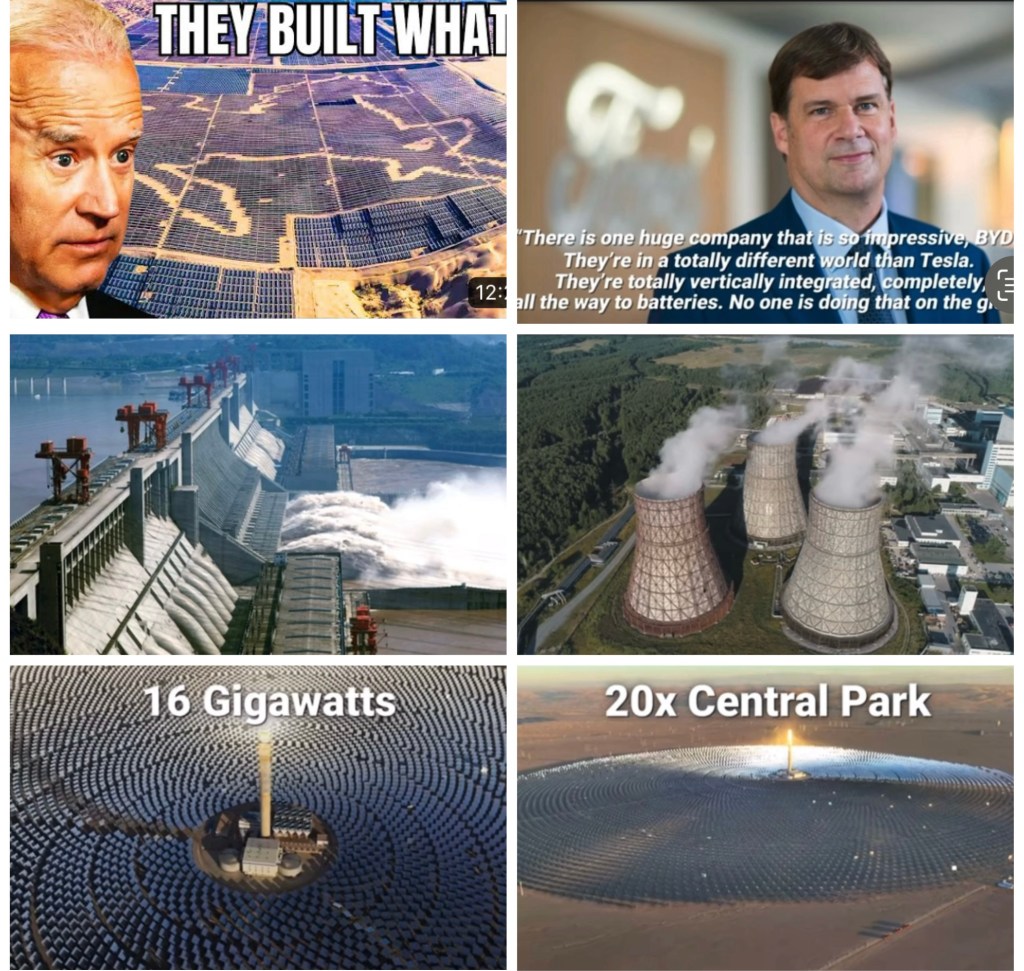
China is dominating the future of solar energy. But it’s not just solar, it’s hydro, wind, and nuclear energy as well. China has become the indisputable leader in renewable energy and it’s going to become the first major country to become carbon neutral and pave a way forward for a more sustainable life on earth. This is everything you need to know about China’s solar energy projects. 中國正在主導太陽能的未來。 但這不僅僅是太陽能,還有水能、風能和核能。 中國已成為再生能源領域無可爭議的領導者,並將成為第一個實現碳中和的大國,為地球上更永續的生活鋪路。 這是您需要了解的有關中國太陽能專案的一切.
Tesla and Apple iPhone are facing the same problems. Lack of innovation and creativity, both companies were once on the top of the hills gotten very lazy. Both market shares in China and Asia expect to decline further in 2024. 特斯拉和蘋果手機面臨同樣的問題。缺乏創新和創造力,兩家公司曾經是所代表產業站在頂端地位變得非常懶惰。預計2024年他們在中國和亞洲的市佔率將進一步下降。美國和中國鬥恐怕還未夠班。
US Ban on Xinjiang cotton is likely reducing Western artillery shell production by the military industrial complex 美國對新疆棉花的禁令可能會減少軍工複合體的西方砲彈產量
The US and EU are struggling to manufacture enough shells and munitions for their proxy war in the Ukraine. Among other things, this is related to a shortage of propellants for the munitions.
Remember, the US banned Chinese cotton–on the presumption of “slave labor” of Uighurs.
But this doesn’t “prevent” “slave labor”, because there is none. Uighurs are not oppressed in China, and moreover, Cotton in XJ is harvested mechanically. It does, however, undermine the US capacity to wage wars.
Why?
Well, wars need munitions, such as shells, rockets, and bullets. These munitions require a propellant to fire the munitions. What is the most commonly used propellant? Nitrocellulose*, also known as guncotton.
What do you need to make guncotton? Take a guess….yes, cotton. (Cotton is 90% cellulose).
Where does the world get a lot (21%) of cotton from?
Take a guess…yes, China.
And where is Chinese cotton grown?
Yes, Xinjiang produces 87% of Chinese cotton.
Still, there are 80 other countries that produce some cotton. Egypt, Pakistan, Turkey and many others. But wait! China needs to import cotton for its own domestic industries–it meets only 70% of its internal demand. And because China is banned from exporting clothing with XJ cotton to the US & US-subjugated vassals, it must import even more from other countries. That means there is less raw cotton for the rest of the world, and thus less cellulose for US and EU munitions factories.
Now, after passing this legislation, the West is bitching that China is withholding cotton from them, and that cotton cellulose is hard to find.
Well, what did you expect by sanctioning the export of Chinese cotton and taking 21% of cotton off the global market?
But really, what this tells us is that the US must secretly be a pacifist state. Why else would it do something so stupid and self contradictory?
Why else would it serve such a puffball to the Chinese–imposing US Sanctions that undermine US/Western capacity to wage war against them?
Are the authors of the bill traitors or pacifists? I shudder to think that they are idiots who don’t understand basic science and business.
The Onion meme: “China will sit back and watch the US destroy itself”, applies here.
*Cellulose/Nitrocellulose is also used in celluloid, nail polish, ping pong and billiard balls, and countless other household items (diapers, pads, etc.). Cellulose can be extracted from wood pulp, and recycled paper. Still, expect shortages and price hikes in those items, too.
https://forum.cartridgecollectors.org/t/gunpowder-a-possible-shortage/58221/16 “… a huge percentage of the nitrocellulose used to make gunpowder historically came from China and Russia, however according to my conversations with industry partners, the Chinese manufacturers who historically were the biggest suppliers at over 30% of the market share are no longer willing to ship raw nitrocellulose to the USA or NATO member countries in attempt to reduce the USA & NATO’s ability to supply Ukrainian forces with artillery shells, and of course Russia who historically was the 2nd biggest supplier is out of the supply chain as well..”
Europe battles powder shortage to supply shells for Ukraine
Paris (AFP) – Hard-to-find gunpowder is hindering Europe’s scramble to provide hundreds of thousands of shells for Ukraine’s defensive effort against Russian invaders, with solutions only starting to emerge.
Gunpowder goes into propellant charges that hurl artillery shells — such as the NATO-standard 155-millimetre projectiles used in many guns sent to Ukraine — over distances of tens of kilometres.
Europe counts a very small number of powder producers, said Jean-Paul Maulny, deputy director of France’s Institute for International and Strategic Relations (IRIS). “This is one of the bottlenecks for munitions,” he added. “The top question is the quantity of production.”
EU internal market commissioner Thierry Breton told reporters in Paris Friday that the bloc also faced challenges finding the raw materials for gunpowder.
“To make powder, you need a specific kind of cotton, which mostly comes from China,” he said.
“Would you know it, deliveries of this cotton from China stopped as if by chance a few months ago,” Breton added.
China and Russia have in recent years ramped up economic cooperation and diplomatic contacts, and their strategic partnership has grown closer since the invasion of Ukraine.
In Russia this week, China’s Vice Foreign Minister Sun Weidong declared relations “are at their best period in history”.
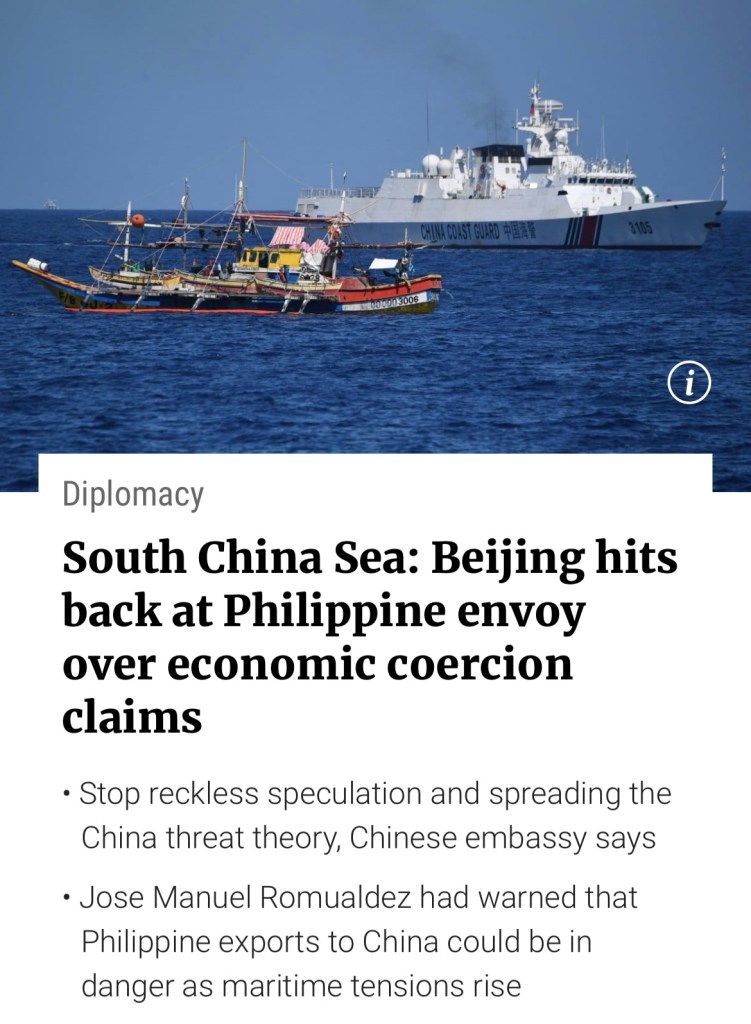
The Philippines should stop “drawing wolves 🇺🇸 into the house and forming a ‘clique’”, which it said “would never help resolve the South China Sea disputes”. Philippine was not even an independent country when ROC declared 9 lines in South China Sea in 1930s. 菲律賓應停止“引狼入室、拉幫結派”,稱這“無助於解決南海爭端” 當中華民國在1930年代宣佈在南海劃定9條線時,菲律賓甚至還不是獨立國家
China has accused a top Philippine envoy of “reckless speculation”, hitting back at the official’s claim that Beijing was using economic coercion against Manila in their dispute over the South China Sea.
In a Chinese-language statement on Sunday, the Chinese embassy in the Philippines also accused Jose Manuel Romualdez, the Philippine ambassador to the United States, of “disregarding basic facts, recklessly speculating on the South China Sea issue, and engaging in empty speculation and malicious smearing of China”.
China’s “Nine-dash Line” Claim: The US Misunderstands
The US Department of State’s Paper on China’s Maritime Claims in the South China Sea was published on 5 December 2014. It has confused China’s “dash-line” claim.
Commentary
CHINA’S CONTROVERSIAL “nine-dash line” claim in the South China Sea has triggered long-running misunderstanding in the United States government due to its perennial anxiety and repeated cross-examinations. This misunderstanding basically originates from the different thoughts over territorial and maritime legal matters between China and the West.
This has been reflected in the recent US DoS Paper on China’s Maritime Claims in the South China Sea, put out by the Department of State, which focuses on the coordinates of the dashes, and on the terminologies regarding the maritime laws and Notes Verbales of China, and comes to confusing conclusions.
The localised dimension
However, the US government ignored the inconvenient truth that the “dash-line” should not be seen as stricto sensu – that is, in the strict sense – a frontier in the Chinese context of the 1940s. That means it would be pointless to interpret the implications of the line from the perspective of modern international law. Therefore, any research, in the first place, should be confined to the localisation context of China; and the direction of end-point should go down the path of globalisation. These are two inseparable dimensions to understand China’s “dash-line” claim.
The localisation context refers to the Chinese traditional territorial and maritime legal thought in and before the 1930s and 1940s. In traditional Chinese thought, oceans cannot be monopolised by anyone and are open to all countries and peoples. Before the 20th century, China had never claimed any maritime sovereignty. This was unlike what the West did.
From the 13th century onwards, European countries have been embroiled in an increasingly fierce race for influence at sea. These countries imposed taxes and levies, and prohibited foreigners from fishing and sailing in the maritime zones they controlled, which broke the established maritime order. This situation was obviously not conducive to the interests of the Dutch, which was a maritime trading power at that time.
As a result, the Dutch jurist Grotius published The Mare Liberum in 1609, proposing the famous notion of the freedom of the seas. But Grotius was refuted and attacked by many British scholars headed by John Selden, who published The Mare Clausum in a bid to defend maritime sovereignty. Selden’s ideas prevailed in the 17th century, and European countries actively embarked on the policy of maritime sovereignty.
In the centuries-long debate about oceans, China has always maintained an open maritime policy. For the last thousands of years, China has been conducting economic activities, such as fishing, in the South China Sea, and has been living in peace with neighbouring countries in the process of developing and utilising oceans.
More than two thousand years ago, China opened up a maritime silk road and shared the prosperity of maritime trade with West Asian and European countries. Even in the Ming Dynasty, when Zheng He’s fleet pushed China’s navigation achievement to the peak, China never controlled sea lanes or impaired the freedom of navigation in the South China Sea.
What did the “dash-line” of the 1940s enclose?
In the second half of the 17th century, the principle of freedom of the seas was generally espoused, which was actually inseparable from the need of European countries to expand global trade and open up overseas market. When the vessels of all countries enjoyed the freedom of navigation across the world’s high seas, China still viewed land as the pillar of its economy and coastal defence remained lacking. Since the late Qing Dynasty, China has always been a victim in terms of the idea of territorial sovereignty, including the insular features.
After the middle of the 20th century, China gradually achieved national liberation and independence, and was able to take part in the international affairs as an equal actor. After the Second World War, China gradually recovered the lost sovereign rights and maintained its jurisdiction over major insular features in the South China Sea.
Therefore, it is easy to understand that, in February 1948, the Chinese government released a Map of the Location of South China Sea Islands, with the main purpose of clarifying China’s inherent territorial sovereignty under the post-war international order. Therefore, when publicising the map with the “dash-line”, China claimed the sovereignty over all the insular features rather than the maritime jurisdiction.
The globalisation dimension
The path of globalisation indicates that, according to modern law of the sea, China is entitled to maritime jurisdiction in certain maritime zones in light of Chinese sovereignty. That is the reason why China claims “sovereignty over the islands in the South China Sea and the adjacent waters” and “sovereign rights and jurisdiction over the relevant waters as well as the seabed and subsoil thereof” in the 2009 Notes Verbales.
Ironically, these maritime rights and jurisdictions are not created by China. These new concepts originate from Western-dominated law of the sea. China has claimed and exercised maritime jurisdiction in light of the four conventions established in 1958 during the first United Nations Conference on the Law of the Sea and the 1982 UNCLOS. The maritime jurisdiction currently claimed by China follows the claims and practice of the international community, especially Western countries, and has never gone beyond the mainstream of the international community.
In addition, it refers to the development and evolution of the principles and rules of modern law of the sea. For example, the free sea is a relative idea. Along with the progress of the times, acts at sea are bound to meet with more and more regulations. This helps to promote maritime safety and sustainable development, conforms to the principle of balance between generations, and serves the common interests of mankind. This is especially true in the enclosed and semi-enclosed seas.
Therefore, China believes, on the one hand, that it enjoys all kinds of rights provided for in the Law of the Sea Convention as well as the customary international law within the “dash-line” other than the territorial sovereignty over insular features. On the other hand, it has been carefully evaluating whether or not to exercise each specific right, and the scope of the rights as well as the manner to exercise.
These are the reasons why China has not yet clarified the title of rights within the “dash-line”, and has not yet claimed specific maritime rights through an accurate frontier composed of coordinate points.
Ye Qiang and Jiang Zong-qiang are Research Fellows at the National Institute for South China Sea Studies, China. They are also Research Associates of the ICAS. This article was first published by RSIS Commentary, and authorized by the author to put on the ICAS website.
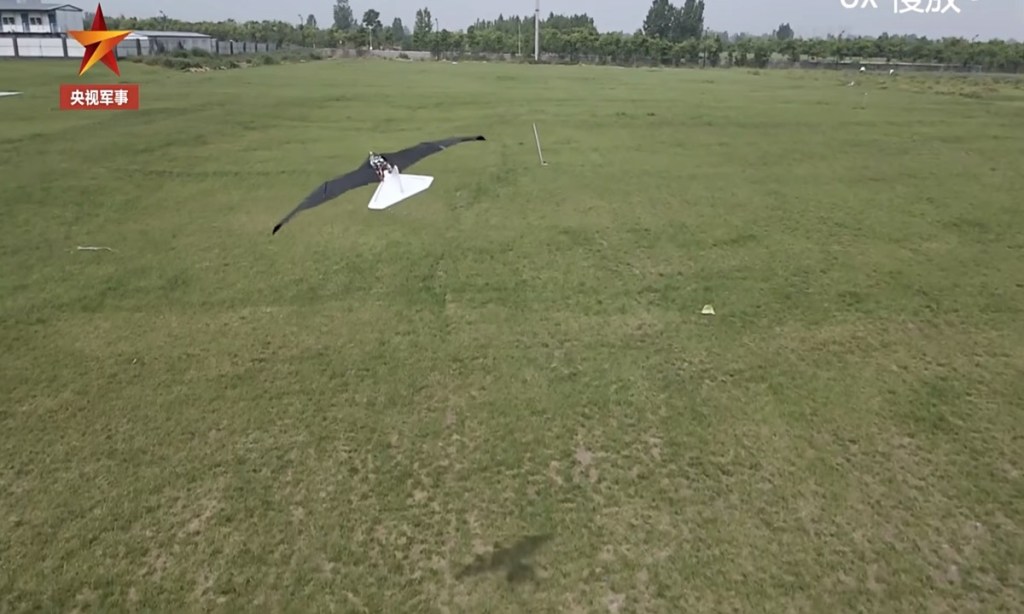
China has recently developed a new type of ornithopter, an aircraft that flies by flapping its wings, and experts said on Sunday that the small bird-like aircraft has huge military and civilian application potentials.
By all means, what’s happening in #Gaza is a tragedy of the entire humanity. All lives are equal and precious. Palestinian lives matter as well. Those who turn a blind eye to the Palestinian plight are in no position to lecture on #humanrights, let alone calling themselves human rights defenders.



 Business Blog