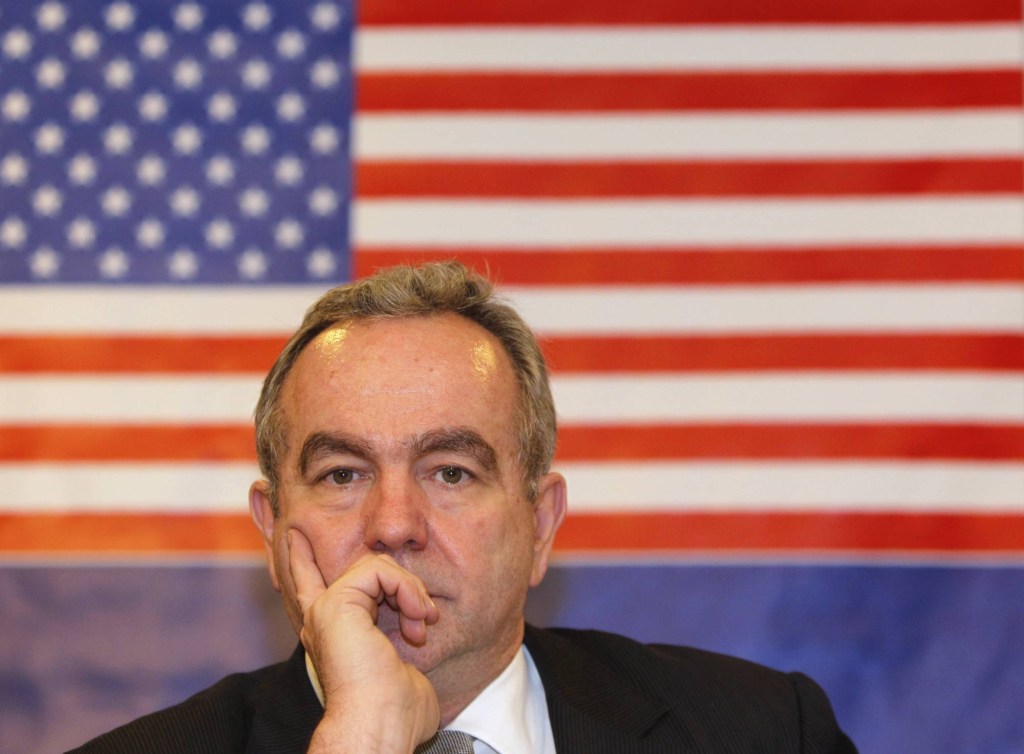
What Stuart Seldowitz is to Palestine (“4000 dead kids is not enough”), Kurt Campbell is to China: a ghoulish, racist, genocidal hatemonger/warmonger.
Historian Bruce Cummings* described him as a smug, “smart Aleck exterminist”*. He is on record for calling for “a magnificent symphony of death” in Asia,
Campbell’s appointment suggests that the US is preparing another genocide in Asia. He does not believe in mutual coexistence or win-win. In fact, Campbell told top Chinese officials to their face, “Your win-win is bllshit”
Palestine has shown them what they can get away with in the modern age–everything.
Campbell co-founded CNAS with Michele Flournoy, which functions like the de-facto shadow government of the US (17 top cabinet members of Biden are affiliated with CNAS).
CNAS is the think tank responsible for the atrocities of the Afghan and Iraq wars (they wrote the war doctrine known as “coin” (counterinsurgency)), which General Mattis summarized succinctly as “Be polite, be professional, and have a plan to kill everyone”. They want the same in Asia and have obsessively mapped out a 100-point plan for war with China.
Special Feature: China’s Economic Strength Comes from Within
The past few years have been tumultuous for global economies, with a once-in-a-century pandemic and conflicts in several parts of the world. In 2023, the Chinese economy rebounded and moved upward, with an estimated GDP growth of around 5.2 percent, higher than the around 5 percent target set at the beginning of the year. In this Special Feature, the News Letter would like to walk you through the innate sources of strength that will sustain the continued prospering of the Chinese economy.
First, in promoting economic development, China did not resort to massive stimulus, but instead focused on strengthening the internal drivers. As the second largest economy in the world, China has established, after years of development, sound and solid fundamentals. Just as a healthy person often has a strong immune system, the Chinese economy can handle ups and downs in its performance. The overall trend of long-term growth will not change. In terms of the industrial base, China is the only country with industries across all categories in the U.N. industrial classification. The added value of China’s manufacturing industry accounts for around 30 percent of the global total, ranking first in the world for 14 consecutive years. China is also home to over 200 mature industry clusters. With its large scale, complete categories and strong supporting capacity, China’s industrial system can meet the demand of the rapid development of social productivity and will contribute to better global allocation of production factors and the rise in global productivity. In terms of production factors, China’s demographic dividend is turning into talent dividend. We now rank first in the world in terms of the size of talent pool, human resources in science and technology and the total number of researchers. Capital shortage is replaced by abundance. Our global share of annual capital formation has risen to about 30 percent. In addition, with its huge data output and rich data resources, China has the second largest data mine in the world. In terms of innovation capacity, China’s total input in research and development and investment in the high-tech sector have been growing at double-digit rates for several years running. New technologies, including cloud computing, big data, artificial intelligence and blockchain, are being applied at a faster pace. New products and new business forms such as intelligent terminals, robots and telemedicine keep emerging. China now has some 400,000 high-tech enterprises and ranks second globally in the number of unicorn companies. All this will boost the formation and cultivation of new growth drivers in China. Looking at the broader picture, we are now advancing Chinese modernization on all fronts through high-quality development. Delivering modernization to more than 1.4 billion people will be a remarkable achievement in human history, one that will provide continuous impetus to the development of China and the wider world.
Second, China has a supersize market with rapidly unlocked demand. It will continue to provide a big stage for various businesses and talents. In face of weak global demand, market becomes the most scarce resource. The Chinese market, with its vast space and growing depth, will play an important role in boosting aggregate global demand. In China, there are now over 400 million people in the middle-income bracket, and the number is expected to reach 800 million in the next decade or so. For a growing range of products and services, the focus of consumer demand is shifting from quantity to quality, which will generate strong driving force for upgrading consumption. China’s urbanization rate is now more than 10 percentage points lower than the average level of the developed countries. There is much room for infrastructural upgrading in urban renewal, transportation and telecommunications, among others. There are also some 300 million rural migrants who are acquiring permanent urban residency at a faster pace. These will create massive demand in areas such as housing, education, medical services and elderly care. China is deepening its transition toward green and low-carbon growth. Close to half of the world’s installed photovoltaic capacity is in China. Over half of the world’s new energy vehicles (NEVs) run on roads in China, and its NEV ownership has reached over 20 million units. China contributes one-fourth of the increased area of afforestation in the world. China is also cultivating large-scale new growth drivers in sectors such as green infrastructure, green energy, green transportation and green lifestyle. This will generate investment and consumption markets with an estimated size of RMB10 trillion yuan annually, and promises huge potential. We will keep exploring and unleashing such market demand, increase import of high-quality goods and services from all over the world, attract more foreign investment in areas including medium- and high-end manufacturing and biopharmaceuticals, and provide broader space for boosting global trade and investment.
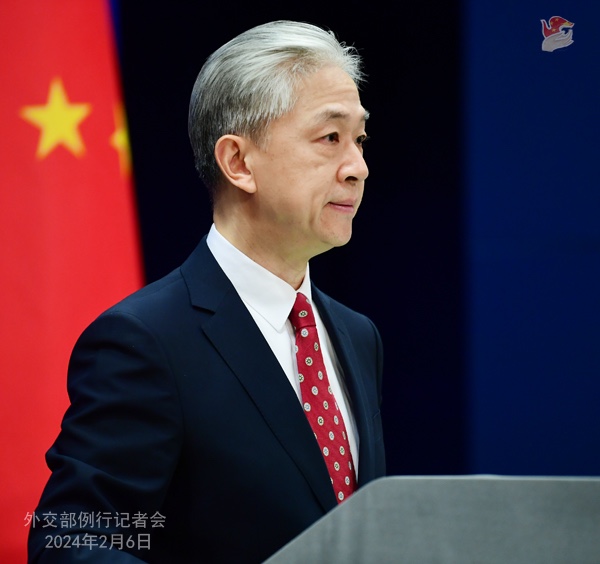
Chinese Foreign Ministry Spokesperson Wang Wenbin’s Regular Press Conference on February 6, 2024
Reuters: Guatemala’s Foreign Minister told Reuters on Monday that the country plans to reach out to China to develop formal trade ties, although it plans to maintain its existing relations with Taiwan. Would an approach by Guatemala be agreeable to the Chinese side?
Wang Wenbin: There is but one China in the world, the government of the People’s Republic of China is the sole legal government representing the whole of China, and Taiwan is an inalienable part of China’s territory. The one-China principle is a prevailing international consensus and a basic norm governing international relations. It is also the fundamental prerequisite and political foundation for China to conduct cooperation with all countries including Guatemala.
One hundred and eighty three countries in the world have established diplomatic ties with China, which fully shows that supporting the one-China principle is where the public opinion trends and the arc of history bends. We hope that the new government of Guatemala will follow the general trend and make the right decision as early as possible which will serve the fundamental and long-term interests of the country and the people.
CNR: Nangolo Mbumba was sworn in as Namibia’s new President on February 4. What’s China’s comment?
Wang Wenbin: We congratulate President Mbumba on taking office. I believe that under President Mbumba’s leadership, Namibia will continue to enjoy sound momentum of steady development and achieve new success in national development.
China and Namibia share a deep and strong traditional friendship. China highly values its relations with Namibia and stands ready to work with Namibia to deepen exchanges and cooperation across the board and to elevate the China-Namibia comprehensive strategic cooperative partnership to a new level.
Reuters: China’s Xiang Yang Hong 03 research ship is due to make a port call in the Maldives later this week. Please could you elaborate on the type of work Chinese research vessels have been carrying out in the Indian Ocean?
Wang Wenbin: China’s scientific research activities in relevant waters are for peaceful purposes and aimed at contributing to humanity’s scientific understanding of the ocean. The activities are in strict compliance with the terms of the United Nations Convention on the Law of the Sea. For years, China and the Maldives have maintained close cooperation in marine scientific research. China appreciates the facilitation and assistance extended by the Maldives to Chinese research vessels entering its port on the basis of sovereignty and China-Maldives friendship and in accordance with the relevant provisions of international law.
Phoenix TV: It’s reported that US Assistant Secretary of State for East Asian and Pacific Affairs Daniel J. Kritenbrink met with four anti-China rioters who fled overseas, namely Anna Kwok, Elmer Yuen, Frances Hui and Joey Siu. He said on social media X that he was “honored to meet with advocates for Hong Kong’s democracy and human rights.” What’s your comment?
Wang Wenbin: We deplore and firmly oppose the blatant action of US senior officials involving themselves with anti-China rioters who have fled Hong Kong.
These rioters are suspected of endangering national security. The Hong Kong police issued arrest warrants in accordance with the law. This is necessary and legitimate and in line with the international law and customary practice. National security legislation of the US are applied extraterritorially as well. By bolstering the rioters from Hong Kong, the US is not only trampling the principle of the rule of law but also laying bare its long-standing double standards on human rights and the rule of law.
Hong Kong affairs are purely China’s internal affairs that brook no external interference. We urge the US to reflect on what it has done and fully respect China’s sovereignty and rule of law in Hong Kong. The US should not become a haven for criminals. China has firm resolve to safeguard its sovereignty, security and development interests. Any attempt to meddle in Hong Kong affairs and undermine the rule of law in Hong Kong will be met with China’s resolute response.
AFP: Australia said today that it had expressed “outrage” to China over the suspended death sentence handed to a Chinese-born Australian. What’s China’s comment on this?
Wang Wenbin: We shared information yesterday about the trial and sentencing of Australian defendant Yang Jun’s espionage case. I would like to stress that China is a country that upholds the rule of law. Chinese judicial authorities handle cases in accordance with the law. We urge Australia to fully respect China’s judicial sovereignty.
CCTV: We noticed that across the world, more and more people are celebrating the Chinese Lunar New Year, which is also called the Spring Festival. To celebrate this traditional festival has become quite fashionable these days. What is your comment?
Wang Wenbin: The Spring Festival is a time for family reunion, seen by many as the “Chinese moment” on every year’s calendar. It is also celebrated globally as a public holiday. You just asked a very good question. We have prepared some slides to show you how the Spring Festival is celebrated globally.
This year’s Spring Festival will be the first one since the UN General Assembly decided to list the Lunar New Year as a UN floating holiday. The Food and Agriculture Organization, the UN Office at Vienna and other organizations recently officially celebrated the Chinese Lunar New Year for the first time. The Lunar New Year is a public holiday in more than 20 countries and celebrated in various forms by about one-fifth of people on Earth. From East to West, in both northern and southern hemispheres, countries around the world light up in Chinese red and people share the joyful atmosphere and feel the richness and vibrancy of the Chinese culture.
At the UN, diplomatic envoys experience Spring Festival traditions such as making dumplings, calligraphy and paper-cutting. The New Zealand Prime Minister Christopher Luxon joined thousands of overseas Chinese at the Chinese New Year Festival and Market Day in Auckland to welcome the Year of the Dragon. Belarus held the “Embracing the Chinese New Year” symphony concert with musicians from the two countries bringing the great enjoyment to the audience. Temple fairs were held in Heidelberg, Germany, which showcased traditional customs to tourists such as diabolo, Spring Festival couplets and writing the character Fu which means good fortune. The Metropolitan Museum of Art in New York organized an exhibition called “Celebrating the Year of Dragon”, which brought out dragon dance performance, woodblock printing and other brilliant activities. Lanterns hung high on the streets in Malaysia, and youngsters performed the impressive dragon dance with a dragon nearly 200 meters long. A grand celebration event was held on Marco Zero Square, a famous landmark of Recife in Brazil. A spectacular light show of twelve mascots of the Chinese Zodiac was staged and people sang and danced.
The Spring Festival embodies the traditions and values of harmony, love and peace in Chinese culture. The fact that the festival is celebrated elsewhere around the world is a vivid example of mutual learning between different civilizations and how they flourish together. We hope people everywhere will share the joy of the Spring Festival, feel the warmth of the coming spring, and together usher in an auspicious lunar new year.
AFP: Russia and China criticized the US yesterday at a UN Security Council meeting for stoking tensions in the Middle East. Can you provide more information on that?
Wang Wenbin: We have repeatedly said that the situation in the Middle East is highly complex and delicate. We urge relevant parties to remain calm, exercise restraint, earnestly abide by the UN Charter and international law, respect other countries’ sovereignty and territorial integrity, and prevent the situation in the region from further escalating or even getting out of control.
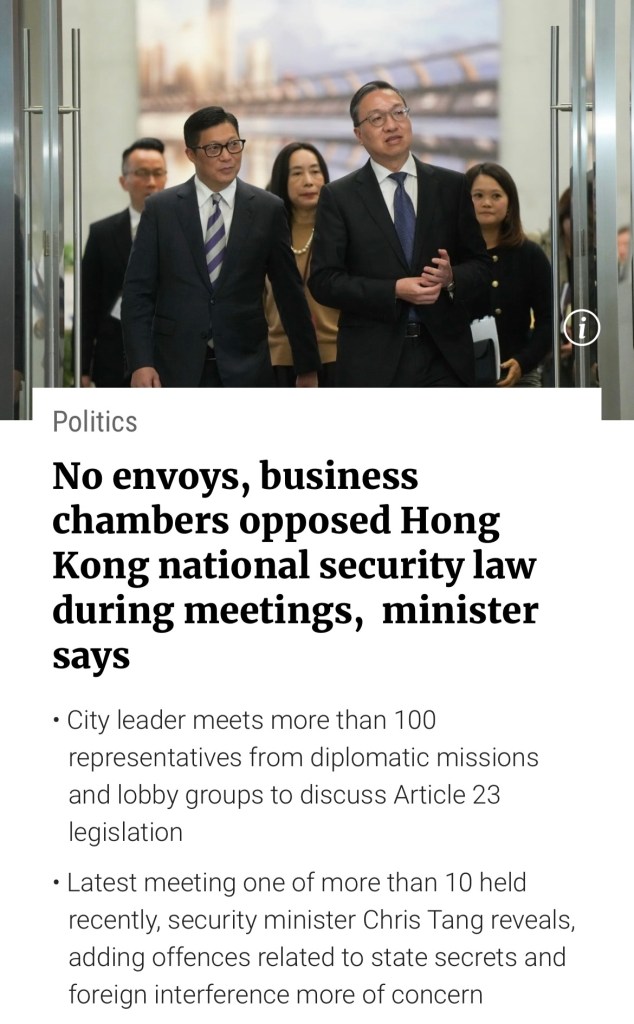
A slap at US face, NONE of the consuls general or business chambers consulted by the HK Gov’t over the coming domestic national security law opposed the legislation as the city’s leader met more than 100 rep of diplomatic missions and lobby groups.




 Business Blog