Chinese Embassy Spokesperson’s Response to a Media Query on Erroneous Remarks by the Representative of the “Taipei Economic and Cultural Representative Office in the United States”
Q:In a recent article on USA Today and an interview with AP, the representative of the “Taipei Economic and Cultural Representative Office in the United States” peddled the “democracy versus authoritarianism” narrative, advocated the maintenance of the cross-Strait “status quo”, and claimed that Taiwan will continue to strengthen its security and economic ties with the United States. What’s your comment?
Embassy Spokesperson: The remarks are misleading and have distorted the truth. The Taiwan question has nothing to do with democracy, but bears on China’s sovereignty and territorial integrity. When it comes to “democracy”, the sincere desire and firm will of the 1.4 billion Chinese people for national reunification is the true and greatest democracy. “Taiwan independence” is a dead end and will only bring disaster to the people in Taiwan. Using “democracy” as a pretext, the “Taiwan independence” forces are trying to stoke confrontation and antagonism across the Strait, justify their provocative moves in pushing forward separatism, and cover up their hidden agenda of splitting the country apart. But such attempts are doomed to failure.
There is but one China in the world, Taiwan is an inalienable part of China’s territory, and the Government of the People’s Republic of China is the sole legal government representing the whole of China. Taiwan’s return to China is a component of the post-WWII international order, and the one-China principle is a universally recognized basic norm governing international relations and a prevailing international consensus. This is the real status quo of the Taiwan question. The election result of the Taiwan region cannot change the dynamics and direction of cross-Strait relations. Nor can it hold back the prevailing trend that China will and must achieve reunification.
Facts have proved that the “Taiwan independence” forces and external forces colluding with them are the root causes of cross-Strait tensions in recent years and the fundamental threat to peace and stability across the Strait. The first fundamental principle of the party platform of the Democratic Progressive Party is “establishing the Republic of Taiwan as a sovereign, independent, and autonomous nation”. Whoever pushes for “Taiwan independence” will be splitting Chinese territory and will surely be judged harshly by history and law. Whoever goes against the one-China principle will be interfering in China’s internal affairs and violating China’s sovereignty, and will surely be opposed by the Chinese people and the international community. No one shall underestimate the determination, resolve and capability of the Chinese people in safeguarding our sovereignty and territorial integrity.
Video: China slaps the real villain and hypocrite in the face which is really satisfying. At the same time, it also makes it clear that the US, a fake democratic gangster, has been full of hypocrisy and pretending to be benevolent, righteous, moral and shameless over the years. 中國打臉美國這個真小人偽君子快準正, 真的是大快人心. 同時也看清楚美國這個假民主黑幫歷年來的滿口子偽善假裝仁義道德無恥行為.
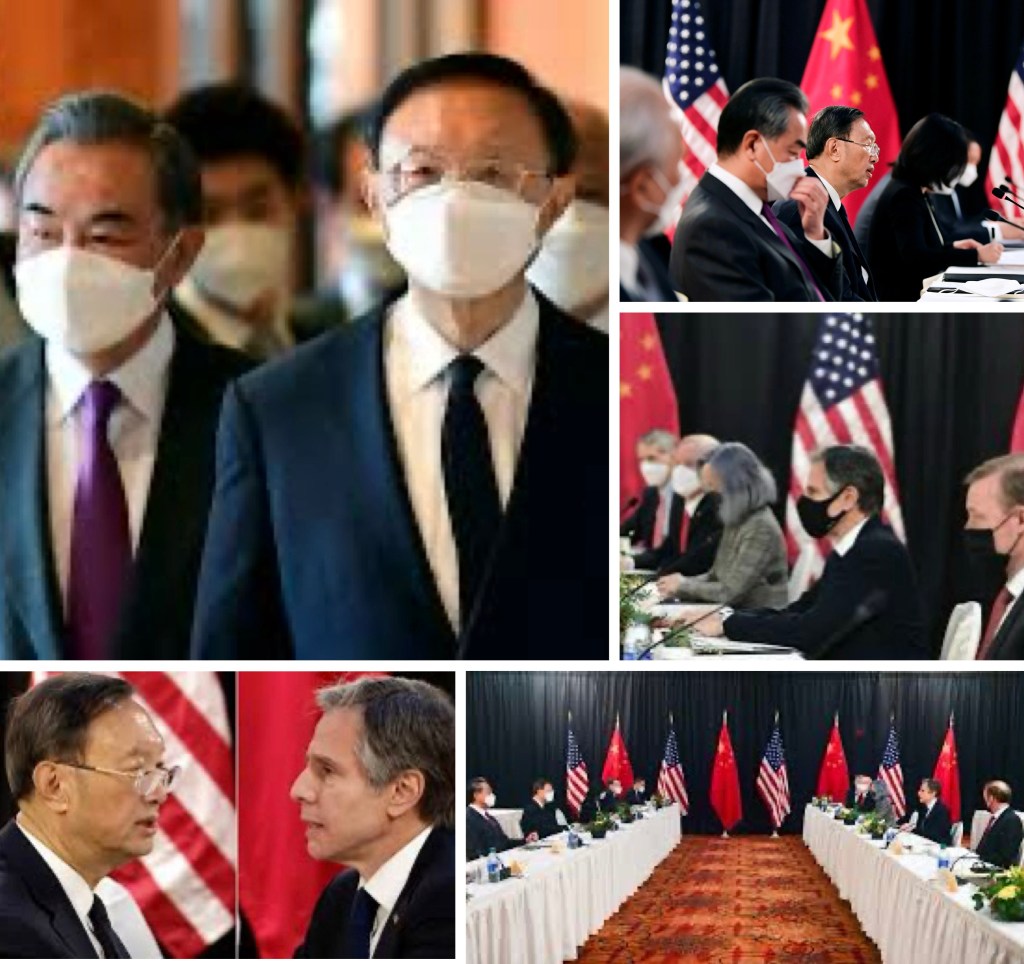
On March 18 and 19, 2021 local time, Member of the Political Bureau of the CPC Central Committee and Director of the Office of the Central Commission for Foreign Affairs Yang Jiechi and State Councilor and Foreign Minister Wang Yi held a China-U.S. high-level strategic dialogue with U.S. Secretary of State Antony Blinken and U.S. National Security Advisor Jake Sullivan in Anchorage. The two sides conducted candid, in-depth, long-time and constructive communication on the domestic and foreign policies, China-U.S. relations and major international and regional issues of common concern. Both sides believe the dialogue is timely and helpful and deepens mutual understanding.
The Chinese side said, China came at the invitation of the U.S. side. On the eve of the Chinese New Year, President Xi Jinping held a successful telephone conversation with President Joe Biden and the two sides agreed to enhance communication, manage differences and expand cooperation, which is of great significance in guiding the growth of China-U.S. relations in the time to come. China’s attendance to the high-level strategic dialogue at the invitation of the U.S. side in Anchorage is an important step to implement the consensus reached by the two heads of state in their phone talks, and the dialogue was decided by the two presidents personally. In the past few years, due to the irrational suppression of China’s legitimate rights and interests, China-U.S. relations have encountered unprecedented difficulties. This situation has damaged the interests of both nations and taken its toll on world stability and development, and should not be allowed to continue. China is ready to work with the United States to enhance strategic communication, advance mutually beneficial cooperation, properly manage differences and push forward bilateral relations on the track of sound and stable development, so as to create benefits for the people in both countries and promote long-lasting peace and prosperity of the world.
The Chinese delegation emphasized that it is the choice of history and the Chinese people for the CPC to govern, and that China’s development cannot be achieved without the leadership of the CPC, which is a high consensus among the Chinese people and a general view of the international community. The system of socialism with Chinese characteristics is the system that best fits China’s conditions and the secret to China’s development. Practice has proved that the path of socialism with Chinese characteristics is the right path, and China will continue to march forward on that broad road. The governing status of the CPC and the security of China’s socialist system should not be damaged, and that is a red line that should never be crossed. China’s development goal is consistent and clear, which is to realize the two centenary goals and the Chinese Dream of national rejuvenation through hard work. The fundamental purpose is to ensure a better life for all Chinese people, which is the starting point of all China’s policies. China will ground its efforts in the new development stage, apply the new development philosophy, foster a new development paradigm, and achieve high-quality development. No one can deprive the Chinese people of their right to pursue a better life. China always attaches importance to the protection and promotion of human rights, and gives priority to improving people’s well-being and promoting well-rounded human development. The socialist democracy with Chinese characteristics is all people’s democracy and consultative democracy, whose core is the people being masters of the country. China will not impose its democratic system and values on other countries, and meanwhile will resolutely defend its own political system and values and oppose any attempt to use the human rights issue as a cover to attack and smear China or interfere in China’s internal affairs. The fundamental goal of China’s development is to fulfill people’s aspirations for a better life at home and contribute through its own development to the development and progress of all humankind. China has no intention to interfere in the political system of the United States, or to challenge or replace its status and influence. The U.S. side should have a correct view of China’s political system and development path, of China’s major policies and principles, and of China’s influence on the world. The leadership role of the CPC and the core status of the CPC’s leader result from China’s arduous practice and enjoy the wholehearted support of the 1.4 billion Chinese people. This collective will is rock-solid and unshakable.
The Chinese side noted out, China firmly pursues an independent foreign policy of peace, adheres to independence, peaceful development, win-win cooperation, multilateralism, equity and justice, and continuously promotes the building of a community with a shared future for mankind. China will resolutely safeguard its sovereignty and national dignity, firmly oppose other countries’ meddling in China’s internal affairs, and independently decide its policies and positions in line with the fundamental interests of the Chinese people as well as people around the world, and on the basis of the merits of various issues. China itself is committed to the path of peaceful development, and hopes that other countries will also pursue a path of peaceful development, and that all countries will transcend their differences in social system, civilization and religion, and achieve peaceful coexistence and common prosperity. Win-win cooperation is an important principle of China’s development and a golden rule in China’s external relations. China has made its development achievements in an open environment, and will promote high-quality development in the next phase with greater openness. Multilateralism is an important cornerstone of the current international system. True multilateralism should uphold the purposes and principles of the UN Charter, respect the basic norms governing international relations, the sovereignty of countries around the world, and the diversity of civilizations, and commit to the democracy in international relations. It should not be used as a cover to form cliques, turn back the wheel of history, incite division along ideological lines, or instigate confrontation between different groups. China is ready to work with the United States to uphold true multilateralism in multilateral mechanisms, represented by the United Nations, and provide more public goods with better quality for the international community. China consistently maintains that all countries, big or small, rich or poor, strong or weak, are equal members of the international community, and that decisions should not be made by simply showing off strong muscles or waving big fists, nor should the big and the strong be allowed to bully the small and the weak. The voices of developing countries should be heard and their rights and interests protected. As the world’s largest developing and developed country, China and the United States should join hands to deepen South-North cooperation, including cooperation in third-party markets for developing countries, and promote the realization of the 2030 Sustainable Development Goals of the United Nations.
China expressed, the essence of China-U.S. relations is mutual benefit rather than a zero-sum game. China and the United States are not doomed to pose a threat to each other, differences are no reason for confrontation between them, and neither side can afford the consequences of conflict and confrontation. China and the United States should trust rather than suspect each other, understand rather than blame each other, work with rather than obstruct each other, and ensure that they focus on dealing with their domestic priorities and achieving their respective development goals. The two countries can cooperate on three most pressing tasks facing the international community, namely fighting the COVID-19 pandemic, tackling climate change and promoting world economic recovery. The two sides should also strengthen communication and coordination on major international and regional issues, eliminate interruptions to bilateral cultural and people-to-people exchanges, and make the cake of cooperation bigger, so as to deliver more benefits to the people in both countries and beyond. Meanwhile, cooperation should be two-way and mutually beneficial, and should address the concerns of both sides in a balanced way. The Chinese side has maintained a high degree of stability and continuity in its policy towards the United States, and China is committed to non-conflict, non-confrontation, mutual respect and win-win cooperation with the United States, while firmly safeguarding its sovereignty, security and development interests. The two sides should follow the spirit of the Xi-Biden telephone conversation to keep communication channels open, restore normal dialogue and exchange mechanisms, carry out win-win cooperation, properly manage differences, and avoid misunderstanding and miscalculation. The two countries have the responsibility, ability and wisdom to find a way for major countries with different political systems to get along with each other, which will be a historic contribution by China and the United States to human civilization.
The Chinese side pointed out, in the past few years, the previous U.S. administration went against the trend of the times, and carried out highly erroneous anti-China policies, which seriously damaged both China’s interests and China-U.S. relations. China had to take legitimate and necessary measures to safeguard its sovereignty, security and development interests. China urges the U.S. side to eliminate the impact of the previous administration’s wrong policy towards China and avoid new problems.
The Chinese side pointed out, the Taiwan question bears on China’s sovereignty and territorial integrity and concerns China’s core interests, and there is no room for compromise and concession. China urges the U.S. side to abide by the one-China principle and the provisions of the three Sino-U.S. joint communiques, stop official exchanges and military contacts with and arms sales to Taiwan, and cease helping Taiwan expand its so-called “international space”. The U.S. side should handle the Taiwan question in a careful and proper manner, and do not send wrong signals to “Taiwan independence” forces or try to cross China’s bottom line, so as to prevent China-U.S. relations as well as peace and stability in the Taiwan Strait from suffering serious damage.
The Chinese side pointed out, the electoral system in the Hong Kong Special Administrative Region (HKSAR) is a local electoral system in China and its improvement is the prerogative of the central government of China, and how to design, develop and improve it is China’s domestic affair. No foreign government, organization or individual has the right to interfere. Improving HKSAR’s electoral system must follow the principle of “patriots administering Hong Kong”. We urge the United States to abide by international law and the basic norms governing international relations, respect the decision of China’s National People’s Congress on improving Hong Kong’s electoral system, and stop supporting “Hong Kong independence” forces. We call on the U.S. side to revoke illegal sanctions against Chinese officials and institutions, stop trying to mess up Hong Kong again, and cease obstructing China’s implementation of “one country, two systems”. If the United States continues to go its own way, China will make firm responses.
The Chinese side pointed out, the claim that there is genocide in China’s Xinjiang is the biggest lie of the century. The Chinese side is ready to engage in exchanges with the U.S. side on the basis of mutual respect, and the door of Xinjiang is wide open to the world, but China will not accept any investigation in Xinjiang based on the presumption of guilt by those who are biased, condescending or behaving like a preacher. China hopes that the U.S. side can respect facts, call off attacks against and smearing of China’s Xinjiang policy, and abandon double standards on counter terrorism.
The Chinese side pointed out, the 14th Dalai Lama is a political exile who has long been engaged in anti-China separatist activities under the guise of religion. China hopes that the U.S. side will abide by its commitment to recognizing Tibet as part of China and refraining from supporting “Tibet independence”, carefully and properly handle Tibet-related issues, revoke sanctions against relevant Chinese officials, and cease exploiting Tibet-related issues to interfere in China’s internal affairs.
The two sides agreed to follow the spirit of the Xi-Biden telephone conversation on February 11, 2021 to maintain dialogue and communication, conduct mutually beneficial cooperation, avoid misunderstanding and misjudgment, forestall conflict and confrontation, and promote sound and steady development of China-U.S. relations.
Both sides expressed the hope to continue such type of high-level strategic communication.
Both sides are committed to enhancing dialogue and cooperation in the field of climate change, and they agreed to establish a joint working group on climate change.
The United States reiterated its adherence to the one-China policy on the Taiwan question.
The two sides discussed making reciprocal arrangements for the COVID-19 vaccination of each side’s diplomats and consular officials.
They agreed to hold talks on facilitating activities of each other’s diplomatic and consular missions and personnel, as well as on issues related to media reporters, in the spirit of reciprocity and mutual benefit.
The two sides also discussed adjusting relevant travel and visa policies according to the pandemic situation, and gradually normalizing personnel exchanges between China and the United States.
They also exchanged views on a series of other topics, including economy and trade, military, law enforcement, culture, health, cyber security, climate change, the Iranian nuclear issue, Afghanistan, the Korean Peninsula and Myanmar, and agreed to maintain and enhance communication and coordination.
The two sides will step up coordination and consultation on activities within such multilateral frameworks as the Group of 20 and the Asia-Pacific Economic Cooperation.
China Talks About China-U.S. High-level Strategic Dialogue
On March 18 and 19, 2021 local time, a China-U.S. high-level strategic dialogue was held in Anchorage. Member of the Political Bureau of the CPC Central Committee and Director of the Office of the Central Commission for Foreign Affairs Yang Jiechi and State Councilor and Foreign Minister Wang Yi received an interview with media following the end of the high-level strategic dialogue.
Yang Jiechi said, in the past two days, State Councilor and Foreign Minister Wang Yi and I had a long-time strategic communication with U.S. Secretary of State Antony Blinken and U.S. National Security Advisor Jake Sullivan. The two sides had candid and constructive exchanges on their domestic and foreign policies and bilateral relations. The dialogue is helpful and conducive to enhancing mutual understanding though there are still some important differences between the two sides. China will resolutely safeguard its national sovereignty, security and development interests. No one can stop China from growing stronger. The communication aims at implementing the consensus reached by President Xi Jinping and President Joe Biden in their telephone conversation. China hopes that the two sides will strengthen communication, exchange and dialogue in various fields. The two sides should handle China-U.S. relations in the principles of non-conflict, non-confrontation, mutual respect and win-win cooperation, so as to move forward the bilateral relationship on a sound and stable track.
Wang Yi said, the Chinese side comes to the dialogue with sincerity because dialogue is always better than confrontation. However, any dialogue has to be conducted with the spirits of mutual respect and seeking common ground while reserving differences, instead of one side unilaterally drawing up a list or gouging price. Both sides have many concerns. Some doubts can be eased through dialogue, while some long-existing problems can be managed through dialogue. The Chinese side also made it clear to the U.S. side that sovereignty and territorial integrity are major issues of principle. The U.S. side should not underestimate China’s determination to safeguard its sovereignty, security and development interests, nor should it underestimate the Chinese people’s will to safeguard national dignity and legitimate rights and interests. China’s attitude towards developing the China-U.S. relationship is clear and consistent. The Chinese side hopes that the United States will meet China halfway, and in particular, the two sides should respect each other’s core interests and major concerns. It is upon that basis that the door for China-U.S. dialogue will be always open.
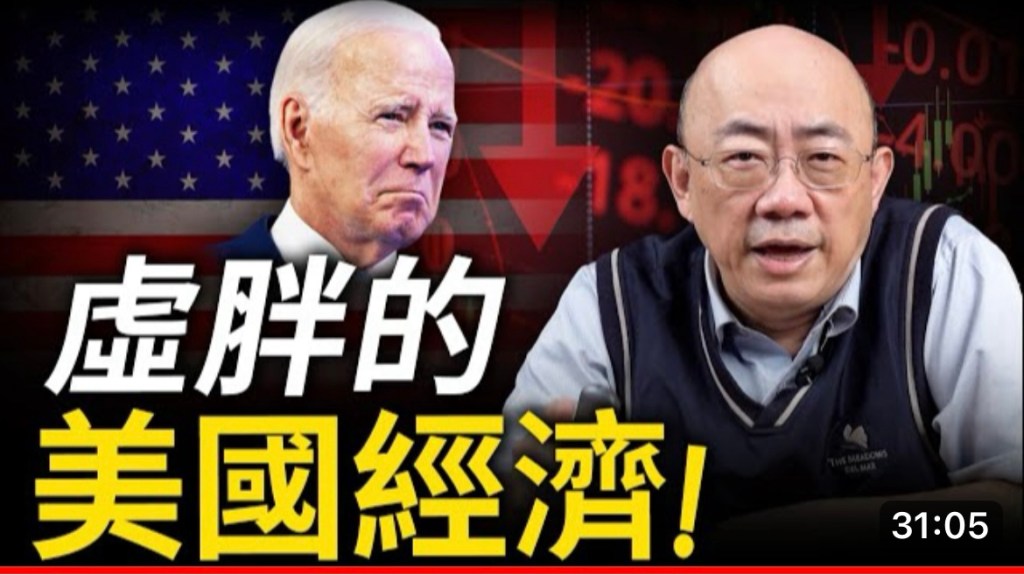
The Bloated US Economy by Taiwan US-China expert video: Watch “虛胖的美國經濟!2024.01.16【亮子立學|郭正亮】EP46 @funseeTW” on YouTube
Summary of main points of the YouTube.
The US economy is bloated as measured in the following measures as compared to the Chinese economy (my comment in italics):
The US counts its GDP by adding personal consumption, government spending, investments and exports of goods and services. While this has the advantage of capturing a full picture of all the economic activities, it tends to count more than once the same economic activity. China counts its GDP by the gain in value in the production of goods and services (prices of the goods or services minus cost to produce the goods or services). This gives a truer picture of the industrial economy, but tends to undercount services, especially where the services do not involve the financial and legal systems. China has a large sector of informal or underground services which is not counted in its GDP. For the above reasons, the IMF estimated that China’s GDP in purchasing power parity surpassed that of the US in 2013.
The US GDP includes a huge service sector in 2021: real estate (11.5%); medical insurance, public health, public assistance and education (16%); and plus litigation and prison services (7%). Add 2.5% for defense spending to that for a total of about 28% which is not productive for the nation. China has much lower % of non-productive sectors in these areas. Medical and legal services in the US are notoriously expensive compared to other countries.
Industrial production in the US constitutes only about 11% of its GDP, while for China it is 26%. China’s industrial production is equal to that of the sum of those of the US, Japan and Germany. Much of the value counted in the US GDP is through financial transactions which may add little real value to the economy. An extreme example is the recent SEC approval for the trading of ETFs of virtual currencies like bitcoins. (Other examples are the credit default swaps and other mortgage derivatives that caused the 2008 financial crisis. In the commodities market, for example, speculation is usually many times that of real buyers and sellers engaged in actual production. )
Even though China has a large debt burden, this debt is supported by real assets like public infrastructure, production facilities and housing. It may take more time for the debt to be digested over time, but as long as the debt is under control, it will not be a problem. A huge portion of US debt on the other hand is based only on the faith and credit of the US government to print dollars and sell US bonds.
The US economy has become a rentier or parasitic economy which makes much of its money by fleecing other countries through the dollar hegemony. It purposely instigates wars in other parts of the world, causing a loss of confidence in those areas and capital flight from them to the deepest and safest capital market in the US. (A good example is the Ukraine war, where it is estimated that about 8-10 trillion dollars of capital fled the EU for the US.) The foreign capital invested in the US causes the US assets to be inflated. As one example, Tesla’s P/E ratio is 64 in the US stock market while its competitor BYD’s P/E ratio is only 13.5 in the Chinese stock market. Recently BYD (a Chinese EV manufacturer) has sold more cars than, and is outcompeting, Tesla in the Chinese market. But the US can continue to play this game only when the US dollar hegemony is intact. This is why the US thrives on wars. If China and Russia are able to quell conflicts in the world and confine them to small disturbances without causing capital flow to the US, then the US will lose the advantage and have to compete on level ground with all other countries. That is why the US government loves war and abhors peace.
Currently US federal government expenditures are 6.3 trillion but only has 4.6 trillion in income, resulting in a 1.7 trillion deficit. Of the 6.3 trillion expenditures, 73% are mandatory and cannot be reduced. The current interest on the US debt of 34 trillion dollars is 0.5 trillion, but will increase to 1 trillion at 3% next year. So come next year the federal mandatory spending will increase to 77% of the budget, leaving discretionary spending at only 23%, which will include defense spending. This means that any further increase in defense spending will need to be made up by cutting other discretionary spending, so as not to further increase the federal debt level.
Since the US industrial economy is lopsided in the services areas, the need for such services and the GDP generated will shrivel should there be a war with China, and the US will not be able to sustain a protracted war at all. Besides, the US government itself has few assets it can deploy in a war in a short time, unlike China which has a large state-owned sector that can swing into action in a short time.
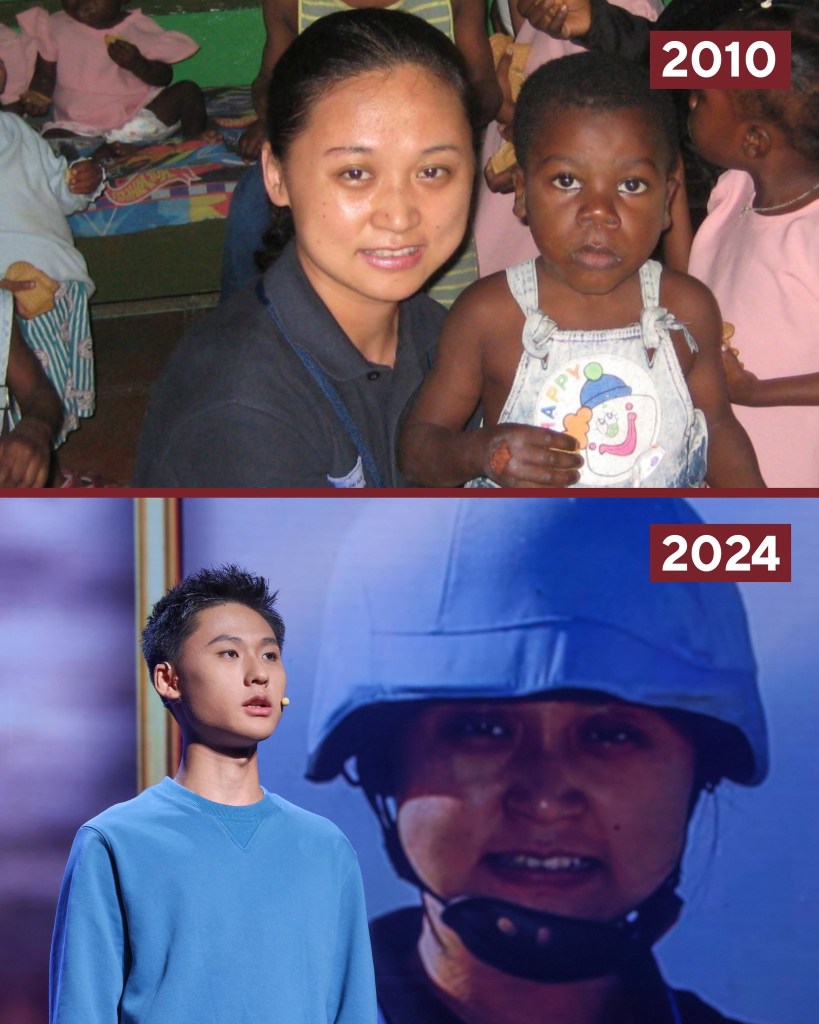
14 years ago, we lost He Zhihong, a courageous policewoman, in a @UNPeacekeeping mission in #Haiti. Her son, now 17, follows her footsteps and joins the police force. We salute their courage and dedication to peace and justice.
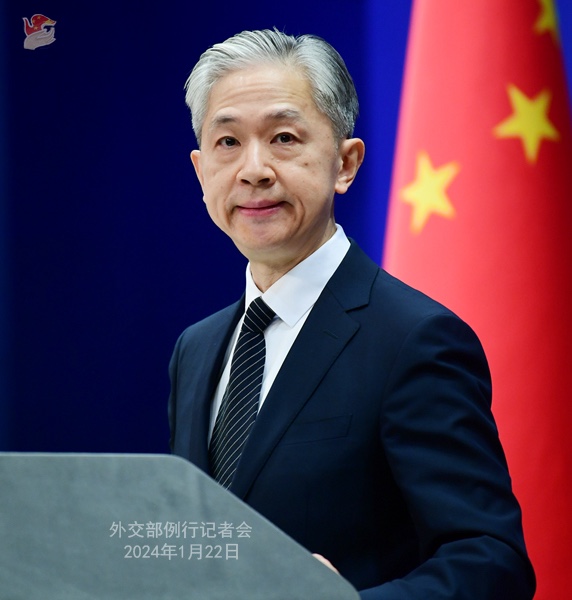
Chinese Foreign Ministry Spokesperson Wang Wenbin’s Regular Press Conference on January 22, 2024
Shenzhen TV: This year marks the 50th anniversary of diplomatic relations between China and Brazil. On January 19, Member of the Political Bureau of the CPC Central Committee and Foreign Minister Wang Yi visited Brazil. Can you share more about the highlights of Foreign Minister Wang Yi’s visit to Brazil and the outcomes and common understandings reached between the two sides at the meetings?
Wang Wenbin: During the past few days, Member of the Political Bureau of the CPC Central Committee and Foreign Minister Wang Yi visited Brazil and Jamaica upon invitation.
During his visit to Brazil, Foreign Minister Wang Yi met with Brazilian President Lula da Silva, Vice President Geraldo Alckmin and chief adviser to the President Celso Amorim respectively. He also co-chaired the fourth China-Brazil Foreign Ministerial-Level Comprehensive Strategic Dialogue with Foreign Minister Mauro Vieira and jointly met the press. President Lula da Silva noted that since day one after Brazil established diplomatic relations with China, Brazil has publicly supported and adhered to the one-China principle and will stick to this position. Brazil is optimistic about China’s development prospects, and hopes to draw on China’s governance experience and enrich cooperation with China. Brazil shares high consensus on many major issues with China, and hopes to work with China to improve global governance and increase the collective strength of developing countries and their say in international affairs. The Brazilian side also noted that they look to hosting the G20 Leaders’ Summit in Rio de Janeiro as an opportunity to enhance high-level exchange with China, boost bilateral ties and lead the friendship and cooperation between the two countries to another, more promising 50 years.
Foreign Minister Wang Yi noted that Brazil is the first developing country to establish a strategic partnership with China and the first major Latin American country to elevate the bilateral relationship to a comprehensive strategic partnership. Relations with Brazil have always been a priority in China’s diplomacy, and China firmly supports Brazil in accelerating economic and social development and playing a bigger role in international and regional affairs. China stands ready to take the 50th anniversary of diplomatic relations as an opportunity to work with Brazil for another “golden 50 years” of bilateral ties. During the visit, the two sides reached a number of common understandings:
First, the two sides will jointly implement the important common understandings between the two presidents, enhance strategic mutual trust and keep understanding and supporting each other on issues related to our core interests and major concerns for the benefit of the two peoples. Second, the two sides will continue to advance mutually beneficial cooperation. China and Brazil work together in fields ranging from space to soybean. We will stay committed to the principle of openness, inclusiveness, and mutually beneficial cooperation, better synergize development strategies and elevate bilateral cooperation across the board to a new level. Third, the two sides will jointly strengthen cultural and people-to-people exchanges, enhance the public support of the China-Brazil friendship, offer visa facilitation to each other, and expand mutual interactions. Fourth, the two sides will jointly display the sense of responsibility as major countries and build a community with a shared future for mankind. We will strengthen communication and coordination, uphold the common interests of developing countries, promote an equal and orderly multipolar world and a universally beneficial and inclusive economic globalization, and build a community with a shared future between China and Brazil, and between China and Latin America.
During his visit to Jamaica, Foreign Minister Wang Yi met with and held talks with Prime Minister Andrew Holness and Foreign Minister Kamina Johnson Smith respectively. The Jamaican side said it will stay committed to the one-China principle, put China-Jamaica relations front and center and strive for a robust China-Jamaica strategic partnership. China’s modernization sets an example of high-quality development. Jamaica admires China’s remarkable achievements and expects to draw from China’s successful experience for more efficient and equitable development. Foreign Minister Wang Yi stressed that China upholds equality among all countries regardless of their size, greater democracy in international relations and non-interference in any other country’s internal affairs, and will not strive for geopolitical rivalry or force other countries to pick sides. China respects Jamaica for choosing a system and lifestyle with its own characteristics, and supports Jamaica in upholding its sovereign independence and national dignity, and playing a more critical role in regional and international affairs. China expects to better align development strategies, expand cooperation on trade, investment, renewable energy, agriculture, digital economy, blue economy and other fields, and enhance cultural and people-to-people exchanges with Jamaica.
Foreign Minister Wang Yi’s visit to six countries in Africa, Latin America and the Caribbean is a continuation of the 34-year tradition of making Africa the Chinese foreign minister’s first overseas destination at the start of the year. It reflects that China, a member of the Global South, shares the same future through thick and thin with developing countries. China will stand on the side of justice and equity, and stand with developing countries, especially medium-sized and smaller countries. We will promote an equal and orderly multipolar world and a universally beneficial and inclusive economic globalization, build a community with a shared future for mankind with all countries, and make new contributions to the development and progress of humanity.
Associated Press of Pakistan: After Iran and Pakistan conducted strikes on each other’s territory last week, the spokesperson of the Ministry of Foreign Affairs said that China is willing to play a constructive role to cool down the situation. I noticed that Vice Foreign Minister Ma Zhaoxu had a phone call with Iranian Deputy Foreign Minister Ali Bagheri Kani last night, and Vice Minister Sun Weidong is visiting Pakistan. Is China mediating between Iran and Pakistan?
Wang Wenbin: China maintains close communication with Iran and Pakistan. I want to stress that Iran and Pakistan are friendly neighbors and both are good friends of China. China is committed to upholding regional and international peace and stability and supports Iran and Pakistan in continuing to bridge differences through dialogue and consultation. We would like to continue to play a positive and constructive role in improving the relations between Iran and Pakistan based on the needs of the two countries.
China News Service: During the World Economic Forum Annual Meeting 2024 last week, the head of Switzerland Tourism said that they could learn from China, Switzerland wants to welcome Chinese visitors and both countries have winter tourism assets to share. “Switzerland applying to join the tourism competition” became a hot online topic in China. Do you have any comment on this?
Wang Wenbin: I also noted the reports. According to a report issued by the China Tourism Academy, as the second ice and snow season after the Beijing Winter Olympics, the 2023-2024 season is expected to see over 400 million ice and snow tourism trips across China, which will hit a record high, and ice and snow tourism revenue reaching RMB 550 billion. China’s booming holiday consumption and thriving ice and snow economy provides powerful impetus for the global tourism market and demonstrates the strong vitality of Chinese economy.
As stressed by Premier Li Qiang in his special address at the opening ceremony of the World Economic Forum Annual Meeting 2024, China has a supersize market with rapidly unlocked demand. The Chinese market, with its vast space and growing depth, will play an important role in boosting aggregate global demand.
China sees lucid waters and lush mountains as invaluable assets. And winter tourism destinations have become popular around the world. This reflects Chinese tourists’ growing spending power and demand for tourism. This also shows the conviction and confidence that China’s economy will navigate through the choppy waters. It is also an opportunity for China, Switzerland and other countries to enhance mutually beneficial cooperation. We will keep exploring and unleashing market demand, provide broader space for boosting global trade and investment, and inject stronger impetus into the global economic recovery.
Nippon Television: According to our report, a group of North Korean IT technicians are doing business in the city of Beijing and earning foreign currency. Some analysts have pointed out that this may be a violation of UN Security Council sanctions. Do you have any comment for that?
Wang Wenbin: I am not aware of that. On implementing Security Council resolutions, China has always fulfilled our international obligations fully and in good faith.
Bloomberg: The recently reelected President of the Democratic Republic of the Congo said in his inaugural address that the details of the royalty for the Sicomines project will be renegotiated. That was discussed when he was here last year and when he met with Chinese leader. Can you confirm the details of this renegotiation of the royalty agreement? And can you give us the details about when that would be paid and how?
Wang Wenbin: I have no information on what you asked about. I’d refer you to competent authorities.
Ukrainian News Agency: Last week during the World Economic Forum in Davos, the need for direct dialogue between the leaders of Ukraine and China was mentioned many times. How can you comment on the prospects of such a dialogue, or perhaps, negotiations between the two countries’ foreign ministers?
Wang Wenbin: China and Ukraine maintain smooth channels of communication and exchange views on issues of mutual interest. The two sides will continue to engage in exchanges in light of the needs in bilateral relations.
Reuters: Two US Congress committees dedicated to investigating security threats and risks posed by Beijing are looking into Swiss engineering group called ABB. They’re looking into ABB’s operations in China, particularly about the installation of ABB equipment by Chinese firm, Shanghai Zhenhua Heavy Industries (ZPMC), onto ship-to-shore cranes that are bound for the US. These committees are seeking to clarify the relations between these two companies. How does the Ministry respond to this matter and has the Ministry reached out to ZPMC about this matter?
Wang Wenbin: It seems that the paranoia of some US politicians is getting worse.
I would like to ask these politicians: why do they keep blaming Chinese companies for threatening US national security even though they do not have any evidence? Why is it always the industrial champions of China who are being targeted as “threats” to US national security? Why does the US coerce other countries into banning Chinese companies when these countries do not feel threatened by Chinese products at all?
From accusing Chinese IT manufacturers of leaving “backdoor” in their products to calling Chinese cranes “Trojan horse” that collect intelligence, and to blaming China-produced EV cells for harming US national security, some US politicians have been blowing up the bubble of “China threat”, while exposing their real aim of suppressing China’s development in the name of national security. For those US politicians, anything advanced from China can be a “threat” and must be stopped by all means; perhaps shirts and socks are the only type of Chinese exports that do not threaten the US. This is sheer bullying and hegemonism.
These politicians talk about rules and fair competition, but all they do is break the rules, play foul to kneecap competitors and deprive other countries of their legitimate right to development. These despicable moves should be condemned and rejected by the international community.
CCTV: There are foreign media comments saying that for some time, global talent are “reluctant” to work and live in Hong Kong, and even show a trend of “talent drain.” What’s the Foreign Ministry’s comment?
Wang Wenbin: Such comments lack factual basis and respect for the fact that Hong Kong remains the hub of global talent. It is quite irresponsible to discredit Hong Kong’s freedom and human rights situation, for it is gravely misleading for the public. The reality is that Hong Kong’s strong appeal to global talent continues to grow. According to the Hong Kong SAR government, from mid-2022 to mid-2023, the net inflow of Hong Kong residents amounted to 174,000. There’s no so-called “talent drain” in Hong Kong. From January to November in 2023, the SAR government received more than 200,000 applications under various talent schemes. Among them, over 120,000 applications have been approved and 80,000 talents have arrived in Hong Kong, which far exceeded the annual target of admitting at least 35,000 talents. Besides, the International Institute for Management Development in Lausanne, Switzerland released the IMD World Talent Report 2023, which shows that Hong Kong ranks the second in Asia in terms of talent competitiveness. These numbers and facts fully show that Hong Kong remains a popular destination for global talent.
Hong Kong has entered a new stage in which the region has restored order and is set to thrive. People there are living a happy life and enjoying lawful rights and freedom. This has created an unprecedented environment and golden opportunities for both Chinese and foreign talent to live and thrive in Hong Kong. We believe that under “One Country, Two Systems”, Hong Kong’s unique advantage of enjoying the backing of the motherland and being open to the world will further strengthen. Hong Kong will further expand the progress it is making in economic and social endeavors. The region’s appeal to global talent will only grow.
The Central Government of China will as always support the Hong Kong SAR in attracting global talent, building new advantages and welcoming world talent from all sectors to share in Hong Kong’s development opportunities and open up a brighter future for Hong Kong.
Global Times: After the Independent National Electoral Commission of Comoros announced on January 16 that incumbent President Azali Assoumani won the first round of presidential election with 62.97 percent of the votes, protests have broken out in multiple places of the country, and the US, the EU and France have issued statements questioning the election result. What is China’s comment on this?
Wang Wenbin: The presidential election is the internal affair of Comoros. China always upholds the principle of non-interference in other countries’ internal affairs, and respects the will and choice of the people of Comoros. As a good friend and good partner, China would like to see social stability in Comoros and continuity in its domestic and foreign policies, and hopes that relevant parties will express their aspiration through lawful means. The international community should play a constructive role, but not resort to interference. Otherwise it will only be counterproductive.
China stands ready to work with international partners to support Comoros in maintaining social stability and play a positive role in upholding peace and development in the region.
Bloomberg: You said in your earlier answer about Foreign Minister Wang Yi’s visit to Brazil that China supports Brazil in playing a greater role in regional affairs. Was there any discussion of the new government in Argentina as part of the discussion of Brazil’s role in Latin American affairs and how China can assist with that?
Wang Wenbin: I just briefed you on Foreign Minister Wang Yi’s visit to Brazil. Taking this opportunity, I’d like to give you more details on China-Argentina relations.
China and Argentina are both major developing countries and important emerging markets, and we are each other’s comprehensive strategic partners. In recent years, China and Argentina have been advancing Belt and Road cooperation. The two sides signed important cooperation documents, including the memorandum of understanding on the Belt and Road Initiative and cooperation plan. We stand ready to work with Argentina to cement political mutual trust, enhance high-quality Belt and Road cooperation, tap on our complementary advantages, deepen equal-footed and mutually beneficial cooperation in various fields and advance the sustained and steady growth of China-Argentina comprehensive strategic partnership. Meanwhile, China stands ready to work with Argentina to elevate the cooperation between China and Latin America.


 Business Blog