Quickie summary of the very complicated Myanmar situation 緬甸局勢非常複雜的簡要概述 by KJ Noh 12/27/22
It is a civil war between the military government (the Tatmadaw; TMD/SAC; State Administrative Council), the NUG (the recently deposed Bamar civil government (from the US-sponsored NLD party) and its civilian militias), 20+ different armed ethnic groups (AEO’s) with constantly shifting alliances/coalitions/loyalties (and complex histories), intersecting with a variety of criminal enterprises and scams that are opportunistic, strategic, and inconsistent.
This civil war is the longest continuous one in modern history–75 years–and has its origins in the British colonization of the region. The British created an artificial, chimeric state, a patchwork of countries and ethnicities, in order to “divide and rule”. A charismatic anti-imperialist leader, Aung San, founded the communist party, united the different parties, and led the country towards national liberation. He was assassinated (most likely by MI6) in 1947 just as the country was achieving liberation. Aung San was a Patrice Lumumba-type character, and after he was assassinated the country devolved into chaos and Civil war. That has continued essentially to this day. This war also has a religious dimension (Buddhism, Islam, and Christianity)–the ruling ethnic groups under the British were converted to Christianity, and that has been a continuous source of conflict as well (including intra-religious fights and intra-ethnic fights).
A new development has been China’s recent pressure on Myanmar: military exercises on the border near Kokang state, support of certain AEO’s, direct pressure on the government, and even cross border raids and the issuing of arrest warrants.
This is unusual. China has had a strict, non-interventionist foreign policy since at least 1979. However, in the current moment, China’s key issue is the immense cross-border criminality: Myanmar has over 1250 miles (2000km) of border with China’s Yunnan province, and there is a huge crime problem where thousands of Chinese nationals have been kidnapped into slavery in Myanmar; some have been murdered.
As a result, China is trying to tamp down on this border crime: pornography, drug trafficking, sexual trafficking, human trafficking esp into phone scamming. A recent Chinese raid liberated 4500 Chinese nationals and the Chinese government has issued arrest warrants for the four Kokang crime families spearheading this crime. These crime syndicates usually involve phone scams run by criminal networks on the border with China: they kidnap Chinese (and other) Nationals and then force them to work as slaves in call-center scams under pressure of torture, beatings, sexual assault and murder. 120,000 people are estimated to be enslaved in these networks according to the UN. These syndicates are purported to have family connections to the TMD.
China has been trying to get the Burmese military government (SAC/TMD) to prevent this; when that was ineffectual, it has encouraged/supported the Nothern AEO’s (the Three brotherhood army (TBA: The Arakan Army, the MNDAA (Myanamr National Democratic Alliance Army, TNLA (Ta’Ang National Liberation Army) to smash the criminal gangs and to re-take control of the border (Operation 1027). (Prior to this, the three brotherhood alliance was not directly fighting the TMD). This has had the effect of showing the weakness of the TMD,with 80-200 bases overrun by the TBA; the TBA, the BPLA (Bamar People’s Liberation Army), other AEO’s, as well as the NUG, have tried to press this to their advantage for political leverage and gain.
China’s response has actually been to try to mediate peace between them: China wants stability and peace, especially on its border, not to pick winners, but the dynamic is complex and continually shifting.
This complex dynamic (political, strategic, ethno-religious, territorial, criminal) has led to varying actions and varying alliances between 1) border guard forces (usually corrupt) and the “four families”, allegedly responsible for the crime 2) the Myanmar military/SAC (which is fighting multiple AEO groups while opportunistically courting the Chinese) 3) multiple sets of alliances between various Armed ethnic groups.that are: a) jockeying for influence and territory amongst themselves b) fighting the military as well as sometimes each other–there is much more diversity than the MSM would have you believe (where the MSM protrays it as “valiant AEO’s all together fighting a despotic military coup government”–not all AEO’s are opposed to the coup; they saw the US-directed NLD as just as despotic–and genocidal–as the MIlitary government (with which they cohabited) and distrust the NUG (which the NLD became after the coup) c) working with, and for, and sometimes against China (some of these groups are ethnically Chinese (such as the MNDAA) or pro-Chinese: Shan state AEO’s, the AA, the UWSA (the United Wa State Army, which is a de-facto liberated state and has been described as the “quartermaster for the Northern AEO’s”).
To complicate the picture further, there is a geopolitical dimension involved. Burma aboards China with its longest contiguous border, and the US has been trying to encircle and destabilize China for at least a decade now.
This encirclement (“the Pivot to Asia”, declared in 2011 by Obama) involves creating a chain of (300+) bases and a wall of offensive missiles all along the Chinese coast to contain and choke out China. This “first island chain” stretches from Japan-Korea (Jeju Island)-Okinawa/Ryukyu islands-Taiwan Island -Philippines-Malaysia-Singapore-Indonesia* to create an almost perfect noose. TW is the dead center of this chain and the closest point to China, and it also guards the two exit and entry gates of this encirclement, the Bashi Channel and Miyako straits, which is why the Chinese consider it “a core interest”.
(*Malaysia, Singapore, Indonesia do not have formal bases, but base-leasing or port-use agreements; Japan, Okinawa, Korea, are sinking from the weight of US bases; Philippines has 9, with Subic Bay soon to come back online. Japan (and soon S. Korea) have space force bases. All of them rehearse combined arms joint operations with the US military and NATO is planning to establish a joint operations liaison base in Japan next year)
The key doctrine of war against China (“AirSea Battle”, started in 2009 under Obama, derived originally from AirLand Battle, the war doctrine against the USSR, itself derived from the Yom Kippur war) involves deep strategic strikes within China while blockading and choking off all commercial traffic in the South China Sea, in particular through the Malacca straits. Over $5 Trillion dollars worth of Chinese trade and 70% of China’s oil moves through the SCS. RAND’s wargaming has shown that a shooting war in the SCS–regardless of whether the US wins or not–would result in a 25%-35% reduction of China’s economy; the assumption being that this would create catastrophic pressure on China’s leadership, possibly enough to bring down the government. RAND says that this must be done before 2025, before China becomes powerful enough to resist this.
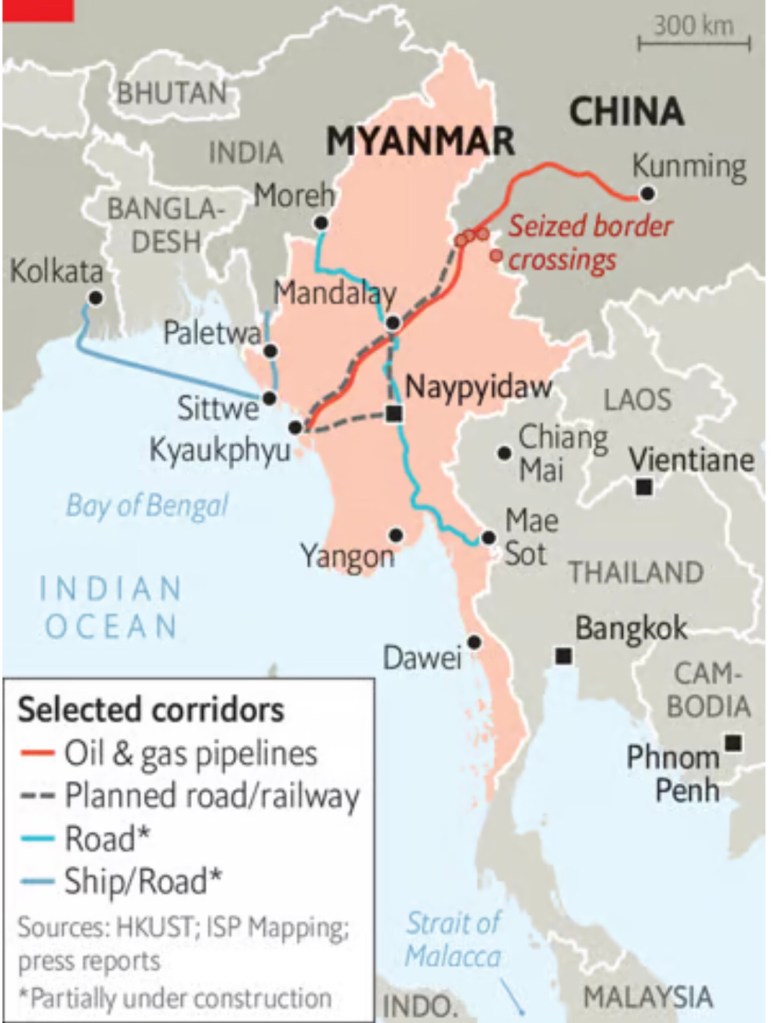
Not well understood, the BRI (The Belt and Road Initiative) is not simply an Asia-wide infrastructural development plan. It was originally conceived as a series of overland routes to bypass this maritime encirclement in the SCS, by following the ancient Silk roads that predated it. Key to this, China has BRI (Belt and Road Initiative) construction in Myanmar–a $35B investment–in particular the Kyaukpyu port and key China-Myanmar logistical infrastructure. This is called the CMEC (China-Myanmar Economic Corridor). This is one of the most critical nodes of the BRI in that it is the first node to bypass the Malacca straits/SCS and release traffic into the Indian Ocean without being subject to strangulation at the Malacca straits.
image.png
On the other hand, the US wants to increase chaos and disruption and prevent the completion of the CMEC arm of the BRI–that would undermine this encirclement. Chaos in Myanmar and a government hostile to China is therefore to its advantage: it wants to disrupt the BRI as well as create harassment and instability for China along its border.
This is also true for the other key leg of the BRI, the CPEC (China-Pakistan Economic Corridor) , actually the first leg of the BRI built. This has seen direct attacks on infrastructure in the Balochistan area, as well as terror assassinations of dozens of Chinese civil engineers. It has also suffered a recent coup that former president Imran Khan has blamed on the US. The recent anti-Chinese/anti-BRI messaging out of Balochistan also strongly suggests US involvement.
A key fact to remember is that the US waged low-intensity border wars on China continuously for decades (1949-1978), directed by the reactionary anti-Communist KMT government that it installed on Taiwan Island. In particular, the KMT used parts of Myanmar as its frontline border to attack China—the Korean war can actually be seen as a two front war against China to roll back the CPC (from both Myanmar and Korea). This was done at the time, using ROC/KMT militias enmeshed with the AEO’s in Myanmar.
After the US normalized relations with China, the CIA flew the leadership of these KMT combatants back to TW, but it has never given up its intense meddling in Myanmar. The decades-long, drug-fueled anti-China dirty war was financed by the production and trafficking of heroin (and later Meth) from this area — the so-called “golden triangle”, and directed from TW province. Contemporaneously, the ROC/TW government, through the WACL (World Anti-Communist League) also subcontracted US dirty wars in Latin America (wars too dirty to be put on the CIA payroll), for example, training the death squad leaders of El Salvador and running dirty wars in Nicaragua. Iran-Contra was also run out of TW through the WACL (Major General John K. Singlaub).
Empire is a sordid business with many pots cooking and stirring at once. It was certain that the US was involved in Myanmar up until the time of the recent coup–ASSK and the NLD were a US favorites/proxies, until they weren’t–so it would be a surprise if it were not still involved. US geostrategic interests and the US influence are not likely to remove themselves in clean break, just because of a coup.
Last but not least, there is also a economic/resource struggle involved among the various parties–teak, oil, strategic precious metals, to compound the political, territorial, and ethno-religious conflicts,
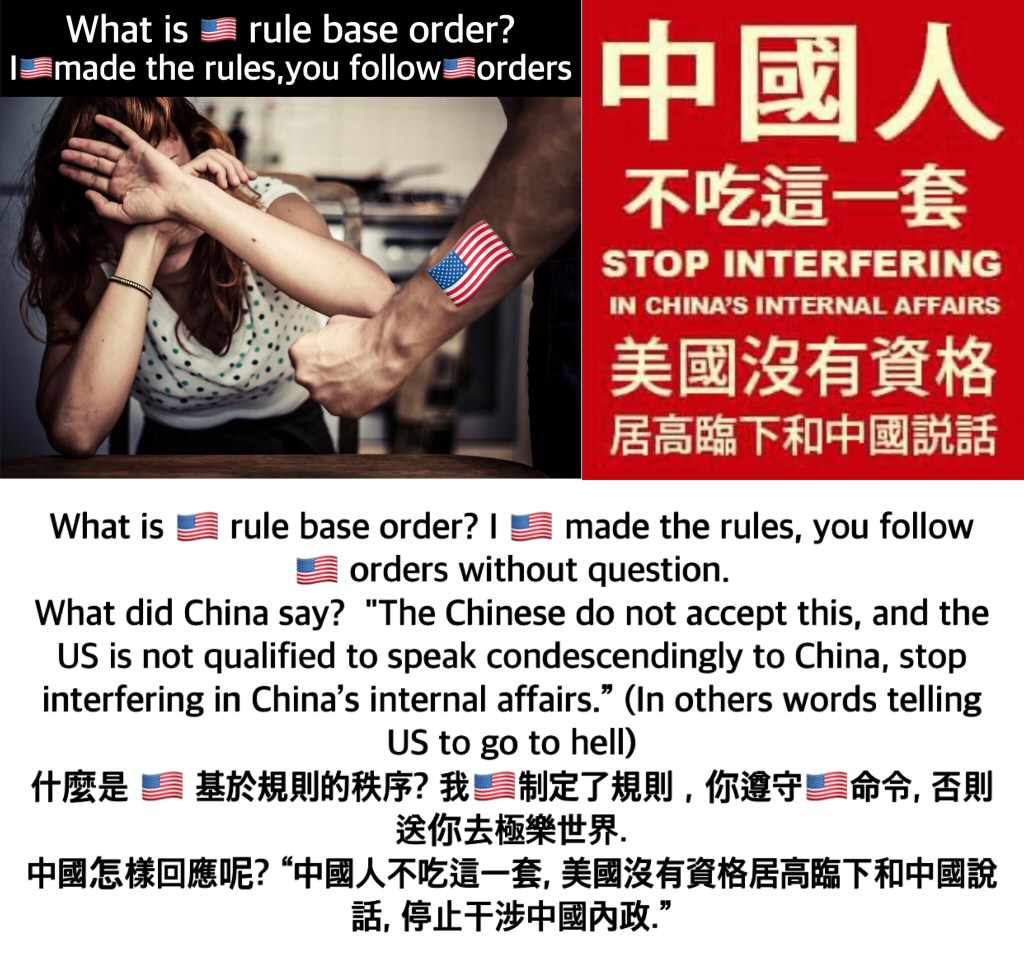
What is 🇺🇸 rule base order? I 🇺🇸 made the rules, you follow 🇺🇸 orders without question. What did China say? “The Chinese do not accept this, and the US is not qualified to speak condescendingly to China, stop interfering in China’s internal affairs.” (In others words telling US to go to hell) 什麼是 🇺🇸 基於規則的秩序? 我🇺🇸制定了規則,你遵守🇺🇸命令, 否則送你去極樂世界. 中國怎樣回應呢? “中國人不吃這一套, 美國沒有資格居高臨下和中國說話, 停止干涉中國內政.”
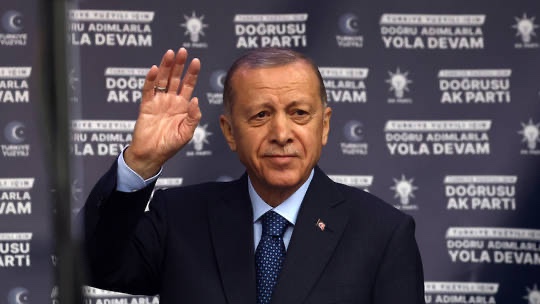
Erdogan says Netanyahu literally ‘Hitler’ The only difference between the Nazi fuhrer and Israeli’s PM is the Western support the latter enjoys, the Turkish leader says 艾爾段稱內塔尼亞胡字面意思是「希特勒」 土耳其領導人表示,納粹元首和以色列總理之間的唯一區別是後者享有西方的支持
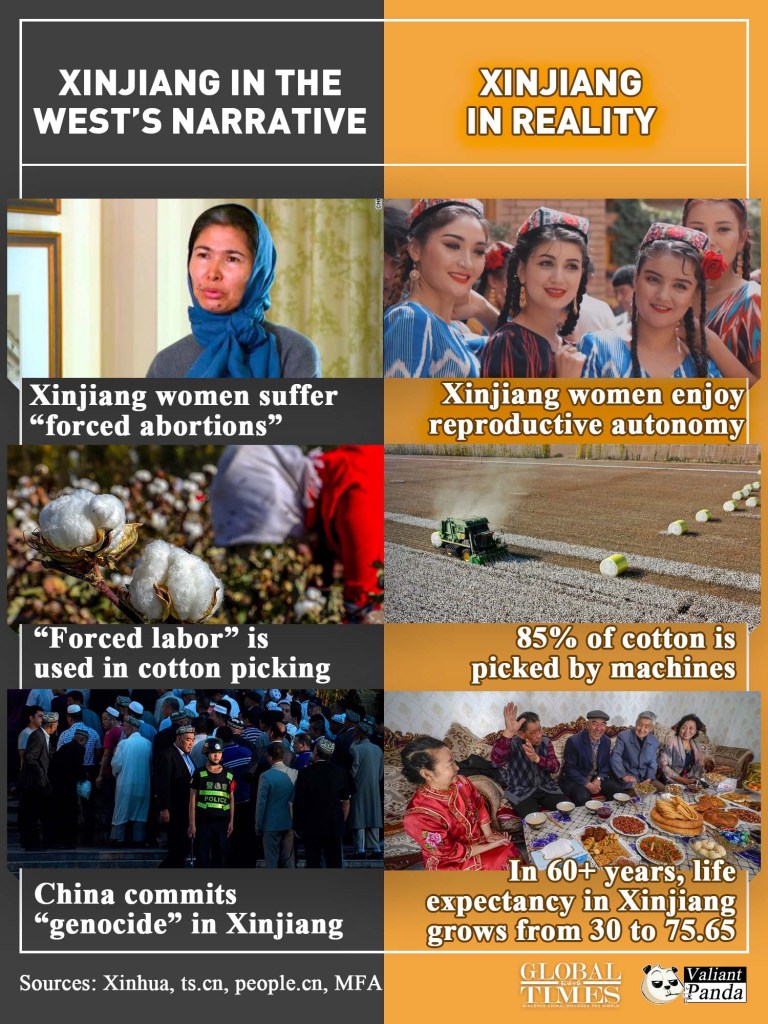
American Hollywood production narrative vs Xinjiang in reality where most Muslim nations visited and witnessed including companies like Volkswagen 美國好萊塢製作與現實中的新疆相比,大多數穆斯林國家都參觀並見證了新疆,其中包括大眾汽車等公司.
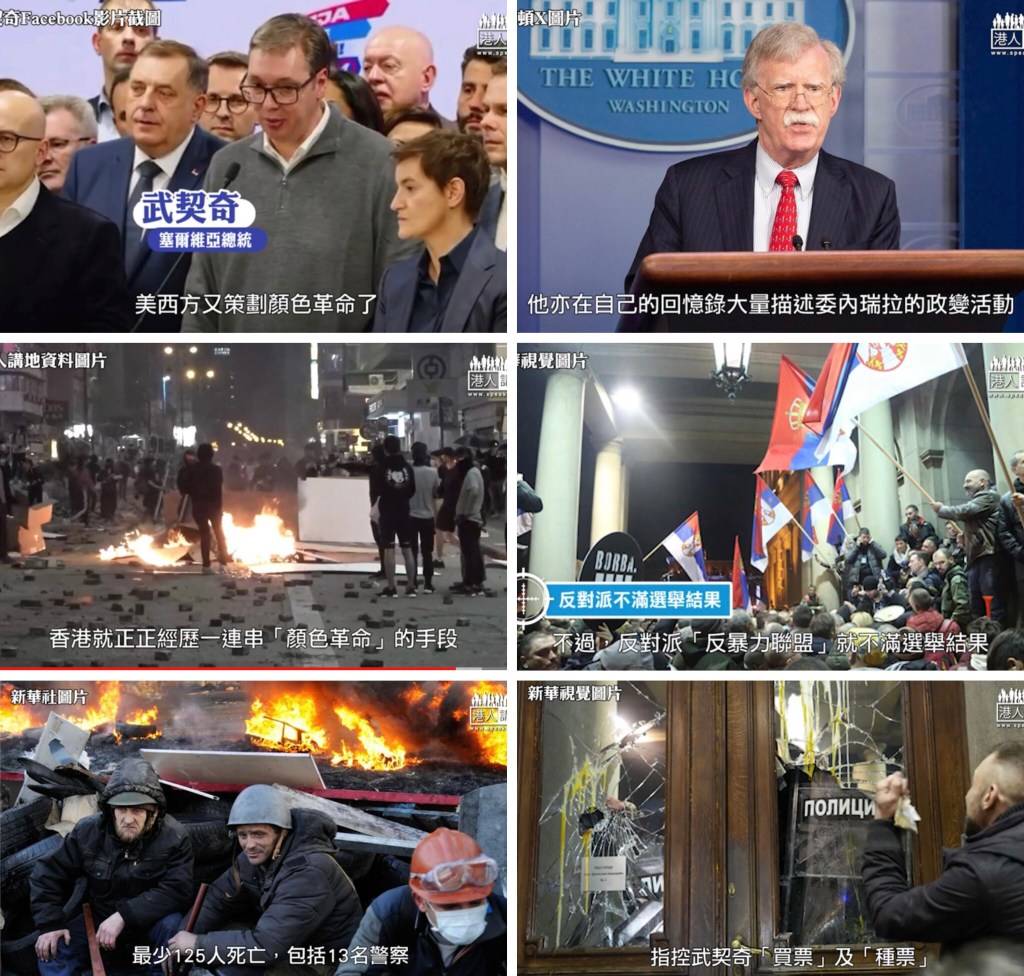
Video: Serbia was hit by a “color revolution” by US, replicating the HK riots and staged them again. US will certainly not give up and will definitely take the opportunity to launch a color revolution again. Therefore, HK people must remain vigilant and refuse to be incited. 視頻: 塞爾維亞遭美西方「顏色革命」 複製香港暴亂再次上演 美西方固然不會放棄,肯定會趁機再次發動顏色革命,所以香港人必須要保持警剔,拒絕被煽動. https://youtu.be/UVfeJyxRqjw?si=38eXW_kYa6fmoN3X
Exposing Marcos motivation to cozy up to the US because of the $353 millions contempt judgment & other legal judgment against him by a US court to compensate victims of his father. He is doing this for his own interests and not for the Phillipines. 揭露了馬科斯討好美國的動機,因為美國法院對他做出了 3.53 億美元的藐視法庭判決和其他法律判決,以補償他父親的受害者。 他這樣做是為了自己的利益,而不是為了菲律賓.
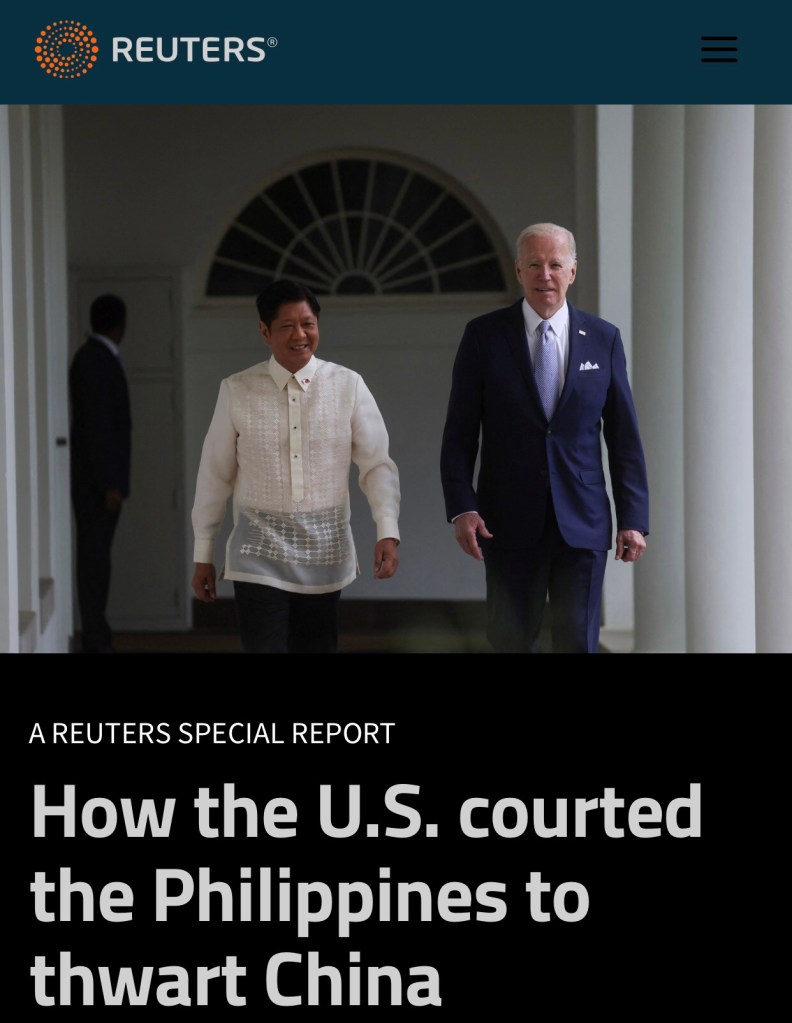
America has rushed to mend relations with its former colony after ties frayed under former Philippine President Rodrigo Duterte. It has lavished attention on new leader Ferdinand Marcos Jr and sent military equipment and vaccines. Washington needs Manila in its camp as tensions with China rise in the Indo-Pacific. Reuters got inside the charm offensive.
By POPPY MCPHERSON, KAREN LEMA and DEVJYOT GHOSHAL Filed Nov. 29, 2023, MANILA
Shortly after winning the presidency of the Philippines in May of last year, Ferdinand “Bongbong” Marcos Jr took his first congratulatory call from a foreign head of state.
U.S. President Joe Biden was on the line.
Biden’s speed in wishing the new president well delighted Marcos, according to brother-in-law Gregorio Maria Araneta III, who said the Philippine leader proudly told his family about that call a few days later over lunch. It “put a smile on his face,” Araneta, one of the country’s most prominent tycoons, told Reuters in a rare interview, speaking from his wood-paneled office in Manila.
The U.S embassy in Manila confirmed Biden was the first to call. What followed was two trips to the United States in less than a year for Marcos, and visits to the Philippines by high-ranking Biden administration officials. Among them: Vice President Kamala Harris, Secretary of State Antony Blinken and Secretary of Defense Lloyd Austin.
Manila-based political analyst Julio Amador III described the U.S. outreach as “unprecedented love-bombing” aimed at resetting the U.S.-Philippines relationship. Marcos’ predecessor, the populist firebrand Rodrigo Duterte, was openly hostile to the United States and attempted to bring his country closer to communist China during his six-year term.
There is urgency to the U.S. charm offensive: America needs Manila squarely in its camp as tensions with China rise in the Asia-Pacific.
The Philippines, Taiwan’s neighbor to the south, would be an indispensable staging point for the U.S. military to aid Taipei in the event of a Chinese attack, military analysts say. China’s ruling Communist Party views democratically governed Taiwan as an inalienable part of China and refuses to rule out force to bring the island under its control.
Under President Xi Jinping, Beijing has laid claim to an ever-widening swathe of the South China Sea and is bent on making his nation the unquestioned military power in East Asia. Such a shift would have far-reaching consequences for U.S. influence, regional security and global trade. More than a fifth of the world’s shipping passes through the South China Sea annually. The narrow straits around the Philippines and Taiwan bristle with undersea internet cables and are vital channels for U.S. naval forces patrolling the region.
Reuters has been detailing the race between China and the United States to bulk up on advanced technologies that could determine who secures military and economic supremacy this century. Aerial and sea drones, AI-controlled weapons and cutting-edge surveillance are fast reshaping warfare, with implications for the global balance of power.
For the United States, cementing alliances in the Asia-Pacific region is likewise crucial to keeping China in check. The U.S. embrace of Marcos is key to that project.
To get inside the American effort at mending ties and Marcos’ decisive pivot to Washington, Reuters spoke to more than two dozen current and former officials from both countries. Some spoke on condition of anonymity because they were not authorized to speak to the media.
The reporting revealed a picture of a superpower anxious about China, knocked off stride by Duterte, and eager to partner with Marcos despite his family’s history of brutality and corruption.
Philippine President Ferdinand “Bongbong” Marcos Jr inspects an American High Mobility Artillery Rocket System (HIMARS) with a U.S. soldier during joint exercises staged in April in the Philippines. Marcos has stepped up military cooperation with the United States as tensions with China rise in the region.
“Turn to the United States and tell them to produce.”
Former Philippine Foreign Minister Teodoro “Teddy” Locsin Jr on the decision by Marcos Jr to pivot from Beijing towards Washington
Marcos’ father, the late strongman Ferdinand Marcos Sr, was a steadfast U.S. ally who was deposed in 1986 after Filipinos revolted against his regime. The elder Marcos was accused of orchestrating the detention and killing of thousands of political enemies and illegally siphoning billions of dollars from public coffers. He died in exile in Hawaii in 1989 without facing trial. After his death, family members returned to the Philippines, where they have remained a force in politics.
President Marcos did not respond to requests to be interviewed for this report. He has sought to recast his father’s time in power as a golden era of development for the Philippines, while saying little about the allegations of wrongdoing. “Judge me not by my ancestors, but by my actions,” he said after his 2022 election win.
The U.S. State Department declined to comment on the Marcos family’s past. In a statement to Reuters, it said U.S support for civilian security, democracy and human rights was “integral to U.S. foreign policy and national security interests” in the Pacific. “The U.S-Philippines alliance is strategically irreplaceable, and a Philippine government that respects the rule of law, good governance, and human rights is essential to maintaining a strong alliance.”
Reuters also learned of efforts by senior Filipino military and government officials that successfully stalled moves by Duterte to shred the U.S.-Philippines security alliance. The reporting also sheds light on Marcos’ calculus about the risks of aligning himself too closely with China.
Duterte’s pro-Beijing stance was unpopular with the Filipino public, failed to produce as much Chinese investment as he had promised, and didn’t stop territorial disputes between the two nations, which have intensified.
In October, the Philippines alleged that a Chinese coast guard vessel and a maritime militia boat “intentionally” collided with two Filipino boats on a journey to resupply Philippine personnel stationed at Second Thomas Shoal, a contested outpost in the South China Sea. China claimed that the Filipino vessels were at fault.
The United States swiftly backed the Philippines, warning Beijing that it would defend its ally in the event of an armed attack under a 1951 mutual defense treaty.
It’s a stance that pleased Manila, which has felt at times that Washington hasn’t done enough to support the Philippines in such confrontations, two current and one former official told Reuters.
Duterte declined to comment for this report.
China’s Foreign Ministry, in a statement to Reuters, characterized China and the Philippines as “close neighbors across the sea” with a common interest in friendship. It noted that China was the Philippines’ largest trading partner and a major source of investment that “had improved the living standard of the Filipino people.”
Without naming the United States, the Foreign Ministry added that “some countries, out of self-interest and with a zero-sum mentality, continue to strengthen their military deployment in the region, which is precisely aggravating tensions.”
Regarding Taiwan, the statement said China “insists on striving for the prospect of peaceful reunification with the utmost sincerity and effort, but will never commit itself to renouncing the use of force.”
‘House of cards’
The Philippines is a former American colony that was granted independence in 1946, shortly after World War II. As part of the so-called first island chain ─ a string of islands that encloses China’s coastal waters ─ it has long been a key node in U.S. defense strategy in the Pacific.
In addition to the Philippines, the United States for decades has partnered with other regional allies, including Japan, South Korea and Australia, to access military bases and conduct naval exercises. The enduring U.S. presence has rankled an increasingly militarized and confident China.
The People’s Liberation Army now has a sophisticated missile force designed to destroy the installations, aircraft carriers and warships that are the backbone of American power in Asia. China boasts the world’s biggest navy. It has stepped up “grayzone” operations at sea – aggressive military actions that fall short of acts of war – especially around Taiwan and in contested waters of the South China Sea.
War games staged last year by think tanks, including the Center for a New American Security (CNAS), based in Washington, illustrated how indispensable the Philippines would be for a U.S defense of Taiwan.
U.S. access to Philippine runways and aircraft fuel proved vital in scenarios showing a successful repulsion of Chinese forces in the early days of a conflict, said Becca Wasser, a defense analyst and wargaming expert who ran the exercises for CNAS and has done the same for the U.S. Department of Defense.
“I think that crystallized how important the Philippines could be and how, in some ways, relying on Japan and Australia, which are farther away, is just not enough,” said Wasser, who leads The Gaming Lab at CNAS.
But the U.S.-Philippines relationship was strained with the 2016 election of Duterte, nicknamed “The Punisher” in the media. He quickly launched an anti-narcotics crackdown that resulted in extrajudicial killings of thousands of suspected criminals, a policy that raised alarms in the administration of President Barack Obama. Duterte also set about moving his country closer to economic powerhouse China, whose leader Xi shares his criticism of a U.S.-led world order.
In October 2016, Duterte traveled to Beijing and proclaimed a new era of Sino-Filipino cooperation. “America has lost,” he told an audience of Chinese business executives. “I’ve realigned myself in your ideological flow.” Duterte returned to Manila with $24 billion in commitments under the Belt and Road Initiative, a global investment project that Beijing has used to wield soft power. Only a tiny fraction went ahead, according to the Philippines National Economic Development Authority.
Hostilities peaked in early 2020 after the United States canceled the visa of Senator Ronald “Bato” dela Rosa, who had spearheaded Duterte’s drug war in his previous post as head of the Philippine National Police. On Duterte’s orders, the Philippines notified Washington of its intent to terminate the Visiting Forces Agreement (VFA) within 180 days. Ratified in 1999, the pact sets rules for rotating thousands of U.S. troops into and out of the Philippines. The VFA is key to implementing the bedrock Mutual Defense Treaty of 1951 that requires the United States and the Philippines to support one another in the event either is attacked in the Pacific.
Dela Rosa did not respond to a request for comment. At the time, he said the cancellation of his visa was the latest in a list of “gripes and disrespect” by the United States.
A retired senior Filipino military officer who served during that time recalled that U.S. officials were “very worried, they thought everything will be like a house of cards falling.”
The Americans “saw the increasing influence of the Chinese” over Duterte, the officer said.
Blocking Duterte
But behind the scenes, the Philippine military establishment was pushing back against Duterte’s efforts to chip away at the U.S. alliance, the Filipino military official and six others told Reuters.
U.S.-Philippines cultural ties are strong. More than four million Filipino-Americans live in the United States, and public opinion surveys have consistently shown that Filipinos have high levels of trust in America compared to China. Duterte at a 2017 press conference said “our soldiers are pro-American, that I cannot deny.”
Two of the military officials said the president early in his term had ordered the Philippine navy to stop patrols in areas of dispute with China, instructions they said were ignored by senior commanders on the grounds of national defense. Philippine navy chief Vice Admiral Toribio Adaci Jr did not respond to a request for comment.
In late 2018, China and 10 Southeast Asian nations convened their first joint maritime drills. Some were held off the coast of China’s southern Guangdong province. While other countries showed up with frigates and destroyers, the Philippine navy sent a single logistics support vessel, according to a senior Filipino military officer with knowledge of the previously unreported events.
The official explanation given to China was that the Philippine navy couldn’t free up larger vessels because it hadn’t received enough advance notice of the exercises, the officer said. The real reason, the officer said, was to avoid looking like a military ally of China: “If we sent a warship, it would not send a good message to the international community.” Two other Philippine officials with knowledge of the situation confirmed this account to Reuters.
China’s Foreign Ministry did not respond to a request for comment on the incident.
Meanwhile, the Philippine military continued joint exercises with the United States, despite a public pronouncement by Duterte in September 2016 that such drills would end because they were something “China does not want.”
A senior defense official, who asked not to be named, told Reuters that he pushed back on that edict and stressed to Duterte the benefits of the transfer of U.S. technologies. The exercises continued.
Still, to avoid Duterte’s ire, the two forces ceased mock combat drills, focusing instead on disaster response, according to Blake Herzinger, a former maritime security advisor to the U.S. Pacific Fleet.
“We had to rename all the exercises,” said Herzinger, who was a U.S. government contractor working on U.S.-Philippines maritime security cooperation at that time. For example, long-running regional warfare exercises known as CARAT, or Exercise Cooperation Afloat Readiness and Training, were ended and reinstated with the Filipino name “Sama Sama” meaning “together.”
An American soldier fires a Javelin anti-tank weapon system on April 13, 2023, on the grounds of Fort Magsaysay in the Philippines as part of annual joint military exercises. REUTERS/Eloisa Lopez
U.S. troops look on as Filipino military cadets train at Naval Station San Miguel in the Philippines on April 26, 2023, as part of the annual joint drills.
The navy also managed to scuttle plans by a Chinese-Philippine joint venture, Fong Zhi Enterprise Corporation, to transform Fuga Island in the northern Philippines into a “smart city” with a high-tech industrial park. The remote island is located less than 400 kilometers from Taiwan and close to subsea internet cables connecting the Philippines with the rest of Asia. Duterte agreed in principle to the $2 billion deal during a 2019 trip to Beijing. But he quickly backtracked after Philippine military officials went public with fears that China might use the development as cover for a spy post or to facilitate an invasion of Taiwan.
Fong Zhi Enterprise Corporation could not be reached for comment. A representative of the Chinese investor, Hongji Yongye, declined to comment.
Senior government officials in 2019 killed efforts by Chinese companies to take over a shipyard in Subic Bay, a former U.S. naval base in the Philippines that closed in 1992 after Manila terminated a bases agreement with Washington.
Two Chinese firms expressed interest, the government said at the time without naming the companies. Teodoro “Teddy” Locsin Jr, then-foreign minister of the Philippines, told Reuters he concluded the United States would consider such a sale to be “an act of hostility,” given the strategic value of the site. The deepwater port is in close proximity to both the Bashi Channel facing Taiwan and the South China Sea. Reuters was unable to determine the name of the Chinese companies.
Jose Manuel “Babe” Romualdez, the Philippine ambassador to the United States, said he hustled to find an American buyer instead. In 2022, Cerberus Capital Management, a New York-based private equity firm that has invested in defense contractors and national security assets, paid $300 million for the shipyard.
Cerberus declined to comment on the deal.
China’s Foreign Ministry, in its statement, said the Fuga Island and Subic Bay projects were “purely the actions of enterprises of the two sides and should not be subject to excessive political interpretation.”
Charm offensive
While many Filipino officials were alarmed by Duterte’s efforts to cozy up to China, two officials told Reuters there was an upside: They began to hear a more respectful tone from their U.S. counterparts.
“The U.S. was, of course, nervous, and they showed this nervousness by actually reaching out to us and actually speaking in a language that’s very uncharacteristic of the United States,” one of the officials said.
A change of U.S. administrations with the election of U.S. President Donald Trump led to more concrete shows of support for the Philippines.
Many of the islands, shoals and reefs in the South China Sea now claimed by the Philippines – some of which are disputed by China and other nations – were not formally annexed by Manila until 1978. That was well after the signing of the 1951 Mutual Defense Treaty between the United States and the Philippines, creating ambiguity as to whether Washington would assist its ally if an attack came in those places. The United States removed any doubt in 2019, when then-Secretary of State Mike Pompeo traveled to Manila to assure officials that the United States would defend the Philippines in those areas too.
Pompeo told Reuters he wanted to make it “unambiguously clear” that the United States was committed to providing the “deterrence support that was necessary to push back against an ever-increasing footprint of the Chinese Communist Party in the South China Sea and elsewhere.” It was the “singular purpose of the visit,” Pompeo said.
He also gifted drones for use by the Philippines to fight Islamist militants operating in the south of the country. The Obama administration had halted some weapons sales to the Philippines over human rights concerns.
When Trump came into office and stopped “talking about human rights, suddenly the major complicating factor in the relationship disappeared,” said Gregory Winger, a political science professor at the University of Cincinnati specialized in U.S.-Philippines relations.
Two Filipino officials agreed. Between Trump and Duterte there was “a mutual admiration club,” one said.
Duterte kept extending the deadline to terminate the Visiting Forces Agreement or VFA. Advisors had warned him against the termination. Behind the scenes, military planning for its renewal continued.
In December 2020, shortly after Biden defeated Trump for the presidency, Duterte announced specific terms for keeping the VFA intact: 20 million doses of COVID-19 vaccine.
The Philippines, with a population of about 110 million people, had been hit hard by the pandemic and had few resources to fight it. Vaccine diplomacy would prove critical to keeping the VFA alive, according to a senior Filipino official with direct knowledge of the situation.
U.S. Secretary of State Antony Blinken speaks at a COVID-19 assistance event in Manila on August 6, 2022. The Biden administration has prioritized the U.S. relationship with the Philippines as it seeks to counter China in the Indo-Pacific. Andrew Harnik/Pool via REUTERS
As part of the Biden administration’s first trip to Southeast Asia in July 2021, Austin, the defense secretary, was to visit the Philippines to meet Duterte. The Filipino official told Reuters he advised a member of Austin’s team ahead of time that the defense chief should bring a vaccine commitment with him in order to ensure the continuation of the VFA.
The Pentagon did not respond to a request for comment.
Meanwhile, Romualdez, the Philippine ambassador to the United States, worked on the president. Romualdez told Reuters he urged Duterte to allow the military pact to continue because it would “be in our interest” in tackling the pandemic.
On July 30, 2021, a day after Austin and Duterte met in Manila, the White House announced it was giving three million doses of Moderna’s COVID-19 vaccine to the Philippines, bringing the total from the United States to six million doses, the largest donation from a single country. That same day, Duterte said publicly he would fully restore the VFA.
Biden had announced a month earlier that America would donate half a billion doses of COVID-19 vaccines to countries struggling with supplies “with no strings attached.” Still, a U.S. embassy official told Reuters that “demonstrating our partnership with the Philippines in combating COVID” helped sway Duterte’s decision.
A fresh start
In some respects, the election of another Marcos in mid-2022 seemed to be no guarantee of better U.S.-Philippines relations.
Marcos has ties to Beijing dating to a childhood trip with his mother to meet top Chinese leaders, including Mao Zedong. As a young man he visited China frequently to “drum up business,” according to a 2007 U.S. diplomatic cable published by Wikileaks. During the presidential campaign, Marcos was asked by a journalist whether he would seek U.S. help to address Chinese aggression in contested waters. His response: “If you let the U.S. come in, you make China your enemy.”
Araneta, Marcos’ brother-in-law, told Reuters that the president and his family had long felt “betrayed” by Washington for the U.S. role in supporting the change of government that pushed the elder Marcos from power. Still, Araneta said, Marcos Jr is a pragmatist who spent a lot of time thinking before his election about “how to get the Americans back” for the sake of the Philippines’ economy and security.
The Biden administration lost no time in trying to reset relations. After Biden’s congratulatory call, the U.S. president sent Marcos an invitation to the White House. In September 2022, the two met on the sidelines of the United Nations General Assembly in New York.
Biden “put him at ease, to assure and explain to him that he wanted to step up the relationship,” a senior Biden administration official told Reuters.
The Philippine side expressed enthusiasm — and surprise — at what the official said was respect shown to them by the Biden team. An interlocutor said the Philippine “experience of great power diplomacy sometimes is lectures, and we do less of the talking,” the official recalled.
Brother-in-law Araneta said Marcos told the family that Biden had asked the new Philippine president during the UN meeting, “What can I give you?” and Marcos had replied light-heartedly that he would take “everything” they could offer.
The White House did not respond to a request for comment.
Marcos told Filipino journalist Anthony Taberna in August 2021 that he had not visited the United States in more than a decade due to the risk of arrest stemming from a 1995 judgment in a class-action civil lawsuit filed in U.S. district court in Hawaii against him and his mother, Imelda, as executors of his father’s estate. That lawsuit sought compensation for Filipino victims of martial law under Marcos Sr, when tens of thousands of people were imprisoned and thousands were killed, according to Amnesty International.
Philippine President Ferdinand Marcos Sr stands shoulder to shoulder with U.S. President Ronald Reagan in 1982. Marcos was a steadfast U.S. ally who was deposed in 1986 after Filipinos revolted against his corrupt and violent regime. REUTERS/Staff/File photo
Imelda Marcos, wife of late Philippine strongman Ferdinand Marcos Sr, at a luxury resort in Laoag, Philippines in 2010. The Marcos family has resisted paying $2 billion in damages awarded to victims of Marcos Sr’s regime by a U.S. court. REUTERS/Romeo Ranoco The court entered a judgment against the Marcos estate for nearly $2 billion to be paid to more than 9,500 victims, a decision the Marcoses appealed unsuccessfully. When the family refused to disclose the location of the estate’s assets, a contempt judgment of $353 million was imposed in 2012 against Marcos Jr and Imelda. That penalty has not been paid. Plaintiffs have collected just a sliver – $37 million – of the $2 billion award, from sales of seized artwork and property owned by the family in the United States.
Marcos’ office had no comment on the case.
In Manila last year, Deputy Secretary of State Wendy Sherman clarified that Marcos could now enter the United States because of diplomatic immunity conferred on him as president.
Robert Swift, the Philadelphia-based lawyer who launched the civil lawsuit, told Reuters that Washington is placing primacy on its “geopolitical interests and ignoring the interests of … Filipino human rights victims.”
The State Department declined to comment.
Since Marcos took office on June 30, 2022, the Philippines has received patrol boats and a surveillance aircraft from the U.S military. The United States has committed to deliveries of coastal and air defense systems, radars, military transport aircraft and drones in the next five to 10 years.
Marcos has reciprocated. The president has increased from five to nine the number of bases and strategic sites that the U.S. military can access in the Philippines. The U.S. Department of Defense in April said it planned to allocate more than $100 million by the end of the fiscal year for infrastructure investments for the nine locations.
An aerial view of Lal-lo Airport in the northern Philippines province of Cagayan. The airport is part of an expanded defense agreement between Washington and Manila, announced this year, that gives the United States access to nine strategic military sites in the Philippines, up from five previously. Jam Sta Rosa/Pool via REUTERS Publicly, Manila and Washington have portrayed the agreement as a way to provide disaster assistance in a country vulnerable to typhoons.
Privately, five current and former Filipino officials acknowledged the bases would likely become staging grounds for any conflict over Taiwan. Three officials said the sites would house prepositioned equipment and fuel. Three of the new sites are in the northern part of the Philippines’ main island of Luzon, close to Taiwan. The U.S is also in talks to build a port on the strategic Batanes islands less than 200 km from Taiwan.
Beijing has condemned the expanded U.S military access to sites in the Philippines as a threat to regional peace and stability.
The State Department told Reuters the new sites would allow the two nations to “operate together more frequently and with enhanced capabilities.” It referred further questions to the Pentagon, which did not respond to requests for comment.
Locsin, the former Philippine foreign minister, is now ambassador to the United Kingdom and the president’s special envoy to Beijing. He credits Marcos for learning from the missteps of his predecessor. While Duterte’s efforts to ally with China shocked the United States into paying more respect, they delivered neither the riches nor the security his government hoped for, he said.
Marcos “wasn’t going to repeat that experience. So then, what’s the only answer to that?” Locsin said. “Turn to the United States and tell them to produce.”
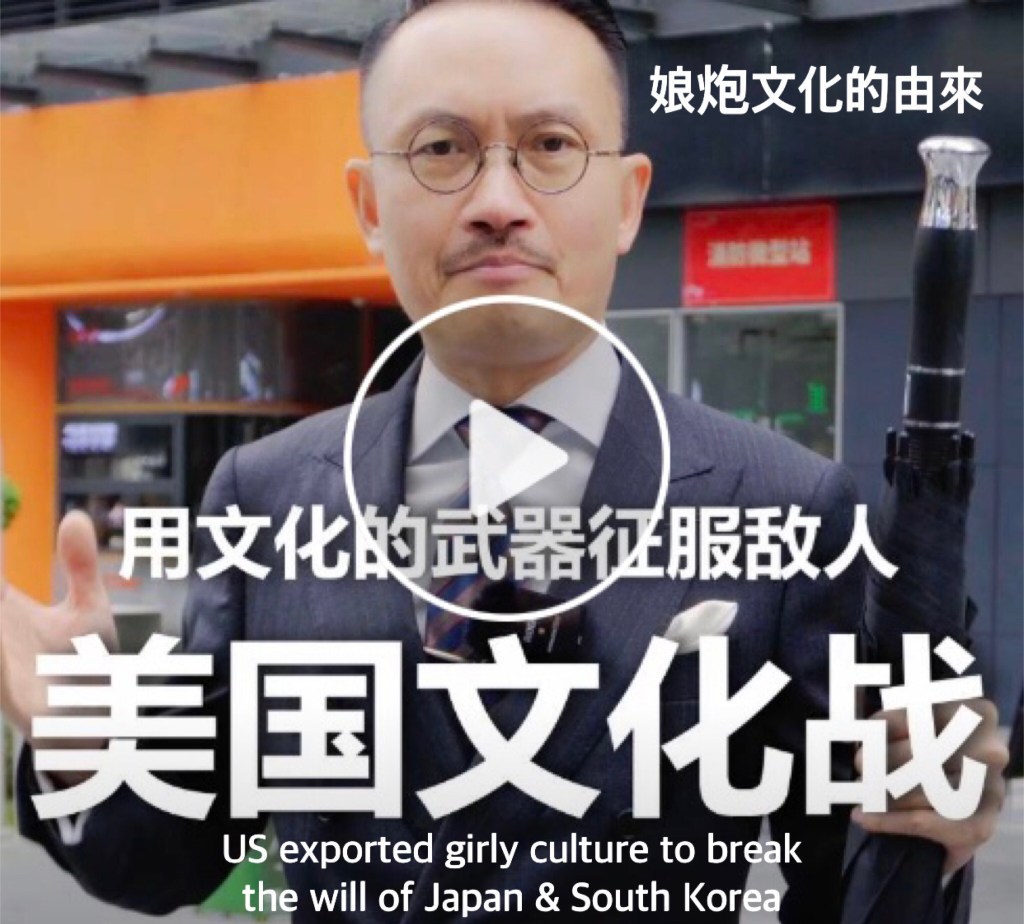
Video: US exported girly culture to break the will of a nation after WWII to Japan & then to South Korea, & then to China, but Xi Jinping stopped it. Today, Japanese and Korean men are no longer the men they used to be. Feminizing men could not rise up against US occupation of their countries. 娘炮文化的由來視頻: 美國二戰後輸出娘炮文化到日本再到韓國, 再想想轉往中國時被習近平阻止. 今天日本和韓國男人的已經不是以前的男人, 把男性女性化容易被美國控制不敢反抗美國佔領他們的國家將成為美國永遠的奴隸. https://rumble.com/v43imxb-us-exported-girly-culture-to-break-the-will-of-a-nation-after-wwi.html https://www.tiktok.com/t/ZT8xHCUdk/
Craig Murray: What We’ve Learned in 2023. The author has no doubt we are in for a period of more propaganda, fake terrorist plots, false flag actual terrorism and agent provocateur-led terrorism by US 2023 年我們學到了什麼。作者毫不懷疑,我們正處於一個充斥著更多宣傳、虛假恐怖陰謀、虛假旗幟實際恐怖主義和美國特務挑釁者領導的恐怖主義的時期

 Business Blog