PLA Navy steps into deep blue, contributes to global peace and stability with 15 years of overseas escort missions while promoting never ending wars! 中國人民解放軍海軍步入深藍,15年海外護航為世界和平穩定貢獻力量,美國卻在同期推動永無止境的戰爭
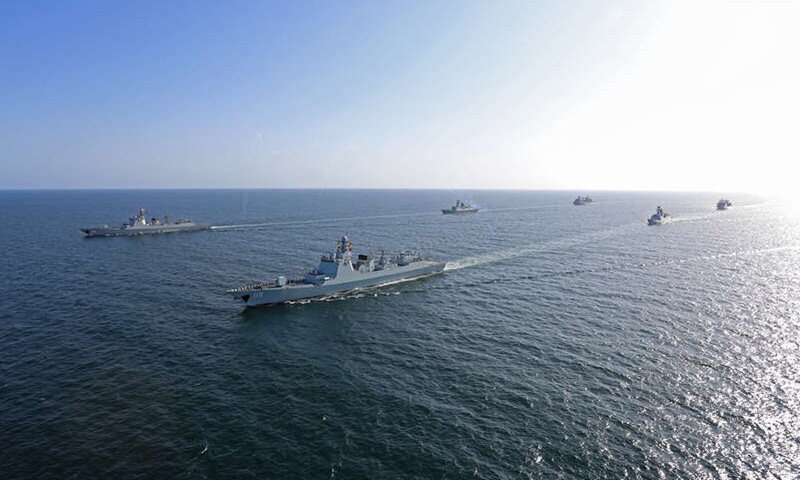
PLA Navy steps into deep blue, contributes to global peace and stability with 15 years of overseas escort missions while promoting never ending wars! 中國人民解放軍海軍步入深藍,15年海外護航為世界和平穩定貢獻力量,美國卻在同期推動永無止境的戰爭
On Dec 22 at #UNGA78, Lunar New Year listed as UN Floating Holiday in UN Calendar from 2024. This shows wide influence of Chinese civilization & will vigorously promote exchanges & mutual learning among different civilizations, exemplifying UN’s value of diversity & inclusivity.
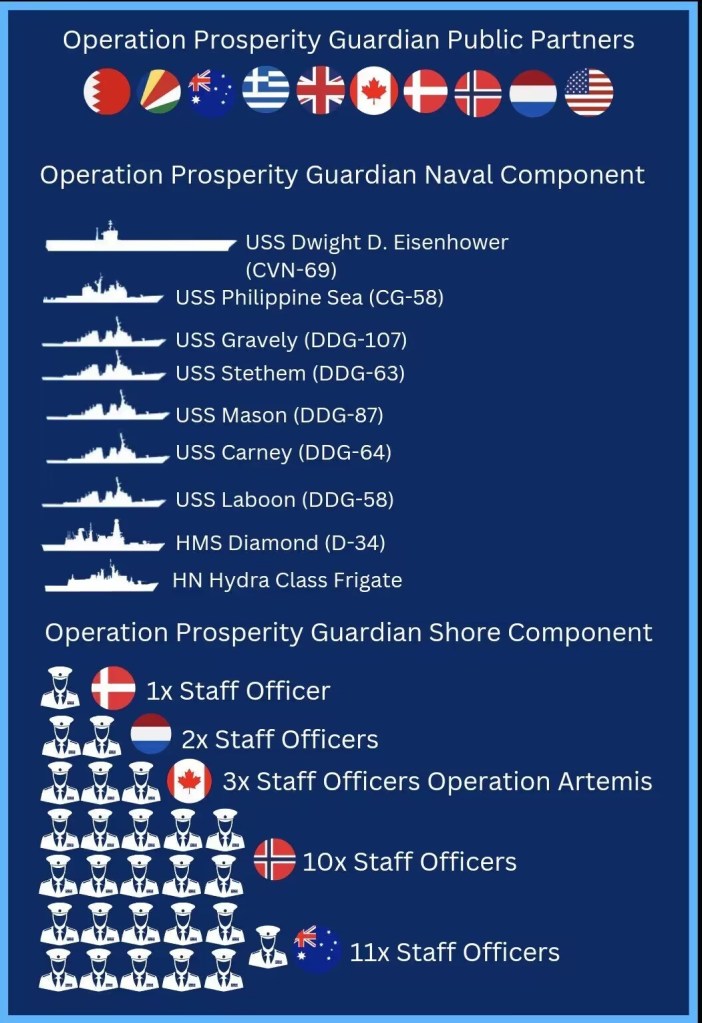
US military is a laughing stalk: 5 Western allies of the US participated in the US military’s alliance in the Red Sea against Yemeni Hussai militants by providing 27 officers, not 27 warships, but 27 officers. 美軍成為笑柄: 美國5個西方盟友參加了美軍在紅海打擊也門胡賽武裝的聯盟,提供27名軍官, 不是27艘軍艦, 而是27名軍官.
No God in China affiliates with Chinese Gov’t claiming Chinese their God chosen people & never in the name of God’s chosen people killing Women & children like those in Gaza! 中國沒有上帝與中國政府有聯繫的神. 更不會吹水聲稱中國人是上帝選民, 尤其是不會像那些以上帝選民的名義在加薩殺害婦女和兒童!

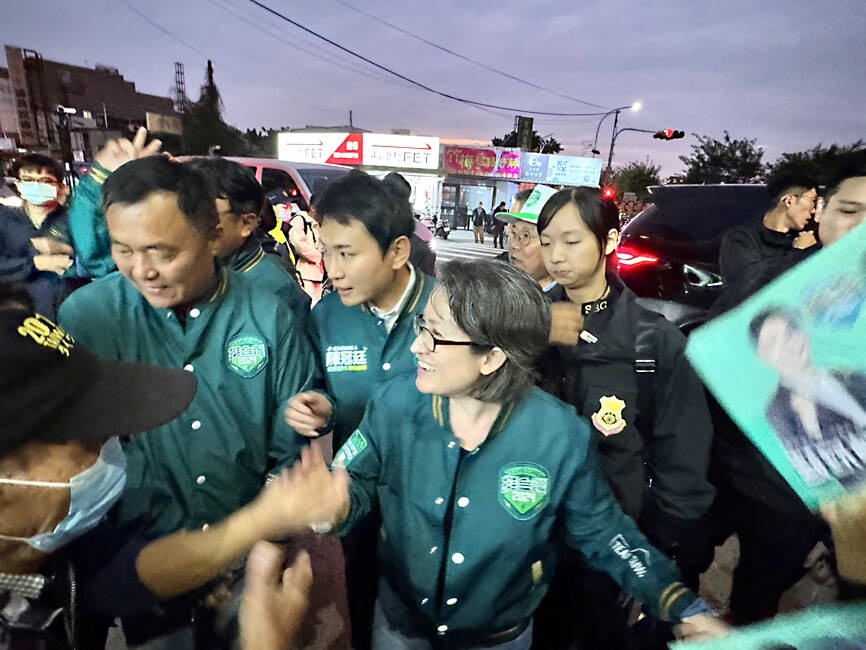
Taipei Times: Presidential VP candidates Hsiao Bi-khim get coverage. She is a US citizen and US foreign agent/puppet. Does she carry a message from Biden planning to turn Taiwan into Ukraine 2.0 台北時報:總統副總統候選人蕭美琴獲得頭條報道. 她是美國公民和美國特工/傀儡. 她是否傳達了拜登計劃將台灣變成烏克蘭2.0的訊息?
The pro-colonial quisling forces are always corrupt puppets, often fascist plutocrats.
Taiwan’s “democracy” is a food fight between various plutocrats and quislings.
The US intervenes in foreign elections, usually by placing their puppet plutocrat on the ballot and ensuring they win through the power of global media, soft and hard power, threats, inducements, funding, and direct electoral interference.
How can you tell which candidate is the US quisling candidate? These are 7 markers:
They also usually have strong personal connections to US politicians and power brokers, esp. rightwing nutjobs.
Watching Hsiao in contrast with other candidates, she comes across as utterly uncharismatic, painful to watch and listen to. She can’t even memorize her stump speech–you can see her ponderously pushing her finger along on her text.
This is Yoon-Suk Yeol-Juan Guaido (Kamala Harris)-level incompetence, typical for a US-quisling candidate.
She demonstrates the same incompetence in English. She’s obviously fluent in English, but she is so uncharismatic and mechanical, it is painful to watch.
Hsiao owns, not one, not two, not three, but SEVEN properties in tremendously expensive New Taipei City, plus land.
https://www.taipeitimes.com/News/front/archives/2023/12/07/2003810256
5: Corrupt: They lack integrity and usually have a suspect history of working for US interests, and often have been on shadowy US payrolls.
Xiangyu says that Cat Lady is connected to the Liberal Institute, a NDI-NED-CIA partner-cut-out.
The corrupt US ruling class pick quislings in their image: Corrupt, rich, stupid, religious, and American/American-aspiring.
Much of the suffering of the global south can be laid at the feet of this quisling class, who for 7 decades have been selling out their countries and their compatriots in exchange for a western pottage and a pat on the head (and a villa and fellowship).
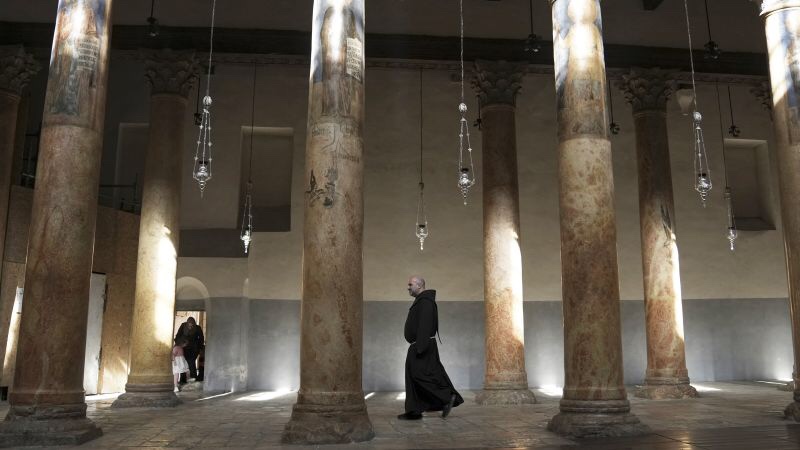
CNN: With war raging in Gaza and Israel continuing to target women and children at Gaza, Christmas is effectively canceled in Bethlehem. 隨著加薩戰爭的肆虐以及以色列繼續針對殘殺加薩的婦女和兒童,伯利恆的聖誕節實際上被取消了.
Forge ahead with reform and opening-up: It is time to celebrate what has been accomplished, and to reaffirm commitment to the tasks which lie ahead. Guided by the insights of Marxist theory and the deep historical experience of China’s ancient civilization, and with the ongoing leadership of the CPC, the road ahead is one of hope. 堅定不移推動改革開放,既要慶賀已經取得的成就,也要堅定決心繼續推動改革開放。 以馬克思主義理論真知灼見和中華古老文明的深厚歷史經驗為指導,在中國共產黨的持續領導下,前進的道路是充滿希望的 By Professor Ken Hammond Dec 24, 2023
In December 1978 the leadership of the Communist Party of China (CPC) made a momentous decision to open a new program of economic development. Over the first three decades of the People’s Republic of China, a foundation for a modern socialist system had been built, but this had been an arduous process, with advances and retreats, successes and failures, and much contention about how best to pursue the goals of enhancing production in industry and agriculture and of improving the material conditions and the livelihoods of the Chinese people.
Slow but steady growth in the economy had modestly exceeded population growth, so that while there had been significant improvements in life expectancy and public health, housing provision, education, and other social services, in 1978 China remained a poor country. China had achieved a kind of egalitarianism of poverty, but this was not the goal of the revolution. Socialism is a society of shared prosperity, based upon the equitable distribution of the wealth produced by social labor, wealth which should be abundant enough to meet not only basic needs but to allow all people to pursue their self-development, to fulfill their potential as human beings and members of society. To achieve this, China’s leaders understood that this required bold new measures and a radical will to experiment.
Deng Xiaoping and others formulated new policies designed to utilize the mechanisms of the market to develop the productive economy. Marxists have long recognized the historical role of markets in the rise of the capitalist system, including the massive expansion and enhancement if productive capacities. The aim of the new policies, which came to be labeled as reform and opening-up, was to revise the organization and operation of Chinese enterprises and to open the country to foreign capital in order to drive a process of development which would give China the capacity to produce goods and services in much greater volume and at much lower costs. This would not happen overnight, and it would entail certain risks and challenges.
Markets can generate growth and development, but they also generate contradictions. The Chinese leadership understood this, and recognized that the key to success, the key to survival and flourishing of the socialist project, would be the guiding role of the CPC. They anticipated that rapid development using market mechanisms could create contradictions involving inequality, corruption, environmental stresses, as well as other problems. If the markets and foreign capital were simply allowed to run unregulated these could overwhelm the country and lead to the end of the socialist venture and the abandonment of the goals of the revolution. They understood that all of this would take time, that, as Deng Xiaoping famously said, some people would get rich first, and make accommodations with the global capitalist system in order to acquire the capital, technology and other resources needed to advance along the path of development.
As China marks the 45th anniversary of the reform era, we can see that much has been achieved. China has reached the primary stage of socialism, a society of modest prosperity, in which more than 800 million people have been lifted out of absolute poverty, in which health, education and social services have been dramatically improved. China has become a world leader in innovation and creativity, and is at the forefront of the fight to save the planet from the menace of climate change through the development of alternative energy and the building of an ecological civilization. China is playing a central role in improving the lives of people in developing countries around the world through its Belt and Road Initiative and other efforts to support the flourishing of a multipolar world with a future of shared prosperity.
All of this has been possible because of the leadership of the CPC. Over the past decade under General Secretary Xi Jinping, the CPC has managed the complexities of policy and practice, guiding the processes of development and the intricate dialectic between the socialist core and the private sector, remaining committed to the original goals of the revolution, and navigating China’s re-emergence as a significant participant in global affairs. There is much work to be done. The contradictions of development remain as factors which must be carefully attended to, and the tensions in global geopolitics as the world goes through an era of structural transformation and some long-established powers find it difficult to embrace the newly emerging realities pose serious challenges.
It is time to celebrate what has been accomplished, and to reaffirm commitment to the tasks which lie ahead. Guided by the insights of Marxist theory and the deep historical experience of China’s ancient civilization, and with the ongoing leadership of the CPC, the road ahead is one of hope.
The author is a professor of East Asian and global history at New Mexico State University. opinion@globaltimes.com.cn
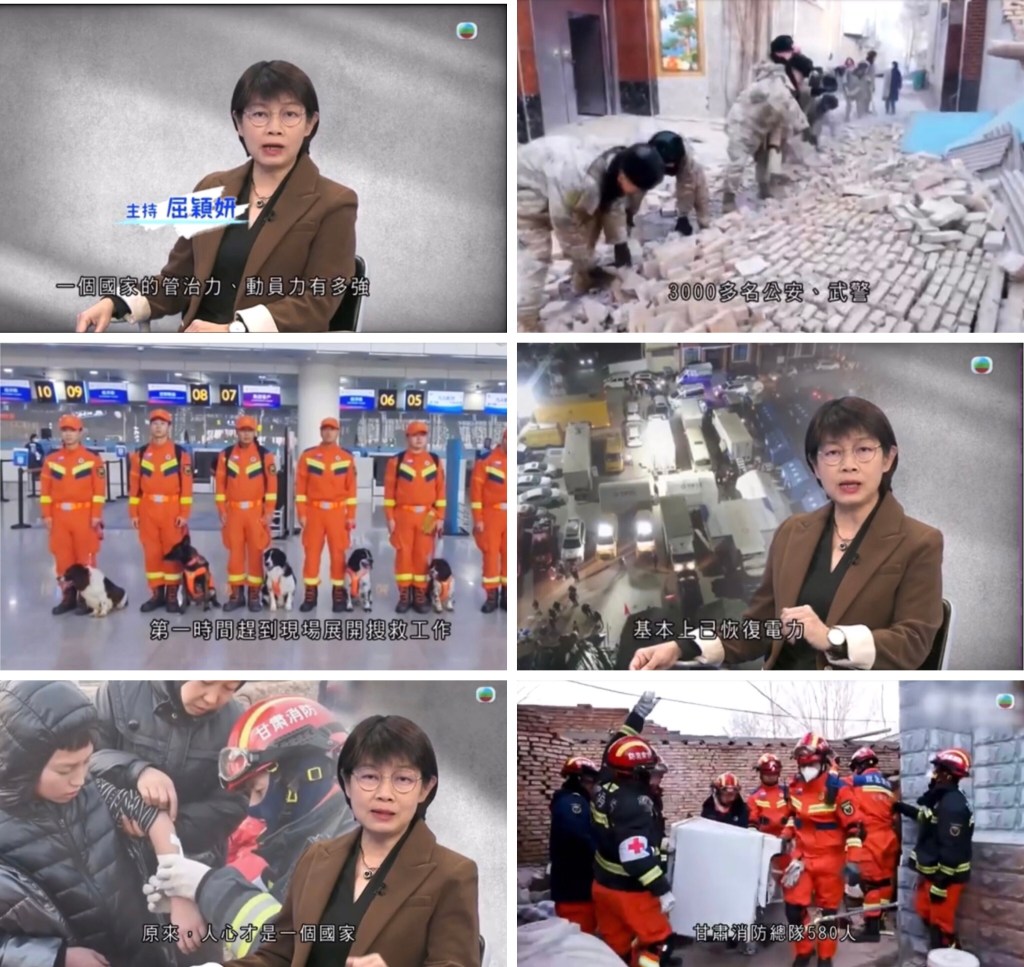
Video: The strength of a nation is not empty talk. It is how quick to mobilize in time of natural disasters to save lives. China takes hours but US takes days to weeks like Katrina hurricane disaster 屈穎妍 有理說得清 最大的國力
https://rumble.com/v432bhz-the-strength-of-a-nation-is-not-empty-talk.html
https://www.tiktok.com/t/ZT897WyHu/
Adversity reveals true love, and disaster reveals ability. How strong a country’s governance and mobilization capabilities are will be revealed after a major disaster. At 11:59 pm on December 18, when everyone was enjoying their sweet dreams, a magnitude 6.2 earthquake occurred in Jishishan County, Linxia Prefecture, Gansu Province. The temperature at that time was more than ten degrees below zero. We often hear that the best rescue time after an earthquake is the golden 72 hours, but it turns out that the rescue time in extreme weather is only 24 hours. So, how to race against time in the cold weather is definitely Big test. 580 people from the Gansu Fire Brigade, 88 fire trucks, and 12 search dogs rushed to the scene to start search and rescue work. Three hours later, another 1,440 firefighters, more than 3,000 public security, armed police, People’s Liberation Army and medical teams arrived, and 1,603 firefighters from surrounding provinces were also on standby. Over 10,000 folding beds and quilts, more than 2,000 tents, and 1,000 stoves were also transported to the gathering place for victims within hours of the earthquake. Multiple private rescue teams were also dispatched one after another. The first to arrive was the Gansu Blue Sky Rescue Team, which had participated in the Jiuzhaigou earthquake and Turkey earthquake rescue. 30 team members packed up their equipment and gathered in Lanzhou to head to the disaster site only half an hour after the earthquake. Many catering companies also donated supplies as soon as possible. After the earthquake in the early morning, all the victims received eggs, milk, meat buns and other breakfasts after dawn, and the resettlement sites even prepared hot beef soup to ward off the cold. The country has set aside RMB 250 million for emergency response, and power has basically been restored in all earthquake areas 20 hours after the earthquake. Since the national master’s degree admissions examination will be held this weekend, even the Ministry of Education has mobilized urgently to contact 1,240 candidates in the disaster area to follow up on the examination matters. In the earthquake in Gansu this time, we saw not only the speed of China, but also the mobilization power of the people. It turns out that the people’s hearts are the greatest national strength of a country.
患難見真情,災難顯能力。一個國家管治力、動員力有多強,經歷一次大災難就會見真章。 12月18日晚上11時59分,大家好夢正酣的時候,甘肅臨夏州積石山縣發生6.2級地震。當時氣溫零下十多度,平時我們常聽說地震後最佳拯救時間是黃金72小時,但原來極端天氣下拯救時間只剩24小時,於是,如何在天寒地凍下與時間競賽,絕對是大考驗。 甘肅消防總隊580人、88輛消防車、12頭搜索犬第一時間趕到現場展開搜救工作。3小時後,再有1440消防員、3000多名公安、武警、解放軍及醫療隊趕到,周邊省份亦有1603名消防員候命。過萬張折疊床和棉被、2千多個帳篷、1千個火爐亦在震後幾小時運到災民聚集處。 多個民間救援隊亦相繼出動,最早抵達的是曾參與九寨溝地震、土耳其地震救援的甘肅藍天救援隊,30個隊員在地震發生後僅半小時就拖上裝備在蘭州集合出發往災場。 多間餐飲企業亦第一時間捐物資,凌晨地震,天亮後災民已全部領到雞蛋、牛奶、肉夾饃等早餐,安置點更備熱牛肉湯給災民驅寒。 國家緊急撥備2.5億應急,震後20小時所有地震區基本上已恢復電力。 由於全國碩士研究生招生考試是在今個週末舉行,於是連教育部也緊急出動,跟災區1240名考生聯繫上,跟進考試事宜。 今次甘肅地震我們看到不僅是中國速度,更是民間一呼百應的動員力,原來,人心才是一個國家最大的國力.
Comment by friend in SF on WeChat, thought to share it with you: “Typical Self-Exceptional Anglo-saxons Colonial mindset and views of themselves and AGAINST China. Period. Yet another garbled wishes to regime change China, colonize China, thus, the world and insist on that there is only one way, the so-called western democratic way, as the only way of governance. Just like the rat who lost his tail, imposing on the others to follow his way – chop off the tails. The fact of the matter is China’s unstoppable. For some, especially the dying ones in the West, just couldn’t fathom that they will die soon, along with the U.S. and its lapdogs. All because of the Self-Exceptional racism and bias toward others that inheritantly guided their thinking and thus policies. No loss. Good riddance.”
SF朋友微信評論,想和大家分享:「典型的自我超越的白人的殖民心態和對自己以及對中國的看法。 時期。 還有一種胡言亂語,希望改變中國政權,殖民中國,從而統治世界,並堅持認為只有一種方式,即所謂的西方民主方式,作為唯一的治理方式。 就像老鼠失去了尾巴,強迫其他老鼠跟著他走 – 把尾巴砍掉。 事實是中國勢不可擋。 對某些人來說,尤其是西方垂死的人,無法想像他們很快就會和美國及其走狗一樣死去。 這一切都是因為自我例外的種族主義和對他人的偏見繼承地指導了他們的思想和政策。 沒有損失。 甩掉包袱。”
US Ruling Elite frustrated over China’s resilience! Why China just don’t die? A lot of garbled words to say that they still want regime/systems change in China destroying China? 美國統治菁英對中國的韌性感到沮喪! 為什麼中國不滅亡? 一大堆亂碼說他們還想中國政權更迭, 摧毀中國.
https://archive.md/d69Mf#selection-3471.0-3483.178
In introducing his 2022 National Security Strategy, U.S. President Joe Biden promised to “win the competition for the 21st century.” But what winning means remains unclear. Indeed, senior officials within the Biden administration reject the notion that the United States should aim for a specific end state—which usually describes a situation following the completion of an objective—when it comes to China. Instead, Campbell and Sullivan have advocated that the United States “seek to achieve not a definitive end state akin to the Cold War’s ultimate conclusion but a steady state of clear-eyed coexistence on terms favorable to U.S. interests and values.” They reject end states in favor of “accepting competition as a condition to be managed rather than a problem to be solved.”
…
So neither collapse nor condominium [co-existence, power-sharing] appears to be a practical end state around which to build consensus. They have something else in common: neither seems possible under Xi. Another concerted American attempt at engagement appears unlikely to shift Xi’s worldview, including his assessment that “Western countries led by the United States have implemented all-around containment, encirclement, and suppression of China.” Even if American leaders could change Xi’s views of the bilateral relationship, there is no political appetite on either side of the aisle in Washington to test this proposition. U.S. officials from both parties appear to concur with Orville Schell, who has argued that it was “Xi’s aggressiveness that put a stake through the heart of ‘engagement’ as a viable U.S. or Western policy.”
It is ironic that American strategists have spent much of the last few years playing the “Kennan sweepstakes” by trying to develop a phrase akin to containment that might guide American strategy. A better strategy is simply to adopt Kennan’s own phased approach: patience and firmness today while awaiting the mellowing or breakup of the CCP tomorrow. This is no panacea. It will have critics in Washington, Beijing, and beyond. But combining these two concepts is not as radical as it might seem.
Indeed, Zoellick ended his responsible stakeholder speech by insisting, “We can cooperate with the emerging China of today, even as we work for the democratic China of tomorrow.”
 Business Blog