Video: Hot pot dinner with friends, Napa Valley Vineyards owner from SF in HK at The Royal Garden Hotel 與舊金山納帕谷葡萄園老闆舊金山朋友在帝苑酒店共進火鍋晚餐
https://rumble.com/v3wltm5-hot-pot-dinner-with-friends-in-hk.html
https://www.tiktok.com/t/ZT8UmqMBB/
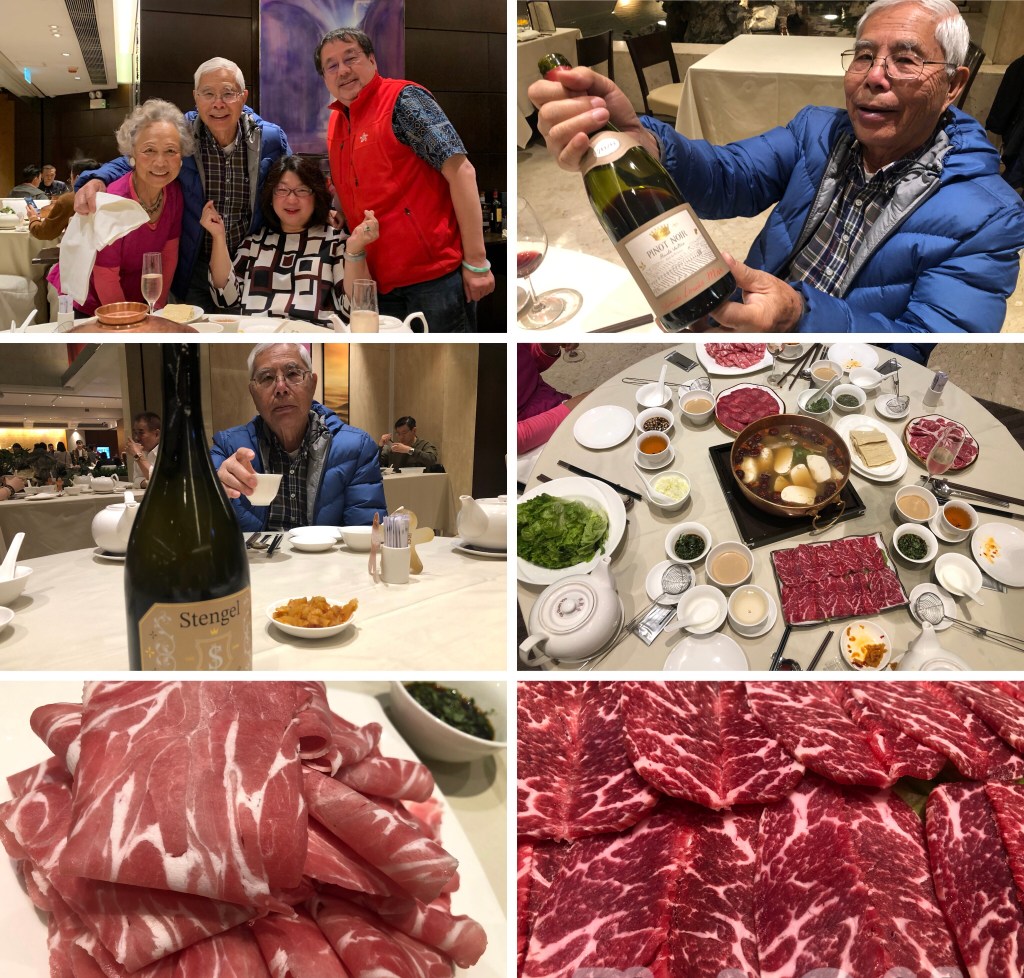
Video: Hot pot dinner with friends, Napa Valley Vineyards owner from SF in HK at The Royal Garden Hotel 與舊金山納帕谷葡萄園老闆舊金山朋友在帝苑酒店共進火鍋晚餐
https://rumble.com/v3wltm5-hot-pot-dinner-with-friends-in-hk.html
https://www.tiktok.com/t/ZT8UmqMBB/
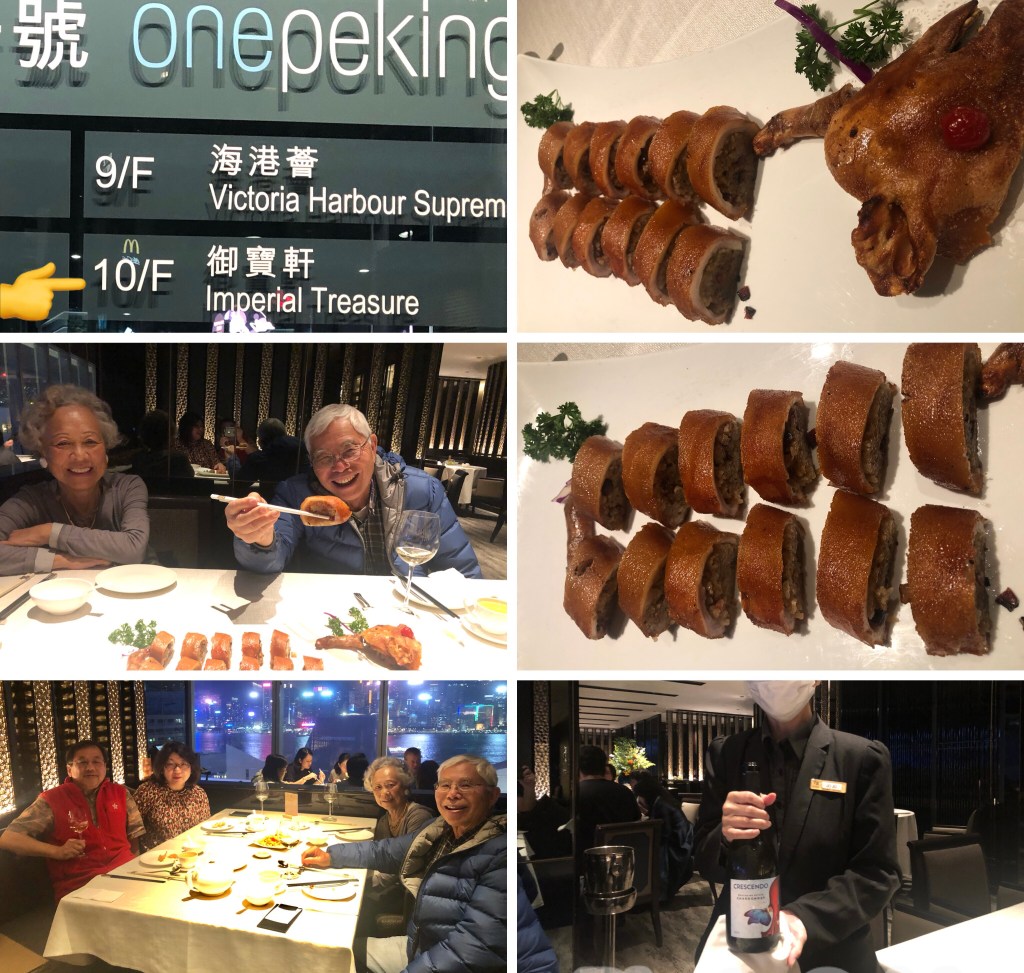
Video: One of the best roast baby pig dinner in Tsimshatsui HK last night 香港尖沙咀的烤小豬晚餐真的是一流, 在北美有錢也吃不到.
https://rumble.com/v3wekhb-one-of-the-best-roast-baby-pig-dinner-in-hk.html
https://www.tiktok.com/t/ZT8UrK9Vh/
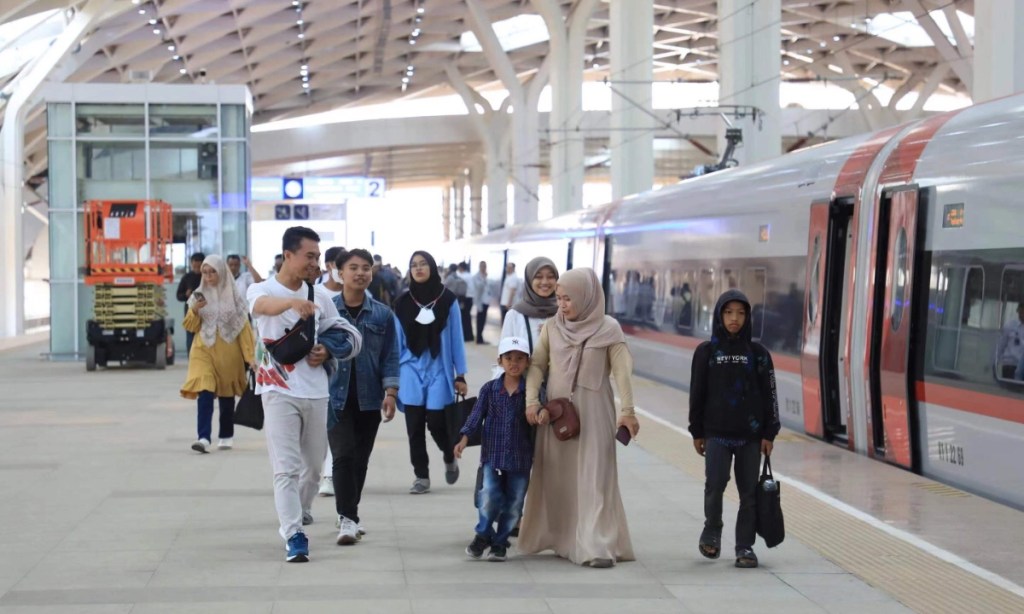
Jakarta-Bandung High-Speed Railway handles 383,000 passenger trips in first month of operation 雅萬高鐵營運首月發送旅客38.3萬人次
The Jakarta-Bandung High-Speed Railway (HSR), the first HSR in Indonesia and Southeast Asia, handled 383,000 passenger trips in its first month of official operation, China State Railway Group Co said on Friday.
Passenger flow saw a strong upward momentum, the Chinese state railway operator said, with highest single day ridership reaching 98.7 percent occupancy rate during the period.
The Jakarta-Bandung HSR, which is 142 kilometers long with a maximum design speed of 350 kilometers per hour, is operated by a consortium of Indonesian and Chinese firms including a unit under the China State Railway Group. It has cut the journey between the two cities from 3.5 hours to just 46 minutes.
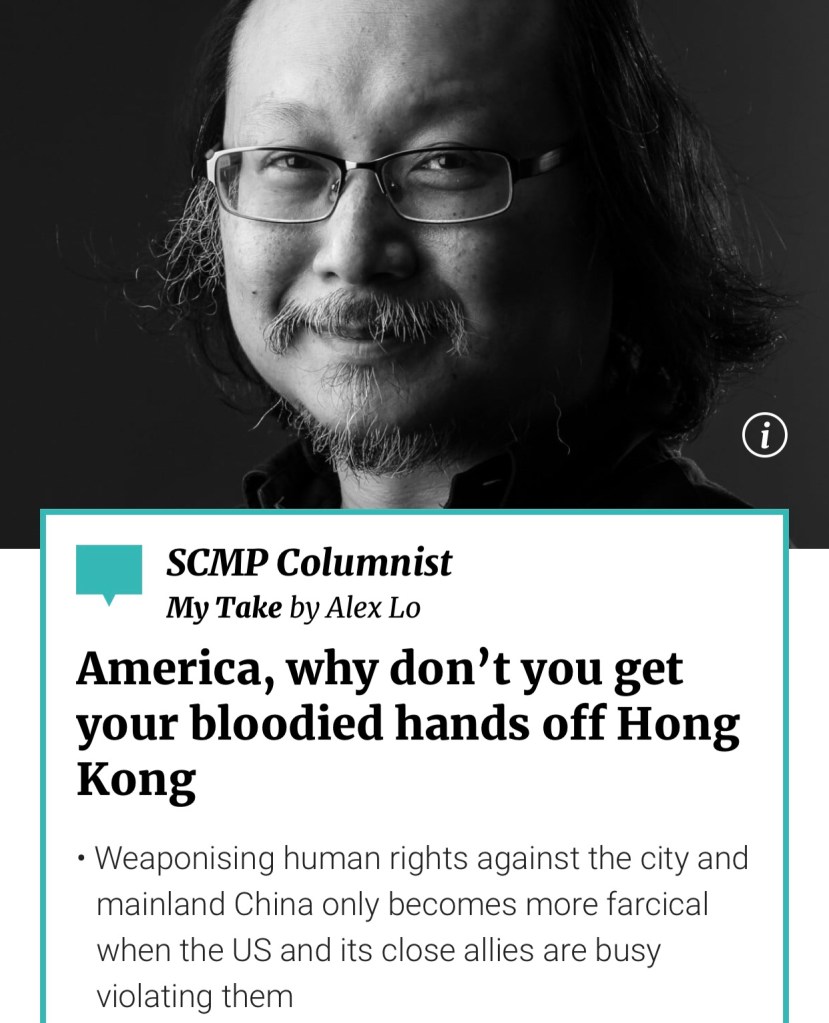
SCMP: American , why don’t you get your bloodied hands off HK. Another day, another official report from the US Gov’t criticising and threatening to punish China for interfering with the affairs of HK, a Chinese city. This is getting farcical. 南華早報:美國人,你為什麼不把你沾滿血的手從香港拿開。 又一天,美國政府又發布一份官方報告,批評並威脅要懲罰中國干涉中國香港事務。 這真是越來越鬧劇了.
The latest annual report is released by the United States-China Economic and Security Review Commission, which reports directly to the US Congress under the Hong Kong Autonomy Act passed when Donald Trump was president. And it came out a day before President Xi Jinping and his US counterpart Joe Biden had their tete-a-tete in San Francisco. A coincidence? 最新的年度報告由美中經濟與安全審查委員會發布,該委員會根據唐納德·川普擔任總統期間通過的《香港自治法》直接向美國國會報告。 消息發布的前一天,習近平主席和美國總統拜登在舊金山舉行了會談。 巧合?
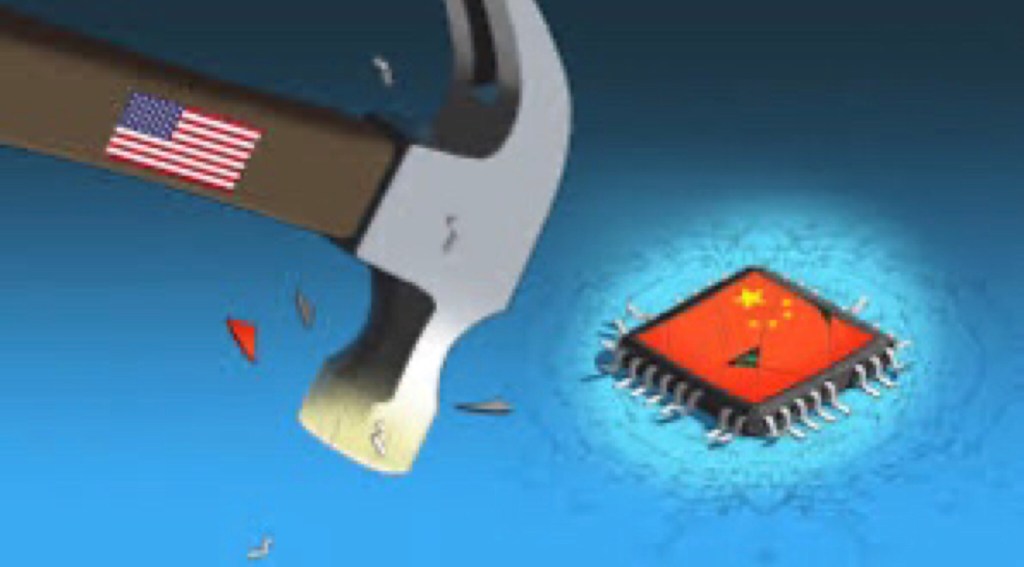
Immediately after President Xi leaves, new Tighter Chip sanctions against China start tomorrow. US could not be trusted. 習主席離開後,明天將對中國實施新的「更嚴格的籌碼」制裁。 美國是不可以信任的.
The NYT referred to the initial BIS Chip sanctions of 10/21/22 as “an act of war”, “a plan to extirpate root and branch China’s tech industry”, and compared it to the invasion of Ukraine. CSIS referred to this as “a 4-fold chokehold strangling with intent to kill”.
This pattern is repetitious. The first set of BIS sanctions came one week after the Bali Summit meeting between Xi and Biden on 10/14/22, during which Biden gave his reassurances he was not seeking to wage a cold war and not seeking to impede China’s development. Then immediately afterwards, the BIS sanctions against China kicked in.
United States Further Expands Restrictions on Exports of Advanced Computing Chips and Semiconductor Manufacturing Items to China
October 25, 2023
The Biden Administration has taken further steps to constrain Chinese access to advanced computing and artificial intelligence technology by refining and expanding existing export control rules restricting China’s access to U.S. semiconductors and related technologies. Building on measures implemented in October of 2022, the U.S. Commerce Department’s Bureau of Industry and Security (“BIS”) has imposed new controls on the export of advanced computing and semiconductor manufacturing items to China as well as transactions related to supercomputer end-uses in China. In announcing the new rule, Secretary of Commerce Gina M. Raimondo set out three goals: “working to protect our national security by restricting access to critical technology, vigilantly enforcing our rules, while minimizing any unintended impact on trade flows.” In keeping with these goals, the new measures demonstrate a determination to counter efforts to circumvent existing rules measures but also reflect careful consideration of input from U.S. industry to ensure that new restrictions do not stifle the vital U.S. semiconductor industry.
Notable Features of New Rules
The new rules are multi-faceted, complex and innovative, and most notably include the following:
Amended Controls for Restricted Chips Address Reported Work-Arounds: Responding to industry concerns, BIS adjusted the control parameters established in the October 2022 rule. A new “performance density” parameter is also designed to pre-empt design work arounds for companies that simply deploy larger numbers of lower performance chips.
Additional Destinations Subject to Restricted Chip Controls: Responding to reports of Chinese companies accessing data centers outside of China to use AI chips that cannot be exported to China, the rule expands licensing requirements to a number of countries, most notably in the Middle East.
Monitoring Exports: Recognizing that chip designers have responded to past measures by designing chips with performance just below restricted thresholds, the new rule requires the notification to BIS of exports for certain chips with performance just below the restricted levels. The rule also establishes more precise export clearance reporting requirements on certain chips.
Semiconductor Manufacturing Equipment: BIS expanded controls by adding new restrictions on existing types of equipment, and expanding the list of controlled destinations to all countries subject to a U.S. arms embargo.
Expanded Jurisdiction over Foreign-Made Lithography Equipment:
In an unprecedented assertion of jurisdiction over equipment made wholly outside the United States, the new rules establish a licensing requirement for certain lithography equipment with any U.S. content if that equipment is being used to develop or produce certain advanced node ICs. Such rules do not apply if the country making the lithography equipment has its own equivalent export controls.
End-Use Restrictions Based on Ownership: Reflecting a concern that companies based in allied countries that have parent companies in China (and other countries of concern) pose greater circumvention risk, BIS established new license requirements for certain IC technology destined for such entities.
The new rules are interim final rules published today in the Federal Register and are effective November 17, 2023.
U.S. export control policy is just one of several areas the United States is pursuing its ongoing economic and strategic competition with China. Through the CHIPS Act, the United States is incentivizing domestic production of semiconductors and conditioning the receipt of federal funding on restricting operations in China. In June, the Commerce Department issued its Final Rule on Securing the Information and Communications Technology and Services Supply Chain implementing the telecommunications supply chain restrictions established in Executive Orders 13873 and 14017, which restrict the use in the United States of foreign telecommunications technology that raises national security concerns. Taken together, these actions demonstrate that the United States continues to aggressively pursue a concerted strategy to decrease U.S. dependence on China, hinder China’s development of critical technologies, and maintain U.S. leadership in various advanced technologies
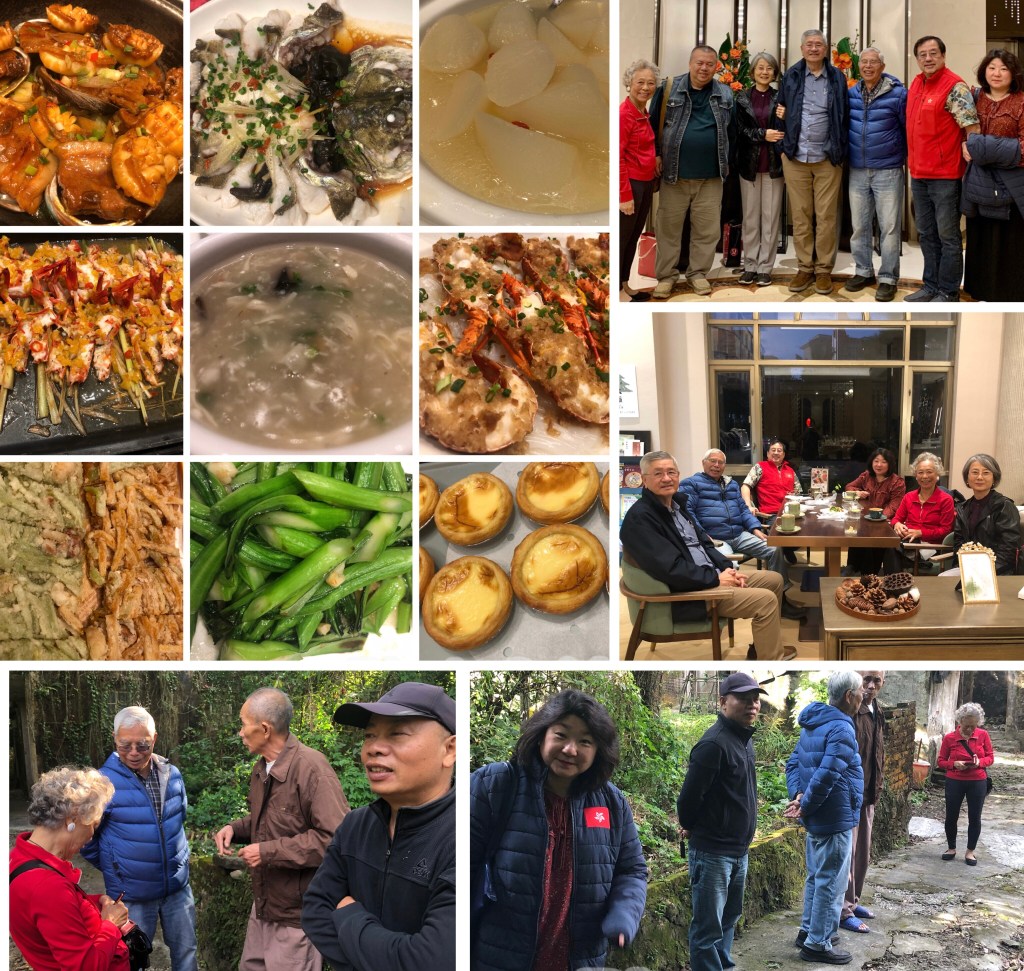
Toisan Guangzhou China: catching up with Toisan old friends from SF, 1st generation Napa Valley vineyard owner and 2nd generation attorney/real estate developer both in their 80s. They bring their families to China regularly so they do not forget their Chinese roots. Unlike US, it is amazing seeing miles of country road has no potholes! Witnessing Toisan transform into a modern clean city while San Francisco and Hawaii is falling apart 中國台山:我們與來自舊金山的台山老朋友,第一代納帕谷葡萄園主和第二代律師/房地產開發商都80多歲了。 他們定期帶著家人來中國,這樣他們就不會忘記自己的中國根. 與美國不同的是,看到數英里的鄉村道路沒有坑洼,真是太神奇了! 見證台山變身現代清潔城市,而舊金山和夏威夷正在分崩離析.
Video: Full text of Xi’s speech at Welcome Dinner by Friendly Organizations in the United States
https://rumble.com/v3w6v1s-full-text-of-xis-speech-at-welcome-dinner-in-sf.html
https://english.news.cn/20231116/e8430b6ab19146f4a15bbed8465530bc/c.html
習總情深意切的陳說中國(人)的觀點。
可惜的是:對牛彈琴,完全對不上頻道。
兩種文化,完全不同的心態。什麼共同發展,共富,人類命運共同體,都是西方創造的烏托邦的洗腦套路。
我們中華儒家文化,思想,就太對路。
西方(猶太資本)才不管什麼共富。祇有老子(猶太資本)有錢,就有世界。所有人都該被奴隸。
知道就好,不會失望,憋氣。
開完會,就各幹各的。
他走他的獨木橋,我們就繼續陽關道。
美国霸權橫行世界
中國王道佈局天下。
有云:
不能用武力恐吓俄罗斯,不能用道德约束美国。
和老美政棍講道德? What’s that ?
Will it bring about wealth and power ?
SAN FRANCISCO, Nov. 15 (Xinhua) — Chinese President Xi Jinping delivered a speech here Wednesday at Welcome Dinner by Friendly Organizations in the United States.
The following is the full text of the speech:
Galvanizing Our Peoples into a Strong Force
For the Cause of China-U.S. Friendship
Speech by H.E. Xi Jinping
President of the People’s Republic of China
At Welcome Dinner by Friendly Organizations in the United States
San Francisco, November 15, 2023
Ladies and Gentlemen,
Friends,
It gives me great pleasure to meet with you, friends from across the American society, in San Francisco to renew our friendship and strengthen our bond. My first visit to the United States in 1985 started from San Francisco, which formed my first impression of this country. Today I still keep a photo of me in front of the Golden Gate Bridge.
Before going further, I wish to express my sincere thanks to the National Committee on U.S.-China Relations, the U.S.-China Business Council, the Asia Society, the Council on Foreign Relations, the U.S. Chamber of Commerce and other friendly organizations for hosting this event. I also want to express my warm greetings to all American friends who have long committed to growing China-U.S. relations and my best wishes to the friendly American people.
San Francisco has borne witness to exchanges between the Chinese and American peoples for over a century. A hundred and fifty-eight years ago, a large number of Chinese workers came all the way to the United States to build the first transcontinental railroad, and established in San Francisco the oldest Chinatown in the Western Hemisphere. From here, China and the United States have made many achievements–USD 760 billion of annual bilateral trade and over USD 260 billion of two-way investment, 284 pairs of sister provinces/states and sister cities, and over 300 scheduled flights every week and over five million travels every year at peak time. These extraordinary accomplishments were made jointly by our peoples accounting for nearly one quarter of the global population.
San Francisco has also borne witness to the efforts by China and the United States in building a better world. Seventy-eight years ago, after jointly defeating fascism and militarism, our two countries initiated together with others the San Francisco Conference, which helped found the United Nations, and China was the first country to sign the U.N. Charter. Starting from San Francisco, the postwar international order was established. Over 100 countries have gained independence one after another. Several billion people have eventually shaken off poverty. The forces for world peace, development and progress have grown stronger. This has been the main fruit jointly achieved by people of all countries and the international community.
Ladies and Gentlemen,
Friends,
The foundation of China-U.S. relations was laid by our peoples. During World War II, our two countries fought side by side for peace and justice. Headed by General Claire Lee Chennault, a group of American volunteers, known as the Flying Tigers, went to the battlefield in China. They not only engaged in direct combats fighting Japanese aggressors, but also created “The Hump” airlift to transport much-needed supplies to China. More than 1,000 Chinese and American airmen lost their lives on this air route. After Japan attacked Pearl Harbor, the United States sent 16 B-25 bombers on an air raid to Japan in 1942. Running low on fuel after completing their mission, Lieutenant Colonel James Doolittle and his fellow pilots parachuted in China. They were rescued by Chinese troops and local civilians. But some 250,000 civilian Chinese were killed by Japanese aggressors in retaliation.
The Chinese people never forget the Flying Tigers. We built a Flying Tigers museum in Chongqing, and invited over 1,000 Flying Tigers veterans and their families to visit China. I have kept in touch with some of them through letters. Most recently, 103-year-old Harry Moyer and 98-year-old Mel McMullen, both Flying Tigers veterans, went back to China. They visited the Great Wall, and were warmly received by the Chinese people.
The American people, on their part, always remember the Chinese who risked their lives to save American pilots. Offspring of those American pilots often visit the Doolittle Raid Memorial Hall in Quzhou of Zhejiang Province to pay tribute to the Chinese people for their heroic and valorous efforts. These stories fill me with firm confidence that the friendship between our two peoples, which has stood the test of blood and fire, will be passed on from generation to generation.
The door of China-U.S. relations was opened by our peoples. For 22 years, there were estrangement and antagonism between our two countries. But the trend of the times brought us together, converging interests enabled us to rise above differences, and the people’s longing broke the ice between the two countries. In 1971, the U.S. table tennis team visited Beijing–a small ball moved the globe. Not long after that, Mr. Mike Mansfield led the first U.S. Congressional delegation to China. This was followed by the first governors’ delegation including Iowa Governor Robert Ray and then many business delegations, forming waves of friendly exchanges.
This year, after the world emerged from the COVID-19 pandemic, I have respectively met in Beijing with Dr. Henry Kissinger, Mr. Bill Gates, Senator Chuck Schumer and his Senate colleagues, and Governor Gavin Newsom. I told them that the hope of the China-U.S. relationship lies in the people, its foundation is in our societies, its future depends on the youth, and its vitality comes from exchanges at subnational levels. I welcome more U.S. governors, Congressional members, and people from all walks of life to visit China.
The stories of China-U.S. relations are written by our peoples. During my first visit to the United States, I stayed at the Dvorchaks in Iowa. I still remember their address–2911 Bonnie Drive. That was my first face-to-face contact with the Americans. The days I spent with them are unforgettable. For me, they represent America. I have found that although our two countries are different in history, culture and social system and have embarked on different development paths, our two peoples are both kind, friendly, hardworking and down-to-earth. We both love our countries, our families and our lives, and we both are friendly toward each other and are interested in each other. It is the convergence of many streams of goodwill and friendship that has created a strong current surging across the vast Pacific Ocean; it is the reaching out to each other by our peoples that has time and again brought China-U.S. relations from a low ebb back onto the right track. I am convinced that once opened, the door of China-U.S. relations cannot be shut again. Once started, the cause of China-U.S. friendship cannot be derailed halfway. The tree of our peoples’ friendship has grown tall and strong; and it can surely withstand the assault of any wind or storm.
The future of China-U.S. relations will be created by our peoples. The more difficulties there are, the greater the need for us to forge a closer bond between our peoples and to open our hearts to each other, and more people need to speak up for the relationship. We should build more bridges and pave more roads for people-to-people interactions. We must not erect barriers or create a chilling effect.
Today, President Biden and I reached important consensus. Our two countries will roll out more measures to facilitate travels and promote people-to-people exchanges, including increasing direct passenger flights, holding a high-level dialogue on tourism, and streamlining visa application procedures. We hope that our two peoples will make more visits, contacts and exchanges and write new stories of friendship in the new era. I also hope that California and San Francisco will continue to take the lead on the journey of growing China-U.S. friendship!
Ladies and Gentlemen,
Friends,
We are in an era of challenges and changes. It is also an era of hope. The world needs China and the United States to work together for a better future. We, the largest developing country and the largest developed country, must handle our relations well. In a world of changes and chaos, it is ever more important for us to have the mind, assume the vision, shoulder the responsibility, and play the role that come along with our status as major countries.
I have always had one question on my mind: How to steer the giant ship of China-U.S. relations clear of hidden rocks and shoals, navigate it through storms and waves without getting disoriented, losing speed or even having a collision?
In this respect, the number one question for us is: are we adversaries, or partners? This is the fundamental and overarching issue. The logic is quite simple. If one sees the other side as a primary competitor, the most consequential geopolitical challenge and a pacing threat, it will only lead to misinformed policy making, misguided actions, and unwanted results. China is ready to be a partner and friend of the United States. The fundamental principles that we follow in handling China-U.S. relations are mutual respect, peaceful coexistence and win-win cooperation.
Just as mutual respect is a basic code of behavior for individuals, it is fundamental for China-U.S. relations. The United States is unique in its history, culture and geographical position, which have shaped its distinct development path and social system. We fully respect all this. The path of socialism with Chinese characteristics has been found under the guidance of the theory of scientific socialism, and is rooted in the tradition of the Chinese civilization with an uninterrupted history of more than 5,000 years. We are proud of our choice, just as you are proud of yours. Our paths are different, but both are the choice by our peoples, and both lead to the realization of the common values of humanity. They should be both respected.
Peaceful coexistence is a basic norm for international relations, and is even more of a baseline that China and the United States should hold on to as two major countries. It is wrong to view China, which is committed to peaceful development, as a threat and thus play a zero-sum game against it. China never bets against the United States, and never interferes in its internal affairs. China has no intention to challenge the United States or to unseat it. Instead, we will be glad to see a confident, open, ever-growing and prosperous United States. Likewise, the United States should not bet against China, or interfere in China’s internal affairs. It should instead welcome a peaceful, stable and prosperous China.
Win-win cooperation is the trend of the times, and it is also an inherent property of China-U.S. relations. China is pursuing high-quality development, and the United States is revitalizing its economy. There is plenty of room for our cooperation, and we are fully able to help each other succeed and achieve win-win outcomes.
The Belt and Road Initiative as well as the Global Development Initiative (GDI), the Global Security Initiative (GSI) and the Global Civilization Initiative (GCI) proposed by China are open to all countries at all times including the United States. China is also ready to participate in U.S.-proposed multilateral cooperation initiatives. This morning, President Biden and I agreed to promote dialogue and cooperation, in the spirit of mutual respect, in areas including diplomacy, economy and trade, people-to-people exchange, education, science and technology, agriculture, military, law enforcement, and artificial intelligence. We agreed to make the cooperation list longer and the pie of cooperation bigger. I would like to let you know that China sympathizes deeply with the American people, especially the young, for the sufferings that Fentanyl has inflicted upon them. President Biden and I have agreed to set up a working group on counternarcotics to further our cooperation and help the United States tackle drug abuse. I also wish to announce here that to increase exchanges between our peoples, especially between the youth, China is ready to invite 50,000 young Americans to China on exchange and study programs in the next five years.
Recently, the three pandas at Smithsonian’s National Zoo in Washington D.C. have returned to China. I was told that many American people, especially children, were really reluctant to say goodbye to the pandas, and went to the zoo to see them off. I also learned that the San Diego Zoo and the Californians very much look forward to welcoming pandas back. Pandas have long been envoys of friendship between the Chinese and American peoples. We are ready to continue our cooperation with the United States on panda conservation, and do our best to meet the wishes of the Californians so as to deepen the friendly ties between our two peoples.
Ladies and Gentlemen,
Friends,
China is the largest developing country in the world. The Chinese people long for better jobs, better lives, and better education for their children. It is what the 1.4 billion Chinese hold dear to their hearts. The Communist Party of China (CPC) is committed to working for the people, and our people’s expectation for a better life is our goal. This means we must work hard to secure their support. Thanks to a century of exploration and struggle, we have found the development path that suits us. We are now advancing the rejuvenation of the Chinese nation on all fronts by pursuing Chinese modernization.
We are committed to striving in unity to achieve modernization for all Chinese. A large population is a fundamental aspect of China’s reality. Our achievements, however great, would be very small when divided by 1.4 billion. But a problem, however small, would be huge when multiplied by 1.4 billion. This is a unique challenge for a country of our size. In the meantime, big also means strength. The leadership of the CPC, the system of socialism with Chinese characteristics, and the endorsement and support of the people are our greatest strengths. China is both a super-large economy and a super-large market. Not long ago the sixth China International Import Expo was held, attracting over 3,400 business exhibitors from 128 countries including the United States. The exhibition area of American companies has been the largest for six consecutive years at the Expo. Modernization for 1.4 billion Chinese is a huge opportunity that China provides to the world.
We are committed to prosperity for all to deliver a better life for each and every Chinese. To eliminate poverty is the millennia-old dream of the Chinese nation, and prosperity for all is the longing of all Chinese. Before I turned 16, I was in a village in northern Shaanxi Province, where I lived and farmed with villagers, and I knew about their worries and needs. Now half a century on, I always feel confident and strong when staying with the people. Serving the people selflessly and living up to their expectations is my lifelong commitment. When I became General Secretary of the CPC Central Committee and President of the People’s Republic of China, 100 million people were still living below the poverty line set by the United Nations. Thanks to eight years of tenacious efforts, we lifted them all out of poverty. We realized the poverty reduction goal of the U.N. 2030 Agenda for Sustainable Development 10 years ahead of schedule. In the process, over 1,800 CPC members lost their lives in the line of duty.
Our goal is not to have just a few wealthy people, but to realize common prosperity for all. Employment, education, medical services, child care, elderly care, housing, the environment and the like are real issues important to people’s daily life and close to their heart. They are being steadily integrated into our top-level plans for national development, thus ever increasing the sense of fulfillment, happiness and security of our people. We will continue to promote high-quality development and deliver the benefits of modernization to all. This is the CPC’s founding mission and the pledge we have made to the people. It will surely be realized with the support of the people.
We are committed to well-rounded development to achieve both material and cultural-ethical advancement for the people. Our forefathers observed that “When people are well-fed and well-clad, they will have a keen sense of honor and shame.” Material shortage is not socialism, nor is cultural-ethical impoverishment. Chinese modernization is people-centered. An important goal of Chinese modernization is to continue increasing the country’s economic strength and improving the people’s living standards, and at the same time, enriching the people’s cultural lives, enhancing civility throughout society and promoting well-rounded development of the person. The purpose of the Global Civilization Initiative I proposed is to urge the international community to address the imbalance between material and cultural advancement and jointly promote continued progress of human civilization.
We are committed to sustainable development to achieve harmony between man and nature. The belief that humans are an integral part of nature and need to follow nature’s course is a distinctive feature of traditional Chinese culture. We live in the same global village, and we possibly won’t find another inhabitable planet in our lifetime. As an English saying goes, “We do not inherit the Earth from our ancestors, we borrow it from our children.” When I was Governor of Fujian Province in 2002, I called for turning Fujian into the first ecological province in China. Later when I worked in Zhejiang Province in 2005, I said that clear waters and green mountains are just as valuable as gold and silver. Today, this view has become a consensus of all the Chinese people. China now has close to half of the world’s installed photovoltaic capacity. Over half of the world’s new energy vehicles run on roads in China, and China contributes one-fourth of increased area of afforestation in the world. We will strive to peak carbon dioxide emissions before 2030 and achieve carbon neutrality before 2060. We have made the pledge, and we will honor it.
We are committed to peaceful development to build a community with a shared future for mankind. Peace, amity and harmony are values embedded in Chinese civilization. Aggression and expansion are not in our genes. The Chinese people have bitter and deep memories of the turmoils and sufferings inflicted upon them in modern times. I often say that what the Chinese people oppose is war, what they want is stability, and what they hope for is enduring world peace. The great rejuvenation of the Chinese nation cannot be achieved without a peaceful and stable international environment. In pursuing modernization, we will never revert to the beaten path of war, colonization, plundering or coercion.
Throughout the 70 years and more since the founding of the People’s Republic, China has not provoked a conflict or war, or occupied a single inch of foreign land. China is the only major country that has written peaceful development into the Constitution of the country and the Constitution of the governing party, thus making peaceful development a commitment of the nation. It benefits from and safeguards the current international order. We remain firm in safeguarding the international system with the U.N. at its core, the international order underpinned by international law, and the basic norms governing international relations based on the purposes and principles of the U.N. Charter. Whatever stage of development it may reach, China will never pursue hegemony or expansion, and will never impose its will on others. China does not seek spheres of influence, and will not fight a cold war or a hot war with anyone. China will remain committed to dialogue and oppose confrontation, and build partnerships instead of alliances. It will continue to pursue a mutually beneficial strategy of opening up. The modernization we are pursuing is not for China alone. We are ready to work with all countries to advance global modernization featuring peaceful development, mutually beneficial cooperation and common prosperity, and to build a community with a shared future for mankind.
Ladies and Gentlemen,
Friends,
The passage of time is like a surging river–much is washed away, but the most valuable stays. No matter how the global landscape evolves, the historical trend of peaceful coexistence between China and the United States will not change. The ultimate wish of our two peoples for exchanges and cooperation will not change. The expectations of the whole world for a steadily growing China-U.S. relationship will not change. For any great cause to succeed, it must take root in the people, gain strength from the people, and be accomplished by the people. Growing China-U.S. friendship is such a great cause. Let us galvanize the Chinese and American peoples into a strong force to renew China-U.S. friendship, advance China-U.S. relations, and make even greater contributions to world peace and development! ■
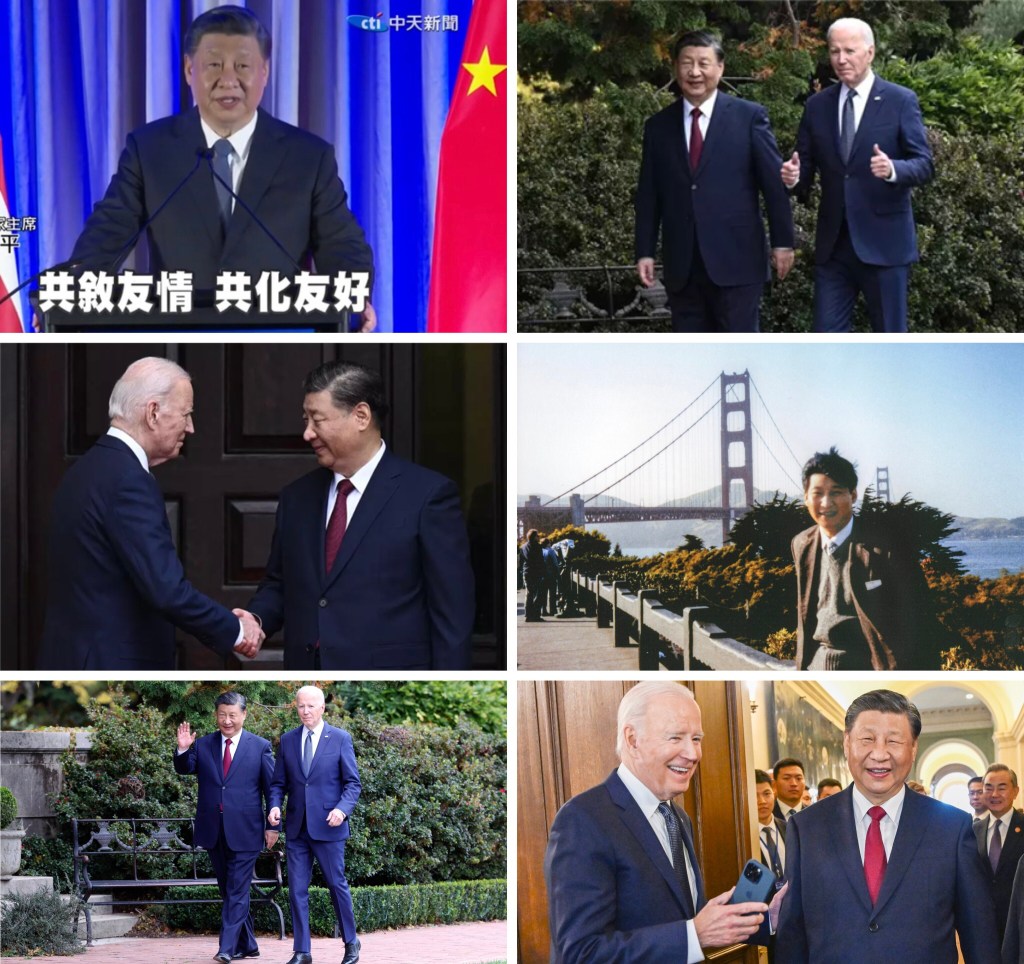
Xi-Biden meeting: the Buddha and the Monster and the Red Flag 習-登會: 佛陀與妖怪與紅旗
President Xi Jinping noted that there are two options for China and the U.S. in the era of global transformations unseen in a century:
One is to enhance solidarity and cooperation and join hands to meet global challenges and promote global security and prosperity;
and the other is to cling to the zero-sum mentality, provoke rivalry and confrontation, and drive the world toward turmoil and division.
The two choices point to two different directions that will decide the future of humanity and Planet Earth.
2: The Buddha and the Beast: I prefer the analogy of the Buddha and the Beast:
China spells out a path for the US and China to achieve peace and prosperity: for solidarity & cooperation, instead of rivalry and confrontation:
Think of this as 5 easy-to-follow steps, modelled on the 8 fold path of the historical Buddha
Notice also that everything was about “jointly developing:
Right Perception (=Right View): China is not out to get you. Jointly develop clear understanding.
Right Communication (=Right Speech): Jointly manage disagreements skillfully
Right Cooperation (=Right Action): Jointly develop mutual cooperation
Right Responsibility/Right Example (=Right Livelihood): Jointly shoulder responsibility and develop public goods for the whole world
Right Relationship (=Right Effort): Jointly develop people-to-people exchanges to support the above
All of these are positive steps, positive injunctions. Note how modest and reasonable they are.
These are counterpoints to the 5 No’s (No regime change, no cold war, no hot war, no economic war, no taiwan provocation) that the US intoned in Bali, but never kept.
China is seeking to heighten the positive. Each is an antidote to the US’s formulation:
But note also the warning about 5.Taiwan island (This is where Right intention is called for), avoid the poison pill
The Monster of Greed (Envy, Jealousy):
“Nice car you have there, [dude][I want one of those].
Did you know ours is called “the monster”?”–The Hongqi is the “red flag” to the monster–a threat.
https://nitter.net/TripInChina/status/1725051893905547762#m
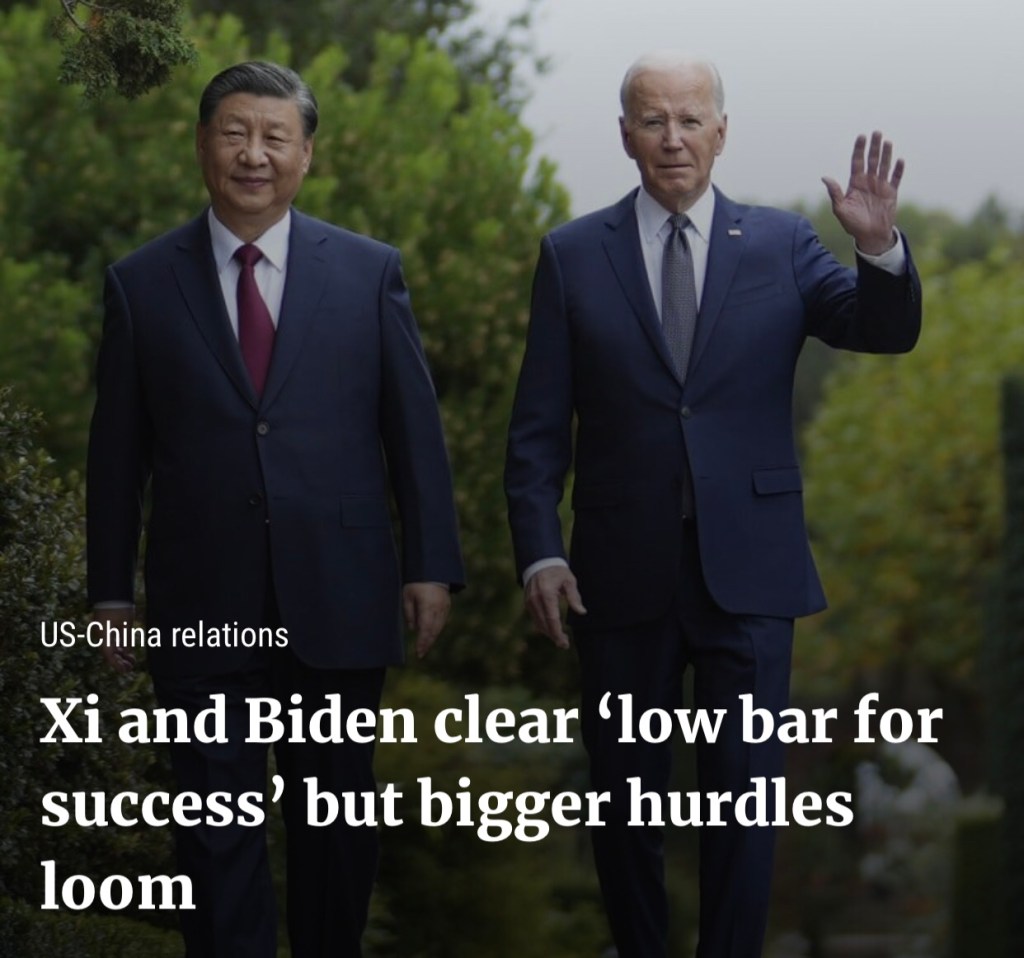
The Monster of Ignorance and Delusion:
https://twitter.com/unusual_whales/status/1724972165634916838?s=20
“The US and China are in competition, noting that the United States would continue to invest in the sources of American strength at home and align with allies and partners around the world. He stressed that the United States would always stand up for its interests, its values, and its allies and partners”
“our one China policy has not changed and has been consistent across decades and administrations.”
“President Biden underscored the universality of human rights and the responsibility of all nations to respect their international human rights commitments. He raised concerns regarding PRC human rights abuses, including in Xinjiang, Tibet, and Hong Kong.”
“the United States will continue to take necessary actions to prevent advanced U.S. technologies from being used to undermine our own national security”
Here’s a key source of ignorance, delusion, violence: https://m.youtube.com/watch?v=loCXuMt9ukk
The Monster of Violence:
“President Biden reaffirmed that the United States, alongside allies and partners, will continue to support Ukraine’s defense against Russian aggression”
“[The President] reiterated U.S. support for Israel’s right to defend itself against terrorism
See here for examples:
https://www.youtube.com/watch?v=Vx5bmMu12Bk
https://www.independent.co.uk/news/world/middle-east/israel-gaza-hospital-babies-hamas-b2446440.html
“President Biden underscored the United States’ support for a free and open Indo-Pacific that is connected, prosperous, secure, and resilient. The President reaffirmed the United States’ ironclad commitment to defending our Indo-Pacific allies. The President emphasized the United States’ enduring commitment to freedom of navigation and overflight, adherence to international law, maintaining peace and stability in the South China Sea and East China Sea, and the complete denuclearization of the Korean Peninsula.”
Nuclear posture
https://lasg.org/MPF2/documents/Americas-Strategic-Posture-Commission-Report_Oct2023.pdf
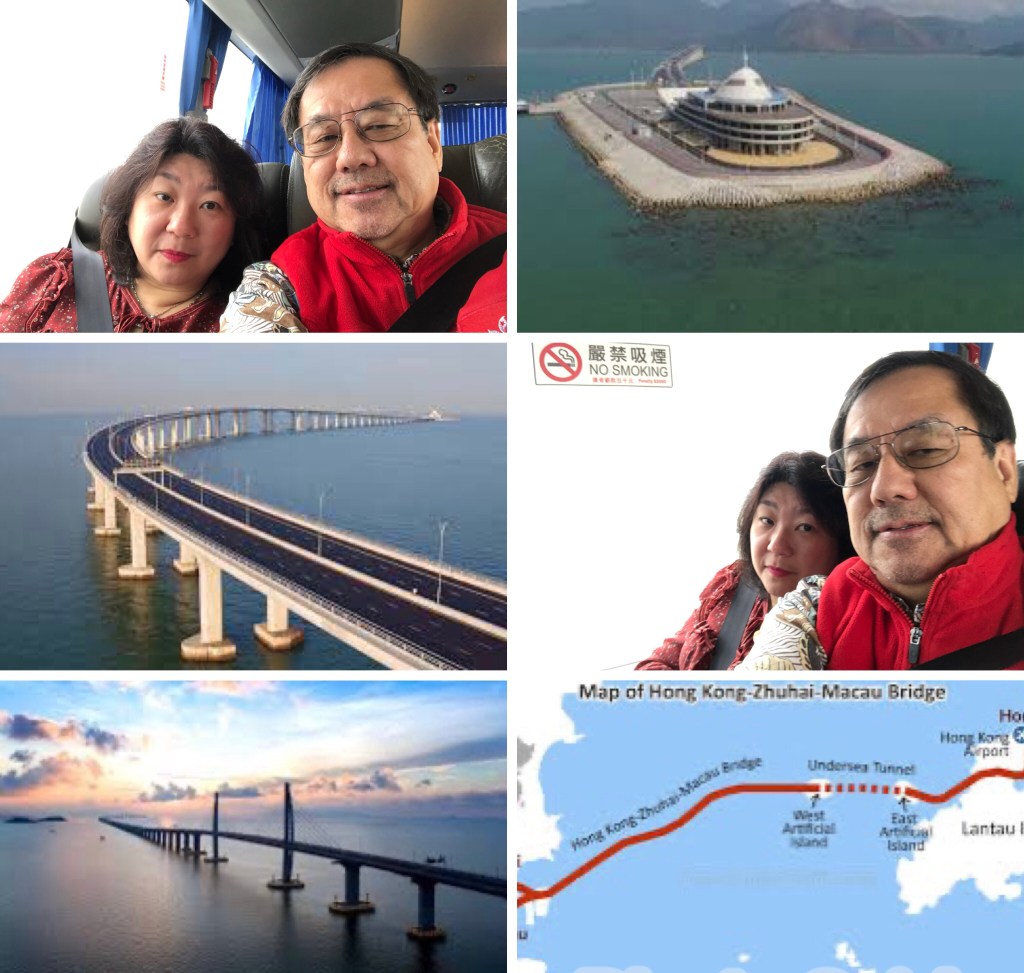
2nd time travel on the 50km HK-Zhuhai-Macau bridge, last time was 2018 to Macau. Amazing Engineering by China/HK putting US to shame 第二次坐巴士走50公里的港珠澳大橋,上次是2018年去澳門。 中國/香港的驚人工程能力讓美國這個吹水王國汗顏
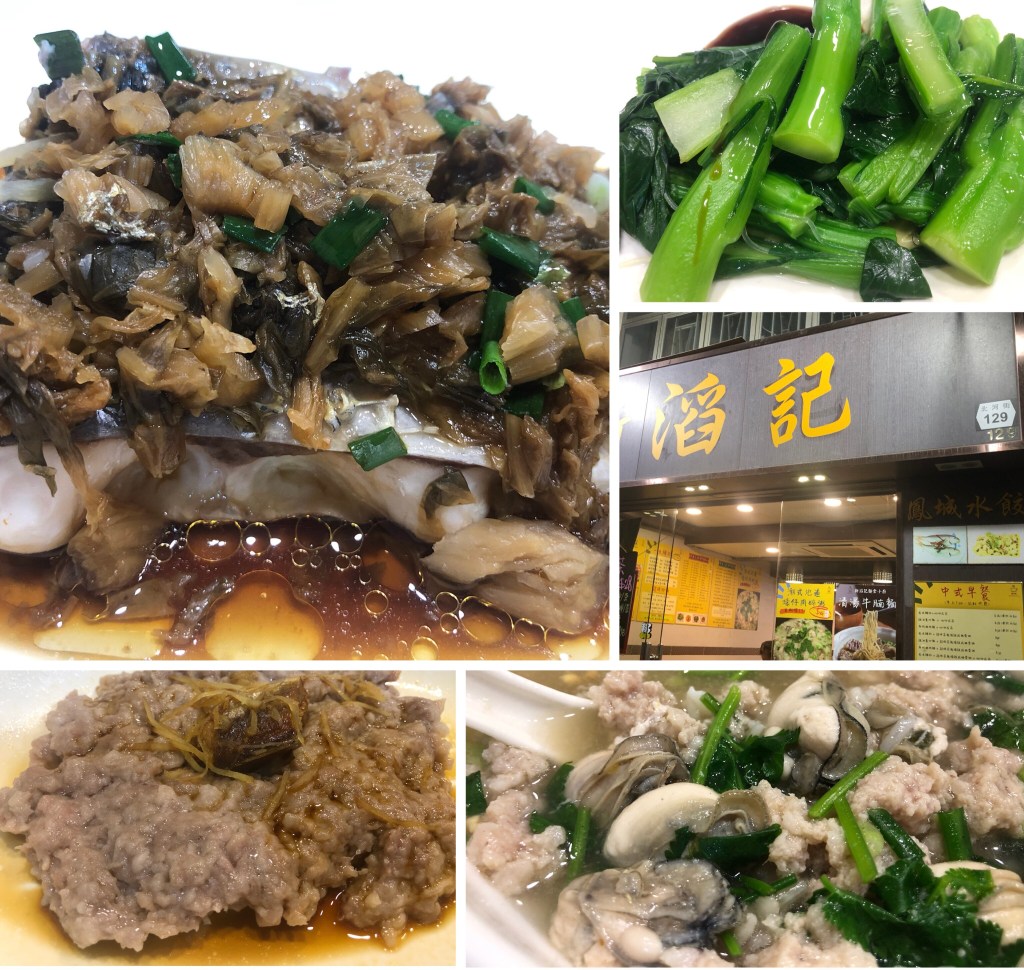
Purchase Price Parity: steam fish, salted fish pork hash, baby oyster rice soup, Choy sum, 2 lemon ice tea, rice for US$22 compared to US$88 in SF. Where would you like to live? HK or US? If that is not bad enough, in US you face Asian Hates, Gun Violence, Police Brutality, High Tax, Failing Infrastructure and High Crimes! 購買價格平價:蒸魚、鹹魚蒸肉餅, 蠔仔粥, 菜心、2杯檸檬冰茶、米飯22美元,在美國三藩市要88美元. 你想在哪裡生活? 香港還是美國? 如果這還不夠糟糕的話,在美國你還面臨對亞洲人仇恨、種族歧視, 槍枝暴力、警察暴行、高稅, 失敗的基礎設施和高犯罪率!
 Business Blog