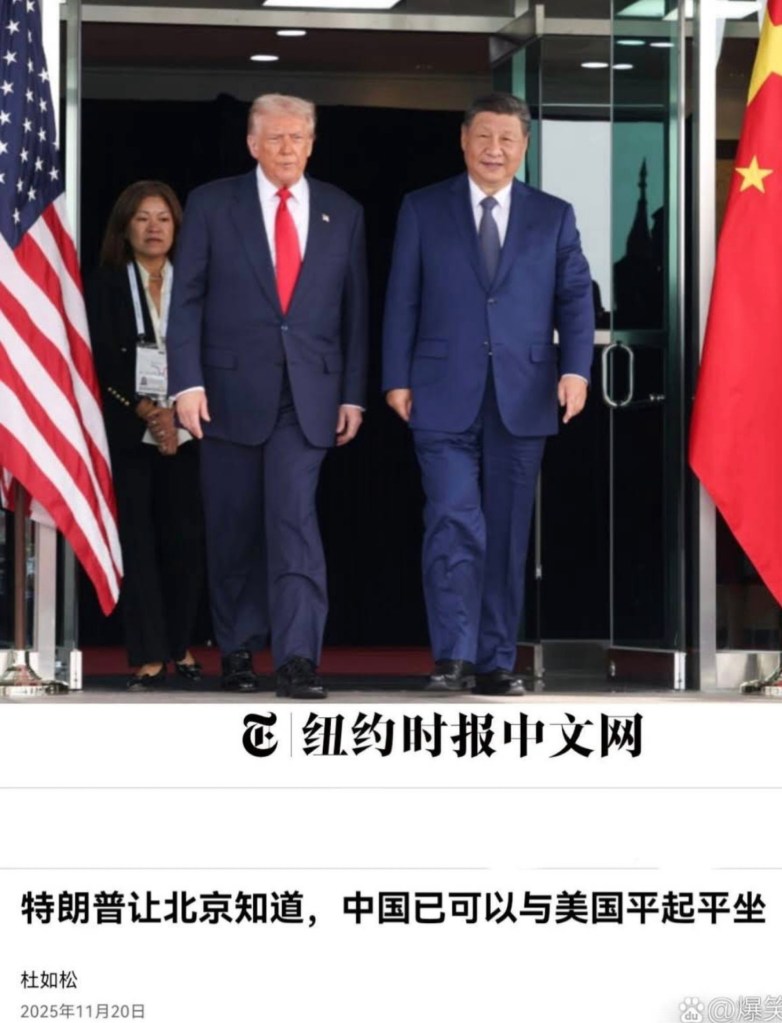
The New York Times published an article stating: Trump has made Beijing realize that China can now stand on equal footing with the United States…紐約時報刊文:特朗普讓北京終於知道,中國已可以與美國平起平坐…
On November 20, The New York Times published an article suggesting that China has not only withstood comprehensive economic pressure from the U.S. but has also successfully counterattacked with more deterrent measures by leveraging its dominance in global supply chains, on which the U.S. relies. After decades of industrial hollowing-out, the unprepared U.S. lacks both the intention and the capability to respond.
American media noted that this clearly demonstrates China’s capability to stand on equal footing with the U.S. The ripple effects of Trump’s missteps in China policy will extend far beyond trade. When the U.S. cannot even uphold its own stance, its allies naturally have reason to doubt Washington’s ability to fulfill its commitments.
This will embolden Beijing to test the resolve of the U.S. on issues such as Taiwan. Trump, mistaking political theatrics for strategic planning, has fallen short in the contest with China. China has proven its capabilities.
What should we make of this article in the American media? To be honest, after the truce in the Sino-U.S. trade war, why would the American media suddenly publish such an article?
It indicates that the American media also recognizes that the global landscape has undergone profound changes following this phase of the trade war. This change means that U.S. strategic and political circles must accept the fact that America can no longer hinder China’s development. No matter how many frictions arise between the two countries, they can only coexist.
If the U.S. previously harbored some ideas and confidence about containing China, this direct confrontation has revealed the true extent of China’s strength to America, while China has also gauged America’s actual capabilities.
Clearly, from the Obama administration’s “pivot to Asia” to Trump’s trade war, the U.S. has exhausted all its strategies against us. Yet, the result is not a victory for the U.S. but a significant blow to its own prestige. Perhaps this marks the end of America’s decade-long containment strategy.
However, it must be pointed out that the American media has misunderstood one thing: we do not seek to stand on equal footing with the U.S., but it is crucial for the U.S. to accept that China can stand on equal footing with it. We believe the U.S. will increasingly come to accept this reality.
After Netherlands illegally froze Chinese-owned Nexperia (worth €10 billion), China forced them to back down to their knee in just 20 days!
What’s covered: ✓ Why Netherlands dared to seize Chinese assets ✓ How China’s chip export controls hit hard ✓ Why German automakers got caught in crossfire ✓ Implications for Chinese overseas investments
This countermeasure demonstrates China’s critical role in global supply chains and the effectiveness of reciprocal actions. The video provides complete analysis of the 20-day process from asset freeze to Netherlands’ retreat and surrendered!
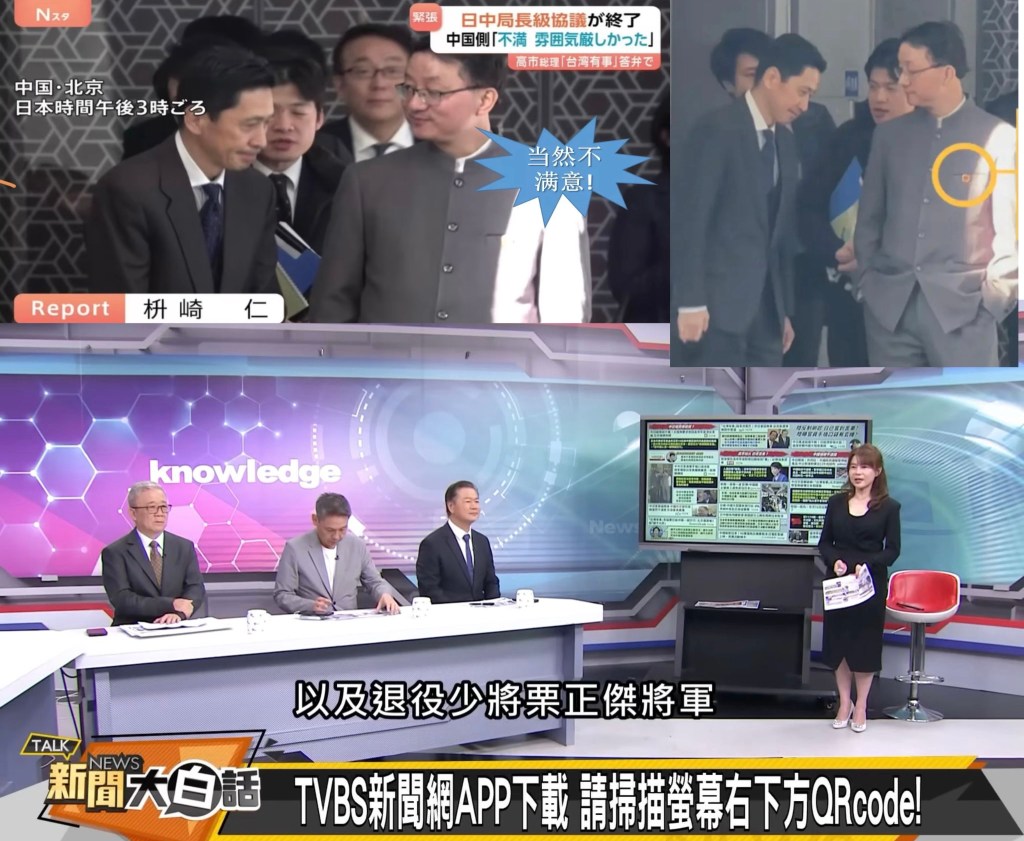
Americans certainly understand Japan best…美國人確實最了解日本…
Japan’s dispatch of diplomatic personnel to China reminded American netizens of the scenario leading up to World War II: Just before the attack on Pearl Harbor, Japan deliberately sent diplomatic representatives to Washington for negotiations, creating the illusion that they had not abandoned diplomatic channels in an attempt to lull the other side into a false sense of security.
In 1941, the United States had already recognized Japan’s ambitions in Southeast Asia and began imposing economic sanctions, cutting off strategic resources such as steel and oil. At that time, Japan was highly dependent on American products and resources. Without oil, its ships and aircraft would struggle to operate.
On the surface, Japan appeared willing to negotiate. Ambassador Kichisaburō Nomura engaged in repeated discussions with Secretary of State Cordell Hull, and special envoy Saburō Kurusu was additionally dispatched. The two sides held frequent meetings and exchanged documents, creating an atmosphere of seriousness and sincerity.
The negotiations seemed substantive. Japan first proposed the “Japan-U.S. Understanding Proposal,” then revised it with other plans, promising not to use force in Southeast Asia as long as the U.S. lifted the oil embargo and unfroze Japanese assets.
The truth was, the Imperial Conference had already decided: if negotiations failed by late October, Japan would go to war. On November 5, this was further confirmed, and by December 1, if no resolution was reached, Japan would attack the United States.
While diplomats in Washington smiled, bargained with the Americans, and even proposed “provisional measures,” the Japanese Combined Fleet quietly set sail, and the timing for the surprise attack was finalized.
On the morning of December 7, Japanese aircraft turned Pearl Harbor into a sea of flames, nearly destroying the U.S. Pacific Fleet.
Just the day before, Nomura and Kurusu had delivered Japan’s final ultimatum to Hull. This duplicity—saying one thing while doing another—seems ingrained in the nature of some. The lesson was so painful that Americans could hardly forget it.
Now, as Japan sends diplomats to China, many American netizens have dug up old photos from that era in the comments sections, emphasizing that such “diplomatic smokescreens” remain cause for vigilance. They are not asserting that Japan is planning another surprise attack, but rather reminding us to be particularly sensitive to such two-faced tactics.
Today, Japan faces numerous challenges: sluggish economic growth, a depreciating yen, pressure on consumer spending, a severely aging population, and difficulties in recruiting workers for businesses.
Militarily, Japan relies heavily on the U.S.-Japan security treaty, yet it cannot afford to ignore China, its largest trading partner. Industries such as automobiles and electronic components are highly dependent on the Chinese market.
Caught between relying on the U.S. for security and seeking economic benefits from China, Japan’s diplomacy appears contorted.
On the surface, Japanese diplomats talk about enhancing mutual trust and strengthening cooperation. Behind the scenes, however, they align with the U.S. on issues related to the Taiwan Strait and the South China Sea, steadily increase defense budgets, and propose so-called “counterstrike capabilities.”
The strong reaction from American netizens stems not only from historical trauma but also from an intuitive response to certain Japanese actions: paying homage at Yasukuni Shrine, where war criminals are enshrined, while preaching peace—such inconsistency makes it hard to trust their sincerity.
Compared to eighty years ago, the international situation has changed. Back then, Japan, cornered, chose to take a risk and deliver a fatal blow.
Today, China’s comprehensive national power and defense capabilities are far beyond what the U.S. military faced in the past. Even if Japan harbored such intentions, it likely lacks the audacity to act on them.
Moreover, the deeply intertwined economic relationship between China and Japan means that deteriorating relations would have severe consequences for Japan.
The vigilance of American netizens is more of a conditioned reflex.
Japan itself is conflicted: aligning with the U.S. against China has yielded few benefits, while instead, it faces issues like yen depreciation and corporate outflows.
By sending diplomats to China, Japan aims to ease tensions and protect its economic interests. Yet, this intention is mixed with calculation—trying to placate China while maintaining close ties with the U.S.
No matter how clever such calculations may seem, they are transparent to discerning eyes.
Americans remember with resentment because such scheming once cost them over two thousand lives.
Today, no one can gain an advantage through surprise attacks. If Japan were truly wise, it would earnestly work to improve relations with its neighbors, rather than constantly playing balancing acts and employing tricks. The lessons of history have repeatedly shown that clever schemes often lead to disastrous falls.
Americans remember this account, and we Chinese remember it too. No matter how pleasing the diplomatic rhetoric may sound, it pales in comparison to tangible actions that contribute to regional peace. Otherwise, neither the U.S. nor China will find it easy to trust Japan genuinely.
The key lies in whether Japan can truly awaken and avoid repeating past mistakes.
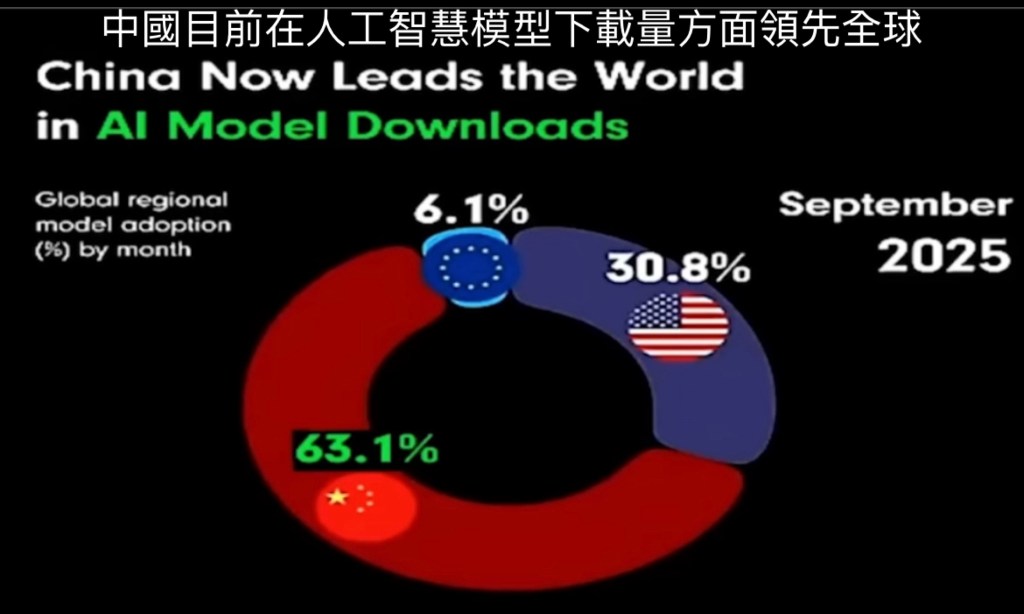
China now lead the world in AI models downloads. By Johnson Choi, Nov 21 2025 中國目前在人工智慧模型下載量方面位居世界領先地位. 作者: 蔡永強, 2025年11月21日
It highlighted a very significant trend in the global AI landscape. My statement is largely accurate, but it’s important to understand the nuances behind it.
Yes, China is a dominant force in AI model downloads, but this is part of a broader, more complex story.
Here’s a breakdown of what’s happening:
The Evidence: China’s Leading Position
The primary data comes from a Q1 2024 report by Hugging Face, a leading platform for the AI community. The report stated that Chinese institutions accounted for the largest number of downloads of AI models on their platform.
Some key highlights:
· Top Models: Chinese-made models like Qwen (by Alibaba), ChatGLM (by Zhipu AI), and Yi (by 01.ai) are consistently among the most downloaded. · Organizations: Chinese companies (Alibaba, Baidu) and startups (Zhipu AI, 01.ai) are rivaling American giants like Meta and Microsoft in terms of raw download numbers on the platform.
Why is This Happening? The Driving Forces
Massive and Active Developer Base: China has one of the world’s largest and most energetic communities of software developers and AI researchers. This creates a huge built-in audience for homegrown models.
Aggressive Open-Sourcing Strategy: Chinese companies have made a strategic decision to open-source their powerful models. This serves several purposes: · Rapid Adoption: It encourages widespread use and testing. · Ecosystem Building: It allows developers to build applications on top of these models, creating a sticky ecosystem. · Global Mindshare: It positions Chinese tech firms as major players in the global open-source AI community, challenging the perception of them being closed off.
Strong Government Support: The “Made in China 2025” initiative and other national strategies explicitly prioritize AI development. This provides funding, policy direction, and a sense of national mission.
Large, Self-Contained Market: China’s vast domestic market allows its AI models to be trained, tested, and refined on a huge scale without initially needing to compete globally. The focus is often on serving Chinese language and business needs first.
Intense Domestic Competition: The competition between tech giants like Baidu, Alibaba, and Tencent (BAT), as well as agile startups, fuels a rapid pace of innovation and release.
The Bigger Picture: Downloads vs. Foundational Leadership
While download numbers are a crucial metric of adoption and influence, they are just one piece of the puzzle. The global AI race has several fronts:
· Frontier Model Development: The US still holds a lead in developing the most powerful, cutting-edge “frontier” models (like GPT-4, Claude 3, etc.). The sheer scale of compute and R&D investment by companies like OpenAI, Anthropic, and Google is immense. · Hardware and Semiconductors: This is the most critical chokepoint. The US, through companies like NVIDIA and its export controls, maintains a dominant position in the AI chip (GPU) market. China’s ability to advance is closely tied to its success in developing domestic alternatives (e.g., by Huawei) which still lag behind. · Real-World Application: Both the US and China are leaders in applying AI. The US excels in software and cloud services, while China has a strong lead in areas like surveillance, facial recognition, and fintech applications.
Conclusion
China is indeed the world leader in downloads of AI models, which is a testament to its vibrant developer community, savvy open-source strategy, and massive domestic market.
However, the overall AI leadership is more fragmented. Think of it as:
· United States: Still leads in foundational research and development of the most powerful frontier models and controls the critical hardware supply chain. · China: Leads in mass adoption, application, and open-source dissemination of powerful (if not always the absolute most cutting-edge) models.
This makes the AI landscape a true “two-horse race,” with each superpower excelling in different, but equally important, aspects of the technology. The high download figures from China signal a major shift in influence and a future where the global AI ecosystem will be deeply shaped by Chinese models and innovations.
Internet and mobile phone fees: Just arrived back from Honolulu, time difference and slept on the plane don’t feel like going to bed.
I look at my internet bill at our home in HK discovered that I am paying HK$150/month. The internet bill in SF also $150/month but in US$ which is 7.7x more expensive.
I further look at my mobile phone fee in HK with 2 lines, the HK and China lines, costing me HK$118/month. The same 2 lines in SF costing me US$110 per month, but in US$ which is 7x more than HK.
Do you guys now know what is purchasing price parity?
US rank#1 in the world in term of GDP is really BS. What make it worst in US, accounting fee, attorney fee, rental payments etc are counting and adding to US’s GDP. In reality what have they produced? China don’t count it. Therefore what is included in the GDP difference by country.
I spent an hour on the plane watching YouTube by KOL eating, buying stuffs and traveling in China. These KOL from HK decided to live in Shenzhen, Zhuhai or Zhongshan. Their dollars buying power immediately increase by 1-2x compared to HK pricing. Housing cost is 1/8 of HK. Visiting doctors at Shenzhen’s hospital managed by HKU is better and medicine cheaper. Do you know the average age of the 21 million people living in Shenzhen is 34 years old? How many 34 years old sees doctor? Therefore you will see most of the patients visiting the Shenzhen hospital run by HKU are from HK.
China is now promoting 10-20 minutes living circle. What does that mean? From where you live, the walking distance to market, restaurant, hospital and shop stay within 10-20 minutes in 1st 2nd and 3rd tiered cities.
Do you know all public transportation including high speed trains are not meant to make money in China? Despite not making money, it is the most well maintained and clean transportation in the world! Why? Beijing believes in transportations are meant to be for the people and not a tool to get rich quick.
I suggest everyone here to live in China 1-6 month to see for yourself.
All those not for profit, your children, your grandchildren etc. Hey I have that too. In fact last 35 years, I spent an average of 40 hours/week of my time on non-profit and 40 hours/week on making money to support my family. I have children and grandchildren. All of these never stopped me to enjoy life spending my time in HK/China on Christmas and New Year! What? should spend it with our children and grandchildren? are you kidding? Don’t they have a life?
What exactly are we afraid of when confronting history?
Today, I want to discuss a little-known story from the past—a “what if” that could have altered the course of China’s modern destiny.
In 1886, the Beiyang Fleet was at the peak of its power. A British instructor named William Lang made a bold suggestion to Admiral Ding Ruchang.
Having seen through the brutality of the law of the jungle, he proposed that the Chinese navy should take decisive action at that very moment to completely suppress potential adversaries.
However, the Qing Dynasty’s adherence to “benevolence” and “saving face” led to the rejection of this proposal.
The outcome, as we all know, was this: we upheld martial virtue, but our对手 did not.
Eight years later, the First Sino-Japanese War broke out. The Beiyang Fleet was utterly destroyed, and the Chinese nation plunged into a half-century-long period of darkness.
Your benevolence is often nothing but a joke to the enemy.
In this world where the weak are prey to the strong, true “inclusiveness” does not mean unconditional tolerance. Instead, it requires the courage to learn from the mindset of the strong—even if it is the mindset of a “wolf.”
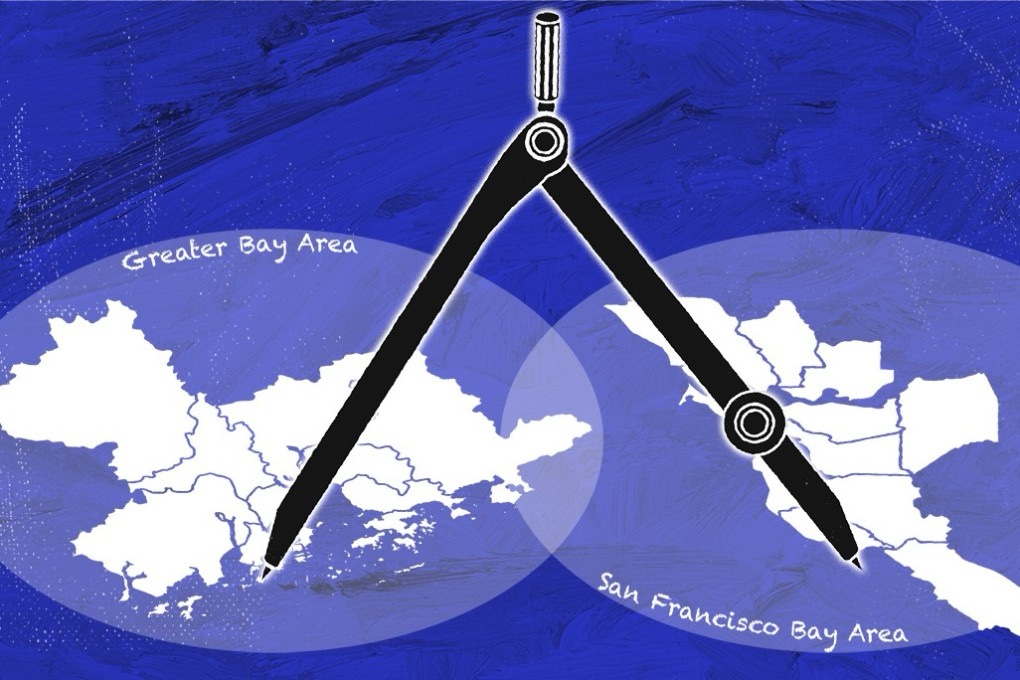
I really enjoy her videos; she travels all over the Greater Bay Area eating out. She must be minimum from an upper middle class family. She moved from Hong Kong to the China Greater Bay Area and enjoys life to the fullest. Today, China is advanced, safe, a paradise for eating, drinking, and having fun, and the prices are only one-third of those in the US! If you had three million US dollars, your spending power would be equivalent to twelve million in the US. You could retire like an emperor right away, and you could retire at eighteen. 很喜歡她的視頻,到處到大灣區吃東西,應該是有錢女,她從香港搬到大灣區,天天享受人生. 今天中國先進,安全,吃喝玩樂天堂,而且價錢是美國的1/3!. 如果拿著三百萬美元,消費能力等於美國一千二百萬,可以皇帝式的馬上退休,十八歲也可以退休了. https://youtu.be/mgVMHWBoSdA 🇨🇳👈👌
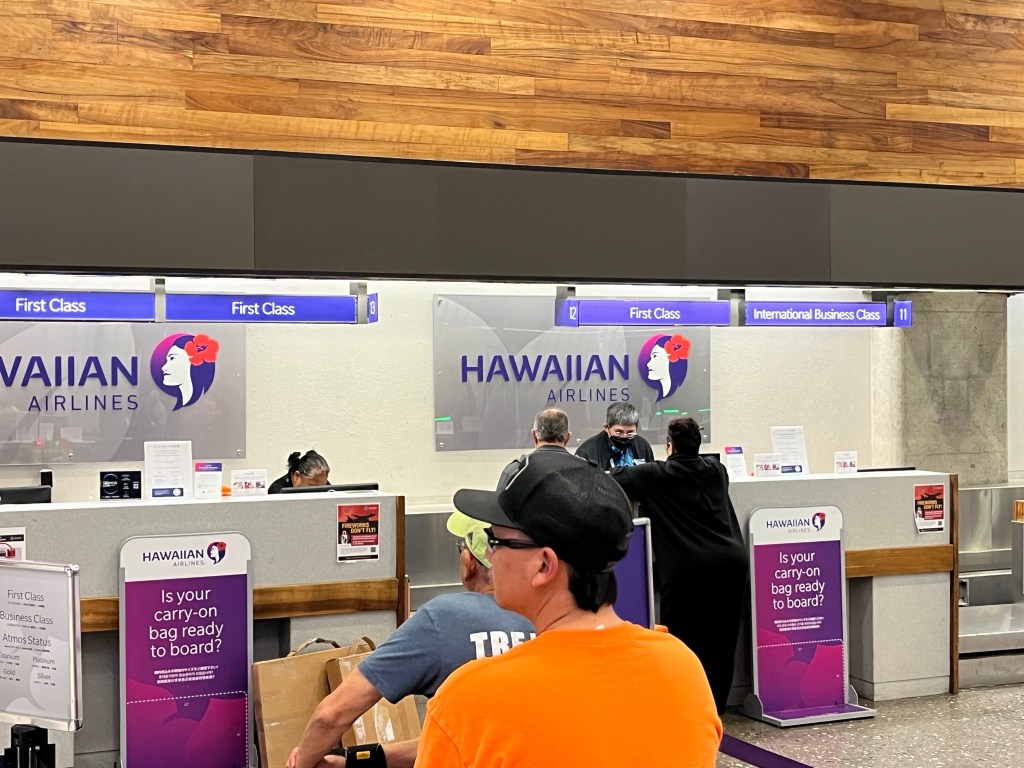
Hawaiian Airlines 1st class check in, 1 working 1 watching, 13 people in line! the older gentleman right behind me, I overhead he called his friend said he is going to miss his flight! 1st Airfare, 3rd class service. Airlines in US, the services worst than any budget airlines in Asia!
Video with English subtitles: I am very curious, do Hong Kong people have an inexplicable sense of superiority over mainland Chinese? 影片有英文字幕: 我很好奇,香港人是否有一種莫名其妙的優越感? 索羅斯在1998年集結全球財富狙擊香港, 面對滅頂危機時,如果祖國沒有岀手, 香港已經玩完,何來經濟繁榮!
Hong Kong hotels ‘actions to lick foreigners and discriminate against compatriots will show you the true source and collapse of Hong Kong people’s “sense of superiority” behind this!
The core highlights of this issue:
A record of hotel discrimination: “Strike hard” to mainlanders and “smile like chrysanthemum” to foreigners? Why is the card of shame broken by Bruce Lee picked up by some Hong Kong people?
Battle for National Fate: How did Soros gather global wealth to kill Hong Kong in 1998? Faced with disaster, how can Premier Zhu Rongji and the central government fight “at all costs” to win this thrilling financial defense battle and lay the foundation for today’s prosperity?
Wealth Code: What does Hong Kong’s prosperity depend on? Is it the “Lion Rock Spirit” or the market dividend for more than one billion people in the mainland? Why did Hong Kong’s economic status begin to waver when China opened up?
Historical truth: From an opium warehouse to a financial center, every take-off in Hong Kong is inseparable from New China’s “long-term plan and full utilization”. Why do we do everything we can to protect Hong Kong?
Hong Kong and the mainland are connected by blood and are both China.
How can they be noble and humble? After watching the video, you will understand that we have the confidence to stand upright and be a person! Don’t bow to outsiders and treat your own people coldly!





 Business Blog