Is your money in your US bank safe 你存錢的美國銀行還安全嗎?

Is your money in your US bank safe 你存錢的美國銀行還安全嗎?
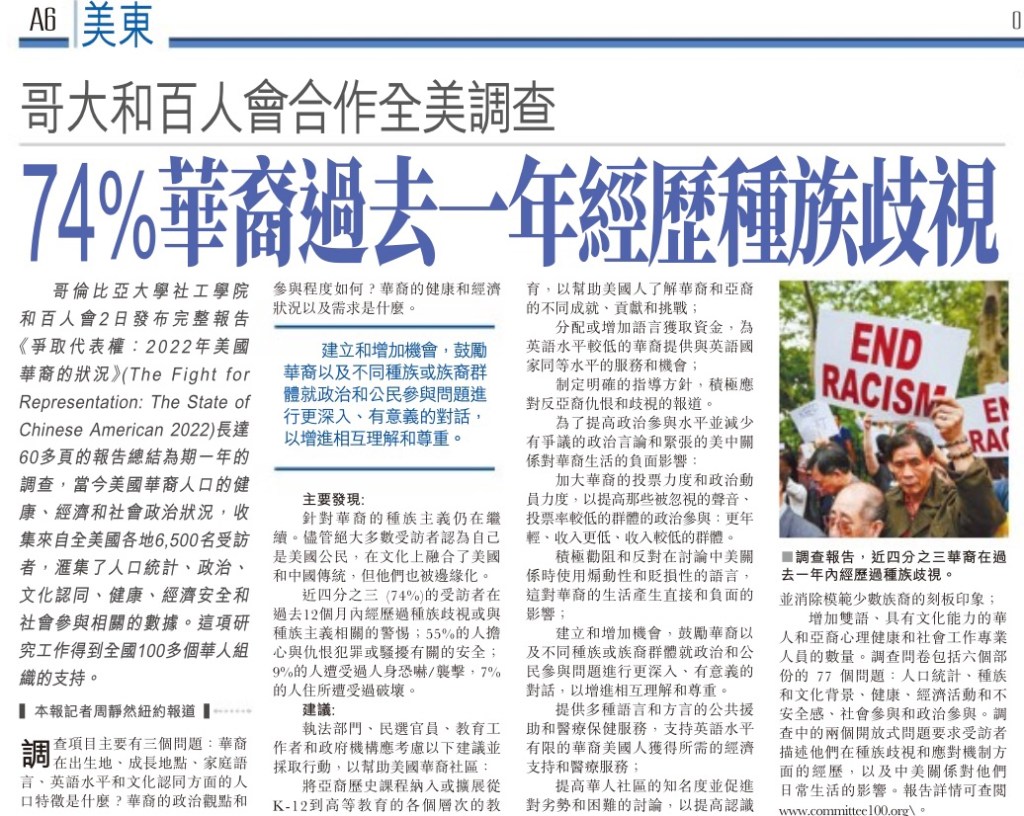
Columbia University Surveys: US $300 millions/yr budget to demonize Chinese & China effective, 74% Chinese Americans experienced discrimination last 12 months 哥倫比亞大學調查:每年3億美元妖魔化華人的預算有效,74%的華裔美國人在過去12個月經歷過歧視
China Was the World’s Biggest Economic Miracle and It Will Be Again 中國曾是世界上最大的經濟奇蹟,而且還會再次出現 By David P Goldman July 31 2023
According to the World Bank, China’s real per capita GDP rose from $404 in 1979—the year Deng Xiaoping opened the economy to private enterprise—to $11,560 in 2022 in constant 2015 U.S. dollars. It jumped five-fold since 2001. By contrast, India’s real per capita GDP rose from $373 in 1979 to just $2,085 in 2022. By comparison, you can see what a success story China has been, one unique in economic activity.
This is not to say Deng’s trajectory is still at play. Deng Xiaoping’s economy, which turned subsistence farmers into semi-skilled industrial workers, surely has peaked. The great migration from country to city is slowing, and China’s workforce is slowly shrinking.
But China is building a new digital economy powered by AI and high-speed broadband, with 2.3 million of the world’s 3 million 5G base stations and download speeds double ours. It has automated ports that can empty a container ship in 45 minutes rather than the 48 hours required at our port of Long Beach. It’s also automated mines where no worker goes underground, factories controlled by AI, and warehouses in which robots do the sorting and packaging.
Most of all, nearly two-thirds of Chinese citizens have an education beyond high school, compared to just 3 percent who had one in 1979. China graduates more engineers than the rest of the world combined, and Chinese universities teach at world standards.
China has also extended its economic reach to developing economies. It now exports more to the Global South than to developed markets, doubling its exports to ASEAN and tripling its exports to Central Asia after 2020. It builds broadband, railroads, and ports from Africa to South America, promoting a permanent market for its exports.
China’s new digital economy is in early days, to be sure, and a lot can go wrong. But some things are going right. China overtook Japan as the world’s largest auto exporter this year, thanks in part to Tesla’s mega-plant in Shanghai. China now makes the 21st century equivalent of the Model T in the form of EVs with a $10,000 price tag.
Demographic doomsayers are simply wrong. A declining workforce doesn’t necessarily mean a declining economy. South Korea quintupled industrial production between 1990 and 2010 while its factory workforce fell by a fifth. It moved up the value-added chain to make high-end electronics, cars and computer chips. Higher education transformed South Korea from a cheap-labor venue to a high-tech contender.
China is on the same path. In 1994, just before the “Asian tigers” took off, Nobel Laureate Paul Krugman derided “the myth of Asia’s miracle,” claiming that the “tigers” had exhausted their reserves of cheap labor. He missed the jump in productivity to come, just as “peak China” pundits do today.
China is determined to lead the Fourth Industrial Revolution. The Chinese telecom giant Huawei claims to have 6,000 contracts to build enterprise 5G networks to support factory AI applications, as I reported in a March commentary for Newsweek. Huawei offers a Cloud-based AI system to enable firms to create their own applications. China is now the world’s largest market for industrial robots. If what we have already seen in the EV sector propagates through the rest of the economy, China will gain an insurmountable lead in industry. U.S. tech controls don’t have much impact. Industrial applications of AI run well enough on the older chips that China makes at home. Without access to the newest chips, Huawei can’t sell a competitive 5G smartphone, but its AI apps can run factories, ports, and mines.
China has made missteps, to be sure. Last year’s COVID lockdowns in Chinese cities were a blunder that continues to depress consumer spending. Beijing’s crackdown on China’s top tech companies has left China’s stock market lagging the rest of the world, and raises the cost of capital for China’s emerging tech companies. China’s universities are graduating STEM majors faster than the tech sector can hire them, and youth unemployment is at a record 21 percent. In the long run, that’s a high-class problem to have. In the short run, it’s painful.
Predictions of China’s imminent collapse, though, are as misguided now as they were 20 years ago. China’s debt-to-GDP ratio is 3:1, a bit higher than America’s 2.5:1 ratio, but much lower than 4:1 in Japan. The Chinese sovereign borrows 10-year money at 2.6 percent, compared to 4.1 percent for the U.S. China’s local governments carry RMB about $5 trillion in debt, but they have almost $30 trillion in assets behind it.
We can’t afford to get the China story wrong again. China may succeed or fail in its high-tech transformation, but waiting for China to crash isn’t a policy. We need a crash program to rebuild industry and regain our technological edge, on the scale of JFK’s Moonshot or Reagan’s Strategic Defense Initiative.
David P. Goldman is Deputy Editor of Asia Times and a Washington Fellow of the Claremont Institute. He formerly was global head of debt research at Bank of America.

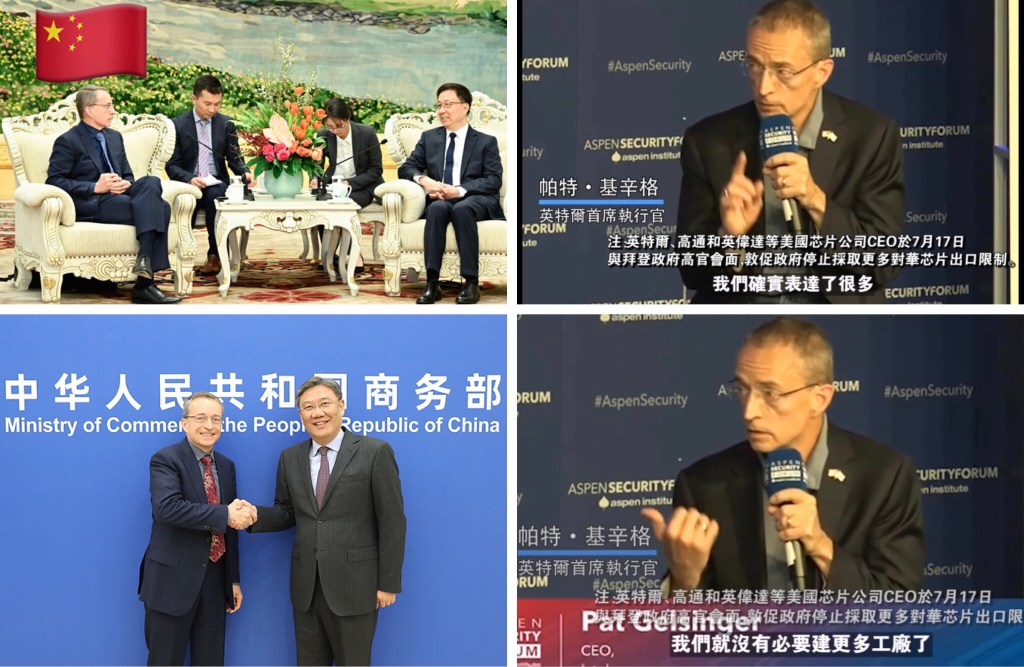
Intel CEO video: Giving up the world’s fastest growing Chinese market is equivalent to giving up 1/3 of revenue really stupid 英特爾行政總裁: 放棄全球增速最快的中國市場等於放棄三分之一收入真笨
https://rumble.com/v34iy7j-intel-ceo-giving-up-chinese-market-really-stupid.html
https://www.tiktok.com/t/ZT8LkJ1Cr/
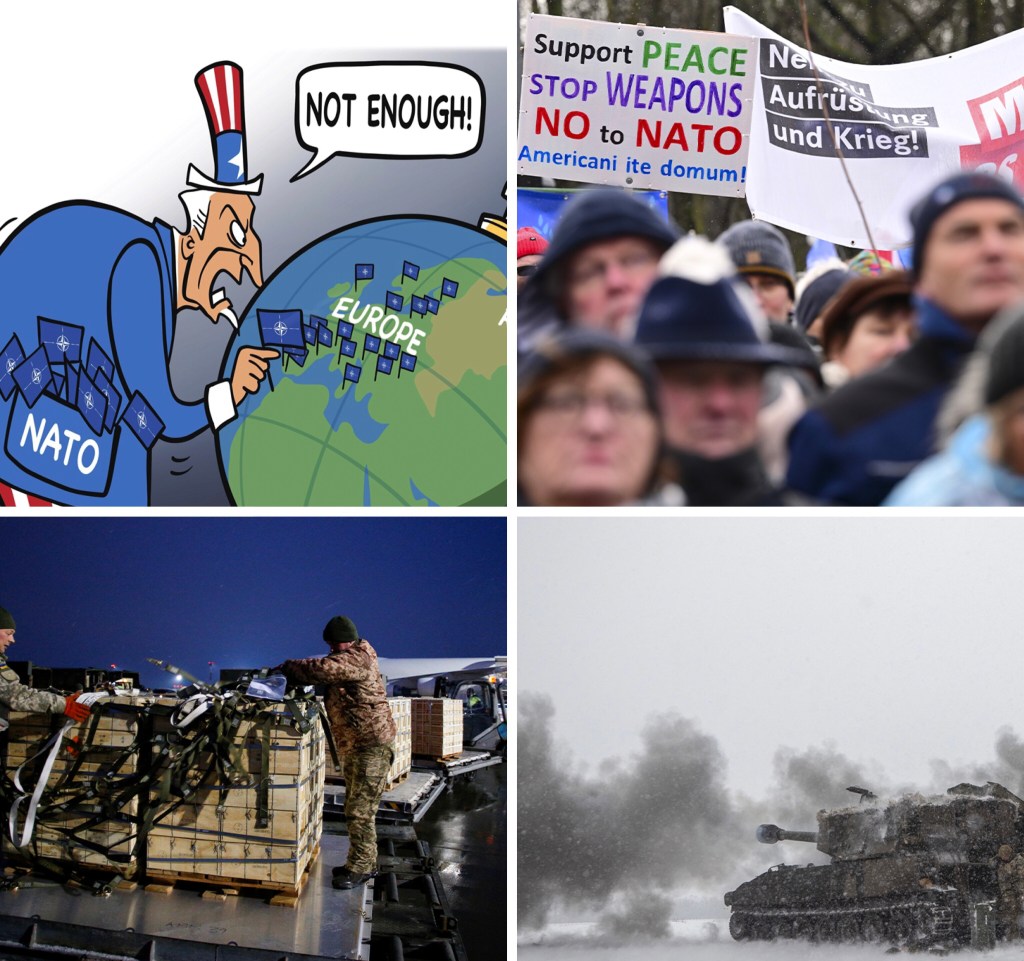
GT Investigates: How much have US ‘Big Five’ weapon manufacturers gained from arms sales to Ukraine? By Huang Lanlan Aug 03 2023
The Biden administration’s approval of the transferring of cluster munitions to Ukraine has sparked widespread criticism and worry. While the bombs, along with the numerous deadly weapons the US and its Western allies have provided to Ukraine, put civilians and children there in grave danger, their manufacturers are probably busy counting money they’ve made from the Russia-Ukraine crisis while hoping that the conflict doesn’t end any time soon.
War is “good for business,” a recruiter for BlackRock told the O’Keefe Media Group in June, acknowledging how such turmoil can create opportunities for profit. BlackRock is one of the world’s largest asset management company and holds shares in several defense industry enterprises.
The recruiter’s words exposed the fact that Ukraine has unfortunately become a gold mine for the US military-industrial complex (MIC). Having seldom bought weapons abroad before the crisis, Ukraine became the world’s third biggest arms importer in 2022, ranking fifth among the US’ main arms export destinations, according to data from Statista.
It’s hard to know exactly know how much money have flowed from the Ukraine frontline into the pockets of US weapon manufacturers. But the Global Times found that most of the MIC giants in the US have enjoyed an income surge or (and) market value increase amid the Russia-Ukraine conflict.
The US is the biggest beneficiary of the conflict. By utilizing proxy war between Russia and Ukraine, the US continues to consolidate its geopolitical interests in Ukraine, and its military industrial enterprises make huge profits by selling weapons, said Yuan Zheng, a research fellow and deputy director of the Institute of American Studies at Chinese the Academy of Social Sciences.
“The US doesn’t seem to mind the weapons bringing great loss and safety hazards to Ukraine and the rest of the world,” Yuan told the Global Times.
A fruitful year
The US used to have dozens of defense contractors before the post-Cold War merger boom. Nowadays, there are only five MIC giants that jointly dominate the US’ huge arms industry – Boeing, General Dynamics, Lockheed Martin, Northrop Grumman, and Raytheon.
The “Big Five” alone routinely split more than $150 billion in Pentagon contracts annually, or nearly 20 percent of the total Pentagon budget, said an article published by The Nation in May.
Ongoing Russia-Ukraine crisis has brought the “Big Five” even more contracts. Lockheed Martin, for instance, won a $4.8 billion deal from the US Army for Guided Multiple Launch Rocket Systems, which “the US has sent in large numbers to Ukraine,” reported Defense News in April.
Previously, the US Army had awarded Raytheon Missiles and Defense a contract worth “as much as $1.2 billion” to “deliver six National Advanced Surface to Air Missile System batteries for Ukraine,” Defense News said in December 2022. In the same month, website Defense One quoted Greg Hayes, CEO of RTX (Raytheon), as saying that the company expected some $2.5 billion in replenishment weapons deals “over the next 12 months.”
The disastrous year of 2022 was a fruitful one for the US MIC. Except for Boeing’s market value shrinking because of its alleged “supply chain problems,” the other four companies in the “Big Five” all increased by more than $10 billion in annual market value – Northrop Grumman added $16.4 billion, Lockheed Martin $16 billion, Raytheon Technologies $14.8 billion, and General Dynamics $10.8 billion, the Global Times found.
Except Boeing, the four aforementioned giants enjoyed good stock market performance in 2022. The share prices of Northrop Grumman, General Dynamics, Lockheed Martin, and Raytheon Technologies respectively grew by 37 percent, 26 percent, 24 percent, and 17 percent in that year.
The future looks promising as well for the US MIC, as the US House and Senate recently approved the 2024 National Defense Authorization Act, which earmarked a record $886 billion in spending. Some media sources predicted that almost half of the money will go to the arms manufacturers, so that the US government can “sustain its military advantage over China” and pay constant attention to the Russia-Ukraine crisis.
The Russia-Ukraine crisis is “a huge profit center for the big companies: Lockheed Martin and Raytheon and Boeing,” says William Hartung, a senior research fellow at the Quincy Institute for Responsible Statecraft (Quincy Institute), where he focuses on the global arms trade and Pentagon spending. “At the moment, I think they’re riding the wave,” he told nonprofit news organization Analyst News in May.
Lobbying for profits
The US MIC continues to profiteer from the Russia-Ukraine conflict as it heads into its second year. The country’s weapons and defense contractors reportedly received nearly half – $400 billion – of the $858 billion earmarked in the 2023 defense budget.
It’s not a secret that to put more money into its pockets, US arms industry has maintained deep connections with the country’s government officials and opinion leaders through several ways, such as funding lobbyists and think tanks and hiring former government officials through the “revolving door” of the government lobby industry.
Through various lobbying measures, the US weapons industry has acquired more “tools of influence” over the government, the Analyst News quoted Hartung as saying.
An interesting phenomenon that’s emerged during the conflict is that some famous lobbying companies are representing Ukraine pro bono, pushing for greater US military support for the Ukrainian military.
Behind their so-called humanitarian care excuses for “aiding” Ukraine are some lobbying firms with obvious financial incentives – they also have arms manufacturers as clients.
In an article published in The Guardian titled They’re lobbying for Ukraine pro bono – and making millions from arms firms, the authors mentioned a lobbying and communications firm called BGR Government Affairs (BGR), which started working pro bono for Ukrainian in May 2022. And earlier in February, a BGR adviser was publicly calling for increased military aid to Ukraine in the face of Russia’s recognition of the Luhansk and Donetsk People’s Republics as independent states.
A probable main reason behind BGR’s enthusiasm is that lobbying for increased military aid to Ukraine benefits its arms manufacturing clients, which will eventually be beneficial to BGR itself. Raytheon, for instance, paid BGR $240,000 to lobby on its behalf in 2022, according to The New York Times.
Driven by private interests, there has been a surge in pro-bono Ukraine lobbying since the conflict erupted. Media sources reported that 25 foreign lobbying and consultant companies have agreed to represent Ukrainian interests pro bono. The number was only 11 before the crisis.
Funding think tanks is another method by which the US MIC amplifies its voice. A report released by the Quincy Institute in June found that of the 27 think tanks in the US whose donors could be identified, 21 received funding from the defense industry, accounting for 77 percent of all funding.
The Quincy Institute report also found that US media outlets “disproportionately rely on” commentary from the defense sector funded think tanks. It said that in articles related to the US military’s involvement in Ukraine, media outlets have cited these think tanks seven times as think tanks “that do not accept funding from Pentagon contractors.”
The “revolving door” mechanism also has a hand in the flow of high-level employees from the defense departments of the US government to the private arms contractors and vice versa.
The perpetually spinning “revolving door” provides current members of Congress, their staff, and Pentagon personnel with a powerful incentive to play nice with said giant contractors while still in government, said The Nation. “After all, a lucrative lobbying career awaits once they leave government service,” it noted.
Nearly 700 former high-ranking government officials in the US now work for defense contractors, including former generals and admirals, revealed a report released by the office of Senator Elizabeth Warren in April. Boeing, Raytheon, and General Electric respectively hired 85, 64, and 60 former government officials as their high-ranking executives or lobbyists, according to the report.
World security risk
The US’ continued transfer of weapons to Ukraine favors the Zelensky and Biden governments as well as the US MIC. Nonetheless, the steady flow of numerous deadly weapons and AI-tech equipment and systems into Ukraine, may pose a serious threat to the security and privacy of Ukrainian people in the long term, military experts warned.
At least 38 human rights organizations have publicly opposed the transfer of cluster munitions to Ukraine, where the weapons have already been used in the conflict with Russia to devastating effect, reported US media.
Cluster bombs are banned by more than 100 countries for the huge security risk they may bring in the long run. “Cluster bombs remain as explosive hazards for decades, and are likely to cause more innocent casualties in the future,” Yuan told the Global Times. “Russia and Ukraine may have to face the troubles of the bombs for long.”
Moreover, with an increasing number of weapons being sent to Ukraine, people found that many of the weapons have trickled into the local black market, said Yuan.
“That will be bring great uncertainty to the security of Ukraine and even the whole world, as no one can’t guarantee that the weapons won’t fall into the wrong hands,” he noted.
Sadly, with the “geopolitical tension” hype from numerous lobbyists, think tanks, and the media, the US military departments and industry jointly keep pouring oil on the flames of the ongoing Russia-Ukraine conflict. And they will continue to increase tensions on the international stage and demonize “rivals” like Russia and China, so as to secure higher military profits, said some international relations observers reached by the Global Times.
The size of the US military and its arsenal are beyond what are needed to keep any country safe and maintain world peace, said Zhang Jiadong, a professor at the Center for American Studies at Fudan University.
The great importance the US attaches to the military industry will unfortunately lead to an even more intense arms race, and destabilize the already fragile relations between the great powers, Zhang said. “That puts world peace and stability at risk,” he told the Global Times.
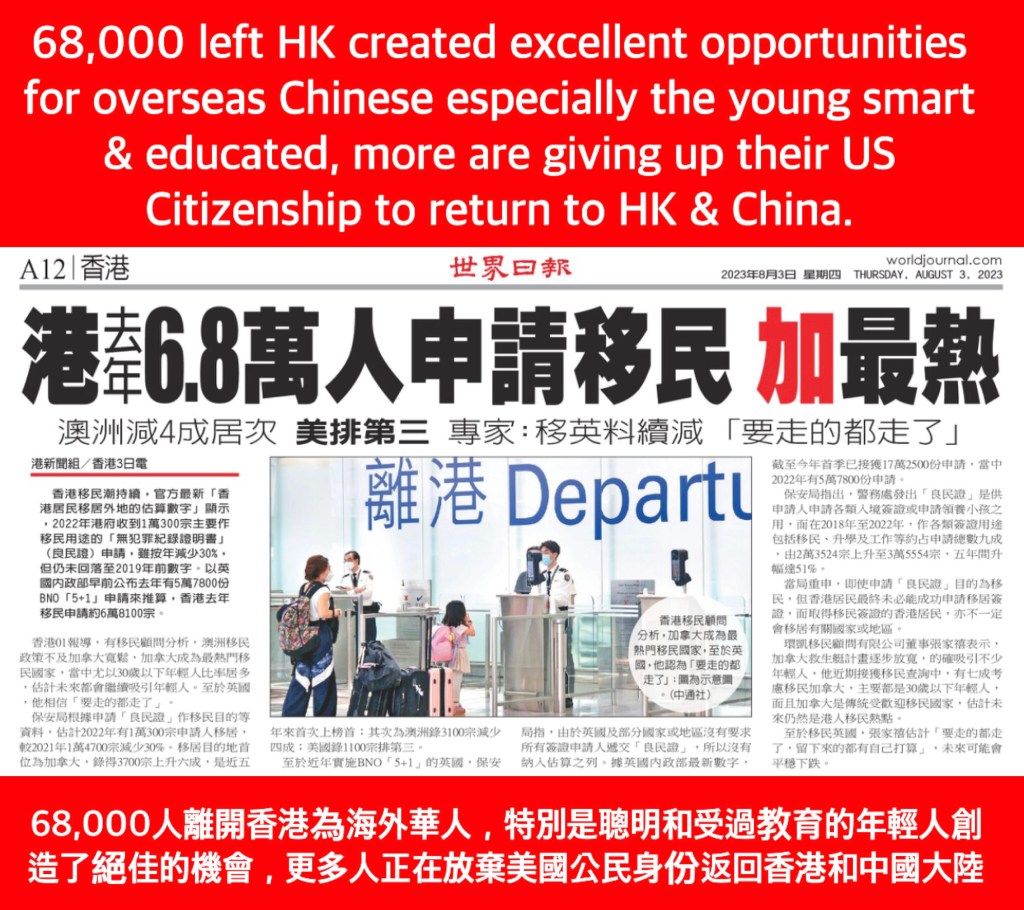
68,000 left HK created excellent opportunities for overseas Chinese especially the young smart & educated, more are giving up their US Citizenship to return to HK & China. 68,000人離開香港為海外華人,特別是聰明和受過教育的年輕人創造了絕佳的機會,更多人正在放棄美國公民身份返回香港和中國大陸
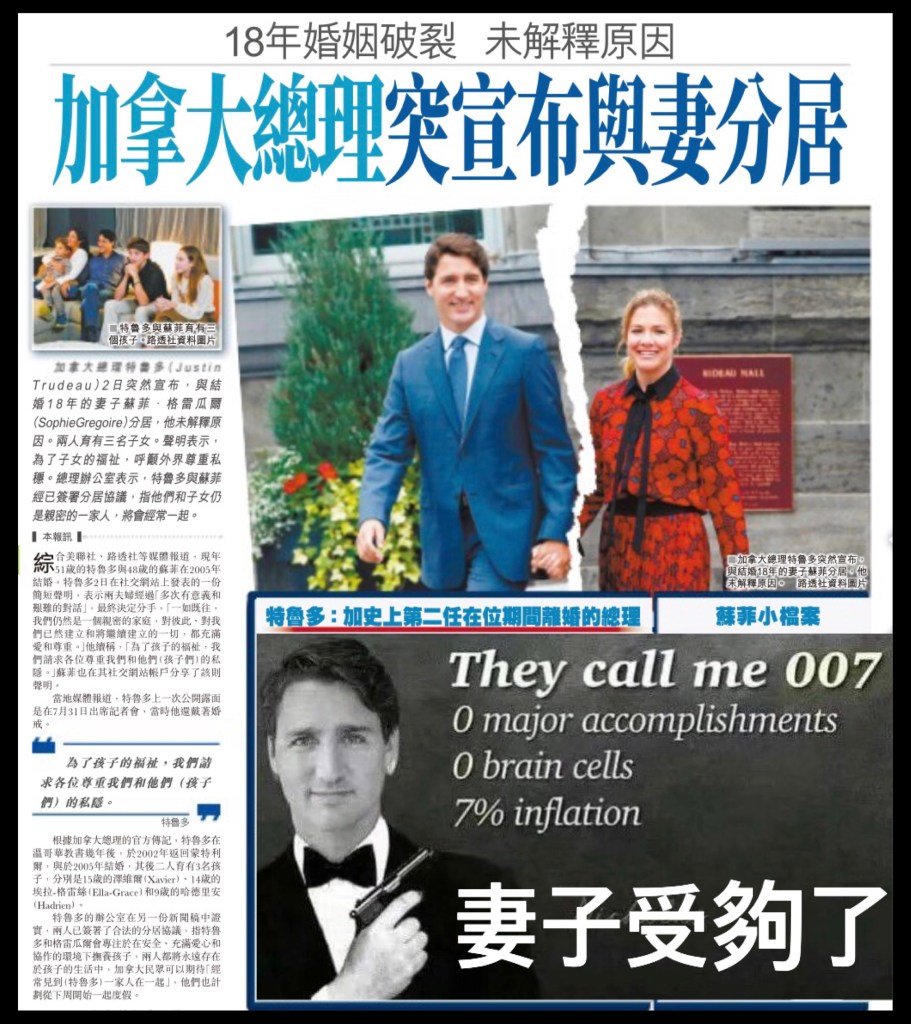
Trudeau wife call it quit for obvious reasons 特魯多妻子和他分居的原因顯而易見
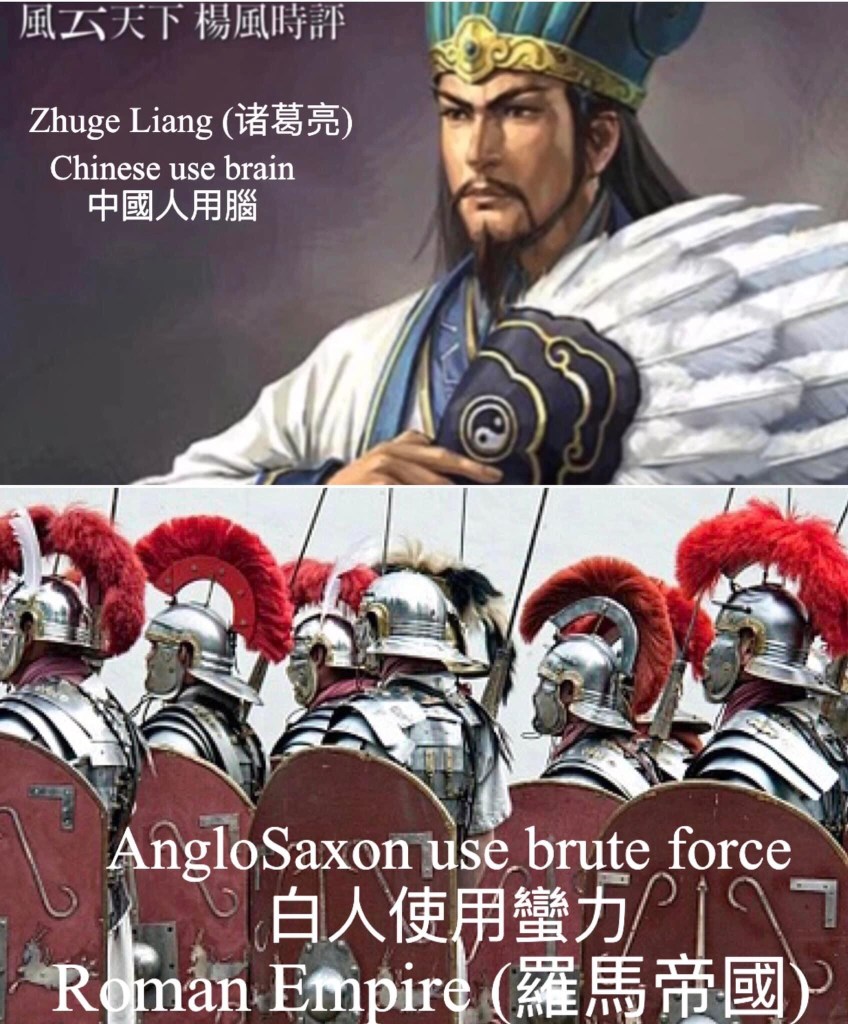
The Civilized verses the Barbarians. Chinese use brain, AngloSaxon like Roman Empire, US & EU use brute force. China still here after 5,000 years, but Roman Empire is long gone. Cool minded and rational war decision – Sunzi: leader should not start a war because of a moment of anger, and a general should not cause a war because of a moment of resentment. From Sun Wu’s “The Art of War: Fire Attack” in the Spring and Autumn Period. 中國人🇨🇳和西人🇺🇸的分別. 白人像羅馬帝國,美國和歐盟祗會使用蠻力. 5000年後中國還在, 但羅馬帝國早已不復存在. 孙子兵法 : 火攻 – 主不可以怒而兴师,将不可以愠而致战; – 中国哲学书电子化计划
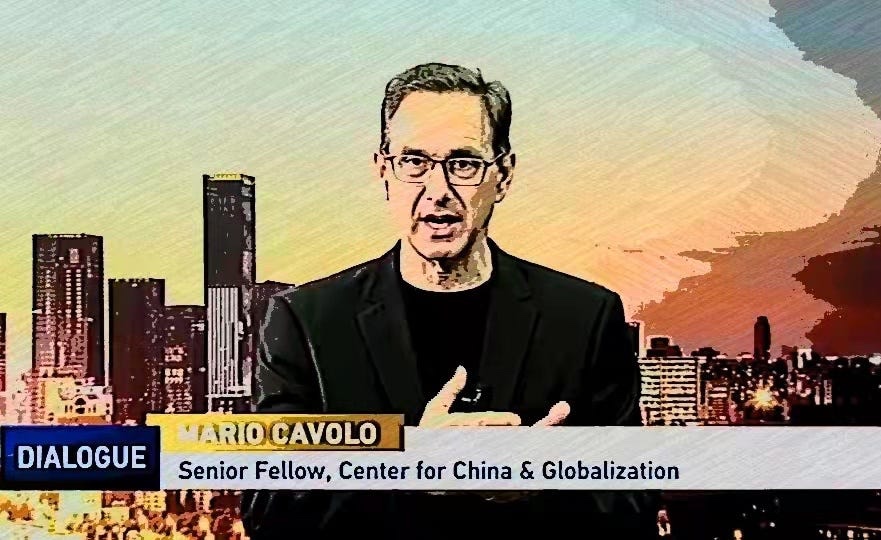
China Update – August 2nd by MARIO CAVOLO AUG 3 2023
Pardon my lack of posts recently, we are on summer holiday currently visiting family in the United States. This is our first time back visiting in over four years and we are having a wonderful time especially reconnecting with the family. It’s important to note that we are on a daily basis here exposed to upper middle class society here and it’s terrific. People are very friendly, the environment around us is very clean and safe American style. Of course it is. If you have money, if you have a high paying job, life in america is quite nice. Expensive, too. It is more obvious than ever the country is split into 2 completely separate societies. It is obvious low income people are struggling And we have caught some glimpses of that along the way.
While on holiday I have been keeping up with the China news feed and it remains as frustrating as ever With the US government, mainstream media and certain other media and public voices constantly presenting a false dark view of China to the world, nothing new.
China is now and without a doubt the largest safe stable and successful capable civil and peaceful country in the world. It didn’t get that way by infringing on people’s rights or oppressing anyone. It got that way remarkably fast in around 25 years by improving the lives of more people in less time than any other country has ever done on earth, by providing hundreds of millions of people more than ever with an entirely safe stable low violence low crime gun free decent middle class society to live. I know because for the past 24 years I’ve been here. I’ve lived it, I married into a local family. I’ve watched it, i’ve witnessed it and i’ve been part of it every step of the way including constant researching and writing about what was happening along the way.
Society TODAY is my focus and my priority and Chinese society today has virtually NONE ZERO ZIP of the nasty societal problems found in today’s United States and other failing neoliberal states which cause people to feel fear and despair in their daily lives.
There is little about US / western society and government that is in any way objevtively better or superior to the way China’s society and government operates. China’s current govt is far superior to the current US govt at doing what govts are supposed to do, responsible governance for the economy and society. This has been the case for well over 20 years and it is deeply disturbing to find the US still claiming it is superior, attacking and lying about China’s success, instead of taking care of its own problems for its own citizens.
Finally, China hasn’t started a war, attacked or bombed any other country in almost half a century so they’ve accomplished all of this rising to superpower status in peace, without killing millions of other innocent people all over the world in order to gain what power and control and influence they have across the world. China’s military built up with respect to Taiwan is strictly defensive to protect its rights sovereignty and the long standing agreements currently in place. As you have probably read in my previous articles, I am more firm than ever in my view that there will not be a war with China over Taiwan.
That my friends, is the straight up, accurate, sober, realistic view of the situation which I offer for your consideration.
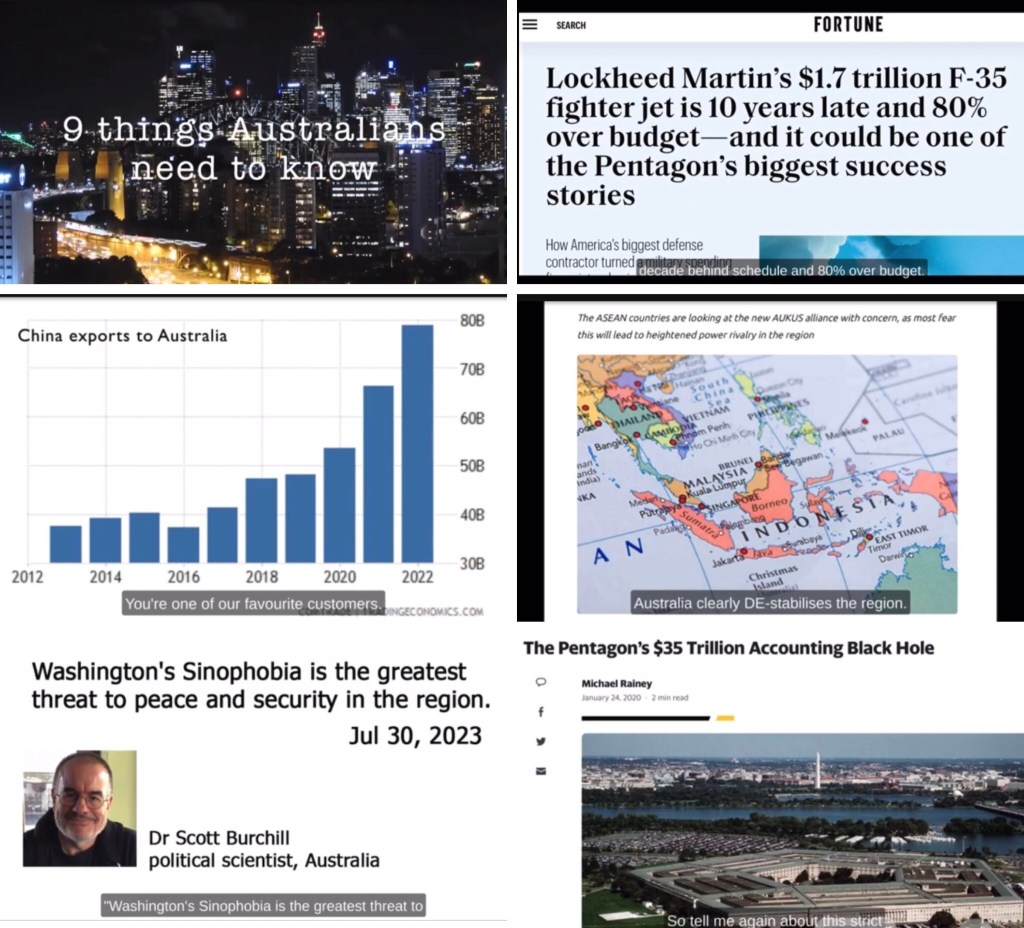
Video: 9 things Australians are not being told about US military deal 視頻:澳大利亞人沒有被告知有關美國軍事協議的 9 件事
https://rumble.com/v349i4x-9-things-australians-are-not-being-told-about-us-military-deal.html
https://www.tiktok.com/t/ZT8LYTxwT/
No, the astonishingly expensive tie-up between Australia and the US military deal is NOT about defense of the country, nor is it about bringing stability to Asia. The opposite is true, and Asians know it. The Australians stand to lose a great deal, not just in terms of money, but in the great relationships that they have built with the rest of Asia over many decades, and in the world’s understanding of the Australian character. 不,澳大利亞和美國之間的軍事協議代價驚人,並不是為了保衛國家,也不是為了給亞洲帶來穩定。 事實恰恰相反,亞洲人也知道這一點。 澳大利亞人將損失慘重,不僅在金錢方面,而且在他們幾十年來與亞洲其他國家建立的良好關係方面,以及世界對澳大利亞性格的理解方面.
 Business Blog