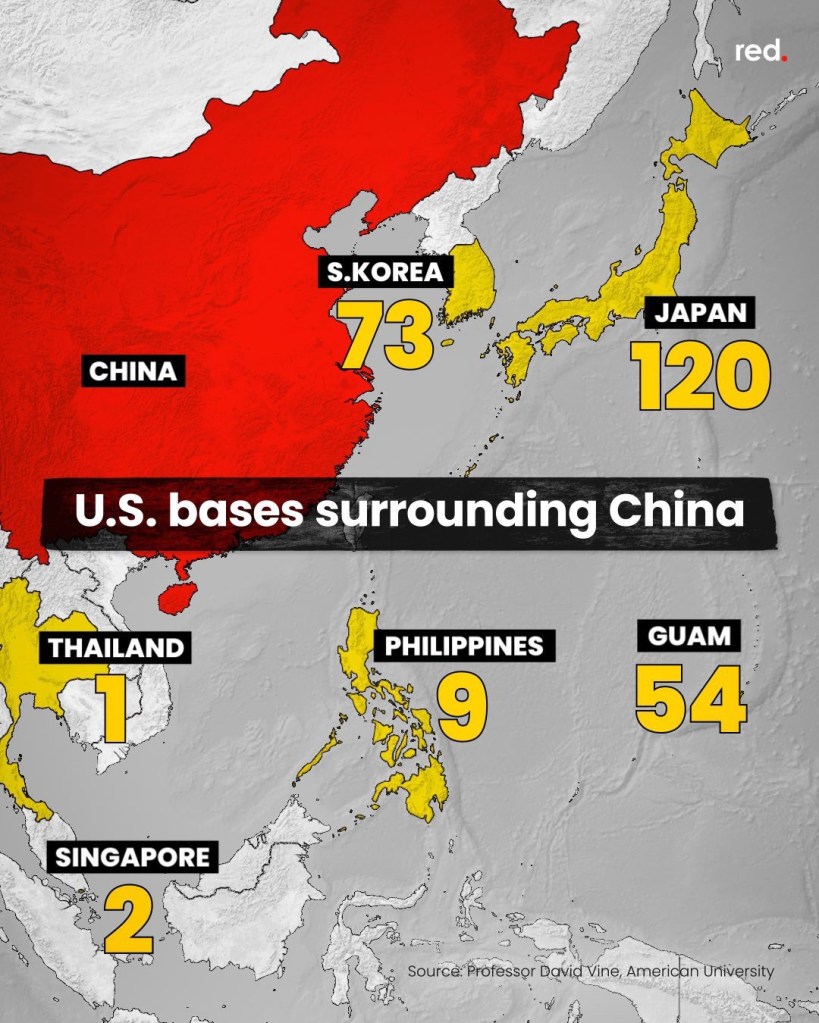
Map of colonies and vassals of the American Empire in South China Sea. 300+ US military bases surrounding China. Why? 美帝國在南中國海的殖民地和附庸國地圖。 中國周邊有300多個美軍基地。 為什麼?
China is the only country that can compete with the US in technology and economic heft.
If you don’t allow Raytheon, JP Morgan, Pfizer and CNN to monopolize your country, American missiles will deliver freedom and democracy.
But now China has its own multipolar missiles to deliver a strong message to American cities.
But globalists think they can have a controlled WW3 — sort of like what’s happening in Ukraine, where the US/NATO are attacking Russia indirectly.
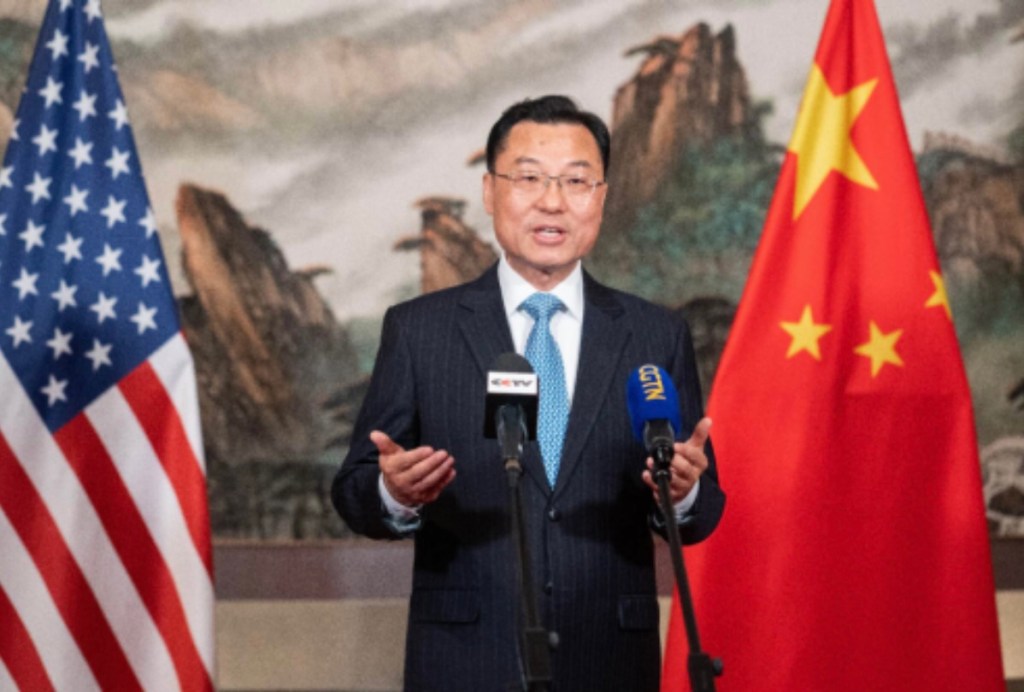
Selling out Taiwan is Despicable, Seeking “Independence” Will Fail — Spokesperson of the Chinese Embassy in the United States Refutes Lai Ching-te’s Egregious Op-ed at the Wall Street Journal
On July 5, Lai Ching-te had an Op-ed published by the Wall Street Journal. He propagated his so-called “four pillars”, a gloss-over of his despicable trade of selling out Taiwan to the United States. Liu Pengyu, the Spokesperson of the Chinese Embassy in the US has sent a Letter to the Editor, which was published by the WSJ on July 18
The letter reads as follows:
To show his loyalty to his American patron, Lai Ching-te, the lead candidate of the Democratic Progressive Party (DPP) for the 2024 local elections of China’s Taiwan region, presents “four pillars” to sell out Taiwan to the U.S. (“My Plan to Preserve Peace in the Taiwan Strait,” op-ed, July 5).
Mr. Lai proposes to “build up Taiwan’s deterrence.” His true agenda is to resist by force the motherland’s reunification. A “military threat” from China’s mainland is the DPP’s pretext for purchasing over $4 billion in U.S. weaponry in two years alone. Squandering 2.6% of local GDP, the DPP is turning the island into a powder keg.
Mr. Lai also advocates “secure supply chains.” The real thing is to decouple with China’s mainland. Certainly, he won’t care about the close cross-Strait economic ties: Trade grew by over 7,000 times from 1978 to 2021. China’s mainland is Taiwan’s biggest export market and investment destination.
Mr. Lai’s support for “the cross-strait status quo” is actually for so-called “peaceful separation” and “one China, one Taiwan.” He has betrayed the totality of the Chinese nation.
Mr. Lai claims to “never rule out the possibility of dialogue without preconditions, based on the principles of reciprocity and dignity.” This is an old camouflage to deny the one-China principle. No wonder in 2017 he called himself a “pragmatic worker for Taiwan independence.” Given the one-China principle is the foundation for cross-Strait peace and stability, Mr. Lai’s word tricks aren’t in the interest of peace at all.
When Mr. Lai calls for “forming partnerships with democracies,” he is requesting U.S. support for Taiwan independence. In what way is the DPP “democratic” and “progressive”? Social division and tepid growth are the DPP’s performance. No one should underestimate the resolve of the Chinese people to defend national sovereignty and territorial integrity. DPP’s attempt to sell out Taiwan is despicable. Seeking independence is doomed to fail.
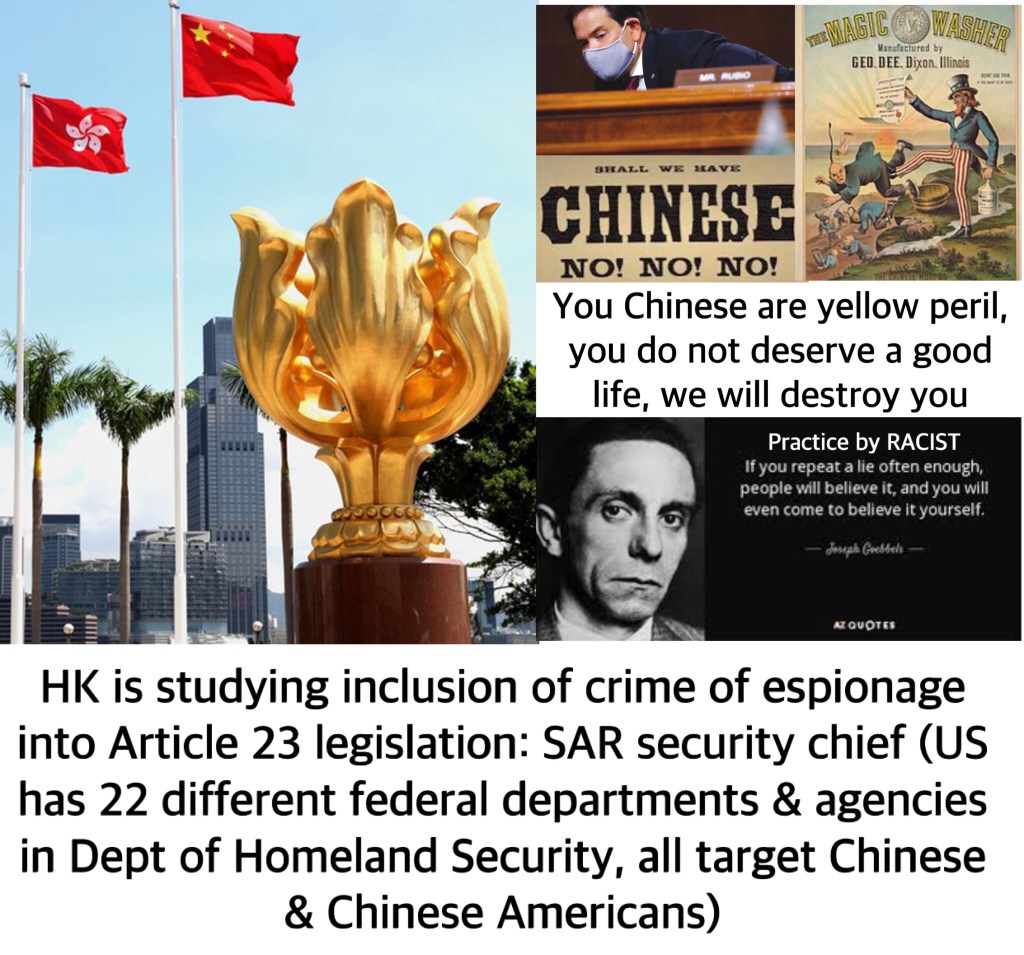
HK is studying inclusion of crime of espionage into Article 23 legislation: SAR security chief (US has 22 different federal departments & agencies in Dept of Homeland Security, all target Chinese & Chinese Americans)
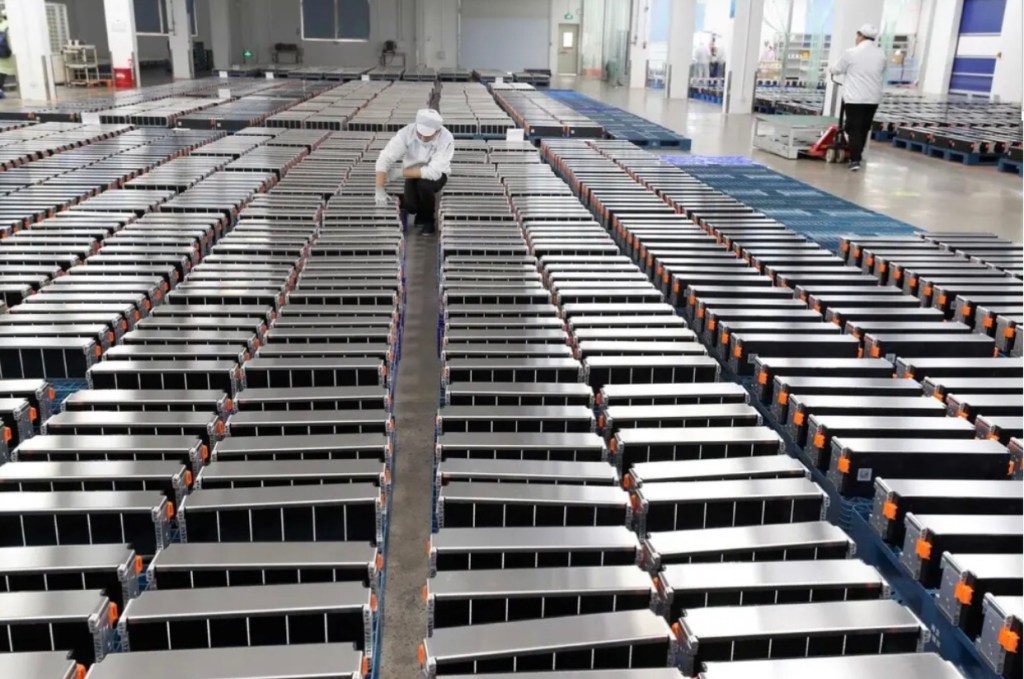
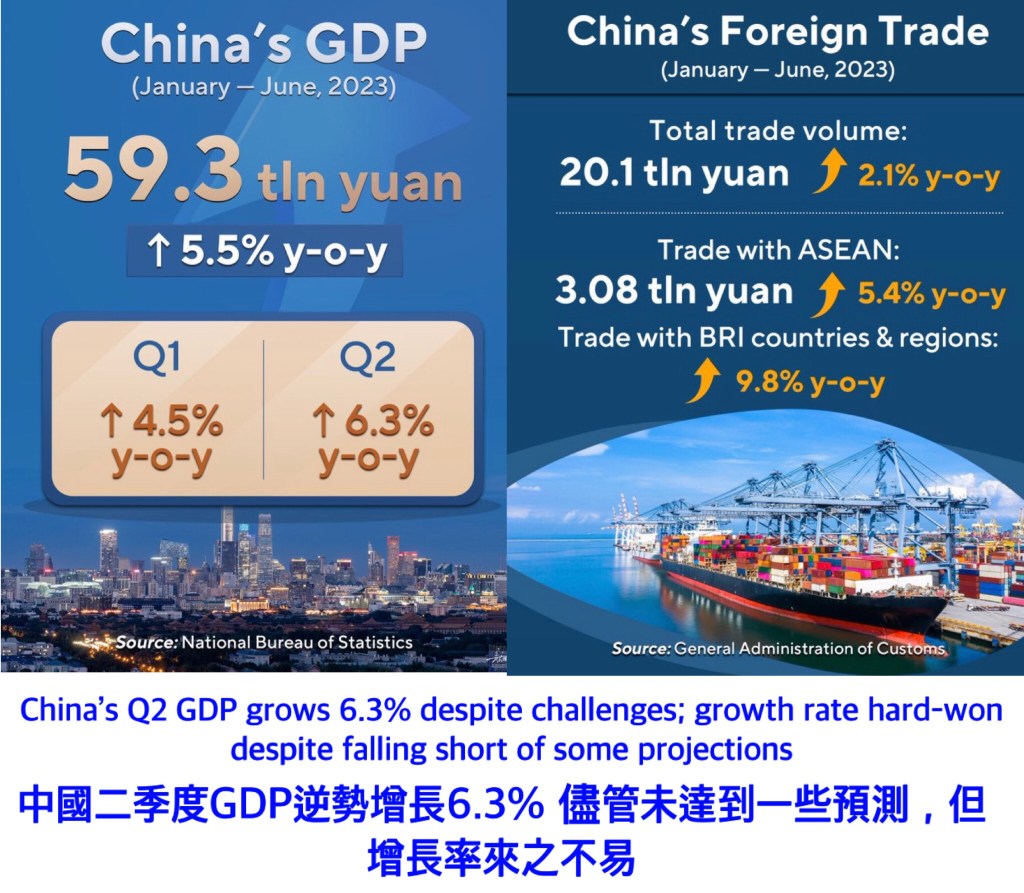
As of this year, China is the world’s largest car exporter — thanks to a surging electric vehicle industry — and it commands at least 74 percent market share in each step of the solar panel supply chain.
China learned to master the solar, battery and electric vehicle industries through the 2010s, while the United States was debating whether to pass clean-energy policy — and even whether climate change existed at all. With the Inflation Reduction Act, the United States now has an opportunity to become more competitive, and nothing gets lawmakers from across the political spectrum pumped up faster than the prospect of crushing China.
But the United States cannot build a competitive renewable or electric vehicle industry from scratch. The history of innovation — and of the modern world, frankly — shows that American engineers will progress in these industries only when they can work with their Chinese counterparts.
Look no further than the pickle Ford is in now. By 2026, Ford wants to start selling electric vehicles outfitted with batteries made of a chemical cocktail known as L.F.P. — lithium, iron, and phosphate — to the American market. L.F.P. batteries can be charged more quickly and more often than the cobalt and nickel batteries that Ford uses today; they’re also cheaper and more rugged and the minerals are easier to source.
The only problem: Ford doesn’t know how to make L.F.P. batteries on a large scale. No American company does. Although Americans first invented and developed L.F.P. technology, back in the 1990s, Chinese companies were the ones that figured out how to produce it at scale. Today, Chinese companies essentially have a monopoly.
But Ford has a solution. In February, it announced plans to open a new $3.5 billion L.F.P. battery factory in Michigan. It would license the technology from a Chinese battery maker, whose engineers would — in the words of Bill Ford, the automaker’s chairman — “help us get up to speed so that we can build these batteries ourselves.” It seemed like a win-win: The Chinese company, CATL, would get cash and prestige; Ford would learn how to make these batteries; and America would get 2,500 new manufacturing jobs. This was, apparently, exactly the kind of situation that Biden’s climate law was meant to set up.
Yet Senator Joe Manchin, the West Virginia Democrat who helped shape the law, exploded at the news. “I’ll be damned if I’m going to give them $900 out of $7,500, to let it go to China for basically a product we started,” he told an energy conference in Houston. (He was referring to the subsidy that the law grants to buyers of new electric vehicles, though Ford says none of that federal money would go to the Chinese company.) “You’re telling me we don’t have the smart people and the technology, and we can’t get up to speed quick enough?” he asked. “That doesn’t make sense.” … But rejecting Chinese know-how would make us, ironically, more dependent on China in any future security-related rupture — because we will simply have to import from China what we never learned to make ourselves.
Asia Times: Arming Taiwan an unacceptable provocation, It pushes the US closer to war with China, a nuclear power by Prof. John Walsh, MD in SF, July 17 2023
The island of Taiwan has been turned into a “powder keg” by the infusion of US weaponry, pushing the Taiwanese people to the “abyss of disaster.” These are the words of the Chinese Defense Ministry in reaction to the recent $440 million sale of US arms to the island. And now the US is also giving, not selling, arms to Taiwan, courtesy of the American taxpayer.
The ‘First Island Chain’ strategy
Taiwan is but one in a series of islands along the Chinese coast, often called the First Island Chain, which now bristles with advanced US weapons. These are accompanied by tens of thousands of supporting US military personnel and combat troops.
The First Island Chain extends from Japan in the north southward through Japan’s Ryukyu Islands, which include Okinawa, to Taiwan and on to the northern Philippines. US ally South Korea, with a military of 500,000 active-duty personnel and 3 million reserves, is a powerful adjunct to this chain. In US military doctrine the First Island Chain is a base to “project power” and restrict to China’s maritime access.
Taiwan is at the center this string of islands and is considered the focal point of America’s First Island Chain strategy. When the fiercely hawkish Cold Warrior John Foster Dulles, as US secretary of state, conceived the strategy in 1951, he dubbed Taiwan America’s “unsinkable aircraft carrier.”
Taiwan is now one source of contention between the US and China. As is often said but rarely done, the pursuit of peace demands that we understand the point of view of those who are marked as our adversaries. And in China’s eyes, Taiwan and the rest of these armed isles look like both chain and noose.
How would the US react in a similar circumstance? Cuba is about the same distance from the US as the width of the Taiwan Strait that separates Taiwan from the mainland. Consider the recent US reaction to rumors that China was setting up a listening post in Cuba. There was a bipartisan reaction of alarm in Congress and a bipartisan statement that such an installation is “unacceptable.”
What would be the reaction if China armed Cuba to the teeth or sent hundreds of soldiers there, as the US has done in Taiwan? It is not hard to imagine. One immediately thinks of the US-sponsored invasion of Cuba at the Bay of Pigs and later the Cuban missile crisis.
Clearly the arming of Taiwan is provocative act that pushes the US closer to war with China, a nuclear power.
Secessionist movement in Taiwan
According to the One China Policy, the official policy of the US, Taiwan is part of China. The United Nations took the same position in 1971 with passage of Resolution 2758 (also known as the Resolution on Admitting Peking), which recognized the People’s Republic of China (PRC) as the legitimate government of all of China and its sole representative in the UN.
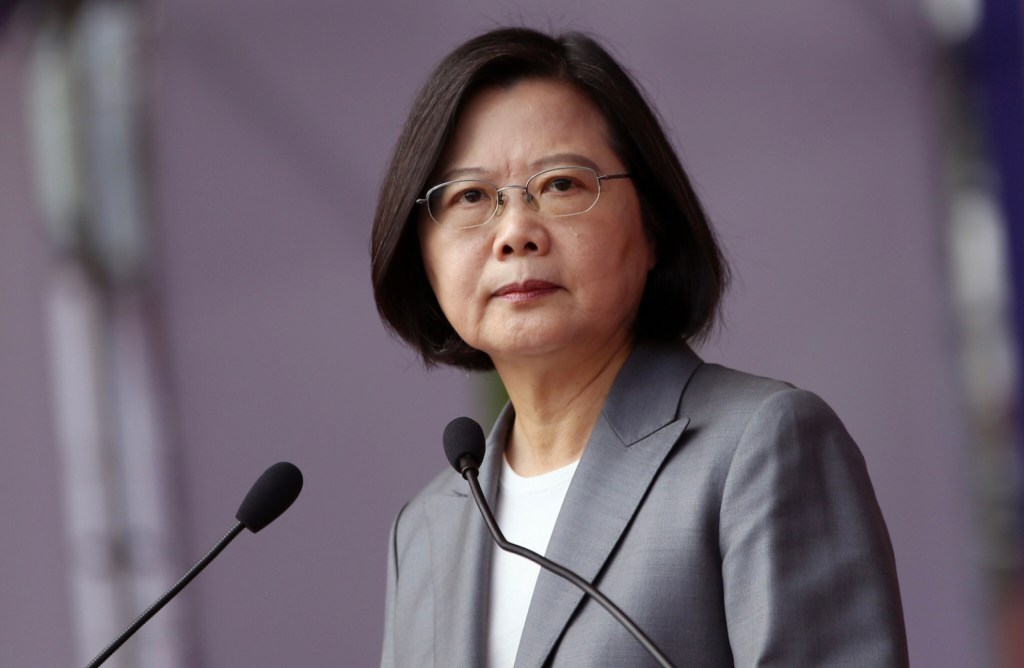
In recent decades a secessionist movement has developed on the island of Taiwan, a sentiment represented by the Democratic Progressive Party. Currently Tsai Ing-wen of the DPP is president. But in the local elections of 2022, the DPP lost very badly to the KMT (Kuomintang), which is friendly to the mainland and wishes to preserve the status quo, or “strategic ambiguity,” as it is called.
Tsai built the DPP’s 2022 campaign on hostility to Beijing, not on local issues. And at the same time her government passed legislation to increase the compulsory military service time for young Taiwanese males from six months to a year. Not surprisingly, this hawkish move was not popular with the under-30 set.
Polling in 2022 showed that an overwhelming majority of Taiwanese now want to preserve the status quo. Only 1.3% want immediate unification with the mainland and only 5.3% want immediate independence.
Compared with previous years, a record 28.6% of those polled said they preferred to “maintain the status quo indefinitely,” while 28.3% chose the status quo to “decide at a later date,” and 25.2% opted for the status quo with a view to “move toward independence.” Thus a total of 82.1% now favor the status quo.
Not surprisingly, every prominent presidential candidate professes to be in favor of the status quo. However, DPP candidates also contend there is no need to declare independence, since in their eyes Taiwan is already independent.
The stated policy of the PRC is to seek peaceful reunification with Taiwan. Only if the secessionist movement formally declares independence does Beijing threaten to use force. Clearly the Taiwanese do not wish to find themselves in the position of Ukrainians, cannon fodder in a US proxy war.
Here we might once more consider how the alleged enemy of the US, China, sees things and might react to a formal act of secession and declaration of independence by Taiwan. And again, we Americans might be guided by our own history.
When the Confederate States seceded from the Union, America descended into the bloodiest war in its history, with 620,000 soldiers dead. Moreover, a secessionist Taiwan, as an armed ally of the US, represents to China a return to the “Century of Humiliation” at the hands of the colonial West. Given these circumstances, arming Taiwan clearly creates a “powder keg.” A single spark could ignite it.
It is difficult to avoid the conclusion that the US is trying to gin up a proxy war that would engulf East Asia, damaging not only China but other US economic competitors like Japan and South Korea. The US would come out on top. It is the neocon Wolfowitz Doctrine put into play. But in the nuclear age such stratagems amount to total insanity.
If some Taiwanese hope that the US will come to their aid, they should ponder carefully the tragedy of Ukraine. Somewhere between 150,000 and 200,000 Ukrainian soldiers have lost their lives so far and millions turned into refugees.
A similar US proxy war in Taiwan could easily turn into a full-scale conflict between the world’s two largest economies, certainly triggering a global depression and perhaps a nuclear exchange. And US President Joe Biden has committed to send troops to fight the People’s Liberation Army should hostilities break out. So the situation is even more perilous than the one in Ukraine.
No arms to Taiwan
When all this is considered, arming Taiwan is asking for trouble on a global scale. Taiwan and Beijing can settle their disagreements by themselves. Frankly put, disagreements between the two are none of America’s business.
So we in the US must stop our government from arming Taiwan. And we need to get our military out of East Asia. It is an ocean away, and no power there is threatening the US. We do not have Chinese warships off our Pacific coast, nor do we have Chinese troops or Chinese military bases anywhere in our entire hemisphere.
China calls for peaceful coexistence and a win-win set of relationships between us. Let’s take the Chinese up on that.
And let’s bring all those troops, submarines, bombers, rockets and warships out of East Asia before they stumble into a conflict or become the instrument of a false-flag operation.
We should keep in mind the Gulf of Tonkin incident, a fake report of a Vietnamese attack on a US ship that led to the Gulf of Tonkin Resolution, a de facto declaration of war against Vietnam. In the end millions lost their lives in Southeast Asia in that brutal, horrific war.
Even that will look like a schoolyard squabble compared with the conflagration unleashed by a US-China war.
Taiwan is moving forward with a regulatory framework that could see the digital industry flourish.
John V Walsh, until recently a professor of physiology and neuroscience at the University of Massachusetts Chan Medical School, has written on issues of peace and health care for the San Francisco Chronicle, EastBayTimes/San Jose Mercury News, Asia Times, LA Progressive, Antiwar.com, CounterPunch and others.

 Business Blog