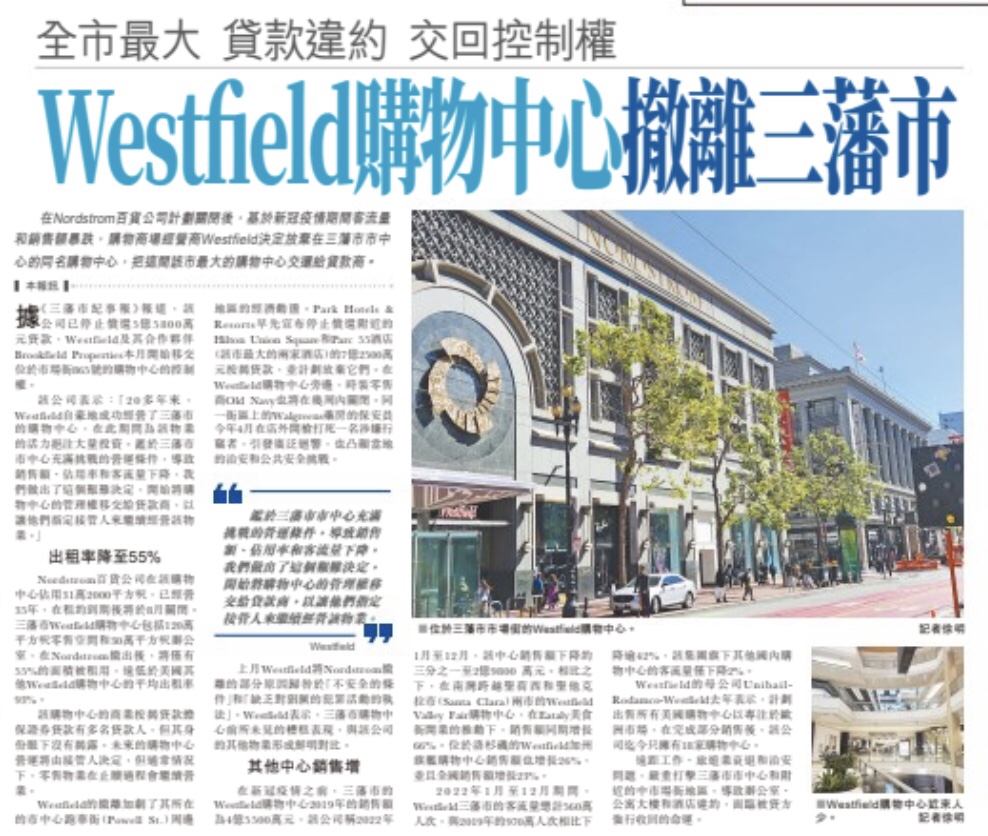
Major shopping malls failing throughout US, largest Hilton Hotel in San Francisco declared bankrupt last week. Commercial Real Estates around the country with commercial mortgage paper between 10-20 trillions could become worthless. Residential real estates are dropping, many paid 3% down payment to buy their home are under the water. In yet another blow to downtown San Francisco, Westfield announced it’s giving up its shopping mall and will surrender to its lender. 全美大型購物中心倒閉,舊金山最大的希爾頓酒店上周宣布破產。 全國各地擁有 10-20 萬億商業抵押貸款票據的商業房地產可能變得一文不值。 住宅房地產正在下跌,許多支付了 3% 首付的房屋都在水下。 對舊金山市中心的又一次打擊是,韋斯特菲爾德宣布放棄其購物中心並將向其貸款人投降。 https://johnsonwkchoi.com/2023/06/12/another-blow-to-downtown-san-francisco/https://www.tiktok.com/t/ZT81XfSX3/https://abc7ne.ws/3NrpTYG 👈
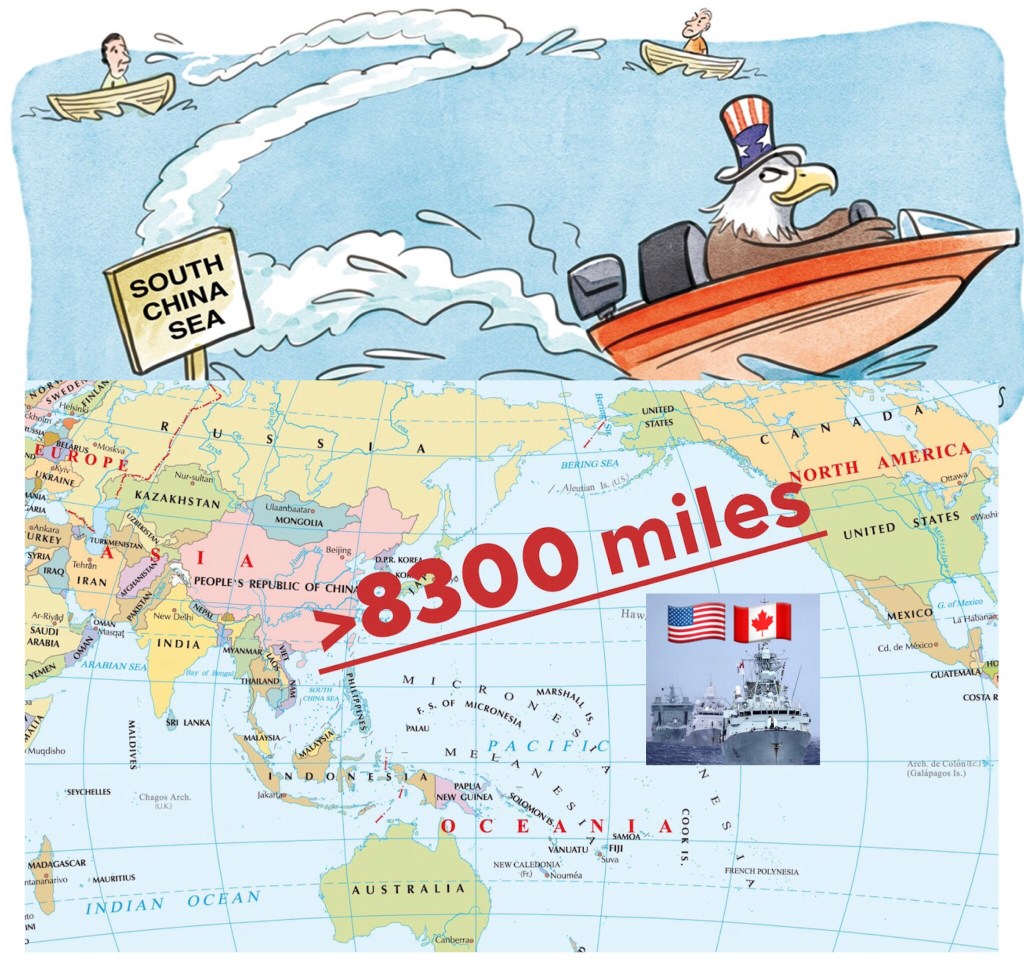
Freedom of navigation or freedom of bullying? US has long been enjoying a “freedom of bullying” in the region around China. The so-called “rules-based maritime order” is designed to advance its geopolitical agenda and heighten disputes.
In yet another blow to downtown San Francisco, Westfield announced it’s giving up its shopping mall and will surrender to its lender. https://abc7ne.ws/3NrpTYG 👈
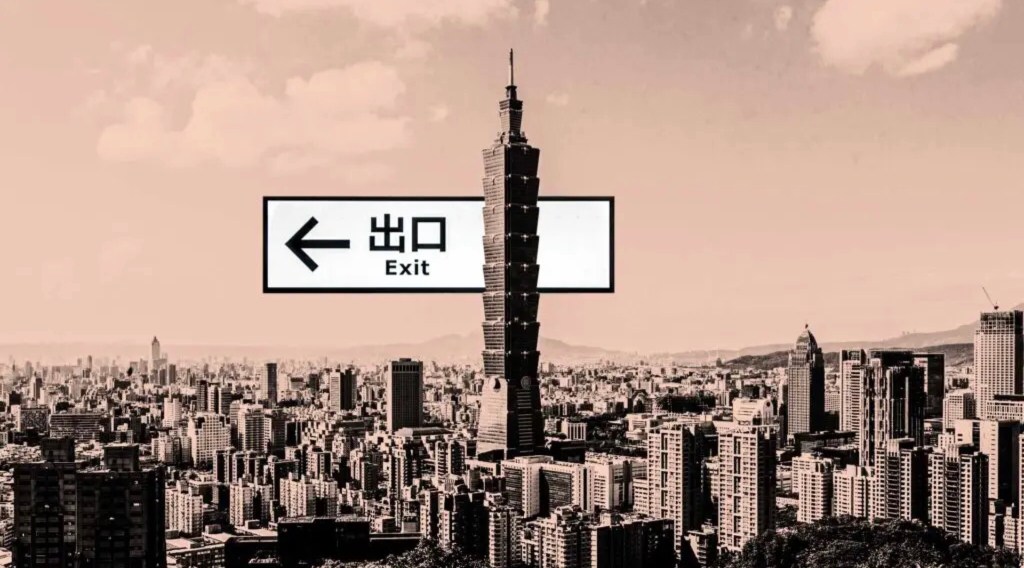
Bad sign: The US Is Preparing Evacuation Plans for American Citizens in Taiwan three sources told The Messenger (Exclusive) Chinese in U.S. could be in concentration camps very soon! 壞兆頭:三位消息人士告訴《信使報》,美國正在為台灣的美國公民準備撤離計劃(獨家) 在美國的中國人錢在銀行人在監房的日子快到了by Lili Pike and Jim LaPorta JUN 11 2023
The U.S. government hasn’t discussed the preparations publicly. The State Department declined a request for comment. While Pentagon spokesperson Lt. Col. Martin Meiners declined to comment directly on the planning, he said, “We do not see a conflict in the Taiwan Strait as imminent or inevitable.”
The planning has been underway for at least six months and “it’s heated up over the past two months or so,” said a senior U.S. intelligence official who spoke on the condition of anonymity because he wasn’t authorized to discuss the planning.
The official said a “heightened level of tension” had driven the preparations. “It’s nothing you wouldn’t read in the news,” he told The Messenger. “Forces building up. China aligning with Russia on Ukraine.”
Taiwan’s US Representative Not ‘Satisfied’ With Biden’s Support by John V. Walsh, MD in SF Jun 11 2023
Bi-khim Hsiao, Taiwan’s Representative in the United States, is a familiar figure in the halls of power but she does not often make public speeches. So a recent talk and press conference by Ms. Hsiao deserve some attention.
The One China Policy, endorsed by the US and UN, does not recognize Taiwan Island as an independent country but as part of China, with the government in Beijing providing the official ambassadors to the US and UN. Hence Hsiao is not an “ambassador” but a “representative,” and her organization is known as the Taipei Economic and Cultural Representative Office (TECRO). Her presence and activities in the US are sensitive points in the US-China relationship, which is why she does not often make public appearances.
We might expect therefore that Hsiao had something of considerable consequence to communicate to an American audience. And so she did, but her message did not center exclusively on Taiwan. Hsiao and the reporters in attendance wished to discuss a country over 8000 km away from Taiwan, almost at the opposite end of Eurasia – Ukraine.
The “Tragedy” of Ukraine in the eyes of Taipei’s Representative
In her opening remarks, Hsiao stated: “The Ukraine war has actually generated a lot more attention and interest in … Taiwan’s defense needs. And so there has been an increase in… initiatives to find ways to support Taiwan so that that tragedy will not be repeated in our scenario.”
“Tragedy” indeed. Hsiao, like everyone else in the world, is well aware of the devastation that has been visited on Ukraine as a result of Biden’s cruel proxy war on Russia using Ukrainians as cannon fodder. The “tragedy” of Ukraine has focused not only Hsiao’s mind but mightily distressed all the people of Taiwan Island. This led to the landslide defeat in the 2022 local elections of Hsiao’s Party, the Democratic Progressive Party (DPP), which is the home of secessionist sentiment and hostility to Beijing. The DPP was soundly thrashed by the Kuomintang (KMT), the Party that wishes to maintain the status quo with the mainland, leave in place the “strategic ambiguity” of the One China Policy and take a peaceful approach to Beijing.
The first thing that struck me about the press conference was the unreality of Hsiao’s purpose, bordering on insanity. Here we had Taiwan’s envoy discussing war with Mainland China which has the largest PPP-GDP in the world and 18% of all of humanity. Taiwan’s population is 24 million, and it is the size of Maryland.
The bureau chief of the Christian Science Monitor, and host of the event, expressed a similar incredulity, asking in the opening question: “Russia versus Ukraine is one thing, but China versus Taiwan is a much more extreme example in terms of proportions…. How do you fight back against that?” The unstated assumption is that Taiwan can succeed with the support of the US. But just how true is that? How sound is Biden’s support for Ukraine?
Asked whether she was “satisfied” with Biden’s commitment to Taiwan, Hsiao demurred.
Was she “satisfied” with Joe Biden’s commitment to defend Taiwan, queried another reporter. Hsiao demurred, did not answer “yes,” but instead opined that “in the long run, nothing is ever completely satisfactory.” Here Hsiao seemed to be channeling Volodymyr Zelensky, always demanding more, ever disappointed. Such is the unenviable position of a proxy whose function in the end is to be used, not championed.
Hsiao sounded very much like someone who had doubts about US support – doubts perhaps aroused after the resounding and very bloody defeat of the US proxy, Ukraine, in Bakhmut. We can be sure that the same doubts are cropping up in the minds of the Taiwan electorate. And such doubts are likely to play a decisive role in the upcoming elections in 2024 for President and Legislative Yuan, the unicameral legislature for the entire island? Will the more pacific policies supported by the electorate in the 2022 local elections prevail again in choosing island wide officials in 2024?
US arms to Taiwan a Provocation to war
Several reporters raised the question whether the US arming of Taiwan Island could be seen as a provocation. In itself this is a step forward for the US press which might be awakening to the fact that US tactics did indeed provoke the war as in Ukraine. Hsiao dodged that question by ignoring the US dimension and speaking instead of Taiwan’s efforts at increased militarization. Of course, little Taiwan acting on its own can scarcely be seen as a threat or serious provocation to China. But it is quite a different story when the weapons and personnel come from the US. After all the US has an enormous military presence in the region and has declared as a matter of policy that its aim is to bring down China. In this circumstance US weapons, military personnel and actions in Taiwan can be a serious provocation indeed.
Although Hsiao spoke in terms of defense not provocation, she herself undermined that way of regarding the US on Taiwan Island. Asked by another reporter whether there was any evidence for Chinese preparation of an invasion of Taiwan Island, Hsiao said there was none. This is hardly surprising since China’s policy is to reunite peacefully with the Island, a long-term goal.
One clear and simple lesson of the Hsiao press conference is that Mainland China quite reasonably perceives the US arming of Taiwan as a threat and provocation. Thus, the way to peace is to end the arming of Taiwan. This should be a top priority in the US peace movement, but unfortunately, it does not often receive so much as a mention.
John V. Walsh, until recently a Professor of Physiology and Neuroscience at the University of Massachusetts Chan Medical School, has written on issues of peace and health care for the San Francisco Chronicle, EastBayTimes/San Jose Mercury News, Asia Times, LA Progressive, Antiwar.com, CounterPunch and others.
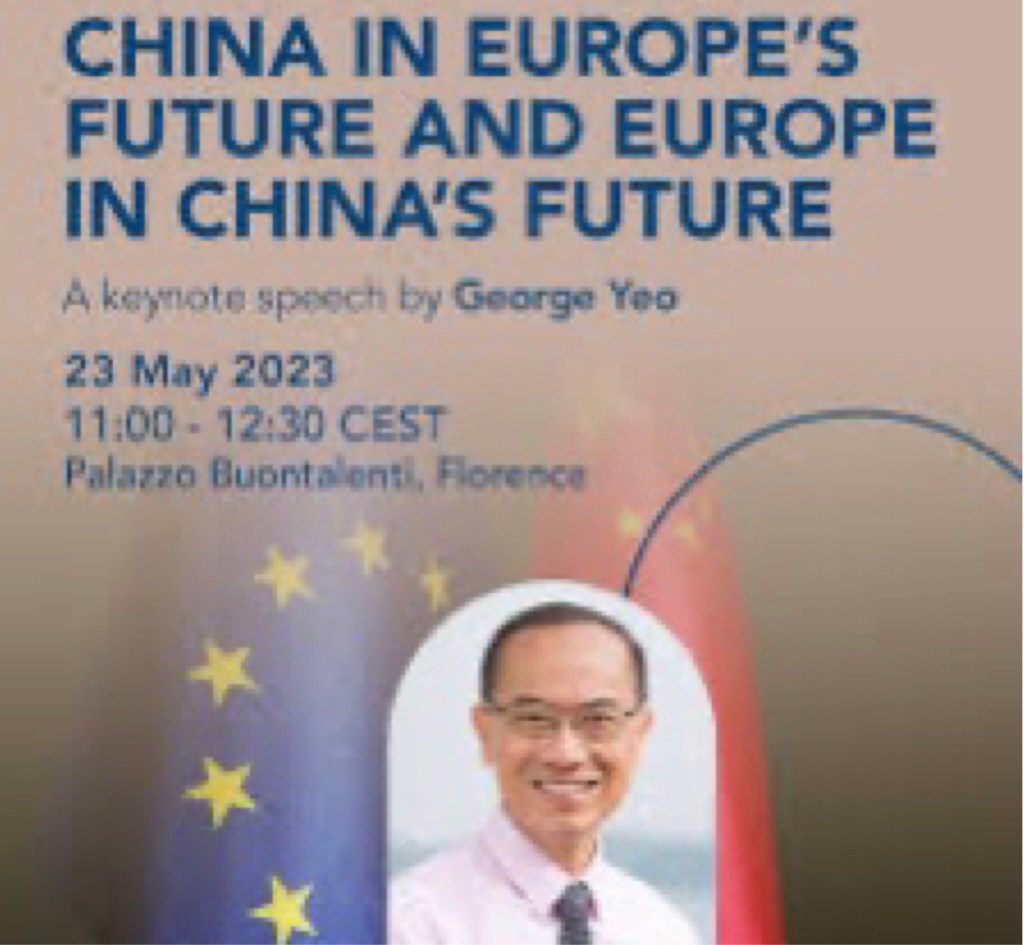
China in Europe’s Future and Europe in China’s Future (US will not be part of it) 中國在歐洲的未來和歐洲在中國的未來(美國不會參與其中) by George Yeo 5-23-23
Anti-China sentiments in Europe have risen in recent years, not just among European leaders but also among ordinary people. It is hard for Singaporeans to understand why the western attitude towards China has become so much worse in the last five years. Different reasons are cited at different times – President Xi Jinping’s autocracy, Chinese diplomats behaving like wolf warriors, alleged genocide in Xinjiang, introduction of the national security law in Hong Kong, perceived threats against Taiwan, excessive claims in the South China Sea, spying, unfair treatment of foreign companies in China, theft of intellectual property, unfair trading practices, baleful influence of Confucius Institutes, hiding information about the origin of Covid-19, and the list goes on. The most recent is probably China’s refusal to condemn Russia for its invasion of Ukraine and its persistence in being friendly to Russia.
While each western grievance is worthy of discussion and debate, we should also know that China has its grievances against the west. Chinese leaders and many Chinese people believe that underlying western negativism towards China is an unwillingness to accept China as an equal and a desire to pull China down if possible. China’s ambassador to the US of many years, Cui Tiankai, in a speech he gave in Beijing after his retirement in December 2021, stated that there was no bottom line to America’s ill will for China. He believed that there was a strong element of racism in US attitude towards China. Repeated hostile statements made by G7 countries remind the Chinese of the aggression of the Eight Nation Alliance which invaded North China in 1890 to put down the Boxer Rebellion. The eight nations were Germany, Japan, Russia, Britain, France, the US, Italy and Austria-Hungary. After suffering for decades at the hands of western powers and Japan, China’s leaders and people are determined to stand up to the west, in particular, the US.
With the exception of Taiwan, the purpose of my lecture today is not to discuss in detail the rights and wrongs of particular issues bedeviling Europe-China relations. If there is time and only if you wish, I am happy to elaborate my views on any of them to explain that no issue is black or white. My purpose today is to explain China’s nature and why China-Europe relations are so critical to world peace. China does not see Europe as an enemy and is certainly not an enemy of Europe.
When the Jesuits set out to convert China to Christianity in the 16th century, they did not have with them guns and gunboats to support their cause. They had to use reason and the power of persuasion. To do this, they had to understand the Chinese mind. The great Italian Jesuit, Matteo Ricci, thought at first that he should dress like a Buddhist monk only to discover that the Chinese literati looked down on monks. He learned quickly that the mandarins respected scholarship and, here, he was in his element. Blessed with an encyclopedic memory and an extraordinary intelligence, he mastered the Chinese language and the Chinese classics. His evangelization had limited success. It met obstacles at every turn. Just to translate deus into Chinese was an intellectual exercise because no equivalent idea existed in Chinese thinking and philosophy. Catholic catechism books of that era published by the Jesuits had Jesus, Mary and the Apostles as Chinese figures. From the Jesuits, Europeans learned about China. They learned how to organise an elite civil service based on examinations. According the Joseph Needham, the French encylopaedists like Voltaire and Descartes learned how it was possible to have a moral order without organised religion. Needham argued that this laid the intellectual basis for the Enlightenment and the French Revolution. In the 19th century, Christian missionaries were backed by military power. Jesus and Mary became European. The Christian God became a foreign god. Europe no longer had anything to learn from China.
The Nature of China
China is an unusually homogeneous country. 92% of its population is Han. There is no comparable nationality in the world, now or in the past, which in huge numbers share a common culture and civilization. China’s population is almost twice that of the EU. Unlike the EU which in my mind remains a confederation of tribal nations, and I ask for your forgiveness if I make this point too strongly, the Han people has only one literature and acknowledge the same heroes. India’s population has overtaken China’s but it has not China’s homogeneity and is perhaps more like Europe in its diversity.
China’s homogeneity did not happen by chance. Neither was it the result of particular policy decisions. The policies were made over long centuries and derived from China’s deep nature. Han rulers always found it difficult to govern non-Han people because they behaved differently. It is for this reason that China’s instinct is always to build walls around itself, not to keep its people in, but to keep foreigners out. Everyday, Chinese people sing the national anthem which talks about rebuilding great walls. China builds walls for everything. Not just physical walls, but also walls for capital flows, cultural imports, foreign movies, educational material, cyberspace and, as we saw in recent years, bacteria and viruses.
Over two thousand years ago, the Qin Dynasty unified China. Weights and measures were standardized. Writing was standardized. Households were not allowed to have weapons. Even kitchen knives beyond a certain size were forbidden. The Qin rulers were legalists, meaning that laws were enforced rigidly and harshly. The dynasty ended with the second emperor because both elite and ordinary people could not take the severity. The succeeding Han Dynasty, which lasted four hundred years, and roughly contemporaneous with Republican and Imperial Rome in Western Europe, changed the ruling philosophy from legalism to Confucianism. Confucianism put great stress on rituals and proper behaviour. If the Emperor, the official, the father and the son behaved in the proper way, society will be in harmony. A famous line in the Great Learning said: cultivate the self, raise the family, govern effectively and the world will be in harmony. In such a world, non-Han people who were brought up differently, could not fit it easily. Force may then have to be used which is never preferred.
During Covid-19, China pursued a dynamic zero policy. If cases were detected in a community, it would immediately be locked down for a few weeks. Chinese people were most unhappy with the draconian measures, particularly in 2022 when the Omicron version made containment very difficult. Unlike foreigners who could not take the restrictions and left in droves, Chinese people complied. These measures enabled China to become the least damaged economy during Covid-19. Before the Omicron variant arrived, China’s manufacturing economy produced for the war. Ships from all over the world were diverted to China. They left China full and came back empty. China’s merchandise trade surplus rose from USD520 billion in 2020 to USD670 billion in 2021 to USD870 billion in 2022. China did not have to print money the way other countries had to in order to keep their economies going. According to the WHO, China also had one of the fewest number of deaths per million. China has complete records of epidemics going back over two thousand years and knew that the only surefire way to contain an epidemic is lockdown. This was done even in the Imperial harem.
Scholars have many explanations for China’s homogeneity. To me, two explanations are the most important. The first is the invention of paper some two thousand years ago and of printing during the Tang Dynasty. Using British school textbooks in Singapore, I did not know that China invented moveable type printing during the Northern Sung Dynasty, centuries before Gutenberg did so in Germany.
Paper and ink enabled China to store and process data in a way no other society could. The earliest sighting of Halley’s Comet was recorded in China. Alan Turing had this insight in computer science that if you have unlimited amount of paper to record results of intermediate calculation, there is no limit to the amount of algorithmic computation that you can carry out. Paper enabled China to organise large numbers of human beings in a complex division of labour. For centuries, China had a monopoly of paper protecting the technology as a state secret. China may protest at US moves to deny China cutting-edge technology but it knows from its own history that it did the same with paper and gunpowder technology for a long time.
Imagine what advantage the US would have if it is the only country which has computers today. With paper, China had an equivalent advantage in data storage and processing for many centuries. It was only in the 8th century, when the Tang Army was defeated by the Abbasids in Central Asia, that paper technology passed to the Islamic world. Among the Chinese prisoners of war were a few who knew how to make paper. Within a relatively short time, paper mills were established in turn in Samarkand, Bukhara, Baghdad and Damascus. The Islamic world was transformed. Around the year 1000, paper technology reached Cairo, two hundred years later, it arrived in Muslim Spain. The Arab world tried to keep paper technology a secret from Europe but it soon leaked into northern Italy. At that time, the Islamic world had many more books than in all the monastic libraries of Europe. Once Europe had paper, a great transformation began leading to the Renaissance and Europe’s subsequent irruption into the world.
My second explanation for China’s historical continuity is the writing system which is based not on alphabets but on pictographs. Children can read words in Chinese earlier than they can read words composed of alphabets because they are pictures. Words written as pictographs keep their value while words written in alphabets change as pronunciations change. A high school student in China today can read Chinese Classics written over two thousand years ago without too much difficulty because the characters have not changed though understanding what is written will take more time. You can’t do this in Europe or in India. Pictographs give written Chinese a digital quality as the value is fixed across time and space.
If paper represented a form of computing, the programmers were the scholar mandarins who mastered the written language. Historians described China as a bureaucratic state. It remains so today. Instead of scholar mandarins, we have Communist Party cadres. Because of paper, the corpus of historical records on China is enormous and has no parallel anywhere else. From the Han Dynasty historian, Sima Qian, every dynasty compiled an official history of the previous dynasty. In all, there are 24 official histories which record with great accuracy events, places, dates and personalities. The last official history was the History of the Ming Dynasty. The History of the Qing Dynasty which lasted from 1644 to 1911. The project was launched by Vice Premier Li Lanqing, whom I knew as Commerce Minister, in 2003. I remember him telling the scholars not to rush to conclusion. The scale of the undertaking has grown and grown because of the vast corpus of material available on the Qing Dynasty, including records kept by western missionaries. During a visit to the MEP (Missions Etrangeres De Paris) in Paris about twenty years ago, I met a lady historian from Sichuan rummaging through old church records.
This obsession with data collection and record keeping continues in 21st century China. China has again become the most data-intensive society in the world making use of IT in a huge way. A common western perspective is that there is no privacy in China with the State intruding into every sphere of life. This is a legitimate point of view but gives only a partial picture. China today makes use of big data analytics to improve governance and reduce corruption. It is much harder for corruption to be hidden when the data is collected through a multi-dimensional matrix and constantly being compared to other towns, cities and provinces. By the end of this year, China will have close to 3 million 5G base stations right up to the base camp of Mt Everest. With more bandwidth available than other countries, new products and services are being rolled out, like driverless vehicles and robotics. The recent Shanghai electric vehicle fair showed how much the industry has developed in China and was a shock to many in the industry. While China has about a sixth of the world’s population, it has one-third of the world’s robots. Last year, almost half the world’s new robot installations were carried out in China. The concern with Huawei has caused many countries to hold back the introduction of 5G and with it the growth of new industry sectors.
US-China Relations
The US and China are locked in a protracted struggle which may extend twenty to thirty years. By 2050, China will probably have a much larger economy than the US in nominal terms. Some economists think that China’s economy at that time will be the size of the US and EU economies put together. The prospect of such a China is daunting to many Americans. China is not a threat to the US but China is certainly a threat to US dominance in the world. At the end of the Second World War, the US economy, which was the only major economy not damaged by war, constituted 40% of global GDP. In the free world, we lived under a Pax Americana. It was under a Pax Americana that Singapore pole-vaulted from the Third World to the First World. With the collapse of the Soviet Union, the US was the new Rome. For a brief period, it was a unipolar world. This was the age of Davos. China took off in an era of relatively apolitical global trade. I was in Qatar in November 2001 when the Doha Development Agenda was launched and China acceded to the WTO. I do not think that China’s acceptance of a rules-based international world order has changed.
Since then, China’s growth astounded the world. From November 2001 to the beginning of Covid-19 at the end of 2019, China’s economy grew seven times in PPP terms, nine times in RMB and eleven times in USD. When PM Gordon Brown convened the second G-20 Summit in response to the Global Financial Crisis, China agreed to pump-prime and keep up global demand. I read a report that in three years China poured more concrete than the US in its entire history. In the process, China’s economy became badly distorted. It took years for the imbalances to be massaged out of the system. The Chinese also knew there was no gratitude. When the next global financial crisis arrives, which may not be long, China will not do what it did in 2009. In any case, with the Ukraine War, the G-20 has become must less vital. The G7 economies by themselves will not be big enough. According to the IMF, China will account for 35% and India 15% of global growth this year. The number of STEM (science, technology, engineering and mathematics) graduates coming out of Chinese universities every year is comparable to that of the entire G7 combined.
Short of nuclear war, China’s re-emergence on the global stage cannot be prevented. Historically speaking, when China was united, it always constituted a large part of the global economy. How China will behave when it recovers that position can be discerned in its history because this is not the first time the world is witness to it. China’s neighbours see a replay of the past and are re-triangulating their positions accordingly. All of them had encounters with China in its earlier incarnations and are able to draw on past experiences and accumulated wisdom.
The US fears that China is seeking to dislodge and replace it as global hegemon. China’s strategy is much more subtle. It certainly has no wish to replace the US as global policeman and to send its warships and military aircraft to all parts of the world. It will however want to protect its own interest for which it needs military assets to protect shipping, which is the purpose of its base in Djibouti, and to evacuate its people from countries that dissolve into violence like Libya some years ago and Sudan recently. Chinese statecraft and strategic thinking much prefer to use non-military means to achieve political objectives. China is often accused of using economic coercion which is not unjustified.
By making use of the size of its market, China is able to influence the behaviour of other countries, especially its neighbours, by economic reward and punishment. China has by far the most integrated economy in the world which is already the largest in real terms. Most economies in the world are more dependent on China than China is on them. Imperial China maintained a tributary system with many of its neighbours. This tributary relationship is not what is commonly understood in Europe where a tributary state pays money to a hegemon either for protection or to keep its autonomy, like the relationship of Muscovy to the Gorden Horde or Dubrovnik to the Ottomans. In the case of China, the tributary state, by acknowledging China’s seniority, which included its representative having to kowtow to the Emperor or to an empty throne, receives in return huge trading benefits. In Southeast Asia, kingdoms vied with one another for a greater share of the China trade.
When I was Chairman of Kerry Logistics, a sugar port we operated southeast of Bangkok suddenly received no sugar. When we investigated, we found out that sugar from Thailand instead of being exported from our port was sent across to Myanmar where they were loaded on trucks and transported to China. A sister company lost money in sugar trading because it did not factor in the opening of a back door into China. This was the year when the military government was ceding power to Aung Saw Suu Kyi whose political party, the NLD, had won the elections. For a year, China allowed sugar to be imported from Myanmar without tariff. The military government must have made a lot of money issuing permits for sugar traders to import sugar which was then sent across to China. A year later, the back door was shut and the sugar returned to our port. In this way, China rewarded its friends in the Myanmar military one last time before dealing with the new civilian government. For Chinese consumers, there was hardly any perturbation in the market. This has always been China’s way of dealing with its neighbours. When it wishes to reward a friendly neighbour, it only needs to open the door a little wider. When it needs to punish a wayward neighbour, it shuts the door a little thus inflicting pain. Neither affects the Chinese market in any significant way. All China needs to do is to import a little less or a little more from other countries. Of course, in doing all this, China makes sure to be WTO compliant, if necessary, by invoking sanitary and photo-sanitary concerns. In the Chinese mind, economic carrots and sticks are a much better way to manage foreign relations than the use of military force. In the Art of War by Sunzi, written more than two thousand years ago, superior strategy is the achievement of strategic objectives without the need for war.
The Dual Circulation Economy is in support of such a strategy. It was put forward in 2020 but is really nothing new. In its history, China’s internal circulation was always much more important than its external circulation. What the Chinese government did under Xi Jinping was to reduce progressively the ability of other countries to hold China to ransom on particular technologies, products or raw material. China’s energy sources are well-diversified. So too its import of critical minerals like lithium, cobalt, nickel and copper. It is concerned by its over-dependence on iron ore from Australia and tries to mitigate it by using less, recycling more, improving technology to process lower grade ore plentifully available in China, and importing more ore from Brazil and other countries. The US has greatly tightened export of high technology products to China in order to slow down China’s advance in AI, quantum computing and other areas. Chris Miller wrote a book called the “Chip War” last year. Technological decoupling is hard to maintain for the long term when the technology is commercial. If the technology is classified, like those carried out by defence establishments, then it can be kept secret for a long time. Instead of “decoupling”, US National Security Adviser Jake Sullivan now adopts the term used by EU President Ursula Von De Leyen called “de-risking”.
The “Chip War” may slow China down by 5 to 10 years but it will, in the end, make China more formidable. In 1960, following deteriorating relations between Nikita Khrushchev and Mao Zedong, Soviet scientists and engineers were suddenly pulled out of China leaving several major infrastructural projects unfinished. The Soviet Union also stopped helping China in the development of an atomic bomb. China progressively overcame all the obstacles. In 1964, it exploded its first atomic bomb. When Brezhnev threatened nuclear war on China, Mao ordered the dispersal of strategic industries and had tunnel complexes dug under every major city. In the last two years, the Chinese people have been psychologically prepared for a prolonged stand-off with the US including the possibility of war. And digging underground complexes again. Korean War movies and TV serials have been produced showing how a young PRC, barely a year after its establishment, sent volunteers to fight well-equipped and battle-tested forces under General Douglas MacArthur under extremely harsh winter conditions.
In the early 50’s, the US was much stronger compared to China which had not completed its revolution and was devastated by decades of war. Yet, the US could not defeat China on the Korean Peninsula. The relative strength of the US and China today is nothing like what it was then. Nevertheless, the strength of anti-China sentiment creates its own reality in the US today. If there is an incident in the South China Sea which causes the loss of many lives, the passions of the US body politic and media may be unstoppable and force the US into an unintended war. If the US is unable to prevail with conventional weapons, which is what repeated war games demonstrate, the temptation to use nuclear weapons may become too strong.
Europe, China and Multipolarity
I find it troubling the way some European leaders support US pressure on China without careful consideration of China’s nature or Europe’s own vital interests. This is a matter of war and peace. Europe’s stance can tilt the balance in US-China relations either way.
Europe must naturally calculate in its own self-interest. The Trans-Atlantic Alliance is based on a common civilizational inheritance which is profound. NATO establishes the security framework for the EU to flourish. Without it, the long peace in Europe following the end of the Second World War would not have been possible. With the collapse of the Soviet Union, relentless US pressure on Russia could lead to one of three possible outcomes. First, Russia could join Europe. For a short period under Yeltsin, there was hope of a western alliance stretching from Vancouver to Vladivostok. That’s past. The second possible outcome is Russia, which spans 11 time zones, breaking up. If that happens, there will be mayhem in Eurasia for decades. China may then be forced to move and may decide to reclaim over a few million square kilometers of land it lost when it was weak. This cannot be a good outcome for Europe. The third outcome is what we have today which is a Russia determined to be its own pole in the world. Though its economy is relatively small, Russia is a significant nuclear power and occupies more than 10% of the earth’s land surface with abundant natural resources.
I do not believe any of the protagonists in the Ukraine War is happy with the situation today. If we could reel back history, a different path to the future would be chosen. Well, Humpty Dumpty has fallen from the wall and all the King’s horses and all the King’s men will not be able to bring Europe back to February 23 last year. Looking forward however, Europe has to decide how it wants to live with Russia as a neighbour and with what kind of Russia. There is naturally a range of views. In the end, Europe has to decide its own position while preserving the essence of the Trans-Atlantic Alliance. The danger for Europe is that a prolonged standoff in Ukraine will undo the careful consensus that had created the Europe of today.
As a result of the Ukraine War, some heat put on China by the US has been taken off. Despite fierce rhetoric, the US cannot lightly open a second military front in the western Pacific. Whether there is war over Taiwan depends ultimately on the US because Taiwan is only a minor piece on a geopolitical chessboard. As I explained earlier, China’s overwhelming preference is for peaceful reunification.
China’s close relationship with Russia is to be expected because both have come under great pressure from the US. They are not natural friends sharing a border of over 4000km. They were close to nuclear war in the 60’s and early 70’s. I was told that in Mongolia alone, the Soviet Union at its peak stationed hundreds of thousands of soldiers in a country with a population of some three million. Today Russia needs China, and China does not want to see Russia defeated. It is not realistic to hope or expect China to condemn Russia and support the west on the Ukraine War. At the same time, China does not want to support Russia in the war either because this is not China’s war. China’s 12-point peace plan is an attempt to square the circle. In reality, it is not a plan but a statement of principles. Nevertheless, China’s proposal may become useful once serious discussion for a ceasefire begins. Right now, both sides are giving war a chance, which is tragic. We are not likely to see a peace agreement for a long time. The west cannot allow Putin to win while Russia, having expended so much blood and treasure, cannot afford to lose. It is entirely possible that a ceasefire without political resolution can go on for decades like in Korea, Kashmir and Cyprus. For as long as there is no peace agreement in Ukraine, Russia will need China because of western economic sanctions.
China may well play an important role in helping to create conditions for an end to the Ukraine War. The time is not yet ripe. Only when the protagonists are exhausted will minds turn towards a ceasefire. At that point, China’s current intermediate position between Europe and Russia may become helpful. China can only be effective with European support. The US, however, will not like to see China playing such a role.
In the meantime, it is not clear how long the US will stay committed to the Ukraine War. If Biden is re-elected, we are likely to see policy continuity. If Robert Kennedy Jr or someone else wins the Democratic Primary, there could be change. If there is another Republican President, whether Trump or a current governor, change is likely. In the midst of all this, the world may go into another major financial crisis which will force all political leaders to turn inwards.
The Taiwan Issue
The sense of the past in Chinese society makes its culture highly conservative. For those who have a sense of Chinese history, the behavior of China today is predictable. For those who are unable or unwilling to understand China and its history, and only measures it against western norms, China comes across as being capricious, unreasonable or wilful. Let me use as an example the misunderstanding, deliberate or otherwise, over Taiwan. In the 19th century, the European powers and Japan carved out pieces of territory for themselves from a declining Qing China. Hong Kong was lost in 1842 after the Opium War. By 1862, all ships arriving at ports on the China coast and up the Yangtze River were inspected and custom dues collected by westerners, mostly Britishers, who after deducting what they claimed for themselves, gave the remainder to the Chinese government. In 1894, Japan defeated China in a war and took Taiwan. During the First World War, China was on the side of the Allied Powers and supplied to Europe 140,000 workers expecting that German concessions in China would be returned to China after Germany was defeated. When, instead, the German concessions were given to Japan, there was outrage throughout China, and among Overseas Chinese in Southeast Asia as well, including Singapore. The revolt began on May 4th 1919 in Peking University which was the epicenter of the movement. In December 1943, General Chiang Kai-shek met President Roosevelt and Prime Minister Churchill in Cairo. The Cairo Declaration promised the restoration of Taiwan to the Republic of China (ROC). In July/August 1946, President Truman, Prime Minister Churchill and (from July 26) Prime Minister Attlee met Soviet Leader Stalin in Potsdam in a Soviet-occupied part of Germany. The US, Great Britain, the Soviet Union and the ROC signed the Potsdam Proclamation affirming that the terms of the Cairo Declaration would be carried out. After Japan’s defeat, the ROC recovered Taiwan in October 1945.
On the Chinese Mainland, a civil war led to the establishment of the People’s Republic (PRC) in October 1949. The PRC would have recovered Taiwan a year or two later but for the supervention of the Korean War. In June 1950, the US sent the Seventh Fleet into the Taiwan Strait to prevent PRC military forces from moving across. Thus the ROC continues in Taiwan today. In the ROC Constitution, Mongolia remains a part of China. The claims of both the PRC and ROC in the South China Sea are identical. China’s reunification is therefore unfinished business and one which remains deeply emotional. Beijing’s wish is for peaceful reunification which was the reason President Xi Jinping was prepared to meet President Ma Ying-jeou as an equal in Singapore in 2015, the objective of which was to open a way forward for President Tsai Ing-wen since President Ma was already stepping down. But Beijing cannot abjure the possible use of force if Taiwan takes the road of independence any more than London or Madrid could if Scotland or Catalonia were to declare independence unilaterally. President Tsai is from the Democratic Progressive Party (DPP) which has its origin in the violent suppression of by the KMT Government of a local Taiwanese uprising in 1947. Thousands of local Taiwanese were killed including many doctors and lawyers, beginning on February 28. The first article in the Party Platform of the DPP is “establishing the Republic of Taiwan as a sovereign, independent and autonomous nation”. This explains why President Tsai and many Taiwanese find it hard to accept the One China Consensus which a Taiwan Government under the the previous KMT government agreed to in 1992. However, it is on the Constitution of the ROC that President Tsai took her oath of office which recognises only one China.
For as long as there is no external involvement, peaceful reunification will eventually take place because the Taiwan economy is increasingly tied to a larger Chinese economy. The great majority of Taiwan’s people are self-consciously Chinese in a cultural sense even though many do not want to be citizens of the PRC. They share similar rituals; they celebrate the same festivals. On both sides of the Taiwan Straits, the people worship the same deities like Mazu 妈祖, the Sea Goddess. I belong to a taiji group which has members in both China and Taiwan. All taiji exponents are familiar with Wudang Mountain in Hubei Province which is where a deity associated with Chinese martial arts Zhenwu Dadi 真武大帝 dwells. On the third day of the third month of the lunar calendar, he is venerated by many martial arts groups. As a Christian, I don’t but still treat him as a patron saint.
When European leaders take positions on Taiwan in disregard of Chinese history, it irritates China but serves no strategic purpose. For China, the issue of Taiwan is not a play of words or about protocol niceties but one of historical justice. China believes that its claim of Taiwan has a stronger legal basis than the legal basis of many countries sovereignty because it was agreed to by the all the victorious powers at the end of the Second World War. Despite repeatedly affirming One China and that the PRC is the sole legal representative of China, the US maintains strong political and military links with Taiwan including the supply of advanced military equipment. It is not surprising that China believes that the US is playing Taiwan as a piece on a larger geopolitical chessboard and wants to prevent reunification indefinitely. The US naturally wants Europe on its side in this game. When German Foreign Minister Annalena Baerbock visited Beijing last month, State Councillor Wang Yi expressed the hope that Germany would support Chinese reunification the way China had supported German reunification. Unlike Germany which was divided because it was an aggressor power, China remains divided because it was a victim.
Taiwan is the key issue in Europe-China relations. All other issues are minor in comparison. When President Macron visited China last month, he had warm meetings with President Xi Jinping. He had with him a large business delegation. In a subsequent interview with Politico, he said that Europe must not get “caught up in crises that are not ours, which prevents it from building its strategic autonomy.” In sharp contrast, the EU High Representative for Foreign Affairs and Security Policy Josep Borrell an article published in a French newspaper last month, called for European navies to patrol in the Taiwan Straits “to show Europe’s commitment to freedom of navigation in this absolutely crucial area”. As expected, China protested. Freedom of navigation has never been an issue in the Taiwan Straits. China knows that European leaders are divided on Taiwan with many feeling that they have to take the US side against China.
Compared to Taiwan, Hong Kong is a side issue. The Joint Declaration between the UK and China in 1984 was not a treaty or it would have been called so. The Joint Declaration was made to facilitate a smooth handover of power in 1997. It did not give the UK a say in how Hong Kong should be run after that. However, China did give a commitment to the people of Hong Kong to preserve one country, two systems for 50 years in the Basic Law which was drawn up in consultation with the people of Hong Kong. The Basic Law required the Hong Kong Legislative Council to enact a National Security Law which, for over twenty years, it refused or was unable to do. After I lost the elections in 2011, I left politics and worked for the Kuok Group in Hong Kong at the beginning of 2012. I lived there till the beginning of 2020. When violent demonstrations took place in 2019, my wife and I did not feel safe and were always relieved to return to Singapore. It sickened us to see how western leaders and the western media lionized violent demonstrators the way they would never do in their own countries. In April 2019, I gave a talk to senior officers of the Singapore Police and warned them against an American-controlled social media encouraging young people to view the Singapore Police as an enemy. Because of the demonstrations and, after that, Covid-19, an apartment I bought at a high price in Hong Kong dropped in value. Even though rentals are still below what they were in the past, property prices have strengthened again. I remain bullish on Hong Kong because of the energy it draws from the Chinese economy.
Need for Europe to Stabilize US-China Relations
The crystallization of a multipolar world is inevitable. If the US tries to maintain global dominance, I fear it will exhaust itself. For as long as the US Dollar enjoys its exorbitant privilege in the world, there is no stark trade off between guns and butter for the American voter. It costs a fortune for the US to maintain over 800 military bases in the world. By printing money to cover the cost of these bases, the US is, in effect, taxing all of us to cover the expense. However, the manner in which the financial system and the USD are being weaponised by the US is encouraging an alternative system to be established. We should not be surprised that Russia, China, India and a number of other countries are actively working to reduce the world’s dependence on the USD and the US-controlled global financial system. When the USD loses its dominance, a great flywheel will turn in the opposite direction with huge consequences for every region.
It is better for the US to shape multipolarity as it is crystallizing, and be primus inter pares. That is completely achievable. China cannot be first among equals because of the nature of its culture. Neither Europe nor India. The US has a culture suited for multipolarity. Although we can’t openly admit it, to some extent, the culture that binds the EU together, and the culture that binds ASEAN together, are both American-derived. It is therefore in Europe’s interest to help bring about a multipolar world with the US as first among equals. China and Russia won’t like it but know there is no alternative.
Europe’s role in shaping such an outcome is decisive. Europe can either fuel American desire for perpetual global dominance or it can force on the US a more realistic agenda. On China, Europe should take its own position. Neither is a natural enemy of the other. Though not decisive, the almost-flippant manner in which the Taiwan issue is discussed in Europe adds to global risk of war. Europe has to be true to itself and maintain its stand on human rights and other issues. China will disagree but will not disengage. China may be able to play a helpful role in brokering a ceasefire in Ukraine after both sides have been exhausted by war.
On a number of issues, a more thoughtful European stance can stabilize other regions. In the Middle East and Africa, Europe has an abiding interest. It has been estimated that in 2050, one in four human beings in the world will be African and one in three will be Muslim. 40% of babies born then will be African and 50% Muslim. These are rough ballpark numbers because demographic projections are never accurate. The stark fact is that if African economies in the coming years do not take off, there will be political upheavals on a continent three times the size of the United States and it will be well-nigh impossible for Europe to prevent a steady influx of refugees, many of whom will be Muslim. For African economies to grow, infrastructure is needed. Right now, the country doing most to help provide Africa with infrastructure is China. China’s links with Africa anew growing steadily. With the end of the Covid-19 pandemic, the number of Chinese working and living in Africa will grow again into the low millions while Africans working and living in China will be in the hundreds of thousands. The US and Europe, to a lesser extent, dislike China’s encroachment into what they sometimes see to be their own backyard. Africans resent Africa being seen as anyone’s backyard. Unlike European colonialism in Africa, which was brutal and sometimes bordered on genocidal, China’s interest in Africa is mostly economic and beneficial to them. Despite American pressure, hardly any country in Africa is anti-China. There are many complaints of course but these are relatively minor compared to Africa’s colonial experience with the west. Looking ahead, it behooves Europe and China to work together to help Africa so that the continent can develop in a healthy way. Europe’s Global Gateway project should complement not compete with China’s Belt and Road Initiative.
In the international trading system, in particular, the WTO, Europe can work with China to propose reforms so that the WTO can continue to function well. Statistically, China is still a developing country. But, in many sectors, like in electric vehicles, shipbuilding and civil engineering, China is already a first-world country. WTO rules which were agreed to when China acceded at the end of 2001have to be amended to take into account the changes of the last twenty years. Between China and the US, the differences are too sharp for negotiations to be easily carried out. Europe can bridge the gap. Happily, in Ngozi Okonjo-Iweala, we have a determined Director-General. China does politicize trade but, when doing so, it is careful to work within WTO rules. When countries take it to WTO tribunal, it argues its case carefully and in detail. It is in China’s interest to have a properly-functioning WTO.
In the prevention of an arms race in outer space, Europe should also exercise a greater leadership role. Imagine if future astronauts, cosmonauts or taikonauts landing on the Moon or in Mars have to be armed, not against aliens, but against fellow human beings from Earth. Taking inspiration from the Antarctic Treaty of 1961, the Outer Space Treaty under the auspices of the UN established the principles governing the exploration and use of outer space including the moon and other celestial bodies. This treaty, which was a major advance for mankind, came into force in 1967. It, however, needs updating – urgently. The establishment of a Working Group by the UN last years has a 5-year work plan is a start. Despite the treaty and the speeches, space is increasingly weaponized. The current treaty does not prevent the placement of conventional weapons in space. In 1985, the US established the Space Command for the purpose of space warfare. Other major powers in the world are surely also working on space warfare. We need intellectual leadership to conceptualise how an arms race in space can be conscribed. Europe must help supply that leadership. The Wolf Amendment passed by the US Congress in 2011 prohibits NASA from using government funds to engage in direct, bilateral coooperation with the Chinese government and China-affiliated organisations without specific authorization. How much Europe should work with China on international space stations has to be carefully thought through because this will affect the US’ own attitude on international cooperation in coming years. Space is humanity’s last frontier. How major powers approach its exploration affects how they relate to one another on earth. China and Russia have agreed to build a space station either on the Moon or orbiting the Moon. With the Ukraine War still ongoing, it is unimaginable for Europe to think of participating in such a project. But we have to think beyond the war. If there are two such undertakings for a lunar space station, one jointly by China and Russia, and the other by the US, should not Europe try to be a partner for both?
At the heart of Europe’s dilemma is the issue of Europe’s strategic autonomy. It seems to me that Europe’s best strategy is to help crystallise a multipolar world with the US as first among equals. It can do this by keeping a healthy Trans-Atlantic Alliance that does not prevent Europe from acting with a degree of strategic autonomy. I believe China will go along with such a course of action. China would of course prefer a Europe which exercises a high degree of strategic autonomy from the US but knows that this is not possible. It is certainly in China’s interest to have a strong Euro. China is well aware that the Trans-Atlantic links are enduring because they are rooted in history and western civilization.
Let me end this lecture with the hope that European leaders and intellectuals, following in the footsteps of Matteo Ricci and his fellow Jesuits, will study China seriously. Today, I can fairly say that China understands Europe more than the other way around. In 2003, China’s government commissioned a study of “The Rise of the Great Powers”. Beginning with Portugal and Spain, the series went on to cover in broad strokes the rise of Holland, France, Germany, Great Britain, Japan, Russia, the Soviet Union and the US. There was little moral judgement and no recounting of how China suffered at their hands. Instead there was a distillation of the key reasons for their rise and the individual characteristics of each. For example, the episode on Great Britain cited Winston Churchill’s remark that William Shakespeare was more valuable to the British Empire than all of India. The episode of France began with a debate in the French Parliament on the induction of Alexandre Dumas into the Pantheon. That on Russia began with Peter the Great witnessing the execution of his own son. I would even say that, for each great power, the Chinese documentary expressed a certain admiration.
For Europeans trying to make sense of China, I suggest using the prism of the Catholic Church which all Europeans are familiar with. In many ways, the Chinese system operates like the Catholic Church. It is hierarchical. No speech is made without moral invocations. Most speeches are boring because they repeat dogmas and past precedents. For both, record keeping is important. In one, the elite is composed of clergy; in the other, of cadres. Both faced corruption as a mortal challenge. Pope Francis and Xi Jinping became leaders almost on the same day. Separately, each decided that tackling corruption was a life and death struggle. The congregations are roughly of equal size. Their unity is maintained by tight control over doctrine. The Catholic principle of subsidiarity which is supposed to be the basis of the European construction has its equivalent in China where around the Party line, considerable flexibility is allowed because of vastly differing local conditions. Both the Vatican and China have a great sense of continuity and are conservative in their deep nature.
China has always honoured Matteo Ricci, whose Chinese name is Li Madou, because of the significant contributions he made to China. In 1584, at the request of a local governor in Guangdong, he made the first Chinese map of the world together with Chinese collaborators. This enabled China to understand Europe. 16 years later, at the request of the 14th emperor of the Ming Dynasty, Ricci, together with Chinese collaborators again, drew up a detailed world map called the Kunyu Wanguo Quantu 坤舆万国全图,roughly translated as Map of the Myriad Countries of the World. One of the maps is in the Vatican Apostolic Library. I saw a Japanese version of the same map with the same name exhibited in Singapore’s National Library two years ago.
I was involved with work in the Vatican for seven years. In the first year, I was appointed by Pope Francis, a few months after his election, to be part of a commission of eight formed to recommend changes to the Vatican’s administrative system. I was the only non-European in the commission. I found out two years later from a Cardinal that I was appointed because the Pope wanted a Chinese. After the recommendations were accepted, I served for six years as a member of the Vatican Council for the Economy. Before one of my meetings in Rome, I visited the Vatican Observatory and the University of Rome “La Sapienza”, and was briefed on an interesting project called the Galileo-Xu Guangqi Meeting on Relativistic Astrophysics organised by ICRA (International Centre for Relativistic Astrophysics). The Vatican Observatory was a participant. Xu Guangqi was a Chinese minister who was converted to Catholicism by Matteo Ricci in Nanjing. With the help of the Jesuits who had created the Gregorian Calendar we now use, Xu Guangqi corrected the Chinese calendar which inscribes within the solar calendar lunar cycles. The old Chinese calendar had gone out of sync. It was a huge embarrassment for the court astronomers when Chinese New Year did not begin on the new moon and when the moon was not full at Mid Autumn. Both Xu and Galileo were contemporaries. Both were mathematicians and astronomers. The third meeting was held in Beijing during which the delegates visited the tomb of Matteo Ricci which is in the compound of the Beijing Communist Party School. At “La Sapienza”, I met a group of brilliant young scientists from Europe, China and elsewhere, who study the cosmic bursts that the earth receives from different directions everyday. In that environment, it does not matter what our nationality is. In February this year, a Chinese scientist was elected President of ICRA. Between Europe and China, we need a multiplicity of such initiatives to pave the way to a better future for all of us.
George Yeo (Visiting Scholar at the Lee Kuan Yew School of Public Policy of the National University of Singapore; Former Minister for Information and the Arts, Health, Trade & Industry, and Foreign Affairs in the Government of Singapore)


 Business Blog