Video: Apple moved some of the iphone assembly from China to India found out big mistakes forced to escape from India 蘋果將部分iphone組裝從中國轉移到印度發現大錯被迫逃離印度
https://youtu.be/QJ5ujhsc_HM 👈
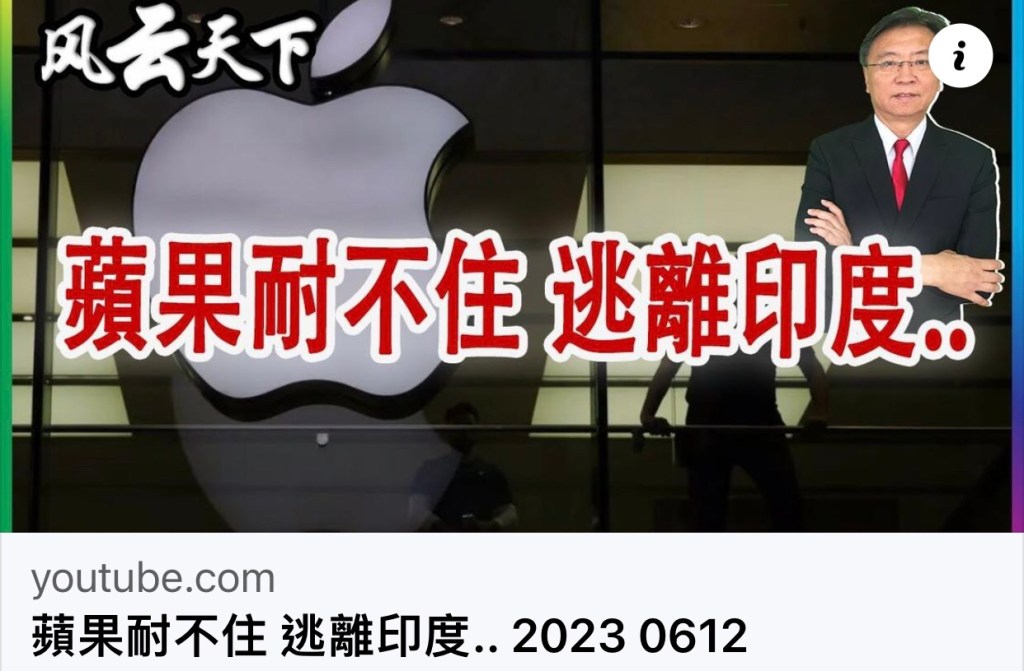
Video: Apple moved some of the iphone assembly from China to India found out big mistakes forced to escape from India 蘋果將部分iphone組裝從中國轉移到印度發現大錯被迫逃離印度
https://youtu.be/QJ5ujhsc_HM 👈
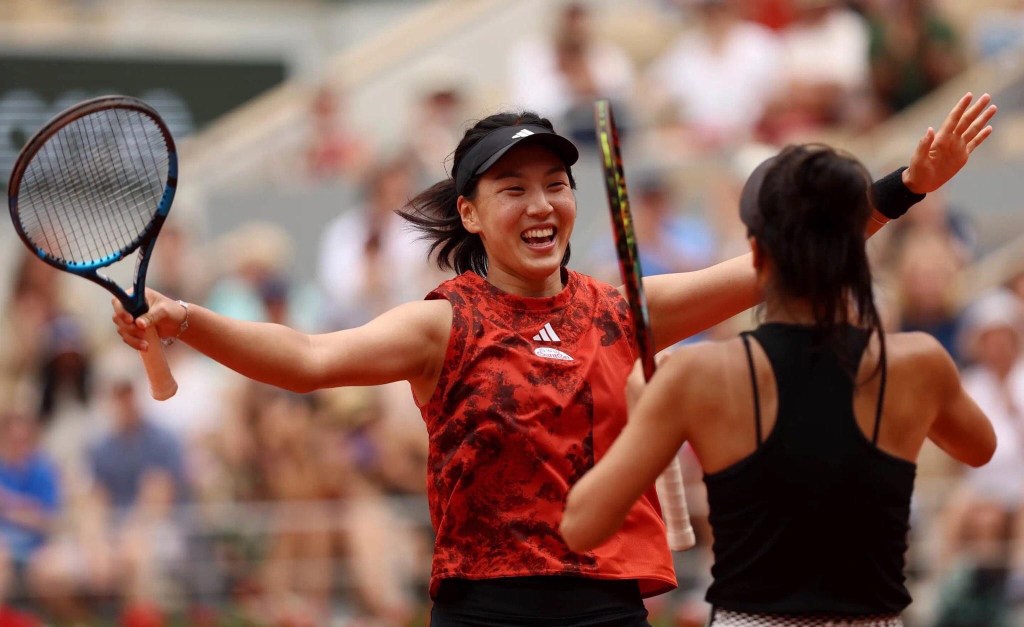
English Tsai upset on the Teamwork! Wang Xinyu from Guangdong and Hsieh Su-wei from Taiwan jointly won the French Open women’s doubles yesterday. 團隊合作! 昨天,廣東的王欣瑜和台灣的謝淑薇聯手奪得法網女雙冠軍.
Many people from mainland China and Taiwan work together, western journalists don’t want the world to know this. More than 400,000 Taiwanese have moved to mainland China. 中國大陸和台灣很多人一起工作,西方記者不想讓世界知道這一點。 超過40萬台灣人移居中國大陸。
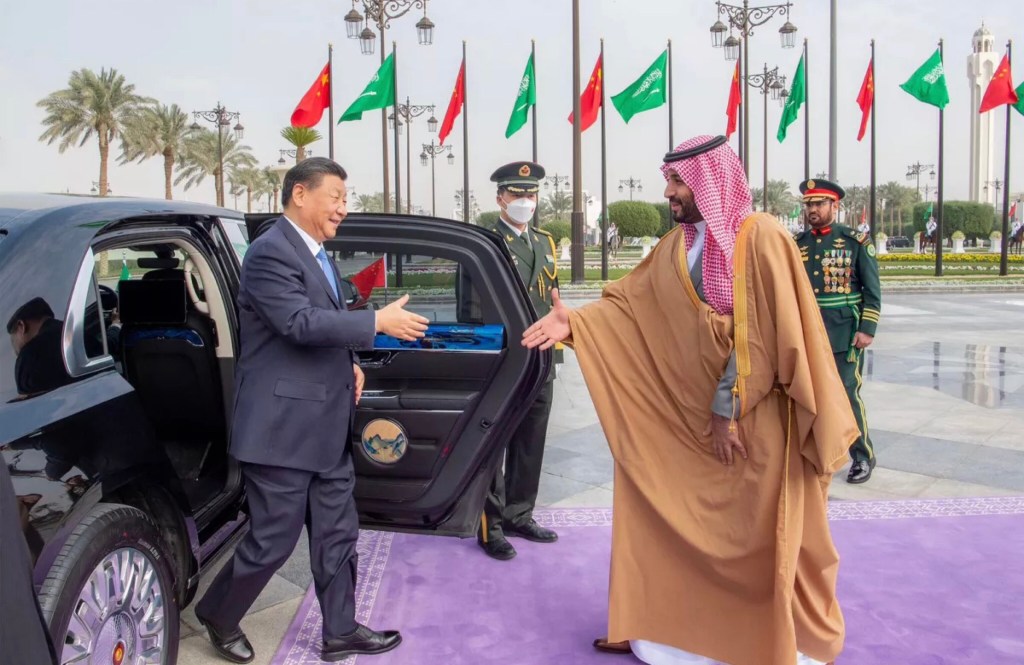
The Middle East: Goodbye America, hello China? The US is losing ground in the region and it has only itself to blame. 中東:再見美國,你好中國? 美國正在該地區失去地盤,只能怪自己 By Marwan Bishara, June 6 2023
https://www.aljazeera.com/opinions/2023/6/6/the-middle-east-goodbye-america-hello-china
In an attempt to salvage his country’s waning influence in the Middle East, US Secretary of State Antony Blinken is embarking on a three-day visit to Saudi Arabia this week. But advancing “strategic cooperation” with his Saudi and Gulf counterparts may well prove an uphill battle.
In July last year, President Joe Biden attended the Gulf Cooperation Council summit in the kingdom and vowed that the United States “will not walk away and leave a vacuum to be filled by China, Russia, or Iran”. But that is precisely what has been happening.
Despite US objections, the past year has seen its regional allies go hybrid: they have improved relations with Beijing and Tehran and maintained strong ties with Moscow.
Although the Biden administration has publicly downplayed the importance of the recent Chinese-brokered Saudi-Iranian agreement to re-establish diplomatic relations, it seems frantic about the growing Chinese influence in the oil-rich Gulf region and the greater Middle East.
Over the past two decades, the US has ramped up oil and gas production, becoming virtually energy independent. It may no longer need Gulf oil as much, but it insists on being in charge in the region so it is able to cut China off of vital energy supplies in the event of a conflict, and secure them for its allies.
As Blinken warned last month, “China represents the most consequential geopolitical challenge we face today: a country with the intent and, increasingly, the capability to challenge our vision for a free, open, secure, and prosperous international order.”
But Beijing’s autocracy may actually be an easier and better fit for the region’s autocrats than Washington’s democracy.
Russia’s sway in the Middle East and beyond has also made the US nervous.
Fed up with their ambiguity, even complicity with Russia, the Biden administration has been ramping up pressure on certain Middle Eastern states, making clear that its patience is running out. It has been warning countries in the region against helping Russia evade sanctions and demanding they pick sides – or else face the wrath of the US and G7 nations.
But to no avail.
Saudi Arabia has thus far refused the US request to substantially increase oil production to lower its market price and offset the effect of Western sanctions on Russia. It has maintained good relations with Moscow and dragged its feet on supporting Ukraine. Saudi Crown Prince Mohammed bin Salman’s “middle finger to Washington” has reportedly made him extremely popular in the region.
Last year, in response to Biden’s threats to punish Riyadh for its presumed insolence, the kingdom went on to host the Chinese president, Xi Jinping for bilateral talks and the China-GCC and China-Arab summits. Saudi Arabia then normalised relations with Iran under Chinese auspices, just as the West was tightening sanctions against Tehran, and in a clear snub to the US, went on to repair ties with Syria.
But this new attitude towards relations with the US is not only evident in Riyadh; it is a regional phenomenon. The United Arab Emirates, another US ally, has also cultivated closer ties with China, improved strategic relations with France, and worked on engaging Iran, Russia and India. This, at times, has been at the expense of its relations with the US.
The region as a whole has been diversifying its global engagement. This is quite apparent in its commercial relations. Between 2000 and 2021, trade between the Middle East and China has grown from $15.2bn to $284.3bn; in the same period, trade with the US has increased only modestly from $63.4bn to $98.4bn.
Six Middle Eastern countries – among them Saudi Arabia, the UAE and Egypt – have recently requested to join the Chinese-led BRICS group, which also includes Russia, India, Brazil and South Africa. This is despite the West’s ever-widening sanctions regime imposed on Russia.
Of course, America has been the dominant strategic power in the Middle East the past three decades and remains so today. But will it be in the next three decades?
In a region where autocratic regimes and the general public do not agree on much if anything at all, saying no to America is a very popular stance because the majority believes it is a hypocritical imperial power that pays only lip service to human rights and democracy.
This is particularly apparent in US foreign policy on Palestine, which staunchly and unconditionally supports the Palestinians’ coloniser and occupier – Israel.
On his visit to Riyadh, Secretary Blinken will likely put pressure on Saudi Arabia to normalise relations with Tel Aviv, hoping to lower its asking price, which reportedly includes a nuclear civilian programme and major security assurances.
The UAE, Bahrain, Morocco and Sudan have already normalised relations with Israel at the expense of the Palestinians in return for American concessions, such as the sale of US-made F-35s to Abu Dhabi, US recognition of Moroccan claims over Western Sahara, and the lifting of US sanctions on Khartoum. All so that the Israeli government does not have to make any “concessions” of its own and end its decades-long occupation of Palestine.
But the Palestinian cause, which is quite close to the heart of ordinary Arabs, is not the only issue that has convinced the Arab public that America is a duplicitous power that should be kept at a distance.
Thanks to satellite television and social media platforms, people of the region saw with their own eyes US crimes in Iraq and its humiliation in Afghanistan, and do not think of it as a guardian of civilisation, let alone an invincible power. The balance sheet of US interventions in the Middle East over the past 20 years since the 9/11 attacks is firmly not in its favour.
No wonder that in a 2022 poll conducted by the Doha-based Arab Center for Research and Policy Studies in 14 Arab countries, 78 percent of respondents believed that the biggest source of threat and instability in the region was the US. By contrast, only 57 percent thought of Iran and Russia in these terms, both of which have had their own share of dirty work in the region – from Syria to Iraq and Yemen.
In his aptly titled book, Grand Delusion: The Rise and Fall of American Ambition in the Middle East, former US official Steven Simon estimates the US has wasted some $5-7 trillion on wars that have resulted in the death of millions of Arabs and Muslims, and the devastation of their communities. In addition, these conflicts have killed thousands of US soldiers, injured tens of thousands and led to some 30,000 suicides of US veterans.
It is no coincidence then, that more Middle Easterners (and Americans) agree that the region’s decoupling from America and at least some American disengagement from the region is as desirable as it is inevitable.
Such a turn of events would also be terribly consequential with messy long-term implications for both sides and it would be determined by whether and how America chooses to change its foreign policy.
But that’s another discussion for another day.
Marwan Bishara
Senior political analyst at Al Jazeera.
Marwan Bishara is an author who writes extensively on global politics and is widely regarded as a leading authority on US foreign policy, the Middle East and international strategic affairs. He was previously a professor of International Relations at the American University of Paris.
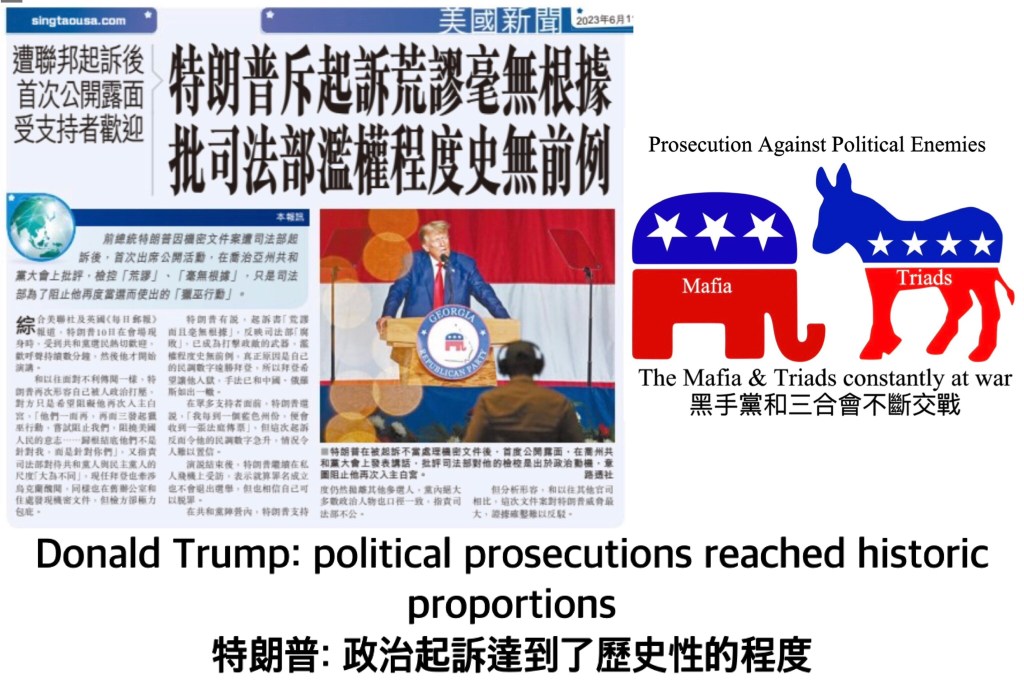
Donald Trump: political prosecutions reached historic proportions 特朗普: 政治起訴達到了歷史性的程度
Repay others in the same way as others, and take the way of the United States so that the United States has nowhere to go
以其人之道還施彼身,走美國的路讓美國無路可走
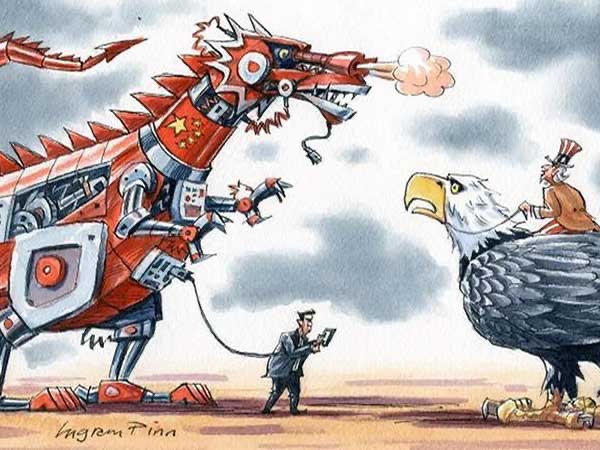
為了永久性獨霸世界,美國對華進行全力的打壓遏制。企圖堵死中國的復興強國之路。中國的反制策略就是,以其人之道還施彼身。也就是堵死美國的霸權之路。或者說走美國的路讓美國無路可走。
用美國的話說,世界已經來到了十字路口。既是中美戰略較量的十字路口,也是單極世界與多極世界較量的十字路口。
美國要堵死中國的復興強國之路。中國自然就要徹底打破美國的封堵。不僅要打破美國的封堵,還必須要堵死美國單極霸權之路。這就必須要削弱美國霸權。
中國早就承諾不爭霸不稱霸,實現和平崛起。中國也是這麼做的。可是,美國卻一直視中國為挑戰和打壓的對手。為了維護自身的利益,中國不應戰都不行。
既然霸權是打壓中國的工具之一,那就必須削弱或剝奪美國的霸權。作為一個負債任的世界大國,作為一個對世界有重要貢獻力和影響力的世界性大國,中國不爭霸不稱霸,但卻不能少了「話語權」。也就是要爭取全球發展和治理的參與權和主導權。不能讓美國霸權來主導世界發展和治理。
雖然說主導權與霸權還是有本質的區別,但不可否認的也是「權利」之爭。霸權與主導權實際上也就是「霸道與王道」之別。不管怎麼說,首要的是堵死美國的單極霸權之路。因此,復興強國的目標就是要實現對美國的超越,就是要有制約美國霸權的能力。爭取世界發展和全球治理的主導權,就是走美國以實力地位領導世界之路。
為了維護美國的單極霸權世界,或者說為了證明美國獨霸世界的合理、合法性,美國不僅要在政治軍事經濟上以實力地位統治世界,更想以自己的意識形態價值觀來統一世界。實際上就是要消滅異己文化文明價值觀。
美國人嘴上說著民主自由,可美國卻從未給世界各國民主的話語權,更沒有給世界各國自由選擇自己道路和堅守自己文化文明價值觀的權利。
自冷戰結束後,政治外交打壓孤立,經濟制裁封殺,以各種藉口甚至於不需要藉口發動恐怖主義式軍事打擊,還有就是通過所謂的顏色革命手段顛覆他國政權。其目的之一就是為了把世界統一在美國的價值觀上來。
因此,價值觀之爭,必然也就成為了中美戰略較量的重點之一。
近來,中國強力向世界推出「全球發展、全球安全和全球文明「三大倡議」。這實際上就是建設全球發展、全球安全和全球文明「三大共同體」倡議。目標就是推動「構建人類命運共同體」。
人類命運共同體理念,實際上就是最大的「普世」價值觀。是意在建設一個沒有霸權的世界,是意在建設一個真正體現國際公平正義的多元文化文明共存的多極世界格局的世界,也就是建立一個真正的「共商共建共享」的世界。絕不接受美國的「霸權霸道霸凌」價值觀。
美國要以價值觀普世,中國也要以價值觀普世。這就是與美國競爭道路,讓美國無路可走。
美國要建立或築固單極霸權世界秩序,中國就強力推動多極世界秩序的建立。美國憑實力稱霸搞亂世界,中國就以實力地位推動和平與互利共贏的世界。美國要走實力稱霸之路,中國也必須打實力牌。最大程度上發揮中國影響力、話語權。這就是中美的道路之爭。
為了扼殺中國復興強國建設,美國欲在世界範圍內建立反華聯盟以孤立圍獵中國。也就是欲堵死中國的復興強國之路。
美國可以做的中國當然也會選擇。美國要圍堵中國,中國也可以選擇對美國進行反包圍戰略。就是以其人之道還施彼身。
在已經擁有的西方聯盟北約的基礎之上,美國又力推了五眼聯盟,四方機制,美英澳三國聯盟,美日韓軍事一體,半導體聯盟,網絡聯盟,科技聯盟,以及印太經濟框架和印太戰略,等等。這些都是圍堵中國的手段。
對此,我方自然不能坐以待斃。一帶一路戰略,亞洲互聯互通,上合組織、金磚國家擴容,RCEP,以及,中國+東盟,中國+阿拉伯世界,中國+非洲聯盟,中國+南美聯盟,中國+中亞五國,中國+歐亞聯盟,等等。
最後以眾多「中國+區域合作」模式推動建立去美國化的世界新秩序體系。
G7是美國霸權的重要工具,也是打壓中國的重要工具。當然也是維護西方利益的重要聯盟。
然而,近來金磚國家正在推動擴容。未來可能擴增到17-19個國家。有意思的是,據英國據英國宏觀經濟研究公司最新公佈的數據顯示,在基於購買力平價的水平下,由世界5個主要發展中經濟體組成的金磚國家集團佔全球GDP)中所佔份額已超過七國集團 (G7)。金磚五國佔31.5%,G7集團佔比30.7%。
在南非召開的金磚外長會議又有11國積極參會。這些國家一至認為:金磚國家是發展中國家的捍衛者。「部長們強調鼓勵在國際貿易和金融交易中使用當地貨幣的重要性。」
印度外長蘇傑生說,這次會議必須「發出一個強有力的信息,即世界是多極的,正在重新平衡」。巴西外長毛羅?維埃拉也稱,金磚國家是「建立多極世界秩序不可或缺的機制,這種秩序體現出發展中國家的方式和需求」。
印度可是被美國視為是自己陣營的一員。而巴西不但是南美的大國,也是美國後院的國家。可見世界正在遠美國而去。
不僅金磚國家的影響力大幅提升,還有擴容的上合組織也在發揮經濟與安全合作的重要作用。分裂的G7聯盟已經成了雞肋。
美國要把中國孤立排除在自己的體系之外,中國同樣要建立獨立於美國之外的體系。美國孤立中國,中國就孤立美國。玩法一樣,打法雷同。
中國不結盟,爭取的是世界上更多的合作者建立合作體系。威力自然也是異曲同工。關鍵是中國推動的體系建設就是對美國霸權體系建設的最大制約。也就等於是在為美國霸權道路設障。
美國要戰爭威脅與訛詐,中國就以戰止戰。「極限思維」,就是準備一戰。強國建設必須以強軍先行或以強軍作為保證。正因為落後,所以必須知恥而後勇。
美國是全球戰略,必須要進行全球軍事部署。而中國並不想全球稱霸,不需要走蘇聯的老路全面競爭。美國要同時面對俄羅斯以及其它致力於發展軍事自保和獨立成極的國家或聯盟。也就是說,在軍備競爭中,美國必須承受比中國多出一倍甚至是數倍的付出。
儘管美國有科技優勢,但中國的高精尖武器已經不輸美國多少。甚至於中國還有沒美國沒有的獨門絕技。真要打起來,美國肯定佔不了便宜。
美國要削弱拖垮俄羅斯,美國利用烏克蘭消耗俄羅斯,而俄烏衝突實際上已經嚴重消耗牽制了美國。
伊朗、朝鮮等國始終是美國的心病,中國與之加強合作,通過伊核問題朝核問題消耗牽制,對美國也足以形成戰略打擊。
打壓中國經濟,維護美國金融經濟霸權,這是美國獨霸世界的基礎前提。
美國把中國威脅論變成了「去中國風險」。中國就推動政治戰略上去美國化,金融經濟上去美元化。
東南亞已經與美國保持了距離,中東西亞或者說阿拉伯世界正在疏遠美國。其它非西方國家則正在加強對華合作。南南合作體系正在快速形成。
即使是搖擺的歐洲,也明確強調戰略自主和反對與中國搞陣營對抗。更是積極尋找與中國加強合作的新路。這些顯然都是去美國化的表現。
重要的是,與政治上去美國化相伴隨的就是,去美元化浪潮的興起。而中國則借機推動人民幣國際化,同時也在推動人民幣支付體系,以及地區本幣支付體系。這是一個不可逆的過程。這將極大削弱美元霸權。
而美國政治軍事霸權以及美元霸權,正是美國經濟的重要支柱。美國一切內政外交政策和經濟結構的基礎,也正是建立在這兩大霸權的基礎之上。霸權的削弱,對美國的傷害將是顛覆性的。
儘管歐盟也強調要擺脫對中國依賴,也試圖要介入南海和台海問題。但歐盟也突出強調:須對中國採取一種「頭腦清晰」但「非對抗性」的態度。這顯然是對美國保持戰略自主。
據說馬克龍公開反對北約在日本設辦事處。這表明了歐洲主要大國之一的法國會牽制北約介入亞太事務,也表明瞭歐盟不會追隨美國與中國對抗。
炒作台灣問題以及炒作南海話題。無非是想把台海、南海問題國際化,以達到孤立圍攻中國之目的。但事關中國主權安全,這是對中國最直接最危險的挑戰。一旦冒險涉足,很可能引發我軍的強烈反制。不怕死的不妨來。可問題是,包括美國在內也沒有幾個不怕死的國家。
重要的是,中國可以借機強化軍事鬥爭準備。美國一直大造大國威脅論或去中國風險論,那中國就通過對美國的軍事強硬政策充分展示一下「威脅」。徹底打破中國周邊的軍事平衡。有必要的話,就不妨借機收回主權。
美國軍事威脅之路中國也不是不會走,更不是不能走。是被美國逼著走。這就是走美國的路,讓美國無路可走。
總之,美國總想著建立反華聯盟包圍中國,以堵死中國復興強國之路。中國就也學著美國建立獨立於美國之外的合作體系,把美國排除孤立在外。也就是對美國來一個反包圍。堵死美國的霸權道路,讓美國無路可走。■
Hong Kong-style Mandarin Video: 香港式普通話
https://rumble.com/v2tg1kk-hong-kong-style-mandarin-video.html
https://www.tiktok.com/t/ZT81ytN3b/

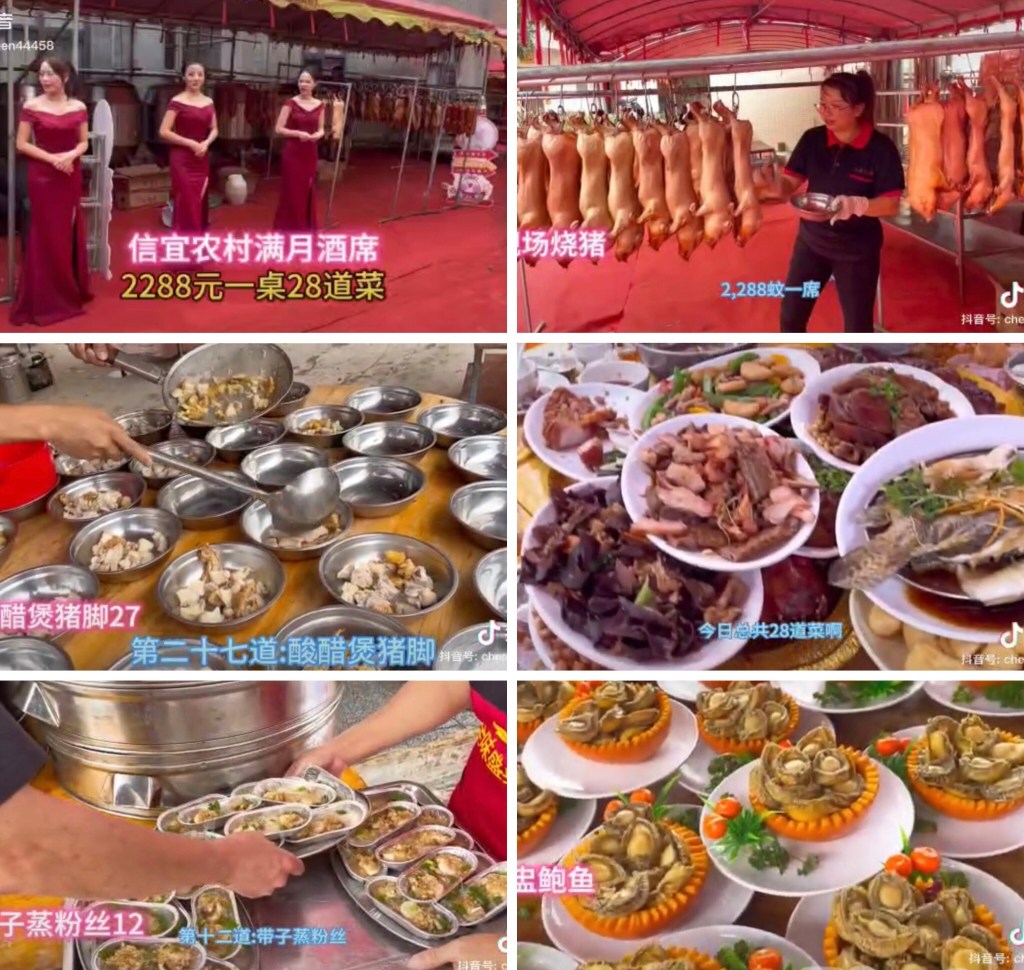
Food Culture China Video: 28 courses Chinese dinner for US$350 only (no tax or tips required) 中國飲食文化視頻:28 道菜的中式晚餐僅需 350 美元(無需付稅或小費)
https://www.tiktok.com/t/ZT81yrCMS/
https://rumble.com/v2tfvng-food-culture-china.html
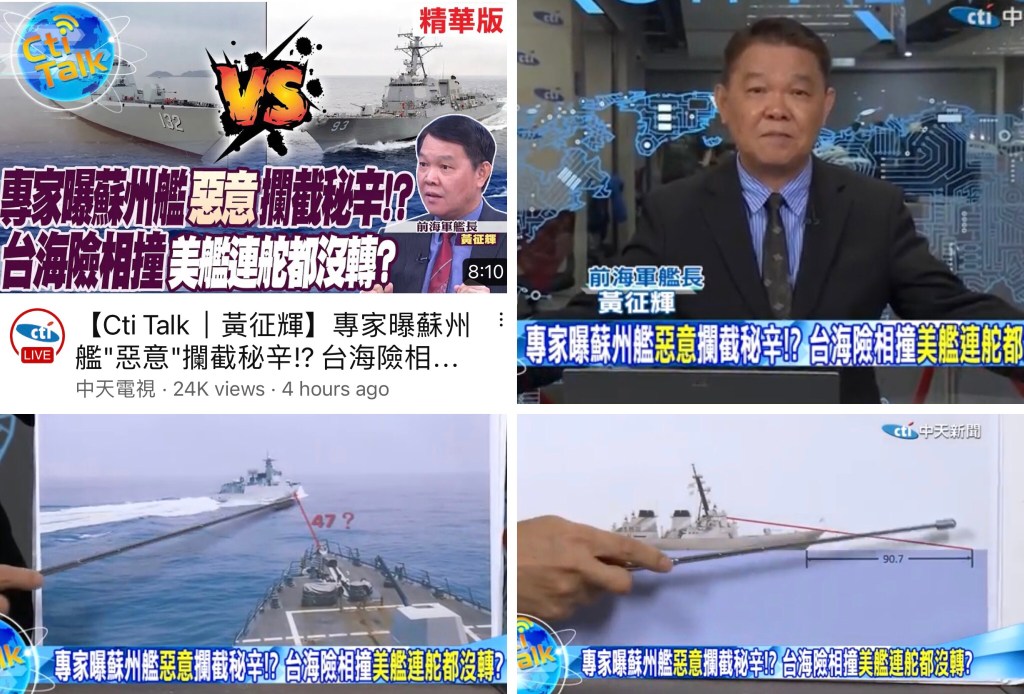
Taiwan Warship Captain Video: US & Canada lied about China warship cut in front of them by 135 meters. It is probably 3x more! 台灣艦長視頻:美國和加拿大謊稱中國軍艦在他們面前135米快速渡過, 最少是135米的3 倍!
https://youtu.be/VmH52Ej19eA
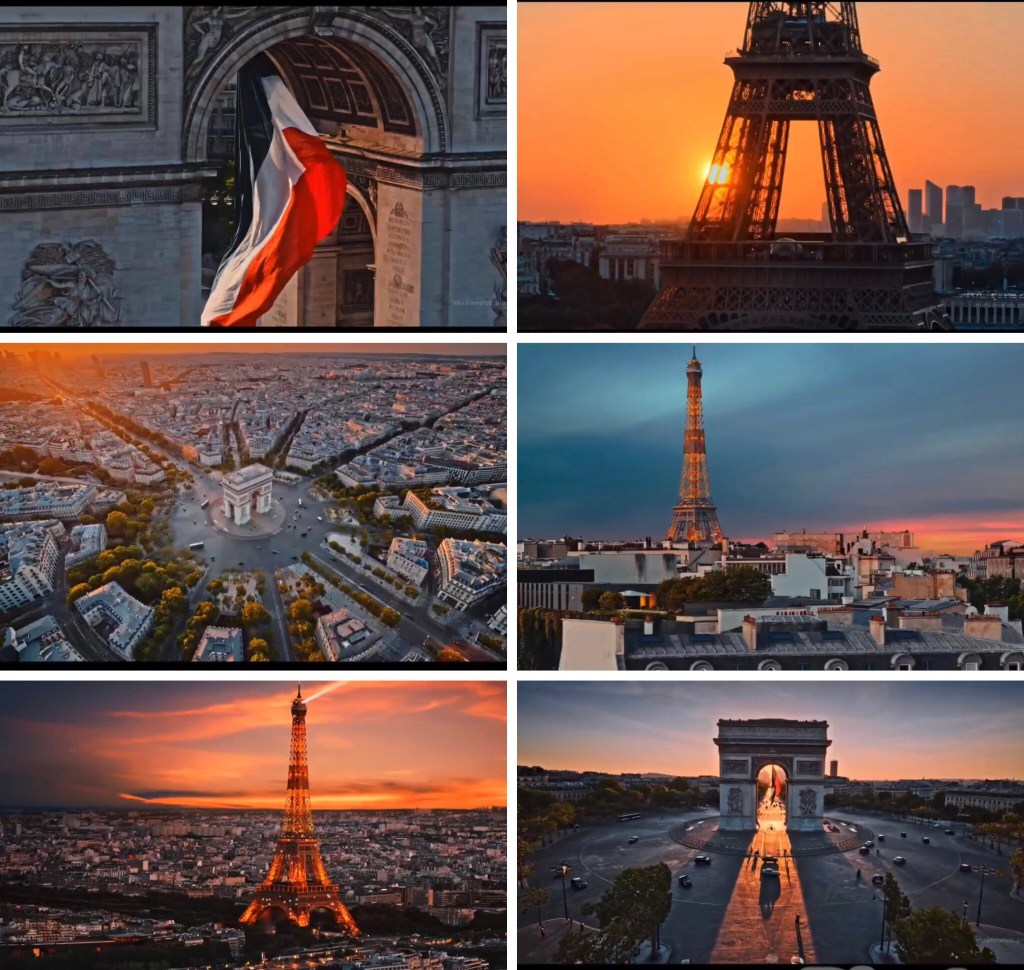
The French Connection video, edited by JWKC 6-10-23 法國連線視頻
https://rumble.com/v2tby50-the-french-connection-video.html
https://www.tiktok.com/t/ZT81A57yH/
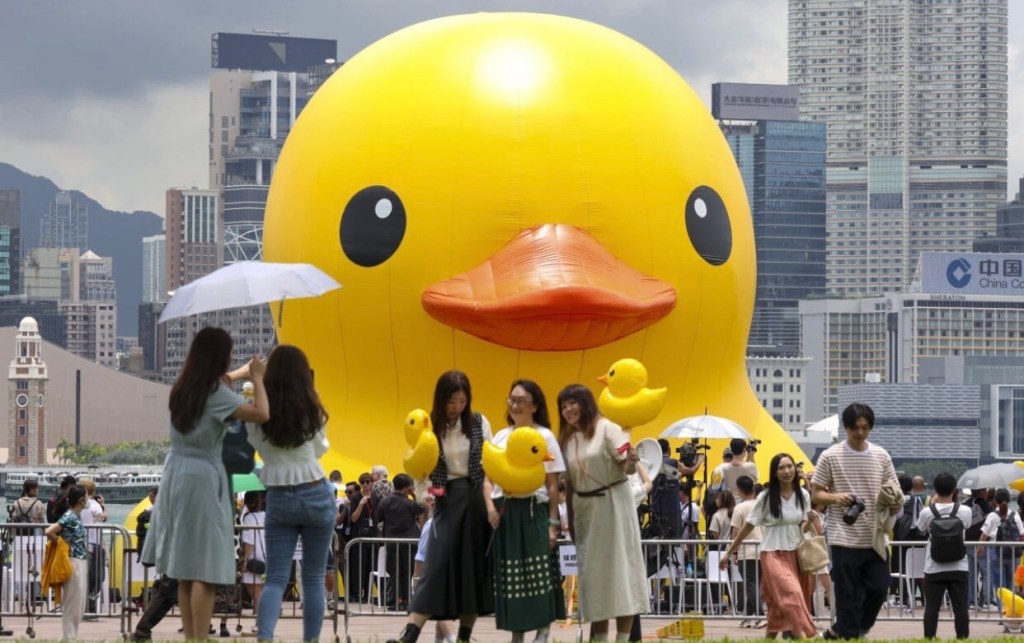
Video: The ducks have landed in Hong Kong. Produced by JWKC 視頻:鴨子已經登陸香港 6-10-23
https://rumble.com/v2tbsjy-the-ducks-have-landed-in-hong-kong.html
https://www.tiktok.com/t/ZT81SoPHm/
 Business Blog