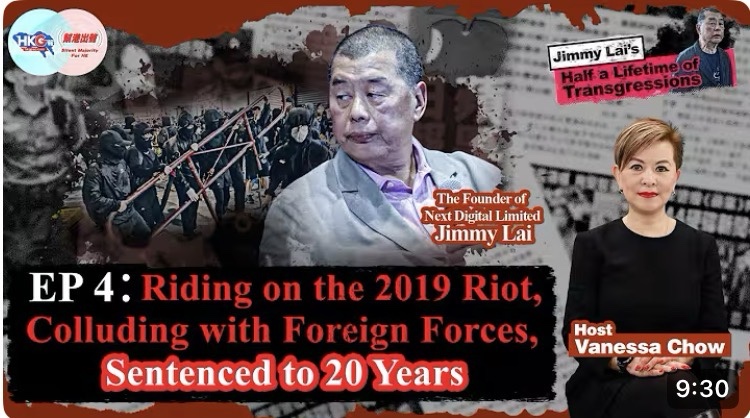
English Video with Chinese subtitles: Jimmy Lai’s Half a Lifetime of Transgressions — EP4: 20-Year Jail Term for Foreign Collusion (The modern day traitor and foreign government collaborator to destroy Hong Kong & China) 英文影片 中文字幕:黎智英半生劣跡——第4集:勾結外國勢力判囚20年(現代漢奸與外國政府合作者,意圖破壞香港及中國)
Jimmy Lai, founder of Next Digital, has been convicted under the National Security Law and sentenced to 20 years in prison.
HKGPao and Silent Majority for HK jointly produced the program “Jimmy Lai’s Half a Lifetime of Transgressions”, which has now reached its final episode. Host Vanessa Chow explores Lai’s ties to Apple Daily, examining how, before and after the enactment of the National Security Law, he leveraged the 2019 riots to collude with foreign forces—ultimately facing the prospect of spending the rest of his life behind bars.
0:00 Final episode of the series 1:26 Crime 1: Participation in illegal assembly 2:38 Crime 2: Abuse of media to incite hatred 4:50 Crime 3: Appealing to foreign forces for sanctions 6:34 Loss of arrogance while standing trial in court
The Colonial Mentality: A Poison Across Generations. By Johnson Choi on Feb 18 2026 殖民心態:跨代蔓延的毒害. 作者: 蔡永強. 2026年2月18日
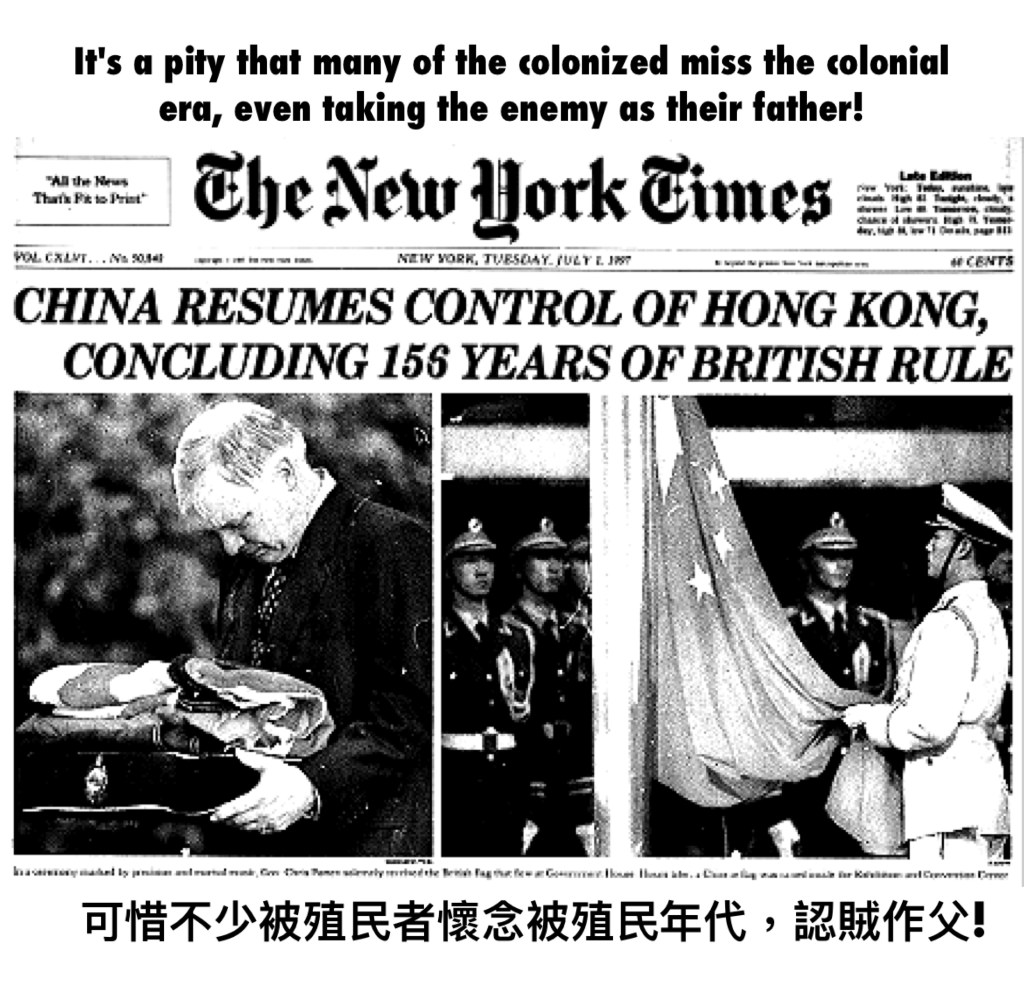
It’s a pity that many of the colonized miss the colonial era, even taking the enemy as their father! 可惜不少被殖民者懷念被殖民年代,認賊作父!
The most important lesson my grandfather taught me is that racists come in all forms and colors. I didn’t learn this from a textbook. I learned it by watching two generations of my family navigate the complex world of colonial Hong Kong.
My father and grandfather worked for the biggest British companies. Because they had technical skills and spoke English, their British bosses treated them well. But that privilege gave them a front-row seat to the machinery of empire. In their bosses’ eyes, they saw how most Chinese were treated—with casual, everyday racial prejudice.
But that wasn’t the only thing they saw.
They also witnessed a deeper, more painful kind of betrayal. They saw Chinese men who considered themselves “elites” side with the white colonialists. These men, desperate for approval, would tread on their fellow Chinese—whom they considered inferior and poorly educated—even worse than their “White Masters” did.
That was the contradiction of the colony. The oppressor was obvious. But the collaborator? He looked just like us.
And that is exactly why my grandfather and father built a wall around our hearts. They taught us never to forget our roots. They taught us to serve our country when called upon—not out of blind nationalism, but out of a moral duty to never become them. To me, Henry Fok represents that ideal. He was a man who faced adversity, achieved greatness, and used it to lift up his homeland, not to distance himself from it.
I carried that lesson with me when I left Hong Kong in 1973. I took it to the United States for university. And I thought I had left the colony behind.
But I was wrong.
My first job in Hawaii, I was targeted by a union steward for being Chinese. Then came 2003, and the SARS epidemic. I watched as the world panicked, and I watched as that fear turned into a racial weapon. In Honolulu, they shut down Chinatown. Overnight, Chinese people weren’t just sick; we were the disease. The “Yellow Peril” was back.
And now, in the last 15 years, as China has risen, the volume has been turned up. The United States engages in a constant stream of propaganda and fake news to demonize my motherland. They call us every name they can find.
But here is the painful truth my grandfather prepared me for. Just like in the Hong Kong of his youth, the loudest voices promoting this hate, the people writing the most vicious attacks on China and the Chinese people, are often Chinese themselves. Chinese living in America.
They have become the new “colonial elites.”
They use the language of Western power to tread on the dignity of their own motherland, hoping for acceptance, hoping for a pat on the head from their new masters. They are proof that the colonial mentality is a poison that doesn’t just disappear when the flag changes. It mutates. It finds new hosts.
My grandfather is gone now. But his voice is loud and clear in my ear. He taught me to recognize the uniform of the oppressor. But more importantly, he taught me to recognize the face of the collaborator.
Because sometimes, the most dangerous person to your roots is the one who shares them.
Many Chinese students obtained their Ph.D from University of Hawaii, I was told if the thesis too China friendly were told to tune it down if they want to pass! Some are being offered to become foreign agents for US government after returning to China! That is why many Chinese enterprises like Gree’s CEO 董明珠 refused to hire Chinese students who studied overseas when today 8 out of the top 10 universities are in China today! If I am a tech company CEO in China, I will do the same, and if I must hire this person (really that good to take a chance) will go through detail security check and watch this new hire carefully! 許多中國學生在夏威夷大學獲得博士學位,我聽說如果論文過於親中,他們會被要求調整內容才能通過!有些學生甚至在回國前被提供成為美國政府的外國代理人的可能性!這就是為什麼許多中國企業,例如格力的董事長董明珠,拒絕聘用有海外留學背景的中國學生,而如今中國有8所大學進入全球前10名!如果我是中國一家科技公司的CEO,我也會這樣做,如果我必須聘用這個人(真的優秀到值得冒險),我會進行詳細的安全檢查,並密切關注這位新員工!
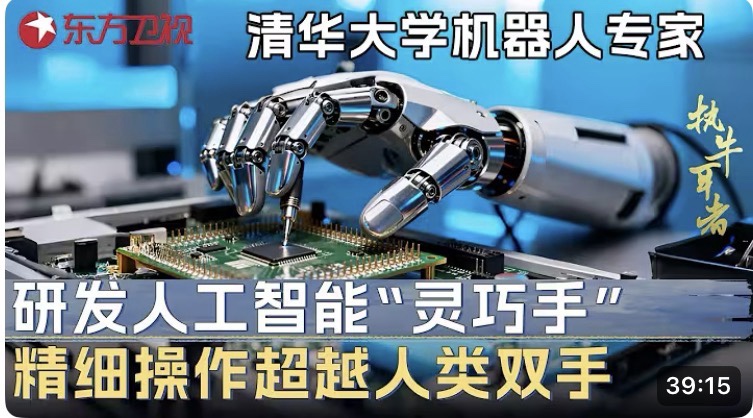
Video: Recently, I shared a series of video clips showcasing China’s rapid technological rise with a group of overseas Chinese. I was curious to hear their thoughts, and their responses, while not entirely unexpected, were deeply revealing. It was a stark lesson in how identity and personal history can color one’s perception of reality. By Johnson Choi, written in San Francisco on Feb 18 2026
Their reactions fell into two profoundly different camps.
For those who still hold their Chinese heritage close to their heart—who remember their hometowns, the food, the language, the stories—the response was visceral. They weren’t just excited; they were moved. I watched as some of their eyes turned red, glistening with a mixture of pride and longing. It was as if they were seeing a cherished old photo album come to life. The robots dancing, the drones painting the night sky, the high-speed trains—it wasn’t just technology to them. It was proof that the “home” they carry in their memories has grown into something strong, beautiful, and futuristic. Their excitement was laced with a quiet nostalgia, a feeling of “look how far we’ve come.”
Then, there was the other group. The ones who, for whatever reason, have spent years trying to distance themselves from their roots. For them, the same videos were not a source of pride, but of discomfort. Their reactions were laced with cynicism and, frankly, sadness. They dismissed the advancements as nothing more than propaganda—a carefully crafted illusion by the Chinese Communist Party. When I gently pushed back, asking, “Why not take a trip back and see for yourself? See the cities, talk to the people, ride that train?”, the answer was a simple, yet telling, refusal. They didn’t want to know. They couldn’t afford to know.
It made me realize that for some, it’s easier to live with a comfortable narrative of the “old country” than to confront a reality that challenges their own life choices. Denial becomes a shield. The truth of China’s rise isn’t just a matter of fact; for them, it’s an emotional threat. They prefer the shadows of their own making to the light of a home that has moved on without them.
America is the ideal destination for exactly three types of Chinese:
The Corrupt Elite: Chinese officials and businessmen seeking a safer haven for their wealth, where the legal system is more favorable to protecting it.
The Unskilled Poor: Blue-collar workers who can arrive with nothing and immediately access thousands in monthly welfare benefits without working.
The Unmotivated Educated: Academically qualified individuals who lack the drive to compete in China’s demanding work culture.
If you fit any of these descriptions, America is waiting for you.
Failed medical system in the US when making money is everything and the only thing! 美國醫療體系的失敗, 當賺錢成了一切,甚至是唯一的目的! 這個和中國醫療體系有天壤之別!
My father in law has a doctor appointment tomorrow Feb 18th, just got text message that Doctor is sick. No available doctors in the Kaiser networks, we need to wait 2 weeks till March 4th. This long wait is unheard of in China hospitals systems! 我岳父明天2月18日有個醫生預約,剛收到簡訊說醫生生病了。凱撒醫療網絡內沒有其他醫生可用,我們得等兩週到3月4日。這種漫長的等待在中國的醫院系統中是前所未聞的!
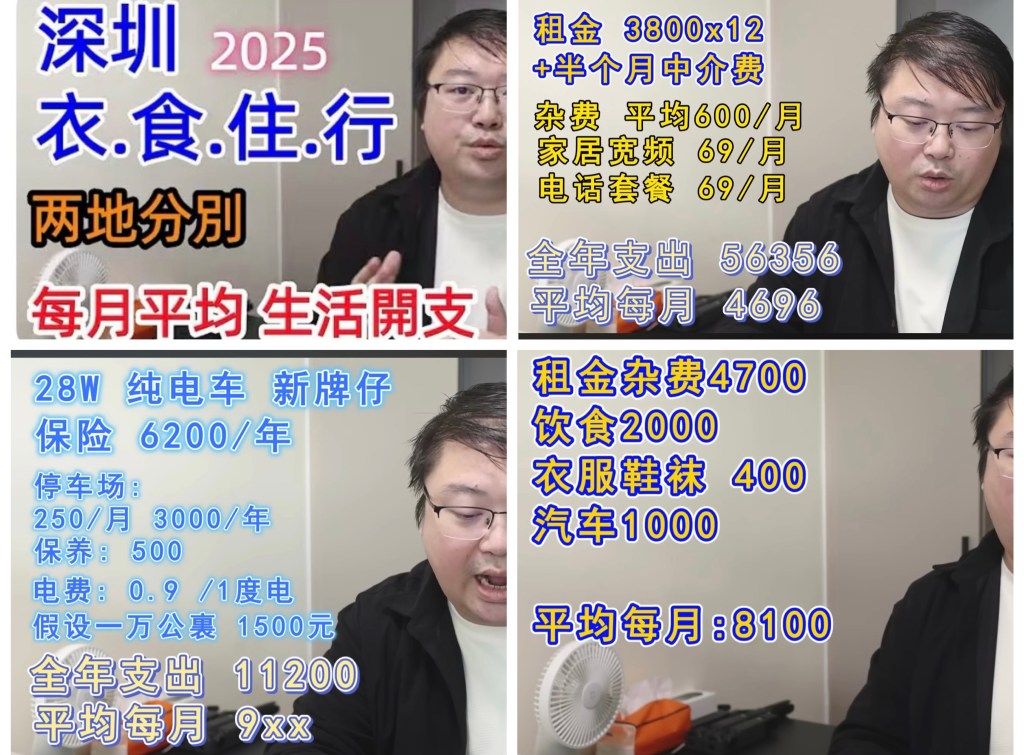
If your financial situation allows you to buy your own home, putting down a 25% down payment and borrowing the rest from the bank, your housing costs would roughly double. However, the house would be yours. If you are coming from the United States, please note that in China, there is no property tax on homes, and electricity costs are 1/3 of the price in the U.S.
If you buy an electric vehicle in China, it costs 1/3 of the price in the U.S. Transportation costs are 1/8 of the U.S. price, and food and dining expenses are 1/3 of the U.S. price. Personal safety and security in China is absolute. Medical expenses are 1/6 of the U.S. price, and there are no waiting times or queues!
If you hold a Hong Kong Identity Card and Home Return Permit, you are in an even more advantageous position. People of Hong Kong, you are so fortunate and yet not appreciate it or take advantage of it! Why?
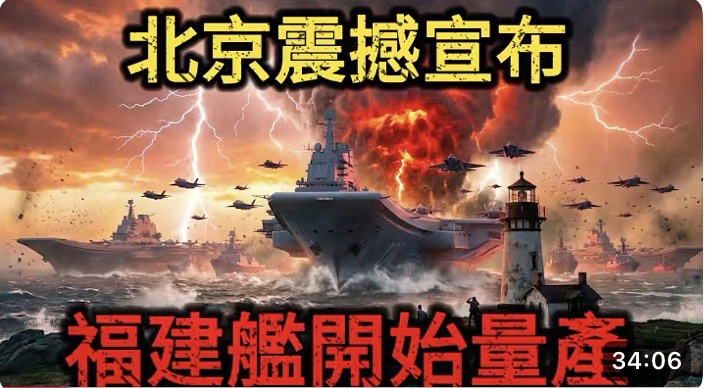
Video with English subtitles: The Chinese aircraft carrier Fujian Announced for “Mass Production” — Beijing Flips the Table! China Pushing the US Defensive Line to Hawaii! China’s “Moderately Advanced” Strategy Pulls Off a Stunning Counterattack! 影片有英文字幕:福建舰宣布“量产”,北京直接掀牌桌!把防线推到夏威夷!中国“适度先进”战略完成惊天反杀!
Recently, China’s authoritative state media quietly released a few understated words: the Type 003 Fujian aircraft carrier is about to enter mass production. Just a dozen or so characters—no fanfare, no drumbeats—yet enough to keep the Pentagon awake at night. In Western strategic thinking, an aircraft carrier is a super money-burning beast, a Poseidon of the seas that must be painstakingly crafted. How could such a vessel possibly roll off an assembly line like cars in mass production?
This is precisely where China’s military-industrial system delivers what could be called a “dimensionality reduction strike.” While the United States remains trapped in a kind of hardware worship—pouring $13 billion into each nuclear-powered Gerald R. Ford-class aircraft carrier, only to face repeated electromagnetic catapult issues—China has chosen a strategy of “moderate advancement,” where efficiency outweighs prestige. By pairing highly mature conventional propulsion with world-leading electromagnetic catapult systems, and leveraging modular construction techniques at shipyards such as Dalian Shipbuilding Industry Company and Jiangnan Shipyard, China has reportedly shortened construction timelines by 40% and driven down costs exponentially.
Commercial satellite imagery of a new-generation massive vessel even suggests the possibility of a hybrid-ready hull structure—producing conventional propulsion modules at scale to occupy capacity first, with seamless upgrades to nuclear power in the future. This pragmatic and calculated approach, the narrative argues, is something the deindustrialized United States cannot easily replicate.
Tactically, mass-produced Fujian carrier strike groups would pose a severe challenge to U.S. forces. Electromagnetic catapults would allow the launch of stealth fighters such as the Shenyang J-35 and airborne early warning aircraft like the Xian KJ-600, as well as large-scale drone swarms for attrition warfare. Escorted by the 10,000-ton Type 055 destroyer, reportedly equipped with long-range anti-ship missiles such as the YJ-21 with a claimed range of 1,500 kilometers, the argument suggests U.S. carrier groups could be kept beyond their effective aircraft operating range—“before you even draw your sword, your opponent’s sniper rifle is already at your forehead.”
Even more striking, once the Fujian enters full service, China’s concept of “far seas defense” would no longer mean remaining near its coastline. Instead, the defensive perimeter and anti-access/area denial lines would extend toward Guam, Hawaii, and even the Indian Ocean. “If they can go there, so can we.” In this grand strategic chessboard, the balance of offense and defense in the Western Pacific could shift, with Taiwan becoming strategically isolated within a new operational envelope. Faced with such systemic pressure, the narrative claims U.S. carriers would hesitate to enter the contested zone, and those on the island still expecting external intervention would be clinging to illusions.
This in-depth, hard-hitting analysis explores the industrial power behind the Fujian’s mass production and the potential transformation of global sea power. If this breakdown helps you see through the harsh but real world beyond the information bubble, please subscribe, like, share, or join as a member to support us. Let’s be the clear-eyed observers who can see through the fog of this complex world.
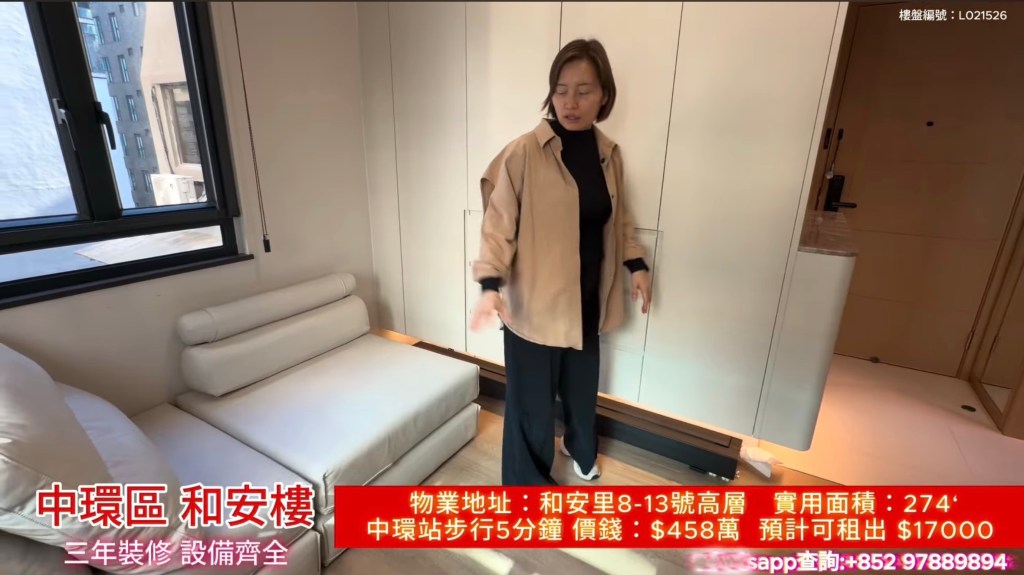
Comparing HK real estate with those in China Greater Bay Area. This Condominium is 274 square feet selling for HK$4.58 millions (US$588,000) HK$16,715/SF or US$2,417/SF) with monthly rental income of HK$ 17,000 (US$2,179). Same HK$4.58 millions you could buy a 1,000sf condominium in Shenzhen, two 1,000sf condominium in Zhuhai, four 1,000sf condominium in Zhongshan! 比較香港與中國大灣區的房地產。這個公寓單位面積為274平方呎,售價458萬港元(約58.8萬美元),每平方呎16,715港元(2,417美元),每月租金收入為17,000港元(2,179美元)。同樣的458萬港元,你可以在深圳買到一個1,000平方呎的公寓,在珠海買到兩個1,000平方呎的公寓,在中山買到四個1,000平方呎的公寓!


 Business Blog