Video with Chinese subtitles: China’s JL-1 Can Make Every U.S. Base An Easy Target: Guam, Hawaii, California…影片有中文字幕: 中國的巨浪-1飛彈能讓每個美國基地都成為輕易目標:關島、夏威夷、加州…
The night sky over the East China Sea is deceptively quiet. A lone H-6N bomber cuts through the clouds, its engines humming like a predator gliding just beyond reach.
Then, alarms erupt. Japanese radar stations light up. Screens flash red. Something massive just dropped from the belly of the aircraft.
For three long seconds, it falls silently. Then, fire ignites. The missile roars alive, climbing into the stratosphere, streaking toward the Pacific horizon.
Operators scramble. They’ve seen cruise missiles before. They’ve seen hypersonics. But this… is different.
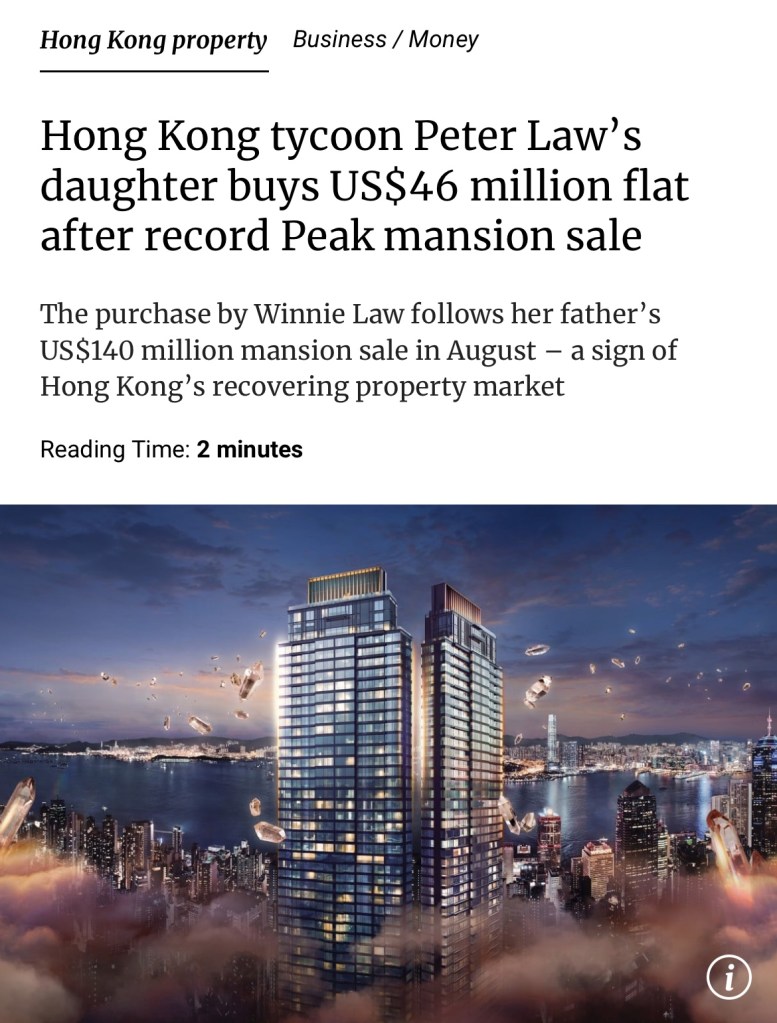
As my grandfather and father have told me “Hong Kong is a blessed land” SCMP: “Hong Kong stands as key beneficiary of China’s continued opening up efforts” “Most of the world’s wealth will originate from mainland China in this century, and Hong Kong will be a key beneficiary, thanks to its unique position as part of the Greater Bay Area and an offshore centre close to the heart of global wealth creation” 正如我的祖父和父親告訴我的,「香港是一塊福地」。 《南華早報》:「香港是中國持續開放努力的主要受益者」。 「本世紀,世界上大部分財富將來自中國大陸,而香港將成為主要受益者,這得益於其作為粵港澳大灣區一部分的獨特地位以及靠近全球財富創造中心的離岸中心.”
SCMP: How are mainland Chinese visitors enjoying Hong Kong during ‘golden week’? Mainland Chinese visitors have continued to stream into Hong Kong for the National Day “golden week” holiday, with many heading to the horse races and enjoying discounts on movie tickets and free transport rides. According to the Immigration Department, 454,778 cross-border trips were made on the first two days of the eight-day holiday. The Fire Dragon Dance in Tai Hang has attracted enthusiasm on social media, with travel guides lauding the local tradition. The National Intangible Cultural Heritage event features a 67-metre (220-foot) dragon made of rattan, rope and over 10,000 burning incense sticks. 《南華早報》:內地遊客在「黃金週」期間如何遊玩香港?國慶日「黃金週」假期,內地遊客持續湧入香港,許多人前往觀看賽馬比賽,享受電影票折扣和免費交通。根據入境事務處統計,在為期八天的假期中,首兩天跨境旅客達454,778人次。大坑舞火龍在社群媒體上引發熱烈討論,旅遊指南也紛紛稱讚這項當地傳統。這項國家級非物質文化遺產的特色是一條67公尺(220英尺)長的龍,由藤條、繩索和一萬多支香火組成. https://www.scmp.com/news/hong-kong/hong-kong-economy/article/3327838/how-are-mainland-chinese-visitors-enjoying-hong-kong-during-golden-week?
Video with English subtitles: China has changed dramatically in 76 years! The Chinese people’s living standards have shocked many foreigners! Those Chinese who have been brainwashed by Western “ideological colonization” can re-understand their motherland. 影片有英文字幕: 中國76年的惊人变化!中国人的生活水平,竟让许多老外破防! 那些華人被西方[思想殖民] 可以重新理解你的祖國, 西方的月亮像阿波羅登月是在好萊塢製作的, 是假的! https://www.tiktok.com/t/ZP8ALXQyo/ https://youtu.be/ocGEa1v38-U?si=uI6cPR6asrMUrfcp
Taiwan US-China expert video with English subtitles: China 93rd military parade is to intimidate US to enter arm race with China to Bankrupt America! 台灣中美尊家苑舉正教授視頻有英文字幕: 北京93閱兵, 中國希望威嚇美國與中國展開軍備競賽,讓美國破產.
It will just as US did to the Soviet Union! Everything in the US costs at least 3x more than China, so the US would need to spend $3 trillion annually, or 50% of its revenue to engage in an arms race with China! Taiwanese Professor Yuan Juzheng lamented: “The US is truly in trouble!” 就像美國對蘇聯一樣! 美國所有東西的價格都是中國的3倍,因此美國每年需要花費3兆美元,也就是50%的收入來與中國進行軍備競賽! 台灣苑舉正教授嘆:美國真的不行了, 無能又不舉了!
Back then, Tsarist Russia seized 1.5 million square kilometers of Chinese territory, and the Chinese people remembered it for more than a hundred years… But today, it’s Russia’s oil and China’s roads; Russia’s gas and China’s furnaces. Money doesn’t go through the U.S. dollar—settlements are done directly in renminbi, accounting for over 90%. This is called pragmatism, not “taking sides.” 曾經沙俄割走一百五十萬平方公里,中國人記了一百多年…可今天,俄羅斯的油,中國的路;俄羅斯的氣,中國的爐,錢不走美元,直接用人民幣,結算率九成以上——這叫務實,不叫站隊.
Last year, the trade volume between China and Russia reached over $200 billion, with more than 90% settled directly in renminbi. Russia sells oil and gas in renminbi, and China sells goods for renminbi as well. This not only bypasses the constraints of the U.S. dollar, but also gives the renminbi more weight in global circulation.
So what supports this $200+ billion trade volume? Closest to everyday life are agricultural and industrial products.
Russia’s land yields large amounts of soybeans and beef each year. The quantity shipped to the Chinese market has been climbing annually, increasing by more than 20%. These products end up on Chinese dinner tables, while Russian farmers earn solid income.
At the same time, Chinese carmakers are also expanding rapidly in Russia. Companies like Geely and Chery have built factories locally. Russians get affordable, good-quality cars, while China’s industrial chain gains a new outlet. This back-and-forth exchange is true complementarity.
But the real key driving this trade is energy—natural gas and oil are the core of cooperation.
The China–Russia Eastern Route natural gas pipeline, stretching over 5,000 kilometers from Siberia to Shanghai, delivered 31 billion cubic meters in 2024 and is on track to hit 38 billion cubic meters this year. That supply can meet the needs of over 400 million people while cutting emissions by more than 100 million tons of CO₂—a boon both to industry and the environment.
With Europe closing its doors to Russian gas, China became the perfect buyer, and the two sides matched up instantly.
In oil, pipelines play an even bigger role. A nearly 1,000-kilometer crude oil pipeline delivers Russian oil directly to Daqing in China, transporting over 100 million tons a year—about 20% of China’s oil imports.
In the past, tankers had to haul oil from the Middle East through the Strait of Malacca—long and vulnerable to external control. Now, with a direct supply line, even if global oil prices fluctuate, China’s domestic supply remains much more stable. That’s tangible security.
With energy and goods flowing, transportation must keep pace. In recent years, the China–Russia border has seen the completion of the Tongjiang railway bridge and the Heihe highway bridge. Around 70% of China–Europe freight trains pass through Russia. Before, shipping to Europe meant detours; now, transit takes several days less, and costs are sharply reduced. With infrastructure opened up, bilateral cooperation truly faces no obstacles.
Still, even with today’s close partnership, history can’t be ignored. In the mid-19th century, three unequal treaties forced China to cede 1.5 million square kilometers of land—a price of national weakness.
China will never forget this memory, but it doesn’t mean today’s reality should be entangled with that old debt. Remembering history is about self-reliance; pragmatic cooperation is about continued development.
The reality is clear: one-third of Russia’s exports go to China, and nearly half its imports come from China. China has also been Russia’s largest trading partner for 15 consecutive years.
Russia lacks industrial capacity, while China’s complete industrial chain fills the gap. China needs energy and food, while Russia has both. Their complementarity ensures cooperation will only deepen further.
This is the true picture of today’s China–Russia relationship: neither an alliance nor confrontation, but a partnership not aimed at any third party.
SCMP: China’s ‘super golden week’ sees record-breaking travel on first day! Does it looks like a country has no money to spend & lack freedom to travel by US fake news propaganda? On the first day of the eight-day holiday, created by an overlap of the week-long National Day celebration and the Mid-Autumn Festival, China’s railways carried 23.13 million passengers – a record single-day figure 《南華早報》:中國「超級黃金週」首日旅客量破紀錄!美國的假新聞宣傳,是不是讓人覺得國家沒錢花,旅行也缺乏自由?國慶日及中秋節重疊的八天長假首日,中國鐵路旅客發送量達2,313萬人次,創單日發送量新高. https://www.scmp.com/economy/china-economy/article/3327772/chinas-super-golden-week-sees-record-breaking-travel-first-day?
Video with Chinese subtitles: China’s JL-3 Missile Turned the Pacific Into a Graveyard, hitting all US cities at the same time. 影片有中文字幕: 中國的巨浪-3飛彈將太平洋變成了一片墳場,同時也擊中了所有美國城市.
The ocean is calm. Midnight. The surface of the Yellow Sea glistens under a pale moon.
Suddenly, the silence is broken. A column of water erupts skyward, thunderous and violent. From beneath the waves, a massive object pierces the surface, trailing fire, shattering the night sky.
Satellites pick up the flare. Early-warning radars in Japan scream to life. In Hawaii, operators scramble as new trajectories flood their screens. The missile climbs higher and higher, arcing over the Pacific.
It’s not coming from land. Not from silos. Not from mobile launchers hidden in the desert.
It’s coming from beneath the sea.
And the designation on the screen sends shivers down every spine in the command room: JL-3.