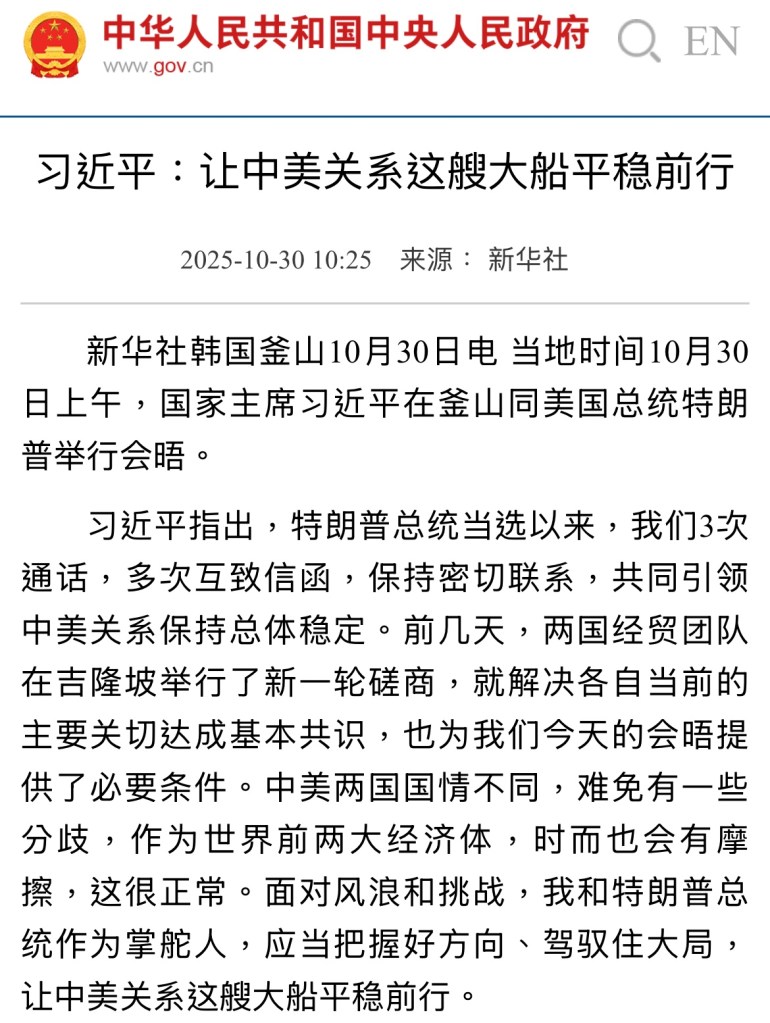
Busan, South Korea, October 30 (Xinhua) — On the morning of October 30 local time, President Xi Jinping met with U.S. President Donald Trump in Busan.
Xi Jinping pointed out that since President Trump’s election, the two leaders have spoken on the phone three times, exchanged multiple letters, and maintained close communication, jointly guiding China–U.S. relations to remain generally stable.
A few days ago, the economic and trade teams of both countries held a new round of consultations in Kuala Lumpur, reaching a basic consensus on addressing each other’s main concerns, which also created the necessary conditions for today’s meeting.
Xi noted that given the differences in national circumstances between China and the United States, some disagreements are inevitable. As the world’s two largest economies, occasional frictions are only natural. Facing winds and waves as well as challenges, Xi said, he and President Trump, as the helmsmen, should steer the course and manage the overall situation well, so that the giant ship of China–U.S. relations can sail steadily forward.
Another smart Chinese scientist left US for China! There is absolutely no future for smart Chinese scientists in America! SCMP: Award-winning Xie Zhenfei, a Harvard University rising star in cutting-edge research aimed at an HIV vaccine, has left the US and joined China’s leading biosafety laboratory in Wuhan. 又一位才華洋溢的中國科學家離開美國返回中國!美國對才華洋溢的中國科學家來說根本沒有未來! 《南華早報》報導:哈佛大學冉冉升起的愛滋病疫苗前沿研究新星、屢獲殊榮的謝振飛已離開美國,加入中國武漢頂尖的生物安全實驗室. https://www.scmp.com/news/china/science/article/3330745/harvard-hiv-scientist-xie-zhenfei-joins-chinas-national-virus-lab-wuhan?
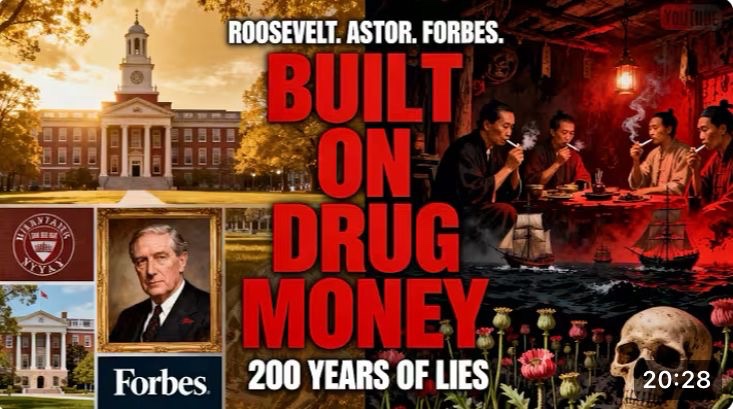
Video with Chinese subtitles: The Opium Fortunes that have been covered up by rewriting history! How America’s Elite Families Got Rich Selling Opium to destroy China. 影片有中文字幕: 被掩盖的鸦片财富:美国精英家族如何通过向中国贩卖鸦片发家致富,用财富改寫歷史, 不爲人知的罪惡故事! 今天中國絕對不會讓美國有任何幻想再次重施古技!
Roosevelt, Astor, Forbes, Yale, Harvard: They All Got Rich Selling Opium to China
Roosevelt. Astor. Forbes. Yale. Harvard. You know these names. What you don’t know? They all got rich the exact same way. Flooding China with opium. Thousands of tons. Millions addicted. Four hundred percent profit. And then they spent 200 years making sure you’d never find out. Until now.
This video documents the historical evidence proving that America’s most powerful families made their fortunes through industrial-scale opium smuggling to China in the 1800s. The shipping records exist. The letters survive. The account books are in archives. This isn’t conspiracy theory. This is documented history that has been systematically omitted from mainstream education.
📚 DOCUMENTED RESEARCH SOURCES:
Primary Historical Sources: “When America First Met China” by Eric Jay Dolin “The Opium Clippers” by Basil Lubbock “The Delano Influence” by Daniel W. Delano “Yankee Traders, Old Coasters, and African Middlemen” by George E. Brooks Jr. Shipping manifests and commercial ledgers (1800-1860) Personal correspondence in historical archives Russell and Company account books
Historical Archives: Massachusetts Historical Society Peabody Essex Museum archives China Trade archives British East India Company records Yale University historical collections Harvard University archives
🔍 THE DELANO FAMILY – DOCUMENTED FACTS:
Warren Delano II (FDR’s Grandfather):
“Warren Delano II was born in 1809 in Massachusetts. At 19 years old, he went to China to work for a trading company. By age 24, he was a partner in Russell and Company—the largest American opium trading firm in China.”
Russell and Company Operations: “Russell and Company wasn’t just participating in opium trade. They dominated American involvement. They had offices in Canton (Guangzhou). They had clipper ships. They had connections with British opium growers in India. And they made millions.”
Warren Delano’s Career Timeline: “Warren Delano ran the operation from 1833 to 1846. Thirteen years of opium smuggling. He returned to America a very wealthy man.”
Evidence of Wealth: “How wealthy? Rich enough to build a 40-room mansion in Newburgh, New York. Rich enough to send his children to the best schools. Rich enough that when he lost money in the Panic of 1857, he could go back to China, make another fortune in opium, and return even wealthier.”
Connection to FDR: “His daughter, Sara Delano, married James Roosevelt. Their son was Franklin Delano Roosevelt. FDR grew up in wealth. Private tutors. Harvard. Political connections. All funded by opium money.”
The Historical Irony: “And here’s the kicker. In 1935, while FDR was president, he signed the first federal laws strictly controlling drugs—the Marijuana Tax Act precursor and expansion of narcotic controls. The man whose family fortune came from selling drugs to Chinese people spent his presidency criminalizing drugs for Americans.”
🔍 THE ASTOR FAMILY – DOCUMENTED FACTS:
John Jacob Astor’s Fortune:
“John Jacob Astor. At one point the richest man in America. His wealth built the Waldorf-Astoria Hotel, funded libraries, created a dynasty. Where did the money come from? Furs, right? That’s the story. He traded furs. True. But that’s not where the real money came from. Opium.”
Documented Wealth: “By 1840, Astor was worth $20 million. That’s $500 million in today’s money. Most of it from opium profits. His great-grandson, John Jacob Astor IV, died on the Titanic as one of the richest men in the world. That wealth? Built on opium.”
Legacy: “The Astor family name is on libraries, museums, university buildings. All of it funded by drug money from China.”
Historical Records: Astor’s shipping manifests and commercial records document Turkish opium purchases and China trade routes. The Macedonian’s voyages are documented in maritime records at the Peabody Essex Museum.
🔍 THE FORBES FAMILY – DOCUMENTED FACTS:
Forbes Family has by Operations:
“Yes, that Forbes. Malcolm Forbes, the magazine publisher billionaire? His family fortune started in China. The Forbes family of Boston sent ships to China in the early 1800s. Robert Bennet Forbes and his brother John Murray Forbes were major opium traders.”
Russell and Company Connection: “They worked with Russell and Company—the same firm Warren Delano worked for. Robert Forbes captained clipper ships that carried opium. John Forbes invested the profits into railroads and became one of the wealthiest men in Boston.”
Modern Legacy: “Their descendants used that wealth to start Forbes Magazine. The family became American aristocracy. And it all started with opium.”
Historical Erasure: “John Murray Forbes is celebrated in Boston as a great businessman and philanthropist. There are statues of him. Buildings named after him. No one mentions the opium. It’s been scrubbed from the official history.”
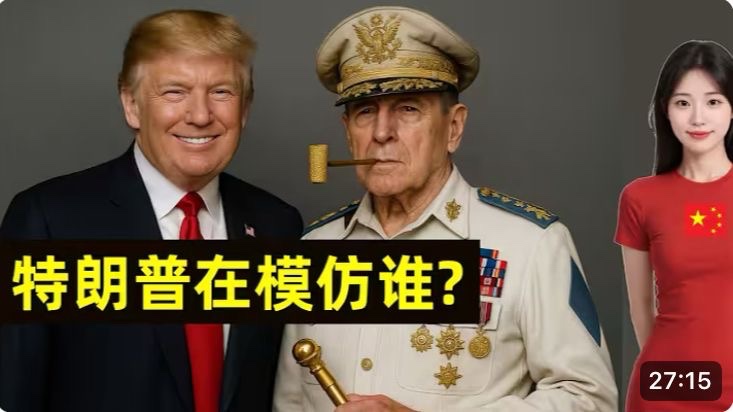
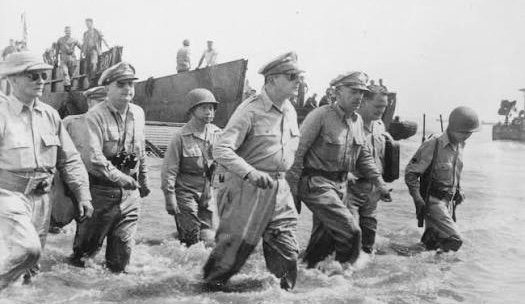
Video: Trump’s spiritual mentor: Unveiling Douglas MacArthur, the most boastful fake “war god” in American history. 視頻: 川普的精神導師:揭秘道格拉斯‧麥克阿瑟,美國史上最自負的自導自演的「戰爭之神」.
How his ignorance got defeated by the Japanese in Philippines during WWII retreated to Australia? He was replaced by Major General Jonathan Wainwright. President Roosevelt no longer trusted Douglas MacArthur. During the Korean War, President Harry S. Truman asked what if China got involved, he said no way! But he was wrong, got defeated by China and retreated in December 1952.
The right brain, left brain or no brain that becomes so forgetful! Wish others don’t do it to you, thou shall not commit the crimes in the first place! 右腦、左腦,或是乾脆沒有腦子,都會變得如此健忘!希望別人不要這樣對你,你一開始就不該犯罪!
The show can’t go on in Europe! The old trick of blackmail and extortion against China no longer works! 歐洲演不下去了!對中國進行敲詐勒索的老伎倆已經失效了!
After all the harsh words, they suddenly find their auto production lines about to halt… This shift from threats and confrontation to urgent pleas for help clearly demonstrates who truly holds the initiative on critical supply chain issues!狠話放完,發現汽車要停產…這場從威脅對抗到緊急求助的轉變,清晰地展示了在關鍵供應鏈問題上,誰才真正掌握着主動權!
Europe’s auto industry is on the brink of large-scale shutdowns due to rare earths and Nexperia semiconductor issues.
The EU’s attitude has done a complete 180!
The Chinese delegation is truly highly competent!
Previously, several EU countries had issued strong threats, vowing to take retaliatory measures against China, including trade “nuclear options.”
However, faced with China’s calm response, these threats proved ineffective, only deepening their own anxiety.
Now, with supply chain disruptions looming, the EU’s stance has clearly changed, and they are urgently seeking dialogue.
This week, a senior Chinese technical delegation will visit Brussels upon invitation to discuss core issues.
Even an EU spokesperson acknowledged that this is a “highly competent, skilled, and efficient” team.
The European side is eager for China to “show leniency” by allowing temporary chip exports to alleviate the urgent crisis in the auto industry.
China’s position, however, is clear and firm: the Dutch side must “promptly and properly” correct its mistake of forcibly intervening in Nexperia semiconductor.
Video with English subtitles; US Surrender Costs Least Now! China-US Power Shift Complete – What Happens Next? 影片有英文字幕: 美国此刻退让代价最小! 中美权力交接完成 – 下一步走向何方?
2025 was supposed to be a sharp turn in human history, but it became a gradual curve. Behind this shift lies a complete reversal in the China-US dynamic—from who holds the initiative to who’s forced to react.
Why do experts say the US surrender now costs the least? This isn’t a joke—it’s a serious strategic assessment.
This video provides in-depth analysis on: ✅ Why 2025 shifted from a “sharp turn” to a “gradual curve” ✅ What strategic consensus China and the US reached last September ✅ The deeper logic behind rare earth controls, chip self-sufficiency, and military breakthroughs ✅ The real reason Trump postponed his China visit 3 times ✅ The under-the-table dynamics of China-US trade negotiations ✅ How to capitalize on the 2-year investment window ahead ✅ The “impossible trinity” dilemma trapping the US ✅ Critical timing of the rate-cut cycle and capital flows
This is a historical turning point. The process may have slowed, but the direction is clear. The power shift is irreversible, and the next 1-2 years will be a gradual realization of this new reality.
For investors, now is not the time to harvest—it’s time to plant. Don’t panic on dips, stay rational on rallies. Understanding the macro trend is key to seizing real opportunities.
Now I understand why Besant lost his temper after that negotiation. 終於明白貝森特為什麼會在那場談判后氣到失控了.
According to U.S. media reports, during a closed-door negotiation session, the Chinese representative unexpectedly made a phone call in front of the American delegation and immediately ordered an investigation into Nvidia.
This move broke the conventional rhythm of the negotiation table, catching the U.S. representatives completely off guard!
What was even more surprising was that, to prevent the U.S. side from denying accountability or attempting to obscure the details of the incident afterward, the Chinese representative specifically instructed the on-site interpreter to translate the entire content of the phone call, word for word, to the American delegates.
The entire process was completely transparent, without the slightest attempt to conceal or avoid the issue. The moment the interpreter clearly conveyed the instruction to “initiate an investigation into Nvidia,” the atmosphere in the negotiation room froze instantly. It felt as if the air had stopped flowing, leaving only the interpreter’s voice echoing in the room.
The expression on Besant’s face at that moment was something even the media dared not describe in detail—perhaps because the mix of shock, embarrassment, and resentment was too complex to capture accurately in words. It was likely the first time in his career that he found himself so thoroughly dominated by an overwhelming presence.
Historically, in various international negotiations, U.S. representatives have often adopted a condescending attitude, accustomed to controlling the initiative. This time, however, they were taught a lesson by the Chinese side, leaving them passive throughout the process without even a chance to rebut.
For Besant, the outcome of this negotiation was not just a loss on specific issues but, more importantly, a severe blow to his pride. The feeling of being publicly humiliated yet having to maintain a façade of composure and dignity would likely cause immense frustration for anyone accustomed to being in a position of power.
Thus, Besant’s subsequent public remarks attacking China were essentially a delayed outburst of the emotions he had suppressed during the negotiation. Given his status and past experiences, he managed to restrain himself to some extent. Someone else might have lost composure right at the negotiation table.
Nowadays, when dealing with matters related to China, U.S. representatives often display anger, loss of composure, and even hysterical reactions. Ultimately, this stems from their long-standing habit of occupying a dominant position in international interactions, expecting other countries to align with their pace and demands. Suddenly being constrained by China and no longer able to act as freely as before has made it difficult for them to accept this shift in roles and posture.
After all, in this negotiation, it was no longer the U.S. that adopted a tough stance and pressured the other side into making concessions. Instead, the Chinese representatives stood firm, refusing to yield on critical issues and demonstrating an unprecedented level of assertiveness.
This role reversal completely disrupted the U.S. side’s expectations and plans, dealing a blow to their long-held sense of superiority!
Besant’s loss of control reveals the complex mindset of the U.S. when facing China’s rise—unwilling to acknowledge China’s growing strength yet unable to control the situation as they once did, they resort to emotional outbursts to mask their inner unease.
Regardless of how the U.S. reacts, one evident fact remains: the international landscape is changing. China is no longer a country that can be easily manipulated. On issues concerning its core interests, China will only grow more resolute in defending its stance. This is something the U.S. side may need much more time to truly come to terms with.
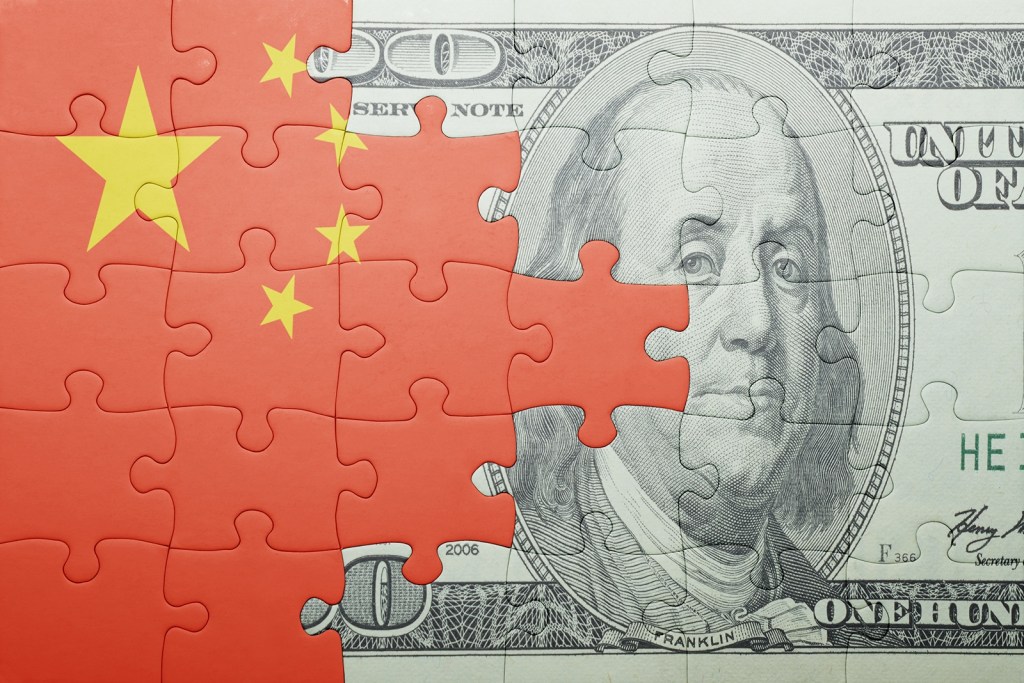
Subject: Strategic Implications of the Ministry of Finance’s Upcoming Offshore U.S. Dollar Bond Issuance
The Transaction at a Glance
The Ministry of Finance of the People’s Republic of China (MOF) has received State Council approval to issue U.S.-dollar-denominated sovereign bonds in Hong Kong. The key details are:
· Size: Up to US$4 billion. · Location: Hong Kong. · Timeline: Scheduled for the week of November 3rd (specific terms to be finalized). · Context: This marks China’s return to the offshore dollar bond market after a three-year hiatus, with the last comparable issuance occurring in October 2021.
Primary Strategic Objectives
This issuance is a calibrated move with several interconnected strategic rationales, extending beyond simple fundraising:
· Diversification of Funding Channels: By tapping the offshore market, China broadens its investor base beyond domestic institutions, accessing global liquidity and diversifying its sovereign funding sources. · Benchmarking Chinese Sovereign Credit: The issuance establishes a crucial offshore benchmark yield curve for Chinese sovereign debt. This provides a reference for other Chinese entities (corporates and financial institutions) to price their own international bond offerings, thereby facilitating smoother access to global capital. · Reinforcing Hong Kong’s Financial Status: Conducting this significant issuance in Hong Kong deliberately strengthens its role as China’s premier international financial center and a hub for offshore CNH and dollar-bond activity. This signals continued central government support for Hong Kong’s relevance in global finance. · Signaling Confidence to Global Markets: Re-entering the international dollar bond market serves as a strong signal of China’s financial stability and openness to foreign capital. This helps manage global investor sentiment and can contribute to maintaining favorable borrowing terms.
Analysis of Motivation: A Move Against Dollar Hegemony?
While not explicitly stated as an attack on dollar hegemony, this action aligns with China’s broader, long-term strategic financial objectives:
· The issuance pragmatically utilizes the existing dollar system to build its own financial infrastructure and credibility. · By creating a liquid, offshore benchmark for its own credit, China incrementally reduces its absolute reliance on U.S. capital markets and dollar-based financing over the long term. · It is a strategic step towards fostering an independent ecosystem for pricing Chinese risk, which is a foundational element for a more multipolar global financial system. Therefore, it can be interpreted as a tactical move within a decades-long strategy to diversify away from dollar dominance.
Market Outlook: Strong Demand Anticipated
Demand for the bond issue is expected to be robust, driven by two key factors:
· Scarcity Value: As the first major offshore sovereign dollar bond from China since 2021, it presents a rare and valuable opportunity for global fixed-income investors to gain exposure to a large, liquid Chinese sovereign asset. · Yield Appeal: In a global context where U.S. interest rates have retreated from their peaks and onshore Chinese yields remain low, these dollar-denominated bonds offer international investors an attractive opportunity to pick up incremental yield from a high-credit-quality issuer.
In conclusion, this US$4 billion issuance is a multifaceted strategic initiative. It simultaneously serves immediate financial objectives, reinforces Hong Kong’s status, and advances China’s long-term goal of building a more independent and resilient financial architecture within the global system.




 Business Blog