Video with English subtitles: Audio and visual reading of “China May Say Thank You to India Again” by Li Yan Video has English subtitles: 聲光伴讀《中國或者要再向印度說謝謝》作者:李湮
The US is pressuring India to stop buying Russian oil. Will India continue to respond with a “worldly” attitude? Will it quickly abandon Russia, a long-term partner? Or will it emulate China and face hegemony head-on? India faces a precipice of national dignity. Whether it can truly become a “great power” depends on the choices made by the Indians. If they make the wrong choice again, China will once again be forced to trample on India. At that point, do you think the Chinese will have to say “thank you” to India after the J-10C publicity
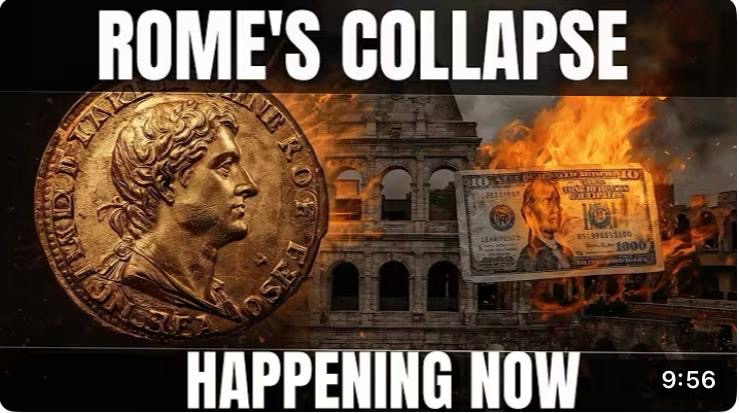
Everyone knows Rome fell. But what most people don’t know is WHY. And if you understood the real reasons—the actual mechanisms that destroyed the greatest empire in human history—you’d see them playing out in America right now. Same patterns. Same mistakes. Same ending.
In this video, I break down the three specific ways Rome collapsed that America is repeating in 2025:
🪙 CURRENCY DEBASEMENT: How Rome destroyed its money (and how the US dollar is following the exact same path since 1971)
⚔️ MILITARY OVEREXTENSION: How Rome bled itself dry maintaining an empire it couldn’t afford (and why America’s $850 billion defense budget is doing the same)
🎪 BREAD & CIRCUSES: How Rome distracted its citizens with entertainment (today in US, we wine dines Hollywood, karaoke) while the system collapsed (and why stimulus checks + social media = the modern version)
History doesn’t repeat, but it rhymes. And right now, the echoes of Rome’s collapse are getting louder.
📊 KEY TAKEAWAYS: The Roman denarius lost 95% of its silver content before collapse US dollar has lost 85% of purchasing power since 1971 Rome’s military spending exceeded 50% of budget at peak America’s defense spending exceeds next 10 countries combined Romans were kept docile with free grain and entertainment Modern Americans average 7+ hours daily on screens
📚 SOURCES & FURTHER READING: “The Decline and Fall of the Roman Empire” – Edward Gibbon Federal Reserve Economic Data (FRED) – Currency debasement statistics Congressional Budget Office – US defense spending reports Historical monetary analysis from various economic historians
You cannot truly know China without being here. And even being in China, your understanding is limited by your own perspective and expertise. By Johnson Choi, President of HK.China.Hawaii.Chamber of Commerce Oct 26 2025 不身臨其境,就無法真正了解中國。即便身處中國,你的認知也會受限於自身的視角與專業領域. 作者: 蔡永強. 中國香港夏威夷商會主席. 2025年10月26日
The limitation of external perspective: China is vast and complex.
Understanding it from the outside, through media or books, is fundamentally different from experiencing its daily rhythm, culture, and social nuances firsthand.
The limitation of internal perspective: A financial analyst in Shanghai, a farmer in Yunnan, and a factory worker in Shenzhen all experience a different “China.” Your profession, social circle, and location create a filter through which you see the country.
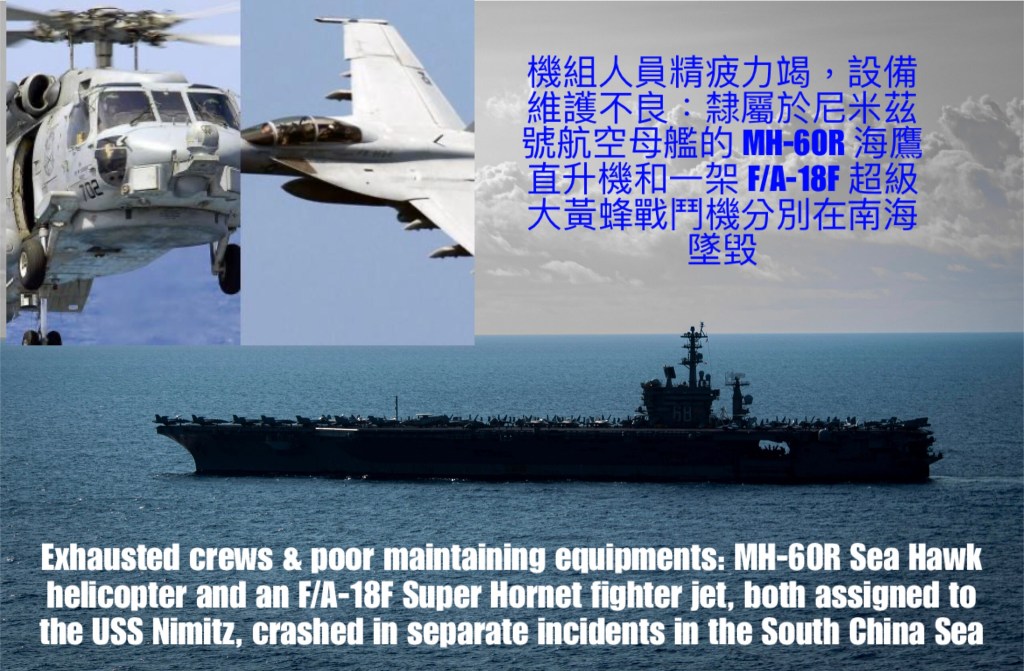
Exhausted crews & poor maintaining equipments: MH-60R Sea Hawk helicopter and an F/A-18F Super Hornet fighter jet, both assigned to the USS Nimitz, crashed in separate incidents in the South China Sea 美國空軍機組人員精疲力竭,設備維護不良:隸屬於尼米茲號航空母艦的 MH-60R 海鷹直升機和一架 F/A-18F 超級大黃蜂戰鬥機分別在南海墜毀
A shocking yet exhilarating piece of news has arrived!
On Sunday, an F/A-18F Super Hornet fighter jet and an MH-60R Seahawk helicopter, both attached to the USS Nimitz (CVN-68), crashed separately in the South China Sea.
The U.S. Pacific Fleet released a statement:
“At around 2:45 p.m. local time, a U.S. Navy MH-60R Seahawk helicopter from Helicopter Maritime Strike Squadron 73 ‘Battle Cats’ crashed while conducting a routine mission in the South China Sea. Search and rescue personnel from Carrier Strike Group 11 safely recovered all three crew members.”
Less than an hour later, at 3:15 p.m., a two-seat F/A-18F Super Hornet from Strike Fighter Squadron 22 ‘Fighting Redcocks’ also crashed while taking off from the Nimitz. The statement continued:
“Both crew members successfully ejected and were safely rescued by personnel from Carrier Strike Group 11.”
However, it’s truly astonishing that two carrier-based aircraft could crash into the sea on the same day—an extremely rare occurrence.
One can’t help but marvel—Trump’s management of the U.S. military is still on point! 🤣🤣🤣
It’s a golden day for military bloggers worldwide—what a great source of stories!
That said, it really does seem that America’s decline is happening faster than anyone imagined!
Video with English subtitles: Taiwan history in 15 minutes! October 25: “Taiwan Retrocession Memorial Day” Becomes National Law — The clock countdown for reunification has begun! 影片有英文字幕: 15分鐘了解台灣省歷史! 10月25日「台灣光復紀念日」被國家立法! 統一的鐘聲已經敲響, 開始倒數!
Mainland’s Highest-Level Jurisdiction Over Taiwan Officially Activated, Marking a Turning Point 大陸對台「最高級別管轄權」正式啟動,台灣變天
After reading the communiqué of the Fourth Plenary Session and the latest decision of the National People’s Congress, I couldn’t calm my thoughts for a long time.
On October 25, the National People’s Congress officially established “Taiwan Retrocession Memorial Day” in law.
This is not just an ordinary holiday — it is a top-level legal declaration, the mainland’s “final warning” to separatist “Taiwan independence” forces, and a new national anchor point for advancing the process of reunification.
👉 Core revelations in this video: • The legal significance of October 25: Why was this date chosen? How does this legal move completely destroy the DPP’s attempts to distort history? • Taiwan media’s rare shift: “The duck is first to feel the warmth of spring waters.” Why are Taiwan’s media suddenly calling for dialogue? What have they sensed? • Upgraded logic of reunification: From legal, historical, and cultural perspectives — how is the mainland “remaining still to control the situation,” keeping everything within its grasp? • Taiwan’s past and present: In just a few minutes, understand the deep bloodline connection between Taiwan and the mainland — from geography to faith, we share the same roots and origin.
Taiwan Retrocession Memorial Day marks not only a starting point in history, but also the countdown to the end of “Taiwan independence.” Understand this move, and you’ll understand China’s future direction.
💡 Key Takeaways:
✅ 1. For the Nation: By enacting this through national legislation, China exercises the highest level of jurisdiction, laying the firmest legal foundation for national reunification.
✅ 2. For the World: It reaffirms the One-China principle and the post–World War II order, defending the achievements of the anti-fascist victory.
✅ 3. For the People: It strengthens shared historical memory across the Strait, reinforces national identity, and accelerates the completion of the great cause of reunification.
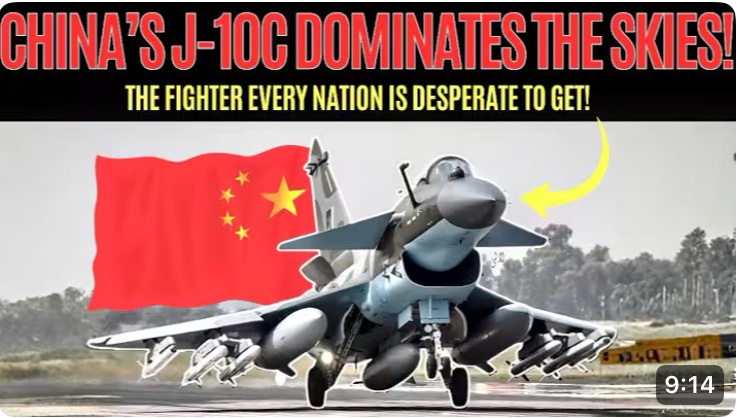
China advance industrial complex allows rapid delivery in months not years at 1/2 of the cost offered by US & France! 中國殲-10C!中國先進的工業體系使其能夠在數月內快速交付,而無需數年時間,而且成本僅為美法兩國的一半!
“Why Do Several Countries Want to Acquire China’s J-10C Fighter Jet?!”
Across multiple continents, the Chinese-made J-10C fighter jet is attracting more attention than ever before. From Indonesia to Iran and even Latin America, countries are exploring deals to bring this advanced aircraft into their fleets. But what makes the J-10C so special? In this episode, we uncover its cutting-edge radar, powerful WS-10B engine, modern avionics, and fast delivery timelines that are reshaping the global fighter-jet market. We’ll also explore how China’s industrial capacity and flexible export approach are giving it a competitive edge over traditional Western suppliers.
Kim Iversen video with Chinese subtitles: They Say China’s Evil! Really? American way to demonize China! Here’s What’s REALLY Going On? 影片配上中文字幕:他們說中國邪惡!真的嗎?這是美國妖魔化中國的方式!這才是真!
Shaun Rein is the Founder and Managing Director of the China Market Research Group in Shanghai. He’s one of the world’s leading experts on China’s economy, consumer trends, and U.S.–China relations.
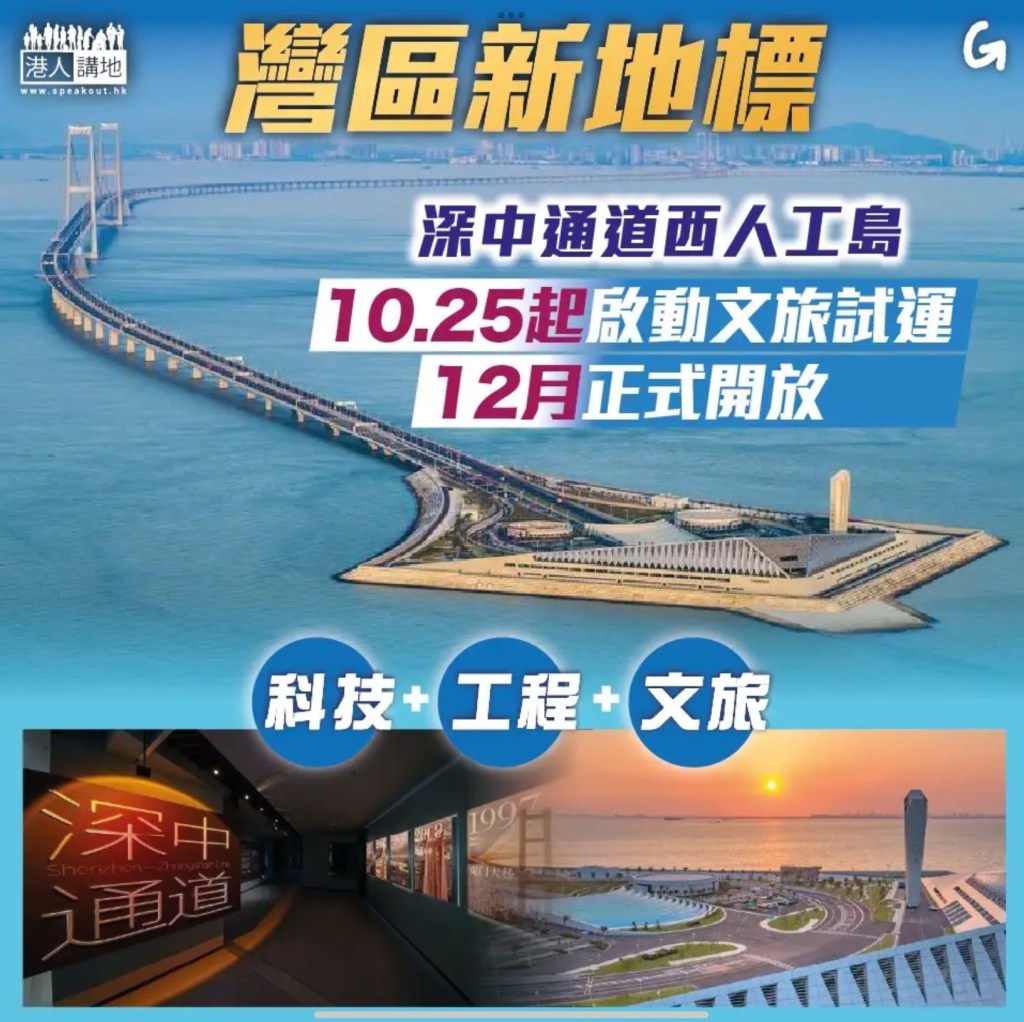
New Landmark in China’s Greater Bay Area: Western Artificial Island to Become a “Tech+Engineering+Culture&Tourism” Composite Super-IP 中國大灣區新地標: 西人工島將打造成為粵港澳大灣區「科技+工程+文旅」複合型超級IP.
After nearly a year of intensive preparations, the Western Artificial Island of the Shenzhen-Zhongshan Link will commence trial cultural and tourism operations tomorrow (25th) and officially open in December.
Chen Hailiang, representing the project operator Shenzhen Cultural Tourism Industry Development Co., Ltd., stated that starting tomorrow, the Western Artificial Island will undergo a one-month pre-operational stress test. Reservations will be available for companies and study tour groups from Monday to Friday, and for individual members of the public on Saturdays and Sundays.
Visitors participating in the internal test who successfully make reservations will gather at designated points and take unified shuttle buses to the island. Through on-site experiences, they will provide feedback and suggestions regarding the tour route of the Guangdong-Hong Kong-Macao Greater Bay Area Cross-Sea Passage Science Education Base, the compatibility of VR/AR interactive equipment, and the provision of supporting services.
According to information from the official ticketing mini-program “Shen-Ai Ticket,” departures from Shenzhen can be made from the People’s Building Station or the Qianhai Bay Cross-City Bus Transfer Station. Departures from Zhongshan can be made from the Zhongshan Expo Center Station. The official adult ticket price after opening will be 188 RMB, student tickets will be 158 RMB, and child/preferential tickets will be 128 RMB. This includes the round-trip bus journey and approximately 3 hours of touring time on the island. Food and beverage facilities are currently being prepared and are expected to be officially available by the end of December.
The Shenzhen-Zhongshan Link is a world-class cross-sea cluster project integrating bridges, islands, tunnels, and underwater interchanges, spanning approximately 24 kilometers and setting ten world records. As a key hub for the bridge-tunnel transition of the Link, the Western Artificial Island covers an area of about 137,000 square meters. In the future, while strictly ensuring traffic operation and management functions, it will gradually expand comprehensive cultural and tourism functions integrating sightseeing, leisure vacations, and supporting services by utilizing areas such as the science education base, rescue dock, and helipad. This will include projects like viewing the bridge from the sea and low-altitude sightseeing flights. Long-term plans involve introducing Shenzhen’s characteristic industries such as robotics, VR, and low-altitude flight, combining diverse experiences like popular science education, thematic sightseeing, and study tours, to develop it into a “Tech+Engineering+Culture&Tourism” composite super-IP for the Guangdong-Hong Kong-Macao Greater Bay Area.
American Tourist Strolling Through Chengdu China Feels Sadness: The Prosperity the Chinese People Have, Americans Should Have Had… An American living in Los Angeles posted after visiting China for the first time: 美遊客漫步成都感到悲哀:中國人擁有的富足,美國人本該擁有…一位生活在美國洛杉磯的美國人第一次來中國之後發帖:
“I spent ten days in China, and at one point, I felt a profound sadness. Strolling through Chengdu, I sensed a sorrow: the prosperity that the Chinese people possess is what Americans should have had. But now we have nothing. What I find hardest to accept is that if the U.S. had focused on industrializing its economy instead of financializing it, then today’s China is what America should have become.”
The financialization of the U.S. allows elites to effortlessly harvest global wealth, but it hasn’t benefited ordinary people. In America, it’s a paradise for the rich and a hell for the poor.
In China, the wealthy are not allowed to interfere with politics or wield power arbitrarily. Ordinary people have basic safeguards—at the very least, they have a piece of land and a house in their rural hometown, so they won’t end up homeless on the streets living in tents.
The U.S. engages in a virtual economy, plays financial games, and has a hollowed-out manufacturing sector. Its infrastructure is crumbling, and social management is chaotic. On the surface, it appears strong and impressive, but in reality, it is already in accelerated decline. Aside from politicians spouting big, harsh, and empty words, Americans have largely given up, feeling lost about the country’s future.
This American’s reflections during his travels in China also serve as a warning to the Chinese people: do not follow the same path as the Americans.






 Business Blog